34 BHUJ
WESTERN INDIA (KUTCH), FIRST HALF OF THE 19TH CENTURY LENGTH: 65 CM LENGTH OF BLADE: 19.7 CM WIDTH OF BLADE: 5 CM
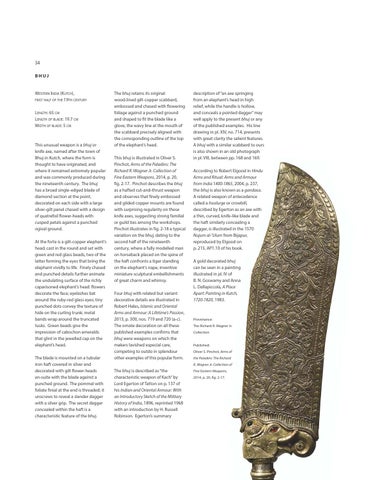
This unusual weapon is a bhuj or knife axe, named after the town of Bhuj in Kutch, where the form is thought to have originated, and where it remained extremely popular and was commonly produced during the nineteenth century. The bhuj has a broad single-edged blade of diamond section at the point, decorated on each side with a large silver-gilt panel chased with a design of quatrefoil flower-heads with cusped petals against a punched ogival ground. At the forte is a gilt-copper elephant’s head, cast in the round and set with green and red glass beads, two of the latter forming the eyes that bring the elephant vividly to life. Finely chased and punched details further animate the undulating surface of the richly caparisoned elephant’s head: flowers decorate the face; eyelashes bat around the ruby-red glass eyes; tiny punched dots convey the texture of hide on the curling trunk; metal bands wrap around the truncated tusks. Green beads give the impression of cabochon emeralds that glint in the jewelled cap on the elephant’s head. The blade is mounted on a tubular iron haft covered in silver and decorated with gilt flower-heads en-suite with the blade against a punched ground. The pommel with foliate finial at the end is threaded; it unscrews to reveal a slender dagger with a silver grip. The secret dagger concealed within the haft is a characteristic feature of the bhuj.
The bhuj retains its original wood-lined gilt-copper scabbard, embossed and chased with flowering foliage against a punched ground and shaped to fit the blade like a glove, the wavy line at the mouth of the scabbard precisely aligned with the corresponding outline of the top of the elephant’s head. This bhuj is illustrated in Oliver S. Pinchot, Arms of the Paladins: The Richard R. Wagner Jr. Collection of Fine Eastern Weapons, 2014, p. 20, fig. 2-17. Pinchot describes the bhuj as a hafted cut-and-thrust weapon and observes that finely embossed and gilded copper mounts are found with surprising regularity on these knife axes, suggesting strong familial or guild ties among the workshops. Pinchot illustrates in fig. 2-18 a typical variation on the bhuj, dating to the second half of the nineteenth century, where a fully modelled man on horseback placed on the spine of the haft confronts a tiger standing on the elephant’s nape, inventive miniature sculptural embellishments of great charm and whimsy. Four bhuj with related but variant decorative details are illustrated in Robert Hales, Islamic and Oriental Arms and Armour: A Lifetime’s Passion, 2013, p. 300, nos. 719 and 720 (a-c). The ornate decoration on all these published examples confirms that bhuj were weapons on which the makers lavished especial care, competing to outdo in splendour other examples of this popular form.
description of “an axe springing from an elephant’s head in high relief, while the handle is hollow, and conceals a pointed dagger” may well apply to the present bhuj or any of the published examples. His line drawing in pl. XIV, no. 714, presents with great clarity the salient features. A bhuj with a similar scabbard to ours is also shown in an old photograph in pl. VIII, between pp. 168 and 169. According to Robert Elgood in Hindu Arms and Ritual: Arms and Armour from India 1400-1865, 2004, p. 237, the bhuj is also known as a gandasa. A related weapon of antecedence called a hoolurge or crowbill, described by Egerton as an axe with a thin, curved, knife-like blade and the haft similarly concealing a dagger, is illustrated in the 1570 Nujum al-cUlum from Bijapur, reproduced by Elgood on p. 215, AP1.10 of his book. A gold decorated bhuj can be seen in a painting illustrated in pl. IV of B. N. Goswamy and Anna L. Dallapiccola, A Place Apart: Painting in Kutch, 1720-1820, 1983.
Provenance: The Richard R. Wagner Jr. Collection
Published: Oliver S. Pinchot, Arms of the Paladins: The Richard R. Wagner Jr. Collection of
The bhuj is described as “the characteristic weapon of Kach” by Lord Egerton of Tatton on p. 137 of his Indian and Oriental Armour: With an Introductory Sketch of the Military History of India, 1896, reprinted 1968 with an introduction by H. Russell Robinson. Egerton’s summary
Fine Eastern Weapons, 2014, p. 20, fig. 2-17.