20 C LO U D B A N D S A N D F LOW E R S
TURKEY (IZNIK), CIRCA 1565-1575 HEIGHT: 27.7 CM WIDTH: 27 CM
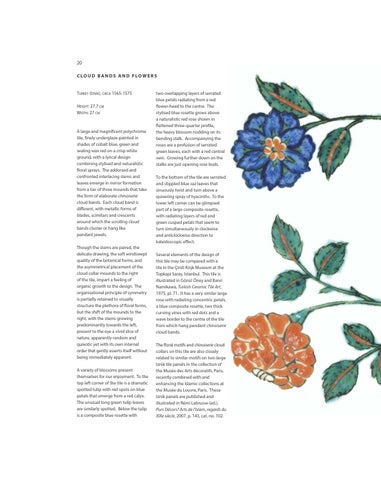
A large and magnificent polychrome tile, finely underglaze-painted in shades of cobalt blue, green and sealing wax red on a crisp white ground, with a lyrical design combining stylised and naturalistic floral sprays. The addorsed and confronted interlacing stems and leaves emerge in mirror formation from a tier of three mounds that take the form of elaborate chinoiserie cloud bands. Each cloud band is different, with metallic forms of blades, scimitars and crescents around which the scrolling cloud bands cluster or hang like pendant jewels. Though the stems are paired, the delicate drawing, the soft windswept quality of the botanical forms, and the asymmetrical placement of the cloud collar mounds to the right of the tile, impart a feeling of organic growth to the design. The organisational principle of symmetry is partially retained to visually structure the plethora of floral forms, but the shift of the mounds to the right, with the stems growing predominantly towards the left, present to the eye a vivid slice of nature, apparently random and quixotic yet with its own internal order that gently asserts itself without being immediately apparent. A variety of blossoms present themselves for our enjoyment. To the top left corner of the tile is a dramatic spotted tulip with red spots on blue petals that emerge from a red calyx. The unusual long green tulip leaves are similarly spotted. Below the tulip is a composite blue rosette with
two overlapping layers of serrated blue petals radiating from a red flower-head to the centre. The stylised blue rosette grows above a naturalistic red rose shown in flattened three-quarter profile, the heavy blossom nodding on its bending stalk. Accompanying the roses are a profusion of serrated green leaves, each with a red central vein. Growing further down on the stalks are just opening rose buds. To the bottom of the tile are serrated and stippled blue saz leaves that sinuously twist and turn above a quivering spray of hyacinths. To the lower left corner can be glimpsed part of a large composite rosette, with radiating layers of red and green cusped petals that seem to turn simultaneously in clockwise and anticlockwise direction to kaleidoscopic effect. Several elements of the design of this tile may be compared with a tile in the Çinili Köşk Museum at the Topkapi Saray, Istanbul. This tile is illustrated in Gönül Öney and Banri Namikawa, Turkish Ceramic Tile Art, 1975, pl. 71. It has a very similar large rose with radiating concentric petals, a blue composite rosette, two thick curving vines with red dots and a wave border to the centre of the tile from which hang pendant chinoiserie cloud bands. The floral motifs and chinoiserie cloud collars on this tile are also closely related to similar motifs on two large Iznik tile panels in the collection of the Musée des Arts décoratifs, Paris, recently combined with and enhancing the Islamic collections at the Musée du Louvre, Paris. These Iznik panels are published and illustrated in Rémi Labrusse (ed.), Purs Décors? Arts de l’Islam, regards du XIXe siècle, 2007, p. 143, cat. no. 102.