44 JADE HORSE HEAD DAGGER
INDIA (MUGHAL), 18TH CENTURY LENGTH OF DAGGER: 36.5 CM LENGTH OF HILT: 12 CM WIDTH OF HILT: 5 CM
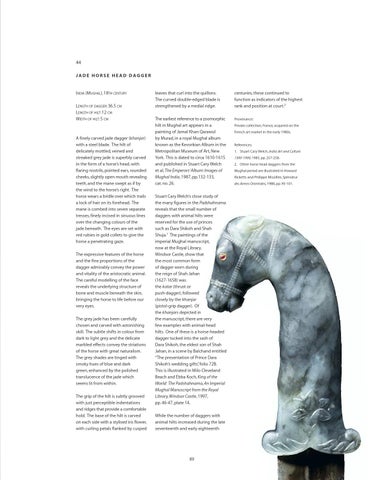
A finely carved jade dagger (khanjar) with a steel blade. The hilt of delicately mottled, veined and streaked grey jade is superbly carved in the form of a horse’s head, with flaring nostrils, pointed ears, rounded cheeks, slightly open mouth revealing teeth, and the mane swept as if by the wind to the horse’s right. The horse wears a bridle over which trails a lock of hair on its forehead. The mane is combed into seven separate tresses, finely incised in sinuous lines over the changing colours of the jade beneath. The eyes are set with red rubies in gold collets to give the horse a penetrating gaze. The expressive features of the horse and the fine proportions of the dagger admirably convey the power and vitality of the aristocratic animal. The careful modelling of the face reveals the underlying structure of bone and muscle beneath the skin, bringing the horse to life before our very eyes. The grey jade has been carefully chosen and carved with astonishing skill. The subtle shifts in colour from dark to light grey and the delicate marbled effects convey the striations of the horse with great naturalism. The grey shades are tinged with smoky hues of blue and dark green, enhanced by the polished translucence of the jade which seems lit from within. The grip of the hilt is subtly grooved with just perceptible indentations and ridges that provide a comfortable hold. The base of the hilt is carved on each side with a stylised iris flower, with curling petals flanked by cusped
leaves that curl into the quillons. The curved double-edged blade is strengthened by a medial ridge.
centuries, these continued to function as indicators of the highest rank and position at court.2
The earliest reference to a zoomorphic hilt in Mughal art appears in a painting of Jamal Khan Qarawul by Murad, in a royal Mughal album known as the Kevorkian Album in the Metropolitan Museum of Art, New York. This is dated to circa 1610-1615 and published in Stuart Cary Welch et al, The Emperors’ Album: Images of Mughal India, 1987, pp.132-133, cat. no. 26.
Provenance:
Stuart Cary Welch’s close study of the many figures in the Padshahnama reveals that the small number of daggers with animal hilts were reserved for the use of princes such as Dara Shikoh and Shah Shuja.1 The paintings of the imperial Mughal manuscript, now at the Royal Library, Windsor Castle, show that the most common form of dagger worn during the reign of Shah Jahan (1627-1658) was the katar (thrust or push-dagger), followed closely by the khanjar (pistol-grip dagger). Of the khanjars depicted in the manuscript, there are very few examples with animal-head hilts. One of these is a horse-headed dagger tucked into the sash of Dara Shikoh, the eldest son of Shah Jahan, in a scene by Balchand entitled “The presentation of Prince Dara Shikoh’s wedding gifts”, folio 72B. This is illustrated in Milo Cleveland Beach and Ebba Koch, King of the World: The Padshahnama, An Imperial Mughal Manuscript from the Royal Library, Windsor Castle, 1997, pp. 46-47, plate 14. While the number of daggers with animal hilts increased during the late seventeenth and early eighteenth
89
Private collection, France, acquired on the French art market in the early 1980s.
References: 1. Stuart Cary Welch, India: Art and Culture 1300-1900, 1985, pp. 257-258. 2. Other horse head daggers from the Mughal period are illustrated in Howard Ricketts and Philippe Missillier, Splendeur des Armes Orientales, 1988, pp. 95-101.