19 T U L I P S A N D R O S E T T E S P R AY S
TURKEY (IZNIK), CIRCA 1575
decorated with cobalt horizontal stripes framed by solid borders of cobalt blue. To the base are three owners’ labels, including one marked: “S.LAGO”.
HEIGHT: 20.8 CM DIAMETER: 13.6 CM
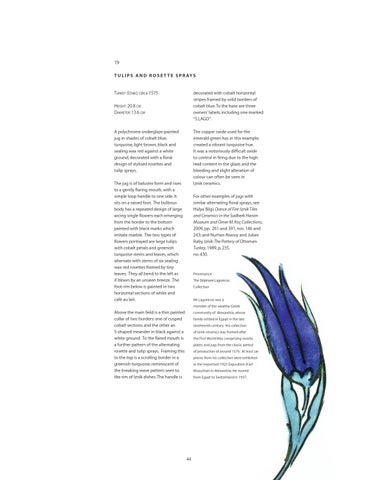
A polychrome underglaze-painted jug in shades of cobalt blue, turquoise, light brown, black and sealing wax red against a white ground, decorated with a floral design of stylised rosettes and tulip sprays.
The copper oxide used for the emerald green has in this example, created a vibrant turquoise hue. It was a notoriously difficult oxide to control in firing due to the high lead content in the glaze, and the bleeding and slight alteration of colour can often be seen in Iznik ceramics.
The jug is of baluster form and rises to a gently flaring mouth, with a simple loop handle to one side. It sits on a raised foot. The bulbous body has a repeated design of large arcing single flowers each emerging from the border to the bottom painted with black marks which imitate marble. The two types of flowers portrayed are large tulips with cobalt petals and greenish turquoise stems and leaves, which alternate with stems of six sealing wax red rosettes framed by tiny leaves. They all bend to the left as if blown by an unseen breeze. The foot-rim below is painted in two horizontal sections of white and café au lait.
For other examples of jugs with similar alternating floral sprays, see Hülya Bilgi, Dance of Fire: Iznik Tiles and Ceramics in the Sadberk Hanim Museum and Ömer M. Koç Collections, 2009, pp. 261 and 391, nos. 146 and 243; and Nurhan Atasoy and Julian Raby, Iznik: The Pottery of Ottoman Turkey, 1989, p. 235, no. 430.
Provenance: The Stéphane Lagonicos Collection
Mr Lagonicos was a member of the wealthy Greek
Above the main field is a thin painted collar of two borders: one of cusped cobalt sections and the other an S-shaped meander in black against a white ground. To the flared mouth is a further pattern of the alternating rosette and tulip sprays. Framing this to the top is a scrolling border in a greenish turquoise, reminiscent of the breaking wave pattern seen to the rim of Iznik dishes. The handle is
community of Alexandria, whose family settled in Egypt in the late nineteenth century. His collection of Iznik ceramics was formed after the First World War, comprising mostly plates and jugs from the classic period of production of around 1570. At least six pieces from his collection were exhibited in the important 1925 Exposition d’art Musulman in Alexandria. He moved from Egypt to Switzerland in 1937.
44