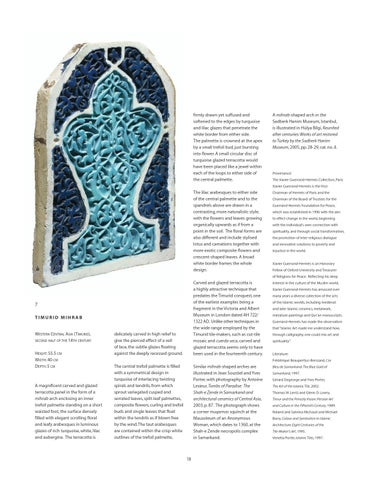
firmly drawn yet suffused and softened to the edges by turquoise and lilac glazes that penetrate the white border from either side. The palmette is crowned at the apex by a small trefoil bud, just bursting into flower. A small circular disc of turquoise glazed terracotta would have been placed like a jewel within each of the loops to either side of the central palmette.
A mihrab-shaped arch in the Sadberk Hanim Museum, Istanbul, is illustrated in Hülya Bilgi, Reunited after centuries: Works of art restored to Turkey by the Sadberk Hanim Museum, 2005, pp. 28-29, cat. no. 4.
Provenance: The Xavier Guerrand-Hermès Collection, Paris Xavier Guerrand-Hermès is the Vice
The lilac arabesques to either side of the central palmette and to the spandrels above are drawn in a contrasting, more naturalistic style, with the flowers and leaves growing organically upwards as if from a point in the soil. The floral forms are also different and include stylised lotus and carnations together with more exotic composite flowers and crescent-shaped leaves. A broad white border frames the whole design.
Chairman of Hermès of Paris and the Chairman of the Board of Trustees for the Guerrand-Hermès Foundation for Peace, which was established in 1996 with the aim to effect change in the world, beginning with the individual’s own connection with spirituality, and through social transformation, the promotion of inter-religious dialogue and innovative solutions to poverty and injustice in the world.
Xavier Guerrand-Hermès is an Honorary Fellow of Oxford University and Treasurer of Religions for Peace. Reflecting his deep
delicately carved in high relief to give the pierced effect of a veil of lace, the subtle glazes floating against the deeply recessed ground.
Carved and glazed terracotta is a highly attractive technique that predates the Timurid conquest, one of the earliest examples being a fragment in the Victoria and Albert Museum in London dated AH 722/ 1322 AD. Unlike other techniques in the wide range employed by the Timurid tile-makers, such as cut-tile mosaic and cuerda seca, carved and glazed terracotta seems only to have been used in the fourteenth century.
The central trefoil palmette is filled with a symmetrical design in turquoise of interlacing twisting spirals and tendrils, from which sprout variegated cusped and serrated leaves, split-leaf palmettes, composite flowers, curling and trefoil buds and single leaves that float within the tendrils as if blown free by the wind. The taut arabesques are contained within the crisp white outlines of the trefoil palmette,
Similar mihrab-shaped arches are illustrated in Jean Soustiel and Yves Porter, with photography by Antoine Lesieur, Tombs of Paradise: The Shah-e Zende in Samarkand and architectural ceramics of Central Asia, 2003, p. 87. The photograph shows a corner muqarnas squinch at the Mausoleum of an Anonymous Woman, which dates to 1360, at the Shah-e Zende necropolis complex in Samarkand.
7 TIMURID MIHRAB
WESTERN CENTRAL ASIA (TIMURID), SECOND HALF OF THE 14TH CENTURY HEIGHT: 55.5 CM WIDTH: 40 CM DEPTH: 5 CM
A magnificent carved and glazed terracotta panel in the form of a mihrab arch enclosing an inner trefoil palmette standing on a short waisted foot, the surface densely filled with elegant scrolling floral and leafy arabesques in luminous glazes of rich turquoise, white, lilac and aubergine. The terracotta is
interest in the culture of the Muslim world, Xavier Guerrand-Hermès has amassed over many years a diverse collection of the arts of the Islamic worlds, including medieval and later Islamic ceramics, metalwork, miniature paintings and Qur’an manuscripts. Guerrand-Hermès has made the observation that “Islamic Art made me understand how, through calligraphy, one could mix art and spirituality”.
Literature: Frédérique Beaupertius-Bressand, L’or
18
Bleu de Samarkand: The Blue Gold of Samarkand, 1997. Gérard Degeorge and Yves Porter, The Art of the Islamic Tile, 2002. Thomas W. Lentz and Glenn D. Lowry, Timur and the Princely Vision: Persian Art and Culture in the Fifteenth Century, 1989. Roland and Sabrina Michaud and Michael Barry, Colour and Symbolism in Islamic Architecture: Eight Centuries of the Tile-Maker’s Art, 1995. Venetia Porter, Islamic Tiles, 1997.