76 T R E E - O F - L I F E PA L A M P O R E
INDIA (COROMANDEL COAST FOR THE EUROPEAN MARKET ), CIRCA 1740 LENGTH: 320 CM WIDTH: 218.5 CM
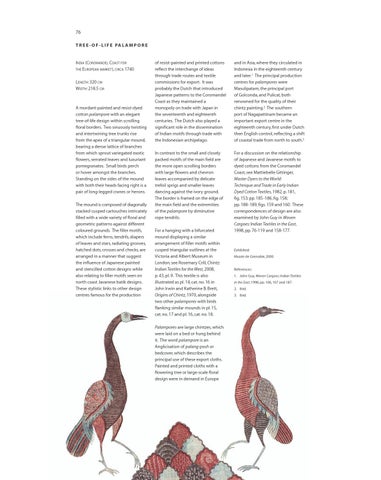
A mordant-painted and resist-dyed cotton palampore with an elegant tree-of-life design within scrolling floral borders. Two sinuously twisting and intertwining tree trunks rise from the apex of a triangular mound, bearing a dense lattice of branches from which sprout variegated exotic flowers, serrated leaves and luxuriant pomegranates. Small birds perch or hover amongst the branches. Standing on the sides of the mound with both their heads facing right is a pair of long-legged cranes or herons. The mound is composed of diagonally stacked cusped cartouches intricately filled with a wide variety of floral and geometric patterns against different coloured grounds. The filler motifs, which include ferns, tendrils, diapers of leaves and stars, radiating grooves, hatched dots, crosses and checks, are arranged in a manner that suggest the influence of Japanese painted and stencilled cotton designs while also relating to filler motifs seen on north coast Javanese batik designs. These stylistic links to other design centres famous for the production
of resist-painted and printed cottons reflect the interchange of ideas through trade routes and textile commissions for export. It was probably the Dutch that introduced Japanese patterns to the Coromandel Coast as they maintained a monopoly on trade with Japan in the seventeenth and eighteenth centuries. The Dutch also played a significant role in the dissemination of Indian motifs through trade with the Indonesian archipelago.
and in Asia, where they circulated in Indonesia in the eighteenth century and later.1 The principal production centres for palampores were Masulipatam, the principal port of Golconda, and Pulicat, both renowned for the quality of their chintz painting.2 The southern port of Nagapattinam became an important export centre in the eighteenth century, first under Dutch then English control, reflecting a shift of coastal trade from north to south.3
In contrast to the small and closely packed motifs of the main field are the more open scrolling borders with large flowers and chevron leaves accompanied by delicate trefoil sprigs and smaller leaves dancing against the ivory ground. The border is framed on the edge of the main field and the extremities of the palampore by diminutive rope tendrils.
For a discussion on the relationship of Japanese and Javanese motifs to dyed cottons from the Coromandel Coast, see Mattiebelle Gittinger, Master Dyers to the World: Technique and Trade in Early Indian Dyed Cotton Textiles, 1982, p. 181, fig. 153; pp. 185 -186, fig. 158; pp. 188 -189, figs. 159 and 160. These correspondences of design are also examined by John Guy in Woven Cargoes: Indian Textiles in the East, 1998, pp. 76-119 and 158-177.
For a hanging with a bifurcated mound displaying a similar arrangement of filler motifs within cusped triangular outlines at the Victoria and Albert Museum in London, see Rosemary Crill, Chintz: Indian Textiles for the West, 2008, p. 43, pl. 9. This textile is also illustrated as pl. 14, cat. no. 16 in John Irwin and Katherine B. Brett, Origins of Chintz, 1970, alongside two other palampores with birds flanking similar mounds in pl. 15, cat. no. 17 and pl. 16, cat. no. 18. Palampores are large chintzes, which were laid on a bed or hung behind it. The word palampore is an Anglicisation of palang-posh or bedcover, which describes the principal use of these export cloths. Painted and printed cloths with a flowering tree or large-scale floral design were in demand in Europe
Exhibited: MusĂŠe de Grenoble, 2000
References: 1. John Guy, Woven Cargoes: Indian Textiles in the East, 1998, pp. 106, 107 and 187. 2. Ibid. 3. Ibid.