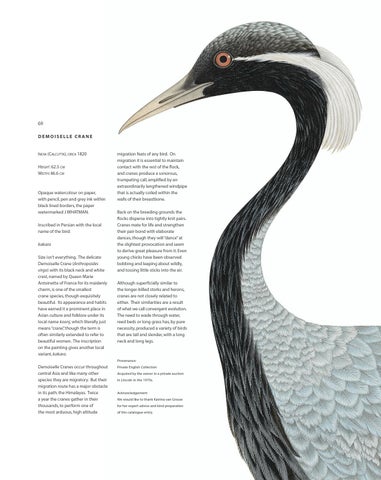
69 DEMOISELLE CRANE
INDIA (CALCUTTA), CIRCA 1820 HEIGHT: 62.5 CM WIDTH: 46.6 CM
Opaque watercolour on paper, with pencil, pen and grey ink within black lined borders, the paper watermarked J WHATMAN. Inscribed in Persian with the local name of the bird: kakara Size isn’t everything. The delicate Demoiselle Crane (Anthropoides virgo) with its black neck and white crest, named by Queen Marie Antoinette of France for its maidenly charm, is one of the smallest crane species, though exquisitely beautiful. Its appearance and habits have earned it a prominent place in Asian culture and folklore under its local name koonj, which literally just means “crane”, though the term is often similarly extended to refer to beautiful women. The inscription on the painting gives another local variant, kakara.
migration feats of any bird. On migration it is essential to maintain contact with the rest of the flock, and cranes produce a sonorous, trumpeting call, amplified by an extraordinarily lengthened windpipe that is actually coiled within the walls of their breastbone. Back on the breeding grounds the flocks disperse into tightly knit pairs. Cranes mate for life and strengthen their pair bond with elaborate dances, though they will “dance” at the slightest provocation and seem to derive great pleasure from it. Even young chicks have been observed bobbing and leaping about wildly, and tossing little sticks into the air. Although superficially similar to the longer-billed storks and herons, cranes are not closely related to either. Their similarities are a result of what we call convergent evolution. The need to wade through water, reed beds or long grass has, by pure necessity, produced a variety of birds that are tall and slender, with a long neck and long legs.
Provenance:
Demoiselle Cranes occur throughout central Asia and like many other species they are migratory. But their migration route has a major obstacle in its path: the Himalayas. Twice a year the cranes gather in their thousands, to perform one of the most arduous, high altitude
Private English Collection Acquired by the owner in a private auction in Lincoln in the 1970s.
Acknowledgement: We would like to thank Katrina van Grouw for her expert advice and kind preparation of this catalogue entry.