57 S A LU K I H O U N D
INDIA (UDAIPUR), DATED 1762 HEIGHT: 48 CM WIDTH: 60.5 CM
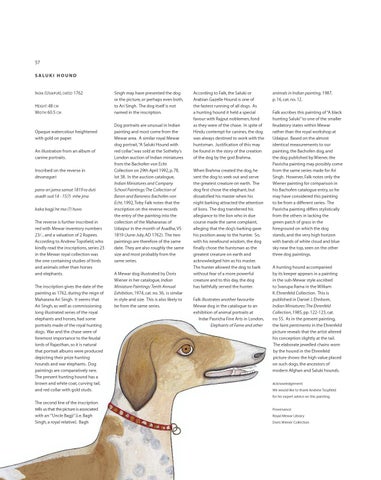
Opaque watercolour heightened with gold on paper. An illustration from an album of canine portraits. Inscribed on the reverse in devanagari: pano ori jama samat 1819 ra duti asadh sud 14 - 15(?) mhe jma kaka bagji he ma (?) huvo The reverse is further inscribed in red with Mewar inventory numbers 23/... and a valuation of 2 Rupees. According to Andrew Topsfield, who kindly read the inscriptions, series 23 in the Mewar royal collection was the one containing studies of birds and animals other than horses and elephants. The inscription gives the date of the painting as 1762, during the reign of Maharana Ari Singh. It seems that Ari Singh, as well as commissioning long illustrated series of the royal elephants and horses, had some portraits made of the royal hunting dogs. War and the chase were of foremost importance to the feudal lords of Rajasthan, so it is natural that portrait albums were produced depicting their prize hunting hounds and war elephants. Dog paintings are comparatively rare. The present hunting hound has a brown and white coat, curving tail, and red collar with gold studs.
Singh may have presented the dog or the picture, or perhaps even both, to Ari Singh. The dog itself is not named in the inscription. Dog portraits are unusual in Indian painting and most come from the Mewar area. A similar royal Mewar dog portrait, “A Saluki Hound with red collar”, was sold at the Sotheby’s London auction of Indian miniatures from the Bachofen von Echt Collection on 29th April 1992, p. 78, lot 38. In the auction catalogue, Indian Miniatures and Company School Paintings: The Collection of Baron and Baroness Bachofen von Echt, 1992, Toby Falk notes that the inscription on the reverse records the entry of the painting into the collection of the Maharanas of Udaipur in the month of Asadha, VS 1819 (June-July, AD 1762). The two paintings are therefore of the same date. They are also roughly the same size and most probably from the same series. A Mewar dog illustrated by Doris Wiener in her catalogue, Indian Miniature Paintings: Tenth Annual Exhibition, 1974, cat. no. 36, is similar in style and size. This is also likely to be from the same series.
According to Falk, the Saluki or Arabian Gazelle Hound is one of the fastest running of all dogs. As a hunting hound it held a special favour with Rajput noblemen, fond as they were of the chase. In spite of Hindu contempt for canines, the dog was always destined to work with the huntsman. Justification of this may be found in the story of the creation of the dog by the god Brahma. When Brahma created the dog, he sent the dog to seek out and serve the greatest creature on earth. The dog first chose the elephant, but dissatisfied his master when his night barking attracted the attention of lions. The dog transferred his allegiance to the lion who in due course made the same complaint, alleging that the dog’s barking gave his position away to the hunter. So, with his newfound wisdom, the dog finally chose the huntsman as the greatest creature on earth and acknowledged him as his master. The hunter allowed the dog to bark without fear of a more powerful creature and to this day, the dog has faithfully served the hunter. Falk illustrates another favourite Mewar dog in the catalogue to an exhibition of animal portraits at Indar Pasricha Fine Arts in London, Elephants of Fame and other
animals in Indian painting, 1987, p. 16, cat. no. 12. Falk ascribes this painting of “A black hunting Saluki” to one of the smaller feudatory states within Mewar rather than the royal workshop at Udaipur. Based on the almost identical measurements to our painting, the Bachofen dog, and the dog published by Wiener, the Pasricha painting may possibly come from the same series made for Ari Singh. However, Falk notes only the Wiener painting for comparison in his Bachofen catalogue entry, so he may have considered this painting to be from a different series. The Pasricha painting differs stylistically from the others in lacking the green patch of grass in the foreground on which the dog stands, and the very high horizon with bands of white cloud and blue sky near the top, seen on the other three dog paintings. A hunting hound accompanied by its keeper appears in a painting in the sub-Mewar style ascribed to Svarupa Rama in the William K. Ehrenfeld Collection. This is published in Daniel J. Ehnbom, Indian Miniatures: The Ehrenfeld Collection, 1985, pp. 122-123, cat. no 55. As in the present painting, the faint pentimento in the Ehrenfeld picture reveals that the artist altered his conception slightly at the tail. The elaborate jewelled chains worn by the hound in the Ehrenfeld picture shows the high value placed on such dogs, the ancestors of modern Afghan and Saluki hounds. Acknowledgement: We would like to thank Andrew Tospfield for his expert advice on this painting.
The second line of the inscription tells us that the picture is associated with an “'Uncle Bagji” [i.e. Bagh Singh, a royal relative]. Bagh
Provenance: Royal Mewar Library Doris Wiener Collection