55 MAHARANA RAJ SINGH AND COURTIERS
INDIA (UDAIPUR), CIRCA 1754 HEIGHT: 37.8 CM WIDTH: 28.5 CM
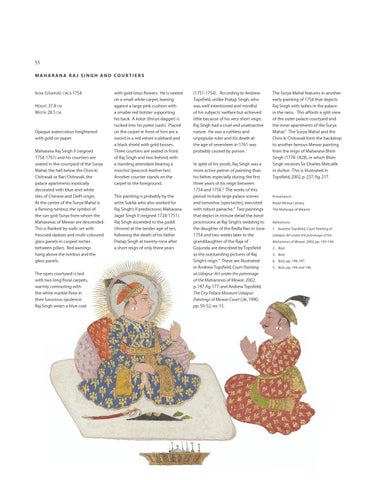
Opaque watercolour heightened with gold on paper. Maharana Raj Singh II (reigned 1754-1761) and his courtiers are seated in the courtyard of the Surya Mahal, the hall below the Chini ki Chitrasali or Bari Chitrasali, the palace apartments exotically decorated with blue-and-white tiles of Chinese and Delft origin. At the centre of the Surya Mahal is a flaming nimbus, the symbol of the sun god Surya from whom the Maharanas of Mewar are descended. This is flanked by walls set with frescoed dadoes and multi-coloured glass panels in cusped niches between pillars. Red awnings hang above the nimbus and the glass panels. The open courtyard is laid with two long floral carpets, warmly contrasting with the white marble floor in their luxurious opulence. Raj Singh wears a blue coat
with gold lotus flowers. He is seated on a small white carpet, leaning against a large pink cushion with a smaller red bolster supporting his back. A katar (thrust-dagger) is tucked into his patka (sash). Placed on the carpet in front of him are a sword in a red velvet scabbard and a black shield with gold bosses. Three courtiers are seated in front of Raj Singh and two behind, with a standing attendant bearing a morchal (peacock feather fan). Another courtier stands on the carpet to the foreground. This painting is probably by the artist Sukha who also worked for Raj Singh’s II predecessor, Maharana Jagat Singh II (reigned 1724-1751). Raj Singh ascended to the gaddi (throne) at the tender age of ten, following the death of his father Pratap Singh at twenty-nine after a short reign of only three years
(1751-1754). According to Andrew Topsfield, unlike Pratap Singh, who was well intentioned and mindful of his subjects’ welfare but achieved little because of his very short reign, Raj Singh had a cruel and unattractive nature. He was a ruthless and unpopular ruler and his death at the age of seventeen in 1761 was probably caused by poison.1 In spite of his youth, Raj Singh was a more active patron of painting than his father, especially during the first three years of his reign between 1754 and 1756.2 The works of this period include large palace scenes and tamashas (spectacles), executed with robust panache.3 Two paintings that depict in minute detail the barat processions at Raj Singh’s wedding to the daughter of the Bedla Rao in June 1754 and two weeks later to the granddaughter of the Raja of Gojunda, are described by Topsfield as the outstanding pictures of Raj Singh’s reign.4 These are illustrated in Andrew Topsfield, Court Painting at Udaipur: Art under the patronage of the Maharanas of Mewar, 2002, p. 197, fig. 177; and Andrew Topsfield, The City Palace Museum Udaipur: Paintings of Mewar Court Life, 1990, pp. 50-52, no. 15.
The Surya Mahal features in another early painting of 1754 that depicts Raj Singh with ladies in the palace in the rains. This affords a split view of the outer palace courtyard and the inner apartments of the Surya Mahal.5 The Surya Mahal and the Chini ki Chitrasali form the backdrop to another famous Mewar painting from the reign of Maharana Bhim Singh (1778-1828), in which Bhim Singh receives Sir Charles Metcalfe in durbar. This is illustrated in Topsfield, 2002, p. 237, fig. 217.
Provenance: Royal Mewar Library The Maharaja of Bikaner
References: 1. Andrew Topsfield, Court Painting at Udaipur: Art under the patronage of the Maharanas of Mewar, 2002, pp. 193-194. 2. Ibid. 3. Ibid. 4. Ibid., pp. 196-197. 5. Ibid., pp. 194 and 196.