50 GUNDA-MALLARA SON OF MEGHA RAGA
INDIA (BILASPUR), 1700-1720 HEIGHT: 21.5 CM WIDTH: 14.8 CM
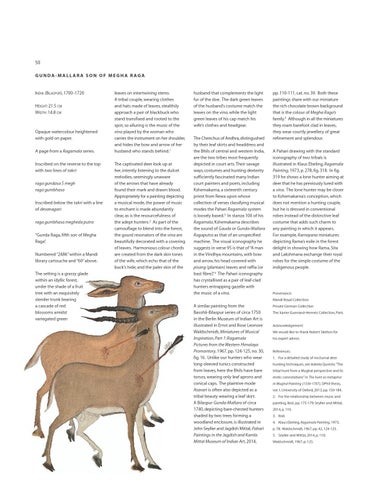
Opaque watercolour heightened with gold on paper. A page from a Ragamala series. Inscribed on the reverse to the top with two lines of takri: raga gundasa 5 megh raga gumbhasa Inscribed below the takri with a line of devanagari: raga gumbhasa megheda putra “Gunda Raga, fifth son of Megha Raga”. Numbered “2486” within a Mandi library cartouche and “60” above. The setting is a grassy glade within an idyllic forest, under the shade of a fruit tree with an exquisitely slender trunk bearing a cascade of red blossoms amidst variegated green
leaves on intertwining stems. A tribal couple, wearing clothes and hats made of leaves, stealthily approach a pair of blackbuck who stand transfixed and rooted to the spot, so alluring is the music of the vina played by the woman who carries the instrument on her shoulder, and hides the bow and arrow of her husband who stands behind.1 The captivated deer look up at her, intently listening to the dulcet melodies, seemingly unaware of the arrows that have already found their mark and drawn blood. Appropriately for a painting depicting a musical mode, the power of music to enchant is made abundantly clear, as is the resourcefulness of the adept hunters.2 As part of the camouflage to blend into the forest, the gourd resonators of the vina are beautifully decorated with a covering of leaves. Harmonious colour chords are created from the dark skin tones of the wife, which echo that of the buck’s hide, and the paler skin of the
husband that complements the light fur of the doe. The dark green leaves of the husband’s costume match the leaves on the vina, while the light green leaves of his cap match his wife’s clothes and headgear. The Chenchus of Andhra, distingushed by their leaf skirts and headdress and the Bhils of central and western India, are the two tribes most frequently depicted in court arts. Their savage ways, costumes and hunting dexterity sufficiently fascinated many Indian court painters and poets, including Kshemakarna, a sixteenth century priest from Rewa upon whose collection of verses classifying musical modes the Pahari Ragamala system is loosely based.3 In stanza 100 of his Ragamala, Kshemakarna describes the sound of Gauda or Gunda-Mallara Ragaputra as that of an unspecified machine. The visual iconography he suggests in verse 95 is that of “A man in the Vindhya mountains, with bow and arrow, his head covered with pisang (plantain) leaves and raffia [or bast fibre]”. 4 The Pahari iconography has crystallised as a pair of leaf-clad hunters entrapping gazelle with the music of a vina.
pp. 110-111, cat. no. 39. Both these paintings share with our miniature the rich chocolate brown background that is the colour of Megha Raga’s family.5 Although in all the miniatures they roam barefoot clad in leaves, they wear courtly jewellery of great refinement and splendour. A Pahari drawing with the standard iconography of two tribals is illustrated in Klaus Ebeling, Ragamala Painting, 1973, p. 278, fig. 318. In fig. 319 he shows a lone hunter aiming at deer that he has previously lured with a vina. The lone hunter may be closer to Kshemakarna’s conception, which does not mention a hunting couple, but he is dressed in conventional robes instead of the distinctive leaf costume that adds such charm to any painting in which it appears. For example, Ramayana miniatures depicting Rama’s exile in the forest delight in showing how Rama, Sita and Lakshmana exchange their royal robes for the simple costume of the indigenous people.
Provenance: Mandi Royal Collection
A similar painting from the Basohli-Bilaspur series of circa 1750 in the Berlin Museum of Indian Art is illustrated in Ernst and Rose Leonore Waldschmidt, Miniatures of Musical Inspiration, Part 1: Ragamala Pictures from the Western Himalaya Promontory, 1967, pp. 124-125, no. 30, fig. 16. Unlike our hunters who wear long-sleeved tunics constructed from leaves, here the Bhils have bare torsos, wearing only leaf aprons and conical caps. The plaintive mode Asavari is often also depicted as a tribal beauty wearing a leaf skirt. A Bilaspur Gunda-Mallara of circa 1740, depicting bare-chested hunters shaded by two trees forming a woodland enclosure, is illustrated in John Seyller and Jagdish Mittal, Pahari Paintings in the Jagdish and Kamla Mittal Museum of Indian Art, 2014,
Private German Collection The Xavier Guerrand-Hermès Collection, Paris
Acknowledgement: We would like to thank Robert Skelton for his expert advice.
References: 1. For a detailed study of nocturnal deer hunting techniques, see Adeela Qureshi, “The tribal hunt from a Mughal perspective and its erotic connotations” in The hunt as metaphor in Mughal Painting (1556-1707), DPhil thesis, vol.1, University of Oxford, 2013, pp. 150-184. 2. For the relationship between music and painting, Ibid., pp. 175-179; Seyller and Mittal, 2014, p. 110. 3. Ibid. 4. Klaus Ebeling, Ragamala Painting, 1973, p. 78; Waldschmidt, 1967, pp. 42, 124-125. 5. Seyller and Mittal, 2014, p. 110; Waldschmidt, 1967, p. 125.