11 INTERLACING ARABESQUES
WESTERN CENTRAL ASIA (TIMURID), LATE 14TH CENTURY HEIGHT: 38.5 CM WIDTH: 31.5 CM DEPTH: 8 CM
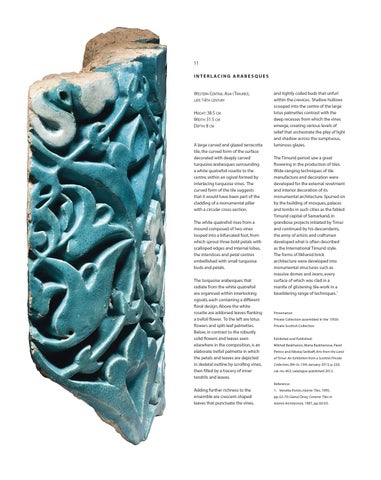
A large carved and glazed terracotta tile, the curved form of the surface decorated with deeply carved turquoise arabesques surrounding a white quatrefoil rosette to the centre, within an ogival formed by interlacing turquoise vines. The curved form of the tile suggests that it would have been part of the cladding of a monumental pillar with a circular cross-section. The white quatrefoil rises from a mound composed of two vines looped into a bifurcated foot, from which sprout three bold petals with scalloped edges and internal lobes, the interstices and petal centres embellished with small turquoise buds and petals. The turquoise arabesques that radiate from the white quatrefoil are organised within interlocking ogivals, each containing a different floral design. Above the white rosette are addorsed leaves flanking a trefoil flower. To the left are lotus flowers and split-leaf palmettes. Below, in contrast to the robustly solid flowers and leaves seen elsewhere in the composition, is an elaborate trefoil palmette in which the petals and leaves are depicted in skeletal outline by scrolling vines, then filled by a tracery of inner tendrils and leaves.
and tightly coiled buds that unfurl within the crevices. Shallow hollows scooped into the centre of the large lotus palmettes contrast with the deep recesses from which the vines emerge, creating various levels of relief that orchestrate the play of light and shadow across the sumptuous, luminous glazes. The Timurid period saw a great flowering in the production of tiles. Wide-ranging techniques of tile manufacture and decoration were developed for the external revetment and interior decoration of its monumental architecture. Spurred on by the building of mosques, palaces and tombs in such cities as the fabled Timurid capital of Samarkand, in grandiose projects initiated by Timur and continued by his descendants, the army of artists and craftsmen developed what is often described as the International Timurid style. The forms of Ilkhanid brick architecture were developed into monumental structures such as massive domes and iwans, every surface of which was clad in a mantle of glistening tile-work in a bewildering range of techniques.1
Provenance: Private Collection assembled in the 1950s Private Scottish Collection
Exhibited and Published: Mikhail Baskhanov, Maria Baskhanova, Pavel Petrov and Nikolaj Serikoff, Arts from the Land of Timur: An Exhibition from a Scottish Private Collection, 8th to 13th January 2013, p. 220, cat. no. 462; catalogue published 2012.
Reference:
Adding further richness to the ensemble are crescent-shaped leaves that punctuate the vines,
1. Venetia Porter, Islamic Tiles, 1995, pp. 62-70; GĂśnul Ă–ney, Ceramic Tiles in Islamic Architecture, 1987, pp. 60-63.