96 MARBLE COLUMNS
INDIA (MUGHAL), 18TH CENTURY HEIGHT: 115 CM EACH WIDTH: 27 CM EACH
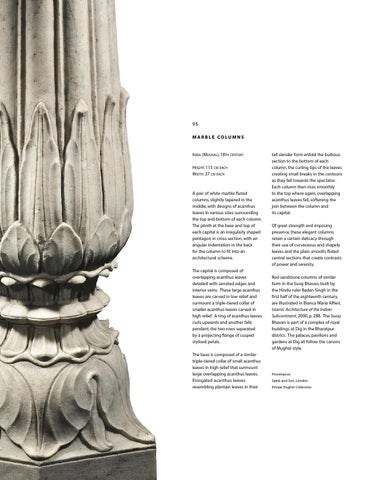
A pair of white marble fluted columns, slightly tapered in the middle, with designs of acanthus leaves in various sizes surrounding the top and bottom of each column. The plinth at the base and top of each capital is an irregularly shaped pentagon in cross-section, with an angular indentation in the back for the column to fit into an architectural scheme. The capital is composed of overlapping acanthus leaves detailed with serrated edges and interior veins. These large acanthus leaves are carved in low relief and surmount a triple-tiered collar of smaller acanthus leaves carved in high relief. A ring of acanthus leaves curls upwards and another falls pendant, the two rows separated by a projecting flange of cusped stylised petals. The base is composed of a similar triple-tiered collar of small acanthus leaves in high relief that surmount large overlapping acanthus leaves. Elongated acanthus leaves resembling plantain leaves in their
tall slender form enfold the bulbous section to the bottom of each column, the curling tips of the leaves creating small breaks in the contours as they fall towards the spectator. Each column then rises smoothly to the top where again, overlapping acanthus leaves fall, softening the join between the column and its capital. Of great strength and imposing presence, these elegant columns retain a certain delicacy through their use of curvaceous and shapely leaves and the plain smooth, fluted central sections that create contrasts of power and serenity. Red sandstone columns of similar form in the Suraj Bhavan, built by the Hindu ruler Badan Singh in the first half of the eighteenth century, are illustrated in Bianca Maria Alfieri, Islamic Architecture of the Indian Subcontinent, 2000, p. 288. The Suraj Bhavan is part of a complex of royal buildings at Dig in the Bharatpur district. The palaces, pavilions and gardens at Dig all follow the canons of Mughal style.
Provenance: Spink and Son, London Private English Collection