79 T H E C E N O TA P H O F S H A H J A H A N
INDIA (AGRA), 1810-1820 HEIGHT: 60 CM WIDTH: 132 CM
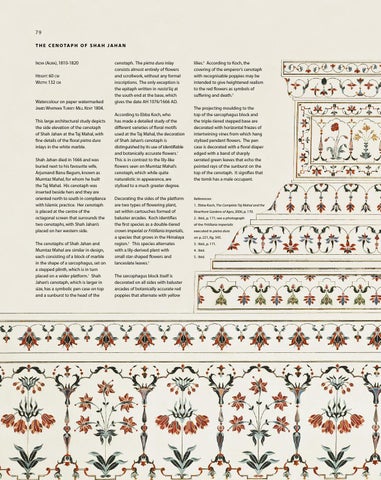
Watercolour on paper watermarked JAMES WHATMAN TURKEY MILL KENT 1804. This large architectural study depicts the side elevation of the cenotaph of Shah Jahan at the Taj Mahal, with fine details of the floral pietra dura inlays in the white marble. Shah Jahan died in 1666 and was buried next to his favourite wife, Arjumand Banu Begum, known as Mumtaz Mahal, for whom he built the Taj Mahal. His cenotaph was inserted beside hers and they are oriented north to south in compliance with Islamic practice. Her cenotaph is placed at the centre of the octagonal screen that surrounds the two cenotaphs, with Shah Jahan’s placed on her western side. The cenotaphs of Shah Jahan and Mumtaz Mahal are similar in design, each consisting of a block of marble in the shape of a sarcophagus, set on a stepped plinth, which is in turn placed on a wider platform.1 Shah Jahan’s cenotaph, which is larger in size, has a symbolic pen case on top and a sunburst to the head of the
cenotaph. The pietra dura inlay consists almost entirely of flowers and scrollwork, without any formal inscriptions. The only exception is ˛ the epitaph written in nasta liq at the south end at the base, which gives the date AH 1076/1666 AD. According to Ebba Koch, who has made a detailed study of the different varieties of floral motifs used at the Taj Mahal, the decoration of Shah Jahan’s cenotaph is distinguished by its use of identifiable and botanically accurate flowers.1 This is in contrast to the lily-like flowers seen on Mumtaz Mahal’s cenotaph, which while quite naturalistic in appearance, are stylised to a much greater degree. Decorating the sides of the platform are two types of flowering plant, set within cartouches formed of baluster arcades. Koch identifies the first species as a double-tiered crown imperial or Fritillaria imperialis, a species that grows in the Himalaya region.2 This species alternates with a lily-derived plant with small star-shaped flowers and lanceolate leaves.3 The sarcophagus block itself is decorated on all sides with baluster arcades of botanically accurate red poppies that alternate with yellow
lilies.4 According to Koch, the covering of the emperor’s cenotaph with recognisable poppies may be intended to give heightened realism to the red flowers as symbols of suffering and death.5 The projecting moulding to the top of the sarcophagus block and the triple-tiered stepped base are decorated with horizontal friezes of intertwining vines from which hang stylised pendant flowers. The pen case is decorated with a floral diaper edged with a band of sharply serrated green leaves that echo the pointed rays of the sunburst on the top of the cenotaph. It signifies that the tomb has a male occupant.
References: 1. Ebba Koch, The Complete Taj Mahal and the Riverfront Gardens of Agra, 2006, p. 170. 2. Ibid., p. 171; see a photograph of the Fritillaria imperialis executed in pietra dura on p. 221, fig. 345. 3. Ibid., p. 171. 4. Ibid. 5. Ibid.