CHRO
feature
“...the Covid-19 pandemic has compounded the woes of an ailing office market battling with high vacancy rates and declining rentals.”
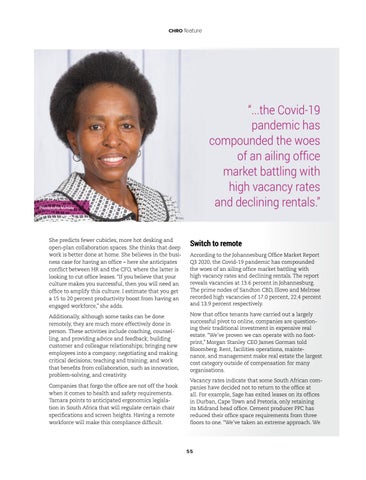
Phindokuhle Mohlala
She predicts fewer cubicles, more hot desking and open-plan collaboration spaces. She thinks that deep work is better done at home. She believes in the business case for having an office – here she anticipates conflict between HR and the CFO, where the latter is looking to cut office leases. “If you believe that your culture makes you successful, then you will need an office to amplify this culture. I estimate that you get a 15 to 20 percent productivity boost from having an engaged workforce,” she adds.
Switch to remote
Additionally, although some tasks can be done remotely, they are much more effectively done in person. These activities include coaching, counselling, and providing advice and feedback; building customer and colleague relationships; bringing new employees into a company; negotiating and making critical decisions; teaching and training; and work that benefits from collaboration, such as innovation, problem-solving, and creativity.
Now that office tenants have carried out a largely successful pivot to online, companies are questioning their traditional investment in expensive real estate. “We’ve proven we can operate with no footprint,” Morgan Stanley CEO James Gorman told Bloomberg. Rent, facilities operations, maintenance, and management make real estate the largest cost category outside of compensation for many organisations.
Companies that forgo the office are not off the hook when it comes to health and safety requirements. Tamara points to anticipated ergonomics legislation in South Africa that will regulate certain chair specifications and screen heights. Having a remote workforce will make this compliance difficult.
According to the Johannesburg Office Market Report Q3 2020, the Covid-19 pandemic has compounded the woes of an ailing office market battling with high vacancy rates and declining rentals. The report reveals vacancies at 13.6 percent in Johannesburg. The prime nodes of Sandton CBD, Illovo and Melrose recorded high vacancies of 17.0 percent, 22.4 percent and 13.9 percent respectively.
Vacancy rates indicate that some South African companies have decided not to return to the office at all. For example, Sage has exited leases on its offices in Durban, Cape Town and Pretoria, only retaining its Midrand head office. Cement producer PPC has reduced their office space requirements from three floors to one. “We’ve taken an extreme approach. We
55