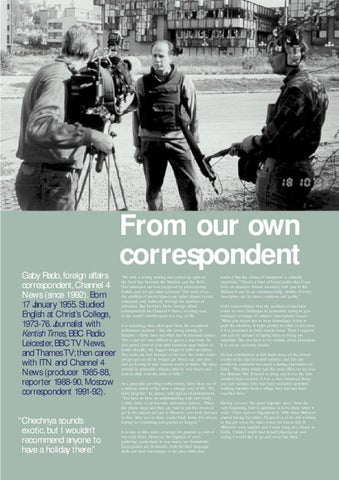
From our own correspondent Gaby Rado, foreign affairs correspondent, Channel 4 News (since 1992). Born 17 January 1955. Studied English at Christ’s College, 1973-76. Journalist with Kentish Times, BBC Radio Leicester, BBC TV News, and Thames TV; then career with ITN and Channel 4 News (producer 1985-88, reporter 1988-90, Moscow correspondent 1991-92). “Chechnya sounds exotic, but I wouldn’t recommend anyone to have a holiday there.”
“We took a wrong turning and ended up right on the front line between the Muslims and the Serbs. Our armoured car was peppered by about twenty bullets, and we got taken prisoner.” For most of us, the conflicts of recent history are rather distant events, witnessed only indirectly through the medium of television. But for Gaby Rado, foreign affairs correspondent for Channel 4 News, covering wars in the world’s trouble-spots is a way of life. It is surprising, then, that apart from the occasional unforeseen incident – like the wrong turning in Sarajevo – Gaby does not often feel in personal danger. “For a start it’s very difficult to get to a war zone. So you spend most of your time nowhere near bullets or shells. Actually, the biggest danger is traffic accidents. The roads are bad because of the war: the better roads always get cut off or bridges get blown up, and you end up having to take country roads or tracks. We drive around in armoured vehicles; they’re very heavy and tend to slide over the sides of hills.” As a journalist covering world events, Gaby lives out of a suitcase much of the time: a strange way of life. “It’s fairly irregular,” he agrees, with typical understatement. “You have to have an understanding wife and family. I think many of us become ‘adrenaline junkies’. When the phone rings and they say ‘you’ve got five hours to get to the airport and get to Moscow’, you look forward to that. After two or three weeks back home I’m always itching for something unexpected to happen.” It is easy to take news coverage for granted, as part of our daily ritual. However, the logistics of news gathering, particularly in war zones, are formidable. Local guides are invaluable, both for their language skills and their knowledge of the area. Gaby has
learned that the choice of interpreter is critically important. “There’s a kind of brutal reality that if you have an attractive female translator with you in the Balkans it can be an enormous help. Armies of every description are far more courteous and polite.” Gaby acknowledges that the medium of television poses its own challenges to journalists, trying to give balanced coverage of complex international issues: “What you report has to have immediacy; it has to grab the attention. It helps people to relate to the story if it is presented in fairly simple terms. Then I suppose you can be accused of taking sides or being too simplistic. But you have to be realistic about journalism. It is not an academic treatise.” He has experienced at first hand many of the pivotal events of the late twentieth century, and yet one conflict in particular has made a lasting impression on Gaby. “The story which had the most effect on me was the Bosnian War. It lasted so long, and.it was the first conflict I had covered. It was a very emotional thing: you saw families who had been suddenly uprooted, walking barefoot from a village they had just been expelled from.” Having covered “the great Yugoslav story” from the very beginning, Gaby’s ambition is to be there when it ends. “I first went to Yugoslavia in 1988 when Milosevic started having his rallies. I’d just love to be still working in this job when the time comes for him to fall. If Milosevic were toppled and I were lying on a beach in Corfu, I think I might find myself phoning up and saying I would like to go and cover the story.”