Loupe. The Magazine of Christopher Ward. Issue 04. Spring 2017
originals. The new
The Malverns reborn
The C60 Trident Pro 600 isn’t a bestseller for nothing. Water-resistant to a depth of 600m, it’s the perfect diving watch. But with its scratchresistant ceramic bezel and elegant stainless steel case, it’ll look great just about anywhere. The 38mm and 43mm case sizes also ensure there’s a C60 for every wrist size.
Loupe. The Magazine of Christopher Ward.
The thing that’s so great about Christopher Ward watches – the thing that first attracted me to the brand, anyway – is the way that it’s committed to making high quality Swiss-made watches accessible to virtually everyone. And that means that the Malvern range – while not the most interesting watches horologically, maybe – are vital, the bedrock on which it is all built. How exciting, then to see that the new Malvern collection – the MkIII version, in C3 quartz and C5 mechanical form – retains this commitment to accessibility, but moves the game on significantly. These aren’t just handsome watches at a great price point, but are truly desirable in their own right – and with an attention to detail that’s astounding at the price. The C3 looks great on our cover this issue but, believe me, they both look even better in the metal. Matt Bielby
Sorcerer’s apprentice There are so many extraordinary claims made about what are actually quite unexceptional things in this industry of ours that, when you do first hear about something exceptional, you tend to take it with a pinch of salt. And when you come across someone who says he designs and then makes every single component of his watches by hand, it’s not surprising that deep scepticism kicks in. This was our reaction when we first heard about the late, great George Daniels, who not only mastered the 35 or so skills required to complete a watch entirely by hand, but arguably – with his co-axial escapement design – was also responsible for the greatest leap forward in horology in more than 200 years. His only apprentice, Roger Smith, vowed to build on this astonishing legacy and is today – with his small team on the Isle of Man – still creating the most wonderful timepieces using the ‘Daniels method’. Despite operating at somewhat different ends of the watchmaking spectrum, we are constantly inspired by the work of Roger and his team, who have overcome some of the most difficult obstacles imaginable in their efforts to create something of beauty, meaning and lasting value. We were, therefore, delighted when ‘The Watchmaker’s Apprentice’ himself agreed to be interviewed for this issue of Loupe. Prepare to be inspired! Enjoy the read.
Editor: Matt Bielby Art Director: Jamie Gallagher Designer: Sam Burn Photography: Damon Charles, Peter Canning
Cover: C3 Malvern Chronograph MkIII 1 Park St, Maidenhead, Berkshire SL6 1SL christopherward.co.uk
Chris, Mike and Peter
Contents Features 16 – 19
20 – 27
28 – 33
Super furry animals Inside Marmoset, suppliers of music to Christopher Ward…
Point of entry The C5 Automatic and C3 Chronograph have long been Christopher Ward’s entry-level watches, but they’ve never been as impressive as this before. Plus: Adrian Buchmann takes a closer look at their design details…
34 – 37
Best of enemies Great rivalries drive everything, and here are some of our favourites…
38 – 39
Sea of sand Jamie Maddison, the new CW Challenger, runs deserts – and the more distant they are, the better. We ask him why…
Morgan watches 09 — 10
Beast wars The world’s most dedicated photographers, and their awardwinning pictures of critters
C5 Automatic MkIII 20 — 27
Regulars 07 – 10
The Brief
41 – 50
Insight What we do, and how we do it. Adrian talks the shared design DNA between the C1 and C3/C5 twins; Jörg Bader explains the Bader buckle; and we enjoy an audience with Roger Smith, last bastion of the English watchmaking tradition
Christopher Ward has made plenty of motorsport-influenced watches, but has never collaborated directly with a car manufacturer like Morgan before. Plus: everyone seems to love the C1, and we auction a prototype…
12 – 15
Forty eight
Desert challenge 38 — 39
Three of our favourite women try out three of our favourite watches, each for a couple of days. How did they get on?
5
The modernity of Swiss watchmaking blends with retro styling in the C65 Trident Classic Vintage Edition. The ‘glass box’ sapphire crystal recalls the chunky aesthetic of the ’70s, while the ‘Old Radium’ luminescent paint on the hands and dial add allimportant visibility. The Vintage Edition is a watch that goes back to the future.
Discover the new breed of watchmaker...
christopherward.co.uk
News, reports & innovations. This issue: Christopher Ward teams up with Morgan, and more…
Highflyer C8 Regulator Limited Edition
A sneak peek at the C8 Regulator, taking the Aviation Collection to further new heights
This slightly-teasing early image provides your first look at the upcoming C8 Regulator Limited Edition, a new addition to the Aviation Collection. The key thing about a regulator is that it makes the large minute hand the most important aspect of the watch, while two smaller sub-dials set into the face handle hour and second duties. That’s right – the hours, minutes and seconds are all on seperate dials. WW2 bomber crews would use watches like this to time the manual release of their payloads, while traditional watchmakers would use a regulator clock, where hour, minute and second hands also operate separately, to check the accuracy of their creations. Christopher Ward’s new 44mm offers a handsome, modernist take on 7
this style, while taking its inspiration from the emerging design architecture of the Aviation collection, following on from the recent C8 Power Reserve Chronometer. What else can we tell you about it? Not much just yet, except that it features a sandblasted DLC case, while a Swissmade handwound movement with a JJ three-wheel module is visible behind a smoked glass exhibition case back. The C8 Regulator will be available as a 100-piece limited edition from February 23, priced £1,350. It’s one heck of a lot of watch for the money, and will feature in more detail in the next issue of Loupe. C8 Regulator (Limited Edition), £1,350 For more, christopherward.co.uk
Last Auction Hero When the prototype of the Spitfire-inspired C8 P7350 went for charity auction, we expected plenty of interest – but not quite as much as this… For each new Christopher Ward model there is, of course, a prototype, and though they’re often kept within the company’s archives, sometimes the co-founders think of something interesting to do with them. So it was with prototype number 000 of the limited edition C8 P7350, created to commemorate the 75th anniversary of the Battle of Britain. The 75 pieces sold out very quickly, but the prototype meant that there was effectively a 76th too – and, like the others, it contained a piece of Duralumin from the last airworthy Spitfire that flew in the Battle of Britain. “We decided to hold an online silent auction,” says Olivia Blakstad of CW’s marketing department, “with all proceeds
Prize package
britishlegion.org.uk; ssafa.org.uk
Forum’s new threads
To no-one’s great surprise, at least at CW, the C1 Grand Malvern wins a WatchPro Award From the very first, everyone who works at Christopher Ward seemed quietly confident that the new, range-topping C1 Grand Malvern Power Reserve was a very significant watch, with beauty and ability far beyond its relatively modest £1,550 price tag. It’s always nice to have your beliefs confirmed by others, however, and the fact that the C1 Grand Malvern was recently named Easy Wearing Watch of the Year 2016 by industry bible WatchPro Magazine in their annual awards – which they run in conjunction with Hearst Magazines UK, the people behind Esquire and Harper’s Bazaar – was most pleasing. It celebrates great watches with a degree of
split between two charities: The Royal British Legion and SSAFA, another of the UK’s biggest military charities. The auction was held on 7 November, and was open for 11 hours. Entrants would send in ‘sealed envelope bids’ by email. “We hoped to raise quite a lot of money for this prototype, as the series watches sold for £3,450, but were stunned when a gentleman in the USA bid £17,500, allowing us to give £8,750 to each very worthy charity. Both have written to him personally since – they were just blown away.”
The Christopher Ward Forum gets a new look As Loupe goes to print, the CW Forum is about to receive a major refresh. Kip McEwen, who leads the team of forum moderators, has worked closely with the team in Maidenhead on the update. “It’s been great working with everyone at CW to create the new look for the forum, and I can’t wait to share this exciting step forward with the members,” he says.
everyday usability, which is, of course, one of the things Christopher Ward is all about.
And what will the new forum look like? Better head over there and take a look… For more, christopherwardforum.com
For more, watchpro.com
8
Morgan: a suitable case for treatment
There’s plenty of good watch inspiration here, we’d say…
Christopher Ward signs a historic deal with the Morgan Motor Company to create a new range of watches for Morgan owners, inspired by the cars One of the most exciting and individual names in British motor sport is Morgan, the proudly independent, family-owned maker of unique, distinctive vehicles that are both fast and ecologically-friendly, cutting edge in the way they’re designed and classically crafted in the way they’re made. Christopher Ward – as a similarly individual and proudly British outfit – has various synergies with Morgan anyway, but from last November it became official, as the two companies announced an ongoing agreement to produce Morgan-based watches. That Morgans are all built at the historic spa town of Malvern in Worcestershire, and the very first Christopher Ward watch was the C5 Malvern, is another rather pleasing piece of coincidence.
The collaboration begins with a range of three watches, only available to new and existing owners of Morgan cars and all powered by Christopher Ward’s inhouse movement, Calibre SH21. Each one references one of the three major strands of the Morgan range. There’s the iconic three-wheeler, the first car Morgan ever made back in 1909, and relaunched in a powerful modern form in 2011; there’s the core, familiar Morgan line of open sports cars, the Plus 4s and Plus 8s, that people think of when they think of Morgan; and then there’s the more recent Aero range, a high-end, retro-futuristic interpretation of the Morgan brand values that launched in 2000 and currently comprises three cars, both open-top and fixed-head. “Morgan is one of the great icons of the British car industry, and the three watches all reflect different aspects
11 9
of their cars,” says Christopher Ward co-founder Mike France. “We’ve modified many key elements, including the bridges that hold the movements, to suit each model, while the case is a redesigned version of the new C1 Grand Malvern case. One of the great things about our new working partnership is that the watches will be available to buy at Morgan dealers across the world, and you’ll be able to get a bespoke version made to match your new car. It will have the chassis number engraved upon it, so it’s almost like part of the vehicle.” Jonathan Wells, Head of Design at Morgan, is equally excited. “There’s a sense of purpose to a Morgan,” he says. “The cars don’t try to satisfy every possible automotive application, but simply offer a fantastic yet reliable driving experience, with the added value of knowing your car is personal to you, thanks to the care of a dedicated team of craftsmen. A watch is a personal item too, acting as an avatar
“I arrived at CW to be greeted by, significantly, a blank sheet of paper” to describe one’s taste and personality, and anything that can be done to ensure that it is bespoke to the client should be considered within the design details.” To this end, Jonathan considers the new relationship between Christopher Ward and Morgan to be more than just financial, but emotional too. “The watches must have integrity,” he says. “A Morgan watch could never be just a badging exercise or a marketing stunt, but has to be designed in the same way as the vehicles. Indeed, it must offer the customer the ability to tailor details to suit their personal taste – and echo the key features of the car that they love.” Because of all this, the decision to collaborate with Christopher Ward was not a difficult one for Morgan. “We had a brief introduction – over a glass of wine! – at a horological fair local to Malvern,” Jonathan says, “and that immediately got me excited about the
The Aero Morgans feature sleek yet retro design
prospect of working with the CW team. The synergies between our brands were immediately obvious. “Further assurance was obtained when I visited Adrian Buchmann, CW’s genius designer, to kick-off the design process. I arrived at their HQ – in a Morgan for reference, obviously! – to be greeted by Adrian, piles of samples and materials and, significantly, a blank sheet of paper! I can’t imagine another company of this scale would offer such a blue sky and personal approach toward design collaboration on a new product. We then spent a fascinating day discussing and discovering each other’s brands further, and are very confident that the best of both are apparent in the resultant watches. The shapes, materials, details and overall language of the watches mean they don’t require a logo to state that they are a ‘Morgan’ CW product, and this was crucial to me. The design is understated yet obvious, and I’m confident each customer will relate to their watch for the same reasons they do their car.” For updates, christopherward.co.uk/morgan
10
A new chapter in the Christopher Ward story, the light-catching lines of the all-new case are inspired by English design. With a power reserve complication to our Swissmade in-house movement Calibre SH21, the C1 Grand Malvern Power Reserve blends Swiss ingenuity with British elegance.
Discover the new breed of watchmaker...
christopherward.co.uk
Forty Eight
Two days with some of our latest models
Ready to wear For watch-deniers like Shelley Frosdick, just putting on something like our C60 Trident Pro 600 was quite an experience…
Like so many people these days, Shelley Frosdick hardly ever wears a watch – and hasn’t done for years. “I usually use my iPhone to tell the time,” she says, “but a couple of things have made me more interested in watches lately. One is that my dad definitely falls into the watch enthusiast camp, and through him I’ve learned to appreciate watches. The other is that, by working with Christopher Ward, my interest in watches has definitely increased, and I now know more about what goes into making one.”
Shelley: loves the C60, but would like it in grey
12
Current C60 Trident models have the latest company logo at the 9 o’clock position
Shelley is Director of Consumer PR at PHA Media – an award-winning PR consultancy – and she’s been heading up the team managing all Christopher Ward’s media and press activity since April 2016. To find out whether she’d appreciate a CW as part of her everyday life, we lent her a new-look C60 Trident Pro 600 for a couple of days this winter. “I actually loved wearing my Trident,” Shelley says. “In fact, it hasn’t been off my wrist since I was sent it! I’ve worn it to work every day, even at weekends. (In fact, I had a long weekend in New York and the watch came with me.) It’s safe to say that I’ve become very attached to it, but because of its style and size I’ve worn it more as a day watch, taking it off if I’m going out in the evening. I’ve really enjoyed wearing a watch again, however, and am already thinking about what I should add to my collection. I’d like a style that works for evenings, too. “My initial reaction, though, was that it’s far too big and heavy, especially as the last watch I wore was a very little one. I was
really aware of having such small wrists, and the watch not looking right on me. It took some getting used to, and felt strange on the wrist – not that I could decide which wrist to wear it on. I’ve typically worn watches on my right, but decided to try this one on my left, then after a couple of days I swapped back to my right, and from the point on it felt much more natural on me. I asked friends and colleagues their thoughts, and everyone was very complimentary, assuring me it wasn’t too big – and did look good. And, indeed, I now actually like the size, and feel that it makes a statement – but in a subtle way.” So, would you say you’re ready for a watch in your life again? “Well, almost. It is quite heavy for me still, but will certainly encourage me to wear a watch again in the future. I’d like one like this, but with more colours for the dial and bezel. Grey would be ideal!” C60 Trident Pro 600 on bracelet, £699
christopherward.co.uk
13
Rosemary Stockdale doesn’t swap watches very often, so what will she make of the C3 Malvern Chronograph MkIII?
35 and counting Rosemary’s go-to watch is a well-loved, regularly-serviced TAG Heuer she’s had for 35 years now – “I find it sporty and elegant at the same time,” she says – while evening tends to belong to a Gucci fashion watch of similar vintage. She knows what she likes, it seems. “Christopher Ward once did a range of ladies’ watches, and my favourite was the Matisse watch with pave diamonds around the outside,” she says. “It was quite large, but elegant at the same time, and great for parties. I have a couple of holiday watches too, the sort that I wouldn‘t worry if they got lost or stolen.” Rosemary is Managing Director of Sterling Marketing, an omni-channel consultancy that has worked with CW since the company’s early days. “We hold their single customer view database, which is used for a variety of marketing purposes – including targeting the people who’ll receive Loupe,” she says. She’s actually worn the C3 Malvern Chronograph MkIII we lent her every day to get a real feel for it. It’s been into work, to client meetings and to the office Christmas Party, and accompanied her on country walks and pre-Christmas
shopping. “I’ve worn it with all sort of outfits, from jeans to more elegant dressing.” Once again, size was an initial concern, but Rosemary found it fitted her wrist perfectly and was comfortable to wear. “The design is classic, which I like – although I am not exactly a ‘classic’ person myself – and works as both an everyday watch and as a dressier one,” she says. “Strangely enough, the size of the watch makes me feel quite upbeat and positive, and, of course, it means that the numerals and so on are easy to see. That the profile is quite slim adds to its elegance, too. But I think I’m more sporty than this watch, really, so I’d like to try a few more CWs to work out which would be right for me. After all, I’d plan to wear it for a while.” Perhaps even 35 years!
Rosemary: rather a sports watch fan
C3 Malvern Chronograph MkIII, from £349
christopherward.co.uk 14
Bright star SalonQP’s Lucy Cheesewright comes across more watches than most, so what does she make of the C1 Grand Malvern Power Reserve? Lucy: loving the C1, and especially the tan strap
For the past six years, Lucy Cheesewright has been event director for London’s SalonQP – it’s one of Europe’s leading luxury watch shows, and one Christopher Ward has been part of for the last three events. “It was fantastic to get CW into the show initially,” Lucy says, “because it was one of the first opportunities for consumers to really meet the brand, and see their fantastic watches. Since the first year, Christopher Ward has been an essential part of the show.” 15
We gave Lucy a C1 Grand Malvern Power Reserve, which she took to numerous events during the build-up to Christmas. “I wore it to the opening of the new Coach boutique on Regent Street,” she says, “and it got lots of attention there. I really like the dial, which is so clean and bright, and the way it was complemented by the lovely blue hands. I’m a big fan of symmetry in life, and so I loved that the power reserve was the same ‘C’ shape as the ‘C’ in the Christopher Ward logo on the other side of the dial. The tan strap colour is gorgeous, too.” Naturally, Lucy is something of an avid watch fan, and her favourite everyday watch is a very cool Heuer Solunar from the 1970s – “it’s on long term loan from a good friend of mine, and most people in the industry go nuts for it,” she says – but the C1 Power Reserve could easily become part of her rotation, too. “I think it’s a great everyday wear watch,” she says. “But is it the right watch for me? Good question, and I must admit that I haven’t worked that out yet! There are just so many great watches to choose from…”
C1 Grand Malvern Power Reserve, from £1,550
The music lovers
Great music makes for highly entertaining promotional films, and Christopher Ward’s rock – but gently – to amazing tracks provided by Oregon outfit Marmoset The way Christopher Ward presents itself has changed greatly over the years, but especially recently – and the cool little videos that accompany the watches on christopherward.co.uk and elsewhere are a case in point. Adding greatly to their effect is the music that accompanies each one, proper tunes by proper, hard-working, hard-gigging bands of the sort that makes you want to check them out further. They’re all supplied by Marmoset, a Portland, Oregon set-up that works so well with music because virtually everyone employed there is a musician themselves.
16
Marmoset was founded in 2010 by two friends with a shared passion for supporting independent recording artists. Since then, they’ve grown rather quickly, now with 40 full-time staff all focused on curating the best of rare and emerging artists, bands and record labels, then representing them for music licensing. Their stuff has been featured in award-winning films, viral brand campaigns and advertising from some of the world’s biggest and most respected brands. “Most music agencies maintain hundreds, or even thousands, of ‘stock’ tracks,” says their Sara Barron, “meaning
“Most music agencies maintain thousands of stock tracks, specifically composed for commercial purposes. Marmoset’s music couldn’t be further from that”
they were specifically composed for commercial purposes. And you can usually tell, because they sound inferior to real music recorded by artists and bands. Marmoset’s music couldn’t be further from that. While we have over 500 artists, bands and record labels on our roster, each was carefully sought out by our A&R team – and handpicked for the qualities that work magically with video and film.” Even better than that, every song that Marmoset represents was written by a real artist who’s put their art into the world and is striving to make a living from their craft. “We are fuelled by the idea that, with every song we license, we’re helping an artist live their dream,” says Sara. “It means they can continue to create – or simply put food on their table!” Marmoset also has an Original Music Team, available to craft brand new music, soundtracks and scores for films and creative projects. If a client can’t find the perfect song in their existing catalog, the guys can work with them to compose the track of their dreams. And there’s another way to find a cool song, too. “Yes, we’ve also developed an award-winning music search platform,”
17
Sara says, “which sets us apart from other licensing companies. When looking for a song, our search and browse features allow users to filter based on genre, mood, type of vocals, energy, arc and more. The combination of all these filters leads filmmakers and creatives closer and closer to their ideal song, without having to waste hours and hours browsing, only to come up empty-handed.” So, how did these guys start working with Christopher Ward? “It’s actually unique in a way, in that CW co-founder Mike France bypassed our Music Supervision team and went straight to our search platform,” Sara says. “This is great news for us, because it means our search function is working as a helpful tool. So far, multiple songs by Marmoset artists have been used to help tell the Christopher Ward story through video.”
Our question is, ‘When do they get any work done…?’
So what should people look for when pairing music with video? “It almost always comes down to the emotion you want to convey. You have to ignore personal bias, and what song you might like the most, and instead choose the one that’s best for the scene. Once you’ve pinpointed the right emotion, it’s about going with your gut and letting the best track win.” Why, then, do they think Christopher Ward picked the songs they did? “While I can’t speak to exactly why Mike chose these songs for Christopher Ward, I suspect it was because they fit perfectly with the imagery and what’s happening on screen,” Sara says. “Unfortunately, we don’t see songs with prominent lyrics and vocals paired with branded work very often, so we really admire how some of the CW videos incorporate songs with lyrics, and so let the music become a more compelling part of the narrative.”
18
A few of the sounds featured so far on Christopher Ward material are ‘The Color of Industry’ and the cover of a Delores song called ‘What Could You Do’, both by Radiation City, and an instrumental called ‘491’ by The Sermon. Though Marmoset has plenty of Portland-based artists on their roster – it is, after all, a big music city, home to The Dandy Warhols amongst others – they have artists from Norway, Germany, Israel, Japan, China, Australia, Africa and more too, not to mention just about every state in the U.S. “If there’s anything especially ‘Portland’ about us, it’s to do with the creativity and eccentricity that is tied to the city, manifested in the people that make up Marmoset,” Sara says. “Each Marmoset family member has their own stories and passions – we’re a bunch of artists, bikers, craft-brewers, writers and more, with most of us actively recording, performing and touring musicians. Maybe that’s why we’ve
“By being creatives ourselves, it makes it easier to serve other creatives”
been successful thus far – by being creatives ourselves, it makes it easier to serve other creatives.” Indeed, the place is certainly fun to visit. There are usually three or four craft beers on tap, as well as two different kombuchas – a sort of fermented, non-alcoholic tea drink – and they always have Stumptown Cold Brew Coffee on tap too. “Drinks of all kinds flow like a river,” Sara says, “while at any given moment you can find staff playing basketball out back, or ping pong in the lounge. This summer, one of our favourite Northwest bands, The Shins, even played a secret show at Marmoset HQ, unveiling new music from their upcoming record for friends and family.”
Check out their offices at vimeo.com/178257043 Check out their work for CW at vimeo.com/165288076
For more, marmosetmusic.com
19
C5 Malvern Automatic MkIII
Enigma Variations Designed to provide more watch for your money than you’d find elsewhere, the C3 and C5 Malvern ranges have been at the heart of Christopher Ward for over a decade. And now, in improved MkIII form, the value for money proposition is stronger than ever
20
21
The Malvern Collection is an important building-block of the Christopher Ward range. It’s where the company began; it remains a best-seller; and it illustrates better than anything else the reason Christopher Ward exists: to put premium Swiss-made watches within the reach of everyone. But you’ve never seen a Malvern like these ones before. For one thing, the case is all new, inspired by the premium dress case of the new flagship C1 Grand Malvern. The level of detail has been ramped up, too – just check out those handsome piston-inspired pushers and the brushed and polished facets on the C3 Malvern Chronograph, or the double curved-top sapphire crystal on this and the C5 Malvern Automatic. Indeed, high quality benchmarks have been set up for every aspect of these watches, from the dials to the hands. “Like any first love, the Malvern range holds a special place of honour at the CW table,” says company co-founder Peter Ellis. “The C5 Automatic and C3 Chronograph were our very first watches, after all, and set the tone for everything that’s followed. And they still hold a very important position in our collection at the entry level.”
The Malvern range was originally named for Edward Elgar’s music – often inspired by the Malvern Hills of his youth, and which he returned to for his most productive years – and, in particular, the innate sense of ‘Englishness’ that it represents. “Elgar’s music is lyrical whilst confident,” says Peter, “and we tried to evoke that back in 2005, with the first Malverns. And, with these new MkIII versions, we’re trying to continue that strong design theme while fundamentally updating it, too. Because the ethos of what makes a Malvern special is so clear, it was relatively easy to get to the watches we wanted this time around – at least, once senior designer Adrian Buchmann had the inspired idea of using the Grand Malvern case as a starting point.” The end result means Christopher Ward has never before offered such a high quality watch at such a low price.
22
“We are not suggesting that the resulting new Malvern MkIII collection – in either C3 or C5 form – are the finest watches in the world,” co-founder Mike France says. “After all, at the end of the day we ourselves sell many finer. But what I do know, absolutely, is that there are no finer watches at these prices anywhere in the world today. And that’s the Malvern difference.” Back in 2005, the very first C5 Malvern Automatic was all about trying to apply a different set of parameters to value. “It’s something we were determined to do,” Mike now says, “especially after having seen close-up what we considered were some outrageous price mark-ups by other luxury watch brands.” Famously, the founders uncovered a 34 times multiple on one model of watch by a major Swiss maker – and many other multiples were definitely in double figures.
“Like any first love, the Malvern range holds a special place of honour at the CW table�
23
“We had never been involved in the ‘luxury’ industry before,” Mike says, “and we were quite shocked by it. Yet it looked to us like the watch sector had a real gap in it. Could we make a company work that relied on fair pricing, rather than the common ‘charge it if you can get away with it’ strategy that seemed to pervade at the time? We believed that we could, and that the internet was the way forward – it seems daft now, but in 2005 everyone we spoke to said we would never be able to sell watches online. To us, though, using the internet was obvious because it meant we could keep our overheads down whilst reaching a wide audience.” The result of this thinking was the original Malvern range. So, what’s changed with the new versions? Let’s start with the C5, as that’s where the Malverns began. A commitment to quality and value drove the company in the early days, and drives it still, but the customers of a decade ago would be stunned by the balance struck by the new C5 Malvern Automatic MkIII, which – while
24
recognisable as a Malvern – brings much sharper design to the party, and has been overhauled in every significant way. “The basic difference between the new C3 Chronograph and the C5 Automatic is that the C3 is a quartz movement watch, while the C5 is mechanical,” co-founder Chris Ward explains. “This time around we’re saying goodbye to our old friend, the C5 Quartz, sales of which have been in decline for quite a while now. It’s just time to move on, as people want either to tradeup to our C5 Automatic, or, if they want to go quartz, prefer the sportier chronograph movement in the C3.” This being the case, inside the new C5 is a Swiss-made Sellita SW200-1 automatic movement with 38 hour power reserve – it’s visible through a transparent case back, and boasts a beautiful bespoke Colimaçoné-finished rotor, engraved with the company twin-flag motif – while the C3 features an accurate and reliable Swissmade Ronda 3520.D quartz chronograph movement, tucked away behind a twinflag engraved backplate that adds to this one’s sports car feel.
“On average, the buyers of Malverns have been younger professionals than have bought our premium dress watch collections, the C9s and new C1s”
“The C3s are the more sporting Malverns, with a look inspired by autosport, and details like those piston-shaped pushers and dashboard-like black minute markers,” Chris says. Once again, the levels of attention to detail have been significantly ramped up, so we now see the multi-faceted blued (or steel) brushed and polished hands curving to follow the shape of the crystal, a sophisticated detail normally only seen on much more expensive watches. “The Malverns have always had a wide audience,” Mike says, “but the C3 particularly appeals to people who want a classic looking watch with a sporty edge – after all, the original was based on the dashboard of an Aston Martin. The C5, on the other hand, builds its following amongst those who’re wanting to step up to a mechanical watch – quite possibly even making their first foray into mechanical watch ownership. This can happen at any age but, on average, buyers of C5s have been younger professionals than those who have bought our premium dress collections, the C9s and new C1s. For many, it is the start of a journey that can become an obsession, and we have countless customers who have started with a Malvern and then gone on to own many more CWs – as well as, of course, other brands.” The look of both these new watches is more modern than before, but still in the British watchmaking tradition that has long inspired Christopher Ward. The details are more finely-wrought and considered too, from the beveled date window to the multi-faceted brushed and polished hands.
“We’ve changed the manufacturer of our entry-level cases to improve quality,” Mike says, “and the level of detailing in the design is now hugely advanced. Although the new Malvern case has the same design DNA as the Grand Malvern, it’s simpler, and therefore less time consuming to manufacture. It is still eye-catchingly good-looking, though, and a step-change both visually and from a quality perspective from the MkII case. The detailing of the dial and hands has moved up several notches too, and all of this naturally adds to the cost. However, there is no watch out there of this quality at anywhere near the price.” No matter how good it might be, though, now that Christopher Ward makes
25
things as exciting as Calibre SH21, is it hard for the co-founders to get excited about an entry level watch? “Actually, that’s not the case at all,” Mike says. “What I love about the new pair of watches is that Adrian has designed a superior watch in every regard, and yet they’re still clearly Malverns – and still within the budget of most people. Certainly, if you’re looking for the best value gateway into owning a fine watch, you will never regret buying one.” The C3 Malvern Chronograph is priced from £349, and the C5 Malvern Automatic from £499. For more, christopherward.co.uk
So, what details of the new Malvern design are especially innovative and exciting? We sat down with senior designer Adrian Buchmann to find out more…
Case Studies “Being a watch designer is very strange, because you’re working in such a tiny area,” Adrian Buchmann, the man responsible for the look of Christopher Ward’s watches, is saying. “If you ask me what’s unique about the new Malvern collection, I’ll say to you, ‘What’s unique about any watch?’ Words like ‘unique’ are rarely relevant in watch design. A better question might be, ‘What’s interesting and aesthetically pleasing about your solution to the problems this particular watch project set you?’ Those terms make much more sense.” Well, okay then. The new Malverns certainly offer some pleasing design solutions – helped of course, in no small degree, by the design team’s recent experience launching the well-regarded C1 Grand Malvern range. “We were all very happy with how the C1 Grand Malvern Power Reserve had turned out, and it was easy to see – in general terms, at least – how we could translate that design language to the new Malvern collection,” Adrian says. “The big trick was to retain the dynamic
curve of the case, while making the rest of the design simpler, so it would be easier to manufacture. And I was so pleased that we were able to incorporate some of the C1’s dial details, too – good news for me, as that’s one area of watch design I’ve been finding particularly exciting lately.” Indeed, looking at all the most recent Christopher Ward watches, you can easily see how Adrian has been playing around with the dial design to great effect. We’ve seen many more raised portions, for instance, and more elements sunk into cut-outs, too. It all makes for a much more dynamic whole. “I think it’s safe to say that the dials are one of my favourite bits on the new Malverns,” Adrian says. “Instead of a flat dial, this one is fully domed – and that makes it easier and more tempting to curve both the glass and the hands, too. Once you do that, it has a knock-on effect on all other aspects of the watch, both making it more expensive to manufacture and more sophisticated too.”
26
So, when we first pick up a MkIII, what will we spot? Which elements will immediately feel better than they did with the MkII? “Can I say ‘everything’?” Adrian is laughing. “The MkI and MkII Malverns were essentially the same watch, after all – the cases were almost identical, just the dial was different – and it looks its age. It’s a bit bulky, and not as elegant as we’d do now. Thanks in part to our new case supplier, the MkIIIs are more impressive. Under the loupe, especially, it becomes very clear how much better finished they are.” Though we call these watches the C3 and the C5, the important word here is ‘Malvern’ – as they’re basically two versions of the same thing. “They follow the same aesthetic, and the dials are – configuration issues aside – exactly the same,” says Adrian. “Yes, the chronograph element of the C3 makes it more sporty, but it’s still essentially a dress watch. One big change with the C3, though, is in the dial layout. The old version had three sub dials at 3, 6 and 9, but the new version has just two, at 6 and 12 – the bottom one is a small seconds dial, while the top one handles the stopwatch minutes and hours. It gives the watch a different, more elegant feel – and a symmetrical layout that I, personally, find very pleasing to the eye.”
“I was so pleased that we were able to incorporate some of the C1’s dial details, too – good news for me, as that’s one area of watch design I’ve been finding particularly exciting lately”
27
Fantastic beasts
All images: Wildlife Photographer of the Year
A Photographic Essay
Every year London’s Natural History Museum develops and produces an exhibition called Wildlife Photographer of the Year, which collects 100 amazing images of the natural world – from the spectacular to the intimate, the monstrous to the minuscule – and has been doing so for the last half a century. In its first year, 1965, the competition attracted 361 entries, but now it gets almost 50,000, drawn from photographers in 96 countries, and is one of the most important photography competitions in the world. Entries are judged by an international jury on everything from creativity to tech-
nical merit, then the top 100 award-winners embark on a tour, taking in six continents. This winter, until 5 March, the tour kicks off at the M Shed museum on Bristol’s Harbourside – it’s well worth making the trip to see it there – then hits six more UK venues until September, before moving overseas. There’s been but one controversy – in 2009, when a winner was stripped of his award for staging his image of a wolf leaping a gate, using a captive animal. Here are some of our favourite images from this year’s winners; entries for each year close just before Christmas, so you’ve plenty of time to enter WPY 54…
28
Entwined lives, by Tim Laman (USA)
29
All images: Wildlife Photographer of the Year
Splitting the catch, by Audun Rikardsen (Norway)
30
31
All images: Wildlife Photographer of the Year
Nosy neighbour, by Sam Hobson (UK)
32
Termite tossing, by Willem Kruger (South Africa)
Playing pangolin, by Lance van de Vyver (New Zealand/South Africa)
33
For more, nhm.ac.uk; visit the tour at M Shed, bristolmuseums.co.uk
Cope vs Marsh. Art by Zander and Kevin Cannon, from Brinkmann, 2015.
Enemy mine Across history, great rivalries have driven innovation and endlessly entertained. Here are some of our favourites, in historical order‌
34
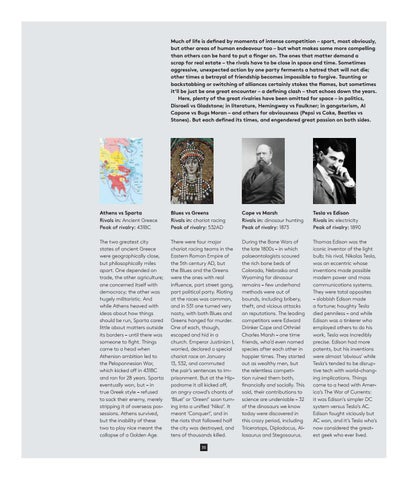
Much of life is defined by moments of intense competition – sport, most obviously, but other areas of human endeavour too – but what makes some more compelling than others can be hard to put a finger on. The ones that matter demand a scrap for real estate – the rivals have to be close in space and time. Sometimes aggressive, unexpected action by one party ferments a hatred that will not die; other times a betrayal of friendship becomes impossible to forgive. Taunting or backstabbing or switching of alliances certainly stokes the flames, but sometimes it’ll be just be one great encounter – a defining clash – that echoes down the years. Here, plenty of the great rivalries have been omitted for space – in politics, Disraeli vs Gladstone; in literature, Hemingway vs Faulkner; in gangsterism, Al Capone vs Bugs Moran – and others for obviousness (Pepsi vs Coke, Beatles vs Stones). But each defined its times, and engendered great passion on both sides.
Athens vs Sparta Rivals in: Ancient Greece Peak of rivalry: 431BC
Blues vs Greens Rivals in: chariot racing Peak of rivalry: 532AD
Cope vs Marsh Rivals in: dinosaur hunting Peak of rivalry: 1873
Tesla vs Edison Rivals in: electricity Peak of rivalry: 1890
The two greatest city states of ancient Greece were geographically close, but philosophically miles apart. One depended on trade, the other agriculture; one concerned itself with democracy; the other was hugely militaristic. And while Athens heaved with ideas about how things should be run, Sparta cared little about matters outside its borders – until there was someone to fight. Things came to a head when Athenian ambition led to the Peloponnesian War, which kicked off in 431BC and ran for 28 years. Sparta eventually won, but – in true Greek style – refused to sack their enemy, merely stripping it of overseas possessions. Athens survived, but the inability of these two to play nice meant the collapse of a Golden Age.
There were four major chariot racing teams in the Eastern Roman Empire of the 5th century AD, but the Blues and the Greens were the ones with real influence, part street gang, part political party. Rioting at the races was common, and in 531 one turned very nasty, with both Blues and Greens hanged for murder. One of each, though, escaped and hid in a church. Emperor Justinian I, worried, declared a special chariot race on January 13, 532, and commuted the pair’s sentences to imprisonment. But at the Hippodrome it all kicked off, an angry crowd’s chants of ‘Blue!’ or ‘Green!’ soon turning into a unified ‘Nika!’. It meant ‘Conquer!’, and in the riots that followed half the city was destroyed, and tens of thousands killed.
During the Bone Wars of the late 1800s – in which palaeontologists scoured the rich bone beds of Colorado, Nebraska and Wyoming for dinosaur remains – few underhand methods were out of bounds, including bribery, theft, and vicious attacks on reputations. The leading competitors were Edward Drinker Cope and Othniel Charles Marsh – one time friends, who’d even named species after each other in happier times. They started out as wealthy men, but the relentless competition ruined them both, financially and socially. This said, their contributions to science are undeniable – 32 of the dinosaurs we know today were discovered in this crazy period, including Triceratops, Diplodocus, Allosaurus and Stegosaurus.
Thomas Edison was the iconic inventor of the light bulb; his rival, Nikolas Tesla, was an eccentric whose inventions made possible modern power and mass communications systems. They were total opposites – slobbish Edison made a fortune; haughty Tesla died penniless – and while Edison was a tinkerer who employed others to do his work, Tesla was incredibly precise. Edison had more patents, but his inventions were almost ‘obvious’ while Tesla’s tended to be disruptive tech with world-changing implications. Things came to a head with America’s The War of Currents: it was Edison’s simpler DC system versus Tesla’s AC. Edison fought viciously but AC won, and it’s Tesla who’s now considered the greatest geek who ever lived.
35
Davis vs Crawford Rivals in: cinema Peak of rivalry: 1943
Adidas vs Puma Rivals in: footwear Peak of rivalry: 1949
Fischer vs Spassky Rivals in: chess Peak of rivalry: 1972
Ali vs Frazier Rivals in: boxing Peak of rivalry: 1975
Borg vs McEnroe Rivals in: tennis Peak of rivalry: 1980
Two women at the top of their Hollywood game were Bette Davis and Joan Crawford, and their decades-long loathing seems to have been – disappointingly – born over a man. Franchot Tone had starred with Davis in a 1935 film, and she was smitten with him. But Crawford was on the prowl and Davis had to watch as she married, then divorced, him in short order. Theatre-trained Davis looked down on Crawford as a “mannequin… who has slept with every male star at MGM, except Lassie.” Crawford, meanwhile, said, “Poor Bette, she looks like she’s never had a happy day, or night, in her life.” When, in 1962’s Whatever Happened to Baby Jane, they finally appeared in a film together the on-screen catfights were very real.
Few sibling fallouts have created two of the world’s giant sporting brands, or split a town for 60 years. But rivalry between Adidas and Puma has kept things fiery in Herzogenaurach since shoemaking brothers Adi and Rudi Dassler fell out in bitter fashion, creating rival manufacturers here. No one is sure how it started, but some guess Rudi had an affair with Adi’s wife, Käthe; others say its was politics that did it, or perhaps a fall-out over who invented the screw-in boot studs that helped Germany beat Hungary in a soggy World Cup Final. Adi won – his Adidas is by far the bigger company – and today their graves are at the opposite ends of the cemetery, just as their corporate HQs scowl across the river.
The World Chess Championship 1972 was dubbed The Match of the Century when eccentric young American challenger Bobby Fischer took on the defending champ – the Russian Boris Spassky – in chilly, neutral Iceland. Fischer was very much the outsider – the Soviet Union had dominated chess for 24 years – and the match became a key landmark in the Cold War. Spassky was a witty, clever, thoughtful player, though, and made mistakes; he was shocked by Fischer’s wild, aggressive commitment and, on losing, graciously applauded his American opponent. These men, though not personal enemies, were very different, and great cultural and political significance rested on the outcome of this match.
One of the greatest ever sporting rivalries was between heavyweight American boxers Joe Frazier and Muhammad Ali. It lasted between 1971 and 1975, defined the essence of this most brutal sport, and peaked three times: first in March ’71 at New York’s Madison Square Garden; then at a 12-round rematch in 1974; and finally at the famous ‘Thrilla in Manilla’ in 1975 in the Philippines – a bruising encounter often called the greatest fight in boxing history. Frazier won the first, Ali the other two, but it was a rivalry that drew power not just from the fights, but from the contrasting nature of the two men – brash, charismatic Ali and his humble foil, Frazier – and the heated atmosphere of the times.
Björn Borg was a handsome Swede with an emotionless demeanour and flowing blonde locks; John McEnroe was a volatile genius, as famous for his tantrums as his curly brown hair. Their ‘ice-versus-fire’ match-ups were exceedingly even-sided – both won seven times – and climaxed with the Men’s Singles Final at Wimbledon in 1980, which the Swede won 8-6. It’s regarded as one of the greatest tennis matches ever played, made even juicer when McEnroe got his revenge at the US Open Final the same year. Though Borg had dominated in 1979, their last confrontations were all McEnroe’s, and after another US Open loss Borg walked right out of the stadium, and soon after retired, aged just 26.
36
Everton vs Liverpool Rivals in: football Peak of rivalry: 1984
Prost vs Senna Rivals in: Formula One Peak of rivalry: 1989
Pakistan vs India Rivals in: cricket Peak of rivalry: 1998
Aniston vs Jolie Rivals in: the tabloids Peak of rivalry: 2005
Starks vs Lannisters Rivals in: Game of Thrones Peak of rivalry: 2013
There are many football rivalries that could go on this list, but we’re picking the Merseyside Derby, Everton versus Liverpool, and why? Because it means the most at CW – with Chris Ward a red, and fellow co-founder Mike France a blue. But it’s also the longest running top flight derby in England, and unusually good natured. Fan segregation is rarely imposed, and – with the two teams based just a mile apart – it’s more a sibling rivalry than anything else. With little obvious geographical, political, social or religious element involved, the atmosphere in which these games are generally played – famously, in 1984, both sets of supporters at the League Cup Final chanted ‘Merseyside’ together – can be grownup and fun.
The rivalry between two of Formula One’s great drivers – Alain Prost of McLaren and Ayrton Senna of, yes, McLaren – reach its peak at the 1989 Japanese Grand Prix, the penultimate round of that year’s F1 Championship. Prost was in a 21 point lead, but Senna saw an overtaking half-chance, and the inevitable crash put both out of the race and gave the Championship to Prost – or did it? Thing is, Senna wasn’t having it, and managed to rejoin the race, broken nosecone and all, eventually making his pass for the win. The title chase was back on – except not everyone saw it like that, and Senna was disqualified. The year was lost, but in 1990 the rivalry resumed – and, once again, the Championship came down to a crash…
This most intense sporting rivalry – an India-Pakistan cricket match can get a billion viewers – has little to do with beef between the players, and more to do with the arch-rival status of the nations these teams represent. It’s a relationship endlessly coloured by the partition of British India in 1947 into two countries, and their subsequent conflict over Kashmir. The pair share a common cricket heritage, but every time they meet it has a dangerous political edge. (Indeed, they spent over a decade ignoring each other between 1962 and 1977, preferring more direct forms of combat instead.) Even in more normal times, players on both sides face intense pressure to win, and are threatened by extreme reactions in defeat.
Most feuds are largely fictional, created by outsiders, but few are quite as pointless-yet-enduring as the supposed Angelina Jolie/Jennifer Aniston rift, big in the early 2000s and now undergoing something of a revival as Angelina Jolie’s marriage to fellow actor Brad Pitt unravels (he’s the one the two women are supposed to be fighting over, after all, with Aniston once married to him too). In the ’90s, this pair represented two poles of ‘woman’, with Aniston in every living room – the girl next door, America’s sweetheart – and Jolie the sexy, unknowable Bad Girl. Their ‘feud’ has such legs because you’re either a Jen or a Jolie – unlucky in love or winner takes all – and who you support says a bit about who you are.
Fiction delivers more animosities than real life ever could, and the dominating rivalry in modern pop culture is between the two major noble families of fictitious Westeross – think medieval England blown up to South American scale – in the all-conquering novel series A Song of Ice and Fire and its spin-off TV series, Game of Thrones. Based, in part on the real life War of the Roses, it sees the honest, gruff, duty-bound House Stark embody all the classic virtues of the rugged north, while their rich, flashy, manipulative rivals of House Lannister couldn’t be more of the south. As the story so far has been about the systematic devastation of House Stark, we’re now all waiting for the moment when the worm finally turns…
37
the
running man 38
There’s something about the vast expanses of central Asia that has attracted explorers for hundreds of years. Now runner, adventurer and new CW Challenger Jamie Maddison is following in some illustrious footsteps… Pictures by Matthew Traver
He’s not much known now, but in the first half of the 20th century British explorer Charles Howard-Bury was something of a big noise, his 1921 Mount Everest Reconnaissance Expedition paving the way for the conquest of the world’s tallest mountain, and accidentally helping create the myth of the Abominable Snowman. (High altitude animal footprints – probably wolf – were described to him as made by a ‘man-bear snowman’ by sherpas, a phrase later mistranslated by a British journalist to sensational effect.) Howard-Bury had earlier travelled extensively though Kazakhstan and Kyrgyzstan, and a book detailing his 1913 trip to the Tian Shan mountains so inspired journalist, climber, competitive club runner and latest Christopher Ward Challenger Jamie Maddison and his pal Matthew Traver that they followed in his footsteps a hundred years later, taking three horses on a 63-day, 800-mile ride across the country. “My passion for central Asia probably began around 2010,” Jamie now says, “when I first read about Howard-Bury’s trip to the so-called ‘Mountains of Heaven’ and was inspired to visit myself. It had just gone through a revolution when we went, and felt very much like the edge of the world. These days it’s actually a bit more touristy, a place where the adventurous backpacker might go.”
This is not something you could say of Jamie’s subsequent trips, a series of increasingly ambitious challenges in remote regions of the old Soviet Union. “For a month in 2013 I lived in the wilds of Tajikistan with a Kyrgyz hunter and herder, and later that year I ran six-and-a-half marathons in eight days across Uzbekistan’s Red Sands Desert. Then, in 2014, I ran seven half marathons in eight days across the Betpak-Dala in Kazakhstan, a country the size of western Europe.” What attracts you to such wild places? “I’m not sure,” he says. “There’s certainly not much there – so it almost feels one-dimensional, like a painting. But then there are these incredible mountain ranges that nobody ever goes to. One totally empty desert I ran across was the size of Scotland.” They’re unspoilt now, but what about in a few years’ time? Will Western tourists arrive to tame these places? “Perhaps some of it,” Jamie says. “Tajikistan has a mountain range called ‘The Roof of the World’, and it’s not like an Earth landscape – more like Mars. Tourism is starting to happen there, but only at the level of about 200 climbers a year, so it’s hardly Magaluf. And if you go down into the deserts there’s nobody there.” Though Jamie’s fascinated by all of central Asia, Kazakhstan is the country he keeps 39
going back to. Though many of his adventures have been shared with Matthew, for his 2014 run across Kazakhstan he went alone, hiring two locals to follow in a jeep. “Back then I wasn’t such a serious club runner, so I was really hurting by the fourth or fifth day. It was just 8 hours a day along this rugged landscape with a jeep trailing behind me. There were old, disused army trails to follow at first – not really roads, just strips where there was no underbrush – until we got to this massive but abandoned military base. Apparently it had been an experimental weapon facility back in Soviet days, and there were still huge rocket nose cones lying about. And beyond that it became much worse, just sandy trails nobody had been down for 20 years. You do get the odd poisonous snake, though – and plenty of birds of prey flying around, waiting for us to conk out. if the jeep had broken down it would have taken a rescue team at least 48 hours of solid driving to get to us.” Next up, Jamie plans another trip to Kazakhstan, this time supported by CW, where he means to run a 100 mile ultramarathon – that’s the whole thing in one go, no stopping – over about 24 hours. “It’ll be interesting,” he says, “because I’ve never run an ultramarathon that long before. The worst I’ve done was 60 miles – but that was London to Brighton, so it was hardly the same.” For more, jamiemaddison.com
It’s a rare accomplishment to find the prestigious ETA Valjoux 7750 in a diving watch as rugged as it is attractive, but the C60 Trident Pro Chronograph 600 manages it. Waterproof to 600m, the dial contains a regulator-inspired ‘breathing’ small seconds indicator. Perfect for professional divers – and those that want to look good.
Discover the new breed of watchmaker...
christopherward.co.uk
Design matters | Watch history | How it works Great watch wearers
You’re my guitar hero Three-time inductee into the Rock and Roll Hall of Fame – the only musician to ever earn that accolade – Eric Clapton not only collects amazing watches, but regularly auctions them off for his Crossroads charity There’s something a little predictable about the best-return-on-investment watch choices made by many highly successful people – it’s Rolex if they want to push the boat out, and Patek Philippe if they want to push the boat out a lot – but when you’re Eric Clapton, one of the most influential guitarists of all time, you’ve earned the right to be just as unexpected or as predictable as you’d like. And actually, the great thing about his collection is that many of his watches are both at once. How so? Well, take the ‘Yacht-Master Daytona’ – a one-off prototype Clapton owns that eventually turned into the Rolex Yacht-Master model we know today – or many of the other Daytona chronographs that have passed through his hands, from ultra-rare models to at least one customised version, with a definitely-not-from-the-factory PVD finish. These are both highly predictable choices –
the Daytona is, of course, one of the most coveted and recognisable of all Rolex models – and totally not so, at the same time. In everyday life he often sports slightly more accessible Rolex models, with a Milgauss in regular rotation, as well as Datejusts, Day-Dates and more, but then once in a while he’ll knock aficionados’ socks off with something like his ultra-rare Rolex Cosmograph Oyster Daytona Albino, Reference 6263, which smashed the world record for the brand, selling for more than $1.4 million a couple of years ago. And beyond even that, of course, there some of his many incredible and unusual Pateks, like the platinum-cased Perpetual Calendar Chronograph Ref 2499 – one of only two ever made – that fetched $3.6m US at auction in 2012. Notoriously reticent, ‘Slow Hand’ Clapton virtually never talks about his watches, but they clearly mean a lot to him – his autobiography actually references Patek, and he even called two volumes of his greatest hits album Timepieces – and the quality of the items that come up for auction speaks for itself.
41
A simple plan The Malverns are Christopher Ward’s entry-level watches, and so have to be quite simple to make. But, as Adrian Buchmann discovers, that doesn’t make them easier to design… Though it might seem counter-intuitive, designing a relatively inexpensive watch is actually more difficult than a more expensive one, writes Adrian Buchmann. It can be just as time consuming – more so, even – and you’re constantly running into barriers, because the cost of each part or procedure is the first and last thing on the agenda. The manufacturing costs, in particular, are in your mind every step of the way.
more expensive watches, demands much more finishing work than an off-the-peg Sellita movement. I was pleased we could make the rotor on the C5 Malvern Automatic bespoke, but the rest of it is the standard finish. The bridge, for instance, is exactly as supplied. What would I have done differently if we’d been given a bigger budget? Well, a movement with more detailing on it would have been nice, and I would have liked to keep the screws. But those are luxuries, really, and in no way essential. When you’re creating an entry level watch, compromises like that are very easy to make.
Take the case, for instance. With these, it’s not how much metal we use that matters. It’s more that each step – the milling, the drilling, the stamping – has a cost attached, so the fewer steps are necessary, the better it will be. The C1 Grand Malvern case has been a big success, and part of that has been to do with all the different elements there are to it – so I always knew that bringing to market something that was simpler to make, but still contained plenty of recognisable C1 design DNA, was going to be quite a task. To make the C3 and C5 Malverns easier to put together, for instance, we use a snap back on the case, instead of the little screws we use on the C1. The screws look lovely, and have a higher perceived value – but, at the end of the day, the functionality is the same. And it’s the same with the movement. Calibre SH21, which we use in our
Looking at a few more specific areas, our new curved dial is one reason why the price has gone up on the new models. The old dial might have cost us something like £10 or £15 a unit, but the new one is two or three times that. The hands are considerably better too, but as they’re a more minor part they don’t impact on the overall cost as much. Even quite complex hands are relatively easy to manufacture, so if the cost goes up by 20%, that’s still only a pound or two. And then there’s the domed glass that comes with the curved dial. This is by no means a recent innovation – plenty of good vintage watches use it – but in recent years many of the big Swiss brands have been so profit driven
42
that they’ve gone for flat glass instead on their more accessible ranges, because it’s so easy to manufacture. In some ways this is to our advantage, though, as by using domed glass at this price point we can immediately create a very noticeable point of difference. Another area where we’ve been able to do things a bit more efficiently is with the straps. With the C1, we replaced the old alligator straps – because the farming of these creatures isn’t the best – with Cordovan leather, which is excellent quality. For the Malverns, though, we’ve used just a nice tanned Italian leather. It’s not hand-stitched, and instead of a Bader buckle we’ve used a standard dress clasp, which all makes for a good strap, but one that’s clearly not as sophisticated as that on the C1. The nice thing, though, is that if you’d like to add Cordovan leather and a Bader buckle to your new watch, you can – it’ll just cost you a bit more, maybe an extra £50 or so. And, as far as I’m concerned, that’s something well worth considering.
“By using domed glass at this price point we can create a very noticeable point of difference”
43
Great watch makers
Isle of Man-based Roger Smith is a unique watchmaker, working in a British tradition that few – mentor George Daniels being a notable exception – have taken this seriously in over a century
Roger Smith British watchmaking has a fine history, one rich in innovation and diversity, and which contributed greatly to both the country’s scientific prowess and its Naval might. By 1800 around half the world’s watches were produced in Britain, and timepieces like Yorkshire carpenter John Harrison’s ‘sea clocks’ remain celebrated. In the glory years, the watchmaking masters took on apprentices, or worked together on projects – so ‘Honest’ George Graham, inventor of the mercury pendulum, both supported John Harrison and took on Thomas Mudge (who developed the lever escapement), and worked with Thomas Tompion, the so-called ‘Father of English Clockmaking’. And Tompion himself worked with Robert Hooke, whose cylinder escapement allowed for a flat watch. Though British watchmaking didn’t last – it remained an industry of innovative small-scale makers, and was eventually outstripped by mass production elsewhere – in recent years we’ve seen a revival of interest in both its history and the few modern practitioners. One watchmaker who works in the British tradition is Roger Smith, who became well-known through a documentary film, David Armstrong’s The Watchmaker’s Apprentice. This told of the last days of British master watchmaker George Daniels, and revolved around his relationship with Roger, his only true apprentice.
Smith’s incredible watches are made in the Daniels tradition, which is to say completely made in-house, using methods that take as little as possible from the wider watch industry. We caught up with him to find out more. “I grew up in Bolton, and left school at 16,” Roger says. “My dad realised I was more suited to something handson than academic, so I went on a course at Manchester School of Horology – one of only two or three in the country at the time – with a view to going into watch and clock repair. I did three years there, and in the second year – at about 17 – something happened that changed my life.” That thing was a visit to his course by the great English watchmaker George Daniels, creator of the Co-axial escapement and considered by many the best in the world. Roger asked him what was on the end of the pocket watch chain he was wearing, and George pulled out one of his own creations, the Space Traveller. “I didn’t really know who he was at the time – none of us did – but I was blown away,” Roger now says. “George’s watch was staggeringly beautiful and all made by hand – it was a life-changing moment.” During his holidays Roger often worked at the TAG Heuer repair centre near Manchester, and they kept him on full-time after he left college.
44
“George’s watch was so beautiful and all made by hand – a lifechanging moment”
“I soon realised that I didn’t see a career for myself in watch repair, though, so I got in touch with George and asked him for an apprenticeship. He told me to come back when I’d built a watch for myself. All the information you’ll need, he told me, was in his book, Watchmaking.” So Roger made a tourbillon pocket watch which just about worked – “it certainly kept going while George handled it” – and, though he was proud of what he’d done, he knew it wasn’t good enough. Indeed, George told him to go away and try again. Five-and-a-half years later Roger had made another one – having left TAG Heuer, he kept himself afloat doing trade watch repairs – which, thank goodness, George did deem good enough. Roger was finally offered a job, moving to work with George on the Isle of Man. This was around 2001, and Roger worked with the master on a series of watches for three or four years – later, in 2010, the pair would work together on another series – before Roger decided to set up on his own.
the sort of watches I am. Here, I’m not tempted to buy my cases from a great little specialist down the road, for instance – I have to make my own. Do you feel alone in working in the old English way? People see me as a late entrant in the English tradition that effectively ended many years ago, and what I basically do is imagine what the top-end English watchmakers of the mid-19th century would be doing if they were still operating now. People like John Harrison, Thomas Mudge and John Arnold made very attractive, elegant and high-precision pieces – they were mostly pocket watches and clocks back then, of course – and I constantly have the likes of the Mudge timekeeper or the Harrison timekeeper in my mind as I make each piece. What interests you about watches, though: is it the movements, the way they look, or the whole thing? With other people’s watches it’s the movement that interests me most, but with my own it’s the whole package: I care about the design and the finish as much as I do what powers it. That’s something George drummed into me. The most insignificant spring mattered as much to George as the crown or the seconds hand. It was an approach that I’ve continued with – the idea that one man does
So, you’re on the Isle of Man because of George? I could live anywhere in the world, but I do like it here. It’s beautiful – but, best of all, there are no other watchmakers around. It’s not that they’re a bad thing, of course, but I fear their influence would mean I wouldn’t be making
45
Great watch makers
You talked about movements before. Is it the clever complications that really excite you? Actually, simple watches can be just as satisfying as the really complicated ones. Often it’s the attention to detail that I enjoy most, not the sophistication. Personally, I own about ten wristwatches, mostly relatively inexpensive vintage pieces from the ’60s and ’70s that I’ve picked up over the years. None have cost me more than about £3,500, and I can’t imagine spending much more than that on a watch. I’m wearing an old Rolex today, for instance, and I’ve got a Heuer Autavia, too – not the best looking watch they ever did, perhaps, but I got it for the 1970s Calibre 12 movement. And I’ve got a couple of Caliber 321 Omega chronographs, which I bought because it’s a very special movement. I rarely strip my watches right down to look at how they were made, but I do service them myself.
everything. We call it ‘The Daniels Method’, and as far as I’m aware I’m the only one following it today. It’s a bit obsessive, though, isn’t it? It is, I confess – but that’s all down to George, really. It’s one reason why people like what we do – as well as the fact that the entire company only makes ten pieces a year, making our watches extremely rare. It means the price of them tends to go up on the second-hand market – they’re going up at the moment, anyway. Ten a year, though! How many people do you have? Three of us are watchmakers, and there are seven involved with the making of the watches in total – it means we each make about three watches a year, on average. An individual piece is not made entirely by a single person, however, and I’ll work myself on every one we do. That’s not the case with a special one-off on commission – with those, nearly everything on that watch will be me. We take on experienced watchmakers – we’ve one, for instance, who trained at Birmingham School of Horology, and worked at Omega for several years – but we also have people straight out of school. You can usually tell how well people will take to it quite quickly, and when you see that they get it and start to fly – well, it’s wonderful.
So what will you buy next? I’m not sure – there’s nothing I especially want right now, but tomorrow I might hear about a particular watch, become suddenly fascinated by it, and I’ll track one down. You don’t wear your own watches, then? I couldn’t justify it, as just to have one myself would be to take a tenth of our potential income out of the compa-
46
“The most simple watches can be just as satisfying as the really complicated ones. Often it’s the attention to detail that I enjoy most, not the sophistication”
ny that year. Our simpler models are in the ball park of £100,000 each, after all, and the more complicated ones are £200,000 or £250,000 – and that’s for the production models. The one-off pieces can be much more expensive, taking me two or three years to make.
from me – and not just the big companies, but even the small, high end manufacturers. Oh yes, there are plenty of superb watchmakers out there, doubtless doing great stuff, but it does nothing for me. The only watches that really interest me are those with a very distinctive and personal level of input to them. Basically, if other people were working the way I do – the George Daniels way – then I’d be fascinated by what they do. But they don’t, so I’m not.
How strange it must be to spend all that time making a one-off watch that you’ll perhaps never see again… Perhaps nobody will – except for the owner and friends. But once I’ve completed a watch I look forward to the next project, so I wouldn’t say I miss them. It’s interesting to be shown them again, though, years later. That second pocket watch I made, the one that got me the job with George, sat in a kitchen drawer before I sold it to finance the company. But then I got shown it again a couple of years ago, and was surprised at how good it was – the movement, at least. It was certainly better than I thought!
So what’s next? Last November we launched a new range of watches and a new movement, and the first completed examples of this – in Series 1, Series 2, Series 3 and Series 4 form – will be coming through over the next ten months, so that’s got us all quite excited. As I started out with pocket watches – that’s what George loved, and what the old English industry used to make – I’ve got a new one of those in the pipeline, too. There’s, perhaps surprisingly, still something of a demand for them, and I’m quite excited by our new one. There’s just something about the size of them, and the way that they tick – it’s almost as if they’re alive.
You’ve got the company where you want it, then…? I’ve certainly no desire to expand. Would I want to do some sort of collaboration with a larger watch company? Oh god, no. I wouldn’t enjoy that at all – and there would be no gain involved in doing something like that for me. To be honest, I don’t take any notice of what other watchmakers are doing. The industry seems very distant
For more, rwsmithwatches.com
47
Clasp act Meet Jörg Bader, CEO of Christopher Ward in Switzerland and board member for CW Holdings, as well as serial watch clasp innovator… Though we often feature Christopher Ward’s master watchmaker, Johannes Jahnke, in these pages, another key person at the company in Switzerland – boss Jörg Bader, who founded Synergies Horlogères, now part of Christopher Ward – keeps a slightly lower profile. He is, however, key to so much of the company’s success – as well as being the creator of the innovative Bader buckle. It was high time, we thought, that we caught up with him. Jörg was born in 1953 to watchmaker parents, and was brought up in Grenchen, Switzerland – home of ETA’s movement factories, though back then that company was known as A. Schild SA – where he worked during school holidays. Later, after time working for a bank and doing military service, he went abroad – first to England, where he polished up his English and worked part time at a machine tools importing company, then to Japan, where the joined a stainless steel bracelet manufacturer that was the main supplier to Seiko. “I went all around Japan, Korea, Taiwan and Hong Kong, where the factories were based,” he says, “before – in the early ’80s – creating Meliga Habillement Horloger Ltd. This was a watch bracelet and case manufacturing specialist, with design offices in Biel and Hong Kong, and a Chinese QC workshop; the whole company was built
around my own design for a groundbreaking flat dresswatch stainless steel bracelet. In time it earned us 95% of the bracelet market, and that’s where I created the butterfly buckle, which was copied 100 million times.” In 2001 Jörg sold up to Fossil, and became managing director at Montres Antima SA (Fossil’s Swiss manufacturing company), based in Biel. About five years later he started his own company, Synergies Horlogères – which Jörg calls “the realisation of my last professional dream” – quickly persuading a talented young watchmaker he’d got to know, Johannes Jahnke, to move from Dresden to Biel to join him. In 2007 Jörg met the three co-founders of Christopher Ward at watch trade show Baselworld, and in 2009 SH started manufacturing and shipping their first CW watches. These days, with the two companies merged, the Bader buckle has become Christopher Ward’s go-to watch fastening. Let’s rewind for a moment, though, Jörg, and talk about your development of the butterfly watch clasp. From 1982 onwards I was very intrigued by the idea that it might be possible to improve watch buckles, because it seemed to me that the market didn’t offer many valuable solutions yet. With the help of a Japanese engineer, our
48
What’s so good and clever about it, then? It’s the simplicity, really. The pin responsible for the closing mechanism is, at the same time, holding the long section of the leather strap in place. This combination has never been done before. The Dexel concept takes a very different approach, as the strap will not have holes and closing is not via a pin. The look, however, is very similar – but very expensive to make. Crucially, the Bader buckle is far less costly. The concept is owned by Christopher Ward Holdings – important, since we went through lots of effort, time and money to protect it! So is there anything else to be done in the world of straps and clasps, or is the Bader buckle your last word on the subject? I am content for the moment, I think. That said, the need to improve the quality and function of everything in life still haunts me, be it my cello playing, my tennis, my mountain biking or, most importantly, my watchmaking. In other words, never say never.
company developed a butterfly buckle for stainless steel bracelets which, back then, practically owned the market. But since this buckle could only be manufactured via the help of the MIM technology – which was only available in Japan at that time – we unfortunately never protected it. As time went on, though, CNC machines got smarter, cutting tools smaller, and soon the industry started to copy our buckle. Still, I enjoyed great commercial success with that buckle, and still like the fact that it was one of the most successful buckle concepts in watchmaking history, and is still being used on stainless steel bracelets today. But now you’ve developed the Bader clasp as a great alternative – it’s one that looks more like the much more expensive Dexel buckle, but is considerably cheaper to make… This fastening had been in my head for years, ever since I had the idea of combining the closing mechanism with the attachment of the leather strap. Through a discussion with the technical staff here, I brought that idea to the table for the nth time, and we finally set about it seriously, deciding to make the first prototypes. Developing it took us about two years, from start to finish.
49
Timespan
15 hours 57 minutes Alcock and Brown flew from New York to Ireland in just under 16 hours, the first non-stop flight across the Atlantic… After the First World War, aeroplanes had advanced to a point where they might give crossing the Atlantic a go, and in May 1919 a Curtiss flying boat did it in 19 days, going New York State to Portugal in a series of hops, stopping at places like Newfoundland and the Azores. Three flying boats had set off on the journey, but only one – NC-4 – survived to the end. Quite an achievement, but two weeks later it was eclipsed by the first non-stop transatlantic flight, taking a far quicker 15 hours and 57 minutes at an average speed of 115mph, by Royal Air Force pilots John Alcock and Arthur Whitten Brown. They did it in a modified Vickers Vimy bomber, a twin-engined biplane with the bomb racks replaced by extra petrol tanks; similar planes would later establish many other distance records. The pair set off from Canada and finally crash-landed in the bogs of County Galway, Ireland, confounding a
rival team from Handley Page that had actually arrived at their shared St John’s, Newfoundland departure point before the Vickers team got there, but that refused to set off before extensive testing. Alcock and Brown, however, simply got there, built their plane and went, though their flight was something of a nightmare from the start – overloaded, the Vimy barely cleared the local trees, and they lost their electrical generator (and so both radio and heating) less than four hours in. Thick fog made Brown’s navigation impossible for much of the flight, and pilot Alcock twice lost control and nearly crashed into the sea. In a snowstorm everything iced-up too, and it’s said Brown had to climb out onto the wings to clear the engines. Both were knighted and pocketed various prizes – including a long established £10,000 from the Daily Mail – afterwards, but although Brown lived into his sixties, Alcock
50
was hardly given the chance to enjoy their success, being tragically killed months later as he demonstrated a new Vickers plane at the Paris Airshow. As Alcock and Brown carried a few letters on board, theirs is considered the first transatlantic airmail flight, and it rather opened the floodgates to transatlantic travel. The British rigid airship R34 made it from Scotland to Long Island that same summer, and then back to Norfolk a week or so later – the first transatlantic return flight – and, three years after that, a Portuguese pair crossed the South Atlantic, from Lisbon to Rio de Janeiro. A few years on again, and Charles Lindbergh made all the papers with the first solo flight from the US to continental Europe. It made all the headlines – but Alcock and Brown did it quicker, in worse weather, and some eight years earlier, a lifetime as far as early 20th century aviation records are concerned.
Powered by a hand-wound version of our Calibre SH21 movement, the C8 introduces a power reserve complication for the first time – when fully wound, the decorated twin barrels provide an incredible five days of power. Meanwhile, the black DLC case and altimeter-inspired date calendar match that practicality with stunningly innovative design.
Discover the new breed of watchmaker...
christopherward.co.uk
securedmail
CUSTOMER DEFINED LOGO
Delivered by
C9 10017 CUSTOMER NUMBER
If undelivered please return to: Christopher Ward (London) Limited, 1 Park Street, Maidenhead, Berkshire, SL6 1SL, United Kingdom
Meet the new C5 Malvern Automatic MkIII, page 20.
Discover the new breed of watchmaker...
christopherward.co.uk