Christopher Podlin: AI Transforming Healthcare Prior Authorization
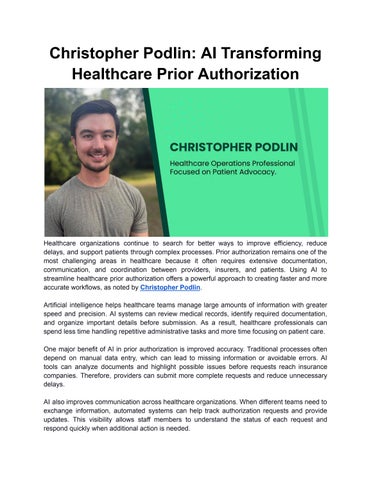
Healthcare organizations continue to search for better ways to improve efficiency, reduce delays, and support patients through complex processes. Prior authorization remains one of the most challenging areas in healthcare because it often requires extensive documentation, communication, and coordination between providers, insurers, and patients. Using AI to streamline healthcare prior authorization offers a powerful approach to creating faster and more accurate workflows, as noted by Christopher Podlin. Artificial intelligence helps healthcare teams manage large amounts of information with greater speed and precision. AI systems can review medical records, identify required documentation, and organize important details before submission. As a result, healthcare professionals can spend less time handling repetitive administrative tasks and more time focusing on patient care. One major benefit of AI in prior authorization is improved accuracy. Traditional processes often depend on manual data entry, which can lead to missing information or avoidable errors. AI tools can analyze documents and highlight possible issues before requests reach insurance companies. Therefore, providers can submit more complete requests and reduce unnecessary delays. AI also improves communication across healthcare organizations. When different teams need to exchange information, automated systems can help track authorization requests and provide updates. This visibility allows staff members to understand the status of each request and respond quickly when additional action is needed.
Moreover, AI can help healthcare organizations identify patterns within prior authorization activities. By analyzing previous requests, AI solutions can reveal common causes of delays and areas where workflows need improvement. These insights allow leaders to make smarter decisions and develop more effective administrative strategies. Although AI offers many advantages, successful implementation requires careful planning. Healthcare organizations must ensure that AI tools support privacy, security, and regulatory requirements. Additionally, healthcare professionals should remain involved in decision-making because human expertise plays an essential role in understanding patient needs. The future of healthcare prior authorization will likely involve greater collaboration between technology and medical teams. AI will not replace healthcare professionals but will help them work more efficiently. By reducing administrative burdens and improving accuracy, AI can create a smoother experience for providers, insurers, and patients. Using AI to streamline healthcare prior authorization represents an important step toward modernizing healthcare operations. As organizations continue adopting intelligent solutions, they can build faster processes, improve communication, and deliver better support for patients. This transformation shows how technology can help create a more connected and efficient healthcare system.