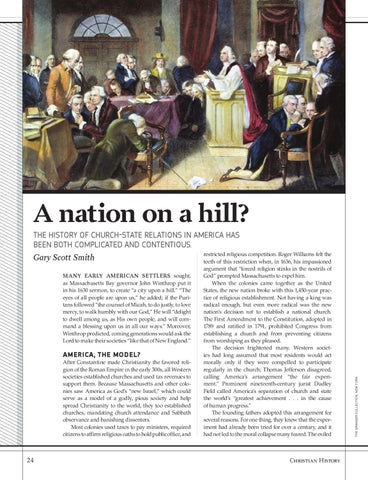
A nation on a hill? Many early aMerican settlers sought, as Massachusetts Bay governor John Winthrop put it in his 1630 sermon, to create “a city upon a hill.” “The eyes of all people are upon us,” he added; if the Puritans followed “the counsel of Micah, to do justly, to love mercy, to walk humbly with our God,” He will “delight to dwell among us, as His own people, and will command a blessing upon us in all our ways.” Moreover, Winthrop predicted, coming generations would ask the Lord to make their societies “like that of New England.”
AmericA, the model?
After Constantine made Christianity the favored religion of the Roman Empire in the early 300s, all Western societies established churches and used tax revenues to support them. Because Massachusetts and other colonies saw America as God’s “new Israel,” which could serve as a model of a godly, pious society and help spread Christianity to the world, they too established churches, mandating church attendance and Sabbath observance and banishing dissenters. Most colonies used taxes to pay ministers, required citizens to affirm religious oaths to hold public office, and
24
argument that “forced religion stinks in the nostrils of God” prompted Massachusetts to expel him. When the colonies came together as the United States, the new nation broke with this 1,450-year practice of religious establishment. Not having a king was radical enough, but even more radical was the new nation’s decision not to establish a national church. The First Amendment to the Constitution, adopted in 1789 and ratified in 1791, prohibited Congress from establishing a church and from preventing citizens from worshiping as they pleased. The decision frightened many. Western societies had long assumed that most residents would act morally only if they were compelled to participate regularly in the church; Thomas Jefferson disagreed, calling America’s arrangement “the fair experiment.” Prominent nineteenth-century jurist Dudley Field called America’s separation of church and state the world’s “greatest achievement . . . in the cause of human progress.” The founding fathers adopted this arrangement for several reasons. For one thing, they knew that the experiment had already been tried for over a century, and it had not led to the moral collapse many feared. The exiled
Christian History
the grAnger collection, new York
The hisTory of church-sTaTe relaTions in america has been boTh complicaTed and conTenTious. restricted religious competition. Roger Williams felt the Gary Scott Smith teeth of this restriction when, in 1636, his impassioned