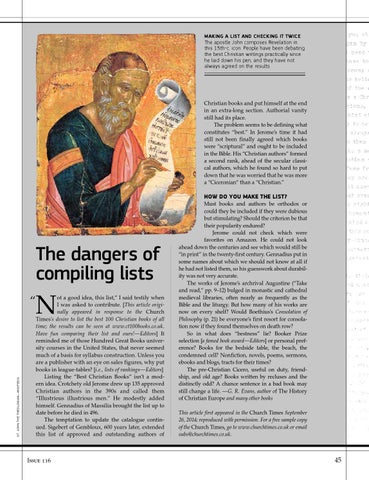
MAKING A LIST AND CHECKING IT TWICE The apostle John composes Revelation in this 15th-c. icon. People have been debating the best Christian writings practically since he laid down his pen, and they have not always agreed on the results.
Christian books and put himself at the end in an extra-long section. Authorial vanity still had its place. The problem seems to be defining what constitutes “best.” In Jerome’s time it had still not been finally agreed which books were “scriptural” and ought to be included in the Bible. His “Christian authors” formed a second rank, ahead of the secular classical authors, which he found so hard to put down that he was worried that he was more a “Ciceronian“ than a “Christian.”
HOW DO YOU MAKE THE LIST?
The dangers of compiling lists
ST. JOHN THE THEOLOGIAN—WIKIPEDIA
“
N
ot a good idea, this list,” I said testily when I was asked to contribute. [This article originally appeared in response to the Church Times’s desire to list the best 100 Christian books of all time; the results can be seen at www.ct100books.co.uk. Have fun comparing their list and ours!—Editors] It reminded me of those Hundred Great Books university courses in the United States, that never seemed much of a basis for syllabus construction. Unless you are a publisher with an eye on sales figures, why put books in league-tables? [i.e., lists of rankings—Editors] Listing the “Best Christian Books” isn’t a modern idea. Crotchety old Jerome drew up 135 approved Christian authors in the 390s and called them “Illustrious illustrious men.” He modestly added himself. Gennadius of Massilia brought the list up to date before he died in 496. The temptation to update the catalogue continued. Sigebert of Gembloux, 600 years later, extended this list of approved and outstanding authors of
Issue 116
Must books and authors be orthodox or could they be included if they were dubious but stimulating? Should the criterion be that their popularity endured? Jerome could not check which were favorites on Amazon. He could not look ahead down the centuries and see which would still be “in print” in the twenty-first century. Gennadius put in some names about which we should not know at all if he had not listed them, so his guesswork about durability was not very accurate. The works of Jerome’s archrival Augustine (“Take and read,” pp. 9–12) bulged in monastic and cathedral medieval libraries, often nearly as frequently as the Bible and the liturgy. But how many of his works are now on every shelf? Would Boethius’s Consolation of Philosophy (p. 21) be everyone’s first resort for consolation now if they found themselves on death row? So in what does “bestness” lie? Booker Prize selection [a famed book award—Editors] or personal preference? Books for the bedside table, the beach, the condemned cell? Nonfiction, novels, poems, sermons, ebooks and blogs, tracts for their times? The pre-Christian Cicero, useful on duty, friendship, and old age? Books written by recluses and the distinctly odd? A chance sentence in a bad book may still change a life. —G. R. Evans, author of The History of Christian Europe and many other books This article first appeared in the Church Times September 26, 2014; reproduced with permission. For a free sample copy of the Church Times, go to www.churchtimes.co.uk or email subs@churchtimes.co.uk.
45