Cooling Solutions
COOL SOLUTIONS FOR RESIDENTIAL CORRIDOR OVERHEATING Dr Chris Iddon, Design Manager at SE Controls explores the growing issue of corridor overheating and studies into real buildings that are enabling effective solutions to be applied to the problem.
I
n some ways, it is ironic that the issue of building overheating can be partly accredited to the increased drive towards improving energy efficiency. This has been recognised by the Zero Carbon Hub in its recent report into overheating in homes, as well as CIBSE’s latest revision to its ‘Guide A: Environmental Design’ (8th edition 2015), which specifically identifies the potential causes and consequences of corridor overheating. It wasn’t that long ago that if a building’s occupants got too hot, they opened a window or turned up the air conditioning to regain the internal temperature within comfortable parameters, although there are clearly some significant issues with this simplistic approach to temperature management. However, during the past 25 years or so, concerns over climate change, dwindling fuel resources and increasing energy costs, have resulted in a firmer legislative and regulatory environment governing building design and energy management. Within this framework, retaining heat within a building is usually a key design goal, as it reduces energy demand
42
for heating and the cost of maintaining a comfortable internal environment, the application of these various energy reduction techniques can have some surprising and unintended consequences. Multi storey residential blocks, for example, are subject to the specifications for ‘leakage,’ ‘infiltration’ and energy performance, yet as Building Regulations deals only with the dwellings themselves a building’s circulation spaces are excluded. As innovative building designs seek to legitimately maximise
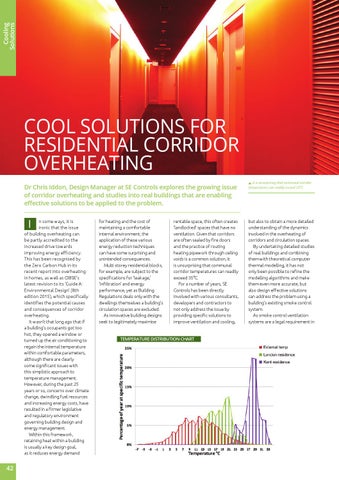
rentable space, this often creates ‘landlocked’ spaces that have no ventilation. Given that corridors are often sealed by fire doors and the practice of routing heating pipework through ceiling voids is a common solution, it is unsurprising that communal corridor temperatures can readily exceed 35°C. For a number of years, SE Controls has been directly involved with various consultants, developers and contractors to not only address the issue by providing specific solutions to improve ventilation and cooling,
TEMPERATURE DISTRIBUTION CHART
It is unsurprising that communal corridor temperatures can readily exceed 35°C
but also to obtain a more detailed understanding of the dynamics involved in the overheating of corridors and circulation spaces. By undertaking detailed studies of real buildings and combining them with theoretical computer thermal modelling, it has not only been possible to refine the modelling algorithms and make them even more accurate, but also design effective solutions can address the problem using a building’s existing smoke control system. As smoke control ventilation systems are a legal requirement in