EDUCATION shared between the headteacher and the authority, and in private or independent schools, the responsibility often lies with the building owner. As part of their obligations, the RP must manage the ongoing compliance with fire safety legislation, while ensuring fire systems and procedures, including fire drills, are uncompromised. Additionally, the RP must possess a robust knowledge of fire safety to manage and perform regular fire safety risk assessments.
Ongoing protection A fire safety risk assessment is designed to help identify the fire hazards within an educational premises. As part of the risk assessment, the RP must inspect everything from firefighting equipment and fire doors to staff training and pupil understanding towards the school’s procedures in the event of a fire. As highlighted by the Cheshire Fire and Rescue Service, a fire risk assessment consists of five steps: Identify the people at risk Identify all potential fire hazards Evaluate the risk Record the findings Review and revise.
Under the evaluation of risk stage, various areas of a school’s fire protection systems are assessed, including fire detection methods and emergency escape routes. Escape routes, for example, are fundamental in the event of a fire and rely upon passive fire protection methods, such as fire doorsets, that will require ongoing assessment and maintenance. Under The Fire Safety Order 2005, fire doorsets in the education sector are a legislative requirement and form a critical role in providing a safer educational environment. Emergency exits conclude escape routes and should be assembled with ‘fire-rated’ doors, which can be rated to FD30 or FD60, and will delay the spread of smoke and fire by 30 and 60 minutes respectively. As part of the risk assessment process, the correct location of all fire doors – whether FD30 or FD60 – is determined based on the risk of the area (FD60s are more likely to be installed in kitchen areas, for example). All fire doors should also be signed appropriately, with a British Standard sign attached to the face of the door on both
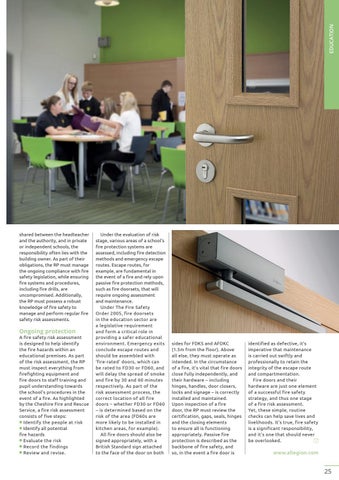
sides for FDKS and AFDKC (1.5m from the floor). Above all else, they must operate as intended. In the circumstance of a fire, it’s vital that fire doors close fully independently, and their hardware – including hinges, handles, door closers, locks and signage – is correctly installed and maintained. Upon inspection of a fire door, the RP must review the certification, gaps, seals, hinges and the closing elements to ensure all is functioning appropriately. Passive fire protection is described as the backbone of fire safety, and so, in the event a fire door is
identified as defective, it’s imperative that maintenance is carried out swiftly and professionally to retain the integrity of the escape route and compartmentation. Fire doors and their hardware are just one element of a successful fire safety strategy, and thus one stage of a fire risk assessment. Yet, these simple, routine checks can help save lives and livelihoods. It’s true, fire safety is a significant responsibility, and it’s one that should never be overlooked.
www.allegion.com
25