Ceilings
How do I work my oak ceiling into the architect’s design? If oak is an important feature you want, make sure you discuss the options with your architect and possibly get an oak framing company involved at this stage. Sharing knowledge right at the beginning of the project can often result in saving money and getting exactly what you want further down the line. Oak framing companies often have their own designers who can work independently or alongside architects and advise on specific issues associated with oak structures. Some will in fact do the design for you as part of the process.
Structural oak ceilings The use of oak structurally is not reserved purely to new builds, extensions or garden rooms. There are many opportunities to use oak to create an amazing space, such as an open double height vaulted entrance hall with exposed roof trusses, a spectacular vaulted kitchen diner, or indeed you could increase the value of your property by adding a loft style bedroom or snug. If you are restricted to a flat ceiling by planning, or simply by the fact you are creating a two-storey extension, you still have the opportunity to expose the structural oakwork. It may be just the odd beam for a cool, contemporary look, or indeed the complete beam layout supporting the upper floor for a more traditional look. Our clients often ask us if oak is structurally sound. Many come to us with drawings incorporating steel structures specified by structural engineers, asking us to suggest a solution to mask them with oak. In fact, whilst in stress tests it becomes obvious that steel is over three times stronger than green oak, steel is 10 times heavier and as such the strength to weight ratio of oak is superior to steel. It is quite possible to build a vaulted oak ceiling spanning over ten metres without using steel.
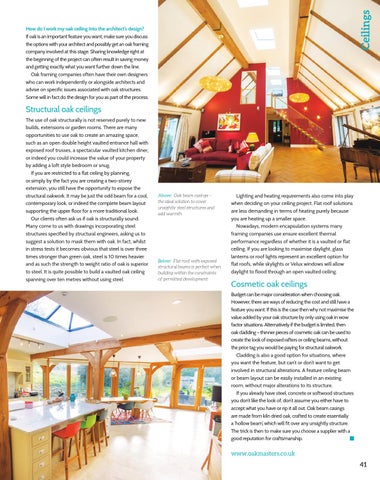
Above: Oak beam casings – the ideal solution to cover unsightly steel structures and add warmth
Below: Flat roof with exposed structural beams is perfect when building within the constraints of permitted development
Lighting and heating requirements also come into play when deciding on your ceiling project. Flat roof solutions are less demanding in terms of heating purely because you are heating up a smaller space. Nowadays, modern encapsulation systems many framing companies use ensure excellent thermal performance regardless of whether it is a vaulted or flat ceiling. If you are looking to maximise daylight, glass lanterns or roof lights represent an excellent option for flat roofs, while skylights or Velux windows will allow daylight to flood through an open vaulted ceiling.
Cosmetic oak ceilings Budget can be major consideration when choosing oak. However, there are ways of reducing the cost and still have a feature you want. If this is the case then why not maximise the value added by your oak structure by only using oak in wow factor situations. Alternatively if the budget is limited, then oak cladding – thinner pieces of cosmetic oak can be used to create the look of exposed rafters or ceiling beams, without the price tag you would be paying for structural oakwork. Cladding is also a good option for situations, where you want the feature, but can’t or don’t want to get involved in structural alterations. A feature ceiling beam or beam layout can be easily installed in an existing room, without major alterations to its structure. If you already have steel, concrete or softwood structures you don’t like the look of, don’t assume you either have to accept what you have or rip it all out. Oak beam casings are made from kiln dried oak, crafted to create essentially a ‘hollow beam’, which will fit over any unsightly structure. The trick is then to make sure you choose a supplier with a good reputation for craftsmanship.
www.oakmasters.co.uk
41