DOORS, WINDOWS & BALUSTRADES
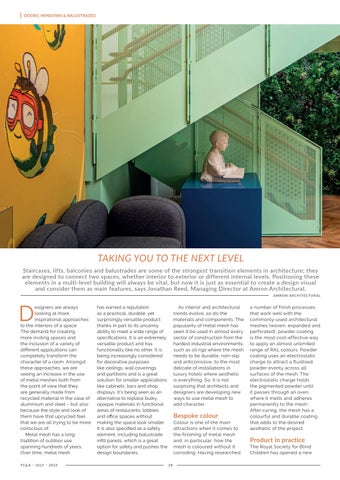
TAKING YOU TO THE NEXT LEVEL Staircases, lifts, balconies and balustrades are some of the strongest transition elements in architecture; they are designed to connect two spaces, whether interior to exterior or different internal levels. Positioning these elements in a multi-level building will always be vital, but now it is just as essential to create a design visual and consider them as main features, says Jonathan Reed, Managing Director at Amron Architectural. AMRON ARCHITECTURAL
D
esigners are always looking at more inspirational approaches to the interiors of a space. The demand for creating more inviting spaces and the inclusion of a variety of different applications can completely transform the character of a room. Amongst these approaches, we are seeing an increase in the use of metal meshes both from the point of view that they are generally made from recycled material in the case of aluminium and steel – but also because the style and look of them have that upcycled feel that we are all trying to be more conscious of. Metal mesh has a long tradition of outdoor use spanning hundreds of years. Over time, metal mesh FC& A – JULY – 2023
has earned a reputation as a practical, durable, yet surprisingly versatile product thanks in part to its uncanny ability to meet a wide range of specifications. It is an extremely versatile product and has functionality like no other. It is being increasingly considered for decorative purposes like ceilings, wall coverings and partitions and is a great solution for smaller applications like cabinets, bars and shop displays. It’s being seen as an alternative to replace bulky, opaque materials in functional areas of restaurants, lobbies and office spaces without making the space look smaller. It is also specified as a safety element, including balustrade infill panels, which is a great option for safety and pushes the design boundaries.
As interior and architectural trends evolve, so do the materials and components. The popularity of metal mesh has seen it be used in almost every sector of construction from the hardest industrial environments, such as oil rigs where the mesh needs to be durable, non-slip and anticorrosive, to the most delicate of installations in luxury hotels where aesthetic is everything. So, it is not surprising that architects and designers are developing new ways to use metal mesh to add character.
Bespoke colour Colour is one of the main attractions when it comes to the finishing of metal mesh and, in particular, how the mesh is coloured without it corroding. Having researched 28
a number of finish processes that work well with the commonly-used architectural meshes (woven, expanded and perforated), powder coating is the most cost-effective way to apply an almost unlimited range of RAL colours. Powder coating uses an electrostatic charge to attract a fluidised powder evenly across all surfaces of the mesh. The electrostatic charge holds the pigmented powder until it passes through an oven, where it melts and adheres permanently to the mesh. After curing, the mesh has a colourful and durable coating that adds to the desired aesthetic of the project.
Product in practice The Royal Society for Blind Children has opened a new