RCI
SPECIFYING UNDER SCRUTINY: RAINSCREEN SYSTEMS THAT PERFORM AS DESIGNED
Last December, Part B (fire safety) of the Building Regulations (England and Wales) banned the use of combustible materials in certain build ups, such as rainscreen facade systems, of residential buildings between 11 and 18m. Materials with Euroclass A1 or A2,s1-d0 reaction to fire classification must now be used unless a full-scale fire test to BS 8414-1 and -2 has been undertaken. The Building Safety Act has also introduced project ‘Gateways’ to ensure specification integrity is maintained from design through to build. KNAUF INSULATION
W
ith this new level of scrutiny, it’s crucial that buildings deliver the required performance not just on paper but in the real world too. For rainscreen applications, the simplest solution is to specify noncombustible products, like Rocksilk RainScreen Slab. It has the best possible Euroclass A1 Reaction to Fire Classification and is also BBA certified for the broadest range of build ups and the widest range of thicknesses of any rainscreen solution on the market. But insulation doesn’t exist in isolation; it must interact correctly with other systems in the cavity. That’s why Knauf Insulation developed Rocksilk RainScreen FFCB, the only cavity barrier that can be fixed to the face of the sheathing insulation in masonry facades. Because the insulation doesn’t need to be cut post installation, it’s quicker and easier to install correctly, reducing the risk of gaps and compromised performance. Products like these – developed with the real world in mind – help you to create buildings that perform as designed.
www.knaufinsulation.co.uk/contact-us
RENSON UK’S LOUVRES HELP REVIVE BRISTOL’S RICHMOND BUILDING TO ITS FORMER GLORY
Leading ventilation louvre specialist Renson UK has contributed to the regeneration of Bristol’s Richmond Building, helping return the iconic structure to its important role as the city’s university’s student union in the affluent Clifton suburb. RENSON UK
B
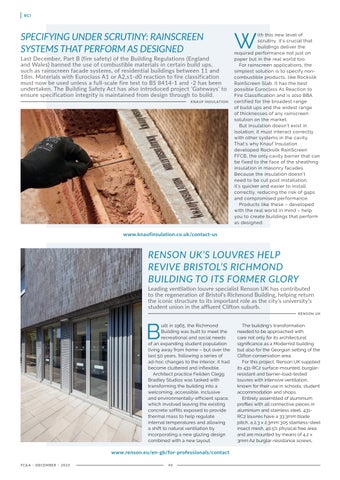
uilt in 1965, the Richmond Building was built to meet the recreational and social needs of an expanding student population living away from home – but over the last 50 years, following a series of ad-hoc changes to the interior, it had become cluttered and inflexible. Architect practice Feilden Clegg Bradley Studios was tasked with transforming the building into a welcoming, accessible, inclusive and environmentally-efficient space, which involved leaving the existing concrete soffits exposed to provide thermal mass to help regulate internal temperatures and allowing a shift to natural ventilation by incorporating a new glazing design combined with a new layout.
www.renson.eu/en-gb/for-professionals/contact FC& A – DECEMBER – 2023
40
The building’s transformation needed to be approached with care not only for its architectural significance as a Modernist building but also for the Georgian setting of the Clifton conservation area. For this project, Renson UK supplied its 431-RC2 surface-mounted, burglarresistant and barrier-load-tested louvres with intensive ventilation, known for their use in schools, student accommodation and shops. Entirely assembled of aluminium profiles with all connective pieces in aluminium and stainless steel, 431RC2 louvres have a 33.3mm blade pitch, a 2.3 x 2.3mm 305 stainless-steel insect mesh, 40.5% physical free area and are mounted by means of 4.2 x 3mm A2 burglar-resistance screws.