THE TWENTY-FIRST CENTURY
BILL TI DY William Edward Tidy, MBE (born 1933) Since selling his first cartoon almost 60 years ago, Bill Tidy has forged a reputation as one of Britain’s best-loved and most prolific cartoonists. He is perhaps best known for his strip cartoons ‘The Cloggies’ and ‘The Fosdyke Saga’.
254
Bill Tidy was born in Tranmere, Cheshire, on 9 October 1933. His father, William Edward Tidy, was a merchant sailor who walked out on the family when Bill was a child. As a result, he was brought up by his mother, Catherine Price, at her off-licence in Liverpool. Educated at St Margaret’s School, Anfield, Liverpool, he left school at 15 and from 1950 to 1951, he worked for R P Houston, a Liverpool shipping office, before joining the Royal Engineers in 1952. Before leaving the army in 1955, he served in Germany, Korea and Japan. It was in Japan in 1955 that he sold his first cartoon to Mainichi, a Japanese, English language newspaper. Returning to Liverpool, he worked as a layout artist at the Pagan Smith advertising agency, and drew advertisements for Radio Times. He soon began freelancing, producing cartoons for publications such as the Daily Mirror. When plans to migrate to Canada fell through in 1957, he embarked on his career as a professional cartoonist. Though he had no formal training, his work soon became very popular. In 1966, it was claimed he could produce up to 15 finished cartoons a day. The same year, he became a founder member of the British Cartoonists’s Association, and was voted Cartoonists’ Club of Great Britain Humorous Cartoonist of the Year.
Bill Tidy would soon become particularly famous for his strip cartoons ‘The Cloggies’, which ran in Private Eye between 1967 and 1981 and in The Listener from 1985 to 1986, and The Fosdyke Saga, which appeared in the Daily Mirror. First appearing in March 1971, ‘The Fosdyke Saga’ was designed as a northern, working-class pastiche of the popular BBC programme The Forsyte Saga. Such was the strip’s popularity, that 14 books of reprints were produced and in 1975, the writer Alan Plater transformed the series into a stage show at the Bush Theatre, London. In 1977, a version of The Fosdyke Saga was, ironically, produced for BBC television, and in 1983 the strip was again adapted as a 42-part series for BBC Radio 2, written by Bill Tidy and John Junkin. The strip continued to run in the Daily Mirror until February 1985. During his career, Bill Tidy’s cartoons have appeared in a huge variety of publications, including The Oldie, New Scientist, the Mail on Sunday, the Yorkshire Post, the Daily Sketch and many others. He also contributed a large number of cartoons to Punch, including covers, before his departure in 1989. In addition, he has contributed single cartoons to a wide variety of publications, has designed board games, ventriloquists’ dummies and even the trophy for BBC television’s It’s a Knockout. Outside of his work as a cartoonist, Bill Tidy has written and presented a number of BBC television programmes such as Tidy Up Walsall, Tidy Up Naples and Three Days Last Summer, and has regularly appeared on shows such as Countdown and BBC Radio 4’s I’m Sorry I Haven’t a Clue. He is the writer of more than 20 books and the illustrator of over 70, including The World’s Worst Golf Club (1992), Bill Tidy’s Book of Quotations (1998), The Greatest Cricketer of Them All (2002) and his autobiography, Is There Any News of the Iceberg? (1995). Bill Tidy received Granada TV’s Cartoonist of the Year award in 1974 and the Society of Illustrators award in 1980. He was awarded an MBE in 2000. He currently lives in South Derbyshire with his wife, Rosa. Together they have three children and two grandchildren. The biography of Bill Tidy is written by Alexander Beetles.
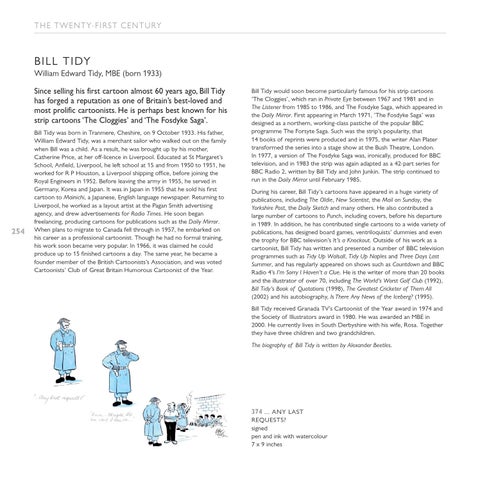
374 ... ANY LAST REQUESTS? signed pen and ink with watercolour 7 x 9 inches