C EO ROUNDTAB LE
LEVERAGING BUSINESS INTELLIGENCE How to use employee data to boost business operations—and your bottom line. BY JENNIFER PELLET WE’VE ALL SEEN WHAT DATA analytics can achieve on the consumer side of business. Insights gleaned from demographic, behavioral and contextual data about potential and current customers are being used to tailor messaging and inform marketing and customer service efforts— delivering greater customer engagement and strengthening brand loyalty. But what about employees? What if the data that companies already collect on their work-
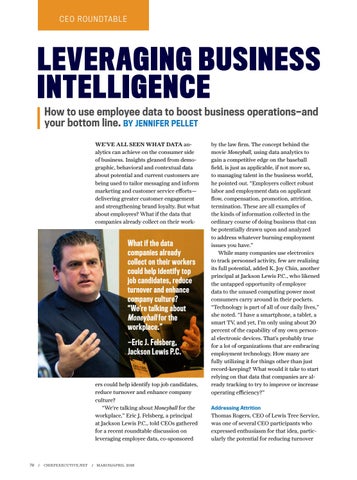
What if the data companies already collect on their workers could help identify top job candidates, reduce turnover and enhance company culture? “We’re talking about Moneyball for the workplace.” —Eric J. Felsberg, Jackson Lewis P.C.
ers could help identify top job candidates, reduce turnover and enhance company culture? “We’re talking about Moneyball for the workplace,” Eric J. Felsberg, a principal at Jackson Lewis P.C., told CEOs gathered for a recent roundtable discussion on leveraging employee data, co-sponsored
70 / CHIEFEXECUTIVE.NET / MARCH/APRIL 2018
by the law firm. The concept behind the movie Moneyball, using data analytics to gain a competitive edge on the baseball field, is just as applicable, if not more so, to managing talent in the business world, he pointed out. “Employers collect robust labor and employment data on applicant flow, compensation, promotion, attrition, termination. These are all examples of the kinds of information collected in the ordinary course of doing business that can be potentially drawn upon and analyzed to address whatever burning employment issues you have.” While many companies use electronics to track personnel activity, few are realizing its full potential, added K. Joy Chin, another principal at Jackson Lewis P.C., who likened the untapped opportunity of employee data to the unused computing power most consumers carry around in their pockets. “Technology is part of all of our daily lives,” she noted. “I have a smartphone, a tablet, a smart TV, and yet, I’m only using about 20 percent of the capability of my own personal electronic devices. That’s probably true for a lot of organizations that are embracing employment technology. How many are fully utilizing it for things other than just record-keeping? What would it take to start relying on that data that companies are already tracking to try to improve or increase operating efficiency?” Addressing Attrition
Thomas Rogers, CEO of Lewis Tree Service, was one of several CEO participants who expressed enthusiasm for that idea, particularly the potential for reducing turnover