
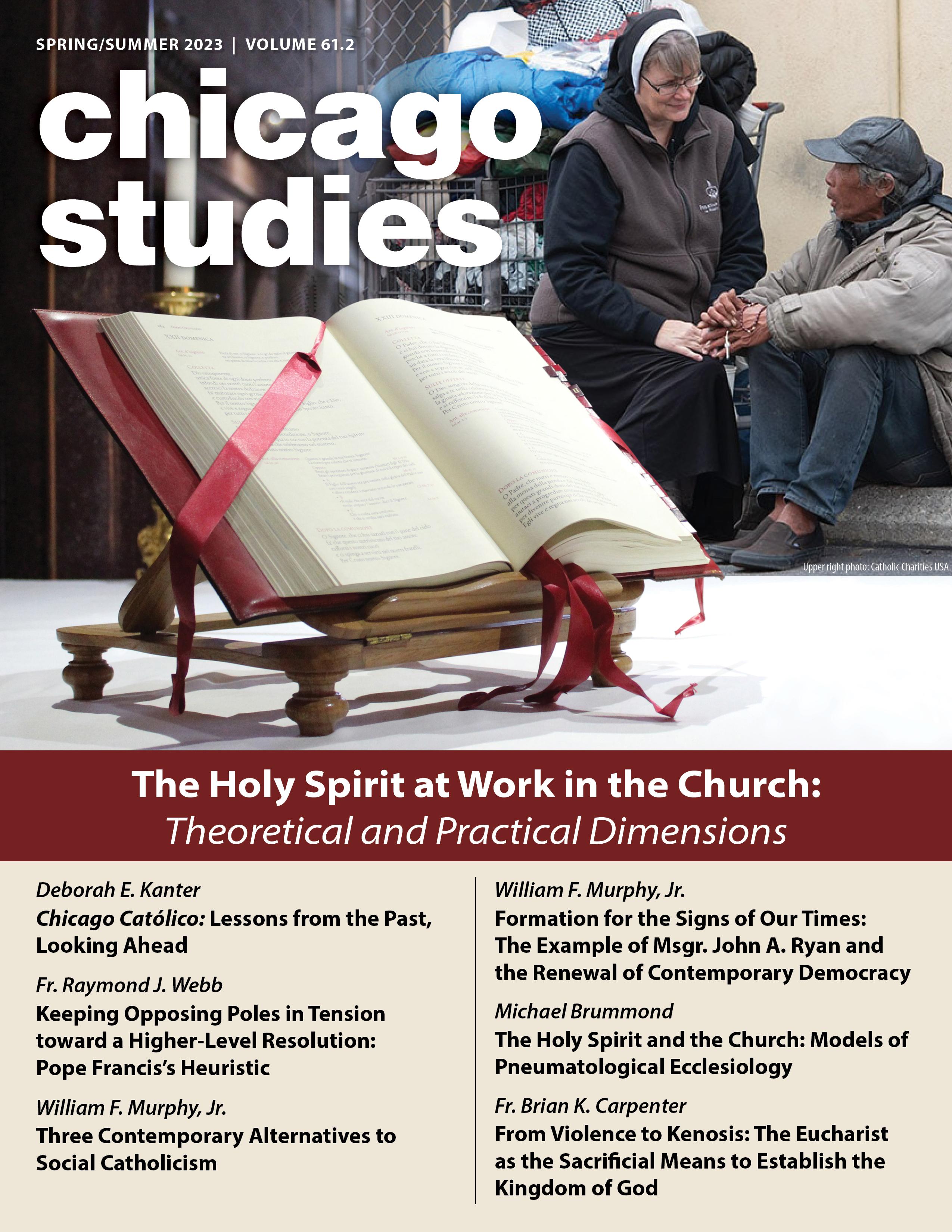
Chicago Studies
Editorial Board
Melanie Barrett Maria Barga Lawrence Hennessey Paul Hilliard John Lodge
Brendan Lupton Kevin Magas David Mowry Anthony Muraya
Patricia Pintado-Murphy Juliana Vazquez Ray Webb
Founding Editor George Dyer
CHICAGO STUDIES is edited by members of the faculty of the University of St. Mary of the Lake/Mundelein Seminary for the continuing theological development of priests, deacons, and lay ecclesial ministers. The journal welcomes articles likely to be of interest to our readers. Views expressed in the articles are those of the respective authors and not necessarily those of the editorial board. All communications regarding articles and editorial policy should be addressed to cseditor@usml.edu. CHICAGO STUDIES is indexed in the ATLA Religion Database and New Testament Abstracts
Cover Design by Deacon Thomas Gaida
Copyright © 2024 Civitas Dei Foundation
ISSN 0009-3718
The Holy Spirit at Work in the Church: Theoretical
and Practical Dimensions
Editors’ Corner Volume 61.2, Spring/Summer 2023
By Dr. Juliana Vazquez, Ph.D. and Dr. Melanie Barrett, Ph.D./S.T.D.From social Catholicism, contemporary democracy, and Pope Francis’s heuristic to ecclesiology and the Eucharist, the current volume of Chicago Studies highlights the work of the Holy Spirit in the Church and in the world. At the center of this issue stand highly original contributions from two of USML’s previous Paluch Lecturers, Dr. Deborah E. Kanter and Dr. William F. Murphy, Jr., both of whom explore issues at the intersection of Catholicism and social ethics. The current volume also features a detailed foray into Pope Francis’s theological methodology by Fr. Raymond Webb; a creative contribution to pneumatological ecclesiology by Dr. Michael Brummond; and a thought-provoking article on the Eucharist as the true sacrifice by Fr. Brian Carpenter.
Dr. Murphy’s two consecutive articles examine how the Church’s social tradition can help transform our polarized culture and revitalize contemporary democracy. These contributions can be helpfully contextualized against the backdrop of his larger project of bringing social Catholicism to bear on the most pressing issues of our time. During his time as Paluch Lecturer at USML, Dr. Murphy gave a series of four lectures, all of which mined the Church’s social tradition for a charity-based renewal of society and culture in line with the Gospel message and the dignity of the human person. Murphy contends that such a renewal will issue in an authentic Christian humanism that constitutes the very heart of authentic Catholic social teaching. Insofar as it faithfully receives, discerns, and enacts the magisterial understanding of the Church’s social doctrine, such a humanism provides us with a critical goal and hermeneutic of proper discernment for communal life, political involvement, and institutional reform. In Murphy’s first Paluch Lecture, originally given in October of 2020 and then published as “Liberalism, Conservatism and Social Catholicism for the 21st Century?” in Chicago Studies 60:1 (Fall 2021/Winter 2022), Murphy argues that the authentic social teaching of the Church critiques both the “liberalism” and the “conservatism” currently reigning in the US’s contemporary social and political scene. The Church’s teaching allows us to harness what is good and true in each stance while replacing distortions with a more expansive view of truly human progress. In Murphy’s second Paluch Lecture, originally given in April of 2021 and then published as “St. Paul, St. Thomas Aquinas, and Social Catholicism as Agent of Societal Reconciliation?” in the same past issue of Chicago Studies (Vol. 60:1), he discusses the theological roots of this humanism
Murphy’s third Paluch Lecture was originally given in October of 2021 and at that time was titled “Three Rival Versions of Social Ethics: Contemporary Alternatives to Social Catholicism.” It is published here under the title of “Three Contemporary Alternatives to Social Catholicism” and engages the highly challenging question of why the Chruch’s social teaching often seems to be ignored. Murphy postulates that there are three “rival versions” of social ethics that dominate the intellectual and cultural spaces that sway Catholics and the larger population, threatening to crowd out the more promising answers that social Catholicism provides. In his fourth Paluch Lecture, originally given in April of 2022, Murphy outlines ten theses on how
contemporary Catholics can be intellectually formed to live out a new social Catholicism. In this last Paluch Lecture, published here as “Formation for the Signs of Our Times: The Example of Msgr. John A. Ryan and the Renewal of Contemporary Democracy,” Murphy gives an extensive and appreciative analysis of the life and work of Msgr. John A. Ryan (1869-1945), whom he describes as the most impactful social Catholic in American history and thus an inspiring and instructive model for us. Murphy contends, ultimately, that social Catholicism can aid the renewal of contemporary democracy.
Dr. Deborah Kanter, a native of Chicago and an expert in Latin American history, is the author of Chicago Católico: Making Catholic Parishes Mexican (University of Illinois Press, 2020). The article presented here, “Chicago Católico: Lessons from the Past, Looking Ahead,” was originally given as the 2023 University of St. Mary of the Lake Paluch Lecture. Drawing on her many years of research on Mexican American identity and community formation, Dr. Kanter traces how several generations of Mexican believers contoured the landscape of Catholic communities throughout Chicago with their rich contributions to parish life. She shows how Catholic parishes served as social and spiritual refuges for Mexican immigrants from the 1920s onward. She concludes with some sobering reflections on the situation of immigrants today, underlining the lessons that clergy and lay leaders can glean from history for ministering more effectively to Chicago’s present population of Mexican Catholics.
In his article “Keeping Opposing Poles in Tension toward a Higher-Level Resolution: Pope Francis’s Heuristic,” Fr. Raymond Webb analyzes the Holy Father’s theological methodology. He argues that Pope Francis’s approach to pastoral and ethical discernment is to appreciate the mutual influence of opposite (but not contradictory) poles and to hold them in a fruitful tension. Pope Francis’s heuristic principle critically balances various elements present in a conflict toward a creative, higher-level resolution For example, individual and community, affection and intelligence, universal and particular, spirit and body, unity and difference, are all authentically human aspects of life that must be balanced and put in a constructive dialogue with the other in order for challenging practical conflicts to be resolved and for something new to emerge.
In his article “The Holy Spirit and the Church: Models of Pneumatological Ecclesiology,” Dr. Michael Brummond plumbs the intimate connection between the Spirit and the Church. He creatively applies Dulles’ original five models of the Church for a unique contribution to pneumatological ecclesiology, explicating in detail how each model implies a correspondent pneumatology. Our views on the work of the Spirit in the lives of believers will color how we see the Church; likewise, our ideas on how the Church can and should operate in the world illuminate different aspects of who the Spirit is. In his exploration of this mutual influence, Brummond places Dulles’ contribution in dialogue with a variety of sources, including the CCC, several modern encyclicals, Augustine, Aquinas, and many prominent authors from the liturgical movement.
The volume closes with Fr. Brian Carpenter offering a provocative, cross-disciplinary essay on the Eucharist as the true sacrifice. He proposes that the authentic self-gift of Christ in the Blessed Sacrament is a foil to the false sacrifice described in the mimetic theory of French historian and literary analyst René Girard The false practice of scapegoating innocent victims to escape the tension created by mimetic rivalry is overturned by the true sacrifice of Christ, the Innocent Victim who reveals that such rivalry is both evil and futile. Only the self-gift of Christ on the cross, offered so that all might enjoy true peace with God, overturns such violence and results in the triumph of God’s love in the Resurrection. This one true sacrifice offered by Christ is continued today in the Eucharist, in which God gives Himself in peace and love, allowing us to share in His authentic self-gift for the salvation of others, thus building up the Kingdom of God.
Chicago Católico: Lessons from the Past, Looking Ahead
By Deborah E. Kanter, Ph.D.Let us admit that, for all the progress we have made, we are still ‘illiterate’ when it comes to accompanying, caring for and supporting the most frail and vulnerable members of our developed societies. We have become accustomed to looking the other way, passing by, ignoring situations until they affect us directly.
Pope Francis, Fratelli Tutti
With the parish as my lens into ethnic identity and community formation, I wrote Chicago Católico: Making Catholic Parishes Mexican. Overall, I argue that the Mexicans who settled in Chicago were fortunate to arrive in a multiethnic, Catholic city. My book tells the story of how Mexicans have made a home in Chicago and its churches. Today, Mexicans and other Latinos are transforming the archdiocese into Chicago católico, in ways that past generations of German and Irish bishops, priests, and sisters could not imagine. I use the Catholic parish to view Mexican immigration and transformation in the US For individuals arriving from Mexico, these parishes served as a refugio (refuge). Mexicans fiercely attached themselves to specific parishes, much like European ethnic groups in days gone by. These churches were a place to speak and pray in Spanish, to kneel before a familiar saint, to get job leads, or to reminisce about Mexico. 1
At the same time, these parishes had an Americanizing influence on Mexican members. Men and women took part in regular devotions and parish activities, in ways quite similar to Polish, Italian, or Irish Catholics elsewhere in Chicago. Their children participated in May crownings of the Virgin Mary and played baseball on parish sport teams. Many Mexican American laypeople gained a sense of mexicanidad by participating in its religious and social events. The parish acted as a glue that connected immigrant parents and their US-reared children.
This story of immigrant Catholics and the subsequent generations should be familiar to most readers here, be it of our Polish and Italian grandparents, or of our Korean and Mexican neighbors, school friends, and workmates today. Yet I find that people, especially outside of the Southwest, do not know the depth of the Mexican history in Chicago and the Midwest. 2
Consider the story of an early Mexican Catholic in Chicago. An overalls-clad Matías Lara arrived in Chicago on a chilly November day in 1918 and could not find his way in the city’s hustle and bustle. Lara found himself so lost in Chicago that he entrusted himself to the Virgin of San Juan de los Lagos, “asking that She illuminate the road that I sought.” When the Virgin granted his petition, he then found his way. Lara never shook that feeling of absolute helplessness that
The author thanks Rector/President Fr. John Kartje and Provost Dr. Brian Schmisek for the invitation to deliver the Paluch Lecture at the University of St. Mary of the Lake. Jojo Galvan, Yohan García, Brett Hendrickson, and Julio Rangel provided valuable input. The epigraph is from Fratelli Tutti (Vatican City, 2020), §64, https://www.vatican.va/content/francesco/en/encyclicals/documents/papa-francesco_20201003_enciclica-fratellitutti.html
1 Deborah E. Kanter, Chicago Católico: Making Catholic Parishes Mexican (Urbana: University of Illinois Press, 2020). Michael J. Pfeifer takes the parish approach to understand regional history in The Making of American Catholicism: Regional Culture and the Catholic Experience (New York University Press, 2021).
2 Mike Amezcua, Making Mexican Chicago: From Postwar Settlement to the Age of Gentrification (Chicago: University of Chicago Press, 2022); Lilia Fernández, Brown in the Windy City: Mexicans and Puerto Ricans in Postwar Chicago (Chicago: University of Chicago Press, 2012)
enveloped him upon arrival in Chicago and his gratitude for the Virgin’s help. Sometime later, back in Mexico, he painted a retablo (ex-voto), showing himself in overalls, kneeling before the Virgin, candle in hand; behind him, Lara painted the downtown Chicago cityscape as best he could. 3 Crucially, Matías had no Catholic space in which he could express his faith. In 1918, no Catholic churches welcomed the growing numbers of Mexican arrivals. That changed a century ago. In the 1920s, two national parishes were established to welcome the “Spanish speaking ” The Spanish-speaking Claretian Missionaries ministered to Chicago’s growing Mexican population. This congregation arrived in the US in 1902 and tended to Spanish speakers in Texas. When the Claretians heard that 3,000 Mexicans now lived in Chicago, they considered how to reach the mexicanos up north. Fr. Domingo Zaldivar, CMF, wrote to Archbishop Mundelein in 1918 and pointed out the need for Spanish-speaking Catholic ministry in Chicago, a growing destination and settlement for Mexican people. For several years these inquiries went nowhere. The archdiocese acquired a decommissioned wood-frame army barracks to serve as a chapel and moved it to the scrappy South Chicago neighborhood where the steel mills eagerly recruited Mexican men. After some fumbled staffing, Mundelein finally decided to invite a religious order to take on the Mexicans in his archdiocese. In 1924, he chose the Claretians who took over the makeshift chapel known as Our Lady of Guadalupe. So began a century of ministry at Our Lady of Guadalupe that dramatically impacted the growing Mexican colonia. 4
A second Mexican parish soon emerged at a declining German parish in the Near West Side: St. Francis of Assisi. From the 1920s through the 1960s, St. Francis the church, rectory, school, convent, and the gym provided a lively, nurturing home for Mexican immigrants and Mexican American young people. The US-born children may have grown up in poverty, but with a parish to call their own, they did not feel marginalized. The Mexican church anchored the community and its children grew up with a positive grounding in Mexican and US Catholic traditions. Their affirmative experience at St. Francis would manifest itself as thousands of Mexican-origin people entered new neighborhoods in the 1960s. Their movement out of the Near West Side was hastened by expressway construction and forced removal to build the University of Illinois Chicago campus (or “Circle Campus”). In new neighborhoods and in new parishes, dominated by Euro-Americans, many former St. Francis members would assume a vanguard position.
Many people from St. Francis moved to the nearby Pilsen neighborhood. Within this compact geography, Pilsen became home to thirteen parishes between 1874 and 1915. The territorial parish of St. Pius V was established in 1874. Early parishes included the Poles’ St. Adalbert and the Czechs’ St. Procopius; parishes dedicated to serving Slovenians, Germans, Slovaks, Croatians, and Italians followed. The last church erected was the Lithuanians’ Providence of God. Each parish maintained a church, rectory, school, and convent. A lively working-class neighborhood surrounded the thirteen Catholic churches, each with a strong ethnic-linguistic community, as Mexicans and Mexican Americans began to rent flats and buy homes in the midtwentieth century.
3Matías Lara retablo, Mexican Migration Project, accessed August, 9, 2023, https://mmp.opr.princeton.edu/expressions/retablos/ret012-en.aspx
4 The Claretian Missionaries’ arrival in Chicago and growth of Our Lady of Guadalupe are detailed in my forthcoming book, On a Mission: Claretians and the Creation of a National Latino Ministry, 1902-2022 See also Malachy R. McCarthy, “Which Christ Came to Chicago: Catholic and Protestant Programs to Evangelize, Socialize, and Americanize the Mexican Immigrant, 1900-1940” (PhD diss., Loyola University Chicago, 2002)
Pilsen’s Euro-American laity and clergy were not necessarily hostile to the smattering of Mexicans in the pews. Yet the parishes hardly welcomed the new arrivals. In time, Catholicism offered common ground between Euro-American clergy and laity with the newer Spanishspeaking laity. The desire to maintain parish structures explains Euro-Americans’ willingness to live with Mexican newcomers. Priests came to understand that Mexican Catholics could become part of the parish structure. If Mexican people developed loyalties to a fading Czech or Croatian parish, if they enrolled their children at the school, if they dropped a dollar into the weekly collection, an aging parish could keep its doors open. Even so, these new parishioners often opted to attend Mass or Holy Week liturgies at St. Francis of Assisi, a Spanish-speaking church. Chicago Catholic Charities reported in 1955 on the recent arrival of Mexicans in the majority Slavic Pilsen neighborhood. “Mexicans are still viewed as ‘invaders’ by the older residents … However, the Mexican is considered a much lesser evil than the surrounding Negroes.” 5 The specter of “Negro invasion” lay in the shadows of Spanish-speaking integration. Many Pilsen priests expressed a grudging acceptance of Mexican newcomers in the 1950s. By 1965 three Pilsen churches celebrated misa en español.
Pilsen’s pioneering Mexican laypeople shared bittersweet memories of transitional years. The installation of the Virgin of Guadalupe at St. Ann’s took place around 1969 and marked a turning point. A Mexican family at the parish donated the image: “It came from Mexico, with papers and all.” Lupe and Matías Almendarez were selected to carry the image, joining the couple that donated it, through the nearby streets. The two couples proudly carried the Virgin of Guadalupe on a two-block procession, led by a priest, before entering St. Ann’s sanctuary. For decades the image remained prominently displayed by the main altar, parallel to Our Lady of Częstochowa. Taking part in the procession and installation felt “beautiful.” Soon after Mexican parishioners purchased a Mexican flag to place by the Virgin’s side. The installation of the Mexican Virgin marked a change to Mexicans and Poles alike. “The Polish people realized that you weren’t going anywhere.” 6
Consider the story of Julia Rodríguez who arrived from Texas in the 1950s. Once settled in Pilsen and then a new mother, she started attending Mass at nearby St. Procopius. Her initial experience was uncomfortable: “¡Los polacos como que no!” (With the Poles, no way!). 7 While Rodríguez could not pinpoint an inhospitable act at her new parish, she felt unwelcome. She supposed that the older European American parishioners did not like the noise her baby made. Although Julia and her growing family did attend St. Procopius, more often they went to Sunday Mass at St. Francis. She did not know many people there, but she felt more comfortable because the priests and parishioners spoke Spanish.
Fast forward to 1976. Julia, her husband, and several children dressed in folklórico costumes, with a framed print of the Virgin of Guadalupe, stood around a smiling Mayor Richard J. Daley in the mayor’s office. 8 Given her impoverished childhood picking cotton and just a bare-
5 Catholic Charities report, cited in Thomas G. Kelliher, “Hispanic Catholics and the Archdiocese of Chicago, 1923-1970” (PhD diss., University of Notre Dame, 1996), 37. For more on Pilsen’s changing demographics in the 1950s, see Kanter, Chicago Católico, 96-106
6 Quoted from the Almendarez interview in Kanter, Chicago Católico, 118-19.
7 “Polaco” literally means Poles Spanish speakers in Chicago used the label broadly, referring to Czechs, Lithuanians, Poles, and others from Eastern Europe.
8 For photos from that day, see Kanter, Chicago Católico, 138; Richard J. Daley Era Photographs, University of Illinois Chicago, accessed August, 9, 2023, https://collections.carli.illinois.edu/digital/collection/uic_rjdaley/id/2164?fbclid=IwAR33owEAobnya4HSzmq8ixiB ChBdUxoOuI9sYNItwd63cTt47oZsnc1wKYc
bones education, this photo expressed an adulthood of stability, respectability, faith, and belonging. Here Julia stands proudly as a Mexican American Catholic with the pinnacle of her adopted city, the mayor, himself a Catholic. With her husband, Rubén, and the parish children, she represented St. Procopius. Two decades earlier she hesitated to attend Mass there, intimidated by the Euro-American parishioners; in 1976 St. Procopius was home. Chicago had usually been willing to give a chance to Mexicans, fellow Catholics, who, like the Irish, Czechs, Poles, and Lithuanians, also expressed their devotion to the Virgin Mary
Pilsen became Chicago’s first Mexican majority neighborhood precisely in the 1970s. The Mexican Catholic voices grew louder. Just months after Julia visited the mayor’s office, on Good Friday, 1977, the first Via Crucis (Living Way of the Cross) took over Pilsen’s main business artery, 18th Street. These events differed greatly in tone and message, but both showed the rise of a Chicago católico
Seven Pilsen parishes banded together planning, rehearsing, making costumes, growing beards, renting a horse to make a Good Friday that no one would forget. 9 The Via Crucis proclaimed Pilsen as a Mexican and Catholic space in a neighborhood dominated just fifteen years earlier by Poles, Czechs, and Lithuanians. Unprecedented, the 1977 Via Crucis reflected lofty goals of engaging issues of social justice and embodied an identity at once Catholic, Mexican, and Chicano. Julia Rodríguez’s portrait with the Mayor and Pilsen’s Via Crucis both embodied a flourishing Mexican and Catholic identity in 1970s Chicago. These 1970s events were unimaginable a century ago when Matías Lara and other Mexicans first arrived in Chicago. In the 1920s no one would have imagined that Chicago would become the second-largest Mexican metropolis in the US; a metropolis with “a new urban mestizo culture with an identity that spans two nations.” 10 Cardinal Mundelein who gave the green light for two national parishes could not have imagined that the city would be dotted in parishes that serve Spanish-speaking people. In 2023 misa en español is celebrated at eighty-six parishes (or 38 percent of parishes in the Archdiocese of Chicago). 11 The making of Mexican parishes helped generations of immigrants create new homes and identities: first, at St. Francis of Assisi and Our Lady of Guadalupe, then in the past half century at parishes across Pilsen and throughout the city and many suburbs. 12 Since the 1990s new Latin American devotions, for example from Ecuador and Guatemala, have emerged in the parishes. Annual processions wind their way through city streets. The Shrine of Our Lady of Guadalupe in Des Plaines, northwest of Chicago, welcomes teeming crowds of the faithful. 13
9 Kanter, Chicago Católico, 123-28. On Chicago’s first Via Crucis, see Robert H. Stark, “Religious Ritual and Class Formation: The Story of Pilsen, St. Vitus Parish, and the 1977 Via Crucis” (PhD diss., University of Chicago, 1981). See also Karen Mary Davalos, “‘The Real Way of Praying’: The Via Crucis, Mexicano Sacred Space, and the Architecture of Domination,” and Roberto S. Goizueta, “The Symbolic World of Mexican American Religion,” in eds. Timothy Matovina and Gary Riebe-Estrella, SVD, Horizons of the Sacred: Mexican Traditions in U.S. Catholicism (Ithaca: Cornell University Press, 2002)
10 Rita Arias Jirasek and Carlos Tortolero, Mexican Chicago (Chicago: Arcadia, 2001)
11 Current numbers do not include the Shrine of Our Lady of Guadalupe in Des Plaines because it is not officially a parish; the Shrine currently celebrates six Spanish Masses. Parish closings have concentrated these Spanish-language liturgies. In 2015 misa en español was celebrated at 130 parishes (or 37 percent of the 351 that comprised the Archdiocese of Chicago).
12 On Chicago’s western suburbs, see David Badillo, Latinos and the New Immigrant Church (Baltimore: Johns Hopkins University Press, 2006)
13 Elaine A. Peña, Performing Piety: Making Space Sacred with the Virgin of Guadalupe (Berkeley: University of California Press, 2011); Deborah E. Kanter, “‘Thanks to San Juan de los Lagos’: The Evolution of la fé sanjuanera in Chicago,” Dialógo (forthcoming).
I wrote a book about making parishes Mexican, but in these same years we have seen a serious unmaking of parishes in the city. In the past decade church closings have impacted urban core neighborhoods dominated by Latino Catholics, taking away vital places of refuge and social infrastructure. The Pilsen neighborhood supported thirteen parishes ca. 1915 to 1950. Pilsen had seven parishes in 2015; today just three parishes remain.
When St. Ann’s final Mass was announced in 2018, parish leaders worried about what would happen to the saints, including the Virgin of Guadalupe, introduced by the pioneering Mexican families in 1970. For that final Mass the descendants of Polish immigrants, the parish founders, and Mexicans of different generations filled St. Ann’s modest sanctuary on a stifling summer evening. Bishop John Manz delivered the homily in Spanish and English. He acknowledged the feelings of sadness that come with closing a parish, akin to the death of a loved one: “A parish is meant to be a living thing.” Chicago today, the bishop explained, simply had “menos parroquias, menos sacerdotes” (fewer parishes, fewer priests), adding that “the Cardinal is the one who makes the final decision.” He stressed that the church is people, not a building. 14 Yet clearly, the building and its spaces do matter. After the Mass, people, some teary-eyed, recalled sacraments, family events, and repeated prayers carried out in this humble church, in recent times and decades long past.
These current parish closings are inseparable from battles over Mexican identity, gentrification, and feelings of abandonment by the archdiocese. Many Mexican people view the string of parish closings as a symptom of gentrification or the “whitening” of their barrio with its distinctly Mexican Catholic cast since the 1970s. For many Pilsen residents, the notions of home, ethnicity, neighborhood, and faith are intertwined very much as it was for the Irish and Italians a century earlier. In an odd twist of demographic fate, it has fallen to Mexican people to fight to preserve the neighborhood and its structures, including the churches built by Lithuanians, Czechs, and Poles. Latinos are the heirs and conservators of some of the most storied churches in northern cities today, for example, St. Anne’s in Detroit, Our Lady of Mt. Carmel in East Harlem, and St. Stanislaus Kostka in Chicago.
I will close with some brief reflections about the four years since Chicago Católico was published. These have been trying times for Latino people: the hate-inspired mass shooting in El Paso, the pandemic, an unstoppable migration crisis, the xenophobia of the Trump administration and its aftermath, and unresolved hopes for a comprehensive immigration reform. In 2023, as I write, Venezuelan refugees line up for food and housing assistance in Chicago on scorching days; the scene repeats itself in New York, Washington, DC, and elsewhere. For many Latino people, no matter what generation in the US, it can feel like America neither cares about them, nor wants them beyond their role as workers. Further, it sometimes feels like the US Catholic Church neither cares about them nor recognizes their particular trials. Not all pastors appreciate their unique flavors of devotion. Not all pastors understand the ways católicos want to connect with the church and parish. As a result, lay people fear erasure of their culture. Latino Catholics, unbidden, have shared with me the sting of pastors who refuse to celebrate December 12, to honor the Virgin of Guadalupe, in parishes with climbing numbers of Mexican laity. Lisa, a college-educated, second-
14 Author’s notes from final Mass on June 30, 2018. On parish consolidations, see Susan Bigelow Reynolds, “‘This is Not Nostalgia:’ Contesting the Politics of Sentimentality in Boston’s 2004 Parish Closure Protests,” U.S. Catholic Historian 41, no. 1 (Winter 2023); Thomas Rzeznik, “The Church in the Changing City: Parochial Restructuring in the Archdiocese of Philadelphia in Historical Perspective,” U.S. Catholic Historian 27, no. 4 (Fall 2009); John C. Seitz, No Closure: Catholic Practice and Boston’s Parish Shutdowns (Cambridge: Harvard University Press, 2011).
generation Chicagoan, feels hurt when her young pastor quips to Mexican American parishioners after the Mass, “I know two Spanish words: Hallelujah and Amen.” Her nearby parish simply does not feel like home. With exasperation, she told me, “Everyone likes our food, but they should know about our culture.”
As Pope Francis urges, “Let us admit that, for all the progress we have made, we are still ‘illiterate’ when it comes to accompanying, caring for and supporting the most frail and vulnerable members of our developed societies. We have become accustomed to looking the other way, passing by, ignoring situations until they affect us directly.” 15 Given the preponderance of Latino laypeople in the Archdiocese of Chicago, now for decades, many members of the clergy remain “illiterate” in accompanying and recognizing their stories and needs. Clergy and lay leaders can learn from local history and experiments in Latino ministry in generations past. Consider, for example, the Archdiocese’s uneven, piecemeal attempts at Spanish language training. 16 As critically-acclaimed author Alejandra Oliva puts it, “Language helps you identify with your people in a new place, it fills your ears with familiar warmth.” 17 Language is one piece of the puzzle of creating places that welcome and support new Chicagoans. More generally, clergy and laity need to listen, break bread, process in the streets, volunteer at a parish festival, and share pews with Latino Catholics of different generations. Listen, accompany, and support in ways that are meaningful and ongoing.
Newly arrived people face a precarity far from my friend Lisa’s concerns as a secondgeneration Chicago Catholic. Educator Yohan García shares,
Many foreign nationals migrate, under conditions of maximal vulnerability, to seek asylum and protection from harm. In the United States, many of them live invisibly, without any sense of belonging or security. Therefore, it is necessary for migrants and refugees to feel connected and welcomed and for the community of believers to encounter them so that they experience a sense of healing, transformation, and communion. 18
The challenge before us is how to connect and welcome all Mexicans and Venezuelans, Haitians and Africans—in the Chicago católico of today and the future. 19
15 Fratelli Tutti (Vatican City, 2020), §2, accessed August, 9, 2023, https://www.vatican.va/content/francesco/en/encyclicals/documents/papa-francesco_20201003_enciclica-fratellitutti.html
16 Michael P. Cahill, Catholic Watershed: The Chicago Ordination Class of 1969 and How They Helped Change the Church (Chicago: In Extenso Press, 2014). On the Cardinal’s Committee on the Spanish-Speaking c195570, see Lilia Fernández, “Chicago’s Catholic Archdiocese and the Challenges of Serving a Multiethnic Latino Population,” in eds. Felipe Hinojosa, Maggie Elmore, and Sergio Gonzalez, Faith & Power: Latino Religious Politics Since 1945 (New York: New York University Press, 2022).
17 Alejandra Oliva, Rivermouth: A Chronicle of Language, Faith and Migration (New York: Astra House, 2023), 8.
18 Yohan García, “‘This Is My Body’: A Reflection on My Migrant Journey and the Eucharist,” National Eucharistic Revival, accessed August, 9, 2023, https://www.eucharisticrevival.org/post/this-is-my-body-a-reflectionon-my-migrant-journey-and-the-eucharist?fbclid=IwAR3R1owYJF0JZrsy6
19 Commendable recent books include Susan Bigelow Reynolds, People Get Ready: Ritual, Solidarity, and Lived Ecclesiology in Catholic Roxbury (New York: Fordham University Press, 2023); Brett Hendrickson, Mexican American Religions: An Introduction (New York: Routledge, 2021); Angel Garcia, The Kingdom Began in Puerto Rico: Neil Connolly’s Priesthood in the South Bronx (New York: Fordham University Press, 2020).
Keeping Opposing Poles in Tension toward a Higher-Level Resolution: Pope Francis’s Heuristic
By Reverend Raymond J. Webb, S.T.L., Ph.D.Introduction & Influences
Pope Francis (Jorge Mario Bergoglio) has developed a heuristic principle for conflicted situations of holding opposite poles in tension toward achieving a resolution on a higher plane. This heuristic, seen throughout Francis’s work, can be useful to the practical theologian in seeking solutions to crisis situations of varying scope and intensity: global, situational, discipline-wide, ecclesial, and personal I will begin by providing some background about influences on Pope Francis, principally but not exclusively Gaston Fessard and Romano Guardini. Then I will consider Francis’s heuristic and move to examples of it in practice. Finally, I will consider one situation of interdisciplinary tension, and a second regarding the good of persons two situations in which the principle can be useful to the practical theologian.
Francis (Jorge Mario Bergoglio) certainly has been influenced by South American thinkers. Among them, the Uruguayan Alberto Methol Ferré foresaw the development of the Latin American Church as a “source church” like Europe. Juan Carlos Scannone contributed to the development of the Theology of the People, a Latin American paradigm which is concerned for the poor but does not rely on Marxist categories or argumentation. 1 Bergoglio’s own contribution to Latin American theological thinking can be noted in his role in authoring the Aparecida Document, which was the result of the meeting of Latin American bishops in Aparecida, Brazil in 2007, as well as in his appreciation of the work of the prior 1979 Latin American Episcopal Conference (CELAM) meeting at Puebla, Mexico.
Very important in Bergoglio’s thinking and development have been two European members of the Society of Jesus, the Roman Catholic religious community in which Bergoglio, now Pope Francis, has spent most of his life Gaston Fessard of France and the Romano Guardini of Germany. Fessard’s work on dialectics in the Spiritual Exercises of St. Ignatius was an initial influence on Bergoglio. As Massimo Borghesi notes, 2 Fessard offers a “Christian” notion of dialectics, influenced by Ignatius Christ is the unity of slaves and free people, men and women, Jews and pagans. “Unlike Hegel and Marx, who saw history as the unfolding of largely abstract forces, [Fessard finds that] Ignatius saw it as a function of the playing out of two liberties, God’s free offer of grace and our equally free acceptance or rejection of that offer.” 3 From Fessard’s dialectical understanding of the spiritual exercises, Bergoglio developed the notion about a “polar” Christian life, which Borghesi (2019, 99) sees importantly as his “guiding interpretive criterion.” 4
1 Christine A. Gustafson, “The Pope and Latin America: Mission from the Periphery,” in Pope Francis as a Global Actor: Where Politics and Theology Meet, edited by Alynna J. Lyon, Christine A. Gustafson, and Paul Christopher Manuel (Cham, Switzerland: Palgrave Macmillan, 2018), 192-95.
2 Massimo Borghesi, “The Polarity Model: The Influences of Gaston Fessard and Romano Guardini on Jorge Mario Bergoglio,” in Discovering Pope Francis, edited by Brian Lee and Thomas Knoebel (Collegeville, MN: Liturgical Press Academic, 2019), 95.
3 Bishop Robert Barron, “Gaston Fessard and Pope Francis,” in Discovering Pope Francis, edited by Brian Lee and Thomas Knoebel (Collegeville, MN: Liturgical Press Academic, 2019), 123.
4 Massimo Borghesi, “The Polarity Model: The Influences of Gaston Fessard and Romano Guardini on Jorge Mario Bergoglio,” in Discovering Pope Francis, edited by Brian Lee and Thomas Knoebel (Collegeville, MN: Liturgical Press Academic, 2019), 99.
In 1976 Bergoglio wrote: “The Ignatian vision is the possibility of harmonizing opposites, of inviting to a common table those concepts that seemed irreconcilable, because it brings them to a higher place where they can find their synthesis.” 5 (Bergoglio 1976, 246).
Mid-twentieth-century theologian and philosopher Romano Guardini worked comfortably in the ambit of phenomenology, looking into things themselves and making them known as they wanted to be made known. 6 His ontology was concerned with “living-concrete persons.” A person is a complex unity, with tensions or polarities, like being an individual and also a member of a family. There can be opposites (tensions) but not contradictions in the polarities of the individual. Contradictions exclude each other. Opposites define each other different facets of a united experience. 7 Epistemologically we are knowing subjects who can know reality. Borghesi thinks that Guardini himself may have been motivated to construct this thought-frame because of the crises which were present after World War I 8
Guardini’s work in ontology and epistemology is principally elaborated in his 1925 book, Der Gegensatz, translated into Italian and into Spanish as El Contraste 9 but never into English. Borghesi summarizes Guardini’s opposites into three types:
1. categorical opposites, which are intra-empirical (act-structure, fulness-form, and individuality-totality);
2. trans-empirical, including production-provision, originality-rule, and immanence-transcendence; and
3. transcendental opposites, consisting of similarity-difference and unitymultiplicity. 10
After many years of leadership in the Society of Jesus, Bergoglio went to Germany for doctoral studies, focusing on Guardini. Though his doctoral thesis was never completed (planned for after his retirement as Archbishop of Buenos Aires), Der Gegensatz (“On Opposites” or “On Tensions”) provided the basis for a set of earlier Bergoglio principles regarding polarity. 11 Bergoglio believes these earlier principles promote the common good and social peace. There are four: “reality is superior to ideas,” “time is superior to space,” “unity is superior to conflict,” and “the whole is superior to the parts.” 12 Barrett Turner sees them as developing from the efforts to
5 See Jorge Mario Bergoglio’s 1976 “Fede e giustizia nell’apostolato dei Gesuiti,” in Pope Francis, Pastorale sociale (Milano: Jaca Books, 2015), 246. See the Italian translation of the passage by A. Taroni in M. Borghesi, “The Polarity Model: The Influences of Gaston Fessard and Romano Guardini on Jorge Mario Bergoglio” in Discovering Pope Francis, edited by Brian Lee and Thomas Knoebel (Collegeville, MN: Liturgical Press Academic, 2019).
6 Robert Athony Krieg, Romano Guardini: A Precursor of Vatican II (Notre Dame, IN: University of Notre Dame Press, 1997), 14.
7 Philip McCosker, “From the Joy of the Gospel to the Joy of Christ,” Ecclesiology 12, no. 1 (2016): 34-36, 46.
8 Massimo Borghesi, The Mind of Pope Francis: Jorge Mario Bergoglio’s Intellectual Journey, tr. Barry Hudock (Collegeville, MN: Liturgical Press Academic, 2018), 107.
9 Romano Guardini, El Contraste: Ensayo de una filosofia de lo viviente-contrato, intro and trad. A.l.Quintas (Madrid: Biblioteca de Autores Cristianos, 1996).
10 Massimo Borghesi, The Mind of Pope Francis: Jorge Mario Bergoglio’s Intellectual Journey, tr. Barry Hudock (Collegeville, MN: Liturgical Press Academic, 2018), 108.
11 See Romano Guardini’s 1925 Der Gegensatz (Mainz: Matthias Grünewald, 2019).
12 Pope Francis, Evangelii Gaudium: The Joy of the Gospel (Vatican: Libreria Editrice Vaticana/Erlanger, KY: Dynamic Catholic Institute, 2013), nos. 231-237.
“achieve a praxis” of the common good in the midst of Latin American challenges and struggles. 13 They are congruent with four basic principles of Catholic social teaching 14 the dignity of the human person, the common good, subsidiarity, and solidarity and they denote a shift not in content but in mode, from proclamation to praxis. Ethna Regan finds that the four principles have been “constant” throughout Francis/Bergoglio’s ministerial life. 15 However, Joseph Flipper claims that the Bergoglio four principles are not entirely the same as Catholic social teaching’s four basic principles, which are directed toward preserving institutions (individual, family, mediating institutions, local government, national government), whereas those of Francis are about changing institutions. 16
Francis’s Heuristic
As mentioned, Francis has long been drawn to a dialectical way of thinking. He finds opposition helpful. Reality is made up of oppositions which do their part to define each other. He thinks of human life as being structured in oppositional form. The desired result of the tension resulting from poles in opposition is the higher-level resolution. He is well aware that life can be an agonizing struggle to overcome conflicts. What I call Francis’s heuristic principle is: polar opposites should be held together in tension with the aim of moving to a higher-level resolution, a “superior solution.” Oppositions are contrary poles (e.g., grace and free will) but not contradictory ones (e.g., good and evil). In no case is a good versus evil opposition or a palpably unjust tension an appropriate pole in the seeking of a higher-level resolution. The goal is a higher-level of solution. It is not “choosing the winner” or “developing options for mutual gain.” It is an achievable, real-world goal. The movement to a higher plane is not usually a compromise or a synthesis except in extremely difficult situations. Whether or not the poles are “equal,” each has something to offer to the higher-level resolution. It is the tension that gives the energy for the higher-level resolutions. Tensions provide energy for newness, previously unthought-of ways of looking at something, searches for alternatives, the discomfort which seeks a solution, the push for a common path, a cooperation which is not a compromise, a “leap” to a new level, an impetus toward solidarity, and a refocusing on the Reign of God “already and not yet” in our midst. Turner observed that we are most fully alive in embracing the polarity in the common projects which are constructed in social life and in the church. “Individuals and the community [are led] through some tension to a hard-won synthesis, without collapsing the tension to one side or the other.” 17 For Francis, following on Guardini’s position, there can be seen in the social polarities a surplus of opposing potentialities that render them capable of being organized into superior levels of social life. There is a new impulse to personal growth entering into community without the loss of individualism, growing into a diversified and life-giving unity, not bogged
13 Barrett Turner, “Pacis Progressio: How Francis’ Four New Principles Develop Catholic Social Teaching into Catholic Social Praxis,” in Journal of Moral Theology, 6, no. 1 (2017): 112
14 Pontifical Council for Justice and Peace, Compendium of the Social Doctrine of the Church, 2004, no. 160.
15 Ethna Regan, “The Bergoglian Principles: Pope Francis’ Dialectical Approach to Political Theology,” Religions 10, no. 12 (December 2019): 670.
16 Joseph Flipper, “The Time of Encounter in the Political Theology of Pope Francis,” in Pope Francis and the Event of Encounter, edited by J. C. Cavadini and D. Wallenfang (Eugene, OR: Wipf and Stock, 2018), 202 n. 3.
17 Barrett Turner, “Pacis Progressio: How Francis Four New Principles Develop Catholic Social Teaching into Catholic Social Praxis,” in Journal of Moral Theology, 6, no. 1 (2017): 120.
down in conflict. 18 (Francis 2013, 228; Borghesi 2018, 115). Of course, there will sometimes be a tension between the poles which others have built and the desire to move toward the new. Yet Bergoglio cautioned, “Be suspicious of any speech, thought, assertion, or proposal that presents itself as ‘the only way possible.’ There is always another possibility. Maybe a more difficult one, a more committed one, more resisted by those who are comfortably installed and for whom things are going very well.” 19 Bergoglio reminds us that “there is no future without a present or a past: creativity also means memory and discernment, equanimity and justice, prudence and strength.” 20
Polar opposites can include points of view, opinions, interests, qualities, differences, and plans of action which are not contradictory. Other examples are the tensions inherent in his original four principles noted above: ideas and reality, whole and part, unity and conflict, and time and space, as well as center and periphery, act and structure, rule and originality, individual and society, local and global. Francis notes that in conflict one might see “contrapositions” as contradictions or even positions locked in a kind of static coexistence, while what is required is new thinking. 21 Francis’s 2020 Let Us Dream: The Path to a Better Future is replete with examples of tensions in opposition, leading to a higher-level resolution. A few “sketches” of the process can be noted. Church doctrines in apparent opposition require close attention to the specifics of the case. 22 From taking sides or ignoring a conflict (closing one’s eyes), one can move to discerning by “digging deeper.” 23 The vision and restlessness of the young can be in polar contrast with the wisdom yet isolation of the old 24 Yet these seemingly opposed groups can be reenvisioned under the umbrella of family. From the poles of truth and context can come resolution through discernment. 25 Excellent work has been done on conundrums, which are described as confusing or difficult problems or questions. 26 By definition, a conundrum is to be coped with, not necessarily solved. An example is F. Cruz’s description of the “tension” between his repeated acceptance and provision of generous and effective leadership in higher education, and his not having published a single-author book. Friends remind him of how leadership interferes with his scholarship. This is a conundrum for him. The solution is not simply to publish a book. It might be that a contribution to knowledge does not require a book but can be a collectivity of transmitted wisdom through example, or “active knowledge.” The conundrum is in the space for research and publication and its place as an academic criterion for “membership excellence.” Framed in Francis’s heuristic of holding opposing poles in tension moving to a higher-level resolution, Cruz’s conundrum seeks a
18 Pope Francis, Evangelii Gaudium: The Joy of the Gospel (Vatican: Libreria Editrice Vaticana/Erlanger, KY: Dynamic Catholic Institute, 2013), no. 228, and Massimo Borghesi, The Mind of Pope Francis: Jorge Mario Bergoglio’s Intellectual Journey, tr. Barry Hudock (Collegeville, MN: Liturgical Press Academic, 2018), 115.
19 Jorge Mario Bergoglio, “To Educate is to Choose Life. Message to the Educational Community. April 9, 2003,” in Jorge Mario Bergoglio/Pope Francis, in In Your Eyes I See My Words: Homilies and Speeches from Buenos Aires, Vol. 1:1999-2004, edited with introduction by A. Spadaro, S.J. and forward by Patrick J. Ryan, S.J., and translation by Marina A. Herrera (New York: Fordham University Press, 2019), 181-82.
20 Jorge Mario Bergoglio, “To Educate is to Choose Life. Message to the Educational Community. April 9, 2003,” in Jorge Mario Bergoglio/Pope Francis, in In Your Eyes I See My Words: Homilies and Speeches from Buenos Aires, Vol. 1:1999-2004, edited with introduction by A. Spadaro, S.J. and forward by Patrick J. Ryan, S.J., and translation by Marina A. Herrera (New York: Fordham University Press, 2019), 177-178.
21 Pope Francis, Let Us Dream: The Path to a Better Future, With Austin Ivereigh. New York: Simon & Schuster, 2020), 77-79.
22 Pope Francis, Let Us Dream, 88.
23 Pope Francis, Let Us Dream, 80.
24 Pope Francis, Let Us Dream, 58.
25 Pope Francis, Let Us Dream, 55.
26 J.A. Mercer and Miller-McLemore, Conundrums in Practical Theology (Leiden, Boston: Brill, 2016).
higher-level resolution—in this case, the position that consistently performed knowledge is a place of excellence, a content that can be transmitted in forms other than a book. This reframing does not change that a commonly accepted criterion for academic “excellence” is a single-author book. But Francis’s model might point in a direction of pondering an additional way to conceive “lived and person-born knowledge” in addition to the perceived criterion of a single-author book. Certainly, other conundrums may be more difficult or even impossible to resolve using Francis’s heuristic.
Solidarity is the solution to many situations of poles in tension. Francis describes solidarity as thinking and acting in terms of community. 27 He provides action examples of solidarity. Lives have priority over the acquisition of goods by a few. Unjust structures cannot be replaced by generous philanthropic gestures. The denial of social and labor rights and the ignoring of structural causes of poverty and inequality can be transformed through solidarity. Peace and justice can be the higher-level resolution. Christopher Lamb notes the challenges of Francis’s dialectical method:
Written into the DNA of every bishop is the desire to maintain the unity of the church. Pope Francis is no different. Unity is one of the marks and strengths of the Catholic Church. But maintaining solidarity in a balance between unity and the “synodal” path mapped out by Francis inevitably creates tension. In Church matters, synodal advances at local or church-wide level unleash debate and raise hopes about reforms, yet they can leave people disappointed, as the final decisions remain in the hands of the bishop or the Pope. Francis’s way of dealing with disagreements and tensions is to seek consensus wherever possible, and to hold back until it is achieved. 28
Historical Examples
An example of “higher-level” resolution can be found in Bergoglio’s time in Argentina. During the “Dirty War” in Argentina, 29 some Jesuits supported the guerrillas for social change, while other Jesuits backed the government for stability and anti-communism. Bergoglio, as appointed leader of the Jesuits in his region, desired the “higher-level” of Jesuit unity, while maintaining a low political profile and serving the surrounding populace and saving them from violence.
Pope Francis’s way of dealing with certain disagreements and tensions is to use synods to seek a “higher-level” solution, and to hold back until it is achieved. During the Catholic 2019 Amazon Synod, although a large majority of persons from the region voted to ordain married elders as priests and women as deacons, most of the non-Amazon participants said no. The sides argued. Lacking resolution on a higher plane, at the end, Francis restated the tensions without suggesting a solution. He later implemented higher-level solutions of instituting a permanent Lay
27 Pope Francis, “Address of Pope Francis to the Participants in the World Meeting of Popular Movements,” given in Rome at Old Synod Hall on October 28, 2014, https://www.vatican.va/content/francesco/en/speeches/2014/october/documents/papafrancesco_20141028_incontro-mondiale-movimenti-popolari.html
28 Christopher Lamb, “View from Rome,” The Tablet: The International Catholic Weekly 275 (9390), February 20, 2021, 28.
29 Christine A. Gustafson, “The Pope and Latin America: Mission from the Periphery,” in Pope Francis as a Global Actor: Where Politics and Theology Meet, edited by Alynna J. Lyon, Christine A. Gustafson, and Paul Christopher Manuel (Cham, Switzerland: Palgrave Macmillan, 2018), 191-92.
Ministry of Catechist (i.e., giving ecclesial official recognition of these important ministers) and exhorting priests to minister in the demanding Amazonia region.
Whereas Bergoglio asserts his higher-level goal in theory, there are many practical examples of this maxim. Bergoglio notes that tensions which are mentioned in the Puebla Document the divine and the human, spirit and body, communion and institution, person and community, faith and country, intelligence and affection are universal but can be concretized, moved from ideas to reality. 30 For example, in the pilgrimages of Guadalupe (Mexico) and Luján (Argentina) those poles are held in tension and played out in the solidarity of the action of the pilgrimage. It is the mystical journey of a community of believers, a “living nucleus.”
The polar tensions of a greater voice for many in the Church is in tension with the need to be faithful to the tradition handed down from the earliest of times. Many Christians feel that their perspectives are not important in the direction of the Church. Others worry that a “watering down” or intellectual anarchy could result from a wider voice, even splitting the Catholic Church into schism. (One notes the letter expressing great concern from some United States-based bishops and others to the Bishops of Germany that the Germans were leading the Church into error with their process.) 31 Even Pope Francis has cautioned the German hierarchy. Francis’s penchant for listening to the “peripheries” (the margins, all the voices) seems to have led him to call for a worldwide Synod of Bishops, which would attempt to include all voices in being able to present their positions and arguments. The final Rome-based Synod of Bishops in 2023 will make decisions about the use of “synodality,” but there are risks in Francis’s effort at this “higher-level resolution.”
In September 2021, in accord with his own perspective that nations in unity should take in refugees, and in response to Hungarian Prime Minister Viktor Orban’s contentions that Hungary’s Christian roots must be preserved, not destroyed by Muslim immigration, and that all rights must be left to nation-states, Francis proposed a higher-level resolution:
The cross, planted in the ground, not only invites us to be well-rooted, it also raises and extends its arms towards everyone…The cross urges us to keep our roots firm, but without defensiveness; to draw from the wellsprings, opening ourselves to the thirst of the men and women of our time….My wish is that you be like that: grounded and open, rooted and considerate. 32
The roots of Christianity are a dynamic tradition, “faith seeking understanding.” The higher-level resolution would call for Prime Minister Orban to understand Catholic tradition in Nostra Aetate of Vatican II and a subsequent document, Human Fraternity for World Peace and Living Together, issued by Pope Francis and the Grand Imam of Al-Azhar (Egypt) Ahmad Al-
30 Jorge Mario Bergoglio, “The Joy of Evangelization. Address on the Sunday Homily at the Plenary Assembly of the Pontifical Commission for Latin America, Rome, January 19, 2005,” in Jorge Mario Bergoglio/Pope Francis, In Your Eyes I See My Words: Homilies and Speeches from Buenos Aires, Vol. 2:2005-2008, edited with introduction by A. Spadaro, S.J. and forward by Patrick J. Ryan, S.J., and translation by Marina A. Herrera (New York: Fordham University Press, 2020), 9.
31 Catholic News Service, “German Bishop Responds to Letter Criticizing Synodal Path,” Chicago Catholic, April 24, 2022, 130 (8), 21.
32 Philip Pullella and Gergely Szakacs, “Pope Francis Urges Hungary to be More Open to Hungry Outsiders,” Reuters September 12, 2021, https://www.reuters.com/world/europe/hungary-pope-meets-pm-orban-his-politicalopposite-2021-09-12/
Tayyeb in a meeting in United Arab Emirates in 2019. 33 This jointly-issued document calls for “dialogue, understanding and the widespread promotion of a culture of tolerance, acceptance of others and of living together peacefully.” Failure to grow in ways for Christians and Muslims to live together risks the proliferation and expansion of smaller crises.
Education
In the school setting, Francis contrasts the pole of affectivity, hospitality, and tenderness with the pole of objective, specific functions; between heart and reason, between the freedom to ask questions and a body of knowledge, between gratuity and efficiency, between freedom and duty. His educational writings stress the educational process, the relationship of teacher and student, more than the content transmitted. For him, the right to the best education possible also means protecting wisdom (“knowledge that is human and humanizing”). This helps one to pursue meaning in life, rather than banalities, consumerism, and immediate gratification. 34 The resolution at a higher-level will be an educational space that is welcoming and oriented toward growth, where personal development is nurtured as “school, knowledge, and life skills” develop. 35 Education is not adjusting children to the accepted norms of society, “gagging them” and taking away their freedom. Bergoglio wants a “selfless relativization of our way of thinking and feeling” so that we can together search for the truth. 36 Bergoglio advocates “the educational encounter,” which has mutuality—two dimensions—for both students and teachers:
I prefer to define the educator as a person of encounter, and this in its two dimensions: the one who extracts something from within, and the other being the person in authority, the one who nurtures and causes growth. He leads toward true nourishment. [For the student in the educational encounter] there are two dimensions or rather two encounters: encounter with the interior self and encounter with the educator-authority that leads one on the path toward inner encounter. I called this educational encounter...But this cannot be reduced to an active-passive equation. The educator also receives from the student, and that capacity to receive perfects and purifies the educator. Hence, the educational encounter requires mutual acceptance.
37
33 Francis and Ahmad Al-Tayyeb, A Document on Human Fraternity for World Peace and Living Together (Vatican: Libreria Editione Vaticana, 2019). https://www.vatican.va/content/francesco/en/travels/2019/outside/documents/papafrancesco_20190204_documento-fratellanza-umana.html. Accessed May 5, 2022.
34 Pope Francis, Christus Vivit: Christ Lives: Post-Synodal Apostolic Exhortation (Frederick, MD: Word Among Us Press, 2019), no. 223, page 106.
35 Jorge Mario Bergoglio, “To Educate: Blending a ‘Warm’ and an ‘Intellectual’ Task. Message to the Educational Community. March 28, 2001,” in Jorge Mario Bergoglio/Pope Francis, in In Your Eyes I See My Words: Homilies and Speeches from Buenos Aires, Vol. 1:1999-2004, edited with introduction by A. Spadaro, S.J. and forward by Patrick J. Ryan, S.J., and translation by Marina A. Herrera (New York: Fordham University Press, 2019), 78-9.
36 Jorge Mario Bergoglio, “Let Us not Waste the Opportunity Given to Us. Letter to the Educational Community. April 6, 2005” in Jorge Mario Bergoglio/Pope Francis, In Your Eyes I See My Words: Homilies and Speeches from Buenos Aires, Vol. 2:2005-2008, edited with introduction by A. Spadaro, S.J. and forward by Patrick J. Ryan, S.J., and translation by Marina A. Herrera (New York: Fordham University Press, 2020), 41.
37 Jorge Mario Bergoglio, “The One who Nourishes and Brings About Growth: Address at a Seminar for Rectors. February 9, 2006,” in Jorge Mario Bergoglio/Pope Francis, In Your Eyes I See My Words: Homilies and Speeches from Buenos Aires, Vol. 2:2005-2008, edited with introduction by A. Spadaro, S.J. and forward by Patrick J. Ryan, S.J., and translation by Marina A. Herrera (New York: Fordham University Press, 2020), 73-4.
Peripheries
Francis talks often about the margins, the peripheries, migrants, and refugees. His visit to the Italian island of Lampedusa, off the coast of Libya, early in his pontificate (2013) was an icon of what was to come. This island is the penultimate goal of many seeking to reach Europe, the graveyard of many whose boats cannot bring them to safety, clearly a crisis situation. He sees people emigrating from African countries due to war and the lack of work. Francis clearly and consistently asserts that people living at the so-called peripheries and margins, including refugees and migrants, have rights and considerations warranted by justice. With the right of asylum, migration, and safe residence must come access to the basic necessities of life, including education. Education can provide hope and a future for migrant and refugee children, a chance to develop their potential, more than survival. 38 Yet they often do not have the opportunity for quality education. Recently, previously-generous Bangladesh has been closing refugee schools. Access is limited, especially for girls and in regard to secondary education, as Francis said to members of the Jesuit Refugee Service.
Governor Gregg Abbott of the state of Texas (US) has begun an attempt to deny state aid to government schools which educate some children who do not have legal documents as immigrants. 39 Governor Abbott claims such children are an unnecessary drain on the economy of the State of Texas. This is but one of many efforts undertaken by Governor Abbott, and others, to keep immigrants out in response to what is regularly referred to as “an immigration crisis” in the United States Additionally, he has put pressure on truckers through unnecessarily thorough inspections and stationed Texas National Guard soldiers on borders (not their normal work). From a differing point of view, Mayor Regina Romero of Tucson, Arizona (US) has said that there have been similar surges of people at the southern border before. With some help from the federal government, Tucson’s network of government and nonprofits has worked together to help asylumseekers on the border by providing decent housing, not shelter situations. She wants to uphold the US’s legal obligation and moral duty as Ukraine’s neighbors are doing. Romero viewed Title 42 (which bars immigrants for health reasons) as a political strategy which trivialized the right to seek asylum and ignored the labor shortage afflicting the US. 40
The polar tension may be between the perception that migrants and refugees are a longterm drain on the resources of a country and data from countries showing their contribution to the good of the country over time. Interestingly, the higher-level resolution may be the publicizing of accurate information. The higher-level solution is found in truth about the situation of US immigrants: the currently more than eleven million unfilled job opportunities in the US, the monies migrants pay in taxes and social security, the benefit to the economy of education, and the willingness to foster private and government cooperation. 41
38 Pope Francis, “A Tragic Exodus: Address to Members of the Jesuit Refugee Service. November 14, 2015,” in A Stranger and You Welcomed Me: A Call to Mercy and Solidarity with Migrants and Refugees, ed. Robert Ellsberg (Maryknoll, NY: Orbis Books, 2018), 36-7.
39 J. D. Goodman, “Abbott Takes Aim at Schooling of Undocumented Immigrants,” New York Times, May 6, 2022, A1, A21.
40 A. Martínez, “How One Arizona City is Preparing for a Potential Influx of Migrants,” National Public Radio, April 5, 2022, https://www.npr.org/2022/04/05/1090992313/how-one-arizona-city-is-preparing-for-apotential-influx-of-migrants. Accessed May 8, 2022.
41 This is a summary of a statistic from the US Bureau of Labor Statistics in 2022, accessed May 15, 2022. For a more current summary of job openings and labor turnover, see https://www.bls.gov/news.release/jolts.nr0.htm
Practical Theology
Practical theology can be described as an intersection between real life concrete situations and theological perspectives coming from both revelation and reason, in light of cultural and social factors. But we can look more deeply at how some of these can be considered as poles in tension looking for a higher-level solution. The discernment of the influence of the poles and reaching a higher-level solution is complex. Some of the complexity will come from how much depth each of the poles is able to bring toward the search for the higher-level resolution, which is also an example of practical theology. We can consider a particular example from the relationship between theology and psychology as well as another about personnel matters and appreciation of the practical demands of human dignity.
To the question of human freedom, theology introduces the concepts of grace and free will, whereas psychology brings dimensions such as structural violence and the question of the influence of the context surrounding individual situations. The issue of how circumstances limit freedom is a contribution to theology, while the heroic virtue God’s grace can bring to seemingly impossible circumstances provides a useful broadening of perspective to both poles and new eyes on human settings.
Every aspect of how the Scriptures describe God’s accompaniment of God’s people can be expressed in psychological terms, which can be modified from discipline-specific words into “common speech,” human terms descriptive of the lives of congregants. Believers can benefit from hearing psychological wisdom in terms they can understand, without the specter of “atheism” overhead. Persons more comfortable with psychological language can be exposed to the humanity found in the biblical narrative and “canon” as well as new slants on accompaniment and ultimates.
Psychology is similarly limited by the point of view of the scientist, presuppositions, interfering “noise,” or unprovided-for variables in its gathering of evidence for the plausibility of hypotheses. Psychology suggests to theology that these intervening variables may be taken into consideration as Bible texts are read or church dogmatic pronouncements are reconsidered. We must suppose that the human sciences can provide evidence-based provisional conclusions about human functioning. We must suppose that psychology cannot have the last word on ultimates. Faith is based on “hints,” not on empirical evidence.
Theology can help psychology with its fundamental premise that there is more than meets the eye, that the unexplainable exists. We may meet in neuroscience, dream analysis, the rediscovery of the unexplainable, even linguistic analysis. We have examples in the mutual understandings of justification between Lutherans and Roman Catholics, and between the Assyrian Church of the East and the Roman Catholic Church on the “communication of idioms” and “theotokos,” the legitimacy of calling Mary the Mother of God. Analysis of language and of meaning represents a recent step toward alleviating centuries of rupture, bringing tensions to higher-level resolutions. Both long-overdue understandings are higher-level resolutions of tragically divisive crises which split the Church. Another higher-level resolution is the difficultto-accept notion that theology and psychology are better and richer and more complete and less prone to error when they are in serious conversation.
Considering a different kind of situation, not infrequently, a certain conflation of theology and psychology takes place in the realm of those who work for or volunteer for the Church. Somehow the work or volunteer situation is thought to be different from similar but non-churchrelated situations. “Working for the Church is a privilege, the ideal situation,” some think when
beginning. With this assumption come expectations. Flaws may be forgiven. One has been loyal, so one cannot be terminated although performance reviews do not meet minimum standards. The “perfect” job can be less than what it had seemed. Long-time Church employees (or volunteers) have rendered great generous service but can see (or not see) a diminishment of their skills and ability to do the required work. They want to be useful, appreciated, even esteemed. Problems can mount with age or physical or mental challenges. Putting age limits in place to solve a particular problem can rob a congregation of much-needed help as the limit impinges on others who retain effective skill levels. Simply ending service can be deflating. Yet the work needs to be done, perhaps even creatively improved. The issue can be addressed a priori when the distinction between organizational psychological issues and theological issues is made clear. Clarity can be dream-deflating but realism is important as one begins the work or task. Lacking that, an a posteriori higher-level resolution may be arrived at Reviewing access compliance issues may solve the problem for the worker, and even the congregation. A higher-level resolution may be putting the employee or volunteer in a new and valued position, fitted to the person’s current ability set and circumstances. A name on a plaque of honor with suitable ceremony, moving from sacristan to greeter in a prominent position, reader of Scripture if appropriate, or titular head of a prayer support group may be higher-level resolutions. Creativity and experience can identify and clarify tensions and look to higher-level resolutions which are creative, more just, more efficient, and hopefully more wisdom-based and graced. What may have seemed to be a crisis to worker or supervisor may simply become a situation calling for a creative higher-level resolution.
Conclusion
Situations of polar opposition will vary in intensity and importance Whether a situation is a polar opposition and also a crisis will depend on the particulars: the perspective of the observer or participant, its scope, and its breadth of effect. Tensions in regard to education and to the plight of migrants are crises and could benefit from use of Francis’s heuristic. The intracongregational tensions could also benefit from Francis’s heuristic, but the term “crisis” might be applied to them only by some. While in particularly taxing situations, higher-level solutions might be compromises or amalgams of elements of both poles, ideally the higher-level resolution must have a newness which is a creative advance. Movement toward a higher-level resolution may come from taking a new perspective, from introducing new elements, from a motivation to refocus on the common good and/or solidarity, or from the paradox of the polar tension producing synergy, in effect new energy. It can develop from the imaginative use, for example, of “brainstorming,” motivated by throwing off presumed restraints for the sake of a higher-level resolution. Sometimes an examination of one’s “absolutes” is needed. Higher-level solutions recently effected by Pope Francis include: creating the Ministry of Catechist, increasingly emphasizing synodality in Church guidance and governance, strongly reiterating everyone’s need of a family, further diversifying church governance (the College of Cardinals), perhaps reducing neoliberal leanings in Church practices, visiting “risky countries,” and inspiring hope rooted in Francis’s vision and creativity in the context of Church tradition.
Three Contemporary Alternatives to Social Catholicism
By William F. Murphy, Jr., S.T.D.Introduction
This article discusses what can be understood as three contemporary alternatives to the renewal of “social Catholicism” that my series of Paluch Lectures explores and for which it advocates.1 As I have presented it in my two previous Paluch Lectures, this social Catholicism can be understood as a nonideological and nonpartisan mode of social and political engagement by Catholics which, guided by the principles and methodology of Catholic social doctrine, addresses the primary challenges of a given time. Although this language of “social Catholicism” is not common in the United States, it is known to those familiar with the history of Catholic social teaching and refers to what I would argue is among the best sources of hope and healing for a world facing grave threats of a dystopian future. Lest one object that the need for a new social Catholicism does not sound like the main social message American Catholics have heard in recent decades, let me note that it aligns perfectly with the “integral and solidary humanism” of the programmatic introductory section to the 2004 Compendium of the Social Doctrine of the Church (nos. 1-18). This excellent but underappreciated volume was published during the Pontificate of St. John Paul II, and this heading of “integral and solidary humanism” nicely captures the spirit of the Catholic tradition of social teaching as adroitly synthesized by the Compendium. It, therefore, reflects the whole preceding tradition as it has developed under the guidance of the magisterium, especially since the era of the Second Vatican Council, which reflects the alignment of the Church with a postwar humanism that includes support for constitutional democratic states and human rights. This heading of “integral and solidary humanism” also aligns nicely with Pope Francis’s emphases on social friendship, social charity, fraternity, and solidarity. According to the Compendium, this principle-guided, “integral and solidary humanism” can also be understood as the Catholic way to live out Christian charity in the modern world and, arguably, as the authentically Catholic way to evangelize.
In this third of my four Paluch Lectures, I will discuss a significant reason why, especially in the United States, there has been little audience for a social Catholicism along the lines called for by Pope Francis and grounded in the key documents of the tradition, whether the social encyclicals, the conciliar documents, or the Compendium. The reason is that alternative perspectives associated especially with the conservative movement in the United States dominate the intellectual and cultural venues that influence Catholics and the broader population.2
1 An earlier version of this paper was delivered as my third Paluch Lecture on October 27, 2021, at the University of St. Mary of the Lake/Mundelein Seminary, under the title of “Three Rival Versions of Social Ethics: Contemporary Alternatives to Social Catholicism.” For a more comprehensive effort toward a recovery of social Catholicism, see my forthcoming Social Catholicism for the 21st Century? Volume 1: Historical Perspectives and Constitutional Democracy in Peril, edited with an introduction and contributions by William F. Murphy, Jr. (Eugene, OR: Pickwick, 2024), and Social Catholicism for the 21st Century? Volume 2: New Hope for Ecclesial and Societal Renewal, edited with an introduction by William F. Murphy, Jr. (Eugene, OR: Pickwick, 2024).
2 To a large extent, these alternative “conservative” and often libertarian perspectives have come to dominate the social and political discussion, even among Catholics, despite the warnings of CST against ideologies. A primary explanation for why this has happened can be found in an immense stream of funding and propaganda rebranded “public relations” provided by well-organized networks of business interests promoting a libertarian social vision. These funds are targeted to achieve the goal of shrinking or eliminating the public institutions that might tax or regulate these businesses. Such investments in the political process not only maximize the short-term profits of
In what follows, therefore, I will discuss three of the most prominent contemporary alternatives to this social Catholicism, with the latter being understood as an authentic living out of the social doctrine of the magisterium.3
The first of these is a new articulation of the most visible social orientation of American Catholics in recent decades, which centers on combating elective abortion and other “intrinsically evil” acts.4 This first alternative to social Catholicism also includes a self-described “radical critique” of magisterial Catholic social teaching (CST) since Pope St. John XXIII. The second alternative is Rod Dreher’s “Benedict option” that initially focuses on cultivating intense forms of Christian life and then proceeds to forming “Christian dissidents” to withstand an allegedly immanent “soft totalitarianism” of the left. The third is a radical critique of a very broad understanding of “liberalism” from the perspective of a theological metaphysics, an approach that underlies much of contemporary “postliberal”5 thought among Catholics. This third alternative often aligns with what we might call neo-integralism.
these businesses; they also channel wealth upward (due to tax breaks) and devastate the planet (due to deregulation), while enabling these interests to dominate the political process so they can “rig the system” in their favor. This phenomenon has been well-understood for generations by American social Catholics like Msgr. John A. Ryan, well over a century ago. To accomplish these goals, such interests have also funded those willing to emphasize the culture war issues that distract the public from the questions of justice that shape society and the future. Pope Francis understands this dynamic well as one can tell from a careful reading of Fratelli Tutti: On Fraternity and Social Friendship (Vatican City: Libreria Editrice Vaticana, 2020). His mostly American critics, on the other hand, seem unaware of it.
An early and revealing example of the opposition of American advocates of laissez faire economics to a Catholic social perspective can be seen in the reaction of the National Association of Manufacturers (NAM) to the “Program of Social Reconstruction” published by the US Bishops in 1919. NAM condemned it as socialism, whereas it was largely an anticipation of the social reforms that were widely accepted in postwar democracies but have been under constant attack since the 1980s. For a recent discussion of the long development of the propaganda campaign these interests perfected over the decades since the 1920s, see Naomi Oreskes and Erik M. Conway, The Big Myth: How Business Taught Us to Loath Government and Love the Free Market (New York: Bloomsbury, 2023). For an earlier discussion of how similar techniques have been employed on other topics, see another contribution by the same authors entitled Merchants of Doubt: How a Handful of Scientists Obscured the Truth on Issues from Tobacco Smoke to Global Warming (New York: Bloomsbury, 2010). These messages have profoundly penetrated American culture, including Catholics, of course, and we are not seriously engaging the social realm if we are not dealing with the situation forthrightly.
3 Although I will not directly discuss the radical traditionalism and integralism of the schismatic Archbishop Marcel Lefebvre, I will discuss other manifestations of the integralism that is now a mainstream position among conservative Catholics.
4 Although the Catholic moral tradition rightly proscribes procured or elective abortion as morally evil, the prioritization of Catholic social and political engagement around abortion and other “life issues” is relatively new. It developed primarily in the United States over the last forty years through the “socially conservative” alliance of Catholics and Evangelical Protestants in the Republican Party. As I discussed in my first Paluch Lecture, although the Evangelicals were originally pro-choice and were primarily interested in protecting the tax-exempt status of their segregated schools, they were persuaded by the Republican political operative Paul Weyrich that the alliance with Catholics around abortion would bring the political power to achieve their ends. This occurred through the process sketched in footnote 2 above. See also my “Liberalism, Conservatism and Social Catholicism for the 21st Century?” in Chicago Studies 60:1 (Fall 2021/Winter 2022): 16-17. In my opinion, the approach of Catholics to these life issues needs to be disconnected from political entanglements of the past and resituated within a robust and organic recovery of Catholic social teaching.
5 This language has moved to the forefront inthe wake of Patrick Deneen’s Why Liberalism Failed. For many insightful criticisms of Deneen’s book, see Martin Rhonheimer’s “Has Liberalism Failed? Patrick Deneen’s Populist Anti-Liberalism: A Catholic Classical Liberal’s Response,” Austrian Institute, November 7, 2020, at https://austrianinstitute.org/en/blog/has-liberalism-failed-patrick-deneens-populist-anti-liberalism-a-catholic-classical-liberalsresponse
These three alternatives overlap in various ways to influence the significant segments of American Catholicism that identify as conservative, which comprise a key part of a broader conservative movement that has become increasingly alienated from the norms and institutions of constitutional democracy. These changes in American conservatism especially among Christians are evident in the “Christian nationalism” that has long percolated among Evangelical Protestants and in the “integralism” of radical Catholic traditionalists. They are also evident in prioreffortsofconservativeRepublicanstopromoteakindofethnicnationalismundertheheading of “national conservatism” and a “postliberalism” in the anticipation of and perhaps hope for a collapse of liberalism. It can also be seen in their growing consensus for the American adoption of the “illiberal democracy” of Victor Orbán’s Hungary, which is a model that locks in a combination of single-party minority rule, oligarchy, and autocracy.6
Because each of these alternatives involves extensive bodies of thought that are advanced by gifted thinkers who are prolific writers and committed Christians, they each deserve a detailed and nuanced consideration. But that is not possible in the present context. In what follows, I can only sketch some of the key features of each approach and some of the primary reasons why I think that Catholics especially should instead embrace a social Catholicism as I have described it above. Against the temptation to embrace autocracy, which would seem to guarantee a dystopian future, the social Catholicism that I am advocating would have us participate in efforts to renew our democracy in a stance of social friendship and fraternity with our fellow citizens, dialoguing with them about how to realize a future worthy of the human person. I will proceed in three steps, discussing each alternative in turn.
A Radical Critique of CST and Proposal to Focus on Opposing “Intrinsic Evils”
A recent and detailed argument for this perspective is found in a volume of essays entitled Catholic social teaching: A Collection of Scholarly Essays, edited by Gerard V. Bradley and E. Christian Brugger.7 This substantial volume consists of an introduction plus twenty-three essays. It seeks “to offer a corrective to” what its authors consider to be “an ideologically lopsided body of literature,”8 precisely because Catholic social ethicists speak too much of building a more just and sustainable world and too little of sexual and life ethics.9 The quality and number of
6 Foran exampleof theformerpresidentof aCatholiccollegeattheforefrontof such efforts,seeLuluGarciaNavarro’s “Inside the Heritage Foundation’s Plans for ‘Institutionalizing Trumpism’” in The New York Times Magazine, January 21, 2024, https://www.nytimes.com/2024/01/21/magazine/heritage-foundation-kevinroberts.html
7 Cambridge Studies in Law and Christianity (Cambridge: Cambridge University Press, 2019).
8 Catholic Social Teaching, 7. To be clear, I support Catholic sexual and life ethics, but also support the postwar evolution of Catholic social doctrine’s embrace of a humanistic mode of social engagement based on virtuous example, participation, dialogue, and persuasion within political communities that are preferably constitutional democracies. With the discernment of the postwar magisterium, I similarly reject any attempt to align Catholic social doctrine with illiberal forces to coerce conformity on the moral questions at the heart of the “culture wars.” Such attempts, in my opinion, are not only contrary to our tradition, but instead reflect the dynamics of financial, political, and propagandistic power in the contemporary world.
9 In his contribution entitled “Catholic Social Teaching is Catholic Moral Teaching,” E. Christian Brugger seeks to overcome what he sees as a bifurcation between matters of justice, on the one hand, and those of sexual and life ethics, on the other. He emphasizes that exceptionless moral norms regarding the latter reflect “an absolutely minimal demand of social justice” and are “primordial requirements of human good and social harmony” (522). He wants to widen “CST by explicitly linking nonabsolute positive norms and exceptionless negative norms as two sides… of the same coin” (523), and he wants future magisterial documents to elucidate which matters concern positive norms and which pertain to negative norms. Although I appreciate his efforts to uphold the integrity of
contributions, plusthe way the volume supports what seems to be themajorityview among leading American Catholics, make it a required and valuable reference for those working in the field. Although many of the essays are not grounded in a strong critique of magisterial CST, do not explicitly provide an ideological corrective to this perceived imbalance, and do not explicitly advance the rival approach focused on opposing intrinsic evils, the concluding three essays in the volume make clear this orientation. This is especially evident in the title of the concluding essay by John Finnis, namely “A Radical Critique of Catholic Social Teaching.”
For the sake of conciseness, the key messages that characterize this critique and reshaping of CST could be paraphrased and enumerated as follows, with those interested in more extended and precise formulations referred to the text itself. First, since CST is part of Catholic moral theology, and questions of “intrinsic evil” like abortion or other acts contrary to human life and the family unit are more foundational and arguably less a matter of prudential judgment, social action should give more attention to confronting them.10 Second, matters of social policy are questions of prudence and the magisterium has no special competence to speak on them. The magisteriumshould, therefore, stop interveningwith any particularityon,forexample, the urgency
Catholic moral teaching, I would do so differently. First, I would shift from the language of norms to virtues, emphasizing their cultivation and practice. In the social realm, I would emphasize the virtue of what Aquinas calls “general justice,” which is justice regarding the common good. This is the highest of the moral virtues for Aquinas but is explicitly rejected by some of the most influential libertarian thought in the United States. I would also emphasize that a Catholic approach to the social realm is rooted in theological virtues like that of faith, which starts with an assent to all that God has revealed, including the social doctrine of the Church, and which would include striving to grasp how such doctrine is understood by the magisterium. It would also emphasize the virtue of hope by which we can look to God’s help not only to reach beatific vision but also to realize earthly goods, for which many today despair. In this way, working for “a better world” when many fear dystopia is something that we can do with a most firm hope in the divine assistance. I would similarly emphasize the virtue of charity, especially understood as a kind of friendship and applied to living in society as Pope Francis’s “social charity.”
Given the grave challenges facing the human family, I would also emphasize the virtue of magnanimity, so Catholics do not shrink through the vice of pusillanimity from the great challenges of our day. We could also discuss virtues reflected in our social doctrine such as solidarity. Second, I think a broader discussion is required about how Catholic teaching on virtues like chastity relates to the social realm. For example, when a particular matter of general justice is at stake, citizens might collaborate in various ways, guided by the virtue of political prudence, and work toward the common good in addressing that injustice. If a Catholic working for justice noticed a colleague violating the virtue of conjugal chastity by committing adultery, for example, whether that Catholic offered fraternal correction on that matter, or not, would be based on many factors, best judged by the person in that situation. In general, I think the focusof those working on the socialrealmwillbe on achieving socialgoodsand rectifying evils pertaining directly to the common good, which need not mean that such persons have a bifurcated view of Catholic moral teaching. It might instead mean that they are reasonably focused on matters of general justice, whereas they might not know how to intervene fruitfully in the “relatively” private matters of unchastity or injustice.
10 TheemphasisofFinnisoncentering CSTonteachingsonsexand marriageasfoundationalissuesofjustice can be seen in his “A Radical Critique of Catholic social teaching,” 555-56. Finnis writes: “And it makes ever more imperative the Church’s need to catechize its own teachers and members about the truth that all Christian moral teaching about sex not only is a teaching about the requirements of a true marriage and the conditions of justice to children, but is entirely integral [emphasis in original] to Christian teaching about human flourishing, including justice, and to ‘Catholic social teaching.’” He continues, saying that “the justice of the socioeconomic system as a whole, means that ‘above all’ concerns the family ” Further, “it has become necessary to clarify further that ‘founded on marriage’ of course means founded on genuine marriage, not state-recognized imitations such as ‘same-sex marriage’ or ‘civil-union.’” (555, n.9). Finnis concludes: “In sum, CST is part of Catholic moral teaching and cannot be studied or taught without a clear grasp of its dependence upon, and integration within, that moral teaching as a whole. It is not so much a plan for ‘making a better world’ as a reminder of individuals’, groups,’ and communities’ duties of justice” (556) It would seem fair to paraphrase that Finnis thinks CST should be understood not so much as ordered toward “making a better world” by working to foster peace, justice, solidarity, and friendship in the world but as reminding everyone of duties of justice, which he sees as centered in upholding Catholic sexual and marital ethics.
of addressing issues like climate change or inequality. Third, magisterial social documents have said far too much already on particular questions and future statements should be much more concise, in the range of, at most, a small number of pages per year.11 Fourth, any ecclesial statements on particular social questions should be highly qualified to indicate that these are matters left to personal prudence.12 Fifth, in light of the above points, ecclesial institutions for promoting Catholic socialteaching,inparticular the Roman dicasteryforthe PromotionofIntegral Human Development, should be shuttered.13 It seems to me, however, that such institutions help us foster one of the most helpful ways of living out social Catholicism, which is to convene broad conversations on key topics of concern to the human family. Although I think we should be attentive to the “radical critique” of CST offered by prolific conservative Catholics like Finnis, I think there are many reasons why Catholics should instead shape their social apostolates according to the social teaching of the Church. Again, I would argue for a renewal of “social Catholicism” thatcorresponds to the “integralandsolidary humanism” of the Compendium which,in turn,aligns withthefundamentalorientationtosocialfriendshipandsolidarityencouragedbythepostconciliar magisterium through Pope Francis.
It Could Encourage a Doubling Down on a
Failed Approach
My first objection to this radical critique of CST is thatit is centered on a “doubling down” on what is, I think, a manifest failure of the “culture war” approach to social engagement. Over the last twenty years, when the Catholic Church in the United States has increasingly participated in a political alliance to confront these moral issues of intrinsic evils, the percentage of the US population identifying as Catholic has declined significantly, and that decline would be much worse ifnotforimmigration.After these decades,we nowsee a nation“coming apart at the seams” and an increasingly strident opposition of the most prominent voices in American Catholicism to the magisterium of Pope Francis. While it is beyond my present scope to weigh the various factors contributing to this decline, there is no doubt that prominent alignment of American Catholicism with the conservative side of “culture wars” alienates significant portions of the population. When we look at the young, for example, we see that they are increasingly estranged from the Church, and the prominence of our public alliance around these issues is a significant reason that many of the young see the Church as not merely judgmental about morality, but also hypocritical, given our widespread moral failures and scandals. Indeed, Massimo Faggioli has recently argued that such approaches are resulting in an “exculturation” in which Catholicism comes to be seen like an epidemic infecting society.14 If Catholics instead exemplified an authentic living out of our actual
11 In his “A Radical Critique of Catholic Social Teaching,” Finnis writes that “Ten pages a year would more than suffice” (573). Brugger is more moderate in suggesting a size of about 8,000 words. Although I have had similar concerns about the apparently excessive length of social documents, I have also thought that these longer reflections on the signs of the times can help interpreters enter sympathetically into the mindset of the authors and thus better grasp what is of importance in the text.
12 In his “A Radical Critique of Catholic Social Teaching” and after explaining how any guidance and direction regarding social matters should be put in “hypothetical/conditional” form, Finnis emphasizes that “in most if not all circumstances it would be beyond their competence, and outside their mandate ” (558)
13 In “A Radical Critique of Catholic social teaching,” Finnis writes that “the recently established Roman Dicasteries, like their predecessors, should be abolished, along with the Pontifical Academies of Science, of Social Science and for Life.” These are “all are (very expensive) distractions from the saving mission of the successors of the apostles…” (576).
14 See his “Call It ‘Exculturation’: How Catholicism has Come to be Seen as the Enemy,” published on December 21, 2022, in Commonweal, https://www.commonwealmagazine.org/church-culture-usccb-massimofaggioli
social tradition, it seems clear to me that we would align with many of the deepest concerns facing the contemporary world, including those of the youth. What better way do we have to attract the young to Christ and his Church than not only standing in solidarity with them in their greatest concerns but also working collaboratively to address them? To instead double down on culture war battles, while radically critiquing the social doctrine of the Church that would align us with the concerns of the next generation, seems intransigent and profoundly wrongheaded to me.
Ofcourse,otherAmericanCatholicswouldcontestthis.Asapartialresponse,Iwilldiscuss in my fourth Paluch Lecture the broader set of challenges that comprise what I think are the key “signs of the times,” and I will argue there that those properly considering the common good should be focused on addressing them. This would better reflect the approach of earlier social Catholics who first focused on the challenges following from the Industrial Revolution, and then those of the Great Depression, and then those of the postwar and conciliar eras. I will argue in the fourth lecture that we should focus on renewing our constitutional democracy so that we can meet the grave challenges of what some are calling the polycrisis.15 This reading of the signs of the times aligns well with the discernment of the papal magisterium and with that of global thought leaders. This would suggest that it accords with right reason about the common good as the Church understands it, whereas the alternative approach of American Catholics focused on culture war issues sets them in opposition to the discernment of the papal magisterium and entails the neglect of existential threats to the common good.
It has been many years, moreover, since one could reasonably foresee the possibility of significantly reducing “intrinsically evil” actions like elective abortions or the destruction of human embryos through democratic processes in the United States by, for example, enacting strict laws to outlaw elective abortion. As a series of ballot initiatives since the overturning of Roe v Wade by the United States Supreme Court have shown, this is not democratically feasible because there is wide public support even in very red states for leaving abortion decisions between the woman and the doctor in at least some cases.16 Since the collapse of American neoconservatism with the George W. Bush administration in the 2008 timeframe, moreover, the most tempting approach to advance conservative moral priorities like overturning Roe v. Wade or banning “gay marriage” has increasingly come to involve a departure from majoritarian democratic rule. As contemporary political developments show, however, this threatens even worse options, such as a combination of autocracy and oligarchy.
15 This term has been increasingly employed since the 2023 World Economic Forum at Davos, where it was used in a keynote by Adam Tooze to describe a situation “where disparate crises interact such that the overall impact far exceeds the sum of each part.” See World Economic Forum, “The Global Risks Report 2023,” at https://www3.weforum.org/docs/WEF_Global_Risks_Report_2023.pdf I further describe how this polycrisis is being understood and how the principles and methodology of social Catholicism could be decisive in responding to it in greater length in the introduction to my forthcoming Social Catholicism for the 21st Century? Volume 1
16 The classic cases include rape, incest, and “health of the mother.” The latter cases are complicated by the fact that some are “open questions” according to the Catholic magisterium, whereas conservative moralists, especially those in the United States, sometimes insist on more stringent positions on these cases than the magisterium. Much of the popular discussion among American Catholics overlooks, moreover, the fundamental distinction between the moral law and the civil law. In particular, the moral law rules and measures all human actions, and Catholic moral teaching rightly rejects elective or procured abortions as evil. The civil law, on the other hand, is ordered to the common good and in democratic societies as distinguished from autocracies or theocracies is established by the consent of those who will live under it. The more that particular cases depart from first principles, the more difficult it will be to reach public consensus. The role of Catholics, I would argue, is to work for the common good as the Church understands it, guided by the “integral and solidary humanism” of the social doctrine of the Church as articulated by the magisterium.
We should note, however, that the Grisez-Finnis-Boyle school of thought that shapes this volume has been consistently supportive of constitutional democracy, although there is increasingly explicit opposition not just to the social teaching of Pope Francis but also to his pastoral discernment.17 As I will discuss below, however, support for constitutional democracy weakens considerably in the second and third alternatives to social Catholicism that I will discuss later.
It Could Encourage an Acceleration of Some Excesses of the GFB School of Thought
As those familiar with the last several decades of Catholic moral theology will recognize, theGrisez-Finnis-Boyleschoolhasbeenattheforefrontofdefendingtheexistenceof“intrinsically evil acts” against more “revisionist” approaches that tended to emphasize that circumstances and intentions rendered the emphasis on particular kinds of acts misguided. Although I agree that it is important to defend the view that some kinds of human acts are always evil, and although I have also worked to do so, I would raise three concerns. First, as suggested above, it seems to me that the emphasis on defending the moral law outside of the broader context of virtue ethics, where it islocatedforAquinas,hasrisks.Itcantendtowardlegalismaswellastowardafailuretorecognize how the lack of virtue can prevent people from grasping the moral truths for which one might rationally argue. Second, I would argue that they have sometimes been overly rigorist more Catholic than the Pope on some “open questions” that have come up over the years, with the CDF intervening in ways unfavorable to the more stringent positions of American conservatives. This excessive rigor, in my opinion, hindered the reception of Veritatis Splendor, which has fostered the subsequent resurgence of physicalism in fundamental morals and integralism in social ethics, both of which the Grisez-Finnis-Boyle school have rightly opposed.18 Third, I think that they were often too belligerent toward those they called “dissenters,” whereas I think these other moralists often had legitimate pastoral concerns that Pope Francis has been struggling to address. Thus, I was not surprised that some from this school would attempt to place their emphasis on combating “intrinsic evil” at the center of Catholic social teaching, which in my opinion is an example of “missing the mark,” in the sense of exceeding the virtuous mean in pursuit of the laudable goal of upholding a sense of moral objectivity.
Lack of a Proper Sense of Ecclesial Communion
Although Finnis is a learned man deserving respect for his many accomplishments and years of service to the Church, I would raise a third objection against this radical critique of, and alternative to, the “integral and solidary humanism” and social friendship that the magisterium has advocated in its social teaching. My third objection is that this stance is contrary to a proper sense of ecclesial communion. As no. 25 of the Second Vatican Council’s Lumen Gentium: Dogmatic Constitution on the Church affirms, even more so than the obsequium religiosum granted to bishops, a “religious submission of mind and will must be shown in a special way to the authentic magisterium of the Roman Pontiff, even when he is not speaking ex cathedra.” Now, in presenting his radical critique of Catholic social teaching and an alternative, John Finnis and perhaps his
17 See, most recently, John Finnis, Robert P. George, and Peter Ryan, SJ, “More Confusion about Same-Sex Blessings” in First Things, January 15, 2024, at https://www.firstthings.com/web-exclusives/2024/01/moreconfusion-about-same-sex-blessings
18 For my reading of these matters, see my “Ethics of Life, Synodality, and Untying Knots in Moral Theology” at https://wherepeteris.com/ethics-of-life-synodality-and-untying-knots-in-moral-theology/ The emphasis on a theological metaphysics in the third section below similarly tends toward physicalismin moral theory and applied ethics and something close to integralism in social ethics.
collaborators are responding not just to the social teaching of Pope Francis. They are also taking a hostile stance to that of his predecessors, spanning back to at least St. John XXIII and including Benedict XVI and Saints John Paul II and Paul VI. Whereas all of these can be seen as reflecting a harmonious sense of reform and renewal within the continuity of the life of the Church, a radical critique of them all is not reconcilable with Catholic ecclesiology. Although there is room for debate regarding precisely how this obsequium religiosum should be understood and lived, I think this approach of “radical critique plus alternative” clearly misses the mark.19
Failure to Recognize and Address Crucial Social Issues of Our Day
Another reason why I think that doubling down on a social strategy centered on battling intrinsic evils would be mistaken is that it would distract us from what are arguably the central social questions of our day There exists today a frightening array of threats to the common good, threats that have been repeatedly emphasized by the Holy Father. The first in order of magnitude is the climate crisis, which has a special urgency. According to the strong scientific consensus among the relevant experts and the growing evidence across the world, significant action must be taken promptly to avoid reaching the tipping points that would “lock-in” horrific consequences for humanity not just for some remote generations, but in the lives of many alive today.
The second challenge concerns the increasing inequality that has followed from over four decades under a predominately neoliberal economic and political paradigm that was implemented in the United States and the United Kingdom under the leadership of Ronald Reagan and Margaret Thatcher, respectively. This neoliberalism subsequently shaped the economies of much of the developed world, especially as globalization accelerated after the fall of the Soviet Union; it has been subject to critical scrutiny, especially since the financial crisis of 2008. Although many of us were part of the bipartisan adoption of this paradigm as an apparent response to the economic stagflation of the 1970s, it is now increasingly understood to have resulted in an unsustainable situationwheretheeconomicelitesaccumulatefabulouswealth,whereasthevastmajoritystruggle for a modicum of security.
This leads toa third major challenge,which is the rise ofpopulist demagogues whoweaken democratic states, making them vulnerable to autocracy. This situation has arisen as the economic paradigm hollowed out the social safety net and exported manufacturing to low wage regions, contributing significantly to undermining social solidarity in developed countries. A fourth challenge, highlighted by Pope Francis, is the mass migration that the first three challenges are already exasperating. These challenges, moreover, threaten not only constitutional democratic states but also the postwar international institutions and order, undermining their ability to collaborate in addressing an array of global challenges. So, in the face of these challenges, the first alternative to a renewal of social Catholicism and the better kind of politics called for by the Holy Father that is, the alternative posed by a radical critique of CST threatens to leave these issues to prudential judgment and to double down on abortion and related culture war issues. To do so, however, is to effectively assist the demagogues in using these issues to distract the populations
19 A more appropriate stance would instead read the magisterial documents in a fundamentally sympathetic way, considering their historical context, while recognizing that all judgments on contingent matters are limited. In so doing,onecanlooksympatheticallyatthemagisterialdocumentsandotherinterventionsasmanifestingtheadmittedly historically-conditioned efforts to respond to the social questions of given eras, drawing on an emerging set of principles and we all hope a competent engagement with the “state of the question” among the relevant specialists and social thinkers of the time. If one did this, I think the conclusion would be to read the social tradition as leading to living out what we find in the Compendium
from a reasonable prioritization of the urgent problems facing the human family, and to distract Catholics from responding to them in light of our tradition.
Given, however, that the beginning of modern Catholic social teaching is generally marked by the intervention of Leo XIII’s 1891 encyclical Rerum Novarum into the major social questions of that day regarding the situation of workers amid the Industrial Revolution, it is hard to imagine that the proper social response of contemporary Catholicism would be to leave these central questions of our day to personal prudence. Pope Leo, for example, vigorously condemned the injustices against the vulnerable, and he strove to offer the best proposals of the day to remedy the situation. To accept the radical critique of Finnis, in my opinion, would be to set oneself against the discernment of the papal magisterium as reflected in the entire tradition of Catholic social teaching. This tradition, moreover, traces back to the fundamental concern of the Old Testament for the justice that finds its ultimate measure in God and manifests itself in the special concern of his people for the most vulnerable, including the widow, the orphan, and the stranger.
I think we would do much better to adopt the magnanimous and apostolic stance of Archbishop John Ireland to “make America Catholic…to solve for the Church universal the allabsorbing problems with which religion is confronted in the present age Seek out social evils, and lead in movements that tend to rectify them...[to] strive, by word and example, by enactment and enforcement of good laws, to correct them.”20
The “Benedict Option” for Christian Dissidents Resisting the Impending “Soft Totalitarianism of the Left”
This second influential alternative to the social Catholicism in the form of the “integral and solidary humanism” of the Compendium and the social friendship and solidarity of Pope Francis is articulated by Rod Dreher. Rod Dreher is a former Catholic who has become especially influential among Catholics who identify as conservative, including many clergy, seminary faculty, and seminarians. His writing has broad appeal because he is very well read, engages in interesting and timely topics, boasts an excellent writing style, writes prolifically, and comes across as sincere and devout. His influence followed especially from his bestselling book The Benedict Option: A Strategy for Christians in a Post-Christian Nation (2018), and to a lesser extent from his Live Not by Lies: A Manual for Christian Dissidents (2020). At the time that I delivered the lecture from which this text was developed, Dreher was still supplementing these books by his prolific blogging on The American Conservative website, which was founded by the paleo-conservative Catholic Patrick J. Buchannan. This traditionalist Catholic foreshadowed, in the early 1990s, the basic approach to politics and culture that would later be adopted by Donald J. Trump. It included the adroit weaponization of culture war issues, inflammatory rhetoric, populist appeals to the working class, racist dog-whistling, white ethnic nationalism, and international isolationism.
As indicated by the subtitle, the primary focus of The Benedict Option is to offer a strategy for Christians to survive and flourish in a post-Christian nation. That strategy centers on forming intense Christian communities to maintain and pass on the faith. This primary message sounds reasonable enough and was well-received, especially among conservative Christians, because the present cultural context that Dreher describes as “liquid modernity” borrowing from Zygmunt Bauman has proventobe particularly uncongenialtocultivatingandtransmittingthefaith. Many
20 Francis L. Broderick, Right Reverend New Dealer: John A. Ryan (New York: Macmillan Company 1963), 15.
readersdrawthelogicalconclusionfromDreher’schoicetoframehisdiscussionundertheheading of the “Benedict Option,” referring to the father of Western monasticism. That is, they assume his focusis onencouragingcontemporary Christiansto withdrawfromthe world. Heargues, however, that this is to misread the book, which focuses more on forming intense and stable Christian communities to be able to persevere in a hostile climate. He also says Christians should do what they can in society, but his continual emphasis on the growing hostility of the “elite” liberal culture toward conservative Christians like himself effectively discourages the productive engagement of Christians in various realms of society.
He also criticizes what he calls the “cultural engagement” model that he associates with liberal Protestantism and less explicitly with Catholic social teaching. Dreher thinks taking such an approach implies weakness on doctrine and neglect of the importance of conversion and the spiritual life. He thinks these weaknesses explain why this “model” thereby fails to pass on the Christian faith, as demonstrated by the decline of Christian practice in places like Europe. He explicitlydenigratesthesocialemphasisofPopeFrancis,whichtheHolyFatherdescribesasliving out “a better kind of politics” marked by “social friendship” while working for justice and the common good in solidarity with our fellow citizens, guided bythe principles of our social doctrine. Influential contemporary Catholics raise similar concerns, fearing that a robust social engagement guided by Catholic social doctrine necessarily entails a return to the “silly seventies” marked by a “balloons and banners Catholicism” that apes liberal Protestantism and fails to appreciate our doctrinal tradition, or the importance of prayer and conversion. I think it would be mistaken, however, to conclude from the fact that some percentage of postconciliar Catholics prioritized social concerns while neglecting doctrine and spirituality that the two priorities reflect an underlying opposition. I think the case is compelling, on the contrary, that they go hand in hand in an authentic presentation of the Catholic faith. Thus, for example, my education and subsequent work has been firmly rooted in the contemporary retrieval of Thomistic ethics in dialogue with ressourcement thought, so I greatly appreciate the contributions of contemporary representatives of these schools. I also think, however, that if those rooted in these traditions take a sufficiently deep look into the case for a contemporary recovery of social Catholicism, I think they will see it as fully compatible with the best of their work, as I argue elsewhere.21
Returning to my discussion of Rod Dreher’s influence on Catholics, I do think that his emphasis on the need for serious ongoing Christian formation is valid and could bear good fruit, depending on the broader context in which it is located. Such formation, for example, would be fully compatible with living out the principled Christian humanism of Catholic social doctrine, which grows organically out of the Old Testament emphasis on justice with a special priority toward the most vulnerable. This revelation is fulfilled in the just one, Jesus Christ, who came to preach the good news to the poor. Unfortunately, however, Dreher locates his call for deep formation within the context of fearmongering against the left and advocacy for right-wing authoritarianism.
This context becomes more apparent in his subsequent book Live Not by Lies, the focus of whichisevidentinthesubtitle,namely“AManualforChristianDissidents.”Itiswrittentoprepare a Christian resistance movement to withstand what he tells his readers is the impending “soft
21 I go into this in some detail in the introduction to my forthcoming Social Catholicism for the 21st Century? Volume 1: Historical Perspectives and Constitutional Democracy in Peril. The two-volume collection, including Volume 2: New Hope for Ecclesial and Societal Renewal seeks to foster a broad conversation supporting a renewed social engagement by Catholics consistent with the wise discernment of the magisterium, growing out of the deepest wellsprings of revelation in friendly dialogue with all interlocutors and all branches of knowledge.
totalitarianism of the left.” The book draws upon the reflections of survivors of the totalitarianism of the Soviet bloc and relies upon an alleged but unconvincing analogy between that earlier totalitarianism and the excesses of the illiberal left in the United States and Western world today. By illiberal left, I mean those of the political and social left who are willing to violate the rights of others such as their freedoms of conscience, of speech, of assembly, of religion to impose their social agenda. These illiberal excesses include leftist forms of identity politics, political correctness, campus speech codes, and the “cancel culture” advanced by so-called social justice warriors. It would also include the promotion of “gender ideology,” such as propagandizing for gender change in public schools and universities over the objections of parents. Dreher skillfully illustrated the excesses of the left on his blog, which made for effective “click bait.” He sought to show that this “soft totalitarianism of the left” was an acute threat to conservative Christians like himself, as it would coerce them to go along with the “lies” entailed in these ideological extremes. Dreher’s blog at The American Conservative provided a plethora of posts critiquing and ridiculing the excesses of the illiberal left to alert and mobilize his readers regarding the impending threat of what he sometimes called a “pink police state.”
One can agree with much of what Dreher highlights as excesses of the illiberal left and many do. Few people want these views imposed on themselves or on their children in public schools, to the extent that is happening.22 There is even a growing body of thoughtful literature by defenders of “liberalism” against these excesses of the illiberal left. Such left-of-center supporters of democracy and human rights realize that these left-wing excesses provide powerful resources for an increasingly illiberal right to rally a significant portion of the population into a right-wing tribalism, which has helped to place American constitutional democracy in its present peril. As someone who admits he is driven by fear and therefore understands the power of appealing to the fears of his audience, Dreher is a master of mobilizing readers through appeals to this emotion, as one can readily see by browsing his posts over time. Despite his demonizing of the left, he will sometimes write that he is “a classic liberal” at heart. Since he calls neoliberal economics “Zombie Reaganism,” he seems to primarily mean by this that he appreciates constitutional democracy and human rights but has given up on them. In general, he used to revert to this claim of supporting “liberalism” when it became obvious that he has no workable alternative to constitutional democratic states, as when his fellow conservatives went to extremes, like advocating for a new Catholic integralism that might encroach on Dreher’s rights, since he is no longer Catholic.
But in tension with his affirmations of liberalism to protect his civil rights against Catholic integralists, Dreher was an early promoter of various reactionary “antiliberal” or postliberal critiques of “liberalism” that reflect the spirit of our age. To protect conservative Christians like himself from the allegedly impending “pink police state,” for example, he has been in the forefront of promoting various conservative reactions against the left, including a new nationalism under the heading of “national conservatism.” This approach would move the country toward a more autocratic polity supportive of their social vision, and usually funded by businesspersons with social agendas emphasizing their seemingly innocuous individualism and libertarianism, but masking an emerging oligarchy.23 But in discussion with fellow NatCon Sohrab Ahmari, who
22 Although I do not doubt there are examples of this, I think the threat is greatly exaggerated by right-wing propagandists, who emphasize such issues to distract from the lack of policy goals among contemporary conservatives, along with their goal of establishing single-party rule. I will discuss these topics below and in my fourth Paluch Lecture and accompanying text.
23 I will get into more detail on such threats in my fourth Paluch Lecture, published in this issue of Chicago Studies as “Formation for the Signs of Our Times: The Example of Msgr. John A. Ryan and the Renewal of Contemporary Democracy.”
advocates a Catholic integralism that would threaten the liberties of an Orthodox Christian like Dreher, he again emphasizes while insisting that liberalism has failed because the culture it requires no longer exists that he still prefers liberalism and, on the other hand, really does not have an answer for the future after the alleged failure of liberalism.
In recent years, however, Dreher has focused his energies on promoting the “illiberal democracy” of Viktor Orbán’s Hungary, where he initially spent months on a fellowship from an institution controlled bythe government, handsomely repaying the investment ofhis sponsors with supportive propaganda.24 From his collaboration with the Orbán regime, he seems to have had a role in facilitating the extended trip to and broadcasts from Hungary by his friend and collaborator Tucker Carlson. Dreher’s lionization of Orbán was key to the subsequent movement of the Conservative Political Action Committee (CPAC) meeting to Budapest. He was also instrumental in fostering the embrace of Orbán’s illiberal democracy as a model for achieving single-party rule in the United States. Thoughtful Catholic readers of Dreher should not have been surprised when he relocated in 2022 to Budapest. From there he writes that the “future of Western conservatism is being hammered out” through “the fascinating experiment in pro-family, aggressive conservative governance undertaken by Prime Minister Viktor Orbán and his Fidesz Party.”25
Given the widespread embrace of Orbán’s model of illiberal democracy by American conservatives, we should recognize that upon assuming office through the electoral processes, he methodically proceeded to tame the media through applying state pressure to facilitate a shift in ownership to his oligarchic allies. This was followed by reshaping the courts by filling them with lackeys. He also gerrymandered the electoral system to implement an ingenious form of minority rule rooted in appeals to the Christian heritage of a post-Christian nation, drawing especially on ethnonationalism and opposition to Muslim immigration. Americans who wish to avoid a similar fate for our democracy will need to read trustworthy authors like Kim Lane Scheppele, including her recent article on “How Victor Orbán Wins,” published in the Journal of Democracy 26 Dreher, on the other hand, sees Orbán’s Hungary as exemplifying much from which we can learn, apparently seeing it as something that his BenOp Christian dissidents can help to foster, especially in the United States. To facilitate the realization of this illiberal democracy in the US, Dreher has floated various potential presidential candidates on his blog. One of these was Tucker Carlson, who defends himself in court against libel by saying that he is an entertainer, and that no reasonable person would believe his lies.27 Another was Sen. Josh Hawley, who gave a fascist fist salute to the capitol insurrectionists of January 6th and voted to overturn a democratic election.
24 See Elisabeth Zerofsky, “How the American Right Fell in Love With Hungary,” in The New York Times Magazine, October 19, 2021, https://www.nytimes.com/2021/10/19/magazine/viktor-orban-rod-dreher.html
25 See, for example, his “It’s Groundhog Day For TAC And Our Supporters” at https://www.theamericanconservative.com/its-groundhog-day-for-tac-and-our-supporters/
26 Volume 33, Number 3 (July 2022): 45-61.
27 The best place I have found to track the media-based machinations of Carlson and other figures of the American Radical Right is the website Media Matters, which daily tracks his powerful disinformation that influences more than a few Catholics, even intelligent and highly educated ones. See https://www.mediamatters.org/ I will say more about propaganda and disinformation in my fourth lecture. Before hisshow was cancelled by Fox News, Carlson had become so effective in communicating Russian propaganda in defense of Putin’s invasion of Ukraine that clips from his show were a regular feature of Russian state media. At the time of the final editing of this essay, Carlson was visiting Moscow and is allegedly filming an interview with Putin for broadcast. See Pjotr Sauer, “Kremlin quiet as Tucker Carlson Russia visit creates Putin interview rumours,” in The Guardian, February 5, 2024, at https://www.theguardian.com/world/2024/feb/05/kremlin-quiet-as-tucker-carlson-visit-to-russia-creates-putininterview-rumours
Yet another is Senator J. D. Vance who is a Yale-educated lawyer and financier who adopted a Trumpian populist stance in his successful campaign for office and propagated conspiratorial disinformation to attract working class voters. Early in the current presidential election cycle, Dreher settled on Ron DeSantis as thefuture American Orbán.28 It is clear that whateverit means for Dreher to say he is a classic liberal at heart his alignment with strands of an increasingly illiberal right is unmistakable. In sum, he wants the protection of his rights by a liberal state unless he is successful in helping to usher in a right-wing illiberalism that will privilege conservative Christians like himself at the expense of the rights of their enemies on the left. One hardly needs to employ the goldenruletorecognizethatthisisthe rationalityofthe culture wars,notthe Gospel.
On the other hand, in a series of posts from early November of 2021 just following the oral delivery of this lecture, Dreher has engaged more deeply with the recent resurgence of interest in Catholic “integralism ” Such integralism is well-positioned to exercise some degree of influence, assuming the US moves toward Dreher’s illiberalism of the right. In realizing the threats that integralism would pose to non-Catholics like himself, Dreher tacked back toward his support for liberalism, feigning humility that he does not see a clear path, before he embraced Ron DeSantis as the American Orbán, focused on crushing the woke liberal enemies. When criticized for his “unchristianbinaryoffriendversusfoe”byTerenceSweeneyinanonlinearticleentitled“Running Out of Options” for the Church Life Journal: A Journal of the McGrath Institute for Church Life, 29 Dreher basically dodged the essence of the criticism, and tacked back to defending liberal democracy.
One could go into considerably more detail about why Catholics should approach the work of gifted and ideologically-driven authors like Rod Dreher with critical scrutiny. To avoid being taken in by visions contrary to the Catholic faith and right reason, we must be aware of the techniques and power of propaganda30 and have an appreciation of the complexity of questions regarding the social and political realms, and a corresponding humility regarding our limitations. To critically scrutinize such authors, we also need an appreciation of a Catholic social vision that is proportionate to the challenges of our times, which unfortunately is not readily available, even in seminary education. Making it so should be an urgent priority for contemporary Catholics.31
If I were to extend my criticism of Dreher, I would further discuss his fundamental error of failing to recognize what St. Paul VI warned of regarding the ambiguous nature of ideologies, an error into which Dreher falls with his fundamental commitment to conservatism understood in opposition to liberalism.32 If one similarly approaches Dreher’s work by identifying as a fellow conservative, especially without the kind of crucial grounding in the Catholic social tradition that hardly any contemporary Catholic receives, there is a high likelihood that one will end up thinking
28 See his “Ron DeSantis Is Conservatism’s Future: Florida Governor’s Speech at NatCon3 Shows that Common-sense Populism is where the GOP Must Stand” at https://www.theamericanconservative.com/ron-desantisis-conservatisms-future/.
29 See https://churchlifejournal.nd.edu/articles/running-out-of-options/
30 For further details and references, see footnote 2 above; see also the discussion of propaganda in my “Formation for the Signs of Our Times: The Example of Msgr. John A. Ryan and the Renewal of Contemporary Democracy” in this issue of Chicago Studies
31 My previously cited and forthcoming two-volume collection on Social Catholicism for the 21st Century? offers an intellectual foundation, but a Catholic social vision needs to be communicated in ways that are accessible and attractive to broader audiences, and advanced through ongoing rational argument. This can be done only to the extent that the necessary resources are provided, and those willing to help are encouraged to contact the author.
32 I sketch a more helpful way of viewing these matters in my “Liberalism, Conservatism and Social Catholicism for the 21st Century?” in Chicago Studies 60:1 (Fall 2021/Winter 2022)
like Dreher. That is, one will identify with the tribe of conservative Christians, and will prioritize a social order that empowers leaders who will fight for “our tribe” and punish “our enemies.” One will see the Catholic social tradition as the work of naive liberals, and Pope Francis as stuck in the silly seventies. One will dismiss the calls for “a better kind of politics” and go along with the contemporary efforts of the American right to install an illiberal democracy that is some mix of oligarchy and autocracy. In turn, such efforts will almost certainly accelerate the slide into a dystopian future, starting with a Russian expansion across Europe that would likely embolden Chinese expansion into Tiawan.33
Radical Critique of Liberalism from the Perspective of a Theological Metaphysics and the Rise of Postliberalism
In this third section, I will introduce another robust, influential, and perhaps less wellunderstood stream of contemporary Catholic thought in the United States that would at least seem to be34 an alternative to the “social Catholicism” that I have advocated. I will do so in three steps, covering first some of the background and context of David L. Schindler’s radical metaphysical critique of liberalism; then some brief remarks regarding D. C. Schindler’s critique of liberalism in relation to contemporary postliberalism and integralism; and, finally, some preliminary reasons for why I think D. C. Schindler would do better to align with a renewed social Catholicism rather than a postliberal integralism that today is ordered toward illiberal democracy.
Background and Context: David L. Schindler’s Radical Metaphysical Critique of Liberalism
This influential stream of contemporary Catholic political thought traces especially to the radical critique of liberalism from the perspective of the theological metaphysics advanced by the late David L. Schindler.
35 This stream has been further developed by his son D. C. Schindler and various colleagues associated with the scholarly journal Communio and the Washington, DC session of the Pontifical John Paul II Institute for Studies on Marriage and Family at the Catholic University of America.
36 From this perspective of theological metaphysics, these erudite and
33 As of the final editing of this article, congressional Republicans under the direction of Donald Trump have refused to fund the resistance of Ukraine against Russian aggression, opening the door for a broader European war with all the threats that brings to the future of the human family.
34 I write “at least seems to be” for various reasons. First, whereas my focus is on the more practical question of how Catholics should be participating in the social and political realm at a time when liberal democracy hangs in the balance, this approach is centered in a metaphysical critique of liberalism, which is seen as radically flawed and apparently bound to fail. Second, the authors would insist that their approach is profoundly Catholic. Perhaps they would see themselves trying to advance the tradition for a time when liberalism has more fully collapsed, and alternatives will be needed. I would hope, however, that there is considerable agreement about how Catholics should live out the life of Christian charity in the contemporary world as explicated by Catholic social doctrine, but this is not clear given the emphasis on radical criticism.
35 For a memorial appreciation of the life and work of David L. Schindler, see “In Memoriam: David L. Schindler” published online at https://www.johnpaulii.edu/resources/in-memoriam-david-l-schindler/
36 In full disclosure, I should note that I completed my doctoral studies at this institution and am greatly appreciative of Professor David L. Schindler’s contribution to my intellectual formation, especially through his doctoral seminar on the theology of Henri de Lubac. I hold him in great esteem as both a scholar and as a person, as I do his collaborators, including especially his son D. C. Schindler. Their work is widely considered to be erudite and even brilliant. I find this work interesting and tightly argued, given various presuppositions, but I consider such radical criticisms of a broad understanding of liberalism that seems to include constitutional democracy to be problematic. Such radical criticisms are corrosive of key aspects of the common good, distract from more obvious problems with
prolific scholars have produced a vast body of literature that few of us have had the opportunity to digest,37 myself included. What I say below, therefore, can be no more than a sketch of some of the key points of relevance to the purpose of this essay, namely, some apparent alternatives to what I understand to be the authentic living out of Catholic social doctrine.
I initially became aware of David L. Schindler’s “radical”38 metaphysical critique of liberalism during graduate studies in the early 1990s through his ongoing debate with Fr. Richard J. Neuhaus and his Catholic “neoconservative” or “theoconservative”39 collaborators, associated especially with First Things: A Journal of Religion and Public Thought, which Fr. Neuhaus founded and edited. At the time, these theoconservatives were building on the successful end of the Cold War to advance the notion of a “Catholic moment” in which the Catholic Church would be in the forefront of providing what they called a religiously informed public philosophy to align withAmericanconstitutionalorliberaldemocracy.Insodoing,theCatholicChurchwouldprovide a model with even global applicability. Within the so-called unipolar moment of even greater American hegemony, which followed after the collapse of the Soviet bloc that largely discredited the political left, they saw vast opportunity for a Catholicism aligned with the American conservatism of their time. This was largely the “fusion conservatism” of the Reagan era that joinedeconomic, foreignpolicyandsocialconservativism.Thistypeofconservatismwascentered in an alliance of Catholics and Evangelical Protestants around the issue of abortion and was fostered by Republican political operatives, especially Paul Weyrich
To paraphrase, David L. Schindler objected that American liberalism could not be reconciled with Catholicism because the former was corrupt from its metaphysical roots. Because liberalism was not rooted in the metaphysical truth of the Trinitarian self-giving love at the origin of all that is, it did not provide as it claimed a neutral environment in which the Church could carry out its mission. Liberalism, understood broadly to encompass the American left and right, wasinsteadslanted against Catholictruth, and a liberalpolitical context wouldalwaysbe corrosive of Catholicism. As we progressed into the new century, this antiliberalism had increasing cultural resonance among the American right, where the word “liberal” had gone from a consensus identity in the postwar decades to becoming almost an explicative, thanks to the long campaign of propaganda funded by conservative think tanks.40 Such antiliberalism was complimented by the weaponization of language by Newt Gingrich and the growing right-wing media ecosystem.
Fr. Neuhaus, on the other hand, argued that, instead of blaming societal dysfunctions on the underlying metaphysical flaws of liberalism, we in the United States should contend through the political process for the version of American constitutional democracy or “liberalism” most compatible with the fullness of Catholic truth. He argued that we had no realistic alternative to working fromwithinourexistingconstitutional democratic orderbecausethere wasnoforeseeable our democracy that could be addressed through the participation of Catholics, and potentially open the door for autocracy, given the contemporary political context.
37 The previously cited memorial for David L. Schindler discusses various books and over eighty articles usually extensive and rigorously argued which were published mostly in the journal Communio, with many translated into various languages. If I am not mistaken, D. C. Schindler has now published eleven books, along with many articles and translations.
38 From the Latin radix, for root.
39 I use “neoconservative” and “theoconservative” interchangeably for these thinkers. Although the former has been used more commonly in Catholic discussions, the latter has the advantage of distinguishing these religious neoconservatives from the Republican neocons, especially during the presidency of George W. Bush.
40 See Oreskes and Conway, The Big Myth
way to replace that with another one.41 These theoconservatives affirmed the oft-quoted claim of John Courtney Murray, SJ about the American founders “building better than they knew,” such that Catholicism could flourish within our democratic order.42
Throughout the 1990s and into the 2000s, it seemed that the Catholic theoconservatives had the upper hand over Schindler’s metaphysical rejection of liberalism. Their vision seemed to be prevailing since it aligned nicely with the growing conservative movement and Republican Party in the US. This movement was increasingly becoming home to practicing Catholics and clergy, especially with the left discredited after the fall of Soviet communism and a new left now emergent. By the end of the George W. Bush administration, however, the conservative movement was in shambles with the 2008 financial crisis and ensuing “Great Recession” discrediting the economic program; the disastrous and ongoing wars in Iraq and Afghanistan discrediting the foreign policy; and the social program centered in the culture wars bearing questionable fruits at best.Inthetimeofthiscollapse,Fr.Neuhauspassedawayand theDemocratBarakObamabecame president, throwing the American right into despair. They quickly regrouped, however, at least in agreement to oppose whatever the administration sought to achieve in a bid to prevent a second term.43
In this context, it seemed that the theoconservative optimism about a “Catholic moment” in harmony with American democracy had been a delusion, lending credibility to the primary alternative among socially conservative American Catholics namely, the radical antiliberalism especially associated with David L. Schindler.44 During the last decade or so, therefore, as American conservatism has flirted with populism, nationalism, postliberalism, and Orbán’s “illiberal democracy,” First Things under the editorship of Russell Reno has provided a venue for discussion of how such developments might contribute to a new politics for religious conservatives. Whereas the journal under Fr. Neuhaus had previously defended American democracy against the radical critique of David L. Schindler, it now regularly publishes the related work of his colleague Michael Hanby. This shift reflects the growing consensus among religious conservatives toward alternatives to liberal or constitutional democracy, especially those that would help social conservatives defeat the left in the so-called culture wars.
As I have suggested above, however, I think that the failure of the theoconservative project can be explained to a significant degree by the flaws in the three pillars of fusion conservatism, which I would argue are also departures from Catholic social doctrine. To the extent that this analysis is true, it helps to illumine a path for Catholics to work for a renewal of American democracy, at a time of what is arguably its greatest peril since the Civil War. I think, moreover, that doing so is of apparently existential importance because historical analysis seems to show that the lack of a center-right coalition committed to upholding democracy makes a slide toward
41 As I have been discussing, however, the contemporary situation is much different in that what Neuhaus saw as unthinkable is now foreseeable in the current election year, with various forms of conservative Catholics in at least implicit alignment with a Republican party that seems to have coalesced on a model of minority rule modeled after Victor Orbán’s “illiberal democracy.”
42 John Courtney Murray, We Hold These Truths (Sheed & Ward: New York, 1960), 10-11.
43 For a discussion of how the Koch donor network kicked off a systematic program of opposition to the Obama administration by employing their broader network of operatives, think tanks, and ground operations, see the introduction toJane Mayer’s Dark Money: The Hidden History of the Billionaires Behind the Rise of the Radical Right (New York: Random House, 2016).
44 The antiliberalism of Alasdair MacIntyre should also be recognized as key in setting American conservatives against constitutional democracy, especially those working in the Aristotelian and Thomistic traditions, whereas Schindler was more influential on those in the ressourcement and especially communio camps. Whether that is a correct reading of MacIntyre is another matter.
autocracy highly likely.45 The most respected literature seems to show, moreover, that we should expect such a slide to be much more in the direction of a dystopian future than toward a flourishing society better aligned with metaphysically grounded truth claims.46
I will briefly expand upon how I think we can understand the failure of Catholic theoconservatism through a discussion of the three pillars of Reaganite “fusion conservatism,” and the opposition between these pillars and the wisdom of Catholic social doctrine. First, regarding economics, the failure of the theoconservative project is inseparable from the breakdown of the previous consensus for a market fundamentalist version of neoliberalism that took hold in the 1980s. Since the 2008 financial crisis, however, such market fundamentalism has increasingly been seen as democratically and economically unsustainable, resulting in a broad rethinking, especially by the left but also by the right. Without getting into the details of intrinsically complex matters, this neoliberal paradigm, with its bias against public institutions, was a departure from that of the postwar Keynesian mixed economy. The mixed model aligns closely with the whole of modern Catholic social teaching because it recognizes the importance of government or public institutions in protecting and fostering the common good. Second, regarding foreign policy, Catholic theoconservatives like George Weigel at First Things were influential champions of the militarily-assertive foreign policy ofthe Republican Partyand the George W. Bush administration. This militarism culminated in the spectacularly disastrous elective invasion of Iraq, against which St. John Paul II vigorously argued to no avail.47 It also contributed to the catastrophic mismanagement of the war in Afghanistan. Such policy was in clear opposition to contemporary Catholic social doctrine, which had come to relocate the just war tradition within a broader context that prioritized working for the peace that follows from justice to avoid or minimize recourse to war.
48
Third, regarding social conservatism, Catholic theoconservatives at First Things were as previously noted a prominent part of the political alliance, especially with Evangelical Protestants around issues like abortion. This alignment led to many bishops implying that Catholics must vote for Republicans based on what they described as the “preeminence” of this issue. As with the other elements of the theoconservative program, this social vision looks quite different from the Christian humanism of the entire postwar social tradition, from the integral and solidary humanism of the Compendium, and from the social friendship and fraternity of Pope Francis. Fr. Neuhaus, moreover, engaged in a continual polemic against public or national institutions as well as international ones, was a committed partisan of Republican politics, and was dedicated to a kind of conservative ideology, none of which align with an authentically Catholic social vision. With this anti-institutional polemic and explicit alliance with the conservative
45 Regarding the need for a center right that accepts democracy, see Edmund Fawcett’s Conservatism: The Fight for a Tradition (Princeton: Princeton University Press, 2020).
46 For an extensive discussion of the decisive role of healthy public institutions in determining whether societies flourish or degrade into failed states, see Daron Acemoglu and James A. Robinson, Why Nations Fail: The Origins of Power, Prosperity, and Poverty (New York: Crown, 2012). This, in my opinion, illustrates a strong reason why Catholics need to be as Fr. Neuhaus argued contending for the best possible version of American democracy. I would hope that D. C. Schindler agrees.
47 Weigel was in the forefront of defending the Administration’s invasion of Iraq, which took advantage of the 9/11 terrorist attacks to pursue a previously conceived goal of fostering a “new American century” by “impressing order” on the Middle East, beginning with the ill-conceived invasion and occupation.
48 See, for example, how The Catechism of the Catholic Church locates the just war tradition within a broader section on safeguarding peace and avoiding war at https://www.vatican.va/archive/ENG0015/__P81.HTM Similarly, St. Thomas Aquinas locates the just war tradition within his treatise on charity, which is the highest virtue guiding the Christian life.
Republicanism of their day, these theoconservatives aligned closely with Catholic convert Newt Gingrich who was uniquely responsible for crippling the legislative branch of American democracy.49 As a result of this deliberate destruction of our public institutions by radicalized Republicans following the playbook of ongoing partisan warfare instituted by Gingrich, we live under the constant threat of government shutdown or defaulting on our national debt, the latter of which has been described as a kind of “legislative terrorism” that regularly threatens to crash the global economy. This crippled legislative branch of government is unable to pass key legislation supported by wide majorities of the population to meet urgent needs such as managing the border, controlling the epidemic of gun violence, transitioning to a sustainable economy, or funding Ukraine in their resistance to Russian aggression, to name just a few.50 Such deliberate attacks on the institutions of our constitutional democracy, combined with the massive opposition to an authentic understandingof Catholic social doctrine bydonor networks seeking wealthand political power provide a much more obvious and defensible explanation for the fragile state of our constitutional democracy than flawed metaphysical foundations.
In summary, the failure of the theoconservative project can readily be explained in terms of their deficient approaches to economics, to foreign policy, to social policy, to institutions, to ideologies, and to partisan warfare.51 The manifest failures of fusion conservatism, neoconservatism, and theoconservatism do not justify, therefore, an illiberal turn by Catholics against constitutional democracy. Similarly, it does not validate a rejection of the last several decades of Catholic social doctrine for a return to something closer to Catholic integralism through which Catholics seek the help of state coercion to win the culture wars.
I assume David L. Schindler would have agreed with at least my critiques of the market fundamentalism and militarism of Catholic theoconservatism. If I am not mistaken, however, he would also emphasize that how one views these different policy matters always implies an ontology, and perhaps understandably for a metaphysician he would prioritize getting the metaphysics right. Without denying a place for metaphysical reflection, however, I would argue that questions of politics and policy are primarily and properly practical matters of ends to be sought, and of the means to achieve those ends. I would argue that it is not feasible to base a political discussion of practical ends and means on a consensus regarding metaphysics. From this perspective of practical reason, supporters of constitutional democracy see the many institutions that comprise such polities as means to achieve ends. For example, the liberal or constitutional democratic state itself can be seen as a means for fostering the peaceful coexistence of persons and
49 For a profile of Newt Gingrich and the ideas behind his gleeful disruption of American politics, see McKay Coppins, “The Man Who Broke Politics,” The Atlantic (November 2018). In https://www.theatlantic.com/magazine/archive/2018/11/newt-gingrich-says-youre-welcome/570832/
50 The damage tothe judicial branch of American democracybyconservativepartisans is also worthy of note. This problem centers in the doctrine of constitutional originalism which was sold as helpful in protecting innocent human life. It is being used, however, to transform the United States Supreme Court and broader judiciary into an increasingly partisan instrument serving the interests of corporations and the wealthy. The basic approach of originalismhas been severely criticized fromthe right aswell as from the left. Fromthe right, see chapter3 of Catholic conservative Adrian Vermeule’s Common Good Constitutionalism (Medford, MA: Cambridge University Press, 2022), which is entitled “Originalism as Illusion.” Left-of-center legal scholars have articulated cogent arguments against originalism for decades, claiming it is largely a rhetorical cover for an ideological and partisan agenda. For a recent example of such criticism, Erwin Chemerinsky’s Worse than Nothing: The Dangerous Fallacy of Originalism (New Haven: Yale University Press, 2022).
51 I think, for example, of John Paul II’s explanation in Centesimus Annus: On the Hundredth Anniversary of Rerum Novarum, nos. 12-13 for the fall of Communism, which can be summarized as being wrong about ownership and economics (no. 12), wrong about the human person (no. 13), and wrong about God (no. 13).
groups with different worldviews, allowing them freedom within due limits to seek the good as they understand it. Within this framework, particular public institutions are created to achieve specificendsthatparticipateinthecommongood,suchasprovidingfornationaldefense,domestic order, health and human services, consumer protection, or public education. Appreciating the institutions of constitutional democracy in this way, I think that Fr. Neuhaus was correct in holding that Catholics in the United States should contend through the political process for the version of American liberalism most compatible with the fullness of Catholic truth. We should follow such a participatory and incrementalist path, however, not based on the failed planks of Reaganite/fusion conservatism. It should instead be pursued in a manner consistent with Catholic social doctrine, which entails a principle-based and friendly dialogue with all interlocutors, drawing upon all relevant fields of knowledge, to protect and advance the common good.
In our contemporary context, where the potential loss of what remains of American constitutional democracy to some mix of plutocracy and autocracy is a grave threat in the current 2024 election cycle, I think the case for a new social Catholicism focused on preserving and renewing our democratic and international institutions is compelling and urgent. The reasons for this conviction include the human family’s need for these institutions to address a range of grave challenges and to prevent what is now widely-known as the global polycrisis from spiraling out of control. These struggles within the United States are inseparable, moreover, from those playing out more globally. The latter include the epochal challenge to the postwar order of liberal democracies from an alliance of autocratic states, which are determined to replace this liberal world order with something allowing them to establish “spheres of influence” by force.52
D. C. Schindler’s Antiliberalism in Relation to Postliberal Integralism and Illiberalism
In the tradition of David L. Schindler’s radical critique of liberalism are two recent books by D. C. Schindler, Freedom from Reality: The Diabolical Character of Modern Liberty (2019),53 and The Politics of the Real: The Church between Liberalism and Integralism (2021).54 The present context does not allow a substantial engagement with these erudite contributions from a prolific Catholic scholar for whom I have deep esteem. For my present purposes, I am primarily interested in the fact that this broad body of work has been influential in if not foundational for the growth of a postliberal movement of political philosophy, especially among American Catholics This postliberal movement of political philosophy is now largely aligned with integralism and differing degrees of advocacy for something like an illiberal democracy after the model of Victor Orbán’s Hungary. In this subsection, I want to indicate some key points from these works by D. C. Schindler that help to illustrate why many would understand them as tending toward integralism and the illiberal right, by which I mean the right that opposes constitutional democracy. Then, in the following subsection, I want to sketch some initial arguments for why I think those in the ressourcement tradition should instead be helping to advance a renewal of our constitutional democracies, specifically through a retrieval of the Catholic social tradition that is aligned with the discernment of the magisterium.
The use of the word “diabolical” in the subtitle of Freedom from Reality is a good example of how D. C. Schindler stakes out a sharply critical stance regarding liberal modernity. In my opinion and based on historical precedent, such a sharply critical stance softens support for
52 See, for example, Thomas L. Friedman, “A Titanic Geopolitical Struggle Is Underway,” in The New York Times, January 25, 2024, https://www.nytimes.com/2024/01/25/opinion/israel-gaza-war-ukraine.html
53 Notre Dame, IN: University of Notre Dame Press.
54 Steubenville, OH: New Polity Press.
constitutional democracy, at least among Catholics in his sphere of influence. The word diabolical immediately raises the question of whether the author is arguing that modern liberty is demonic Instead, the term refers to Schindler’s etymological recovery of the distinction between “diabolical,” in the sense of “driving apart” or “subverting,” versus “symbolical,” which connotes ajoining-together.Forafirst-rateworkofscholarship,thisisclearlyunobjectionable,andthebook merits careful consideration by scholars. My concern, however, is how such work relates to a radicalized cultural context in which American Christians are aligned with authoritarian forces threatening to displace our constitutional democracy, already weakened by several decades of increasing illiberalism, especially from the right. We see another example of this sharply critical stance regarding liberal modernity in the following citation from The Politics of the Real: The Church Between Liberalism and Integralism:
…there is literally nothing good about liberalism per se there is nothing good about it because, first of all and according to its essence, it is as total a rejection of Christianity as is possible, and, moreover, by its nature it is parasitical, something unreal in itself in the strict metaphysical sense of being privative, insofar as it is founded in a potency that asserts itself over actuality: it is not a reality, as we have seen, but a negation of reality, or perhaps a contrived conspiracy to negate reality. To put this in an extreme formulation, understanding evil in the ontological sense of the privation of goodness, we could say that liberalism is evil as a political form.55
Especially in our contemporary social and political context, my experience suggests that statements such as “liberalism…is astotal arejectionofChristianityas ispossible”and“liberalism is evil as a political form” will, unfortunately, effectively frame Schindler’s broader and insightful discussion in a distorted way. Among conservative Catholic readers, the main takeaway for all but the most scholarly minority will be something along the lines that liberal democracy was always radically disordered and has already failed, so we should be open to conservative alternatives. In a year when democracy is almost certainly on the ballot, there exists a stark contrast between such argumentation and Pope Benedict XVI’s encouragement in no. 7 of Caritas in Veritate that we “…take a stand for the common good…” by being “…solicitous for and..” availing ourselves of “…that complex of institutions that give structure to the life of society, juridically, civilly, politically and culturally…”56
Building on his understanding of liberalism as radically flawed, The Politics of the Real proceeds to diagnose what D. C. Schindler sees as the root of modern error, namely the privileging of the empty possibility of human freedom over the flourishing perfection that is fostered by being properly ordered to supernatural fulfillment. The solution to this core failure of liberalism is that the temporal power, which in his view should help order us to fulfillment in God, must be placed under the guidance of the spiritual authority of the Catholic Church. This may sound like the integralism advocated by traditionalist Catholics: that is, a political order that focuses on the Church-state relationship and “the Church’s (essentially coercive and therefore violent)
55 The Politics of the Real, 38.
56 Caritas in Veritate: On Integral Development in Truth and Love (Vatican City: Libreria Editrice Vaticana, 2009), https://www.vatican.va/content/benedict-xvi/en/encyclicals/documents/hf_benxvi_enc_20090629_caritas-in-veritate.html
intervention into temporal matters.”57 D. C. Schindler distinguishes his perspective in subtle ways from such essentially coercive and violent integralism, which mistakenly presumes a dualism between the natural and supernatural orders. His account is rooted in an understanding of “an inner orderingofthepoliticaltotheecclesial”and“aviewofnaturethatisnaturallyself-transcending.”58 According to this view, moreover, “the state has the charge of realizing the Christian order in this world.”59 Sowiththeintegralists,D.C.Schindlerwantsthestatetobetheagentoforderingsociety to the good, but he sees this not as imposing a separate order but of “deepening the completeness of the political order’s ordination to goodness in its intrinsic sense.”60 Thus, the political order is understood as “naturally open to the healing, elevating, and transforming grace of the doctrine of the Church.”61 Whereas the more violently coercive integralist would respond to contemporary societaldisintegrationwithevermoreforcefulcoercion,Schindlerwritesthat “ourapproachwould be much more organic…a result of fundamental principles,” though “not dismissing the proper place of coercive power.”62 Whereas D. C. Schindler has subtitled his book Between Liberalism and Integralism, the sketch I have offered to this point would seem to place him much closer to the latter than the former. While understanding them as analogous to the good of the development of doctrine coming as the fruit of heresy, he still acknowledges the many good things found in liberal societies. So I do not want to deny the potential of his approach to support the institutions of constitutional democracy that I am especially concerned to defend.
As previously noted, Catholic postliberal thinkers like Patrick Deneen and Chad Pecknold havebeeninfluencedinitiallybytheantiliberalismofDavidL.Schindler,butareclosertopractical politics and seem to trace a logic along the following line of thought. It begins with “inherently corrupt liberalism has already failed,” and then proceeds to “integralism is the Catholic alternative to be sought,” and then, in varying degrees, to “Orbán’s illiberal democracy provides a model for realizing a postliberal order.” Regarding the word “order,” the Catholic postliberals are concerned especially with grounding civil law in an understanding of natural law that begins with sexual ethics, thereby defeating the sexual revolution. In adjacent political activities, Republican donors and operatives have staffed ambitious programs such as the Heritage Foundation’s “Project 2025” –to realize their own priorities for the political order they seek to establish after the deconstruction of American liberalism. These priorities center on dismantling the regulatory and “administrative state.”
63 According to Deneen’s new book Regime Change: Toward a Postliberal Future, 64 which makes many valuable points, he envisions the replacement of the old regime of liberals with a new one staffed by authentic aristocrats, apparently Catholic postliberals who will
57 The Politics of the Real, 290.
58 The Politics of the Real, 288.
59 The Politics of the Real, 278.
60 The Politics of the Real, 291.
61 The Politics of the Real, 291.
62 The Politics of the Real, 279.
63 See the previously cited article by Garcia-Navarro, “Inside the Heritage Foundation’s Plans for ‘Institutionalizing Trumpism.’” This profile was published the same week as the leader of that plan, Heritage Foundation President Kevin Roberts, the former President of Wyoming Catholic College, blasted the “global elites” at the World Economic Forum meeting at Davos with a “scorched earth” rant. He described as “laughable” their stated goal of “protecting liberal democracy,” and declared that “climate alarmism is probably the greatest cause for mental health crisis in the world.” He also said that a second Trump term would be inspired by Argentinian anarchocapitalist Javier Milie. See Jimmy Orr, “Former Wyoming Catholic College Head Kevin Roberts Blasts ‘Global Elites’ At Davos,” in Cowboy State Daily, January 19, 2024, https://cowboystatedaily.com/2024/01/19/formerwyoming-catholic-college-head-kevin-roberts-goes-scorched-earth-at-davos/.
64 New York: Sentinel, 2023.
implement a postliberal order based on common good constitutionalism.65 Although one could reasonably expect that Catholics in such a regime might indeed be in the forefront of implementing restrictions on things like abortion and “gender-affirming care,” this is, at best, a subset of the Catholic social vision as synthesized in the Compendium as “an integral and solidary humanism.” Such an arrangement would apparently align with the priorities of John Finnis, however, as outlined above. I think the more significant changes that would follow domestically from such a regime would be the end of the relatively fair elections we have enjoyed in most states, although voter suppression efforts forthe upcoming election,such as purgingvoterrolls, arewellunderway. It would also entail the solidification of single-party minority rule, for which the Republican Party has been striving aggressively for several years to implement in “red states.”66 This new regime will primarily benefit the libertarian corporate donors who have funded the network of libertarian institutions that have effected these changes, which are designed largely to increase their profits and political power.
To be clear, I am not saying that D. C. Schindler is advocating the model of Orbán’s Hungary. I think we are at a time, however, when many contemporary American Catholics are doing so, which I think reflects the fact that they are too aligned with the remnants of the socially conservative alliance of another era and not sufficiently aware of how this alliance has opposed a Catholic social vision (or the urgency of recovering one). These Catholics who are advocating illiberal democracy and a more coercive kind of integralism include Chad Pecknold who to my consternation is the first endorser on the cover of The Politics of the Real. 67 I do think, therefore, that a radical antiliberalism disconnected from an explicit defense of the institutions of constitutional democracy or of Catholic social doctrine as understood by the magisterium since at least St. John XXIII has contributed to what we might understatedly describe as a very delicate situation, one requiring forthright discussion. This is a situation in which various elements of conservative American Christianity mostly white Evangelical Christian nationalists, Catholic integralists, and other social conservatives such as pro-life advocates are closely aligned with a MAGA version of the Republican Party. This version of the Republican Party is seeking to effectively end American democracy in the current election cycle, which seems to be a consensus goal of aspiring autocrats like Donald Trump and libertarian economic elites.
65 To be clear, I encourage the participation of virtuous and properly qualified Catholics in all fields of public service. I would argue, however, that we need to do a much better job of helping Catholics to appreciate the authentic social doctrine of the Church, and to distinguish this from widespread distortions that would reduce it to taking the conservative side of “culture war” debates or embracing various forms of right-wing illiberalism.
66 Although both of our major parties have abused their power in the past, the current situation is one where Democrats almost universally favor legislation ensuring free and fair elections, whereas Republicans almost universally oppose it. A sober assessment of the current state of these parties would recognize that the Democratic Party of 2024 is a broad coalition including many leading “constitutional Republicans” of just a few years ago focused on preserving American democracy against a Republican Party that joins the populist MAGA wing with the corporate, oligarchic wing.
67 Pecknold writes of “beautiful Hungary” which “has a true vision of reality” and not one based on the “democratic disorder which wrecks the family and the person” but rather on the “great tradition which is mindful of the truth about God and his eternal law.” See his “Hungary’s Christian Realism” at Postliberal Order at https://www.postliberalorder.com/p/hungarys-christian-realism For a sense of Pecknold’s views on the Second Vatican Council and the Church’s postwar reconciliation with religious freedom and democracy, see his “Making Disciples of All Nations” at Postliberal Order, found at https://www.postliberalorder.com/p/making-disciples-of-allnationst. Here he advocates a return to the integralist utilization of state coercion to assist in what he understands to be evangelization.
Although I deeply regret having to raise such concerns about a situation to which the wellintentioned work of colleagues seems to be contributing,these concerns follow from my attempt inspired by Catholic social teaching to consider the ethical dimensions of the social, political, economic, legal, and cultural “signs of our times.” These apprehensions are rooted not solely in the study of contemporary developments that are unfolding rapidly, but also in the historical precedent of the interwar years. Such a historical precedent is now being studied by a range of contemporary scholars because of the parallels with what is currently happening in the United States and elsewhere.68 Contemporary American Catholics should understand how many of our coreligionists either explicitly supported or did little to resist the rise of fascism in Europe in the years leading to the Second World War. This story was famously told by Catholic philosopher Yves Simon in his 1942 classic The Road to Vichy: 1918–1936, which documents his years of futility in warning of the disaster to come.69
Regarding Simon’s narrative, the historian John Hellman published a helpful discussion in the conservative Crisis magazine in 1988, back when we all thought fascism was a thing of the past. In it, he spoke of “the role of the Right, particularly of the Catholic Right, in softening up the countryforfascism,”andoftheirprominentplaceamongthe“forceswhichledtotheabandonment ofrepublican and democratic institutions in wartime France.”70 This ledto the disgraceful situation in which conservative Catholics who opposed democracy were prominent members of the Vichy French government that was helping the Nazis send their Jewish neighbors to the concentration camps. Hellman also notes how Simon’s mentor Jacques Maritain along with most of his students in the Thomist revival of the early 1920s “were convinced that the metaphysics of St. Thomas Aquinas nurtured the ‘new Right’ authoritarian politics of Charles Maurras and the Action Francaise” (AF), apparently seeing this nurturing as a good thing. Later in 1941, Maritain will expresshisregretstoSimonabouthowhisperceptionofaparallelismbetweenAFandtheThomist revival was “one of the greatest errors of my life.”
71 After the 1926 condemnation of AF by Pope Pius XI, Maritain increasingly worked to reconcile Catholicism with constitutional democratic states, arguably playing the decisive role in the postwar shift of Catholicism from a paternalistic moralism in alliance with authoritarian states to a more fraternal stance of Christian humanism.
72
The entanglement of Catholics with fascism was not limited to Europe. Here in the United States, the radio priest Fr. Charles Coughlin who broadcast from 1926 to 1940 not only had the proportionately largest mass media audience in American history, but explicitly espoused fascism and antisemitism, while more covertly aligning with Hitler. Even more shocking, he had a paramilitary wing of Catholic followers called the Christian Front that was collaborating with Nazi spies in the United States from the late 1930s. These Christian Front Catholic fascists and antisemites were also gathering arms and training to use them in a plot to overthrow the administration of Franklin Delano Roosevelt and replace it with one friendly to Hitler.73
68 For an interview with John Ganz on how knowledge of Europe’s interwar period illumines the present, see Rick Perlstein, “American Fascism,” in American Prospect, January 24, 2024, https://prospect.org/politics/202401-24-american-fascism-john-ganz/
69 New York: Sheed and Ward.
70 Hellman, “The Road to Vichy: Yves R. Simon’s Lonely Fight Against Fascism,” in Crisis (1988), https://crisismagazine.com/vault/the-road-to-vichy-yves-r-simons-lonely-fight-against-fascism.
71 Hellman, “The Road to Vichy.”
72 For a discussion of this shift, see James Chappel, Catholic Modern: The Challenge of Totalitarianism and the Remaking of the Church (Cambridge: Harvard University Press, 2018).
73 See Charles R. Gallagher, SJ, Nazis of Copley Square: The Forgotten Story of the Christian Front (Cambridge: Harvard University Press, 2021).
I should also note that whereas influential American Catholics continue to align with the increasingly antidemocratic agenda of the radicalized right, Pope Francis understands how contemporary populists are following the authoritarian playbook from the 1930s.74 He has, moreover, discerned a prudent response centered in social friendship, building solidarity, and what he calls a “better kind of politics.” My hope is that a wide range of contemporary Catholics will recognize the signs of our times and work in solidarity to renew American democracy, while we still have the chance.
Ressourcement Theology and Social Catholicism
In this subsection, I will outline several additional reasons why I think scholars building on the ressourcement and Communio schools should not only explicitly reject integralism and illiberal democracy, but also should be in the forefront of fostering a new social Catholicism to address the great challenges of the twenty-first century. To do so would reflect what Benedict XVI calls the institutional and political path of charity, beginning with the need to protect and renew our constitutional democracy. Although I do not claim to have the expertise in ressourcement or Communio theology of a D. C. Schindler, it seems to me that there are many reasons why he and others of these schools would want to make this decisive choice.
The first reason is that such an orientation would reflect the social dimension of Catholic doctrine as understood through the sympathetic reception of the discernment of the magisterium that is proper to Catholic thought and practice. Second, at a time of truly unprecedented challenges and extreme polarization, which are leading many of our contemporaries to despair for the future, such a retrieval of social Catholicism would exemplify a life marked by the theological virtues. It would reflect, for example, a renewed trust in God regarding the social doctrine that has been developed and handed on through the Church, and in our Lord’s ongoing presence in and guidance of the Church. It would also manifest a most firm hope in the divine assistance to achieve the good things we can ask for through God’s help, such as addressing the grave challenges of our day and realizingthedisappointedhopesofthepostwarandconciliareras.Inlivingoutthesocial,ecclesial, institutional, and political paths of charity, such a choice also would help the Church to recover the much-neglected social dimension of evangelization through the incarnation of cruciform love, working in solidarity for the good of our brothers and sisters.
Third, such a retrieval of social Catholicism would also align such thinkers with the decisive orientation ofMauriceBlondel.Blondelwas one ofthe seminal thinkers of ressourcement theology who defended the social Catholics of his day, precisely in their broad collaborations in the pursuit of justice that included even the anticlerical Republicans of interwar France.75 On the other hand, Blondel firmly rejected the integralism advanced by Action Française, despite the fact
74 For a discussion of an interview that Pope Francis gave on the day of Donald Trump’s inauguration, which illustrates his familiarity with contemporary populist propaganda and its roots in prewar fascism, see Paul Vallely’s “Epilogue: After Populism and Polarization A Better Kind of Politics,” forthcoming in Social Catholicism for the 21st Century? Volume 2: New Hope for Ecclesial and Societal Renewal. In it, Francis discussed how contemporary populists were following the playbook on propaganda found in Hitler’s Mein Kampf, which Vallely shows to be exactly the case. The interview with Francis was published as “The danger is that in times of crisis we look for a savior,” in El País, January 22, 2017, at https://english.elpais.com/elpais/2017/01/21/inenglish/1485026427_223988.html
75 See Peter Bernardi, SJ, “Maurice Blondel’s Defense of the Social Catholics and His Enduring Critique of Catholic Integralism,” forthcoming in Social Catholicism for the 21st Century? Volume 1: Historical Perspectives and Constitutional Democracy in Peril, edited with an introduction and contributions by William F. Murphy, Jr. (Eugene: Pickwick, 2024).
that this movement strongly opposed the secular liberals, which would have identified AF as allies to less astute Catholics. The implications for contemporary Catholics in the tradition of Blondel would seem clear and urgent. Fourth, the choice for social Catholicism would arguably align with some of the primary emphases of another seminal figure of the ressourcement movement, namely Henri de Lubac, SJ. These Lubacian emphases might include the social implications of dogma, to which I alluded above; his opposition to fascism and the Vichy collaborators; his wartime support for the resistance movement that included a significant number of communists; and his fundamental identity as a man of the Church, among others. Fifth, I think a strong orientation toward a retrieval of Catholic social doctrine and especially of the corresponding rejection of integralism would also align with at least the refutation of the latter by Hans Urs von Balthasar in his famous essay Integralismus, which largely affirmed the analysis by Blondel.76 In my opinion, this rejection of contemporary integralism should entail corresponding rejections of the allied movements of Christian Nationalism and illiberal democracy.
My sixth point builds on the understanding that the work of St. John Paul II and Benedict XVI reflects the influence of ressourcement and Communio thought as received by the papal magisterium. It also recognizes that their social doctrine clearly reflects the Christian humanism of the conciliar era, which affirms constitutional democracy and presumes a mixed economy with a strong social safety net. From such facts, I would argue that their authority would further strengthen the case that contemporary representatives of these schools should be supportive of a renewal of the integral and solidary humanism of Catholic social doctrine, which at the risk of monotony implies a clear rejection of contemporary trends toward integralism and illiberalism. If leading ressourcement and Communio thinkers agreed, that could provide a key impetus to a contemporary retrieval of social Catholicism, including the necessarily broad collaborations to address the most pressing challenges facing the human family. As I noted briefly above, I think the case is also compelling for prominent contemporary advocates of what might be called postliberal ressourcement Thomism to do the same.
77
Conclusion
In this essay, I have discussed what I think can be understood as three alternatives that help to explain why many American Catholics including much of the institutional infrastructure of the Church have very different approaches to the social realm than we find in the last several decades of magisterial documents. These three alternatives include the thoughts of gifted and prolific thinkers with deep roots in an earlier social and political situation, not yet coming to grips with a much different situation. This situation has developed rapidly into what is now called the polycrisis, which is almost certainly the most complex set of challenges to ever face the human family. In discussing these figures who represent significant influences on American Catholicism, I have offered various arguments against what I see as their departures from Catholic social doctrine as understood by the magisterium.78 I have also offered reasons why Catholics should instead of doubling down on the priorities and alliances of the past recognize the grave
76 See the translation by Charles Hughes Huff and Anne Carpenter, Integralismus, at https://theologyandsociety.com/integralismus/. Balthasar described Blondel’s account as “the as-yet unsurpassed [treatment of] the most acute symptoms and diagnosis of this phenomenon.”
77 I address this at some length in the “Introduction” to Social Catholicism for the 21st Century? Volume 1: Historical Perspectives and Constitutional Democracy in Peril
78 This should not be understood as fideism, but rather as the reflection of a reading of the magisterium presupposing the harmony between faith and reason.
challenges of our century and work toward a contemporary retrieval of our social tradition to address them.79 I think that a broad range of Catholics should be part of such efforts, including not only those who have been focused on Catholic social teaching, but also ressourcement and Communio scholars, Thomists, and what we might call postliberal ressourcement Thomists, and even postliberals, all of whose lasting contributions will find their place within a renewed Catholicism that includes our social doctrine.
I think this current year is especially opportune for fostering not only such dialogue but also concerted action, and for at least two reasons. First, considering the Catholic communion within the Universal Church, the current emphasis of Pope Francis on synodal dialogue provides a model for conversations about how we might draw upon our social tradition to address the great challenges facing our nation and world. Second, in a year during which American Catholics are celebrating a Eucharistic revival, there is an opportunity to give due attention to the fact that as the USCCB’s “The Mass: Structure and Meaning” makes clear those who celebrate the Eucharistic liturgy “are sent forth to bring the fruits of the Eucharist to the world.”80 This fundamentally Catholic insight is expressed beautifully in Pope Benedict XVI’s 2007 PostSynodal Apostolic Exhortation Sacramentum Caritas: On the Eucharist as the Source and Summit of the Church’s Life and Mission. This reference in the subtitle to the place of the Eucharist in the Church’s “Life and Mission” is reflected in the structure of the exhortation. The Eucharist is not only a mystery to be believed, as developed in part 1, and a mystery to be celebrated, as we see in part 2; it is also a mystery to be lived, as developed in part 3, with Catholic social teaching providing the principles to do so.
81
The concurrently published text of my fourth Paluch Lecture should be understood as a continuation of the argument of this essay. It is entitled “Formation for the Signs of Our Times: The Example of Msgr. John A. Ryan and the Renewal of Contemporary Democracy.” That essay begins by illustrating a key example of how Catholic social teaching was advanced as part of a strategy for “making America Catholic” that is, evangelizing by taking a leading role in responding to the challenges of the Industrial Revolution and Great Depression in the United States This understanding of the intimate relationship between evangelization and social doctrine is central to the Compendium of the Social Doctrine of the Church, and it needs to be recovered in a robust and authentic way in discussions of evangelization in the United States. On the basis of Ryan’s example of evangelizing by addressing the great social challenges of our day, the essay presents several theses about how Catholics can become intellectually formed to follow a similar path in our day, beginning with the urgent need to renew our democracy
79 As previously noted, I think Catholic social doctrine should be received as part of God’s revelation, with a firm hope in the divine help to address a frightening set of problems and with a commitment in love to work for the good of the human family.
80 See https://www.usccb.org/offices/public-affairs/structure-and-meaning-mass
81 As a mystery to be lived, it includes “social implications” such that the Church “cannot and must not remain on the sidelines in the struggle for justice,” because the Eucharist is also “a mystery of liberation” (no. 89) requiring a “commitment to solidarity in our world” (no. 90). The “Synod considered it necessary for Dioceses and Christian communities to teach and promote the Church’s social doctrine,” because it brings much needed “reason and moderation” as well as “great wisdom that guide Christians in their involvement in today’s burning social issues” (no. 91). “The justified concern about threats to the environment present in so many parts of the world,” moreover, “is reinforced by Christian hope, which commits us to working responsibly for the protection of creation” (no. 92).
Formation for the Signs of Our Times: The Example of Msgr. John A. Ryan and the Renewal of Contemporary Democracy
By William F. Murphy, Jr., S.T.D.Introduction
In the first of my previous three Paluch Lectures, I located the principled, “integral and solidary humanism” of social Catholicism with respect to the “liberalism” and “conservatism” that dominate social and political discourse as well as identity in the contemporary United States. In so doing, I sought to show that Catholics should accept what is good and true in each, while primarily identifying as Catholic and with our own social tradition, which would have us working in solidarity with those of good will for a renewal of society that addresses the great challenges of our day. 1 In my second Paluch Lecture, 2 I argued that this Christian humanism should be understood as growing from the richest sources of our tradition, including St. Paul and St. Thomas Aquinas. 3 In the third lecture, I critically engaged with what I called “three contemporary alternatives to social Catholicism ” The promulgation of such alternatives helps to explain why despite many worthwhile social initiatives by American Catholics so much of the institutional infrastructure of the Church in the United States has such a difficult time appreciating the much more robust mode of social engagement encouraged by our tradition, and by Pope Francis.
As indicated by the title, the focus of the fourth lecture and this text is on the formation required if contemporary Catholics are to bring the wisdom of our tradition to bear on addressing the signs of our times, including the perilous state of American democracy. I approach this question with an eye to the formation needed among Catholics so we can have a sufficient understanding (i) of “the social question” in our day, (ii) of our own social tradition, and (iii) of the broader conversation and literature so that we can make our indispensable contribution. A formation in all of these is critically necessary for Catholics to be a source of democratic renewal, of reawakened solidarity, and of hope for a polarized nation and world that increasingly dread the prospects of a dystopian future under the threat of oligarchy, autocracy, and environmental collapse.
I will elucidate this necessary formation in two main steps. In the first part, I will look back to the example of Msgr. John A. Ryan (1869-1945), who was almost certainly the most influential social Catholic in American history. Certainly, Ryan understood the social, political, economic, legal, and cultural challenges of his day namely, those of the Industrial Revolution and Great Depression but that is not all. He also understood the means that could be employed to address these challenges, thereby leading a fruitful Catholic contribution to the reform of American democratic capitalism. In so doing, he helped us to avoid the extremes of socialism on the left and
1 “Liberalism, Conservatism and Social Catholicism for the 21st Century?,” Chicago Studies 60:1 (Fall 2021/Winter 2022): 3–26. https://issuu.com/chicagostudies/docs/cs_fall_2021_winter_2022_complete_issue
2 “St. Paul, St. Thomas Aquinas, and Social Catholicism as Agent of Societal Reconciliation?” Chicago Studies 60:1 (Fall 2021/Winter 2022): 27–38 at https://issuu.com/chicagostudies/docs/cs_fall_2021_winter_2022_complete_issue
3 This mode of what recent popes have called “social friendship” follows naturally from how St. Paul “became all things to all men in order to save some” (1 Cor 9:22) and from Aquinas’s understanding of charity. Through the latter, Aquinas explicates, with the help of Aristotle’s philosophical treatise on friendship, Jesus’s reference to his disciples as friends in Jn 15:15.
fascism on the right. In addition, he built Catholic support for employing public institutions in service of the common good, especially in the task of lifting a broad portion of the population from the precarity of poverty to the stability of a middle-class standard of living. Because it is increasingly clear that we face similar challenges and should seek similar goals, I will show how familiarity with the story of earlier social Catholics like Ryan can illumine the path before us, which begins with coming to understand the relevant challenges and the most promising responses. In the second part, therefore, I will survey what seem to be the primary contemporary challenges that Catholics must understand if they are to contribute to a much-needed renewal of constitutional democracy in the United States and elsewhere. In this way, we can meet the challenges of our time rather than despair of a dystopian future.
The Formation of John A. Ryan “To Make America Catholic”
This first part is divided into five short subsections, treating, in turn, the “signs of the times”; some key aspects of Ryan’s youth and early formation; some key aspects of his seminary formation; his graduate and ongoing formation; and the most important achievement that his formation facilitated.
The “Signs of the Times”
To understand how Ryan’s formation helped him to address what the Catholic Social Tradition has come to call “the signs of the times,” we need first to note the key social and economic challenges during which he lived. 4 His birth in 1869 just preceded the start of the so called “Gilded Age (1870/7–1890),” which was the era in which the Industrial Revolution came to the forefront in America. This period of rapid industrialization took place before public institutions had been formed to foster the common good by providing what was coming to be seen as the necessary regulation of the economy This era was informed by the philosophies of unregulated, or laissez-faire, capitalism and social Darwinism, the survival of the fittest. This heading of the “Gilded Age” suggested a thin gilding of gold that symbolized the incredible wealth of the few, covering over not just the corruption of the elites but also a much broader poverty and suffering among the masses of industrial workers and farmers. The main challenges of Ryan’s age, therefore, included the poverty and suffering of the masses; the political corruption through which the wealthy furthered their advantages by buying influence with public officials and the press; and the rot of big-city political machines that courted the masses. As it had in Europe, this created a volatile situation in which the possibility of political insurrection threatened social stability.
Ryan’s Youth and Early Formation for His Social Apostolate
Ryan was the first of eleven children born to devoutly practicing Catholic parents, both of whom had immigrated from Ireland before settling in Minnesota as farmers. John noted in his biography that his parents were both very virtuous. His father, for example, chose to take a
4 Whereas the Industrial Revolution had slowly unfolded in the United States for several decades before the civil war, it was in rapid acceleration by the time of Ryan’s birth in 1869, the same year as the completion of the first transcontinental railroad. Ryan lived amidst an influx of fourteen million immigrants in a forty-year period (1860–1900), during which time the United States surged ahead of Britain in industrialization. See, for example, Jackson Lears, Rebirth of a Nation: The Making of Modern America, 1877–1920 (New York: Harper, 2010). The challenges that workers faced during the Industrial Revolution are well known and included wages in the sustenance range; an average work week in 1890 of one hundred hours, making even Sunday worship difficult; hazardous working conditions; child labor; and a lack of benefits like insurance for illness, accident, or old age.
significant financial burden rather than participate in the injustice of backing out of a loan that he had cosigned with three others to help a neighbor in distress, when the others walked away from the loan. 5 Through the daily example of his Catholic parents and work on the farm, young John not only developed the habit of working diligently; he also became well-acquainted with the struggles of the working class, whether in the factory or on the farm.
Ryan became such a voracious reader that by the fourth grade he would anxiously await Monday mornings when he could be back at school 6 He became alert to social issues from an early age through a monthly newspaper his father received that was called the Irish World and American Industrial Liberator, which was published out of New York under the editorship of Patrick Ford. 7 As suggested by the title, the paper both reported on matters of interest to Irish immigrants in America and focused on their liberation from the injustices of both agricultural and industrial work that so many of them were experiencing. The Irish World strongly supported a labor union called the Knights of Labor which had been founded by a Catholic man named Terrance Powderly. This paper regularly illustrated the main struggles and injustices that these Irish workers were enduring, such that the young John Ryan would have already understood them well. He later wrote that “one could not read the Irish World week after week without acquiring an interest in and love for economic justice, as well as political justice ” 8 The Irish World also explicitly supported the National Farmer’s Alliance, of which Ryan’s father was a member.
Through such experiences, Ryan learned naturally to associate with those struggling under systemic injustices, because they included his family and fellow Irish and Catholics. Not surprisingly, such association of American Catholics with the marginalized seems to have become less of a natural occurrence as we “came of age” and assumed positions of social prominence in the decades after the Second Vatican Council. The closest we have come to contemporary Catholics associating with the most vulnerable of recent times is in the pro-life movement, but this has come within broader political alignments that have tended to blind Catholics to broader social challenges like the rapid downgrading of the middle class for the enrichment of the “one percent ” The potential for the emergence of a significant number of contemporary Catholics committed to a more comprehensive program of social reform must come from the development of greater solidarity with those suffering from the broader range of contemporary systemic injustices, including economic precarity, social marginalization, and political disempowerment. Perhaps the development of a broader social solidarity among Catholics could make a “happy fault” of the last several decades of declining middle class and growing social maladies.
Returning to our narrative of John Ryan, in 1880, when he was eleven years old, the Farmer’s Alliance and the Irish World were organizing protests against the monopolistic railroad system, which it denounced for defying laws, corrupting politics, and oppressing both producers and consumers. 9 By this young age, Ryan was already following political debates over parties and candidates based on issues of concern to the working class. He was also keenly alert to the machinations of the wealthy plutocrats of his day, who effectively controlled the levers of political power through the politicians who served their interests. In his early teens that is, in 1882 or 1883 a neighbor recommended Henry George’s 1879 Progress and Poverty. This title was wildly
5 John A. Ryan, Social Doctrine in Action: A Personal History (New York: Harper and Brothers, 1941), 2.
6 Francis L. Broderick, Right Reverend New Dealer: John A. Ryan (New York: Macmillan Company 1963), 5.
7 Broderick, Right Reverend New Dealer, 3-4.
8 Ryan, Social Doctrine in Action, 8.
9 Broderick, Right Reverend New Dealer, 8.
popular, not only among workers but also among many intellectual elites, especially because it offered an intriguing proposal of a “land tax” to address the address the precarity of the masses that followed from vast concentrations of wealth and power. The neighbor lent his copy to the teenage Ryan, who read at least parts of it; it increased his sympathy for the vulnerable classes and encouraged a lifelong deliberation about George’s intriguing proposal of a land tax.
Even a decade before the 1891 publication of Rerum Novarum, the first modern Catholic social encyclical, the teenage Ryan showed sufficient common sense to remain unconvinced of Henry George’s proposal for a single tax on the value of privately held land. 10 Well into the twentyfirst century, moreover, intellectual elites are often similarly intrigued by George’s proposal, but have never been able to gain consensus for broad implementation of it. 11 Ryan spent part of the academic year of 1886–1887 attending the Christian Brother’s Cretin School in St. Paul for the equivalent of high school level coursework But by the fall of 1887, at the age of eighteen, he had discerned a priestly vocation and transferred to St. Thomas Seminary.
Ryan’s Seminary Formation for His Social Apostolate
Ryan spent the next five years at St. Thomas Seminary as a student of the classics, where he learned Greek, Latin, and German before graduating in 1892 as valedictorian. 1887 was also the year that James Cardinal Gibbons of Baltimore wrote the famous letter to Pope Leo XIII that brilliantly defended the Knights of Labor union against calls from five of the seventy-five American bishops for its condemnation. Because of this letter, Ryan credits Gibbons as “one of the first and also one of the most enduring contributions to [his] social education ” 12 It is highly likely that Gibbons was assisted in writing this tour de force by his friend, and Ryan’s ordinary, Archbishop John Ireland of St. Paul. While in Rome to present the letter, Cardinal Gibbons also encouraged Pope Leo to write on the labor question, which he finally did four years later with the publication of Rerum Novarum. Ryan saw this publication as strong confirmation of his discernment to devote himself to working for social justice.
By this time, Ryan’s interest in questions of social justice had been further stimulated by the spellbinding Ignatius Donnelly, who lived in a neighboring township, occupied various state offices, and was the state orator for the Farmer’s Alliance. Against the oligarchs and monopolists, Donnely had organized the Anti-Monopoly Party back in 1870 and was focused on fighting for the “rights of man” that is, the rights of the broad population of farmers and wage laborers against the “rights of the property,” that is, the privilege of the tiny fraction of wealthy elites. Through moving and sometimes inflammatory rhetoric, Donelly argued for generally reasonable policies such as the regulation of railroad rates, cheap water transportation for small-scale businessmen, and direct and progressive taxation. 13 That is, those with higher disposable income should pay higher “marginal” tax rates as their income rose through the tax brackets. When the state legislature was in session, Ryan frequently took the short trolley ride from the seminary to watch the debates about the questions of the day and to enjoy the eloquence of Donnelly. 14 By the time Ryan completed his classics program at the age of twenty-three in 1892, the four-year era of the “populist” reform movement was just beginning. Ignatius Donnely wrote the preamble to the
10 Ryan, Social Doctrine in Action, 9.
11 For a recent discussion about the ongoing interest in the feasibility of a land tax, see Annika Neklason, “The 140-Year-Old Dream of ‘Government Without Taxation’,” in The Atlantic, April 15, 2019, at https://www.theatlantic.com/national/archive/2019/04/henry-georges-single-tax-could-combat-inequality/587197/.
12 Ryan, Social Doctrine in Action, 18-20.
13 Ryan, Social Doctrine in Action, 14.
14 Ryan, Right Reverend New Dealer, 12
platform of what was officially called the People’s Party but was more commonly known as the Populist Party. Ryan, of course, was a strong and articulate supporter of the party, given that it had been formed through a joining of the Farmer’s Alliance and the Knights of Labor, 15 both of which Ryan’s family had followed and supported from his youth.
In 1892, Ryan cast his first vote in a presidential election for the Populist Party candidate, and through his later years he continued to hold that their platform was vindicated by subsequent developments, comparing Donnely’s assessment of the situation favorably with that of Pius XI’s 1931 encyclical Quadragesimo anno, written during the Great Depression. 16 Note that the message of these populists like Donnely was propagated through first rate oratory to mobilize the broad working class against the actual injustices of an oligarchic and plutocratic elite. Therefore, this populism should be distinguished from analogous forms advanced in recent years by nationalist demagogues for the sake of illegitimate ends, such as overthrowing democracy to gain autocratic power.
During Ryan’s college studies in Minnesota, a situation was emerging in which Catholics were increasingly embracing what were coming to be recognized in the United States as either conservative or liberal stances with respect to the surrounding American culture. German Catholics generally exemplified the conservative stance, which saw American culture as reflective of Protestant and secular influences and thus as a threat to the integrity of the faith. Their focus, therefore, was on preserving the Catholic faith from cultural corruption. Irish Catholics, on the other hand, had been deeply shaped by their prior experience of the potato famine and exploitation by the British. They saw a unique opportunity to build a better life in America and tended toward what was called a liberal stance. This was characterized by a more sympathetic appreciation of the freedoms allowed by American culture and a corresponding desire to make it their home, which entailed building cordial relations with Protestant and secular culture. 17 The differences between these conservative and liberal Catholics centered, therefore, not in doctrine but in differing approaches to American society.
Ryan’s Archbishop, John Ireland of St. Paul, was the leader of the liberals and issued a rousing call in 1899 that articulated their perspective on American culture that John Ryan, then a sophomore, took to heart. Ireland called upon the Church to “make America Catholic” and “to solve for the Church universal the all-absorbing problems with which religion is confronted in the present age.” Ireland took on the conservatives directly and by name. He said:
[t]he conservatism which wishes to be safe is dry rot. … It is deplorable that Catholics grow timid, take refuge in sanctuary and cloister, and leave the bustling, throbbing world with its miseries and sins to the wiles of false friends and cunning practitioners. … These are the days for action, days of warfare. … Into the arena, priest and layman! Seek out social evils, and lead in movements that tend to rectify them. … strive, by word and example, by enactment and enforcement of good laws, to correct them. 18
Together with Rerum Novarum, these were the marching orders that would shape the rest of John Ryan’s life. It was a program of making America Catholic by confronting the “all-absorbing
15 Ryan, Social Doctrine in Action, 15.
16 Ryan, Social Doctrine in Action, 17-18
17 Broderick, Right Reverend New Dealer, 14-15
18 Broderick, Right Reverend New Dealer, 15.
problems of the day,” by enacting and enforcing good laws to correct them. From this example, we should note that a prerequisite to Ryan’s bringing a Catholic social vision to bear on the challenges of the Industrial Revolution was a clear rejection of the defensive, inward-looking stance of the “conservatives” of his day, who focused on protecting against perceived outside threats. His alternative was what, I think, was clearly a more missionary, apostolic, and magnanimous posture of working for social reform to win others to Christ and the Church by their example of working for the common good It prefigured, moreover, the principled Christian humanism that the Church has reflected in her social doctrine, especially since the Second World War. This post-World War II social teaching entailed a departure from the earlier approach of aligning with the coercive power of the state to uphold doctrine and with an understanding of morals focused on sex and marriage.
The social evangelism of Ireland and Ryan is grounded in the confidence that Catholics can and should be fully engaged in addressing the great social challenges of their day, and that such efforts are integral to their broader evangelical mission. Ryan would have been right to consider anything less as a failure in a variety of virtues, including faith, hope, charity, justice, and courage, especially in the form of magnanimity. 19 The alternative of withdrawal before the threat of a secular and Protestant culture would certainly have been seen as a manifestation of pusillanimity, among other vices.
Although Archbishop Ireland was a great advocate of social reform, he was particularly concerned to foster cordial relations with the nation’s political and industrial leaders and did not want to be associated with what he saw as the sometimes demagogic rhetoric of people like Ignatius Donnelly or William Jennings Bryan, even though Ireland was sympathetic with their desired reforms. 20 Ireland’s own approach to civil society was laid out in an 1884 address on “The Church and Civil Society,” given at the Third Plenary Council of Baltimore, which was fundamentally an encouragement to work for mutual understanding between the Church and American society. Ryan took an important lesson from his Archbishop’s approach to social injustices. Such an approach certainly recognized the need to make compelling intellectual arguments and to drawing upon all the relevant fields of knowledge. At the same time, it strove to employ moderate speech to avoid unnecessarily offending one’s interlocutors even when speaking of matters of grave injustice, which, according to my experience, is easier said than done. As always, the manifestation of truth must be done in the right way, given the circumstances. To his seminarians, Archbishop Ireland gave a rousing call to action. To business and political leaders, he built relationships and did what he could To his fellow bishops, he encouraged them to follow a similarly constructive path.
Ryan’s “clerical course” of studies at St. Paul’s began in 1892 with two years of philosophy, which, at the insistence of Archbishop Ireland, included courses in sociology and economics. This gave his clergy the background to understand the socioeconomic context in which they would minister 21 Ryan’s personal journal indicates, moreover, that he followed the populist
19 We should note that thoughtful American Catholics like Ireland and Ryan had already recognized by the late nineteenth and early twentieth centuries that the great social challenges of the Industrial Revolution must be addressed through legislation, and thus through public institutions. This recognition has been lost, however, in recent decades as a neoliberal economic paradigm was widely embraced by the early 1980s, although a new paradigm shift may be occurring.
20 Ryan, Social Doctrine in Action, 21.
21 As far as I know, no contemporary seminary in the United States includes such courses in the required curriculum, even though the situation one hundred and thirty years later is considerably more complex, as I will discuss
movement over the next four years with great sympathy. His ongoing attention to the injustices following from an economy dominated by oligarchs is reflected in the following quote: “The money power is the real enemy of the people’s prosperity; yet the people, misled by the hireling press and plutocratic orators, have voted to continue the power of Wall Street. … Great is the influence of Mammon and misrepresentation ” 22 As can be seen in the second part of this essay, we can be confident that Ryan would say the same thing today about the influence of money and propaganda in politics, but there are few signs that many contemporary American Catholics are solicitous of these problems.
A decisive point in Ryan’s education came in 1894 when he was given a class assignment to write a paper on Leo XIII’s 1891 encyclical Rerum Novarum: On Capital and Labor. Having already read and thought about these questions from his youth, Ryan saw this encyclical as a confirmation of his life’s mission of addressing “the social question” from a Catholic perspective. He focused his paper on the role of the state in rectifying injustices according to Rerum Novarum, which was a crucial breakthrough for Catholics. This encyclical opposed the regnant doctrine of laissez-faire or “liberal economics,” thereby challenging the broad acquiesce of Catholics to the status quo and opening the way to work for justice through legislation on behalf of workers. Ryan then devoted the summer of 1894 to the study of economics, beginning with the broad overview provided by the Italian Jesuit Matteo Liberatore in his Principles of Political Economy, and building upon this with the works of English Catholic writer William Lilly.
Having been introduced to the basics of economics from trusted European Catholics, Ryan turned to the work of Richard T. Ely, the renowned founder of both the American Economic Association and the Christian Social Union. Ely was also in the forefront of the Progressive Reform and Social Gospel movements, both of which sought reforms along the lines encouraged by Rerum Novarum. In Ely’s book Socialism and Social Reform, 23 the seminarian Ryan gained an appreciation of what a broad program of social reform in dialogue with the best of contemporary thought would look like. Rather than having to create from scratch, Ryan recognized that there were resources available in the contemporary scholarship upon which Catholics could draw and use to collaborate in their work for justice and the common good. With these foundations in place, Ryan got his written apostolate underway by publishing some short pieces on social questions in the local Catholic newspaper under a pseudonym.
Ryan’s Graduate and Ongoing Studies
Following his ordination in 1898, Ryan was assigned to a parish for the summer, but after a few months Archbishop Ireland sent him for graduate studies at the Catholic University of America. His primary instructor in moral theology was the Belgian Fr. Thomas J. Bouquillon, who was of international repute and would later be described by Ryan as the most erudite man he had ever met. This gave Ryan an appreciation for world-class scholarship, but that would not be his personal focus. As part of his studies, Ryan also gained a further appreciation of the history of economics, although he never approached the expertise of a leading contemporary like the economist and social ethicist Richard T. Ely. He instead focused on learning what he needed to foster the cause of justice. As Ryan worked on his dissertation on the ethics of the living wage, he established a relationship with Ely. The completion of the dissertation was delayed until 1905,
in the second part of this essay. Thus, it is not surprising that the contemporary American Church has no John Ryans in recent decades
22 Broderick, Right Reverend New Dealer, 15, 18.
23 Broderick, Right Reverend New Dealer, 21.
however, as Archbishop Ireland called him back to St. Paul to teach moral theology at his rapidly growing seminary. Ely was delighted to write an introduction to the book version of Ryan’s dissertation, since he saw the burgeoning population of Catholics as key allies in building a political coalition for social reform. With the help of the attention that Ely’s introduction brought to Ryan’s study, it was widely reviewed in the US and Europe. This wide review gave the new Dr. Ryan an international reputation as a social ethicist who was bringing the Catholic Church in America into dialogue with the key questions and thinkers of the day. His ongoing learning focused on what he needed to know to participate intelligently in discussions about how best to address emerging challenges. This meant keeping on top of economic and social developments; their impact on society; reform policies being proposed or implemented in various states and countries; and the efficacy of these policies. With the gravitas of a doctorate and international reputation, and with a solid grasp of the state of the key questions of the day, Ryan entered energetically into working for social reform. He did so not just through his teaching, academic and popular writing, and public speaking, but also through his participation in the political process.
Within four years of completing his doctorate, Ryan published his two-part “Programme of Social Reform by Legislation,” which, as indicated by the title, specified those social reforms that he thought should be implemented through legislation. Those in the first part focused on the interest of wage-earners and included:
…minimum-wage legislation, the eight-hour day, minimum working age of sixteen years for children, the creation of boards for conciliation and arbitration in labor disputes, state employment agencies, municipal housing, and state insurance against unemployment, accidents, sickness and old age. 24
By the mid-twentieth century, there was a broad consensus in developed nations for many of these reforms, which reflects their prescience and illustrates the fecundity of working from a Catholic perspective in broad dialogue with other interlocutors. The second part of his program focused on the interest of consumers, whom he thought were best served by a wide range of public utilities, which would also prevent the concentration of wealth and power. The list included:
national and state ownership of railroads, … telegraphs and telephones, municipal ownership of gas and electric lighting, waterworks, and street railways; state retention of the ownership of all mineral and forest lands that have not been alienated…, government control of prices of things produced by monopolies…progressive imposts upon incomes and inheritances, and also the partial appropriation of the future increases in the value of land. Finally, I declared that government should regulate the stock and produce exchanges to prevent the manifold evils of speculation. 25
Although several of these items sound especially extreme after forty years of market fundamentalism in the United States, others have proven far-sighted such as progressive taxation and the regulation of stock markets and would have arguably helped us to avoid the disaster of
24 This program is discussed in Ryan’s autobiography, Social Doctrine in Action: A Personal History (New York: Harper and Brothers, 1941), 107-8.
25 Social Doctrine in Action, 108.
the Great Depression and ensuing rise of fascism. Others are back on the table as our contemporaries discuss economic reforms after the loss of the neoliberal consensus and accelerating societal breakdown following the 2008 financial crash.
Ryan’s Achievements
Of Ryan’s many achievements, I will highlight the two that would seem to be most relevant to a new flourishing of social Catholicism. The first was his leading contribution of the 1919 program of the United States bishops’ “Social Reconstruction: A General Review of the Problems and Survey of Remedies.” This can be summarized as twelve proposals and recommendations that have significant overlap with Ryan’s 1909 document but that benefit from consideration of the dozens of postwar proposals for postwar reconstruction that were developed throughout Europe. The bishops’ program was attacked as socialism, however, by groups such as the National Association of Manufacturers, 26 who helped to usher in the laissez-faire economics of the Roaring Twenties Following the crises that caused, such reforms were characteristic of the consensus for the mixed economy after the Second World War.
His second major achievement can be understood as his central role in helping to shift American Catholics from a defensive posture against the dangers of a diverse culture shaped by Protestantism and secularism to a magnanimous striving to “make America Catholic,” precisely by moving the Church to the forefront of efforts to solve the grave social problems of his day. Whereas the defensive posture left the working and lower classes to the vicissitudes of a laissezfaire market rigged by the rich and powerful to further enrich and empower themselves, the magnanimous approach contributed in the postwar decades to a broad consensus for a “mixed economy.” In the latter, the government actively worked to serve the common good through an array of public institutions regulating business and providing social services During the Great Depression, this not only helped to fend off the threats from fascism on the right and socialism on the left but also to foster solidarity for the war effort and then build a broad middle class in the postwar decades. 27 This accomplishment of Ryan is of great contemporary relevance. In our own day, besides those who are more inclined to preserve the status quo, there is promising discussion on both the right 28 and the left regarding the need for a similar transition, from the market fundamentalist economic and political paradigm dominating since the 1980s to a new one meeting the needs of our century.
26 For a recent discussion of the long development of the propaganda campaign that the NAM initiated, as well as a network of libertarian think tanks, among others, perfected over the decades since the 1920s, see Naomi Oreskes and Erik M. Conway, The Big Myth: How Business Taught us to Loath Government and Love the Free Market (New York: Bloomsbury, 2023).
27 Related to this primary achievement are many others that enabled him to shape the direction of the US bishops for several decades and brought him into close collaboration with the administration of President Franklin Delano Roosevelt. Indeed, Ryan gave the benediction at two of Roosevelt’s inaugurations, and was nicknamed Right Reverend New Dealer The appreciation of the Roosevelt administration for Catholic social teaching can be seen in the references to “social justice” in FDR’s “Address to the National Conference of Catholic Charities” given on October 4, 1933 In what was understood as an allusion to the emphasis on “social justice” in the 1931 social encyclical Quadragesimo Anno: On the Reconstruction of the Social Order, Roosevelt explained that “humanity is moving forward to the practical application of the teachings of Christianity as they affect the individual lives of men and women everywhere ” For the complete text, see Franklin D. Roosevelt, “Address to the National Conference of Catholic Charities,” October 4, 1933, https://religioninamerica.org/rahp_objects/address-to-the-national-conferenceof-catholic-charities/
28 On the right, the most prominent initiative looking to move beyond neoliberal economics is The American Compass project led by Oren Cass. See https://americancompass.org/
Contemporary Formation for Advancing a New Social Catholicism
Many aspects of John Ryan’s formation for his social apostolate are foundational for mission and the pursuit of holiness in any age, including our own. These include his basic faith formation and human formation, both of which were fostered by the example of his parents. Ryan was formed to see justice as a fundamental virtue so that he rightly saw acting for social justice as a basic requirement of charity. Ryan was also more blessed than most to gain deep insights, even from his youth, into the violations of justice that marked the Gilded Age. He also had the opportunity to do graduate studies and professional work that enabled him not only to understand the magisterial social teaching of his day but also to put this into dialogue with the relevant intellectual disciplines, social and economic conditions, and efforts of others trying to address them.
Although most contemporary Catholics will not have the opportunity to go through a similar formation as Ryan, modern technology provides the means for making a robust social education widely available. In what follows, my goal is to sketch key aspects of the intellectual formation that will enable Catholics to understand our somewhat analogous but much more complex contemporary challenges. Such intellectual formation will foster conversation about, and action toward, these challenges via the principles and methodology of social Catholicism. I choose to focus on intellectual formation because it helps us develop what St. Thomas Aquinas calls the “confidence” or “preparedness of mind” necessary for magnanimously that is, with greatness of soul play our indispensable part in what Archbishop Ireland described as “making America Catholic.” Or, at the very least, we hope to achieve a better alignment with a Catholic understanding of the common good, by taking the lead in solving the great social challenges of our day. This is a proven indeed, almost self-evident strategy for drawing people to the Church. Having been largely neglected, it is one that we now need to recover
By citing various sources in what follows, I seek to illumine today’s great social questions by indicating some of the abundance of literature widely recognized as helpful This is intended also to help readers appreciate the discernment of the magisterium, not only regarding Catholic social doctrine in general, but also regarding the signs of the times. In this vein, documents to be consulted include some of Pope Francis’, like Fratelli Tutti: On Fraternity and Social Friendship (2020), Laudate Deum: To All People of Good Will on the Climate Crisis (2023), and Laudato Si: On Care for Our Common Home (2016) This intellectual formation, which illumines the signs of the times and compliments the discernment of the magisterium, helps us to fruitfully work toward the common good in a renewed spirit of the theological virtues: faith in God’s revelation (including Catholic social doctrine); hope in the divine promise of help; and the rationality of charity, which reflects the marks of social friendship in working for the common good.
In focusing on intellectual formation, therefore, I am in no way denying the need for a broader formation in all the virtues, not just the theological but also the moral virtues. 29 Nor am I
29 The apostolate of social Catholicism will require the full configuration of the cardinal and moral virtues. This will include the virtue of prudence to put the light of right reason into our actions, which will include a deep understanding of the relevant principles and the benefit of experience, for example. This virtue of prudence also necessarily includes an openness to taking counsel, through which we make beneficial use of the learning and wisdom of others. Trustworthy agents of a new social Catholicism will have cultivated a burning hunger and thirst for justice, especially for the sake of those who have been disadvantaged or left behind in any way. These disadvantaged include those who have suffered from the denial of their rights and human dignity. It includes the victims of war and
denying the need to engage in practical action, or to reform and build institutions for this mission. These are essential, but they must be informed by understanding. I have organized my remarks around ten theses.
Thesis 1: An Ecclesial Theological Methodology and Hermeneutic Can Foster a New Social Catholicism
Given what I think must be recognized as the significant non-reception of Catholic social doctrine in the United States over at least the last forty years, one way we can begin to appreciate this doctrine anew is to reconsider it in the context of the most fundamental principles of Catholic theological methodology and hermeneutics.
According to the Second Vatican Council’s Dei Verbum: Dogmatic Constitution on Divine revelation, although the fullness of truth is revealed in Christ (no. 2), the Church endeavors throughout her history to gain deeper insights into this fullness. In striving to grasp God’s revelation, a fundamental principle is the inseparability of scripture, tradition, and the teaching office of the Church (no. 10). When considering how Catholics should assess contemporary discussions of a “postliberal” present and future, which seem to entail the obsolescence of constitutional democratic states, we need to consider the discernment of the Magisterium regarding the political community. We should give heavy weight, therefore, to the fact that magisterial statements from at least Pius XII have increasingly endorsed and even presupposed an understanding of the political community in the form of a constitutional democratic state These magisterial pronouncements have, moreover, consistently encouraged Catholics to fraternal participation in such states, guided by the principles of Catholic social doctrine and a methodology of “integral and solidary humanism” and social friendship. As I have noted above, this also entails friendly dialogue with all branches of knowledge. Such dialogue aligns with our long tradition of seeking the harmony of faith and reason since the God revealed in Christ is the one whose wisdom created the cosmos and gave us minds that are naturally ordered to grasping the truth of things. Regarding theological hermeneutics, the essential principle was most famously articulated by Pope Benedict XVI in his 2005 “Christmas Address to the Roman Curia,” but it is at least implicit in the tradition of social encyclicals. In this “Christmas Address,” Benedict addressed the vital topic of how contemporary Catholics should understand the development of the tradition since the Second Vatican Council. A key part of the Council was bringing the Church into a less confrontational and more incarnational approach to the modern world marked by natural sciences and constitutional democratic states supporting human rights, including freedom of religion. As his test case for this hermeneutic, Benedict took the Council’s Dignitatis Humanae: On the Right of Persons and Communities to Social and Civil Freedom in Matters Religious. Against a hermeneutic of rupture and discontinuity, on the one hand, and one of strict continuity, on the
oppression, those left behind by rising economic inequality, those oppressed by systemic injustices, and those threatened by a dystopian future, among others. A new generation of social Catholics will need heroic courage, aided by the gift of the Holy Spirit of the same name. They will need this courage not only because they will be striving to address often systemic injustices that have generally been imposed through the unjust acts of those in positions of power. These social Catholics will also need patience and perseverance because these systemic injustices permeate the various structures of power, including political parties, lobbying organizations, donor networks, thinktanks, and universities. They will also meet opposition within the Church, in which the reception of the actual social teaching of the Church has been distorted by a multigenerational campaign of ideological persuasion, whether in the form of an individualism that rejects or obfuscates the common good, or a denigration of the role of public institutions in serving that same good.
other, he proposed a hermeneutic of reform and renewal in the continuity of the life of the one Church. 30 This approach allows for elements of both continuity and discontinuity with the past. While affirming continuity in the key principles, he recognized the possibility of discontinuity at the level of contingent matters, such as how the principles apply in a particular historical context. In particular, Benedict considers the question of religious freedom corresponding to the Church coming to accept and even prefer the secular democratic state after the Second World War, reversing the nineteenth-century judgment of Pius IX as typically cited from his Syllabus of Errors. 31
Following these fundamental theological and hermeneutical principles would strongly incline one toward the Church’s preference for a political community of constitutional democratic states. As in my third lecture, these principles would also inspire critical scrutiny of the contemporary advocacy of radical antiliberalism or postliberal integralism, especially if it amounts to a rejection of the institutions of constitutional democracy.
Thesis 2: The Church Must Foster Distinctively Catholic Identities to Support Social Catholicism
The vital importance of identity has become increasingly evident in recent decades, whether in the proliferation of various forms of identity politics, in the resurgence of nationalism, in various studies regarding the sociology of knowledge in relation to tribalism, 32 or in the insights of contemporary neuroscience regarding how humans with the rest of the animal kingdom react positively to those we identify as “us” and negatively to those we see as “them.” 33 Because human behavior is so grounded in identity, the prospects for a new social Catholicism are proportionate to the extent that Catholics appropriate identities informed by an understanding of the Catholic faith that includes an authentic account of Catholic social doctrine.
The bad news, however, is that the ideologies dominant in particular cultures can distort a properly Catholic identity. Here I have referred to “ideologies,” implying the strongly negative connotations associated with them in Catholic social documents See, for example, no. 390 of the Compendium of the Social Doctrine of the Church, which attributes the failure to build societies marked by “civil friendship” to “the influence of individualistic and collectivistic ideologies.” 34 Whereas socialist collectivism has been less of a serious threat in the United States than a rhetorical bogeyman, individualism has been one of the most distinctive characteristics of American society for centuries Because individualism prioritizes the pursuit of personal goods over the common good, it thereby neglects and undermines the relational dimensions of human existence. This social
30 This principle of reform and renewal within the life of the Church is at least implicit in all the modern social encyclicals. See, for example, the introduction to John Paul II’s 1987 Solicitudo Rei Socialis: On Social Concern
31 On one hand, the Church upholds in continuity principles such as 1) that divine revelation has been entrusted to the Church, 2) that we must seek the truth and adhere to it when found, and 3) that the act of faith must be made freely. On the other hand, it allows discontinuity in the contingent judgment of whether the Church can accept the secular state of a particular time, place, and form. With this hermeneutic, the Church is able to recover the original separation between Christianity and the state
32 Jonathan Haidt, The Righteous Mind: Why Good People Are Divided by Politics and Religion (New York: Pantheon, 2012)
33 Robert M. Sapolsky, “This Is Your Brain on Nationalism: The Biology of Us and Them,” Foreign Affairs (March/April 2019), https://www.foreignaffairs.com/articles/2019-02-12/your-brain-nationalism
34 Compendium of the Social Doctrine of the Church, Pontifical Council for Justice and Peace (Washington, DC: Libreria Editrice Vaticana, 2003), no. 390.
and relational character of human existence, however, is presupposed by the Old Testament, the New Testament, the Greco-Roman philosophical tradition that understands humans as political animals, and the Catholic theological tradition that builds upon these foundations. Individualism in American culture is closely associated with libertarianism, whose economic implications characterize the right, with the implications for personal ethics more evident on the left Since the alignment of Catholics with the social conservatism of the Reagan era, it has been common, if not normative, for Catholics to identify as conservative. This brings with it a social vision rooted in individualism, which presents significant obstacles to the reception of Catholic social doctrine.
The good news includes the fact that more robust and adequate identities can be appropriated. Catholics seeking holiness should be open to such growth, especially those in leadership positions, those in formation for service, and, most importantly, those preparing for ordination to priestly ministry. The goodness, truth, and beauty of appropriating an authentically Catholic identity ordered to a life of social charity should, moreover, be naturally attractive. The major challenge would seem to be communicating and mediating that vision in an effective way given a dearth of institutions and funding to do so.
Various works of recent scholarship can also be invaluable in reflecting upon identity and its formation, such as Francis Fukuyama’s 2018 book Identity: The Demand for Dignity and the Politics of Resentment. 35 This work can help us to appreciate, for example, that the demand of persons and groups that their identities be affirmed follows from the desire that the truth of their human dignity be recognized. Fukuyama also provides valuable insights into how we can develop a multifaceted sense of identity for life in a diverse but interdependent world. Thus, for example, I could see myself most fundamentally as a Catholic Christian, but also as a husband, a son, a brother, a colleague, an American, a member of the human family, a defender of human rights and dignity, a Fan of Fighting Irish football, someone who appreciates key aspects of Edmund Burke’s early conservatism, a former Republican, a political independent, someone who wants to work collaboratively with those of good will for the common good, etc.
Thesis 3: A Multifaceted Historical Narrative Can Inform a New Social Catholicism
The power of narratives to shape identity and motivate action has been recognized for millennia, and I am convinced that the resources are available to articulate a compelling narrative that can inform a new movement of social Catholicism. Such a narrative will include multiple dimensions or subnarratives. One of these would tell the long story of Christianity and the secular state, and how the original Christian separation between church and state was lost for at least several centuries before being recovered with the Second Vatican Council. 36 As distinguished from the liberalism of the French Revolution, it will include the significant influence of the constitutional democracy or “liberalism” of the American revolution, precisely in the midtwentieth-century form of the mixed economy, which was predominant at the time of the Council.
37
35 New York: Farrar, Straus, and Giroux, 2018.
36 See, for example, Martin Rhonheimer, “Christianity and Secularity: Past and Present of a Complex Relationship,” in The Common Good of Constitutional Democracy: Essays in Political Philosophy and on Catholic social teaching, by Martin Rhonheimer, edited with an introduction by William F. Murphy, Jr (Washington, DC: The Catholic University of America Press, 2013), 342-428.
37 For a sober discussion of liberalism in the sense of constitutional democracy, see James Traub, What Was Liberalism: The Past, Present, and Future of a Noble Idea (New York: Hatchette, 2019) More recently, see Francis Fukuyama’s Liberalism and Its Discontents (New York: Farrar, Straus, and Giroux, 2022).
A second subnarrative would treat American history, especially the long struggle between attempts to realize the three founding principles human equality, human rights, and popular sovereignty as told by Jill Lepore in her 2018 work These Truths: A History of the United States. 38 This second subnarrative would also include a discussion of the oligarchic ideology that has persisted since the American founding, the idea that “lesser” people should be ruled by their “betters.” This ideology intertwined with the ongoing problem of racism, and the individualism that militates against the common good. In regard to racism, this narrative of oligarchy would include its full manifestation in antebellum slavery in the South, followed by its continuation in the Jim Crow era. The second subnarrative would also include a sober assessment of oligarchy in its more subtle version in contemporary efforts at voter suppression, gerrymandering, etc. The historical thread linking oligarchy, racism, and individualism is skillfully narrated by Heather Cox Richardson in her How the South Won the Civil War: Oligarchy, Democracy, and the Continuing Fight for the Soul of America. 39 Moreover, if we are to approach the understanding that the young John Ryan had of the mix of oligarchy, propaganda, and political corruption of his day, our narrative would benefit from works like Jane Mayer’s Dark Money: The Hidden History of the Billionaires Behind the Rise of the Radical Right. 40 I will save the economic thread of this narrative for the next thesis.
A third subnarrative would treat the history of social Catholicism in the United States, including the story of Msgr John A. Ryan as sketched above. The historical dimension of some of the additional theses discussed below can further support such a narrative.
Thesis 4: Social Catholicism Will Foster an Economy that Works for Everyone
This fourth thesis is that, if there is to be a new era of social Catholicism to address the great challenges of our century, Catholics will need to be sufficiently engaged in questions of what we might call political economy to contribute to the building of a system that works for everyone I distinguish such an era of reform from recent decades in which income and wealth have shifted decisively to the wealthiest members of society, making the relative security of middle-class existence increasingly unattainable. With this shift of wealth has followed the effective capture of political power by economic and corporate elites, the widespread perception that the system is rigged, a subsequent breakdown of democratic norms and institutions, and other crises, including unsustainable environmental degradation.
Such a broader engagement of Catholics toward a more sustainable economic model would entail a broadening of the narrative supporting social Catholicism. So we must include here yet another subnarrative addressing the history of political economy. This subnarrative would have to make sense of the transition from the postwar consensus for the mixed economy, which saw a broad sharing in economic growth, to the era of what is commonly called a “neoliberal” consensus, which emerged through the 1980s in response to the economic challenges of the 1970s. These challenges had undermined confidence in the Keynesian economics underlying the mixed economy The subsequent shift to a market fundamentalist form of a neoliberal paradigm created great wealth but distributed it especially to the top earners, while devastating the natural environment, before this consensus ended during the 2008 financial crisis and subsequent Great
38 For an excellent account along these lines, Jill Lepore’s 2018 These Truths: A History of the United States is well-deserving of the wide acclaim it has received.
39 New York: Oxford University Press, 2020 See also her substack “Letters from An American ”
40 New York: Penguin Random House, 2016.
Recession. This economic subnarrative would continue into the last decade or so of rethinking economics in the wake of this lost neoliberal consensus. 41 Until perhaps recently, this rethinking has been pursued from both the political left and right 42 without a significant change of direction. Early signs of a change include the bipartisan Keynesian relief and stimulus during the pandemic, and the rebellion of the financial markets against the “skinny budget” prosed by short-lived UK Prime Minister Liz Truss. 43 It would include the emergence of efforts toward a new “middleout” in contrast to a “trickle-down” economic paradigm through organizations such as the Roosevelt Institute on the left. 44 It goes without saying, moreover, that our economic model needs to be sustainable, addressing the multifaceted climate crisis. 45
Thesis 5: Social Catholicism Avoids Ideological Extremes: Illiberalisms, Traditionalism, and the Far Right
I would argue that the whole tradition of modern Catholic social teaching can be understood as seeking a Thomistic understanding the rational mean between the extremes that is, what reason judges to be best in different historical contexts. From this understanding, the rejection of contemporary ideological extremes follows naturally. Through the conciliar era, the social encyclicals primarily rejected the extremes of socialism on the left and laissez-faire capitalism on the right, but by the time of Paul VI’s Octogesima Adveniens in 1971, this seeking of the rational mean transitioned into a warning about the ambiguous nature and inadequacy of ideologies. The scope of this warning was broadened to address contemporary trends, such as the left-wing utopianism of that era and the post-War, radical right-wing Traditionalism of the Italian eclectic and neofascist Julius Evola. The warnings against ideologies multiply in the social teachings of Popes St. John Paul II, Benedict XVI, and Francis, although these documents do not offer a crisp definition or developed discussion of ideology.
One contemporary message we should take from this rejection of extremes and ideologies surrounds the proper use of philosophy within theology, as discussed in John Paul II’s 1998 encyclical Fides et Ratio: On Faith and Reason. This document gives a rich account of the Catholic understanding of the harmony between faith and reason, which was mentioned under our first
41 It would need to address how the magisterium came to prefer constitutional democracy in the postwar era, during which there was a consensus for a “mixed economy” that aligns roughly with European-style social democracy. In the United States and elsewhere during the postwar decades, such arrangements resulted in broadly shared prosperity, a growing middle class, and relatively high levels of social harmony. As we moved through the 1980s, the market fundamentalist version of a “neoliberal” economic paradigm came to prevail in the United States and beyond, which emphasized deregulation, tax cuts, and the shrinking of social safety nets. The same philosophy had informed American foreign policy since the implementation of the 1975 “Report of the Trilateral Commission,” which promoted neoliberal economic development without the social supports to foster a broadly shared prosperity.
42 As far as I know, the most prominent initiative on the right is The American Compass led by Oren Cass at https://americancompass.org/
43 For an informed discussion, see the interview of Adam Tooze by Cameron Abadi entitled “Is the British Economy in a Doom Loop?” at https://foreignpolicy.com/2022/09/30/british-economy-liz-truss-budget-currencypound/
44 See, for example, the November 2021 “A New Paradigm for Justice and Democracy: Moving beyond the Twin Failures of Neoliberalism and Racial Liberalism,” a Roosevelt Institute report by Kyle Strickland and Felicia Wong, and the 2020 report “The Emerging Worldview: How New Progressivism is Moving Beyond Neoliberalism A Landscape Analysis,” by Felicia Wong.
45 For a four-part symposium on “New Economic Thinking After the Neoliberal Consensus,” see my forthcoming Social Catholicism for the 21st Century? Volume 2: New Hope for Ecclesial and Societal Renewal, edited with an introduction by William F. Murphy, Jr. (Eugene: Pickwick, 2024).
thesis as essential for a properly Catholic theological method. Regarding the social realm, I would argue that this harmony of faith and reason would put Catholic social teaching in dialogue with the tradition of political philosophy, as in Martin Rhonheimer’s The Common Good of Constitutional Democracy: Essays in Political Philosophy and On Catholic Social Teaching. 46 A key point I would emphasize is that a proper appreciation of the harmony of faith and reason would rule out the illiberalisms of both the left and the right, support the achievements and institutions of constitutional democracy as part of the common good, and work for a political and economic paradigm that allows us to address contemporary challenges.
To navigate between today’s ideological extremes, a renewal of social Catholicism would also do well to draw on the lively scholarship on ideology, regarding which there is an excellent Journal of Political Ideologies, as well as on timely books. In an interview about his forthcoming Lost in Ideology: Interpreting Modern Political Life, 47 Jason Blakely discusses how “in a time of tremendous ideological tumult and confusion” he seeks to illumine “a term that everyone uses (experts and ordinary people alike) without having a very good idea of what they mean by it, or at least not a philosophically adequate one.” 48 Drawing on a range of thinkers, especially Charles Taylor, Blakely accepts Clifford Geertz’s understanding of ideology as “cultural maps that orient people within social reality ” 49 He adds, however, that these cultural maps are also “worldmaking.” “Ideologies are not simply attempts at description but always exceed description in efforts to inspire and inaugurate entire social worlds.” 50 His criticism of ideologies focuses on when they falsely claim as in Milton Friedman’s presentation of free-market economics as just “science” not to be attempting to shape the world 51 Blakely engages with ideologies of the left and right from a humanistic perspective, which makes his contribution of particular interest to those working from the Catholic social tradition. Because Catholic social doctrine also has somewhat of a cultural map, similarly oriented toward shaping the world according to a Christian humanism, such scholarship on ideology could help foster our critical engagement with potentially complementary and contradictory visions
In the decades following the rise of the new left in the late 1960s, through the ascent of postmodern relativism into the 2000s, it seemed to many of us that the ideologies of the often illiberal left were the greatest threat to the common good. Few in the seminary context in which I delivered the lecture corresponding to this text are tempted by forms of left-wing illiberalism, such as political correctness, cancel culture, speech codes, wokeness, or the coercive imposition of nonbinary pronouns. 52 Therefore, I will focus on the illiberalism of the right, which I think poses
46 Washington, DC: Catholic University of America Press, 2012, edited with an introduction by William F. Murphy, Jr. I hope it can be a valuable resource when Catholics return to a more sober discussion of political philosophy and its relation to Catholic social teaching, but that has not recently seemed to be what our age seeks, as I will discuss below
47 The interview with Maryellen Stohlman-Vanderveen is published as “Recently Published Book Spotlight: Lost in Ideology” on the Blog of the APA, https://blog.apaonline.org/2024/01/26/recently-published-book-spotlightlost-in-ideology/.
48 Blakely, “Book Spotlight,” par. 2.
49 Blakely, “Book Spotlight,” par. 5.
50 Blakely, “Book Spotlight,” par. 5.
51 Blakely, “Book Spotlight,” par. 6
52 Some of the most helpful critiques of the illiberal left come from those of the left. See, for example, Jonathan Rauch’s The Constitution of Knowledge: A Defense of Truth (Washington, DC: Brookings, 2021), Chapter 7 on “Cancelling: Despotism of the Few ” Similarly, see Michelle Goldberg, “The Left’s Fever Is Breaking,” in the New York Times at https://www.nytimes.com/2022/12/16/opinion/left-activism.html
the most urgent threats to the common good in both the short and medium terms, seeking, as it does, to shape the world in ways diametrically opposed to wisdom of the Catholic tradition.
The long history of this illiberalism of the right can be seen in the last two centuries of conservatism, as traced by Edmund Fawcett in his 2020 volume Conservatism: The Fight for a Tradition. Fawcett illustrates in detail how constitutional democracies can flourish where the conservative parties take a more moderating role that accepts the legitimacy of democracy. However, such polities become unstable and fail if a moderate conservative party that accepts democratic norms and institutions is lacking. After the Second World War, the Republican Party of President Dwight D. Eisenhower exemplified such a moderate conservatism, as treated by David Stebbene in his Modern Republicanism: Arthur Larson and the Eisenhower Years. 53
Unfortunately, it is currently difficult to envision how such a modern Republicanism will arise in the United States, given the radicalization that has culminated in the party in the last several years, to the extent that it has been described as extreme, radically antiliberal, neofascist, and hard right.
I will next focus on the broader international revival of the far right, which is certainly trying to shape the world in ways that are profoundly opposed to Catholicism, a reality that should awaken us from lethargy. Recent decades have witnessed a global resurgence of a form of the radical that is, antidemocratic right, which is known among its advocates as Traditionalism This is to be distinguished from the Traditionalism we know within Catholicism, which often aligns with a preference for the Traditional Latin Mass. This broader movement of far-right Traditionalism, on the other hand, builds on thinkers tracing back to at least the nineteenth century. They are treated in a range of recent works, including Mark Sedgwick’s Key Thinkers of the Radical Right: Behind the New Threat to Democracy 54 and Matthew Rose’s A World After Liberalism: The Philosophers of the Radical Right. 55
These thinkers are generally defined by their opposition to liberal society and democracy, especially its universality, its understanding of human rights, and its understanding of equality. They instead explicitly advocate things like human inequality, hierarchy, and authoritarianism Although the intellectual leaders and others in this radical right affirm a kind of spirituality and are often even well-versed in Christian theology, they tend to despise Christianity. This animus traces to the fact that Catholic, and more broadly Christian, social ethics affirm the dignity and rights of every person. They see this stance as destroying Western Civilization by uplifting what they consider to be lesser races, especially those with darker skin Although I am referring here to thinkers who are explicitly opposed to Christianity and thus not members of the Church, their explicit rejection of principles central to Catholic social doctrine can easily spillover into Catholic contexts, whether in online venues or in institutions.
We should not be surprised if self-identified Catholic conservatives, including some who are well-educated, might feel an affinity for prominent proposals and figures from this far right. Given the broad consensus among Catholic conservatives regarding the failure of liberalism, some Catholic publishing venues for example entertain proposals for a world after liberalism. These proposals might include ethno-nationalism, integralism, the denigration of human rights, the destruction of public institutions, the employment of coercion and violence against political foes, and the abandonment of the social safety net. The evangelically minded, on the other hand, might see semina verbi at work in the lives of those on the far right and seek to build bridges with them in the hope of bringing them or their followers into the Church. Whereas evangelical outreach
53 Indiana University Press, 2006.
54 New York: Oxford University Press, 2019.
55 New Haven: Yale University Press, 2021.
toward and dialogue with everyone is to be encouraged, we need to be clear-headed about how committed advocates of such ideologies are seeking to shape the world in a way that is quite contrary to the incarnational mission of the Church, which looks to build a world marked by social friendship. 56
The Church and Western world encountered some of the early fruits of the antiliberal right through their influence on the rise of fascism in the 1920s and 1930s. Sadly, as I also noted in my third lecture, a great many Catholics throughout Europe supported or acquiesced to these authoritarian regimes, at least as they initially came into power, after which it was too late to change course. Perhaps the most notorious case was how Catholics in Vichy France came to collaborate with the Nazis, an early account of which was provided by Catholic philosopher Yves Simon in his 1942 book The Road to Vichy: 1918-1938. As James Chappel treats in his 2018 study Catholic Modern: The Challenge of Totalitarianism and the Remaking of the Church, 57 the Catholic Church learned a hard lesson from having taken a paternalistic approach to social ethics in aligning with or at least insufficiently opposing fascists in the decades leading to the Second World War. After the horrors perpetrated by these regimes, the Church wisely adopted a fraternal approach of collaborative and dialogical participation in democratic societies, which has been integral to Catholic social doctrine ever since
As I discussed in my first lecture, however, this social doctrine has been largely opposed by the mainstream conservative Catholics in the United States, since at least the famous response of “Mater Si, Magistra No” in William F. Buckley’s National Review, following the publication of Pope St. John XXIII’s 1961 encyclical Mater et Magistra: Christianity and Social Progress That is, Buckley’s flagship journal of the conservative movement admits the Church as our mother, but not our teacher, especially given the alignment of the Church with the postwar “mixed economy” and with international efforts toward development 58
Returning to the radical right, we might also mention Benjamin R. Teitelbaum’s 2020 The War for Eternity: Inside Bannon’s Far Right Circle of Global Power Brokers 59 Teitelbaum’s book is based on his close access to various members of the radical right, especially Steven K. Bannon, who served for a time as Chief Strategist for President Donald Trump. Bannon a Catholic of sorts has not only been deeply immersed in the key thinkers of the alt-right for decades. He has also brought their agenda to the White House, and worked for years to implement it, including
56 It seems to me that we should be very cautious about giving such figures a platform, especially without critically engaging them on points where they oppose Catholic doctrine. As Matthew Rose discusses in the concluding chapter of his World After Liberalism, he hears from many who left the Catholic Church under the influence of the alt-right. On the other hand, certain forms of Catholicism are drawing converts from at least the fringes of the radical right. A key question for me is whether they are being converted from social views opposed to the Catholic faith, or whether they are exacerbating a situation in the United States where Catholic social doctrine has been received in a distorted form that alienates us from the papal and social magisterium, undermines our evangelical mission, and renders our social doctrine anemic. See Rebecca Bratten Weiss’ “Conversion to Catholicism Shouldn’t be a Rightwing Power Play” in the National Catholic Reporter at https://www.ncronline.org/opinion/guest-voices/conversioncatholicism-shouldnt-be-right-wing-power-play
57 Cambridge: Harvard University Press, 2018.
58 Buckley had an ideological vision according to which he sought to shape the world, and it was strongly and explicitly opposed to the Christian humanism of postwar Catholic social teaching, with the latter’s support for a mixed economy in which public institutions were directed to work for the common good His alternative vision can be understood in light of the following facts: he was an heir to a petroleum fortune; a man with deep roots in the South who initially opposed the civil rights movement; the beneficiary of an international, aristocratic upbringing; a supporter of the Franco dictatorship in Spain; an advocate of neoliberal economics; and a champion of American individualism.
59 New York: HarperCollins, 2020.
after he left that position. This agenda was multifaceted but centered on undermining American liberal democracy by deconstructing our public institutions and international alliances, especially NATO, the North Atlantic Treaty Organization that protected Europe from Soviet aggression during the Cold War.
Inspired by the apocalyptic vision of the radical right, Bannon literally delights in the opportunity to usher in a new era of turmoil analogous to the 1930s. This phenomenon is reminiscent of the way Newt Gingrich, convert to conservative Catholicism, rejoiced in the havoc he wrought in grinding Congress to a halt by propagating a vicious style of partisan combat, as I discussed in my first lecture. After leaving the White House, Bannon worked to build alliances with other thinkers of the radical right, including Alexander Dugin, who is the intellectual architect behind Vladimir Putin’s goal of establishing a Eurasian Empire that spans from Dublin, Ireland on the Atlantic to Vladivostok on the Pacific Authors including Teitelbaum document how Bannon also worked to undermine democracies and foster autocracy in Europe, Latin America, or wherever the opportunity arose. He continues to push his agenda of ushering in a postliberal age, especially through his “War Room” broadcasts, which he conducts beneath an image of the Sacred Heard of Jesus. If Bannon had made more progress in undermining NATO before Vladimir Putin’s invasion of Ukraine, it is frightening to think of how far the Russian invasion into Europe would have progressed. Now in 2024, however, congressional Republicans are blocking funding for Ukraine, and Donald Trump recently said that he would encourage Putin to attack NATO countries who were behind on their financial commitments. 60
As I discussed in my first Paluch Lecture, the Republican Party has become increasingly radicalized and antagonistic toward constitutional democracy since at least Newt Gingrich’s term as Speaker of the House in the 1990s. Given the global phenomenon of democratic backsliding, there is ample literature on how this regression tends to unfold. Among the most respected works in this regard is the 2018 book How Democracies Die by Steven Levitsky and Daniel Ziblatt, 61 which explains how this usually happens through a gradual slide of democracies into autocracy This gradual slide is achieved through obstructing the legislature, packing the courts, gerrymandering voting districts, corrupting the voting process, cultivating propaganda, sowing disinformation, and attacking the press. Is there any need to even ask whether such tendencies can be reconciled with the Catholic social tradition, or whether the Republican Party has been following this playbook, especially in the last several years?
As Daron Acemoglu and James A. Robinson have argued convincingly in their Why Nations Fail: The Origins of Power, Prosperity, and Poverty, 62 open and inclusive political institutions are the decisive factor for flourishing societies. The corruption that prevents or undermines these political institutions, on the other hand, leads to failed states and widespread misery. At a time when the illiberalism of the right threatens to destroy the institutions of American democracy and plunge much of the world into dystopia, Catholics need to reject illiberal tendencies and work in a spirit of “integral and solidary humanism,” in order to follow the call of Pope Benedict XVI “to take a stand for the common good.” 63 We must take the “institutional” and
60 See Michael Gold’s “Trump Says He Gave NATO Allies Warning: Pay in or He’d Urge Russian Aggression” in New York Times at https://www.nytimes.com/2024/02/10/us/politics/trump-nato-russia.html
61 Cambridge: Harvard University Press, 2018.
62 New York: Crown, 2012.
63 See no. 7 of his encyclical Caritas in Veritate at https://www.vatican.va/content/benedictxvi/en/encyclicals/documents/hf_ben-xvi_enc_20090629_caritas-in-veritate.html .
“political path of charity,” to renew and reinvigorate the institutions that shape our shared lives. I take it for granted that Catholics should equally reject any illiberal tendencies of the left.
Thesis 6: Social Catholicism Must Respond Wisely to Today’s Propaganda, Disinformation, and Post Truth
Whereas the word “propaganda” originally had positive connotations about communicating the truth, as in the Vatican Society for the Propaganda Fidei , it developed strongly negative ones during the First World War, when efforts to deceive the enemy were developed and deployed. In 1925, Edward Bernays published his influential book Propaganda, which sought to channel the lessons that had been learned about persuasion during the war toward commercial purposes, out of which grew the twentieth-century advertising and public relations industries During the Second World War and the Cold War, these techniques were further perfected, and subsequently channeled into controlling populations, both by governments as in the American campaigns to sell the Vietnam War and the 2003 Invasion of Iraq and by businesses. Both governments and businesses concur in employing the evolving tools of mass media as treated in Noam Chomsky’s 2002 Media Control: The Spectacular Achievements of Propaganda My main point for the present context is that propaganda of various forms profoundly influences the twentyfirst-century social and political context that we are called to infuse with the spirit of the Gospel If we are to avoid being “easy marks” for manipulation by these powerful forces, we need to be well-informed about them, about how they are being deployed, about the vision of the world they seek to advance, and about how to advance an alternative vision consistent with a defensible account of the common good.
Although this is not the place to construct a detailed exposition, I would argue that a primary reason why the actual social teaching of the Church has been rendered relatively impotent in shaping American society in the last several decades as compared to the era of John Ryan is largely because of a massive campaign of “persuasion” to advance an alternative social vision. The best recent account is the previously cited work by Naomi Oreskes and Erik M. Conway, The Big Myth: How Business Taught Us to Loath Government and Love the Free Market. Although it does not treat the Catholic thread of the story, this invaluable work for aspiring social Catholics treats in detail the development of the campaign of propaganda that started in the 1920s through the work of the National Association of Manufacturers (NAM). Their story starts precisely in the era when NAM leveled their standard charge of socialism against the bishops’ 1919 postwar “Program of Social Reconstruction.” This deceptive but effective tactic has been frequently employed against almost any government regulation or taxation in the broader propaganda campaign described by Oreskes and Conway. In fact, however, the bishops’ program of reform was a synthesis of the most promising proposals under broader discussion in the developed nations. It foreshadowed the midcentury mixed economies that built broad middle classes by embedding markets within the frameworks established by public institutions. Briefly, this campaign initiated by NAM succeeded in the 1980s by replacing the so-called postwar liberal consensus for a mixed economy with a market fundamentalist form of a neoliberal economic paradigm that lowered tax rates, cut regulations, shrunk the social safety net, and channeled wealth and power upward.
As we progressed through the neoliberal era that had clearly begun by 1981, this campaign of persuasion increasingly appealed to religious conservatives by supporting socially conservative priorities, but the goals were profit and power It initially succeeded in overturning the postwar mixed economy, and not just because the economic malaise of the 1970s provided an opportunity
to promote an alternative socioeconomic paradigm to benefit those seeking wealth and power. It also succeeded because of related propaganda employing fearmongering and exaggeration to gain political power, such as Richard Nixon’s “Southern” and “law and order” strategies, which grew into the “culture war” politics advanced by Catholic operatives, including Patrick J. Buchannan and Newt Gingrich The promotion of an increasingly radical right-wing agenda that is, one that seeks to overthrow democratic norms and institutions continues to be advanced through similar propagandistic techniques Although I would expect that most of us think we are competent to avoid being manipulated by propaganda, I think it is closer to the truth to say that most of us are more influenced by it than we would think.
It is important to recognize that the contemporary challenge of propaganda and disinformation is a multifaceted one with national and international dimensions that gravely threaten the common good. Internationally, the most aggressive forms of disinformation have been employed by Vladimir Putin, with the asymmetric war of disinformation he has waged for several years in preparation for his military aggression. This disinformation has been focused on not only Ukraine but also the United States as the center of the “liberal world order,” but it has been employed more broadly to foster chaos wherever possible. Rather than present a narrative to persuade, as does traditional propaganda, this disinformation seeks to disorient us so that we give up on trying to separate truth from fiction and become cynical, disengaging in frustration after being convinced that everyone is corrupt. According to This Is Not Propaganda: Adventures in the War Against Reality by the Ukrainian author Peter Pomerantsev, 64 this disinformation strategy is based on the work of the Soviet KGB that came to fruition just before the Soviet Union fell. It is highly effective, especially when propagated to the masses via social media.
Within the United States, such disinformation has been employed to gravely undermine social solidarity, which is integral to the asymmetric warfare being waged by Putin’s Russia In the words of Steve Bannon, who employs a form of it, the strategy is simple, namely to “flood the zone with excrement,” only he used the four-letter word rhyming with “hit ” The strategy is well understood by Donald Trump, who has been described as a “super-spreader of disinformation” by Anne Applebaum, 65 the Pulitzer-prize winning historian and co-director of the Program on Disinformation and Twenty-First Century Propaganda at the Johns Hopkins School of Advanced International Studies. Before it was canceled because of the massive fines leveled as a result of the defamation suit by Dominion Voting Systems, the Tucker Carlson Show of Fox was masterful in purveying propaganda and disinformation, especially in support of Kremlin talking points. It was so effective that Kremlin memos, obtained and published by American media, actually direct Russian media to frequently rebroadcast excerpts from his show. 66 At the time of the final editing of this text, Carlson had just conducted what was allegedly an “interview” with Putin, during which the dictator spewed lies and propaganda for more than two hours without serious challenge.
My basic point is that a new era of sociopolitical engagement by Catholics must be alert to the contemporary context that is being shaped by sophisticated propaganda. These campaigns are being conducted by a combination of libertarian oligarchs seeking to maximize profit and political power, as documented at length by authors like Oreskes and Conway, along with a new generation of domestic and foreign autocrats. I will further discuss autocracy under my seventh thesis. The
64 New York: Hatchette, 2020.
65 See her “Trump Is a Super-Spreader of Disinformation” in The Atlantic at https://www.theatlantic.com/ideas/archive/2020/10/trump-super-spreader-disinformation/616604/
66 See, for example, https://www.theguardian.com/media/2022/mar/14/kremlin-memos-russian-mediatucker-carlson-fox-news-mother-jones
threat from this seemingly disparate set of actors is more acute because their ends overlap to a considerable degree.
Thesis 7: We Must Understand the Struggle Between Democracy and the New Autocracy
My last two theses have discussed how the contemporary resurgence of the radical right has built upon the recovery of a robust body of thought that traces back well over a century It is not only firmly set against the postwar order of constitutional democracies; it is also explicitly opposed to key principles of Catholic social doctrine that have aligned us with that order. I have also discussed how this and other ideologies seeking to shape the world in ways profoundly opposed to an authentically Catholic vision have been promulgated by vast campaigns of propaganda and disinformation. Under this seventh thesis, I will simply build upon my reference to the 2018 book How Democracies Die by Steven Levitsky and Daniel Ziblatt by introducing two complementary works connecting the decline of democracies with the rise of autocracy
The first is 2022 book The Revenge of Power by Moisés Naím. In it, Naím offers a fascinating explanation for the frightening proliferation of autocratic leaders in the last several years. After the 1989 fall of communism, democratic governments were seen as the only legitimate form of polity, but these governments were weakened by the shift of power to corporations with globalization, and by their apparent inability to deal with the aftermath of the Great Recession that followed the 2008 financial crisis. This inability had to do with fact that the still dominant neoliberal ideology demanded austerity programs for everyone but the banks. In this climate, aspiring autocrats developed a new and highly effective playbook for gaining power based on the “3Ps” of Populism, Polarization and Post Truth. This strategy starts with populism, blaming socioeconomic problems on the “liberal elites” who represent “the establishment,” especially in the government, but also in cultural institutions like universities. They present themselves, in contrast, as “outsiders” dedicated to defending “the people ” The 3P strategy continues by polarizing the population by siding with the majority and demonizing not solely the elites but also minority groups and immigrants, among others This playbook concludes with post truth, the propagation of disinformation, which disorients the population, discourages the opposition, and allows the seizure of power, after which democratic safeguards of checks and balances are undermined, as described in How Democracies Die With this strategy, people soon realize they are living under an autocrat, with all that entails regarding the loss of rights and the rapid degradation of society These autocracies are almost always kleptocracies, that is, criminal or gangster states, which can evolve out of democracies that have been corrupted by oligarchs who first get politicians to weaken the public institutions that would control them. The terminology that most accurately applies to a democracy in a given state of decline is debatable. This is because what Sergei Guriev and Daniel Treisman call today’s “spin dictators” come to power through democratic means and maintain the pretense of democracy as they tighten their control through the help of oligarchic and kleptocratic collaborators. 67
A second resource is Jason Stanley’s How Fascism Works: The Politics of Us and Them It explains not a particular fascist regime such as those of the thirties, but the basic tactics of authoritarian politics, which echoes what one would find in The Revenge of Power or How Democracies Die. We have seen many of these tactics employed in recent years.
67 Sergei Guriev and Daniel Treisman, Spin Dictators: The Changing Face of Tyranny in the 21st Century (Princeton: Princeton University Press, 2022)
Thesis
8:
Social Catholicism will Support Constitutional Democracy as Integral to the Common Good
Because influential contemporary Catholic intellectuals are asserting the failure of and radical opposition between “liberalism” and Catholicism, I would instead argue that the institutions of constitutional democracy should be recognized as integral to the common good in the contemporary world and that Catholics should be working collaboratively to renew and strengthen democracy. This follows clearly from the 2003 Compendium of the Social Doctrine of the Church, especially Chapter 8 on “The Political Community.” 68 That these public institutions are integral to the common good can be seen especially in the ones that uphold particular aspects of that good, such as those for national defense, law enforcement and the judicial system, infrastructure and public transportation, health care, education, social services, public administration, etc. A broader argument along these lines can be found in the previously mentioned book on The Comon Good of Constitutional Democracy. Among the social encyclicals, I would argue that this recognition about public institutions being integral to the common good is implicit in many of them, but it is most explicit in Benedict XVI’s 2009 Caritas in Veritate: On Integral Development in Charity in Truth, especially no. 7. Although I have mentioned it above, it is of sufficient importance to merit further emphasis. Here Benedict encourages Catholics to “take a stand for the common good” by being solicitous of “that complex of institutions that give structure to the life of society, juridically, civilly, politically, and culturally.” He continues, “[t]his is the institutional path we might also call it the political path of charity, no less excellent than the kind of charity that encounters the neighbor directly.” I think that Benedict XVI offers a message of great urgency in our day, especially when American Catholics are too often at the forefront of “softening up” if not attacking constitutional democracy, or otherwise discouraging fruitful participation in it, rather than working for renewal. As extensively documented in the previously cited work by Acemoglu and Robinson, there is compelling evidence that such efforts to renew our institutions, instead of attacking and undermining them, can truly make the difference between flourishing societies offering a future worthy of the human person, on the one hand, and dystopia, on the other
Thesis 9: Political Parties Should be Supported in Proportion to Their Potential to Renew Democracy
Given the length that this essay has already reached in striving to follow the wise warnings of the Catholic tradition about the limitations of ideologies and dangers of falling into partisanship, I will not elaborate this thesis at any length. Looking back to the example of Msgr. John A. Ryan, however, we already saw that he supported whichever party best served the common good by employing the powers of the government to address the challenges of the time. He shifted his support, therefore, between Populists, Republicans, and Democrats, as the circumstances indicated.
This understanding of ordering political activity to serve the common good is almost selfevident. It is reflected, for example, in Aquinas’s understanding of political prudence, that species of prudence where we deliberate, choose, and execute means which are actions directed to the
68 This text synthesizes the tradition through the pontificate of Pope John Paul II and can be accessed at https://www.vatican.va/roman_curia/pontifical_councils/justpeace/documents/rc_pc_justpeace_doc_20060526_com pendio-dott-soc_en.html
common good. The Catholic Church, moreover, has a commonly accepted definition of the common good, which reads as follows: “The common good is the sum total of those conditions of social living whereby men are enabled more fully and more readily to achieve their own perfection.” 69 This formulation, which some mistakenly criticize as being novel, instead built upon similar ones that could be found in the moral manuals during prior generations. These prior generations saw the Church and world coming to understand the possibilities and challenges of a world marked by modern science and technology, constitutional democratic states, and mixed market economies. Global thought leaders are now urgently drawing attention to the “polycrisis”: it threatens national and international security, poses the highest levels of nuclear threat since the Cuban missile crisis, and endangers the very habitability of the planet. Given all of this, the whole human family needs Catholics to recover promptly a more holistic way of considering the social and political realms, drawing upon our tradition and right reason. I would add that there is an urgent need to foster an informed conversation about the common good among Catholics, which, as I discuss in the conclusion to my third lecture, is quite apt for our synodal year. It is also apt for our year of Eucharistic revival because, as the USCCB’s “The Mass: Structure and Meaning” makes clear, those who celebrate the Eucharistic liturgy “are sent forth to bring the fruits of the Eucharist to the world.” 70
Thesis 10: Social Catholicism Will Foster a Global, Integral, and Catholic Perspective
As with my ninth thesis, I will not articulate this tenth one at any length. I will simply add that many of our recent challenges illustrate the Catholic understanding that the common good needs to be understood at the global level due to the unity and interdependence of the human family.
71 This interdependence could be seen in the global financial crisis and subsequent Great Recession, in the COVID-19 pandemic, in the growing threats of autocracy, in the challenge of mass migration, and in the climate crisis These challenges have provided an opportunity for a revival of the radical right, which has no problem with autocratic rule that denies the unity of the human family and the equal rights and dignity of every human person. If our century is to be characterized not by antihumanism but rather by a renewed and necessarily global Christian humanism, the Catholic Church will need the help of an outpouring of divine assistance and a robust recovery of social Catholicism, lived out in a spirit of social friendship
Conclusion
I began by sketching how the experiences and education of Msgr. John A. Ryan enabled him to lead the Catholic Church in America into effective efforts to address the key challenges social, political, economic, legal, and intellectual of the Industrial Revolution and Great Depression, which had fostered the rise of Fascism in Europe In so doing, he made significant
69 See Gaudium et Spes, §26, at https://www.vatican.va/archive/hist_councils/ii_vatican_council/documents/vat-ii_const_19651207_gaudium-etspes_en.html
70 See https://www.usccb.org/offices/public-affairs/structure-and-meaning-mass
71 For an excellent account of the inherently global character of Catholic social doctrine and ministry, see Maryann Cusimano Love, “Cooperating Beyond Borders: Catholic social teaching and the Global Human Family” in the forthcoming Social Catholicism for the 21st Century? Volume 2: New Hope for Ecclesial and Societal Renewal, edited with an introduction by William F. Murphy, Jr. See also the epilogue to the same volume by Paul Vallely, “After Populism and Polarization: A Better Kind of Politics.”
contributions to the common good, precisely by bringing Catholics into coalitions working to reform a “liberal” (in the sense of a largely unregulated, or laissez-faire) form of democratic capitalism. He helped to reform it into what eventually came to be known in the United States as the “mixed economy” or “embedded liberalism,” which overlapped in Europe with what was called social democracy or Christian democracy. This new economic paradigm of the mixed economy was at the heart of the post-World War II “liberal consensus” for a balance between market activity and the government institutions that provide various “public goods,” such as national defense, public order, infrastructure, consumer protection, business and environmental regulation, and social services. This new paradigm helped to avoid the extremes of fascism on the right and socialism on the left to build a broadly shared prosperity in the decades following the Second World War, which resulted in a relatively high degree of social solidarity. This era was, moreover, marked by the growing influence and prestige of Catholics and the Catholic Church in American society, where our contribution to the socioeconomic order was known and appreciated.
In the second part, I outlined several theses regarding the primarily intellectual formation needed today if the Church is to recover the proven, but subsequently abandoned, strategy of “making America Catholic,” at least in the sense of making Catholicism attractive to others and making society more just It is my view that Catholics should take the lead in solving the great social challenges facing the country. In our time, these challenges follow especially from over four decades under a market fundamentalist version of a neoliberal economic paradigm This era has starved public institutions, exploded the national debt, decimated the middle class, undermined social solidarity, and provided an occasion for demagogues to divide us into warring tribes And all of this has occurred while ravaging the planet, shifting much of the national wealth to a tiny fraction of the population, and threatening the very existence of American democracy and the postwar international world order
My ten theses attempted to illumine the “signs of the times” so that Catholics can be prepared to undertake the magnanimous task of advancing a new era of social Catholicism, which will center in a renewal of American democracy to meet the challenges of our century. I would argue that the time is especially opportune for Catholics to awaken from a widespread lethargy and recognize the need to take a leading role in this renewal and reconciliation of our society. This occasion to look afresh at our democracy is provided by the brave resistance of the Ukrainian people to Vladimir Putin’s brutal rupture of the post-World War II peace in Europe This resistance also helped to inspire brief uprisings against the oppressive and seemingly invulnerable regimes in Russia itself and in Iran Such valiant struggles against oppression now in jeopardy by those seeking to turn the United States into an illiberal democracy offer an opportunity, especially for American Catholics. It is an opportunity to appreciate the blessings with which we have been entrusted, the pivotal age in which we are living, and how our social tradition not only helps us to understand how we got into such a precarious situation, but also how we might respond to it.
I hope and pray that many Catholics are given the grace to see this magnanimous task of working collaboratively for the common good as integral to their high calling in Christ and their vocation to what St. Paul calls “the ministry of reconciliation” (2 Cor 5:18). In this way, the Church can show herself to be “a sign and instrument both of … union with God and of the unity of the whole human race,” spoken of by the Fathers of the Second Vatican Council in the opening paragraph of the Dogmatic Constitution of the Church: Lumen Gentium.
The Holy Spirit and the Church: Models of Pneumatological Ecclesiology
By Michael Brummond, S T DIntroduction
Pneumatology is closely intertwined with ecclesiology. Put more concretely, there exists an intimate bond between the Holy Spirit and the Church. 1 As St. Irenaeus wrote, “It is to the Church herself that the ‘Gift of God’ has been entrusted…. For where the Church is, there also is God’s Spirit; where God’s Spirit is, there is the Church and every grace.” 2 Any understanding of the nature of the Church therefore implies some notion of the work of the Holy Spirit. 3 Pneumatology and ecclesiology mutually inform one another, and an ecclesiology lacking a robust theology of the Holy Spirit remains incomplete, while a pneumatology that fails to account for the work of the Spirit in the Church likewise lacks something essential. 4
Avery Cardinal Dulles famously proposed to explain and explore the nature of the Church using a series of models. 5 The Church, as a mystery in the properly theological sense, cannot be fully objectified and given a clear, univocal definition. The Church lends itself to description by the use of various images, particularly biblical images. Used reflectively and critically, an image
1 In the Church’s creeds, statements about the Church uniformly appear in the article devoted to the Third Person of the Trinity: “I believe in the Holy Spirit, the Holy Catholic Church….” The Catechism of the Council of Trent explains this link: “This Article [on the Holy Spirit] hinges upon the preceding one [on the Church]; for, it having been already shown that the Holy Ghost is the source and giver of all holiness, we here profess our belief that the Church has been endowed by Him with sanctity” (Roman Catechism, I, art. 9; cf. Catechism of the Catholic Church [hereafter CCC], §749) The Church is relative to the Spirit, and the Spirit’s work of sanctification. Speaking of the fittingness of professing faith in the Church, Thomas Aquinas says that “our faith is directed to the Holy Ghost, Who sanctifies the Church; so that the sense is: ‘I believe in the Holy Ghost sanctifying the Church’” (ST II-II, q. 1, art. 9, ad. 5). Faith in the Holy Spirit is primary, while belief directed to the Church is analogous and referred ultimately to the Spirit who works through the Church.
2 Adv. haeres. 3, 24, 1, quoted in CCC, §797.
3 Indeed, it may be said that the Church finds its origin in the eternal procession of the Holy Spirit from the Father and the Son. Charles Journet has elegantly laid out the parallels between the immanent processions of the Son and the Spirit and their respective manifestations in the economy. The eternal procession of the Word by way of intellect-knowledge has a corresponding temporal, visible mission in the Incarnation which, by a personal and hypostatic union, results in Christ, the Head of the Body. Similarly, the eternal procession of the Holy Spirit by way of will-love is manifest in a temporal, visible mission at Pentecost when, through a union of grace and inhabitation, the Church, the Body of Christ, comes fully into being. Hence, “the Church in the whole of her life…is the consequence in time of the eternal and immutable procession of the Holy Spirit” (Charles Journet, Theology of the Church, trans. Victor Szczurek [San Francisco: Ignatius Press, 2004], 66)
4 Lumen Gentium, §4 makes use of scriptural language to describe the role the Spirit in the Church. The Holy Spirit continually sanctifies the Church, giving access through Christ to the Father. The Spirit of Life is the source of eternal life and resurrection. The Spirit indwells the Church and each of the faithful. The Holy Spirit guides the Church in all truth and unifies the Church in communion and works of ministry. The Spirit provides for both hierarchical and charismatic gifts in the Church. Finally, “by the power of the Gospel He makes the Church keep the freshness of youth. Uninterruptedly He renews it and leads it to perfect union with its Spouse. The Spirit and the Bride both say to Jesus, the Lord, ‘Come!’” (Lumen Gentium [1964], §4, hereafter cited as LG). All conciliar and papal texts are taken from the translations found on the Vatican website unless otherwise noted.
5 See Avery Dulles, Models of the Church (New York: Image Books Doubleday, 2002).
becomes a model through which one gains a deeper theoretical knowledge of a reality. Any single model is only a partial representation of the full reality, and needs to be used in combination with other models, mutually qualifying each other, each disclosing something true about the reality in question. Thus, Dulles suggests the models of the Church as institution, mystical communion, sacrament, herald, and servant. 6
Given the close bond between the Church and the Holy Spirit, different models, which highlight various facets of the ecclesial reality, in turn imply a variety of emphases in pneumatology, or how the Spirit relates to or works in the Church. This realization is critical because, in practice, our operative ecclesiology may circumscribe how we anticipate and recognize the activity of the Holy Spirit among us. This article, therefore, surveys Dulles’s five original models of the Church and draws out the primary elements of their corresponding pneumatologies, which are often not explicit in Dulles’s original work. Though offered as models of the Church, they may be effectively enlarged and employed as models of pneumatology, describing and exploring the mystery of the Holy Spirit in the Church.
The Spirit of Truth: The Church as Institution
The first of Dulles’s models considers the Church as an institution. In this model, the Church is viewed essentially as a society, described by analogies taken from political societies. The Church is termed a “perfect society,” one which is autonomous and lacking in nothing for its institutional wholeness. This model is characterized by an insistence on visibility, defining the Church and its bonds in terms of visible structures, particularly its structure of government and the rights and powers of its leaders. Powers are divided into teaching, sanctifying, and ruling, and “the Church” as institution is always on the giving end of those three offices. In other words, the Church is practically identified with its hierarchy. In another sense, the Church is like a school whose sacred teachers hand down the doctrine of Christ.
The Spirit Guides the Magisterium and Guarantees Truth
If the primary paradigm for the Church is institutional, then the Holy Spirit’s action in the Church will be portrayed chiefly in relation to the institution, in this case as the guarantor of the truthfulness of magisterial authority and teaching. This approach is reflected in much ecclesiology from the Counter-Reformation through the beginning of the twentieth century. 7 The Catechism of the Council of Trent, for instance, speaks of the apostolicity of the Church in this way:
6 Dulles originally proposed five models, but in a subsequent revision, added a sixth, the Church as community of disciples.
7 The Spirit’s role in apostolic succession, tradition, and guaranteeing truth is also a theme in the early Fathers. See Benoît-Dominique de la Soujeole, Introduction to the Mystery of the Church, trans. Michael J. Miller (Washington, DC: Catholic University of America Press, 2014), 158-65. He concludes, “In short, the essential data of the Church Fathers in this period [prior to 381] is unanimous: the Spirit communicates divine life through the institutions of Christ that he animates (apostolic preaching, sanctification, ecclesial ministry)” (165). See also Yves Congar, I Believe in the Holy Spirit (New York: The Crossroads Publishing Company, 2005), 2:43-44.
For the Holy Ghost, who presides over the Church, governs her by no other ministers than those of Apostolic succession. This Spirit, first imparted to the Apostles, has by the infinite goodness of God always continued in the Church. And just as this one Church cannot err in faith or morals, since it is guided by the Holy Ghost; so, on the contrary, all other societies arrogating to themselves the name of church, must necessarily, because guided by the spirit of the devil, be sunk in the most pernicious errors, both doctrinal and moral. 8
The Holy Spirit’s activity in the Church is defined in terms of governance, specifically through apostolic succession, and therefore by implication, by means of the hierarchy. The result of the Spirit’s guidance is the Church’s infallibility in teaching in matters of faith and morals. Another illustrative example is Pope Leo XIII’s 1896 encyclical on the unity of the Church, Satis Cognitum. The document contains a total of ten explicit references to the Holy Spirit, all of which are in relation to the hierarchy, and in particular to the teaching authority of the Magisterium and its assurance of teaching the truth. 9 Likewise, the same pontiff’s 1897 encyclical dedicated to the Holy Spirit, Divinum Illud Munus, places its ecclesiological emphasis on the Spirit’s relation to the hierarchy. Pope Leo XIII states the following on the relation between the Holy Spirit and the Church (§§5-6):
• The Church was made manifest on the day of Pentecost with the outpouring of the Holy Spirit and his gifts to the Church.
• The Holy Spirit completes and seals the deposit of doctrine committed to the Church under his inspiration.
• The Spirit of Truth communicates truth to the Church, guarding her from falling into error.
• The Holy Spirit guarantees the perpetuity of the Magisterium by giving life and strength to the Church.
• The Holy Spirit constitutes the episcopacy and priesthood to rule, feed, and forgive sins.
• The Holy Spirit is the author of the gifts and graces adorning the Church.
• Finally, quoting St. Augustine, the Pope states, “Let it suffice to state that, as Christ is the Head of the Church, so is the Holy Ghost her soul. ‘What the soul is in our body, that is the Holy Ghost in Christ’s body, the Church.’” This final point will be taken up and developed by those espousing the model of the Church as a mystical communion.
8 Roman Catechism, I, art. 9.
9 Satis Cognitum (1896), §3 refers to the Spirit of Truth invoked upon the disciples in their mission to preach and teach. In a series of scriptural quotes, §8 speaks of “the Spirit of Truth,” “the Paraclete,” “the Spirit of Truth,” “another Paraclete,” “the Spirit of Truth,” “Holy Ghost,” and “Spirit.” All but the final title are invoked in relation to the apostles; the final mention is then applied to the successors of the apostles. Ephesians 4:3 is quoted in §9, referring to “unity of the Spirit in the bond of peace,” and this is connected to unity in one faith, the principle of which is the Magisterium. Finally, “Christ instituted in the Church a living, authoritative and permanent Magisterium, which by His own power He strengthened, by the Spirit of truth He taught, and by miracles confirmed” (§9, emphasis mine). See also Jos Moons, “The Holy Spirit in Pre-Conciliar Ecclesiology: The Beginnings of a Rediscovery?,” International Journal of Philosophy and Theology 74, no. 3 (July 2013): 240-54.
While still rather narrowly focused on the hierarchical aspect of the Church, the text of Divinum Illud Munus does expand slightly beyond the charism of truth to include “those gifts and graces with which she [the Church] is adorned, and whose author and giver is the Holy Ghost” (§6). Nevertheless, comparatively little attention is given to charismatic elements of the Church nor to the Holy Spirit’s role in the lives of the laity as it pertains to the Church. Indeed, Pope Leo does turn to the actions of the Holy Spirit indwelling and sanctifying the individual souls of the just in the subsequent sections (§§7-9). However, the very distinction is instructive. In treating the Holy Spirit in relation to the Church, the encyclical centers on the hierarchy. When it turns to the Spirit’s actions in all the faithful, the encyclical departs from ecclesiological themes and focuses on individual sanctity, or what might be called spiritual theology. 10
The Second Vatican Council, while not presenting the Church exclusively or primarily through an institutional model, does not lack reference to the Holy Spirit’s relation to the hierarchical structure of the Church. Chapter three of Lumen Gentium, for example, says:
• The apostles were fully confirmed in their mission on the day of Pentecost in accordance with the Lord’s promise (§§19, 24).
• The apostles chose successors, “recommending to them that they attend to the whole flock in which the Holy Spirit placed them to shepherd the Church of God” (§20, cf. Acts 20:28)
• To carry out these duties, the apostles “were enriched by Christ with a special outpouring of the Holy Spirit,” a gift that was subsequently passed on through the laying on of hands and episcopal consecration (§20).
• The Holy Spirit supports the harmony and organic structure of the Church, including the college of bishops and the Roman pontiff (§22).
• The infallible definitions of the Pope are “pronounced with the assistance of the Holy Spirit” (§25).
• Revelation is religiously preserved and faithfully expounded in the Church “under the guiding light of the Spirit of truth” (§25).
• Finally, “the Holy Spirit unfailingly preserves the form of government established by Christ the Lord in His Church” (§27).
Though the Second Vatican Council broadens its understanding beyond the institutional model of the Church, we may conclude that within this model, the role of the Holy Spirit is rather clearly circumscribed. The Holy Spirit establishes and guides the institutional structure, specifically the hierarchical Magisterium. As such, the Spirit of Truth also ensures the veracity of the doctrines of the Church’s teaching office.
10 “The manner and extent of the action of the Holy Ghost in individual souls is no less wonderful, although somewhat more difficult to understand, inasmuch as it is entirely invisible” (Divinum Illud Munus, §7)
While the Church certainly has and needs institutional elements, the mystery of the Church is not exhausted by this model. 11 As the subsequent models of the Church shed greater light on the nature of the Church, they also suggest further ways of considering its pneumatological dimension. The Church as Mystical Communion is a particularly fruitful framework for articulating the theological relationship between the Church and the Spirit.
The Soul of the Mystical Body: The Church as Mystical Communion
Dulles’s second model of the Church turns from the centrality of external, visible elements to consider the Church primarily in light of her inward, spiritual bonds. In this model, the Church is understood as essentially an interpersonal community, a fellowship of persons, both humans among themselves and in their union with God through Christ. The distinguishing characteristic of this communion is its vertical dimension, the life of grace and charity communicated by the Spirit. This model emphasizes the immediate relationship of the believer to the Holy Spirit. While primarily interior, this mystical communion is also expressed by the external bonds highlighted in the institutional model (creed, worship, ecclesiastical fellowship) and all those means by which the fellowship of the Church is brought about and perpetuated. As Dulles says, “The resulting union would surpass anything known to pure sociology; it would be a transforming mystical union, deeper and more intimate than anything describable in moral or juridical terms.” 12 He points to the biblical images of the People of God and the Body of Christ as harmonizing with this model. We shall focus our pneumatological lens primarily on the latter.
There was a resurgence of interest in the theology of the Mystical Body of Christ in Catholic thought during the mid-nineteenth century which continued to flourish in the first half of the twentieth century under the influence of the return to biblical and patristic sources. The zenith of this rediscovery of the Church as the Mystical Body of Christ is undoubtedly Pope Pius XII’s 1943 encyclical Mystici Corporis Christi. The Holy Father there writes:
If we would define and describe this true Church of Jesus Christ which is the One, Holy, Catholic, Apostolic and Roman Church we shall find nothing more noble, more sublime, or more divine than the expression “the Mystical Body of Christ” an expression which springs from and is, as it were, the fair flowering of the repeated teaching of the Sacred Scriptures and the Holy Fathers. 13
11 See Johann Adam Möhler, Unity in the Church, or The Principle of Catholicism, trans. Peter C. Erb (Washington, DC: Catholic University of America Press, 1996), 209, quoted in de la Soujeole, Introduction to the Mystery of the Church, 185: “The concept of the church is defined in a one-sided manner if she is designated as a construction or an association, founded for the preservation and perpetuation of the Christian faith. Rather, she is much more an offspring of this faith, an action of love living in believers through the Holy Spirit.”
12 Dulles, Models of the Church, 49.
13 Pius XII, Mystici Corporis Christi (1943), §13.
The Church as the Body of Christ is an organic image, an analogy taken from living things rather than from sociology. The analogy has long lent itself to a consideration of the Holy Spirit as the soul of the Church.
The Soul of the Church
In addition to the Pauline imagery of the Church as the Body of Christ (Rom. 12:5; 1 Cor 12:12-27; Eph 4:15-16, 5:23; Col 1:18, 24), the apostle also assigns functions to the Holy Spirit that pave the way for conceiving of the Spirit as the soul animating the ecclesial Body of Christ. In particular, scripture reveals the Spirit dwelling in the Church as its principle of life and unity, functions attributable to the soul within the living human body:
• St. Paul speaks about the Holy Spirit dwelling in both the individual believer (1 Cor. 6:19) and in the community (1 Cor. 3:16-17) as in a temple.
• Paul alludes to the Spirit’s unifying role, urging his readers to be “eager to maintain the unity of the Spirit in the bond of peace. There is one body and one Spirit” (Eph. 4:3-4).
• The Holy Spirit directs and coordinates the diverse aspects of the Church’s life toward a common end: “Now there are varieties of gifts, but the same Spirit…. To each is given the manifestation of the Spirit for the common good…. All these are inspired by one and the same Spirit, who apportions to each one individually as he wills. For just as the body is one and has many members, and all the members of the body, though many, are one body, so it is with Christ” (1 Cor 12:4, 6, 11-12)
• This unity originates in the gift of the Holy Spirit at baptism, and so is common to all members of the Church: “For by one Spirit we were all baptized into one body Jews or Greeks, slaves or free and all were made to drink of one Spirit” (1 Cor 12:13)
• The Spirit is also the principle of life in the Church. As Ernest Mura said, “We would have to review the entire eighth chapter of his Epistle to the Romans in order to understand to what degree everything that lives in Christ lives only through the Holy Spirit.” 14
Though the scriptures do not explicitly refer to the Holy Spirit as the soul of the Church, these various elements the Church constituted as a body, and the Holy Spirit’s indwelling, unifying, vivifying action allow later theological reflection to draw this conclusion. Perhaps no Church Father did so as eloquently as St. Augustine. His thought here is so influential that it is worth quoting at length. For instance, in a sermon for the feast of Pentecost, Augustine writes:
If you want to have the Holy Spirit, consider this, my dear brothers and sisters: our spirit, by which every person lives, is called the soul…. And you can see what the soul does in the body. It quickens all its parts; it sees through the eyes, hears through the ears, smells through the nostrils, speaks with the tongue, works with the hands, walks with the feet. It’s present simultaneously to all the body’s parts, to make them
14 Ernest Mura, The Nature of the Mystical Body, trans. M. Angeline Bouchard (St. Louis, MO: B. Herder Book, 1963), 142.
alive; it gives life to all, their functions to each. The eye doesn’t hear, the ear doesn’t see, the tongue doesn’t see, nor do the ear and eye speak. But they’re alive, all the same; the ear’s alive, the tongue’s alive; different functions, life in common. That’s what the Church of God is like; in some of the saints it works miracles, in other saints it proclaims the truth, in other saints it preserves virginity, in other saints it preserves married chastity; in some this, in others that. All doing their own thing, but living the same life together. In fact, what the soul is to the human body, the Holy Spirit is to the body of Christ, which is the Church. The Holy Spirit does in the whole Church what the soul does in all the parts of one body. 15
Augustine constructs an analogy between the functions of the soul in the human body and that of the Holy Spirit in the Church. The soul gives life to the body and coordinates its various members and their functions. Thus, the Bishop of Hippo points here to the vivifying function of the Holy Spirit in the Church through the harmonization of the various gifts which sanctify her. In another homily for Pentecost, from some years earlier, Augustine draws on the same analogy, but with a different emphasis:
So whoever has the Holy Spirit is in the Church, which speaks the languages of all people. Whoever is outside this Church, hasn’t got the Holy Spirit. The reason, after all, why the Holy Spirit was prepared to demonstrate his presence in the tongues of all nations, was so that those who are included in the unity of the Church which speaks all languages might understand that they have the Holy Spirit. One body, says the apostle Paul, one body and one spirit (Eph 4:4) Consider our own bodies and their parts. The body consists of many parts, and one spirit quickens all the parts. Look here, by the human spirit, by which I am myself this human being, I bind together all parts of my body; I command the limbs to move, I direct the eyes to see, the ears to hear, the tongue to talk, the hands to work, the feet to walk. The functions of the different parts vary, but the unity of the spirit coordinates them all. Many things are commanded, many things are done; but it’s just one who commands, and one who is served. What our spirit, that is our soul, is to the parts or members of our body, that the Holy Spirit is to the members of Christ, to the body of Christ. That’s why the apostle, after mentioning one body, in case we should take it as a dead body One body, he says. But I ask you, is this body alive? It’s alive. What with?
With one spirit. And one spirit. 16
15 Serm. 267.4 in Sermons 230-272B, part III, vol. 7 of The Works of Saint Augustine: A Translation for the 21st Century, trans. Edmund Hill (New Rochelle, NY: New City Press, 1993), 276 (emphasis mine)
16 Serm. 268.2 in Sermons 230-272B, part III, 278-79.
The same life-giving theme is present in this passage, but added to it is the notion of unity. The soul binds together as one the various parts of the human body, making this my arm, and my hand. The various functions of the body find their unity through one spirit animating them all. In like manner, the Church is one Body of Christ because the one Holy Spirit vivifies its members. Each of these two Pentecost homilies also contains a caution not to separate from the Body of Christ, so as not to lose the Spirit:
So consider, brothers and sisters, the case of our own bodies, and grieve for those who cut themselves off from the Church. With our parts or members, as long as we’re alive, while we’re in good health, all the members carry out their functions. If one member is hurt in any way, all the other members sympathize with it. And yet, because it’s in the body, while it can feel pain, it can’t expire. What, after all, does it mean to expire, but to lose the spirit? But now, if a member is cut off from the body, the spirit doesn’t follow, does it? And yet the member can be recognized for what it is; it’s a finger, a hand, an arm, an ear. Apart from the body it retains its shape, it doesn’t retain life. So too with persons separated from the Church. You ask them about the sacrament, you find it; you look for baptism, you find it; you look for the creed, you find it. That’s the shape or form; unless you are quickened inwardly by the Spirit, any boasting you do about the outward form is meaningless. 17
For Augustine, if the Spirit is the soul animating the ecclesial Body of Christ, then there is no possession of the Holy Spirit apart from the Church.
When St. Thomas Aquinas considers Christ as the Head of the Church, he asks if it is fitting that Christ, the universal principle of the Church, be equated with a particular member, the head. The head, after all, receives an influx from the heart as do all members of the body. Should Christ, then, be called the Heart of the Church? In response, “St. Thomas strayed from the common mode of expression when he spoke of the Holy Spirit as the heart of the Mystical Body.” 18 St. Thomas writes: “The head has a manifest pre-eminence over the other exterior members; but the heart has a certain hidden influence. And hence the Holy Ghost is likened to the heart, since He invisibly quickens and unifies the Church; but Christ is likened to the Head in His visible nature in which man is set over man.” 19 Thomas’s formulation in this passage recognizes the vivifying and
17 Serm. 268.2 in Sermons 230-272B, part III, 279. See also Serm. 267.4 in Sermons 230-272B, part III, 276: “But notice what you should beware of, see what you should notice, notice what you should be afraid of. It can happen in the human body or rather from the body that one part if cut off, a hand, a finger, a foot; does the soul follow the amputated part? When it was in the body, it was alive, cut off, it loses life. In the same way too Christian men and women are Catholics, while they are alive in the body; cut off, they have become heretics, the Spirit doesn’t follow the amputated part. So if you wish to be alive with the Holy Spirit, hold on to loving-kindness, love truthfulness, long for oneness, that you may attain to everlastingness.”
18 Mura, The Nature of the Mystical Body, 147.
19 ST III, q. 8, a. 1, ad. 3.
unifying work of the Spirit in the Church. However, in order to explain how Christ is said to be the head of the body and not its heart, he emphasizes the distinction between the visibility of the head and the unseen quality of the heart, paralleled by the visible human nature of Christ and the invisible work of the Holy Spirit.
Nevertheless, outside of this particular objection, it is more common for Thomas to speak of the Holy Spirit as the soul of the Mystical Body. 20 For instance, responding to an objection that peace in the Church is harmed by distinctions of states and duties, Thomas says: “Just as in the natural body the various members are held together in unity by the power of the quickening spirit, and are dissociated from one another as soon as that spirit departs, so too in the Church’s body the peace of the various members is preserved by the power of the Holy Spirit, Who quickens the body of the Church.” 21 Here again the unifying and life-giving functions of the human soul are attributed to the Holy Spirit in the Church. 22
Aquinas specifies the Holy Spirit’s role in the Church even further by comparison to a fourfold union of all the members of a natural body. 1) The members of a body are the same in nature, “as a hand and a foot from flesh and bone.” 2) The parts of a body are connected together “by continuity” with nerves and joints. 3) The body is unified insofar as “the vital spirit and powers of the soul are diffused through the whole body.” 4) The body is one since “all the members are perfected by the soul, which is one in number in all the members.” Thomas then applies this fourfold unity to the Church:
And these four unions are found in the mystical body. The first, insofar as all its members are of one nature (either in species or genus). The second, insofar as they are connected to each other through the faith, since thereby they are connected in one object of belief. The third, insofar as they are vivified through grace and charity. The fourth, insofar as the Holy Spirit is in them, who is the ultimate and principal perfection of the entire mystical body, as the soul is in the natural body. 23
Hence, Thomas adds to the notion of the soul of the Church the function the soul serves as the form of the body. A thing’s form gives it its perfection in being that which it is. Without going as far as calling the Holy Spirit the informing principle of the Church in the manner of a substantial
20 See Mura, The Nature of the Mystical Body, 147.
21 ST II-II, q. 183, a. 2, ad. 3.
22 See also Super Col. 1, lect. 5 (no. 46): “Just as a body is one because its soul is one, so the Church is one because the Spirit is one.” And Super Rom. 8, lect. 2 (no. 627): “For just as that is not a bodily member which is not enlivened by the body’s spirit, so he is not Christ’s member who does not have the Spirit of Christ.”
23 Sent. III, d. 13, q. 2, a. 2, qla. 2. See de la Soujeole, Introduction to the Mystery of the Church, 179-80: “Hence we can note the two major principles of unity of the Mystical Body. The first and radical one is the uncreated gift of the Holy Spirit who is really (in re) transmitted from the Head to the members and dwells in each one; the second is the created gift of the grace of the virtues that is given by the education (quasi-creation) of the obediential potency of the soul of each human being.”
form, 24 Thomas ascribes the Church’s ultimate perfection to the Holy Spirit, present identically in each member. 25 As Ernest Mura explains, “The soul is not just an ordinary formal element of organic unity, but the ultimate principle, the prime root of unity, the original cause of all the movements, of all the activities of the living organism. And in the Mystical Body this role belongs to the Holy Spirit alone.” 26
Modern magisterial teaching has readily adopted this understanding of the Holy Spirit as the soul of the Church. We have already encountered it in Pope Leo XIII’s Divinum Illud Munus. Pius XII, in his exposition of the Church as the Mystical Body of Christ, turns to the place of the Holy Spirit:
To this Spirit of Christ, also, as to an invisible principle is to be ascribed the fact that all the parts of the Body are joined one with the other and with their exalted Head; for He is entire in the Head, entire in the Body, and entire in each of the members. To the members He is present and assists them in proportion to their various duties and offices, and the greater or less degree of spiritual health which they enjoy. It is He who, through His heavenly grace, is the principle of every supernatural act in all parts of the Body. It is He who, while He is personally present and divinely active in all the members, nevertheless in the inferior members acts also through the ministry of the higher members. Finally, while by His grace He provides for the continual growth of the Church, He yet refuses to dwell through sanctifying grace in those members that are wholly severed from the Body. This presence and activity of the Spirit of Jesus Christ is tersely and vigorously described by Our predecessor of immortal memory Leo XIII in his Encyclical Letter Divinum Illud in these words: “Let it suffice to say that, as Christ is the Head of the Church, so is the Holy Spirit her soul.” 27
Pope Pius XII repeats the dictum of Leo XIII (1897), already found in Augustine, that the Holy Spirit is the soul of the Church. The Holy Father explains that the Spirit is the invisible principle of unity in the Body of Christ. The Holy Spirit is also the Church’s source of life, as the principle
24 See Mura, The Nature of the Mystical Body, 158: “The Holy Spirit is not received in the Mystical Body after the manner of a substantial form, united to matter as its act. His specific effect, his quickening action remains in the line of efficient causality.” Nevertheless, as Charles Journet says, “The Church is made to receive the Spirit, as the body of a man is made for the soul” (Theology of the Church, 84).
25 See Mura, The Nature of the Mystical Body, 151: “The soul is not just an indifferent principle of life or activity, but a universal and primary principle, upon which depends the vital activity of the whole body.” See also de la Soujeole, Introduction to the Mystery of the Church, 179: “The unity brought about by the Holy Spirit is the strongest numerical unity: the same reality (the same being) is present in all in the manner of a formal cause in other words, so as to bring about the most complete unity: a being that is one and not just united (while preserving the distinction of persons: and here we find again the unum mysticum).”
26 Mura, The Nature of the Mystical Body, 154.
27 Pius XII, Mystici Corporis Christi, §57
of all supernatural action and one that provides for growth. 28 As the soul of the Church, the Spirit dwells numerically the same in Christ, in the whole Church, and in each of the members. 29 The Spirit’s indwelling, though, is absent from those who are wholly cut off from the body. 30 The Holy Spirit is active in all members of the Church, though the hierarchically-centered vision of his predecessor remains.
Essentially the same teaching is found in the Second Vatican Council’s Lumen Gentium, though the language of Leo XIII and Pius XII is somewhat modified to emphasize that the Holy Spirit is not the soul of the Church as if it were the Church’s substantial form. 31 The analogical character of the comparison is highlighted by focusing on the operation of the Holy Spirit rather than his being what the Holy Spirit does rather than what the Holy Spirit is. The Holy Spirit functions in the Church as the soul functions in the human body, enlivening, unifying, and moving:
28 See Mura, The Nature of the Mystical Body, 155: “The soul gives the body movement, heat, and life; and we recognize that the soul has left the body when the latter is inert, penetrated with the frigidity of death.” Mura explains that the Holy Spirit is “the wellspring of life for the whole Mystical Body” by being the principle of every grace. “Whether grace comes to us through the sacraments or outside of them, it is always to the Holy Spirit that it is attributed” (156) Further, “the life-giving influence of the Spirit of love…touches us in many ways, enlightening our minds, inspiring and stimulating our wills. These are the actual graces ” (157). See also Pope John Paul II, General Audience of November 28, 1990, in The Spirit, Giver of Life and Love: A Catechesis on the Creed (Boston: Pauline Books & Media, 1996), 322: “Holiness is the first and the basic form of life that the Holy Spirit, like the ‘life-giving soul,’ infuses into the Church…. Holiness constitutes the Church’s basic identity as the Body of Christ, given life and sharing in his Spirit. Holiness gives the Body spiritual health.”
29 There is a profound connection between ecclesiology (the presence of the Holy Spirit in the Church) and the indwelling of the Holy Spirit in each of the Church’s members, neither of which can be adequately described purely in terms of efficient causality. See Mura, The Nature of the Mystical Body, 158: “The notion of the soul of the Church as applied to the Holy Spirit is primarily analogical….[Nevertheless, the] Holy Spirit retains a certain resemblance with our soul. He does not act on the members of the Mystical Body after the manner of a cause that is entirely outside of us…. he resides within the depths of our souls, he dwells in us like a most gentle Guest, he fills our souls and all our faculties with his life-giving action.” The same author explains, again, “If, moreover, this life-giving principle is immanent in the body that it animates, intimately present within it by a certain indwelling which does not go as far as information in the strict sense… the notion of soul will apply even more aptly to this principle of divine life, intimately present in the subject that it vivifies” (152-53).
30 This affirmation must be read in light of the Church’s teaching on invincible ignorance. See Mura, The Nature of the Mystical Body, 145: “The soul of the Church does not extend beyond her Body, and quickens only those that are in some manner attached to the unity of the Body.” The same author continues: “We can enjoy the benefit of incorporation and of the life-giving influences of the soul of the total Christ through adhering in desire, in voto, to the unity of the Mystical Body” (146) See also Journet, Theology of the Church, 81: “Without a doubt, there are some men who are in truth and love and who, nevertheless, are still invincibly ignorant of the true Christ and his true Church. The Holy Spirit, the Spirit of Christ, already dwells in them. But the bond that unites them, whether to Christ himself or to others, still lacks a mysterious perfection.”
31 See Mura, The Nature of the Mystical Body, 152: “In a social organism, and notably in the Mystical Body, there can be a common form or soul only in an analogical sense. The reason for this is that the formal cause is bound up with a subject that is numerically one. The same form cannot inform several actually distinct subjects…. But at the same time that it is a formal cause, the soul is also a principle of life, an efficient cause of immanent activity. In the rational being, it is the source of knowledge, of volition, and of love. It follows that in the analogical acceptation of the word soul, we may retain only the second element separated from the first. In other words, we may designate as the soul the principle of life, of knowledge, and of life, even though it is not, in the strict sense, a form of the organism that it quickens.”
In order that we might be unceasingly renewed in Him, He has shared with us His Spirit who, existing as one and the same being in the Head and in the members, gives life to, unifies and moves through the whole body. This He does in such a way that His work could be compared by the holy Fathers with the function which the principle of life, that is, the soul, fulfills in the human body. 32
As a mystical communion, the Church is animated by the Holy Spirit who dwells within the Lord Jesus, within the Church, and in each of the faithful. In the Mystical Body of Christ, the Third Person of the Trinity, while not becoming the substantial form of the Church, functions analogously to the soul in a human body, giving life, providing unity, and coordinating the various functions of her members.
Already we have seen that two different models of the Church have yielded varied emphases on how the Holy Spirit is present and active in the Church. In the institutional model, the Holy Spirit establishes and guides the Church’s hierarchy, safeguarding the truth of magisterial teaching. Considered as a mystical communion, the Holy Spirit is the soul of the Mystical Body of Christ, dwelling in each of her members, giving it life, unity, and movement. It is already clear that if one teaches or ministers within the Church, or simply lives the Christian life, with an ecclesiology too narrowly defined by one of these models, then one’s recognition of the work of the Holy Spirit in the Church may be greatly attenuated. In the remainder of this essay, we will consider further aspects of the Spirit’s role in the Church by examining the Church as sacrament, herald, and servant. As we will see, the Church as sacrament brings to light new emphases: The Holy Spirit serves to recall and manifest Christ to the Church (anamnesis) and to make the saving work of Christ present and active in the Church by his transforming power (epiclesis).
The Sanctifying Spirit: The Church as Sacrament
The model of the Church as sacrament weds elements of the previous two models: the external and visible aspects of the institutional model, and the internal, invisible features of the Church as mystical communion. This merging of the bodily and the spiritual in the sacramental is profoundly anthropological. As Dulles says,
Man comes to himself by going out of himself. He becomes active only in reception, and receives only through encounter with the world about him. The body mediates that encounter. Without contact with the world through the body, the spirit simply would not actuate itself…. Whatever takes place in the recesses of the human spirit somehow comes to visible or tangible expression through the body.
32 LG, §7. See also de la Soujeole, Introduction to the Mystery of the Church, 187: “We can state the two principal characteristics of pneumatological ecclesiology. On the one hand, the Spirit constitutes the Church as one because he is in Person her principle of unity; this is the ‘static’ aspect. On the other hand, the Spirit constitutes the Church as something alive, in other words active, for he is her principle of life; this is the ‘dynamic’ aspect.”
The structure of human life is therefore symbolic. The body with all its movements and gestures becomes the expression of the human spirit. 33
This anthropological truth, if applied to supernatural reality, means that “sacrament” is the profoundly human way of encountering God and his grace in this earthly exile. A sacrament, though, is not just a sign pointing to or calling to mind another reality. “Thanks to the sign, the reality signified achieves an existential depth; it emerges into solid, tangible existence.” 34 It is a “full sign,” a sign that makes present or produces what it signifies.
While Catholics quite naturally associate sacramentality with the seven sacraments, it is also helpful to broaden the notion and consider in the first place Christ himself as the sacrament of God. As Dulles says, “Christ, as the sacrament of God, contains the grace that he signifies. Conversely, he signifies and confers the grace he contains. In him the invisible grace of God takes on visible form.” 35 If Christ makes visible the grace of God, but Christ’s sacred humanity is absent from us since the Ascension, it seems we need further links in this sacramental chain. The Church, then, is the sacrament of Christ, signifying Christ and making him present in a visible, historical manner. Thus, Lumen Gentium could say, “The Church is, in Christ, a kind of sacrament of intimate union with God and of the unity of all mankind; that is, she is a sign and instrument of such union and unity.” 36 The Catechism puts it succinctly, calling the Church “the sacrament of the Holy Trinity’s communion with men.” 37 We could likewise borrow the definition of a sacrament from the Baltimore Catechism and call the Church itself an outward sign instituted by Christ to give grace.
The Spirit in the Church: Anamnesis and Epiclesis
If we conceive of the Church as a sacrament, then it seems fitting to consider the Holy Spirit’s role in the Church by analogy to the Holy Spirit’s actions in the sacramental liturgy. The Catechism names four:
In this sacramental dispensation of Christ’s mystery the Holy Spirit acts in the same way as at other times in the economy of salvation: he prepares the Church to encounter her Lord; he recalls and makes Christ manifest to the faith of the assembly. By his transforming power, he makes the mystery of Christ present here and now. Finally the Spirit of communion unites the Church to the life and mission of Christ. 38
33 Dulles, Models of the Church, 57.
34 Dulles, 59.
35 Dulles, 60.
36 LG, §1. See also LG, §48: “Christ, having been lifted up from the earth has drawn all to Himself. Rising from the dead He sent His life-giving Spirit upon His disciples and through Him has established His Body which is the Church as the universal sacrament of salvation.” Compare also Sacrosanctum Concilium, §5: “For it was from the side of Christ as He slept the sleep of death upon the cross that there came forth ‘the wondrous sacrament of the whole Church.’”
37 CCC, §747.
38 CCC, §1092 (emphasis mine).
If this analogy holds, then we would expect the Holy Spirit to be at work in these four ways, not just in the Church’s liturgy, but in the whole life and activity of the Church.
The Church participates in the joint mission of the Son and the Holy Spirit to bring all people into the communion of the Holy Trinity, and “the Church’s mission is not an addition to that of Christ and the Holy Spirit, but is its sacrament.” 39 The Catechism of the Catholic Church identifies four actions of the Holy Spirit in the Church which contribute to this end, the same four actions it names in reference to the liturgy. 40
First, “the Spirit prepares men and goes out to them with his grace, in order to draw them to Christ.” 41 In relation to human effort or response, prevenient initiative always belongs to the Spirit. As Möhler points out, “The Father sent the Son, and the Son sent the Spirit: in this way God came to us. We come to him in the reverse way: the Holy Spirit guides us to the Son, and the Son to the Father.” 42 The Holy Spirit makes use of the Church as the instrument of this preparatory work: “For the Church is compelled by the Holy Spirit to do her part that God’s plan may be fully realized, whereby He has constituted Christ as the source of salvation for the whole world. By the proclamation of the Gospel she prepares her hearers to receive and profess the faith. She gives them the dispositions necessary for baptism.” 43
Second, “the Spirit manifests the risen Lord to them, recalls his word to them and opens their minds to the understanding of his Death and Resurrection.” 44 Proceeding eternally from the Father and the Son, the Holy Spirit now reveals the Son from whom he proceeds. As Thomas Aquinas said, “everything which is from another manifests that from which it is. Thus the Son manifests the Father because he is from the Father. And so because the Holy Spirit is from the Son, it is appropriate that the Spirit will glorify the Son.” 45 The Holy Spirit also recalls Christ’s words to the Church. “But the Counselor, the Holy Spirit, whom the Father will send in my name, he will teach you all things, and bring to your remembrance all that I have said to you” (Jn. 14:26). The Holy Spirit is, then, the anamnesis, the living memory of the Church. 46
39 CCC, §738.
40 See also Jean Corbon, The Wellspring of Worship (San Francisco: Ignatius Press, 2005), 100-113.
41 CCC, §737.
42 Johann Adam Möhler, Unity in the Church, 77, quoted in de la Soujeole, Introduction to the Mystery of the Church, 185.
43 LG, §17
44 CCC, §737.
45 Super Ioan. 16, lec. 4 (no. 2107).
46 Cf. CCC, §1099 and Pope Francis, Homily on the Solemnity of Pentecost (June 8, 2014), accessed at https://www.vatican.va/content/francesco/en/homilies/2014/documents/papa-francesco_20140608_omeliapentecoste.html: “The Holy Spirit reminds us, he reminds us of all that Jesus said. He is the living memory of the Church, and when he reminds us, he helps us to understand the words of the Lord…. A Christian without memory is not a true Christian but only halfway there: a man or a woman, a prisoner of the moment, who doesn’t know how to treasure his or her history, doesn’t know how to read it and live it as salvation history. With the help of the Holy Spirit, however, we are able to interpret interior inspirations and life events in light of Jesus’ words. And thus, within us grows the knowledge of memory, knowledge of the heart, which is a gift of the Spirit.”
Third, the Holy Spirit “makes present the mystery of Christ, supremely in the Eucharist.” 47 The Spirit interiorizes and universalizes what was particular and circumscribed in the Incarnate Lord. “Sent by the Father who hears the epiclesis of the Church, the Spirit gives life to those who accept him and is, even now, the ‘guarantee’ of their inheritance.” 48 Through the power of the Holy Spirit, the Church becomes in some way contemporaneous with the Paschal Mystery, an event seemingly remote in time and space, and participates already in her final consummation in glory. 49
Finally, the Holy Spirit acts in the Church and in Christ’s faithful “to bring them into communion with God.” 50 The Church is the instrument of this communion because of the presence of the Holy Spirit within her: “The Spirit who is the Spirit of communion, abides indefectibly in the Church. For this reason the Church is the great sacrament of divine communion which gathers God’s scattered children together.” 51 Only because God is eternally a communion of Persons can the Church be “a communion of life, charity and truth,” 52 and as the bond of love common to Father and Son, the Holy Spirit is also the bond of communion within the Church, and between the Church and God.
In short, under the model of the Church as sacrament, the Holy Spirit is present and active in the Church to unite her to Christ and his Paschal Mystery. Through the actions of preparing, manifesting, making present, and bringing into communion, the Spirit joins the historical, visible Church to the unseen grace-giving mysteries of Christ, making the Church an efficacious sacrament of Christ.
Dulles’s first three models institution, mystical communion, and sacrament focus more on the internal structure of the Church. The final two models center on an understanding of the mission or work of the Church. As such, we will focus on the role of the Holy Spirit in that mission, beginning with the Church as herald.
The Spirit as Principal Agent of the Mission of Evangelization: The Church as Herald
This fourth model of the Church makes word primary. Considered in the first place as a herald of the word, the Church is gathered and formed by the word of God, and the mission of the Church is to proclaim what is heard and believed. The Church is essentially kerygmatic, centered on Jesus Christ and the Bible as the primary witness to him in the world. The emphasis is on proclamation and faith rather than institution, interpersonal relations, mystical communion, or
47 CCC, §737.
48 CCC, §1107.
49 See Yves Congar, I Believe in the Holy Spirit, 2:18: “The Spirit is anticipation (arrha), prophesy (see Jn 26:13), also memory. As memory, he makes the actions and words of the Word made flesh into a present and penetrating reality (see Jn 14:26; 16:13-15). In the Church, then, he is the principle of that presence of the past and the eschatological future in the here and now, of what can be called the ‘sacramental era.’”
50 CCC, §737.
51 CCC, §1108.
52 LG, §9.
sacrament. In this ecclesiological model, the Holy Spirit is first and foremost the principal agent in the Church’s mission and work of evangelization. 53
The Spirit Directs the Church’s Mission of Evangelization
In his 1975 apostolic exhortation Evangelii Nuntiandi, Pope Paul VI offers a description of the Church very much in keeping with the herald model: “Evangelizing is in fact the grace and vocation proper to the Church, her deepest identity. She exists in order to evangelize.” 54 Perhaps no better description can be found of the Holy Spirit’s place in the Church’s mission of evangelization than the one found in Pope Paul’s Evangelii Nuntiandi. It is worth quoting at length, since it articulates well the role of the Holy Spirit in this model of the Church. 55
“Evangelization,” says the Holy Father, “will never be possible without the action of the Holy Spirit.” 56 This affirmation is rooted in the first place in the evangelical ministry of Christ which was animated by the Spirit, and Christ in turn imparting the Spirit to his disciples as he sent them forth. 57 “In fact, it is only after the coming of the Holy Spirit on the day of Pentecost that the apostles depart to all the ends of the earth in order to begin the great work of the Church’s evangelization.” 58 The centrality of the Holy Spirit in the early spread of the Gospel is manifest throughout the Acts of the Apostles in individuals like Peter, Paul, and Stephen, who are all filled with the Holy Spirit. 59
The same Holy Spirit is operative in the Church’s mission of evangelization today. The Spirit “acts in every evangelizer who allows himself to be possessed and led by Him. The Holy Spirit places on his lips the words which he could not find by himself, and at the same time the Holy Spirit predisposes the soul of the hearer to be open and receptive to the Good News and to the kingdom being proclaimed.” 60 The Holy Spirit thus works interiorly both in the one
53 See CCC, §852, quoting John Paul II, Redemptoris Missio (1990), §23 (hereafter cited as RM): “The Holy Spirit is the protagonist, ‘the principal agent of the whole of the Church’s mission.’ It is he who leads the Church on her missionary paths.”
54 Pope Paul VI, Evangelii Nuntiandi (1975), §14 (hereafter cited as EN).
55 See especially the whole text of §75. See also RM, §§21-30.
56 EN, §75.
57 See also RM, §23: “The different versions of the ‘missionary mandate’ contain common elements as well as characteristics proper to each. Two elements, however, are found in all the versions. First, there is the universal dimension of the task entrusted to the apostles, who are sent to ‘all nations’ (Mt 28:19); ‘into all the world and...to the whole creation’ (Mk 16:15); to ‘all nations’ (Lk 24:47); ‘to the end of the earth’ (Acts 1:8). Secondly, there is the assurance given to the apostles by the Lord that they will not be alone in the task, but will receive the strength and the means necessary to carry out their mission. The reference here is to the presence and power of the Spirit and the help of Jesus himself (Mk 16:20).”
58 EN, §75.
59 See also John Paul II, Dominum et Vivificantem (1986), §42: “Of course Jesus entrusts this work to humanity: to the Apostles, to the Church. Nevertheless, in these men and through them the Holy Spirit remains the transcendent principal agent of the accomplishment of this work in the human spirit and in the history of the world.”
Compare also John Paul II, RM, §21: “The Holy Spirit is indeed the principal agent of the whole of the Church’s mission. His action is preeminent in the mission ad gentes, as can clearly be seen in the early Church: in the conversion of Cornelius (cf. Acts 10), in the decisions made about emerging problems (cf. Acts 15) and in the choice of regions and peoples to be evangelized (cf. Acts 16:6ff). The Spirit worked through the apostles, but at the same time he was also at work in those who heard them.”
60 EN, §75.
proclaiming and the one hearing the Gospel. As such, the work of evangelization can never be reduced to merely human efforts of eloquence or persuasion since the work of the Holy Spirit always remains primary:
Techniques of evangelization are good, but even the most advanced ones could not replace the gentle action of the Spirit. The most perfect preparation of the evangelizer has no effect without the Holy Spirit. Without the Holy Spirit the most convincing dialectic has no power over the heart of man. Without Him the most highly developed schemas resting on a sociological or psychological basis are quickly seen to be quite valueless. 61
Hence, in the model of the Church as herald, the Holy Spirit holds a central and indispensable place in the constitution and operation of the Church. “Now if the Spirit of God has a preeminent place in the whole life of the Church, it is in her evangelizing mission that He is most active. It is not by chance that the great inauguration of evangelization took place on the morning of Pentecost, under the inspiration of the Spirit.” 62 Paul VI sums up the various works of the Spirit in the process of evangelization which is at the heart of the Church understood as herald:
It must be said that the Holy Spirit is the principal agent of evangelization: it is He who impels each individual to proclaim the Gospel, and it is He who in the depths of consciences causes the word of salvation to be accepted and understood. But it can equally be said that He is the goal of evangelization: He alone stirs up the new creation, the new humanity of which evangelization is to be the result, with that unity in variety which evangelization wishes to achieve within the Christian community. Through the Holy Spirit the Gospel penetrates to the heart of the world, for it is He who causes people to discern the signs of the times signs willed by God—which evangelization reveals and puts to use within history. 63
Thus, if the Church is understood in the first place in light of its missionary mandate to herald the Gospel of Jesus Christ to all people, then the Holy Spirit will be recognized as the preeminent impetus and agent empowering and directing the work of evangelization. This is precisely the activity of the Spirit seen from Pentecost through the growth of the Church in the pages of the Acts of the Apostles. The Church’s activity is not, of course, exhausted by the proclamation of the word. Others have seen a different function of the Church as more central to her self-understanding, one which Dulles explores in the model of the Church as servant.
61 EN, §75.
62 EN, §75.
63 EN, §75
Turning to the World: The Church as Servant
This, the last of Dulles’s original five models, is inspired in part by the approach of Gaudium et Spes, and includes a greater openness to dialogue with the world, affirming the accomplishments of the world and learning from it lest the Church become irrelevant and ineffective in preaching the Gospel. It recognizes the legitimate autonomy of human culture, especially the sciences. This model encourages ongoing aggiornamento, adopting the good found in modern secular life. Above all, it recognizes that Christ came to serve, and the Church, carrying out the mission of Christ, can do no different. The Church is to be the servant of, and in, the world. This means a reduction of structures that stand in the way of that mission, and an openness to working within the structures of the world. A Church with a mandate to serve necessitates the renunciation of triumphalistic claims to power and honor.
The Church’s more optimistic stance toward the world in Gaudium et Spes also has repercussions for conceiving the scope of the Holy Spirit’s activity. We shall explore two notions here: first, a more robust recognition of the Holy Spirit as being active in the world as such, not restricted to the domain of the Church; second, the conception of the Holy Spirit as working through the charisms given for service to the common good of the Church as well as the world.
The Spirit Who Fills the World
Whereas the institutional model of the Church tends to focus on the Spirit’s ecclesial activity within the hierarchy, and the Church as the Mystical Body of Christ can seem to restrict the Spirit to the body which it animates as its soul, the Church as servant highlights the activity of the Holy Spirit throughout the entire world. “The wind blows where it wills” (Jn. 3:8). The basic stance is summed up in Gaudium et Spes: “The People of God believes that it is led by the Lord’s Spirit, Who fills the earth.” 64 Certainly the Church has a unique and preeminent relationship to the Holy Spirit, but the Spirit “Who fills the earth” is working in human individuals, institutions, and cultures which have no discernible connection to the Church. As John Paul II says,
The Spirit manifests himself in a special way in the Church and in her members. Nevertheless, his presence and activity are universal, limited neither by space nor time…. The Spirit’s presence and activity affect not only the individuals but also society and history, peoples, cultures and religions. Indeed, the Spirit is at the origin of the noble ideals and undertakings which benefit humanity on its journey through history…. Again, it is the Spirit who sows the “seeds of the Word” present in various customs and cultures, preparing them for full maturity in Christ. 65
These “seeds of the Word,” a notion deriving from patristic times, point to the presence of the Holy Spirit in goodness and truth, wherever it may be found. St. Thomas Aquinas affirmed the
64 Gaudium et Spes (1965), §11 (hereafter cited as GS).
65 RM, §28
Spirit’s activity in this way, saying, “every truth by whomsoever spoken is from the Holy Ghost as bestowing the natural light, and moving us to understand and speak the truth.” 66 In other words, the Church does not have a monopoly on truth, but the Holy Spirit does.
Gaudium et Spes also sees the Holy Spirit operative in the world in the improvement of the social order, which requires values such as truth and justice animated by love. “God’s Spirit, Who with a marvelous providence directs the unfolding of time and renews the face of the earth, is not absent from this development.” 67 The Council goes even further, though, and sees the Holy Spirit at work not just in the societies of the world, but in the hearts of every human being, regardless of their immediate and visible relation to the Church: “All this holds true not only for Christians, but for all men of good will in whose hearts grace works in an unseen way. For, since Christ died for all men, and since the ultimate vocation of man is in fact one, and divine, we ought to believe that the Holy Spirit in a manner known only to God offers to every man the possibility of being associated with this paschal mystery.” 68 This passage, of course, cannot be absolutized in such a way that it denies or relativizes the necessity of either Christ or his Church for salvation. John Paul II offers a fitting summary:
The universal activity of the Spirit is not to be separated from his particular activity within the body of Christ, which is the Church. Indeed, it is always the Spirit who is at work, both when he gives life to the Church and impels her to proclaim Christ, and when he implants and develops his gifts in all individuals and peoples, guiding the Church to discover these gifts, to foster them and to receive them through dialogue. Every form of the Spirit’s presence is to be welcomed with respect and gratitude, but the discernment of this presence is the responsibility of the Church, to which Christ gave his Spirit in order to guide her into all the truth (cf. Jn 16:13). 69
While not suggesting a simplistic form of universalism, this model of the Church does serve to highlight the universality of the Holy Spirit’s activity which other models may tend to obscure or circumscribe.
The Church Serves the World through Charisms Given by the Spirit
If the whole world is the realm of the Spirit’s movements, then the Church must be directed to the service of the world, as this model suggests. The Spirit, then, is active in the Church by equipping her members for this service through a variety of gifts and charisms. Gaudium et Spes notes this, saying, “the gifts of the Spirit are manifold: some are called to testify openly to
66 ST I-II, q. 109, art. 1, ad. 1. Thomas goes on in the same reply to specify the distinction between the Holy Spirit’s role in natural knowledge in general “not as dwelling in us by sanctifying grace, or as bestowing any habitual gift superadded to nature”—and in coming to know truths pertaining to the faith, which necessarily imply these supernatural aids.
67 GS, §26, Austin Flannery translation.
68 GS, §22 (emphasis mine).
69 RM, §29. See also Congar, I Believe in the Holy Spirit, 2:15: “The Spirit acts in order to enable men to enter that Body, but he is given to the Body and it is in that Body that we receive the gift of the Spirit.”
humanity’s yearning for its heavenly home and to keep the awareness of it vividly before people’s minds; others are called to dedicate themselves to the service of people on earth and in this way to prepare the way for the kingdom of heaven.” 70 The Holy Spirit, in other words, provides gifts or charisms for building up, not just the Church, but also the world. The Catechism of the Catholic Church provides a definition of charisms that includes precisely this dimension: “Whether extraordinary or simple and humble, charisms are graces of the Holy Spirit which directly or indirectly benefit the Church, ordered as they are to her building up, to the good of men, and to the needs of the world.” 71 This also views the scope of the Spirit’s work more broadly than merely in the hierarchy, as all the faithful are subjects of these gifts of the Holy Spirit. 72
As such, while entering into fruitful dialogue with the world in order to benefit from a world in which the Spirit is at work, 73 the Church is also the servant of the world, empowered and equipped by charisms deriving from the same Spirit. Thus, if the mystical communion model suggests the Holy Spirit as the soul of the Church, the servant model can say with the author of the second century Epistle to Diognetus that the Church is the soul of the world:
We may say that the Christian is to the world what the soul is to the body. As the soul is present in every part of the body, while remaining distinct from it, so Christians are found in all the cities of the world, but cannot be identified with the world. As the visible body contains the invisible soul, so Christians are seen living in the world, but their religious life remains unseen…. It is by the soul, enclosed within the body, that the body is held together, and similarly, it is by the Christians, detained in the world as in a prison, that the world is held together. 74
Appropriations
As actions of God ad extra, everything thus far said about the Holy Spirit’s work in the Church could rightly be said as common to the divine essence, a joint operation of the three Persons. 75 Actions of the Holy Trinity are attributed to one of the divine Persons through appropriation because the action bears some resemblance to an essential characteristic of that Person of the Trinity. In other words, we appropriate actions to the Father, Son, or Holy Spirit, insofar as those actions bear a resemblance to what that Person does in the inner life of the Trinity. We appropriate creation to the Father, for instance, not because the Son and Spirit are uninvolved in creation, but because the Father is the font of divinity from whom the Son and Spirit proceed,
70 GS, §38.
71 CCC, §799 (emphasis mine).
72 Nonetheless, charisms have a clear relationship to the hierarchy of the Church. See CCC, §801: “It is in this sense that discernment of charisms is always necessary. No charism is exempt from being referred and submitted to the Church’s shepherds. ‘Their office [is] not indeed to extinguish the Spirit, but to test all things and hold fast to what is good,’ so that all the diverse and complementary charisms work together ‘for the common good.’”
73 Cf. GS, §44.
74 https://www.vatican.va/spirit/documents/spirit_20010522_diogneto_en.html
75 See Thomas Aquinas, Summa Contra Gentiles IV, ch. 21.2.
while himself not originating as proceeding from another Person. A property of the Holy Spirit is that he proceeds from the Father and Son by love, and thus we appropriate to the Spirit the attributes common to the three Persons, things like goodness, holiness, and love. 76
We can say something, then, about the actions appropriated to the Holy Spirit in this pneumatological ecclesiology by considering the eternal procession of the Spirit in the Holy Trinity. This will not be exhaustive of every affirmation made, since the ultimate origin of our language about the Spirit is scriptural and liturgical. Nevertheless, this systematic reflection offers a further glimpse at what the mission of the Spirit accomplishes in the Church. We will follow mainly Thomas Aquinas’s discussion of appropriations in his Summa Contra Gentiles as a guide.
The Holy Spirit proceeds by way of love and, Thomas says, “love is an impelling and moving force,” so the movement in things, which is from God, can be fittingly appropriated to the Spirit. 77 One such motion is God’s directing and moving of all things to their appointed ends, a movement Thomas calls “government.” “If impulse and movement belong to the Holy Spirit as love, it is fitting that government and increase be ascribed to the Holy Spirit.” 78 Hence, it is clear why the institution and guidance of the hierarchy charged with governing the Church is attributed to the Holy Spirit.
Thomas also says that life is particularly manifested in motion, since living things generally move themselves. “If, then, impulse and movement are ascribed to the Holy Spirit as love, life also is fittingly ascribed to him.” 79 This explains why the Holy Spirit is understood as vivifying the Church as her soul. Elsewhere, in the Summa Theologiae, Thomas gives an account that may serve to clarify the appropriation of the Church’s unity to the Holy Spirit:
“Union” implies the unity of two; and is therefore appropriated to the Holy Ghost, inasmuch as He proceeds from two…. Likewise, if the Holy Ghost, Who is the union of the two, be excluded, we cannot understand the oneness of the union between the Father and the Son. So all are connected by reason of the Holy Ghost; because given the Holy Ghost, we find whence the Father and the Son are said to be united. 80
The Holy Spirit, in other words, is the source of oneness in the Church because he is the union between Father and Son in the Trinity.
Thomas then turns to consider the love which is in us by the Holy Spirit. “[T]he love whereby we love God properly reflects of the Holy Spirit. And thus the charity which is in us, although it is an effect of the Father, the Son, and the Holy Spirit, in a special way it is said to be
76 See de la Soujeole, Introduction to the Mystery of the Church, 142.
77 SCG IV, ch. 20.3.
78 SCG IV, ch. 20.4.
79 SCG IV, ch. 20.6. Thomas further explains in this chapter that “this is in harmony with the name ‘spirit,’ for an animal’s body lives by the vital spirit which is diffused throughout its members by the principle of life.” See also ST I, q. 39, art. 8, in which he states that “life is appropriated to the Holy Ghost, as implying a certain kind of interior movement, agreeing in that sense with the property of the Holy Ghost as Love.”
80 ST I, q. 39, art. 8.
in us from the Holy Spirit.” 81 Through charity, the Holy Spirit establishes us as friends with God, and this has several implications for Thomas. First, since it is the proper mark of friendship to reveal secrets to a friend, “it is fittingly said that the divine mysteries are revealed to men by the Holy Spirit.” 82 This grounds the affirmations regarding the Holy Spirit manifesting the risen Lord and recalling his words to the Church. Then, having received these divine mysteries, and since “man’s speech is based on the things he knows … it is fitting that man should speak divine mysteries by the Holy Spirit.” 83 Thus, the heralding of the Gospel in the Church’s mission of evangelization is fittingly appropriated to the Holy Spirit.
Finally, it is proper to friendship that a person have his possessions in common with his friend. “Therefore, all God’s gifts are fittingly stated to be given us by the Holy Spirit: To one is given through the Spirit the utterance of wisdom, and to another the utterance of knowledge according to the same Spirit (1 Cor. 12:8).” 84 Hence it is clear that the various charisms which serve to build up the Church and by which the Church serves the world are fittingly said to come from the Holy Spirit.
Conclusion
It should be clear that none of these models of pneumatological ecclesiology can be absolutized or taken in isolation from the rest, nor can any be completely ignored. This is important because there is a mutual influence between pneumatology and ecclesiology. Our understanding of the work of the Holy Spirit shapes our understanding of the Church, and our ecclesiology determines how we view the scope of the Spirit’s operations. Thus, the operative ecclesiology out of which we theologize, minister, or live as disciples, potentially shapes how we expect the Holy Spirit to work. Each model suggests some partial aspect of the mystery of the Spirit at work in the Church, and thus they complement and correct one another.
The Holy Spirit establishes and guides the Church’s hierarchy, ensuring the truth of solemn magisterial teaching. Thus, obedience to the Church’s pastors and assent to Catholic doctrine 85 can never be reduced to sociological or juridical categories since the Holy Spirit sets the shepherds over the flock (Acts 20:28) and leads the Church into all truth (Jn. 16:13).
The Holy Spirit is the soul of the Mystical Body of Christ, giving it life, unity, and movement. Thus, in a church (diocese, parish, or domestic church) that is wounded in charity or unity, or in one that is languishing in tepidity or lethargy, corporate devotion to the Holy Spirit seems essential to reinvigorating what has been lost.
The Spirit makes the Church an effective sacrament of Christ, preparing hearts from afar, continually manifesting Jesus to people today, making him present in time and space, and drawing us into the communion of the Father and the Son. The Church as sacrament is most fully herself
81 SCG IV, ch. 21.2.
82 SCG IV, ch. 21.5.
83 SCG IV, ch. 21.6.
84 SCG IV, ch. 21.7.
85 See LG, §25 and §37.
in the celebration of the sacramental liturgy, and thus participation in the Church’s liturgy is a preeminent place of encountering the work of the Spirit in the Church.
The Holy Spirit directs the Church’s mission of evangelization. Each Christian has been filled with the Holy Spirit at Baptism and at Confirmation: “the Holy Spirit endows them with special strength so that they are more strictly obliged to spread and defend the faith, both by word and by deed, as true witnesses of Christ.” 86 Thus, none of the baptized are exempt from the Spiritled mission to herald the Gospel. 87
Finally, the Holy Spirit works in the world in a variety of ways in human societies, cultures, and individual hearts. The Church is at the service of the world, in part through the various charisms given to her members. The faithful should pray for and cultivate these gifts, and pastors should discern, call out, and encourage the charisms of the faithful as genuine signs of the Holy Spirit operative in the Church. 88
86 LG, §11.
87 See LG, §35.
88 See LG, §30: “For their pastors know how much the laity contribute to the welfare of the entire Church. They also know that they were not ordained by Christ to take upon themselves alone the entire salvific mission of the Church toward the world. On the contrary they understand that it is their noble duty to shepherd the faithful and to recognize their ministries and charisms, so that all according to their proper roles may cooperate in this common undertaking with one mind.”
From Violence to Kenosis: The Eucharist as the Sacrificial Means to Establish the Kingdom of God
By Reverend Brian K. Carpenter, S.T.D.The three-year National Eucharistic Revival provides an opportunity to explore how the Eucharist can renew relationships between humanity and God, as well as interpersonal relationships. The author of the Book of Revelation records Christ as saying, “Behold, I make all things new” (Rev 21:5) This theme of renewal was at the heart of Christ’s earthly mission. That is to say, he did not come to demolish the establishment and replace it with something different, but rather to bring what was already established to its perfection. Hence, he says, “Do not think that I have come to abolish the law or the prophets. I have come not to abolish but to fulfill” (Mt. 5:17).
Despite Christ’s insistence that he came not to abolish but to fulfill, when it comes to the Sacrament of the Eucharist, it seems the sacrificial character has been lost in many theological circles. The emphasis for the past fifty-plus years has been placed on the notion of the table or meal aspect of the Eucharist, and little has been written about the way in which the Eucharist is the fulfillment of sacrificial rituals. IfI were to speculate the reasons for such an omission, it would seem that to both pastors and academics alike, sacrifice often has archaic and pagan undertones, and is associated with violence that is difficult to reconcile with an all-loving and merciful God. Furthermore, many scholars and pastors have seen how emphasizing sacrifice can lead to poor soteriological understandings, often making God appear to be a violent god who needs to be appeased, or a cosmic child abuser one who is upset with human sin and imposes his wrath upon his son. This has led some theologians, such as Robert Daly, to argue that the word “sacrifice” has become “freighted with such negative meaning that the word itself has become almost unusable in a pastorally sensitive religious context.”1 But while Daly concludes that, “There has been so much incorrect thinking connectedwith ‘sacrifice’ thata realistic pastoral strategysuggests that the word should be avoided,”2 such a strategy seems untenable for Catholics, and for Christianity in general. As Daly himself states,
The Roman Catholic tradition, all the more so from the perspective of its historical development, cannot simply prescind from words and concepts like the ‘Sacrifice of the Mass,’ or the ‘Holy Sacrifice,’ and still think of itself as Catholic. And for Christians generally, notjust forCatholics,ifyoutake awaythe ‘sacrifice ofChrist’ you take away Christianity itself.3
It is here that I believe that René Girard’s mimetic theory can be useful for developing a Christian understanding of sacrifice that can then be applied to the Eucharist in such a way that we can say that the Eucharist renews archaic forms of sacrifice and becomes the source for renewing
1 Robert J. Daly, “Sacrifice Unveiled or Sacrifice Revisited: Trinitarian and Liturgical Perspectives,” Theological Studies 64 (2003): 24.
2 Daly, “Sacrifice Unveiled or Sacrifice Revisited,” 41.
3 Robert Daly, Sacrifice Unveiled: The True Meaning of Christian Sacrifice (New York: T. & T. Clark International, 2009), 5.
culture and manifesting the Kingdom of God.4 This information can be used by pastors and academics during this time of Eucharistic revival to foster greater participation in the sacrifice of Christ, as the Eucharist renews our lives and our culture by drawing us away from systems of rivalry-based violence and toward those of unifying kenosis the sacrificial offering of oneself for the sake of others.
Girard on Sacrifice
René Girard’s mimetic theory explores the roots of sacrifice and the impact it had on forming culture. Girard’s theory begins by reiterating an observation made by Aristotle, namely that human beings are the most imitative of all creatures.5 Girard holds that many of the qualities that define us as individuals and as a culture, including our desires and preferences, are learned through imitation of the desires and preferences of others whom we admire and choose as our models for imitation.6 A crisis arises when, due to our imitation of others, we become so similar that we cannot find our unique identity, a condition Girard refers to as undifferentiation. Girard then posits that this condition of undifferentiation often leads to rivalry and violence, as he observes that “it is not the differences, but the loss of them that gives rise to violence and chaos.”7 Thus, he contends that it is not our differences but similarities that lead to violence. He notes that this theme is presentin many ofthe great literaryworks.Take, forexample,WilliamShakespeare’s Romeo and Juliet. 8 The Montague and Capulet families are rivals not because of their differences, but because of their similarities. In fact, the two are so similar that readers may not even recall who is the Montague and who is the Capulet. (For the record, Juliet is the Capulet.)
When individuals or groups become too similar, Girard contends that there is a “need” for them to differentiate themselves. This is most often expressed by defining oneself or a group against the other, to insist that there is a real difference between the two.9 To an outsider with no vested interest in either party, both parties will look similar. But to an insider, there is a need to insist that there is a significant difference. As an example, consider fans of the Boston Red Sox and New York Yankees. To an outsider with no vested interest in American baseball, these teams look rather similar. Both play the same sport, both gripe and complain about unfairness and incidentsofthepast,andwhodidwhattowhom.Infact,anoutsidercouldeasilyconfuseaYankees
4 I make a similar case in Brian Carpenter, “René Girard and the Eucharist as the Eschatological Sacrifice,” Church Life Journal (August 14, 2023), https://churchlifejournal.nd.edu/articles/rene-girard-and-the-eucharist-asthe-eschatological-sacrifice/.
5 Cf. Aristotle, Poetics, trans. S. H. Butcher (Fairhope, AL: Mockingbird Classics Publishing, 2017), Part 1, Chapter 4.
6 This is the main idea upon which Girard’s entire theory is built and has been summarized by virtually all of his disciples and critics alike. Grant Kaplan offers one of the most succinct summaries of mimetic desire: “Desire, according to mimetic theory, is most primarily mediated through another person rather than generated from the individualsubject.”GrantKaplan, René Girard, Unlikely Apologist (NotreDame,IN:UniversityofNotreDamePress, 2016), 17. Girard first presents this idea inhis book Deceit, Desire and the Novel: Self and Other in Literary Structure, trans. Yvonne Freccero (Baltimore, MD: Johns Hopkins University Press, 1976). For a more thorough summary of mimetic theory and mimetic desire, see the first chapter of Kaplan’s book.
7 Cf. René Girard, Violence and the Sacred, trans. Patrick Gregory (Baltimore, MD: The Johns Hopkins University Press, 1977), 51.
8 Girard makes this same point using Shakespeare’s Troilus and Cressida. I choose to use Romeo and Juliet as it is more widely read or viewed by American audiences. For Girard’s analysis of Troilus and Cressida see René Girard, A Theater of Envy: William Shakespeare (South Bend, IN: St.Augustine’s Press, 2004), 120-66.
9 Although Girard introduces this notion in his earlier works, a succinct summary of this idea can be found in René Girard, I See Satan Fall Like Lightning, trans. James G. Williams (Maryknoll, NY: Orbis Books, 2001), 22.
fan with a Red Sox fan. But to an insider, nothing could be more insulting. AYankees fan would be aghast to be confused with a Red Sox fan. That would be the height of insult, as Yankees fans are nothing like those people in Boston, or so they think.
When these rivalries between undifferentiated parties deal with issues more serious than sports, they become highly personal and can threaten the existence of a society as a whole. They threaten to bringabout a situationofall-against-all violence.10 This wasespecially true inprimitive societies that lacked modern policing and juridical systems that often kept violence and rivalries under control. In a primitive society, two undifferentiated rivals had no system to prevent their rivalry from attracting others and leading to all-against-all violence. A rivalry between two individuals over a lover could easily escalate to a rivalry between families, which could lead to a rivalry between tribes, and eventually the rivalry would consume everyone. This snowballing effect of human rivalries threatened the existence not only of a group of people, but of the entire human species.11 A solution had to be found that would address this situation. That solution, according to Girard’s theory, was to find a single victim, a scapegoat, who could be blamed as the source of the societal tensions. This scapegoat would then become the target of the aggression of both rival parties and would be sacrificed in some manner. The sacrifice of the scapegoated victim would ease the tensions between rival parties and establish peace, even if only momentarily.12 Later, as new rivals formed, the same cycle would repeat itself. However, this time, people would remember that the last time such tensions threatened their society, a sacrifice was offered and that sacrifice brought about an end to the tensions and restored peace. The original sacrificial victimwould thus become perceived as having a godlike power to ease tensions.The people would come to view the original sacrificial victim as a type of god who had both the power to cause and ease these particular tensions. The community would, therefore, invoke the power of the original victim by repeating the initial sacrifice in a ritualized form, namely by violently immolating another victim in order to bring about the same type of relief that the original murder produced. Over time, this sacrifice would form the identity of a group of people. It would become ritualized, and the ritual would form the basis for various pagan religions. Such ritualized sacrifices established the norms and taboos around violence and rivalry, thereby preventing the society from deteriorating into a state of all-against-all violence. Eventually these rituals formed the basis for the religious practices that would in turn form the basis for the society as a whole.13
This is a cursory summary of Girard’s thought on sacrifice, particularly in archaic cultures. The first critical point to understand is that sacrifice is a means of controlled violence against a single victim, in order to prevent a situation of all-against-all violence.14 The second point to retain is that sacrifice is based on the scapegoating of a single victim, whose guilt need not be real, but
10 “Once violence has penetrated a community it engages in an orgy of self-propagation.” Girard, Violence and the Sacred, 67.
11 For a more in-depth analysis of this point see Girard, Violence and the Sacred, 16-18.
12 “If primitive societies have no tried and true remedies for dealing with an outbreak of violence, no certain cure once the social equilibrium has been upset, we can assume that preventative measure will play an essential role. Here again we return to the concept of sacrifice as I earlier defined it: an instrument of prevention in the struggle against violence.” Girard, Violence and the Sacred, 17.
13 As Girard succinctly states, “all religious rituals spring from the surrogate victim, and all the great institutions of mankind, both secular and religious, spring from ritual.” Girard, Violence and the Sacred, 306.
14 Or, in Girard’s words, “The function of sacrifice is to quell violence within the community and to prevent conflicts from erupting.” Girard, Violence and the Sacred, 14.
only perceived as real.15 A final point is that the sacrifice of the scapegoated victim becomes ritualized, establishing the norms and taboos that will lead to the formation of religion, and thus formthebasisfortheoverallculture.16 Socultureisgroundedinreligion,whichinturnisgrounded in sacrifice.
Christian Sacrifice as the End of Rivalry-Based Violence
Girard’s study of literature and mythology revealed that the culture-forming dynamic described above was present in virtually all the literature and myths across human cultures. The dynamic of culture being grounded in a process that involved the violent scapegoating of an innocent victim, and its ritualized repetition, appeared to be omnipresent. However, when Girard went to explore the Judeo-Christian texts, he noticed that these texts, while using similar imagery such as gods, angels, devils, miracles, etc., contained a significant difference. Rather than identifying and justifying the violence of a mob against an innocent scapegoat, the Judeo-Christian texts side with the victim of the violence.17
This meant that while archaic cultures portrayed the violence against the scapegoated victim as necessary to appease the gods, the Judeo-Christian texts present a different view of sacrifice. In the Judeo-Christian system, God does not demand sacrifice, but rather sides with the victims. For Christians, the full and proper understanding of sacrifice is ultimately revealed on the Cross.18 The Cross then becomes the true form of sacrifice one that proves all other forms to be false imitations. The key dynamic in Christianity is that on the Cross, it is not humanity that offers a sacrifice to appease God, but rather God who offers a sacrifice of himself for humanity.19
For Girard, the power of the Cross is twofold. It reveals the innocence of the victim, and the fact that humanity often (falsely) justifies its violent behavior in the name of God. This is seen at Calvary and in the subsequent Resurrection of Christ. Those who crucified Christ truly believed himtobeguilty.Furthermore,theytrulybelievedthatGoddemandedthatsuchviolencebeenacted upon a person who was guilty.20 As such, the dynamic appears to be the same as archaic sacrifices insofar as humanity is justifying its thirst for violence by invoking the demands of the divine. In reality, a different dynamic is taking place. Humanity is not taking the life of Jesus; rather, Jesus is offering his life for humanity. For as Jesus himself said, “I lay down my life in order to take it up again. No one takes it from me, but I lay it down on my own. I have power to lay it down, and power to take it up again” (Jn. 10:17-18). In other words, there are two views on what is happening at Calvary. The view of the mob is that they are taking Christ’s life in order to appease a God who has been offended by his blasphemy. The view of Christ is that he is laying down his life as an
15 “The true ‘scapegoats’ are those whom men have never recognized as such, in whose guilt they have an unshaken belief.” René Girard, Things Hidden Since the Foundation of the World, trans. Stephen Bann and Michael Metteer (Stanford, CA: Stanford University Press, 1987), 46-47.
16 Cf. Girard, Things Hidden Since the Foundation of the World, 48-83.
17 Cf. Girard, I See Satan Fall Like Lightning,1-3.
18 “Christian notion of sacrifice recapitulates and perfects archaic concepts of sacrifice by demonstrating that true sacrifice is grounded in kenosis, not scapegoating.” Carpenter, “René Girard and the Eucharist as the Eschatological Sacrifice,” Church Life Journal (August 14, 2023).
19 I make this same point in “René Girard and the Eucharist as the Eschatological Sacrifice,” Church Life Journal (August 14, 2023). However, this point is not unique to me, and has been repeatedly expressed by Girard and his followers for decades.
20 In John’s Gospel, when Pontius Pilate finds no guilt in Christ, the Jewish people respond, “We have a law, and according to that law he ought to die, because he made himself the Son of God” (19:7). The law they are referencing is attributed to God, not to mankind.
offering for the people who insist on holding to their violent behavior, falsely believing it to be the divine will.21
Christ’s subsequent Resurrection is the arbitrator of these two opposing views. The fact that Jesus rose from the dead reveals that God was not on the side of those who crucified Jesus, but rather on the side of Jesus the victim.After all, had God been on the side of the mob, then Jesus would have remained dead. The fact of the Resurrection reveals that it is Jesus with whom God sided. It was he who was doing the divine will, not the mob.
The Cross and subsequent Resurrection expose as false the scapegoating mechanism, whereby humanity prevented all-against-all violence by unleashing its wrath upon a single victim in the name of God. In Girard’s assessment, exposing the scapegoating mechanism as being false is what differentiates Christianity from all of mythology. For him, Christianity is not one religion among many, or one myth among many myths.22 Rather, it is the hermeneutical key for understanding all of religion and all of human culture. What is revealed is that since the beginning of recorded history, humanity has been trapped in this scapegoating mechanism, justifying its violent behavior in the name of God. This led to the false notion that God (or the gods) demanded sacrifice in order to be appeased by humanity.
Christian Sacrifice as Real Sacrifice
Initially Girard concluded that the Judeo-Christian God stood against sacrifice all together. He held that Christ came to end all sacrifice. This was because Girard’s understanding of sacrifice was limited to the archaic systems connected with the scapegoating mechanism.23 Years later, after several conversations with the Swiss Jesuit Raymund Schwager, Girard realized that his notions of sacrifice were completely wrong and admitted that there could be another type of sacrifice.24 Using the Judgment of Solomon (1 Kgs. 3:16-28) as his example, Girard acknowledged that this scriptural passage provided two diverging views of sacrifice. The first is that of the woman who is willing to sacrifice the child for the sake of the rivalry she has with the child’s real mother. This notion of sacrifice fits with the archaic notions of sacrifice that involve the immolation of a victim as the result of a mimetic rivalry. However, Girard realized that the real mother’s response was also one of sacrifice as she was willing to sacrifice that which was most dear to her, her
21 “[T]he defining characteristic of Christ’s sacrifice is not the immolation of Christ as a victim, but rather Christ’s kenosis, his offering of himself for the sake of others.” Carpenter, “René Girard and the Eucharist as the Eschatological Sacrifice.”
22 Girard states: “All of my work has been an effort to show that Christianity is superior and not just another mythology. In mythology, a furious mob mobilizes against scapegoats held responsible for some huge crisis in [Christianity] the victim is innocent and the victimizers are guilty. Collective violence against the scapegoat as a sacred, founding act is revealed as a lie.” René Girard and N. Gardells, “Ratzinger is Right: Interview with Nathan Gardells,” New Perspectives Quarterly 22, no. 3 (2005): 46.
23 “I spoke of a non-sacrificial Christianity. I was in no way trying to take issue with orthodox theological teaching, in which case I knew little about. I only wished to dispel among non-Christians, and today among Christians themselves, the equivocation perpetuated by the ambivalence of the term sacrifice.” René Girard, The One by Whom Scandal Comes (East Lansing, MI: Michigan State University Press, 2014), 42.
24 Here I am expanding on the same claim I made in my article “René Girard and the Eucharist as the Eschatological Sacrifice” in Church Life Journal In that article I was not as thorough, and I did not include Girard’s reading of the Judgment of Solomon as the key text for his change in thought, but merely presented Girard’s anthropological claim “that sacrifice was more than the ritualistic violence imposed upon a victim whose expulsion was intended to recall a founding murder and bring about the conciliatory effects the murder produced. Sacrifice could also be understood as ‘consecration-on-behalf-of-others.’”
motherhood, for the sake of her child.25 In this, Girard saw a different notion of sacrifice, one that would be definitively revealed in the Christ-event. It is the sacrifice defined by self-emptying, or kenosis.
Yet, despite acknowledging this new type of sacrifice, Girard’s focus in regard to Christ’s sacrifice was largely on the fact that Christ exposed the archaic forms to be false and rendered them powerless.26 That is to say, once Christ exposed that God did not side with the violent mob, butratherwiththeinnocentvictim,theentirescapegoatingsystemfellapart.This,Girardcontends, gave rise to a new dynamic, one that is so engrained in us today that we almost forget that it is uniquely Christian, namely, the modern concern for victims. That is to say, prior to the Cross, victims were believed to be guilty and deserving of the fate that befell them.27 The proper response to a victim would not have been to have compassion, but to disassociate yourself from them, for fear of contagion. In other words, if the gods were upset with this victim, the last thing you wanted to do was to side with the victim and incur the wrath of the gods yourself. Hence, in the parable of the Good Samaritan (Lk. 10:29-37), the priest and Levite keep their distance from the man who had fallen victim to bandits. This was not due to cold-heartedness on their part. Rather, it was their attempt to remain in God’s graces. They distanced themselves from the victim, who had, in their estimation, been punished or forsaken by God. They believed (albeit erroneously) that God was not on the side of the victim, but with those who inflicted violence upon the victim.
The Cross and subsequent Resurrection of Christ exposed the false notion that God sides with the mob and forsakes the victim.They reveal that the sacrifices that humanity so often believe to be demanded by God are really intended to appease not God, but a human thirst for violence. It was, after all, humanity and not God who cried out “Crucify him!” (Jn. 19:6). The Resurrection revealed the truth that such sacrifices were not demanded by God. Instead, to be united with God required a recognition of the innocence of victims. This often led Girard and many of his disciples to argue that Christ came to bring an end to sacrifice.28
When making this claim, Girard and his disciples are usually referring to the archaic understandingofsacrifice wherebyhuman beingswhoareentangledinamimetic conflictsacrifice an innocent victim, all the while attributing this to the divine will.29 This system of sacrifice must
25 Cf. Girard, The One by Whom Scandal Comes, 43.
26 This has been one of my ongoing criticisms of Girard, and is also mentioned in my article “René Girard and the Eucharist as the Eschatological Sacrifice.” Girard seems to miss the importance of the Cross as kenosis and focuses largely on the fact that the Cross exposes the lie of pagan myths and reveals the innocence of victims Thus he holds almost exclusively to the notion that “the Crucifixion reduces mythology to powerlessness by exposing violent contagion, which is so effective in the myths that it prevents communities from ever finding out the truth, namely the innocence of their victims.” Girard, I See Satan Fall Like Lightning, 138.
27 This dynamic is even seen in scripture. When Jesus encounters a blind man, he is asked, “Rabbi, who sinned, this man or his parents, that he was born blind?” (Jn. 9:2). The assumption is that someone must be guilty of some sin in order for this fate to have befallen this man.
28 In Brian Carpenter, “René Girard and the Eucharist as the Eschatological Sacrifice,” I alluded to Patrick McCormick, as an example of such thinking. McCormick argues that it would be better to refer to the Cross and Eucharist as “un-sacrifice.” See Patrick McCormick, A Banqueter’s Guide to the All-Night Soup Kitchen of the Kingdom of God (Collegeville, MN: Liturgical Press, 2004), 130-31. JamesAlison is critical of the idea that Jesus established a sacrifice at the Last Supper, noting “that would be to substitute one sacrificial order for another.” See JamesAlison, The Joy of Being Wrong (New York: The Crossroad Publishing Company, 1998), 172.
29 Robert Daly, “Both the mimetic anthropologist, René Girard, and the liturgical theologian, Edward Kilmartin, independently of each other but almost in the same words, observe that the Christ event did away with sacrifice in the history-of-religions sense of the word.” Daly, “Sacrifice Unveiled or Sacrifice Revisited,” 26-27.
be denounced.30 But at the same time, the authentic system of sacrifice, revealed by Christ, must be maintained. It is on this point where Girardian scholars have mixed views. For example, Robert Daly makes his own attempt to define a Christian concept of sacrifice and then situates the Eucharist as an expression of Christian sacrifice.31 Yet, many others shy away from the term “sacrifice.” Patrick McCormick, for example, refuses to place the Eucharist in any sacrificial terms, and instead argues that “it would be better to speak of the cross and Eucharist as Christ’s ‘un-sacrifice,’for they testify to a God who rejects sacrifice and makes an end of scapegoating.”
32 McCormick further states, “early Christians described both the mystery of Christ’s death and resurrection and the Eucharist as ‘sacrifice,’but they used the term metaphorically, even ironically, and did not mean that Christ’s pasch and the Eucharist were anything like the burnt offerings and blood rites being offered to other gods.”33
Problematic with this view is that it denies any reality to the sacrificial aspect of the Eucharist, reducing the sacrificial aspect to mere metaphor. Here the thought of Jean-Pierre Torrell can be useful. Torrell analyzes the concepts of spiritual sacrifice and ritual sacrifice as presented in the New Testament.34 Spiritual sacrifice refers to things such as the offering of praise and alms, as well as sharing, but it also includes the entire life and personhood of a devoted disciple.35 Ritual sacrifice includes things such as the immolation of crops, an animal, or a person, usually through violence. When analyzing these forms of sacrifice, Torrell rejects the notion that the New Testament presents the former as a metaphor for the latter, stating:
There is no room for doubt here. Even if such an extended sense of priesthood and sacrifice seems disconcerting, it is, to be sure, spiritual; it is also thoroughly real. Such consistency in using the cultic vocabulary, as well as using the word hiereus for the officiant of that interior worship, forbids us to consider it metaphorical.36
Torrell further contends that not only are spiritual sacrifices not metaphorical, but they are the only true form of sacrifice:
One could even maintain non-paradoxically that this priesthood and this sacrifice are the only “real” ones, that is, the ones fully entitled to derive from the order of reality (res in Latin, whence our word real), but from the reality that is ultimately at stake here in other words, from grace, from the divine life. We recall how Augustine puts it in The City of God: “The visible sacrifice is the sacramentum of the invisible sacrifice”; and a little further on: “That which in common speech is called sacrifice is only the symbol of the true sacrifice” (10.5).37
30 I allude to some of my critiques with certain interpretations of mimetic theory that claim Christ came to end sacrifice in my article “René Girard and the Eucharist as the Eschatological Sacrifice.” Here I choose to address directly those concerns.
31 Cf. Daly, Sacrifice Unveiled, 6-22.
32 Patrick T. McCormick, A Banqueter’s Guide to the All-Night Soup Kitchen of the Kingdom of God (Collegeville: Liturgical Press, 2004), 131.
33 McCormick, 131-32.
34 This is an expanded version of the same claim I made in “René Girard and the Eucharist as the Eschatological Sacrifice.”
35 Jean-Pierre Torrell, A Priestly People: Baptismal Priesthood and Priestly Ministry, trans. Peter Heinegg (Mahwah, NJ: Paulist Press, 2013), 43.
36 Torrell, A Priestly People, 56.
37 Torrell, 56-57.
Rejecting McCormick’s thought in favor of Torrell’s on this matter allows for the preservation of the Catholic claim that the Eucharist is in fact a sacrifice. Following Torrell’s thought process, we can claim that the Eucharist is a spiritual sacrifice, and that it is a real sacrifice as well, as it is the sacrifice that is truly derived from the order of reality established by the one true God. As such, Christianity must be thought of as a sacrificial religion, and the Eucharist as the central sacrifice of Christians.
Christianity as a Sacrificial Religion
Girard’s mimetic theory contends that sacrifice is aimed at controlling violence and establishing peace. Furthermore, his theory contends that sacrifices are necessary in order for a culture to form and a society to survive. In his last work, Battling to the End, Girard posits that by unmasking the scapegoat mechanism that lies behind archaic sacrifice, Christianity has brought an end to the sacrificial system that keeps violence at bay.38 This has placed humanity in a precarious situation where it must adopt Christianity, or fall victim to manmade apocalyptic violence.39 His reason for holding this view is because Christianity has deprived humanity of a necessary sacrificial system to control human violence.
But in making this claim, it seems Girard has overlooked that Christ did not merely expose and reveal archaic systems of sacrifice as false, but he also left us with the true sacrificial system the systemthat is capable oftruly establishing peace, and theone that canbringabout the Kingdom of God as a new culture.40 That sacrifice is the Eucharist.41
Interestingly enough, Girard does acknowledge that the death and subsequent Resurrection of Christ impact and transform nearly every culture by establishing a concern for victims:
Our society has abolished slavery and serfdom. Later has come protection of children, women, the aged, foreigners from abroad, and foreigners within. There is
38 “Christians understand that the Passion has rendered collective murder inappropriate. This is why, far from reducing violence, the Passion aggravates it.” René Girard, Battling to the End: Conversations with Benoît Chantre, trans. Mary Baker (East Lansing, MI: Michigan State University Press, 2010), 216. I have already expressed my opposition to this view, most notably in “René Girard and the Eucharist as the Eschatological Sacrifice.”
39 “Having a scapegoat means not knowing that we have one. Learning that we have a scapegoat is to lose it forever and to expose ourselves to mimetic conflicts with no possible resolution. This is the implacable law of the escalation to extremes. The protective system of scapegoats is finally destroyed by the Crucifixion narratives as they reveal Jesus’ innocence, and, little by little, that of all analogous victims.” Girard, Battling to the End, xiv. Girard develops this notion over the course of the book, and concludes, “It is the loss of sacrifice, the only system able to contain violence, which brings violence back among us…As soon as the Passion teaches people that the victims are innocent, they fight. This is precisely what scapegoat victims used to prevent them from doing. When sacrifice disappears, all that remains is mimetic rivalry, and it escalates to extremes.” Girard, Battling to the End, 198, emphasis his. Finally, he observes that this escalation to extremes will result in a man-made apocalypse: “Total loss of sacrifice will necessarily provoke an explosion because sacrifice is the political-religious framework that sustains us. Without this elementary peace and all the ensuing justifications, humanity will be led to the apocalypse.” Girard, Battling to the End, 199.
40 I originally made this claim in “René Girard and the Eucharist as the Eschatological Sacrifice.” Here I expand my exploration of Girard to provide a more complete analysis.
41 This is my primary criticism of Girard. Cf. Brian Carpenter, “René Girard and the Eucharist as the Eschatological Sacrifice.”
also the battle against poverty and ‘underdevelopment.’ More recently we have made medical care and the protection of the handicapped universal.42
Girard further contends that this phenomenon is unprecedented in human history, and credits this dynamic solely to Christianity:
Our society is the most preoccupied with victims of any that ever was. Even if it is insincere, a big show, the phenomenon has no precedent…Examine ancient sources, inquire everywhere, dig up the corners of the planet, and you will not find anything anywhere that even remotely resembles our modern concern for victims.
The China of the Mandarins, the Japan of the samurai, the Hindus, the preColumbian societies,Athens, the republican or imperial Rome none of these were worried in the least about victims, whom they sacrificed to their gods, to the honor of the homeland, to the ambition of conquerors, small or great.43
But he does not explore the Eucharist as the sacrificial basis for this transformation.44 Instead, he seems to focus on the knowledge of the scapegoat mechanism as the reason for the increased awareness of victims. While he firmly roots this revelation in Christ, he does not thoroughly explore the need for Christians to participate in the sacrifice of Christ in order to enter into this awareness.
Here I contend that this rise in the concern for victims is actually the manifestation of a new culture, namely the Kingdom of God.And the fact that it impacts all cultures, even ones that are not on Christian soil, point to the eschatological nature of this Kingdom, as well as its universal expanse. This manifestation of the Kingdom of God is in fact the manifestation of a new society and new culture.Therefore, according to Girard’s mimetic theory, this new Kingdom, like all other societies, must be grounded in sacrifice.
Girard’s mistake, in my estimation, is that he simply attributes the increased concern for victims to knowledge of the Christian revelation rather than participation in the sacrifice of Christ. This has led many of Girard’s critics to accuse him of promoting a modern brand of Gnosticism.45 Yet, to be fair to Girard, in his later years, he recognized that knowledge of the scapegoat mechanism would not suffice to save humanity from its own undoing, thus preventing him from truly falling into Gnosticism.46 Unfortunately, he did not find a viable alternative manner in which humanity could be a participant in its own salvation.
But if we apply the Catholic notion that the Eucharist is a participation in Christ’s sacrifice at Calvary to mimetic theory, it becomes clear that the Kingdom of God is manifest through a sacrificial system. In other words, the Kingdom of God cannot be established through the mere dissemination of knowledge about the nature of violence and sacrifice. Rather, the knowledge that
42 Girard, I See Satan Fall Like Lightning, 166.
43 Girard, 161.
44 See Brian Carpenter, “René Girard and the Eucharist as the Eschatological Sacrifice,” for my original presentation of this claim.
45 For a brief survey of critics who accuse Girard of Gnosticism, see Michael Kirwan, S.J., Girard and Theology (New York: T. & T. Clark, 2009), 140-42.
46 “My book Things Hidden Since the Foundation of the World expressed the confidence that universal knowledgeofviolencewouldsuffice.Ino longerbelievethat.”Girard, Battling to the End,44. HereGirard isspeaking of reconciliation among human beings.
truesacrificeisnecessarytobuildtheKingdomofGodonearthshouldleadhumanitytoparticipate in the one true sacrifice offered by Christ.
With this in mind, we can see the Eucharistic liturgy, the Mass, as the means for participation in the sacrifice of Christ.47 To begin, we can recognize that the purpose of sacrifice, from the mimetic perspective, is to bring about peace. The Eucharist is to establish peace by bringing humanity into an authentic relationship with God.48 It is here that the Eucharist succeeds where archaic sacrifices failed. Archaic sacrifices attempted to restore peace by appeasing the wrath of the gods. The Eucharist, on the other hand, is not a human attempt to appease God, but is God’s offer of peace to humanity.49 Hence Christ’s statement, “Peace I leave with you; my peace I give to you” (Jn. 14:27, my emphasis). The emphasis on “my peace” stands in contradistinction from the peace of the world. The peace of the world was established by the scapegoating mechanism. However, this was a false peace, as it was given to all but one the scapegoated victim. Christ’s peace is a peace that comes from God, not humanity. It is the true peace that reconciles all relationships, omitting no one. Rather than creating victims, it unites all to the one truly innocent victim, Christ, and allows all of humanity to share in the very life of God. Unlike archaic sacrifices, the Eucharist does not leave anyone in a state of God-forsakenness.50
In addition, archaic sacrifices often allowed a society to partake in some aspect of the divine. By consuming a sacrificial meal, for example, members of archaic societies hoped to take in some aspect of the divine power invoked in the sacrifice. The Eucharist allows us to participate in the actual self-offering of Christ. That is to say, by consuming the Eucharist, we incorporate Christ’s sacrifice into our being, so that we can become self-sacrificial and offer ourselves to God. In so doing, we establish within ourselves the Kingdom of God, which, from the perspective of Girard’s theory, is marked by the radical concern for others, especially victims.
Pastoral Implications of the Eucharist as Sacrifice
Girard’s mimetic theory has important pastoral implications that are significant for understanding the relationship between the Eucharist and the Kingdom of God. Yet in order to do so, those involved in pastoral ministry must overcome the tendency to shy away from presenting the Eucharist as a sacrifice. While there certainly are headwinds to overcome regarding the use of the term “sacrifice,” Robert Daly is correct in noting that the term is essential to Christianity in general, and to the Eucharist specifically.
The scandal that surrounds the world “sacrifice” cannot be overcome simply through catechesis or a vocabulary lesson. Christians must recover both the language and concept of sacrifice in their daily lives. That is to say, sacrifice must become part of our mindset and parlance. It is not uncommon for Christians to speak of their faith as their motivation for acts of mercy and
47 The argument I present here follows the same logic as my presentation in “René Girard and the Eucharist as the Eschatological Sacrifice.” See especially the section entitled “Eucharistic Ritual as Recapitulation ofArchaic Rituals.”
48 CCC 1391: “The principal fruit of receiving the Eucharist in Holy Communion is an intimate union with Christ Jesus.”
49 CCC 1410: “It is Christ himself, the eternal high priest of the New Covenant who, acting through the ministry of priests, offers the Eucharistic sacrifice.”
50 Liturgicallythis is expressed after the consecration, at the signof peace.This liturgicalmoment is not about human beings declaring their individual and personal attitudes of peace toward one another. Rather, it is humanity being invited to share in Christ’s peace, which is a necessary condition in order for us human beings to receive God into our bodies, in the sacrament of the Eucharist.
love. Yet seldom do Christians speak about how this faith, this notion of mercy and love, flows fromtheirparticipationinthesacrificeofChrist.Yet,whenweturntoscripture,Paulhasnoqualms about speaking of his life in sacrificial terms.And he does so not merely with the platitude that he needs to “offer up” his sufferings as a sacrifice. Rather, he views his life as a sacrifice for others. He notes that his life is “poured out as a libation upon the sacrificial service of your faith” (Phil. 2:17). In so doing, he is not lamenting himself as a victim or simply griping; rather, he does so to “share my joy with all of you.”
Christians need to frame their sacrifices in terms of joy.As a Catholic priest, I find that far too often Catholics view their sacrifices in terms of obligations and burdensome ones at that. I have frequently had parishioners ask me how late they can arrive to Mass and have it still “count.” This epitomizes part of the problem that Catholics must overcome in our thoughts about the Eucharist. People see participation in the Eucharistic liturgy not as the source of joy that allows them to become a libation poured out for others, but as a burdensome obligation. Speaking of the Eucharist in terms of obligation often leads to an archaic mindset where participation in the Mass is functionally viewed as a sacrifice to appease God. People attend Mass not to participate in the divine life of love and mercy, but for fear of God’s just punishment. I contrast this with the fact that in my years of ministry, never once has a parent come to me to ask what the minimum requirements were for them to prevent CPS from taking custody of their children. Do parents have an obligation to feed and clothe their children? Certainly. But good parents do not view their sacrificial relationship with their children in terms of obligation, but in terms of love. They do not see their obligation to feed, clothe, and protect their children as burdensome, but rather as an opportunity to show love and this often becomes a source of joy for parents. Similarly, the Eucharist should not be approached in terms of obligation, but in terms of an opportunity for us to participate in an act of love.
To love, according to Thomas Aquinas and echoed by the Catechism, is “to will the good of another” (CCC 1766, citing Aquinas). Willing the good of others necessitates sacrifice, as it requires us to prioritize others over ourselves. It involves laying down our lives. Christ himself says there is no greater love “than to lay down one’s life for one’s friends” (Jn. 15:13). These are not empty words. Christ himself offers that greatest love for us by laying down his life for us. But it is not enough for us merely to receive this love. We must participate in this love. For he also states, “I give you a new commandment: love one another.As I have loved you, so you also should love one another” (Jn. 13:34). To love others as he loves us necessitates that we participate in the love he offers. It is a command that we offer to others the very same love that he offers to us.
The Eucharist provides us the means to love one another as Christ loves us. It does so precisely because it allows us to participate in the sacrifice in which Christ offered that greatest act of love, laying his life down for his friends. It allows us to incorporate Christ’s love into our being, so that we can in turn offer this same love to others. Thus, the Eucharist allows us to fulfill the command to love others as he loved us.As such, it becomes the source of all true acts of love. But not only is the Eucharist the source of love, it is the sacrifice that provides us with the norms for living in communion with God. Far from requiring us to appease God through immolation of a victim, the Eucharist establishes kenosis that is, the offering of oneself for the sake of others, as the means for entering into communion with God. As such, it establishes a new culture one where rather than scapegoating one another, we offer our lives for one another. This new culture, complete with its commandment of love, is the Kingdom of God.51 Establishing or
51 Cf. Brian Carpenter, “René Girard and the Eucharist as the Eschatological Sacrifice.”
“building up” the Kingdom of God on earth requires us to participate first in the sacrifice of Christ present in the Eucharist. Our participation in the Eucharist can then radiate into the world and manifest the Kingdom of God through acts of charity. And through this process, the Sacrifice of the Eucharist establishes a true culture that is grounded not in violence and scapegoating, but in self-giving love, in kenosis
Authors’ Page
Deborah
E. Kanter
Deborah E. Kanter is Professor Emerita of History at Albion College. A Chicago native, she lived and worked in Mexico for over four years. She has published two books, Chicago Católico: Making Catholic Parishes Mexican (University of Illinois Press) and Hijos del Pueblo: Gender, Family, and Community in Rural Mexico (University of Texas Press). Her next book On a Mission: Claretians and the Creation of a National Latino Ministry, 1902-2022 is forthcoming from New York University Press.
Rev. Raymond J. Webb
The Reverend Raymond J. Webb is a priest of the Archdiocese of Chicago and Professor Emeritus in the Department of Pastoral Theology at the University of St. Mary of the Lake/Mundelein Seminary, where he served for several years as academic dean. He holds an M.A. and a S.T.L. from the University of St. Mary of the Lake, as well as an M.A. and a Ph.D. from Loyola University of Chicago. Over the years he has been involved in the academic, pastoral, and formational dimensions of USML. His publications and interests include the morale of priests, MuslimCatholic dialogue, human rights and religion, the situation of migrants, income inequality, and empathy. He is a member of the Catholic Theological Society of America, the American Psychological Association, the International Academy of Practical Theology, and the International Society for Empirical Research in Theology.
William F. Murphy, Jr.
William F. Murphy, Jr., is Theologian in Residence at St. Edmund’s Retreat in Mystic, Connecticut, and Adjunct Professor at the University of St. Mary of the Lake/Mundelein Seminary. He earned a S.T.L. from the Dominican House of Studies and a S.T.D. from the John Paul II Institute for Studies on Marriage and the Family. Dr. Murphy has held faculty appointments at various institutions, including the University of Notre Dame. He was Professor of Moral Theology for seventeen years at the Pontifical College Josephinum, where he also edited the Josephinum Journal of Theology He has published widely in moral theology, including on Thomistic ethics, on its Pauline foundations, and on the philosophical aspects of disputed questions in the field. His forthcoming Social Catholicism for the 21st Century? is a two-volume edited collection that builds upon his Paluch Lectures in collaboration with over two dozen scholars. The first of these volumes is subtitled Historical Perspectives and Constitutional Democracy in Peril and the second is subtitled New Hope for Ecclesial and Societal Renewal.
Michael Brummond
Michael Brummond holds a S.T.D. from the University of St. Mary of the Lake/Mundelein Seminary. He is Associate Professor of Systematic Studies at Sacred Heart Seminary and School of Theology. His main interests are in the areas of liturgy and sacramental theology, with an emphasis on liturgical formation and the baptismal priesthood. His articles have appeared in Antiphon: A Journal for Liturgical Renewal, Logos: A Journal of Catholic Thought and Culture, Adoremus Bulletin, and Homiletic and Pastoral Review. He is currently working on a book on living out the baptismal priesthood.
Fr. Brian K. Carpenter
The Reverend Brian K. Carpenter is a priest of the Diocese of Rochester in New York. He serves as the Parochial Vicar at St. Matthew Cathedral in South Bend, Indiana, and is an Adjunct Professor of Theology at Holy Cross College in Notre Dame, Indiana. He holds a S.T.D. from the University of St. Mary of the Lake/Mundelein Seminary, as well as a B.S. from the University of Notre Dame. Over the years he has been involved in the academic, pastoral, and formational dimensions of seminarians at St. Mary Seminary in Baltimore, Maryland. His interests include the formation of priests and René Girard’s mimetic theory. He is a member of the Academy of Catholic Theology and the Colloquium on Violence and Religion.