l
TK caption ò TK CREDIT
A Wisconsin supper club is back for seconds A midcentury-modern architectural curiosity, the Gobbler has been transformed into a theater for live music. By DAVE HOEKSTRA
T
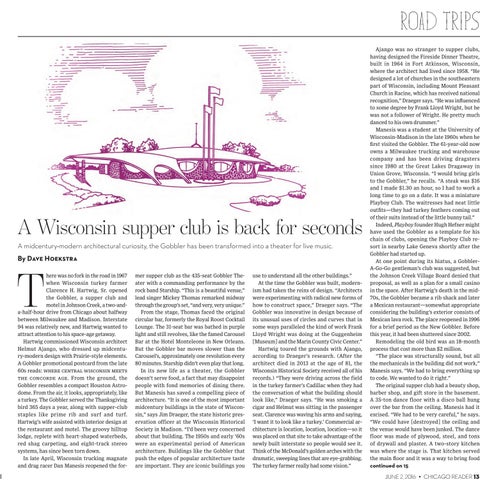
here was no fork in the road in 1967 when Wisconsin turkey farmer Clarence H. Hartwig, Sr. opened the Gobbler, a supper club and motel in Johnson Creek, a two-anda-half-hour drive from Chicago about halfway between Milwaukee and Madison. Interstate 94 was relatively new, and Hartwig wanted to attract attention to his space-age getaway. Hartwig commissioned Wisconsin architect Helmut Ajango, who dressed up midcentury-modern design with Prairie-style elements. A Gobbler promotional postcard from the late 60s reads: where central wisconsin meets the concorde age. From the ground, the Gobbler resembles a compact Houston Astrodome. From the air, it looks, appropriately, like a turkey. The Gobbler served the Thanksgiving bird 365 days a year, along with supper-club staples like prime rib and surf and turf. Hartwig’s wife assisted with interior design at the restaurant and motel. The groovy hilltop lodge, replete with heart-shaped waterbeds, red shag carpeting, and eight-track stereo systems, has since been torn down. In late April, Wisconsin trucking magnate and drag racer Dan Manesis reopened the for-
mer supper club as the 435-seat Gobbler Theater with a commanding performance by the rock band Starship. “This is a beautiful venue,” lead singer Mickey Thomas remarked midway through the group’s set, “and very, very unique.” From the stage, Thomas faced the original circular bar, formerly the Royal Roost Cocktail Lounge. The 31-seat bar was bathed in purple light and still revolves, like the famed Carousel Bar at the Hotel Monteleone in New Orleans. But the Gobbler bar moves slower than the Carousel’s, approximately one revolution every 80 minutes. Starship didn’t even play that long. In its new life as a theater, the Gobbler doesn’t serve food, a fact that may disappoint people with fond memories of dining there. But Manesis has saved a compelling piece of architecture. “It is one of the most important midcentury buildings in the state of Wisconsin,” says Jim Draeger, the state historic preservation officer at the Wisconsin Historical Society in Madison. “I’d been very concerned about that building. The 1950s and early ’60s were an experimental period of American architecture. Buildings like the Gobbler that push the edges of popular architecture taste are important. They are iconic buildings you
use to understand all the other buildings.” At the time the Gobbler was built, modernism had taken the reins of design. “Architects were experimenting with radical new forms of how to construct space,” Draeger says. “The Gobbler was innovative in design because of its unusual uses of circles and curves that in some ways paralleled the kind of work Frank Lloyd Wright was doing at the Guggenheim [Museum] and the Marin County Civic Center.” Hartwig toured the grounds with Ajango, according to Draeger’s research. (After the architect died in 2013 at the age of 81, the Wisconsin Historical Society received all of his records.) “They were driving across the field in the turkey farmer’s Cadillac when they had the conversation of what the building should look like,” Draeger says. “He was smoking a cigar and Helmut was sitting in the passenger seat. Clarence was waving his arms and saying, ‘I want it to look like a turkey.’ Commercial architecture is location, location, location—so it was placed on that site to take advantage of the newly built interstate so people would see it. Think of the McDonald’s golden arches with the dramatic, sweeping lines that are eye-grabbing. The turkey farmer really had some vision.”
Ajango was no stranger to supper clubs, having designed the Fireside Dinner Theatre, built in 1964 in Fort Atkinson, Wisconsin, where the architect had lived since 1958. “He designed a lot of churches in the southeastern part of Wisconsin, including Mount Pleasant Church in Racine, which has received national recognition,” Draeger says. “He was influenced to some degree by Frank Lloyd Wright, but he was not a follower of Wright. He pretty much danced to his own drummer.” Manesis was a student at the University of Wisconsin-Madison in the late 1960s when he first visited the Gobbler. The 61-year-old now owns a Milwaukee trucking and warehouse company and has been driving dragsters since 1980 at the Great Lakes Dragaway in Union Grove, Wisconsin. “I would bring girls to the Gobbler,” he recalls. “A steak was $16 and I made $1.30 an hour, so I had to work a long time to go on a date. It was a miniature Playboy Club. The waitresses had neat little outfits—they had turkey feathers coming out of their suits instead of the little bunny tail.” Indeed, Playboy founder Hugh Hefner might have used the Gobbler as a template for his chain of clubs, opening the Playboy Club resort in nearby Lake Geneva shortly after the Gobbler had started up. At one point during its hiatus, a GobblerA-Go-Go gentleman’s club was suggested, but the Johnson Creek Village Board denied that proposal, as well as a plan for a small casino in the space. After Hartwig’s death in the mid70s, the Gobbler became a rib shack and later a Mexican restaurant—somewhat appropriate considering the building’s exterior consists of Mexican lava rock. The place reopened in 1996 for a brief period as the New Gobbler. Before this year, it had been shuttered since 2002. Remodeling the old bird was an 18-month process that cost more than $2 million. “The place was structurally sound, but all the mechanicals in the building did not work,” Manesis says. “We had to bring everything up to code. We wanted to do it right.” The original supper club had a beauty shop, barber shop, and gift store in the basement. A 35-ton dance floor with a disco ball hung over the bar from the ceiling. Manesis had it excised. “We had to be very careful,” he says. “We could have [destroyed] the ceiling and the venue would have been junked. The dance floor was made of plywood, steel, and tons of drywall and plaster. A two-story kitchen was where the stage is. That kitchen served the main floor and it was a way to bring food
continued on 15
JUNE 2, 2016 - CHICAGO READER 13