Maestro ƒ Master AW_Layout 1 02/04/2012 11:57 Page 17
In Flanders Fields (3 May 1915) by Lieutenant Colonel John McCrae (30.11.1872 – 28.01.1918)
In Flanders fields the poppies blow Between the crosses, row on row, That mark our place; and in the sky The larks, still bravely singing, fly Scarce heard amid the guns below. We are the Dead. Short days ago We lived, felt dawn, saw sunset glow Loved and were loved, and now we lie, In Flanders fields. Take up our quarrel with the foe: To you from failing hands we throw The torch; be yours to hold it high. If ye break faith with us who die We shall not sleep,though poppies grow In Flanders fields.
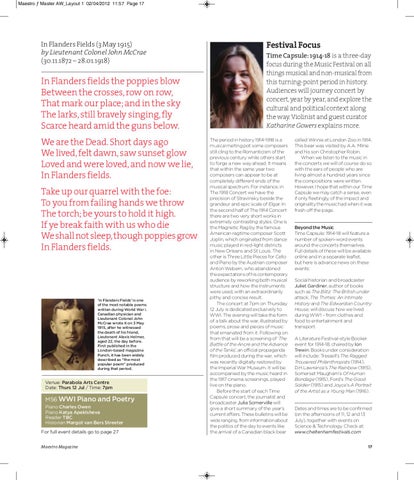
‘In Flanders Fields’ is one of the most notable poems written during World War I. Canadian physician and Lieutenant Colonel John McCrae wrote it on 3 May 1915, after he witnessed the death of his friend, Lieutenant Alexis Helmer, aged 22, the day before. First published in the London-based magazine Punch, it has been widely described as “the most popular poem” produced during that period.
Venue: Parabola Arts Centre Date: Thurs 12 Jul / Time: 7pm
M56 WWI Piano and Poetry Piano Charles Owen Piano Katya Apekisheva Reader TBC Historian Margot van Bers Streeter For full event details go to page 27 Maestro Magazine
Festival Focus Time Capsule: 1914-18 is a three-day focus during the Music Festival on all things musical and non-musical from this turning-point period in history. Audiences will journey concert by concert, year by year, and explore the cultural and political context along the way. Violinist and guest curator Katharine Gowers explains more. The period in history 1914-1918 is a musical melting pot: some composers still cling to the Romanticism of the previous century while others start to forge a new way ahead. It means that within the same year two composers can appear to be at completely different ends of the musical spectrum. For instance, in The 1918 Concert we have the precision of Stravinsky beside the grandeur and epic scale of Elgar. In the second half of The 1914 Concert there are two very short works in extremely contrasting styles. One is the Magnetic Rag by the famous American ragtime composer Scott Joplin, which originated from dance music played in red-light districts in New Orleans and St Louis. The other is Three Little Pieces for Cello and Piano by the Austrian composer Anton Webern, who abandoned the expectations of his contemporary audience by reworking both musical structure and how the instruments were used, with an extraordinarily pithy and concise result. The concert at 7pm on Thursday 12 July is dedicated exclusively to WWI. The evening will take the form of a talk about the war, illustrated by poems, prose and pieces of music that emanated from it. Following on from that will be a screening of ‘The Battle of the Ancre and the Advance of the Tanks’, an official propaganda film produced during the war, which was recently digitally restored by the Imperial War Museum. It will be accompanied by the music heard in the 1917 cinema screenings, played live on the piano. Before the start of each Time Capsule concert, the journalist and broadcaster Julia Somerville will give a short summary of the year’s current affairs. These bulletins will be wide ranging, from information about the politics of the day to events like the arrival of a Canadian black bear
called Winnie at London Zoo in 1914. This bear was visited by A.A. Milne and his son Christopher Robin. When we listen to the music in the concerts we will of course do so with the ears of people who are living almost a hundred years since the compositions were written. However, I hope that within our Time Capsule we may catch a sense, even if only fleetingly, of the impact and originality the music had when it was fresh off the page.
Beyond the Music Time Capsule: 1914-18 will feature a number of spoken-word events around the concerts themselves. Full details of these will be available online and in a separate leaflet, but here is advance news on these events: Social historian and broadcaster Juliet Gardiner, author of books such as The Blitz: The British under attack, The Thirties: An Intimate History and The Edwardian Country House, will discuss how we lived during WW1 – from clothes and food to entertainment and transport. A Literature Festival-style Booker event for 1914-18, chaired by Ion Trewin. Books under consideration will include: Tressell’s The Ragged Trousered Philanthropists (1914), D.H.Lawrence’s The Rainbow (1915), Somerset Maugham’s Of Human Bondage (1915), Ford’s The Good Soldier (1915) and Joyce’s A Portrait of the Artist as a Young Man (1916).
Dates and times are to be confirmed (on the afternoons of 11, 12 and 13 July), together with events on Science & Technology. Check at: www.cheltenhamfestivals.com
17