FORMULA STUDENT Wheely Small
I
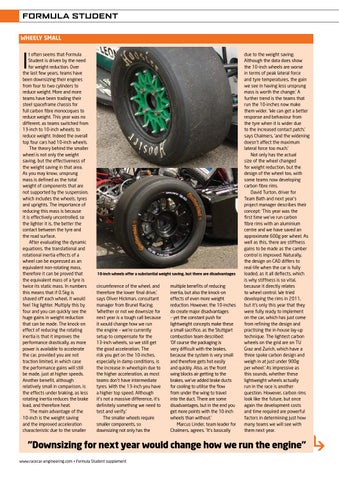
t often seems that Formula Student is driven by the need for weight reduction. Over the last few years, teams have been downsizing their engines from four to two cylinders to reduce weight. More and more teams have been trading their steel spaceframe chassis for full carbon fibre monocoques to reduce weight. This year was no different, as teams switched from 13-inch to 10-inch wheels; to reduce weight. Indeed the overall top four cars had 10-inch wheels. The theory behind the smaller wheel is not only the weight saving, but the effectiveness of the weight saving in that area. As you may know, unsprung mass is defined as the total weight of components that are not supported by the suspension, which includes the wheels, tyres and uprights. The importance of reducing this mass is because it is effectively uncontrolled, so the lighter it is, the better the contact between the tyre and the road surface. After evaluating the dynamic equations, the translational and rotational inertia effects of a wheel can be expressed as an equivalent non-rotating mass, therefore it can be proved that the equivalent mass of a tyre is twice its static mass. In numbers this means that if 0.5kg is shaved off each wheel, it would feel 1kg lighter. Multiply this by four and you can quickly see the huge gains in weight reduction that can be made. The knock-on effect of reducing the rotating inertia is that it improves the performance drastically, as more power is available to accelerate the car, provided you are not traction limited, in which case the performance gains will still be made, just at higher speeds. Another benefit, although relatively small in comparison, is the effects under braking, as less rotating inertia reduces the brake load, and therefore heat. ‘The main advantage of the 10-inch is the weight saving and the improved acceleration characteristic due to the smaller
10-inch wheels offer a substantial weight saving, but there are disadvantages
circumference of the wheel, and therefore the lower final drive,’ says Oliver Hickman, consultant manager from Brunel Racing. ‘Whether or not we downsize for next year is a tough call because it would change how we run the engine – we’re currently setup to compensate for the 13-inch wheels, so we still get the good acceleration. The risk you get on the 10-inches, especially in damp conditions, is the increase in wheelspin due to the higher acceleration, as most teams don’t have intermediate tyres. With the 13-inch you have a higher top speed. Although it’s not a massive difference, it’s definitely something we need to test and verify.’ The smaller wheels require smaller components, so downsizing not only has the
multiple benefits of reducing inertia, but also the knock-on effects of even more weight reduction. However, the 10-inches do create major disadvantages – yet the constant push for lightweight concepts make these a small sacrifice, as the Stuttgart combustion team described: ‘Of course the packaging is very difficult with the brakes, because the system is very small and therefore gets hot easily and quickly. Also, as the front wing blocks air getting to the brakes, we’ve added brake ducts for cooling to utilise the flow from under the wing to travel into the duct. There are some disadvantages, but in the end you get more points with the 10-inch wheels than without.’ Marcus Linder, team leader for Chalmers, agrees. ‘It’s basically
due to the weight saving. Although the data does show the 10-inch wheels are worse in terms of peak lateral force and tyre temperatures, the gain we see in having less unsprung mass is worth the change.’ A further trend is the teams that run the 10-inches now make them wider. ‘We can get a better response and behaviour from the tyre when it is wider due to the increased contact patch,’ says Chalmers, ‘and the widening doesn’t affect the maximum lateral force too much.’ Not only has the actual size of the wheel changed for weight reduction, but the design of the wheel too, with some teams now developing carbon fibre rims. David Turton, driver for Team Bath and next year’s project manager describes their concept: ‘This year was the first time we’ve run carbon fibre rims with an aluminium centre and we have saved an approximate 600g per wheel. As well as this, there are stiffness gains to be made as the camber control is improved. Naturally, the design on CAD differs to real-life when the car is fully loaded, as it all deflects, which is why stiffness is so vital, because it directly relates to wheel control. We tried developing the rims in 2011, but it’s only this year that they were fully ready to implement on the car, which has just come from refining the design and practising the in-house lay-up technique. The lightest carbon wheels on the grid are on TU Graz and Zurich, which have a three spoke carbon design and weigh in at just under 900g per wheel.’ As impressive as this sounds, whether these lightweight wheels actually run in the race is another question. However, carbon rims look like the future, but once again the development costs and time required are powerful factors in determining just how many teams we will see with them next year.
"Downsizing for next year would change how we run the engine" www.racecar-engineering.com • Formula Student supplement