Is each of us responsible solely to ourselves or do we hold a deeper responsibility to one another as individual members of a greater society? Do we carry a burden to care, protect, and assist our fellow human beings? Should we hold compassion for strangers we tend to ignore? Should we pause and give the needy the dime we usually keep for ourselves? Does a portion of our earnings belong to starving children we’ve never met or should all of it feed our personal bank accounts? Sadly, compassion in our world seems to have grown so thin that most would tell you to look away in the face of suffering. The majority hides behind the excuse that an ordinary person has no place playing heroics. However, every once in a while, an average person disrupts the pattern of compliance, ignores personal dangers, and rises up as a warrior for the greater good of man. Throughout history, there have been people proving that the most important element of greatness is finding the initial courage to take a stand. It is beyond our mortal reach to comprehend the power that would not let Raoul Wallenberg stand by with arms meekly crossed as innocent blood poured down like rain all around him. He chose not to shut his eyes hoping for a better tomorrow while Jews were butchered; instead, he made the decision to step up to the responsibility he had toward his fellow man, the responsibility each of us holds yet to which few respond. aoul Wallenberg had no particular reason for putting his life on the line for a R people on the brink of extermination. There was no family for him to rescue or a dear friend he wished to avenge. In fact, as a wealthy Swedish diplomat, it would have been perfectly natural for him to take a leisurely seat inside his comfortable home basking in the knowledge that the upheaval sweeping much of the world would never lay its mark on him. Yet Wallenberg was driven by a deeper calling. He answered the call that even if all of us could hear, most would be too fearful to answer. In Wallenberg’s eyes, mankind was interconnected. Regardless of race, gender or religion, we are all brothers and sisters. Motivated by these principles, Raoul Wallenberg became a savior to thousands of his needy brothers and sisters. here is no one way to be heroic because true heroism is fueled by one’s inner T strength. A hero does not try to be so; he does not plan the outcome of his actions or visualize the praise and glory waiting once the mission is complete. A hero has no time to weigh pros and cons of every situation; therefore, a hero relies on instinct diving into the thick of danger with blind temerity. As a member of the wealthiest class of society, Raoul Wallenberg realized that rather than rely on brute force in the military, his charismatic personality, charming smile, and quick wit could be used as much more powerful weapons. Serving as the First Secretary at the Swedish Legation in Budapest, Wallenberg relied on unconventional methods of diplomacy to issue Swedish passes to thousands of Hungarian Jews. These passes protected Jews against the Nazis hoping to send them to the death camps. Wallenberg used whichever method was most available to him at the
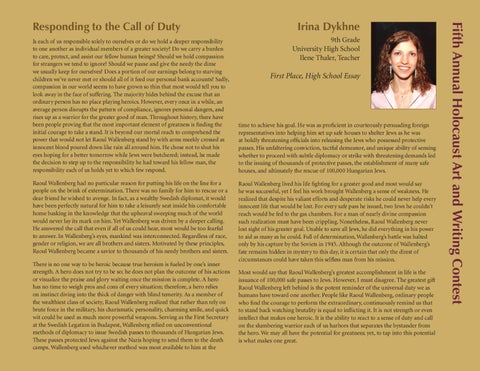
Irina Dykhne 9th Grade University High School Ilene Thaler, Teacher
First Place, High School Essay
time to achieve his goal. He was as proficient in courteously persuading foreign representatives into helping him set up safe houses to shelter Jews as he was at boldly threatening officials into releasing the Jews who possessed protective passes. His unfaltering conviction, tactful demeanor, and unique ability of sensing whether to proceed with subtle diplomacy or strike with threatening demands led to the issuing of thousands of protective passes, the establishment of many safe houses, and ultimately the rescue of 100,000 Hungarian Jews. Raoul Wallenberg lived his life fighting for a greater good and most would say he was successful, yet I feel his work brought Wallenberg a sense of weakness. He realized that despite his valiant efforts and desperate risks he could never help every innocent life that would be lost. For every safe pass he issued, two Jews he couldn’t reach would be fed to the gas chambers. For a man of nearly divine compassion such realization must have been crippling. Nonetheless, Raoul Wallenberg never lost sight of his greater goal. Unable to save all Jews, he did everything in his power to aid as many as he could. Full of determination, Wallenberg’s battle was halted only by his capture by the Soviets in 1945. Although the outcome of Wallenberg’s fate remains hidden in mystery to this day, it is certain that only the direst of circumstances could have taken this selfless man from his mission. ost would say that Raoul Wallenberg’s greatest accomplishment in life is the M issuance of 100,000 safe passes to Jews. However, I must disagree. The greatest gift Raoul Wallenberg left behind is the potent reminder of the universal duty we as humans have toward one another. People like Raoul Wallenberg, ordinary people who find the courage to perform the extraordinary, continuously remind us that to stand back watching brutality is equal to inflicting it. It is not strength or even intellect that makes one heroic. It is the ability to react to a sense of duty and call on the slumbering warrior each of us harbors that separates the bystander from the hero. We may all have the potential for greatness; yet, to tap into this potential is what makes one great.
Fifth Annual Holocaust Art and Writing Contest
Responding to the Call of Duty