CHANGING IRELAND
Not for Profit
AUTUMN 2016
€2.25
Issue 55 - COMMUNITY DEVELOPMENT - COLLECTIVE ACTION - EMPOWERMENT - SOCIAL INCLUSION - www.changingireland.ie
challenging stereotypes
UNEMPLOYED man WINS NATIONAL award for growing...
grass NOW HIS PRODUCE IS SELLING ALMOST NATIONWIDE Let’s hear it for: Garryowen, the Ploughing, Volunteers, Co-ops, Activists & Community Planning
This publication is produced by Changing Ireland Community Media Ltd, an independent, not-for-profit NGO funded through the Department of Housing, Planning, Community and Local Government.
‘Changing Ireland’ is an independent not-for-profit publication.
ABOUT US
‘Changing Ireland’ engages in original journalism to highlight the impact of local and community development and social inclusion work across Ireland. We report on action on the ground and provide a space for reflection on what serves people and communities best. The magazine was established in 2001, is based in Moyross, Limerick, and is core-funded by the Department of Housing, Planning, Community and Local Government. This year, we began to produce journalism to reflect social inclusion work funded or supported by an array of Government departments and agencies. At the same time, we provide space for those with empty pockets and nothing but community development in their hearts. We are dedicated to promoting social justice, equality and fair play and to giving people who are rarely heard a voice. While covering serious issues, we hope our style of journalism provides encouragement to workers, activists and volunteers nationwide, including civil and public servants and all involved in social inclusion in Ireland today. See page 4 for information about the team behind ‘Changing Ireland’.
SUPPORT
‘Changing Ireland’ generates a small amount of social enterprise revenue. It is core-funded by Government since 2001, receiving support from the:
5 NEWS BRIEFS / Letters 6-7 PLOUGHING PICS: Community to the fore 8-12 COVER STORY: Entrepreneur awards 13 HORACE’S DIARY: Dead cows don’t fart, Mary. 14-15 REPORTS: On SICAP / Co-ops. 16-19 GARRYOWEN: Socially excluded. 20-21 ACTIVE AGEING: Best practise in Mahon.
contents
INDEPENDENT
22-25 COMMUNITY & ECONOMIC PLANS: Pictorial coverage of launch by Minister Coveney.
26 NINE GROUNDS: Who to call when law broken. 27 HOUSING: Galway Travellers confront Ministers
28-29 JOBBRIDGE IS GONE, BUT LET’S KEEP & REVITALISE COMMUNITY EMPLOYMENT: And here’s how! 30-31 VALUED: ‘Community’ retains senior status.
Our Communities – A National Forum Wednesday, 23rd November, 2016 9.30am – 16.30pm The Royal Hospital Kilmainham, Dublin 8 • The Framework Policy for Local and Community Development is now in place. To deliver on this Policy we now need to develop an Implementation Plan. Our Communities – A National Forum will take place on 23rd November 2016 and will contribute to the development of the Plan. • Invites will issue to community and voluntary organisations, LCDC chairs and chief officers, local development and community development bodies, government departments, local authorities and others. • The Forum will ensure that people who are directly involved in local development and community development will have a voice in developing the Implementation Plan. • Further information, including a detailed programme and booking arrangements, is now available. Please email forum@housing.gov.ie by 11 November 2016 if you are interested in participating in the forum. • Places will be limited and participants will be selected on the basis of ensuring a balanced participation across all stakeholder sectors.
The Community & Local Government Division, Department of Housing, Planning, Community & Local Government, Government Offices, Ballina, Co Mayo. F26 E8N6. Tel: 096 24316. Email: lcdev@housing.gov.ie
Editorial A ROUND OF APPLAUSE
a
A round of applause for Derek Walker from Donegal, whose story features on our front cover. He overcame barriers to employment and is a role model for others. The same can be said for all 18 finalists in the inaugural enterprise awards featured on pages 8-12.
Well done to the Irish Local Development Network for organising the competition. It was the first such national awards event held for people who were unemployed and who availed of self-starter support. It also successfully showcased proven interventions by two government departments working with community-based organisations. A round of applause to the 31 local authorities around the country who recently launched their Local Economic and Community Plans. The plans are a product of 12 months hard work by a broad range of local interests. These first round of plans will no doubt be worked on and enhanced over their six-year lifetime.
results, it seems. A round of applause to everyone who works in or is involved in supporting - locally, regionally and nationally - the Social Inclusion and Community Activation Programme. While it was only launched in April of last year and obviously needed some time to bed down, it has scored some remarkable achievements in the battle for social inclusion for all. The report produced by Pobal also clearly marked the way forward. However, more investment is needed in SICAP. The case couldn’t be made more clearly than by people like Derek and the people of Garryowen in Limerick city. The Garryoweners deserve a special round of applause for doing their best - mostly through volunteering to give their children and everyone in their community a better chance at life. Garryowen is “very disadvantaged” according to the official designation, but has largely slipped through the net. We need a bigger net if we’re to truly tackle social exclusion in this country. In the meantime, the Government will have to wait for a heartfelt round of applause.
Allen Meagher
A round of applause to Travellers and other human rights activists for continuing to insist they have a case. They are gradually getting
FILE A REPORT FOR US! If you believe in Community Development and enjoy writing, why not file a report for us about your community project and what makes it unique. 300-400 words is plenty (and a photo if possible). Certain criteria apply. Your first point of contact should be the editor.
Published By:
Established in 2001, ‘Changing Ireland’ is a national magazine focused on community development and social inclusion. It is managed and published by Changing Ireland Community Media Ltd., through funding from the Department of Housing, Planning, Community and Local Government. Postal address: ‘Changing Ireland’, c/o Community Enterprise Centre, Moyross, Limerick. Office base: Unit 3, Sarsfield Gardens Business Centre, Sarsfield Gardens, Moyross, Limerick. Tel Editor: 061-458011. E: editor@changingireland.ie W: www.changingireland.ie T: @changingireland. F: www.facebook.com/changingirelandmedia/ B: changingireland.blogspot.ie
Disclaimer
Y: youtube.com/changingireland L: linkedin.com/company/changing-ireland Also: Issuu.com
Production:
Editor: Allen Meagher Editorial Team: Juan Carlos Azzopardi, Viv Sadd, Gearoid Fitzgibbon, Joe Saunders, Rosie Smyth and Allen Meagher. Packing and Distribution: Speedpak, Dublin, an awardwinning social enterprise. Printed by: Davis Printers, Limerick. Voluntary Board of Directors: Claire Gallery (chair), Gearoid Fitzgibbon, Kay Flanagan, Viv Sadd, Ellen Duffy, George Clancy, Seamus McGiff, Jude Meaney and Cathy Jones.
oss r y o m n i Made limerick
The views expressed in this magazine are those of the author concerned. They do not, by any means, necessarily reflect the views of the editor, the editorial team, the voluntary management board of Changing Ireland Community Media Ltd, or the Department of Housing, Planning, Community and Local Government.
4
NEWS BRIEFS
70 groups TO share €16m over 3 years
R
What have you missed? €28M from dormant accounts for communities
A
hefty €28.5 million in Dormant Accounts funding is being invested in communities across the Republic this year. The funding scheme was in the works for some years and the application process is now closed. Details of who gets what were released in May with the funding spread across three broad social inclusion “themes” listed as follows: 1. The personal and social development of persons who are economically or socially disadvantaged; 2. The educational development of persons who are educationally disadvantaged. 3. Persons with a disability (within the meaning of the Equal Status Act 2000). The biggest single allocation of funding is €7m which is going to support “evidence informed” childhood intervention (ref: front cover, ‘Changing Ireland’ Spring 2016). According to the Dormant Accounts Action Plan 2016 this investment “will embed early intervention into mainstream policy”.
ecently, Simon Coveney, Minister for Housing, Planning, Community and Local Government, announced funding of €16.409m over the coming three years for 70 national community and voluntary organisations. The allocations come under the Scheme to Support National Organisations (SSNO). The overall aim is to provide multi-annual funding towards the core costs of national organisations in the community and voluntary sector to assist them to operate and fund core staff positions.
Rosaleen wins ‘sheroes’ award
R
CHARITY NO LONGER RELEVANT
osaleen McDonagh’s work in Community Development was recognised at the annual SHEROES Awards which took place in Navan, County Meath, on October 2nd. Rosaleen is a leading feminist in both the Traveller and disabled communities. She is currently a PhD candidate in Northumbria University.
PRO-SOCIAL DRIVERS’ PROGRAMME WINS 3 AWARDS
A
project we covered a year ago (Issue 49, Spring 2015) has picked up a trio of awards in the recent months. The Pro-Social Drivers Programme which began as a pilot project in Donegal in 2012 is beginning to impress district court judges nationwide. If they can have the course run in their areas, they have the final say over whether an offender goes to prison or might benefit more from doing the course. The programme is the brainchild of Gary Doggett and is based on best practice and proven solutions in other countries. See our Winter edition for more.
The Disability Federation Ireland is receiving €232,338 through the Scheme to Support National Organisations. For more, see above.
“Martin Naughton had the vision, skills and determination dignity and the fulfilment of human rights for all groups in
5
Martin Naughton, renowned activist. R.I.P. Dear Editor, Disability activist Martin Naughton was laid to rest in his native Spiddal, Co. Galway on October 13th. He was sixty two years old. He was a leader in the disability sector and his legacy will have positive impacts long into the future. Martin was instrumental in Ireland’s shift away from the institutional approach. We now have a disability act, however imperfect it is, and Ireland is beginning to adopt the universal approach of Personal Assistance rather than Carers. Ireland is on the cusp of approving the Article 19 of the UN Convention for people with a disability. The legislative groundwork is being developed for direct payment to people with a disability which should cover the cost of services such as personal assistance and other essential supports so that people with disabilities can live inclusively in Irish society. I call on politicians of all parties to go the extra step and ensure these measures urgently go into legislation so that Martin Naughton and many more warriors like him, who sat outside Dáil Eireann on cold bitter nights, can say their work was fruitful in the end. Charity has no place in the disability sector. Yours sincerely, Dermot Hayes Ennis, Co. Clare.
to build solidarity between all those who strive for equality, society.” - President Michael D Higgins.
PLOUGHING 2016: Community initiatives t
ON-SITE SNAPS
The National Ploughing Championships are a great opportunity for the public to meet with ministers, civil servants, agency officials and even community workers. This year, the event was held near Tullamore, Co. Offaly. The Department of Housing, Planning, Community and Local Government was among those to have a marquee and ‘Changing Ireland’ popped along to see who was about.
Teenagers give the De pt. of Housing, Planning , Community & Local promote fire safety. Government a hand to Jerry Murphy, Pobal, and Rosie Smyth, Dept.
Ian Brannigan, Western Dev’t Commission CEO. He was based in a marquee managed by the Dept. of Arts, Heritage, Regional, Rural & Gaeltacht Affairs.
Dept. of HPCLG staff SERVING OUR COMMUNITIES! An Taoiseach, Enda Kenny and ng Championships. Ploughi the at Smyth Bernie Reape, Clodagh McDonnell and Rosie
Paul Skinnader, Clodagh THEY ANSWERED A THOUSAND QUESTIONS! Bernie Reape, the others work with the while Pobal for works McDonnell, Rosie Smyth and Philip Finn. Paul Ploughing. the at e margue Dept’s the in stands nned (wo)ma All . Dept. of HPCLG
6
David Dalton, Dept. of HPCLG.
to the fore
Dept. of HPCLG staff - David Dalton, Paul Geraghty and Bernie Reape from the LCDC Policy and Development Unit.
GIVING IT WELLY - MARY HURLEY
Mary Hurley was the best prepared for ploughing! She is assistant secretary in the Department of Housing, Planning, Community and Local Government.
CAPTION COMPETITION
Competition! What are they saying? Prize for best caption. Entries to editor@cha ngingireland.ie
WHAT DO YOU READ? Eileen Davey who works with the Libraries Development section in the Dept. of HPCLG with the pioneering Mary Stuart, Offaly County Librarian.
Local staff from Offaly ipal Two members of inc ! pr SK ll, DE ne on LY cD FA THE OF to Clodagh M at ch ny pa G. m Development Co the Dept. of HPCL munity section of officer in the Com
Best Wellie winner Mary Hurley.
7
Changing Ireland
SELF-EMPLOYMENT IS ONE OPTION TO O INTRODUCTION entrepreneur who fa Unemployed geniuses with national award for ideas for small enterprises
M
ost employment in this country is provided not by tax-shy multinationals, but by small enterprises run by dedicated individuals who usually have their workbase in the local community. These are companies that truly add value to local economies and the national tax-take. Often their owners start off on the floor - unemployed, turned down for jobs they apply for, perhaps the victim of recession or discrimination and feeling stuck about what to do next. In Dublin, recently, an awards ceremony shone the spotlight on 18 previously unemployed individuals who had availed of support and started their own businesses. Supports included guidance on how to start up a business, how to develop a business plan, training workshops, one-to-one business mentoring, advice on company and tax registration and guidance on other supports available to enterprising individuals. Alongside the awards finalists, each year thousands of people across the country receive a range of valuable enterprise supports from local development companies funded under the Social Inclusion and Community Activation programme (SICAP). The Department of Social Protection provides an important source of financial support for enterprise start ups through the Back to Work Enterprise Allowance and Short Term Enterprise Allowance Schemes. Among the positive and unexpected outcomes - an unemployed person can begin to earn a living from growing grass, in one case at any rate.
- Derek had eureka moment while recovering
W
ALLEN MEAGHER REPORTS
hen an unemployed Donegal man sought a quick recovery from knee surgery, he found a solution that’s now earning him a living, as well as accolades and awards. Derek Walker (28) from Letterkenny was advised to take wheatgrass as part of his recovery, because the natural food product is rich in protein, vitamins and minerals and helps with healing. Wheatgrass is even said to help cure cancer. However, it isn’t the easiest item to digest, so Derek began growing and producing convenient 30ml shots of fast-frozen wheatgrass juice for his own consumption and for sale. He felt he had to try to make a living somehow. Derek is registered blind and had been unable to find normal paid work, partly he believes because of discrimination. With support from Donegal Local Development Company’s (DLDC) selfemployment support unit, he was able to move production from a spare room in his house to custom-designed facilities. Today, his wheatgrass juice shots are sold in dozens of Tesco, Supervalu and other
stores. When he discovered that Letterkenny had no market for local food, craft and art producers, he and his fiancé Anna McQuade simply set one up. Letterkenny Artisan Market at Carrygally Business Park now caters for 40 exhibitors. For his entrepreneurship, Derek won a regional award during the summer and last week was chosen as national winner of the inaugural Irish Local Development Network award for unemployed people who set up their own businesses. Derek’s disability is not obvious at first, but his sight has been diminishing since he was 12 years old due to a rare condition. He applied for many jobs but could not get past the interview stage. He recalled dropping his magnifier and it rolling across the floor during one job interview: “That was me done for,” he said. “I’m glad it happened now,” he said of the discrimination, as it prompted him to go it alone. On winning the national award, Derek said, “I feel nothing but gratitude. With losing my eyesight, this is very special to me. I made
When he discovered that Letterkenny had no market for local producers, he and Anna simply set one up.
Derek Walker, national enterprise winner, holding a box of his products. Two years ago, Derek had knee-surgery and wheatgrass helped in his recovery. This prompted him to develop a convenient way to consume it – blast-frozen juice shots.
Less than 2% of the “caseload” under the Social Inclusion in 2015 were people from the Traveller and Roma
8
and Community Activation Programme (SICAP) communities. - SICAP’s end-of-year report, 2015.
OVERCOME BARRIERS faced disablism wins r grass-juice
AUTUMN 2016
50 Benefits of wheatgrass
g from knee surgery
Inset: Derek Walker with Marie Price Bolger, ILDN chairperson. the job myself and I want a future to work towards, where as at one point I felt I was going to have nothing.” He praised the staff in DLDC and the Back to Work Enterprise Allowance (BTWEA) scheme. “They restored some inner belief in me that others had taken away from me. I learned that I am a person of value. Don’t set limits. Just because you can’t do one or two things, with help you can do as many things as you want to.” “And the BTWEA was a big help, because it enabled me to create a network of contacts. I was on a blind pension – a disability allowance – and the scheme gave me two years to try out my idea.” The scheme allows participants to retain their social welfare payment, plus secondary benefits, on a reducing basis over a two-year period. Derek’s success and the achievements of 17 other finalists were hailed as an example to 11,500 people currently availing of the BTWEA scheme. “It shows what you can do with the right ideas, support and determination,” said Kathleen Stack, Assistant Secretary General at the Department of Social Protection, speaking at the awards event,
in Dublin, on September 15th. Ms Stack was impressed by the number of jobs created. Last year, 715 people set up in full-time self-employment through support provided by Local Development Companies funded through the Social Inclusion and Community Activation Programme. The success is as a result of collaboration between Ms Stack’s Department and the Department of Housing, Planning, Community & Local Government, in tandem with Local Development Companies which are trusted by unemployed people. Meanwhile, Derek had advice for people who can’t find work because of lack of jobs, because of the recession, or because of discrimination over disabilities: “You can do it for yourselves, with support. I wouldn’t have had the courage on my own to do it. The scheme gave me security and now the world is my oyster.” He intends to invest his €2,000 prizemoney into the business and to begin employing people shortly. Busy times beckon as Derek and Anna also became parents recently.
Derek Walker, national enterprise winner, cracks open the bubbly for his fiance Anna McQuade and social enterprise co-ordinator Louise Brogan of Donegal Local Development Company (DLDC) while Padraig Fingleton, CEO of DLDC, waits in turn. The Social Inclusion and Community Activation Programme and families in disadvantaged areas, lone parents, people
9
W
heatgrass advocates are sometimes accused of exaggerating its benefits, but many are convinced it is a “superfood”. For instance: 1. Wheatgrass juice is viewed as an effective healer because it contains all known minerals as well as vitamins A, B-complex, C, E, l and K. It is rich in protein and contains 17 amino acids, the building blocks of protein. 2. Wheatgrass juice contains up to 70% chlorophyll, which is an important blood builder. 3. Chlorophyll contains more light energy than any other food element. 4. Wheatgrass juice can be taken orally and as a colon implant without side effects. In addition, scientists have never found wheatgrass to be toxic in any amount.when given to either animals or humans. Check out a list of ‘50 Reasons Why You Should Drink Wheatgrass’ everyday: http:// bit.ly/2dDEzmM
Anna McQuade harvests wheatgrass.
had 10 target groups in 2015. eg Travellers, children with disabilities, unemployed people, etc.
Changing Ireland
ENTERPRISE: NATIONAL AWARDS
We break down barriers and help to change lives
FINALISTS HAILED AS ROLE 11,500 OF THIS YEAR’S
- Awards recognise achievements of people who wer - Businesses cover everything from catering to joiner
I
Samantha McCarthy, Development Company, awards ceremony.
T
Clare Local attended the
he Social Inclusion and Community Activation Programme has three goals and Clare Local Development Company (CLDC employs three co-ordinators to oversee the work in relation to each goal. Samantha McCarthy is education and enterprise coordinator at CLDC. Here, she explains her work: “Under Goal 3, we focus on assisting individuals who are long term unemployed to return to education, work or self-employment through a range of intensive supports that are both short term and long term. My role specifically looks at training, employment and enterprise. “It is my belief that the only person that can fully realise and reach a goal is the individual themselves, but they can be helped along the way through networking and support. “Training programmes, guidance and mentoring are at the core of the supports we provide. They are developed and delivered by people who believe that education and time given to individuals has the potential to assist in breaking down barriers and turning disadvantaged situations into positive opportunities, thereby positively changing lives. “Through one-to-one work, personal action planning and group engagement, individuals are empowered to focus on their strengths and develop strategies to achieve goals be they big or small. “To date, in 2016, the Training, Employment and Enterprise team have supported over 680 individuals to formulate a plan. Meanwhile, 160 individuals have taken up training opportunities, over 40 individuals have got employment with 15 more individuals are using their talents to move into self-employment. “Everyone’s journey is so valuable,” she said.
f you’re unemployed for over six months and have a small business idea (and even if you don’t - there are other services) there is support available through the Social Inclusion and Community Activation Programme. Every one of the people pictured here received a range of supports and are up and running a successful business today. All 18 were finalists in the inaugural ILDN enterprise awards competition. The support is delivered by local development companies nationwide.
Derek Dolan of Pro SEO Ltd, a search engine optimisation company in Dublin city.
Jonathan and Mary Elizabeth Weir of Tastys, Inishowen, Co. Donegal.
W: proseo.ie
On Facebook.
Shane Bonner of Newmarket Kitchen in Co. Wicklow.
Mari Donelan, owner of Dan and Monstro Pasta Sauce, based in Rathmichael, Co. Dublin.
THIRD PLACE! Oliver Hynes from Dublin, who established tech company Hub Controls.
W: newmarketkitchen.com
W: danandmonstro.ie
W: thehubcontroller.com
Moira Hart of Lavender Farm.
Michael O’Connor of the Red Door Coffee Shop & Deli, Carrig-on Bannow Co. Wexford.
Mairead McDaid, Chartered Physiotherapy & Neurological Rehabilitation, Taghmon, Co. Wexford.
On Facebook.
W: maireadmcdaidphysio.com
Wexford
On Facebook.
Through the Social Inclusion & Community Activation to providers of Life-Long Learning and Further Education
10
Programme, in 2015, 946 people were referred and Training services.
S
The Enterprise Support Officer’s role in the community
ROLE MODELS TO S SELF-STARTERS
re long-term unemployed ry to lavender production
Deirdre Conroy of Redz Hair Design and Beauty from Claremorris, Co. Mayo.
Michael and Natalia McGreal from Westport, Co. Mayo, owners of an indoor play village.
Carmel Dunleavy from On the Way Café, Killala, Co. Mayo.
W: redzhairdesignandbeautybar.ie
W: thewildwest.ie
On Facebook.
Walter Ryan Purcell of Loughbeg Farm Ltd, Schull, Co. Cork.
SECOND PRIZE! Tomasz and Katarzyna Gwis of K&T Bakery and Restaurant in Co. Kerry,
Garrett Stokes of MFI (sponsor) with Brid O’Connor co-founder of Integreat.
W: loughbegfarm.com
On Facebook.
W: integreat.ie
Kay Faulkner of Partners in HomeCare, Co. Clare.
Kevin Lynch of Airmid Natural Irish Skincare & Gifts, Kilfenora, Co. Clare.
Darragh Murphy of Murphys Bespoke Joinery, Kilmallock, Co. Limerick.
W: partnersinhomecare.ie
W: airmid-natural-irish-skincare. myshopify.com
W: murphysbespokejoinery.ie
Through the Social Inclusion & Community Activation 3 employment supports. For 66%, their educational
11
Louise Brogan, Donegal Local Development Company with Derek Walker, award-winner.
L
ouise Brogan was “over the moon” with Derek Walker’s win at the enterprise awards. “I’m very proud of him,” she said. Within minutes of the announcement, she was on the phone to colleagues back in Donegal eager to know how he got on. He was representing himself, but also Letterkenny and indeed much of Donegal. “It is remarkable that he has won the national award, and for the first time ever the awards were held too,” she said. Louise Brogan leads a team of seven employment and enterprise support officers based in three offices operated by Donegal Local Development Company (DLDC). They aim to meet with people within a week of receiving a call. “We’d bring them along to a two-day ‘Start your own business’ course. We take them through that and once they’ve heard all the information and know what’s involved, we ask are you really interested. Then we start to work very closely with them on a one-to-one basis,” said Louise. DLDC help them prepare a business plan, do cash-flow projections, look at the market and take it forward from there. Mentoring is provided as part of the support. They can also open the door to (free) business training, enterprise skills training, tailored mentoring support and they help people to apply for the Back to Work Enterprise Allowance Scheme. Participants also get to network with other small business owners, which was one of the factors Derek rated very highly. The LDCs are also expert at looking at other barriers that might prevent you from becoming self-employed. Derek for instance is visually impaired. “His story is important. He wouldn’t have had a lot of chances that other people would have,” said Ms Brogan. She emphasised that “While we do help people set up in business, we are focused on the person first and foremost.”
Programme, in 2015, 23,546 people received Goal attainment level was the Leaving Cert or lower.
Changing Ireland AUTUMN 2016
ENTERPRISE: NATIONAL AWARDS 2nd & 3rd prize to kerry & dublin companies SOON TO EMPLOY 80
P
olish couple Katarzyna and Tomasz Gwis, owners of K&T Bakery and Cafés in Caherciveen, Co. Kerry, came second in the ILDN Enterprise Awards competition. They
Katarzyna and Tomasz Gwis now run a bakery, restaurant and café.
currently employ 15 staff - eight full-time and seven part-time. Katarzyna was originally on a Community Employment scheme. Around the same time, she began selling her home-made bread and cakes at car boot sales and country markets In October 2014, she and Tomasz took the big plunge - they opened a bakery in Caherciveen. Business expanded and this year they opened a restaurant and cafe. Not bad going, given that Katarzyna originally came over here from Krakow in 2006 just for a summer. By next year, she and Tomasz expect to have 50 people on the payroll with a turnover of €8m. Oliver Hynes, from Tallaght, Dublin, who established Hub Controls Ltd, a tech company currently employing seven people, won third place. Oliver worked in the heating industry for 16 years but found himself unemployed during the recession. Two years ago, he developed a household utility bill controller that allows real-time remote control of spending on heating.
Tr
Oliver expects employee numbers to increase to over 30 within the next 18 months as the company expands into international markets.
Oliver Hynes, from Dublin, who established a tech company, Hub Controls, receives his award from Marie Price Bolger, ILDN chair,
715 full-time jobs TWO COLLABORATE IN LENDING SUPPORT created in 2015
Last year, between April and December, the Social Inclusion and Community Activation Programme (SICAP) played a pivotal role in the creation of 715 full-time jobs. Under the same programme, the following were outcomes from its support in 2015 for people who were unemployed: • Almost 10,000 individuals received SICAP self-employment support. • In total, there were over 19,000 support interventions, covering information sessions on allowances, assistance with generating business ideas, preparing business plans, market research, business coaching, among others. • Some 2,000 clients received self-employment follow-up support – the majority related to the day-to-day running of the business as well as business skills workshops and mentoring sessions. • 232 individuals received SICAP funding to assist in starting their businesses, to help for instance with the costs of safe pass courts, tax consultancy fees, marketing & research, or the purchase of set-up equipment. • The most important outcome is that through self-employment support provided through the Social Inclusion and Community Activation Programme, 715 full-time and 85 part-time jobs were created by the enterprises that progressed to self-employment. The majority of those people also benefitted from the DSP’s BTW or BTWEA allowances.
U
nicycles might be cheaper to produce, but they will never take as many people as far as bicycles do. By way of comparison, the two wheels of support on offer to long-term (over six months) unemployed people gives them a better chance of overcoming barriers. The two government departments offering joined-up support are the Department of Social Protection (DSP) and the Department of Housing, Planning, Community and Local Government. Working with the latter, Diarmuid O’Leary said it was “vital that our Department works collaboratively with the Department of Social Protection” to give citizens the best support possible when unemployed. Not everyone will escape the dole due to serious structural barriers - a scarcity of jobs especially in rural areas, continuing discrimination (despite it being illegal) and high rents in Dublin. However, the collaboration of two Departments working hand-in-hand makes a difference, particularly for those who want to try the selfemployment route.
12
That’s the message the Department conveyed when their representatives spoke at the ILDN enterprise awards ceremony. Mr O’Leary said, “My Department’s SICAP has played its part in assisting those of you who needed support in taking the decision to become self-employed and getting to the stage of setting up an enterprise. “We believe it’s vital that our Department works collaboratively with the Department of Social Protection – in ensuring that SICAP complements the vital income support provided through the Back to Work Allowance (BTWEA) and the Back To Work Enterprise Allowance schemes. Kathleen Stack, Assistant Secretary General in the DSP, said, “The BTWEA is very important to us. It’s a key element in how we support our customers.” “The Department comes in for a lot of stick at times, so it’s really heartening to hear how important the enterprise scheme has been in getting businesses off the ground,” she added.
Horace’s Diary
ADVERTISE Dead cows don’t fart, Mary WITH US! - and true patriots don’t strike Visit us at www.changingireland.ie
to view our ratecard, reach & readership
MOST POPULAR MAGAZINE LONGEST ESTABLISHED WIDEST REACH Winter edition deadline: Mon, Dec 5th, for publication 1st week in January. 33% discounts for non-profits
CALL FOR SPECIAL OFFERS ADVERTS FROM €199 Contact the editor, Allen Meagher. E: editor@changingireland.ie T: 061-458011.
I
stormed off to the pub after attending this year’s Community Workers Representative Association AGM. It was held in Knock – in recognition of the fact that it is a miracle any community workers still have a job. I got mad because community workers plan to strike on four successive Mondays (not to clash with the Gardai) for better pay and conditions. How ridiculous! How are we supposed to pay off the national debt of €950billion or whatever by 2017 if we don’t make sacrifices. Then, that same night, drunk, in Supermacs in Ballina, with a quarter-pounder burger in hand, I got accosted by Mary Robinson. “And where do you think you’re going with THAT, young man,” she said. Bloody elders! She started lecturing me about global warming, methane gas and why I should become a vegetarian. “At least the cow in my hand won’t fart again,” I said. “Sure, I’m a saint. Mary - Think of all the forests that were knocked for all your books.” She wants to open a library. Undeterred, she began lecturing me about the Sustainable Development Goals (SDGs) we all agreed on in Paris. What - I wouldn’t have minded going to Paris!
Next thing, Michael Fitzmaurice appeared and I knew it was the prime opportunity to sneak away, with my burger. Last time I looked back, Mary had the fairly new TD in a headlock and was making him learn off the SDGs by heart. I think it would be easier on everyone if they didn’t call them ‘SDGs’, it makes ‘em sound like a sexual disease. I’m with my hero Ryanair’s Michael O’Leary on the whole issue – keep flying high and f*** ‘em all. I’d also tend to agree with him on the importance of getting rid of anything vaguely “left” – turns, sleeves, leftover food, communists, pompous poverty industry types, the Department of Transport, etc. Did you hear Michael was at the Tipp V Kilkenny All-Ireland Hurling Final and the guy beside him had an empty seat beside him? Horrified, because it would never happen on a Ryanair flight, O’Leary asked why he hadn’t sold it. The man – actually my cousin Herbert - said he’d bought the ticket for his wife but that she’d died and therefore couldn’t come. When O’Leary asked Herbert why he didn’t invite a friend or relative to use the ticket, Herbert replied, “Sure, none of them are free, they are all at the funeral!” You have to laugh…. Slán agus beannacht! H.
ABOUT HORACE:
A former civil servant, community worker and agony uncle, Horace knows it all. He has addressed everything from world poverty to extraordinary rendition and estate enhancement, and has a huge readership among people seeking change in their pockets. A few of his better columns are available exclusively on the ‘Changing Ireland’ website.
--------------------------------------- Cut out & keep, courtesy of ‘Changing Ireland’ ---------------------------––––––––––––––
Community work sometimes involves a little admin... Conor joins SICAP * in 2015...
Conor 2016....
Conor 2017.
* SICAP is the acronym for the Government’s Social Inclusion and Community Activation Programme which operates nationwide.
13
Changing Ireland
SOCIAL INCLUSION
inclusion REPORT PUBLISHED - Outlines programme achievements in Year 1 and ambitions in 2016
I
n September, Pobal published the 2015 end-of-year report for the Social Inclusion and Community Activation Programme (SICAP). The 125-page document - available at pobal.ie - provides full analysis, including case studies, and outlines the progress and achievements under the national programme since it was launched in April 2015. It also identifies areas needing - in some cases crying out for - more attention. The report notes that in total, almost €28 million was allocated to help reduce poverty, promote social inclusion and progress equality at local, regional and national level. This was led by Local and Community Development Committees (LCDCs) and delivered by 45 ‘Programme Implementers’. At grassroots level, staff worked hard to make the programme work for communities. The findings note that in its nine months, SICAP supported a higher percentage of people living in disadvantaged areas, helped more people who had lower levels of educational attainment and reached a greater percentage of long-term unemployed clients than forecast. Some of the SICAP’s key achievements outlined in the report include: • 36,800 people were assisted on one-to-one basis. • 23,500 clients received employment and job training supports. • 13,400 people participated in the life-long learning courses. • 4,687 people set up new businesses, which created 715 jobs. • 3,958 young people not in work or studying were helped by education and job initiatives. The Department of Housing, Planning, Community and Local Government leads on SICAP. It is overseen and managed by Local and Community Development Committees in each Local Authority area. Pobal works on behalf of the Department in relation to the national management and oversight for the monitoring and evaluation of the programme.
ROOM TO IMPROVE
Based on the learning from the performance of SICAP in 2015, a number of areas to strengthen were jointly identified by the Department and Pobal. A “number of” community organisations delivering the new programme said it took a few months for the programme to bed down, which impacted on their ability to deliver on targets. Looking forward, however, the report drew attention to the following, to quote: • Progression of Local Community Groups: 8% of local community groups progressed along the community development matrix. Although, it is not easy to progress groups, more collective action and strategic involvement should be the ambition.
• Traveller and Roma communities: Less than 2% of the SICAP caseload were from the Traveller and Roma communities. The programme should work towards a greater level of engagement with these communities and build upon the engagement with local community groups.
• New social enterprises: Only 11 new social enterprises were supported in their set up. More work locally is needed to support more social enterprises to get off the ground as they can provide invaluable jobs and services.
• Employment: In 2015, 1,337 people got a job after receiving a SICAP support. Supporting more people to find employment is a priority as being employed is one of the most effective ways to reduce poverty and social exclusion and boost quality of life.
Above: Infographic work produced by Pobal to mark the report’s publication. The report is available on Pobal’s website: www.pobal.ie
• Apprenticeship and traineeship: In 2015, only 3 people were supported into an apprenticeship or traineeship. Facilitating more of these types of placements will give people a chance to sample different career pathways and gain new skills. • Gender balance: 45% of the SICAP caseload were women. This is an improvement from the previous social inclusion programme, but efforts should be made to ensure even greater gender balance.
• New female business owners: In 2015, the ratio of men to women who set up their own business was 2.5:1. This is below the national ratio for new female business owners (GEM, 2015). SICAP should strive to enable a greater number of women to become entrepreneurs. • Initiatives with local employers: 26 new initiatives with local employers were agreed. Employers play a key role in providing jobs and training, and stronger engagement with them is needed.
- A. MEAGHER
The Social Inclusion and Community Activation Programme (SICAP) 2015-2017 is funded by the Irish Government and co-funded by the European Social Fund and includes a special allocation under the Youth Employment Initiative.
National Adult Literacy Agency: A new OECD survey
basic written text. 1 in 4 people find it difficult to do simple
14
shows that 1 in 6 Irish adults has difficulty understanding maths calculations.
Credit unions & Co-operatives
When Big Co-ops Fail C redit Unions in Ireland topped a recent poll for the second year running for best “customer experience”, beating a cosmetics retailer and An Post into second and third place. Irish Water surprise, surprise - came last. Now, the fact that a civil society organisation came out tops should be no surprise to those of us familiar with the ethos and openness practiced in community and voluntary organisations. However, big co-operatives, including credit unions can get ahead of themselves, as people attending the UCC Credit Union Summer School learned recently.
By PETER COUCHMAN & MURRAY FULTON
The international co-operative movement has seen a series of catastrophic failures of large-scale co-operatives in recent decades — the Saskatchewan Wheat Pool in Canada, retail co-ops in Germany, France, and Atlantic Canada, co-op banks in Austria, and the near meltdown of the Co-operative Group in the UK. And credit unions have not been immune to this. Yet, co-op culture has not encouraged us to either identify or analyze the common factors in these events, which, if understood, might prevent such collapses in the future.
EXPERT VIEW: Peter Couchman (3rd from left) CEO of the Plunkett Foundation and Professor Murray Fulton (4th from left) director of the Centre for the Study of Co-operatives at the University of Saskatchewan, Canada.
The Wrong People
A Common Problem
The starting point for this work was the similarity between the crisis experienced by the Co-operative Group in the UK and the collapse of the Saskatchewan Wheat Pool — two very different forms of co-ops in two different cultures. But the analysis of why one failed gave significant insights into the failings of the other. We looked at a wide range of failures — French retail co-ops, Austrian banking co-ops, German retailers, Canadian wholesalers, British dairies and Austrian and Belgian retailers to name but a few. Some big co-ops collapse completely, some are demutualized, while others survive in a reduced form. Yet in most cases, the failure results in a massive loss of member assets and job losses for large numbers of people. We believe there are five common factors and that these are best understood working backwards from the moment of collapse rather than working forward:
The Final Roll of the Dice
When major co-ops go down, their final gasps for breath are a violent attempt to put off what is seen as inevitable by outsiders. Their final years are spent on a series of acquisitions, mergers, and restructuring. These final moves, portrayed as bold and groundbreaking by management at the time, with the bravado in the language suggesting to other co-operatives that this is how it should be done. All of these fail to solve the problems and hasten the end of the co-op. Why, when other co-operatives and businesses adopt these approaches and thrive, do these fail? It is not the tactics that are at fault, but the mindset already in place, discussed in Factor 4.
Overconfidence
Hindsight allows us to see that these final acts were doomed. They put too high a value on mergers and acquisitions and significantly underestimated the challenges to be overcome. The managers of these co-operatives exhibit significant overconfidence in their ability to turn the situation around. They overvalue acquisitions and underestimate the complexity of the tasks required. They regard their thinking as superior to their peers and to the members of their own co-operative. Overconfidence is thus combined with a culture that dismisses any voices that might challenge the wisdom of their decisions.
Lack of Board Oversight
None of this would be possible without a lack of board oversight. Boards in these failed co-ops did not develop a relationship with their management that gave a strong values base to the organisation, a clear strategic direction linked to the needs of their members, or a proper evaluation system of mergers, acquisitions, and investments.
National Adult Literacy Agency: Research shows most find it hard to understand official forms or deal with
This fatal combination of management’s excessive pride and lack of board oversight develops when the co-op elects and recruits the wrong people. Put simply, board members who fail to understand their role in a co-operative appoint managers who have thinly concealed contempt for co-operative values.
Seeing Co-operation as the Problem
The root of the other four factors is a failure to believe in and understand the nature of a co-operative. The earliest sign is a co-operative that sees being a co-op as a problem, not a solution. Cynicism about co-operative democracy and member engagement can develop long before the actions that cause the eventual collapse. If not rooted out by active co-operative promotion and education, it will fester and eventually grow into the other factors.
The Early Warning Signs
The most depressing part of these collapses is not that they follow similar paths, but that the warning signs were there for all to see. The signs are: • A co-operative that falls silent on its co-operative identity and its need to engage with its members. • Board members who exhibit little understanding of the nature of a co-operative business. • Managers appointed, either externally or internally, who have no interest or belief in the co-operative model. • A board that is unable to explain how the major changes it is pursuing will help add value for their members. • A management that conducts mergers, acquisitions, and investments that lack clarity and business logic, and are valued much higher than the market can justify. • A shift in power and authority to a small group within the co-operative — a group that is increasingly isolated from both the membership and the employees, both senior and junior. • A board and management that shifts focus from what is good for the members to what is good for them personally. It is never too late to act, but acting on the earlier signs rather than waiting for the inevitable can dramatically reduce the loss of member value and increase the chance of survival. The antidote to the problem is to ensure that there is a conversation about the value of co-operation and the role we can all play in unlocking it.
Peter Couchman is CEO of the Plunkett Foundation, which supports rural communities to take control of issues that matter to them, such as saving their shop, pub or supporting local food. It operates in both in the UK and Ireland: https://www.plunkett.co.uk/about-us For a longer version of this article, visit: www.bit.ly/bigcoopsfail
15
adults with literacy difficulties can read something but modern technology.
Changing Ireland
SICAP: A safe pair of hands for Garryo WE’VE YOUTH CLUB SPACE FOR 45; TH
- Place with population of 4,000 doesn’t even have
G
arryowen Community Development Project was established eight years ago by a voluntary group known as the Garryowen Community Committee. It operates in a fast-growing community of around 4,000 people, including 800 between the ages of 8 and 18.
BY ALLEN MEAGHER
For those young people, the CDP does all it can, running summer camps, setting up a drop-in youth cafe and arranging meetings confidentially with local service providers. But even with four staff and many willing volunteers, it is stretched to provide weekly activities year-round for more than 45 young people. No staff member is full-time. Parents who call to put their children’s names down for a place have no hope at present, but staff still take down their names while explaining the situation clearly. The pressure is intense at times. The CDP almost closed down this year due to the lack of a suitable premises to operate from – it had to find one outside the community in a unit built for retail use. This all adds to the urgency of the CDP’s campaign to see a community centre built in Garryowen. For now, it has the distinction of being Limerick’s largest housing estate without a
community centre. And in the public eye, the area’s reputation has taken a hammering with local press reports of an attack on firemen during bonfire night by local youths. “Garryowen faces challenges, there’s no point pretending otherwise,” said project coordinator, Maghnus Collins. “There were just over 3,200 people in Garryowen in the last census (2011), but anecdotal evidence tells us we’re closer to 4,000 – when you count people coming in from regeneration areas, in addition to us having the highest birthrate in Limerick.” From Corbally, Maghnus is new to the job and new to the Sector, but burning with passion and commitment. All staff including Maghnus work unpaid overtime every week. The project is busy. The completely voluntary board in 2008 put “as much pressure as possible on local and national agencies and they put together a project here that provides youth work, adult education and employment supports to name just three,” said Maghnus.
16
Going in the door, I almost tripped with surprise when I found a man leaning over doing mouth-to-mouth resuscitation on the floor on what thankfully turned out to be a dummy. A dozen others were doing the same thing. Once first aid classes finished, other classes would take over the space. I met Maghnus in the basement. Not exactly wheelchair accessible. “We’ve at least 800 young people aged under 18 and we’ve one part-time youth worker doing double her hours with unpaid overtime, but even with her best efforts we’re still only able to work on a weekly basis with 45 young people. That’s at full capacity with a huge amount of volunteering support from the community.” “The sad thing – which us three (staff) speak about on a weekly basis – is we have parents coming to us asking for support, looking for us to work with their children. We take their names, but we do so knowing we’re never likely to be able to call unless there is a change in our current circumstances. “We’re not laying the blame. We’re funded through Regeneration/the local authority and very grateful. “But the demographics are changing. Needs are changing. “We talk about a recovery nationally, but Garryowen hasn’t experienced recovery, things haven’t got better, but considerably
AUTUMN 2016
owen? HERE ARE 800 YOUNG PEOPLE
e a community centre worse. “We’re just not (considered) disadvantaged enough. That irony is not lost on us, or on the community,” said Maghnus. In the 2006 and 2011 censuses, Garryowen was deemed “very disadvantaged”, one rung below “extremely disadvantaged” - it meant they were not included in the regeneration area or for example RAPID area. “We are engaging with young people at a particularly vulnerable time in their lives, in a particularly vulnerable community,” he said. What has been achieved is remarkable. We work with 45 young people, but this represents a fraction of the young people who live in Garryowen.
Maghnus. Garryowen CDP is a member of a consortia of ten organisations called ‘Limerick Urban SICAP’. (Together, they deliver SICAP across the Limerick city area). “We’re engaged in community education and we’re not short of volunteers – for example, people come through our youth programme and want to give back. But volunteers by their very nature cannot be relied on – their circumstances can change. “The State is leaning on the community, leaving volunteers do what the State should be doing. While it’s not deliberate, the absence of services is in a way taking advantage of us. “Garryowen people feel the area has been
“We have parents asking us to work with their children. We take their names, but unless there is a change in our circumstances...”
“We run classes for people who are far from the education system and people who are isolated in the community. I can think of 8 to 12 seniors who otherwise wouldn’t spend much time outside their homes only for the CDP. “We set up Garryowen Ladies Club which meets weekly, where people relax and can discuss issues facing the community. “Through funding from the Social Inclusion and Community Activation Programme we engage one-to-one with people who are unemployed - we meet people where they’re at to get them into work or education,” said
hard done by. The community feels that acutely and we hear it every day. We need services and supports and we need them as a matter of urgency now.” “We’re the perfect candidate for a community centre and we have to be on top of the list by this point. There’s four thousand people here. There’s either a need for community centres in this country, or there isn’t,” he said. “If we as a country accept that community centres have a positive influence for localities, then the absence of a centre in a highly disadvantaged community of 4,000 people is
Youngsters and youth workers from Garryowen CDP.
17
Maghnus Collins, co-ordinator of Garryowen CDP, is paid to work 28 hours per week. an affront to the residents. “The people of Garryowen are very proud, they don’t want handouts, they don’t want to be spoonfed, but they need some of the supports and services provided already in other parts of the city and country,” he added. Either Garryowen CDP had more visitors that morning than expected or budgets are tight. Perhaps both; by midday, coffee was still on offer, but only if you liked it black. I look forward to returning one day to have a cuppa, with milk and a buttered scone, in Garryowen Community Centre. You can follow the project on Twitter - @ garryowencdp - or on Facebook at https:// www.facebook.com/garryowencdp/ The project also has a website: https:// garryowencdp.com
Changing Ireland
SICAP: A safe pair of hands for Garryo No point kicking to touch when people are ready to engage
W
hat is the Social Inclusion and Community Activation Programme (SICAP) really capable of this year and next and what can it do for a target community like Garryowen? It promises much for communities across Ireland - particularly those that are disadvantaged - but in this instance the needs greatly outweigh the level of support on offer. In rugby terms, Garryowen’s community workers and resident volunteers are willing to catch the ball, but the Government is kicking for touch. We know there are a lot of communities in similar situations to Garryowen. For rural as well as urban, Garryowen is a bellweather for disadvantaged communities. Government rules and regulations have somehow left people out and it’s left to community workers in their wisdom to move the goalposts slightly. They know the needs of the community best and that they don’t necessarily neatly fit in with a national social inclusion plan. While SICAP is designed to be able to be flexible and to respond to local needs, its emphasis on training and employment means that the most pressing local needs are not always met. The Trutz Haase index tells a tale of disadvantage. How disadvantaged do you need to be, Garryowen community workers ask. According to the index, Garryowen comes very close - it is “very disadvantaged”, but still not close enough for concentrated support. Has there been an oversight? As children grow to become teenagers and adults, investment in developing the area’s social capital remains well below optimum. In Cork and elsewhere, we are told of areas that fall just outside the rules for becoming designated RAPID areas. A similar story. Even if a youth or community centre is built in Garryowen, it cannot on its own cater for the interests of all 800 young people in the area. Thankfully, there are many excellent sports clubs nearby. Limerick City and County Council are currently Garryowen Community Development Project’s main funder. Others also recognise the community is losing out. For instance, Garryowen was this year added to the areas in the city where people were eligible for bursary awards, through Limerick City Community Development Project. Such interventions are minor; the challenges are large. There are many other communities around the country who also walk in Garryowen’s shoes. No doubt, the first End-of-Year Report on SICAP’s performance (page 14) identifies such gaps. Ultimately, more investment in the Programme is required if the Government is to play ball.
Deprivation Index statistics (2011)
T
he following figures come from an electoral district in Garryowen called ‘Singland A’. Figures for other areas in this community in Limerick city reflect only slightly less neglect and deprivation. • Deprivation Index Score: -23 • Classification: Very Disadvantaged. • Small Area ID: 128035002. Ranking (1 Being Most Disadvantaged): • All-Island Rank: 186 of 23,025. • Rank in Republic of Ireland: 186 of 18,488. • Rank within Local Authority District (Limerick City): 46 of 258. Key Demographic Variables: • Population 2011: 245 • Population Change (%) from 2006 to 2011: -12.8%* • Age Dependency Rate: 29.00 • Lone Parents: 40% • Low Educational Qualification: 69.2% • High Educational Qualification: 3% • Low Social Class: 45.3% • High Social Class: 5.6% • Male ILO Unemployment Rate: 46.5% • Female ILO Unemployment Rate: 39.1% • Average Persons Per Room: 0.52 * Anecodotally, we know that the population in Garryowen has increased since 2011.
Probably, the only community with a kick named after it prestige of Garryowen has been by the famous Limerick rugby Tteamheenhanced that bears its name. The community’s
name is known worldwide among rugby fans due to the club’s achievements and a kick the club devised that became world famous. A ‘Garryowen’ is an up and under kick now used in various codes of football. It is a high kick intended to send the ball relatively straight up, so players can get under it before it comes down. Garryowen Football Club was formed in 1884 and was based in Garryowen until 1958, when it moved grounds to Dooradoyle. The old ground - which gave the term ‘Garryowen’ to the English language - is today owned by Limerick Enterprise Development Partnership. After Garryowen RFC left the area, Richmond RFC became the club associated today with the community of Garryowen. Richmond’s colours are green and white. The picture here shows a Richmond player kicking a ‘Garryowen’.
18
AUTUMN 2016
owen?
SUSIE CRONIN STARTED AS A VOLUNTEER
S
usie Cronin has been the youth worker in Garryowen for the past five years: Community development has to come from the community. Volunteers here do the same amount of work as I do. There are about 15 volunteers involved on my end. We provide for youth aged 8-18. For example, we do sports, baking and arts and crafts for 8-year-olds. During the year, we run 5-6 week programmes such as drug and alcohol or sexual health awareness. There’s a carrot at the end, a trip somewhere, once they’ve put in the hard work. I was a member of the youth club myself, which led to me becoming a youth worker. I know the value of the working for your community, of giving back, of community spirit. We had 120 young people in summer camps over four weeks last year and it was the same this year. It was still not
enough. Recently, we’ve opened a new ‘Drop-In Youth Cafe’ for 14-17 year olds and you don’t have to be in one of our current youth groups to use the cafe. This is in response to the waiting list we currently have, it’s a way of reaching more people. - In conversation with Allen Meagher
Caption... caption...
ADRIAN POWER QUIT TELECOMS FOR YOUTHWORK
Sources of Funding The following is the percentage breakdown of Garryowen CDP’s income: 1. Limerick City & County Council (Regeneration) 61.8% 2. Private donations/ fundraising 25.4% 3. Social Inclusion and Community Activation Programme 12.7% Data: Garryowen CDP. Note: Garryowen CDP belongs to a consortia of ten organisations involved in delivering SICAP in Limerick city area.
A
Adrian Power.
drian Power is originally from Moyross, Limerick, and is on placement with Garryowen CDP while completing studies in community and youth development in UCC. He is focused on seeing the quality of life improve for people in Garryowen. Unusually, he moved from a career in telecommunications to youthwork. He came to a sudden realisation that tech work wasn’t for him; community work was calling. “The work here is fantastic,” he says. “Susie said I’d love it and she was right.” Adrian applies what he learns on his course to his work. From his own experience, he can also empathise with the people. He works with the young men’s group, and recently brought groups to play soccer in Dublin and to visit a horse project in Galway. It took him a while to settle in and there was a generation gap when it came to some things. “I haven’t a clue about the television they watch!” he admitted.
19
Changing Ireland
Mahon ran 2 of over a thousand events held nationwide for Positive Ageing Week
O
ver one thousand events took place across Ireland to celebrate Positive Ageing Week (PAW). The central aim of the week, said the organisers, was to “dispel the many negative perceptions that surround ageing and to transform attitudes towards ageing and older people. It celebrates the fact that we are living longer and that ageing is not a burden, but an opportunity.” So, what did groups around the country get up to? Here are two examples of what a group in Mahon, Cork, achieved. Positive Age Week nationally was organised for the 11th year running by Age Action Ireland which lists many of the events held at: https://www.ageaction.ie/ events There is undoubtedly a stigma to being old/older. Age Action once published a magazine called ’50-Plus’, but “nobody wanted to be seen with it”, recalled Gerard Scully of Age Action. “It is because of ageism that we organise Positive Aging Week, which is a celebration of age in the community.”
POSITIVE AGEING WEEK Mobile phone workshops A
ll good community-based projects respond to needs emerging in the community. So when an older person attending a computer class at Mahon CDP told development worker Lynda Wakefield, “I can use this computer now, but I haven’t a clue how to use my mobile phone”, the seeds of a new initiative were sown.
Lynda checked with other older people who quickly confirmed their frustrations and lack of knowledge in using their mobile phones. Recognising this need and that young people are the experts in this field prompted Lynda to develop mobile phone workshops with young volunteers from the Foroige Youth Development Project.
Rita Kelly and Cillian McCarthy go through how to get the most from your i-pad and mobile phone.
Why ‘The Intern’ is the perfect movie C
‘The Intern’: Starting a new job can be a difficult challenge, especially if you’re already retired. Looking to get back into the game, 70-year-old widower Ben Whittaker (Robert De Niro) seizes the opportunity to become a senior intern at an online fashion site.
ommunity groups are always looking for creative ways of working with their target groups, often taking ideas from their own daily life experiences. Whilst watching a film one evening, Mahon CDP Development Worker Lynda Wakefield was inspired by a movie which dealt with life issues people deal with at any age. The film -‘The Intern’ - starring Robert De Niro is about an older man who is widowed, has lost his way a bit and spots an advert looking to give an opportunity to someone who has retired to come work in a hi-tech, fashion e-business. “Positive Ageing Week was a great chance to show the film to a local group of older and younger people. I checked out the idea first wtih them, there was a great response and we went for it”, said Lynda. The movie was screened in the local youth centre on a big screen and with some improvisation - the windows were blacked, seats were arranged in rows and for one afternoon a large room was magically transformed into a cinema. Over 50 older people and 15 young people from the local Youthreach project filled the pop-up cinema. “Many older people said they hadn’t been to the movies in years and they were
37% of Irish people aged 65 to 74 use the internet. Source: 2015
20
excited. “I really can’t remember the last time I went to the cinema” said Chris Fahy, one of the older people. “The film was particularly good as it highlighted some of the stereotypes about older people and how wrong they can be”. Another movie date is planned soon. Now, how to pick a suitable movie. Suggestions from readers welcome. E: lyndawakefield@ gmail.com
INTER-GENERATIONAL APPROACH
Mahon Community Development Project has for the past 15 years taken an intergenerational approach to its work. “Young people and older people are the only two age groups that suffer from persistent ageism,” said Viv Sadd, coordinator of Mahon CDP. “They are also the only two age-groups who don’t come together frequently. When they do meet through an intergenerational initiatives, there are wonderful consequences. Intergenerational work is a proven way to foster good community relations.”
(Sept) Eurostat report
AUTUMN 2016
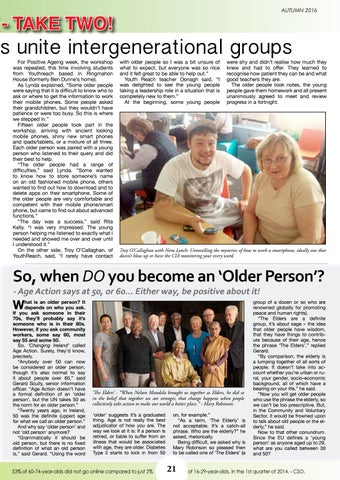
- TAKE TWO! s unite intergenerational groups For Positive Ageing week, the workshop was repeated, this time involving students from Youthreach based in Ringmahon House (formerly Ben Dunne’s home). As Lynda explained, “Some older people were saying that it is difficult to know who to ask or where to get the information to work their mobile phones. Some people asked their grandchildren, but they wouldn’t have patience or were too busy. So this is where we stepped in.” Fifteen older people took part in the workshop, arriving with ancient looking mobile phones, shiny new smart phones and ipads/tablets, or a mixture of all three. Each older person was paired with a young person who listened to their query and did their best to help. “The older people had a range of difficulties,” said Lynda. “Some wanted to know how to store someone’s name on an old fashioned mobile phone, others wanted to find out how to download and to delete apps on their smartphone. Some of the older people are very comfortable and competent with their mobile phone/smart phone, but came to find out about advanced functions.” “The day was a success,” said Rita Kelly. “I was very impressed. The young person helping me listened to exactly what I needed and showed me over and over until I understood it.” On the other side, Troy O’Callaghan, of YouthReach, said, “I rarely have contact
Tr
with older people so I was a bit unsure of what to expect, but everyone was so nice and it felt great to be able to help out.” Youth Reach teacher Oonagh said, “I was delighted to see the young people taking a leadership role in a situation that is completely new to them.” At the beginning, some young people
were shy and didn’t realise how much they knew and had to offer. They learned to recognise how patient they can be and what good teachers they are. The older people took notes, the young people gave them homework and all present unanimously agreed to meet and review progress in a fortnight.
Troy O’Callaghan with Nora Lynch: Unravelling the mysteries of how to work a smartphone, ideally one that doesn’t blow up or have the CIA monitoring your every word.
So, when DO you become an ‘Older Person’?
- Age Action says at 50, or 60… Either way, be positive about it!
W
hat is an older person? It depends on who you ask. If you ask someone in their 70s, they’ll probably say it’s someone who is in their 80s. However, if you ask community workers, some say 60, most say 55 and some 50. So, ‘Changing Ireland’ called Age Action. Surely, they’d know, precisely. “Anybody over 50 can now be considered an older person, though it’s also normal to say it about people over 60,” said Gerard Scully, senior information officer. “Age Action doesn’t have a formal definition of an ‘older person’, but the UN takes 50 as the norm for an older person.” “Twenty years ago, in Ireland, 50 was the definite (upper) age for what we call an older person.” And why say ‘older person’ and not ‘old person’ anymore? “Grammatically it should be old person, but there is no fixed definition of what an old person is,” said Gerard. “Using the word
‘The Elders’ : “When Nelson Mandela brought us together as Elders, he did so in the belief that together we are stronger, that change happens when people collectively take action to make our world a better place.” - Mary Robinson. ‘older’ suggests it’s a graduated thing. Age is not really the best adjudicator of how you are. The way we look at it is: If a person is retired, or liable to suffer from an illness that would be associated with age, they are older. Diabetes Type 2 starts to kick in from 50
53% of 60-74-year-olds did not go online compared to just 2%
on, for example.” “As a term, ‘The Elderly’ is not acceptable. It’s a catch-all phrase. Who are the elderly?” he asked, rhetorically. Being difficult, we asked why is Mary Robinson so pleased then to be called one of ‘The Elders’ (a
21
group of a dozen or so who are renowned globally for promoting peace and human rights). “The Elders are a definite group, it’s about sage – the idea that older people have wisdom, that they have things to contribute because of their age, hence the phrase ‘The Elders’,” replied Gerard. “By comparison, the elderly is a lumping together of all sorts of people. It doesn’t take into account whether you’re urban or rural, your gender, socio-economic background, all of which have a bearing on your life,” he said. “Now you will get older people who use the phrase the elderly, so we can’t be too prescriptive. But, in the Community and Voluntary Sector, it would be frowned upon to talk about old people or the elderly,” he said. Now to that other conundrum. Since the EU defines a ‘young person’ as anyone aged up to 29, what are you called between 30 and 50?
of 16-29-year-olds, in the 1st quarter of 2014. - CSO.
Changing Ireland
PLANNING & PEOPLE
Counties plough ahead with local
- Minister congratulates communities & local authorities, as Ireland plans and
T
he Minister for Housing, Planning, Community and Local Government, Simon Coveney, has officially launched the first round of six-year Local Economic and Community Plans. The plans detail “how different strands of local economic, social and community development work will be brought together to best serve local areas”, said the Department in a statement. The official launch took place at the National Ploughing Championships, in Screggan, Tullamore, Co. Offaly, on Sept 20th. “There’s an extra million people living in Ireland over the past 20 years – our lack of preparation for that resulted in huge increases in population and a doughnut around Dublin,” said Minister Coveney, noting that other communities had experienced population decline. Minister Coveney said the new plans will ensure Ireland is better prepared “when the next million people are added.” “The plans are integrated, locally, given the leadership of local authorities and Local and Community Development Committees (LCDCs).” “It’s a new structure that’s still bedding down and that people are getting used to, but we believe it can be hugely effective in giving leadership from the ground up within communities, where community ideas and activity can be harnessed, supported and funded to make things happen locally.” “That’s what this is about - creating a vision and a plan for the future within communities, in towns and villages and bigger urban populations.” “We can envisage where we want to take communities in the future, responding to challenges, pressures, technological change and climate change that communities and families will have to deal with in the coming years.”
National Planning Framework
“Nationally, this will feed into the new National Planning Framework (NPF) whereby we’re trying to prepare for what Ireland should look like in 20 to 30 years time.” He said the NPF will be completed by the middle of next year and possibly earlier. “This is about getting people discussing, talking, dreaming and planning for what they want for their communities and plugging that into the local authority system, through the LCDC structure and then harnessing a partnership with national government, as well as other voluntary organisations, community leaders, to get better outcomes.” “We will ensure the work you’ve done will be instructive in how we put together the national plan, which will be a combination of the work of so many different committees, counties, local authorities and LCDCs,” he said. Minister Coveney paid tribute to Department and local authority staff and local community groups. He complimented the volunteers and professionals alike on the “extraordinary work” they put into their plans.
Minister Simon Coveney and Michael Rainey, Chief Officer, Laois Co Co.
Minister Coveney with the delegation from Offaly, including Ann Marie Delaney and Cllr. Eddie Fitzpatrick, CEO and cathaoirleach respectively of Offaly Co Co.
22
l economic & community plans
d prepares for population increase of a further one million people
Charles Stanley Smith, chair of Tipperary LCDC, Minister Coveney and Attracta Lyons, Tipperary County Council.
Peter Stanley, Galway Co Co, Breda Fox, Local Enterprise Office, Minister Coveney, Padraig Conneely, chair of the Economic SPC.
Helen O’Leary, Bernie Doherty, Dublin City Council and Minister Coveney.
Cllr Noel Gleeson, Deputy Mayor, Limerick City & County Council, Minister Coveney and Cllr Eddie Ryan.
Brendan Reilly, CEO Breffni Integrated, Minister Coveney, Tommy Ryan Chief Officer, Cavan Co Co, Olive Hannigan, Cavan LCDC, and Padraig McBreen, Breffni Integrated.
Cllr Seamus Kilgallon, Sligo Co Co, Minister Coveney and Dorothy Clarke, Chief Officer, LCDC.
23
Changing Ireland
PLANNING & PEOPLE
Groups launch plans with Minister Coveney faster than you’d score a goal with a tractor T
he efficiency with which 19 plans were launched at the National Ploughing Championships would leave the farmers playing tractor-soccer (yes!) a few hundred metres away gasping. From all corners of the country, groups assembled in the marquee of the Department of Housing, Planning, Community and Local Government, outside Tullamore, Co. Offally, to meet with Minister Simon Coveney and Minister of State Damien English. Minister Coveney met the groups, delivered a good speech (see previous pages) - leaving his scripted one aside - and then launched the Local Economic and Community Plans (LECPs). There are 31 LECPs in total and they will feed into a new National Planning Framework. In his speech, Minister Coveney acknowledged that, “Rural Ireland faces big challenges maintaining vibrant, young communities, where we have lots of vacant properties that could be brought back into productive use if we manage and develop communities in a way that is planned in the medium and long-term.” Locally, from now on, new SICAP annual plans for each area will need to reflect recommendations in the same area’s Local
Economic and Community Plan. Each plan took a mammoth amount of work and the group representatives are pictured here proudly presenting their plans for the local, economic and community development of their areas.
Monaghan launch: Fintan McPhillips, LCDC Chief Officer, Cllr. Pat Treanor, SPC Chair, Ann Murray, Admin Officer, P.J. O’Hanlon, Mayor of Monaghan Co Co, Emer Brennan, LCDC Chair, Paul Clifford, Director of Services and Eamonn O’Sullivan, CEO of Monaghan Co Co. This photo was submitted for inclusion by the Monaghan LCDC.
Christine Flood and Lorraine Gallagher, both senior executive officers with Wicklow Co Co, Michael Nicholson, Director of Services, Wicklow County Council and Minister Coveney.
MEATH: Barry Lynch, Meath Co Co and Minister Coveney.
Futurists all, they showed they could move faster for the multiple-group photoshoot than a tractor driver could score a goal with a big bale of hay (about two minutes). Yet, after the long journey to Screggan, it was still smiles all round; the work was done.
Hugh O’Reilly, Chief Officer, Westmeath LCDC, Minister Coveney and Anne Galvin, Community Development Section, Westmeath Co Co.
Cllr. Norma Moriarty, Kerry Co Co, with Minister Coveney.
24
Minister Coveney with Cllr. Kieran Dennison, Acting Mayor, Fingal Co Co.
Minister Simon Coveney, Cora Gilligan, LECP Co-ordinator, and Declan Turnbull, Chief Officer, LCDC, Mayo Co Co.
Michael Brennan, Chief Officer of Carlow LCDC, Ann Scully, Community Staff, Carlow Co Co, Cllr. John Murphy, Cathaoirleach of Carlow Co Co, John Nolan, member of Carlow LCDC, Minister Simon Coveney and Margaret Moore, Community Staff, Carlow Co Co.
Nollaig Whyte of Leitrim Co Co and Minister Coveney.
Cllr. Laurence Fallon, Roscommon LCDC member, Cllr Tony Ward, chair of Roscommon Co Co, Martina Earley, chair of Roscommon LCDC, Cllr Kathleen Shanagher, chair of Roscommon Co Co’s Economic Development & Enterprise Support SPC, Pat Murtagh, Chief Officer, Roscommon LCDC and Maurice Gannon, Roscommon LCDC member.
Lar Power, Waterford City & County Council, and Minister Coveney.
25
Minister Coveney with Ger Mackey, Wexford Co Co.
EQUALITY & THE LAW 9 Grounds for
Unlawful discrimination he Employment Equality Acts 1998 – 2015 T outlaws discrimination on nine specific grounds. Discrimination occurs where one
person is treated less favourably than another person is, has been or would be treated. By law, you must be treated equally and cannot be discriminated against in relation to work and employment based on the following.
MEMBERSHIP OF THE TRAVELLER COMMUNITY If you are a member of the Traveller community. Pavee Point (paveepoint.ie). T: 01-878-0255. Irish Traveller Movement (itmtrav.ie). T: 01-679-6577.
GENDER
If you are a woman, a man, a transgender person or an intersex person. National Women’s Council of Ireland (nwci.ie). T: 01 878-7248 Men’s Development Network (mens-network.net). T: 051-844260/1 Gay & Lesbian Equality Network (glen.ie). T: 01-672-8650. LGBT Helpline: 1890 929 539.
MARITAL/CIVIL STATUS:
If you are single, married, separated, divorced, widowed or in a civil partnership. Irish Council for Civil Liberties (iccl.ie). T: 01-799-4504
FAMILY STATUS
If you are the parent or person responsible for a child under 18, or if you are the main carer or parent of a person with a disability who needs ongoing care. Spunout provides advice to youths (spunout.ie). T: 01 675 3554. Barnardos (barnardos.ie). T: 01 453 0355.
AGE
In general this means people in employment between the ages of 18 and 65 and people in vocational training between the ages of 15 to 65. Spunout provides advice to youths (spunout.ie). T: 01-675-3554. Age & Opportunity (olderinireland.ie). T: 01-805 7709.
Gay & Lesbian Equality Network (glen.ie). T: 01 6728650. LGBT Helpline: 1890 929 539.
RACE
No discrimination is allowed based on race, colour, nationality, ethnic or national origins. European Network Against Racism Ireland (enarireland.org). T: 01889-7110.
RELIGIOUS BELIEF
If you have a religious belief or do not. Athiest Ireland (atheist.ie) Roman Catholic Church (http://www.catholicbishops.ie/dioceses/) Church of Ireland (https://www.ireland.anglican.org/find-a-church) Islamic Cultural Centre of Ireland (islamireland.ie)
Direct V Indirect Discrimination:
To establish direct discrimination, a direct comparison must be made, for example, in the case of disability discrimination the comparison must be between a person who has a disability and another who has not, or between persons with different disabilities. Indirect discrimination occurs when practices or policies that do not appear to discriminate against one group more than another actually have a discriminatory impact. It can also happen where a requirement that may appear non-discriminatory.
DISABILITY
To find out more about your rights, contact a local organisation you trust, your local Citizens Advice Centre, or the Irish Human Rights and Equality Commission (which replaced the Equality Authority) which is based in 16 – 22 Green Street, Dublin 7. LoCall Line: 1890245545. T: 01-8589601. E: info@ihrec.ie W: ihrec.ie For further information online, visit: https://www.ucc.ie/en/hr/ equality/grounds/ And when you think the law’s been broken, talk to a trusted community or youth worker and/or call the Gardai.
SEXUAL ORIENTATION
Note: Discrimination on the basis of your social class or socioeconomic status is not illegal, despite such cases being common.
If you are a person with a physical, intellectual, learning, cognitive or emotional disability. Also if you experience a range of medical conditions Forum of People with Disabilities (inforum.ie). T: 01-8786077. Gay, lesbian, bisexual or heterosexual.
The drawings here are from a poster designed to raise awareness among the Traveller community about the nine grounds .
Free secondary education was first introduced in Ireland
26
in 1967.
Tr
HOUSING IS A HUMAN RIGHT
Galway Travellers confront ministers with calls to address accommodation crisis
Minister Coveney met with members of the Travelling Community in Galway city while there to open Threshold’s new Tenancy Protection Office and a number of social housing units. He said the Traveller accommodation crisis is proving a challenge, but he is committed to help solve it.
QUESTION - Bridget Kelly, Galway Travellers Movement
Bridget Kelly (pictured below) of Galway Traveller Movement asked Simon Coveney Minister for Housing, Planning, Community and Local Government, in September, to “make a public commitment to address the Traveller accommodation crisis is Galway City and County”. The Minister was in Galway for the government’s ‘Rebuilding Ireland’ ‘roadshow’ and GTM held a protest outside to demand action after decades of broken promises successive governments have made in relation to Traveller accommodation. Bridget said that while the Minister’s word is promising, Galway’s city and county councils need to deliver on their targets. #TravellerLivesMatter
REPLY - Minister Simon Coveney
Minister Coveney replied: “There is a need for a more sustainable and permanent solution to Traveller accommodation in Galway city. We cannot continue to have evictions, Travelling families moving from one illegal site to another and the friction within the Traveller community and with the settled community which comes from that, as well as the difficulties for local party officials and Gardai and all the rest of it. That is what creates the kind of divisions and fears and prejudices that we’re trying to move away from. “We do need to make brave decisions that are difficult political decisions sometimes around Traveller accommodation in Galway city and we will do what we can to support that. “My department’s role in this really is a financial one and we are planning to increase the budget for Traveller specific accommodation next year quite significantly and there’s a whole
load of conversations going on about Traveller accommodation generally, nationally, at the moment. The housing agency is being asked to do a review of that. “We’ve just published a report over the last few days on the fire risk on all of the specific Traveller accommodation sites around the country following the appalling tragedy last year in Carrickmines. So it’s an issue that is getting a lot of discussion at the moment within my department but I know there are particular issues and difficulties and pressures in Galway city at the moment, so obviously we will try to encourage resolution to those, but I can’t and I’m not going to dictate to councillors and to management how that is going to be done, but I know there are some proposals on the table and there are political conversations that need to be had to try to come to a conclusion on that.”
Following the Government’s announcement of Budget 2017, Pavee Point welcomed a 64% increase in capital funding to €9 million for Traveller-specific accommodation, calling it and other measures “positive”. The Traveller NGO said it hoped the funds help “to alleviate the overcrowding and dire conditions that Travellers are living in”, although it feared they may be “swallowed up in fire safety works” (which Pavee Point wish to see paid for from a separate fund).
NALA: Literacy is like a muscle. If you don’t use reading
27
and writing skills every day you can get out of practise.
Changing Ireland
GRASSROOTS OPINION Jobbridge is gone, but let’s revitalise Community Employment is good, but here’s how it could be great, WRITES CHRIS O’RALAIGH re-connect people and communities. As it peeks around the corner of its third decade, the programme itself has outlasted half a dozen governments, survived the recessioninspired cutbacks and proved an enduring pillar of the labour and skills market. However with the introduction of Jobpath and ongoing whispers about CE’s future, what is the future for a service which delivers to and for communities of disadvantage? I see this as a chance to rejuvenate and revitalise CE. Community Employment produces the best outcomes for participants and the scheme when three factors combine – enthusiasm from the participant, encouragement and guidance from the scheme, and opportunity from educational institutions and government policy. I call this the Success Equation. In one project I manage, all ten participants are beginning or completing major award level programmes, ranging from level 4 through to level 9 masters. This is an example of ‘The Success Equation’ in action and it is replicated around the country. The same applies even with a broader group. For example, we initiated an innovative jointventure with Ballsbridge College of Further Education, facilitating the establishment of a CEspecific FETAC major award in Employability Skills. This has seen the participants progressing to employment and full-time educational opportunities within the college. CE participants must be encouraged to dream big. Why shouldn’t CE participants be encouraged to achieve major awards, or thirdlevel training while simultaneously completing CE? Let’s avail of Springboard. Let’s avail of the SUSI grant. Let’s encourage CE participants to explore full-time studying commitments while
working. Many of the Colleges of Further Education offer full-time programmes where the 5-day week is split - three days on-campus and two days on work experience, the latter being fulfilled through their CE placement. For learners with restrictive timecommitments, the growing movement towards on-line and blended learning should be embraced. The SOLAS sponsored ecollege (ecollege. ie) and An Cosán’s Virtual Community College (ancosanvcc.com) offer modules from level 5 through to degree level and these provide
“CE has outlasted half a dozen governments, survived the (cuts) and proved an enduring pillar of the labour and skills market.”
Chris O’Ralaigh says that three simple changes would change everything.
C
ommunity Employment (CE) has a 22-year track-record of providing vital support for communities and to the people that make those communities prosper. Just look at the hundreds of community organisations, charities and notfor-profits which flourish with support from CE employees. But imagine the devastation that will fall upon them without this support. Community Employment is an asset and as an asset it should be protected and invested in: it is both a social and an economic investment in the social economy. For the CE participants, the programme delivers pivotal opportunities to re-engage with work, with broader society, and in many ways,
positive opportunities for CE participants to engage in the educational medium of the future. So, what do we need to achieve this revitalisation? Funding? Yes. A little flexibility and imagination from the Department of Social Protection (DSP)? A bigger yes! Three simple changes could make a substantial difference. 1. Triple the education budget from €250 to €750: This would open up a far greater range of educational opportunities for CE participants, naturally increasing employment and progression rates. The total cost of this tripling is €11.2 million annually, or one two-hundredths of 1% of the state’s annual expenditure.
DEPARTMENT OF SOCIAL PROTECTION RESPONSE
We are “cognisant of the valuable community
T
he Department of Social Protection (DSP) issued a statement in response to Chris O’Ralaigh’s article. It pointed out that Community employment (CE) is the largest employment programme administered by the Department; the budget for this year is €376.5m. The Department emphasised that it “continues to support and improve the programme for the benefit of the participants and recognises the valuable contribution it makes to local communities and services around the country.”
of the training proposed in terms of furthering the employment prospects of the individual.”
Communication and Childcare CEC Places
Training
“Delivery of training is in accordance with a tailored ‘Individual Learning Plan’ compiled by the CE supervisor with the participant, given the participant’s training requirements and employment goals. The training budget for Community Employment (CE) in 2016 is €6m. “The training budget is based on a notional per capita allocation of €250 per CE place. Flexibility is applied in the allocation of training costs per individual, particularly when the training leads to a Major Award e.g. in childcare or health and social care. Training is assessed based on the value
The Department of Social Protection will this year spend education places for jobseekers.
Under 5 years
March 2016 1,079
Over 5 years
363
Total Childcare Places
1,442
“Childcare is a crucial element for parents embarking on CE or returning to the workforce. The CE Childcare (CEC) Programme which commenced in January 2014 provides 1,200 subsidised childcare places for CE participants with children up to 5 years of age and 800 after-school childcare places. This programme is aimed at ensuring that CE participants get the childcare
28
more than €1 billion on work, training and
AUTUMN 2016
and keep Community Employment 2. Make the CE scheme pay a living wage: Increase the weekly payment by €30, freeing up participants to afford, for example, childcare, allowing that time to be then dedicated to training and education. Total cost? €29m annually.
“We need funding (and) a little flexibility and imagination from the Department.”
3. Remove the funding ban for third-level programmes: Para-phrasing Charles Stewart Parnell, whose monument overlooks the DSP’s Community Employment office, ‘No man has the right to say... Thus far shalt thou go and no further”. The Department, residing in the shadows of its inscription, should consider this statement if they continue to enforce the funding ban, because they are effectively saying to CE participants, “Thus far shall thou go, and no further”.
These three simple, affordable changes would help revitalise CE. Furthermore, the increases in funding will become self-financing in the long-run. The increased educational opportunities inevitably lead to increased employment, and therefore increased tax revenue. Essentially, this is a classic example of the state investing in its own citizens, and reaping a financial return, in kind. With a small budgetary increase and a commitment to the Success Equation, CE can move from being good to being great.
JARGON BUSTER
Chris Ó Rálaigh is a Learning and Development Coordinator with 10 years experience of working with Community Employment schemes. He can be contacted at oralaigh.chris@gmail.com
TELL US: WHAT DO YOU THINK?
What’s the best scheme then? How do you rate CE? Or Tús? Jobbridge is gone. What about the Rural Social Scheme? Neither our writer nor the Department are the only ones with ideas. Share your best suggestions with our readers. Email: editor@changingireland.ie
Community Employment (aka CE) - Established in 1994 (replacing the Social Employment scheme) it helps the long-term unemployed and people who are otherwise disadvantaged by offering them work experience and training within their communities. Participants work 19.5 hours a week and receive a minimum of €210.50 (including a €22.50 participation bonus). It aims to enhance the employability and mobility of participants. W: welfare.ie
Solas - The Irish for light or enlightenment, it now also refers to the Republic’s Further Education and Training Authority which oversees the work of Education and Training Boards (which took over from VECs and FÁS Training Centres in 2013). W: solas.ie. Springboard - One of the most popular springboards in the country is in Salthill, Galway... The new ‘Springboard’ offers free, higher education courses at certificate, degree and masters level in sectors where there are jobs. To qualify you must be in receipt of an unemployment payment, however no waiting period applies. W: springboardcourses.ie Jobpath - A year old this July, this programme offers skills support and guidance to people who are long-term unemployed. The Department of Social Protection (DSP) selects jobseekers on a random basis for referral to JobPath which is delivered by two private companies. W: welfare.ie/en/Pages/JobPath.aspx SUSI - SUSI was established in 2012 as the single awarding authority of education grants (replacing 66 previous grant awarding bodies). Often confused with the famous Japanese seafood dish. W: susi.ie
ty and voluntary services” that CE delivers supports they need to have a better future for themselves and their families. This Department continues to work closely with the Department of Children and Youth Affairs in this regard. “Take-up of the CEC Programme is monitored by the Department of Social Protection; at the end of March 2016 there were 1,442 children participating in the Scheme (see table). “Given the profile of participants on CE, only programmes accredited up to and including Level 6 in the National Framework of Qualifications (NFQ) will be funded,” the Department stated. This covers Advanced Certificates and Higher Certificates. “This is in line with the stated target group for CE of long term unemployed with low educational qualifications and the many disadvantaged groups with similar characteristics,” the statement continued.. The Department explained that, with its approval, courses at NFQ Level 7 - which include ordinary level degree courses - may be approved for partial funding (meaning participants must also make a financial contribution).
Jobbridge is gone. What next?!
consultation & engagement
“The Department recognises that consultation and communication in general helps improve the experience of CE for participants and sponsoring organisations. Such engagement, which occurs on a regular basis locally, offers the possibility for a more integrated programme and improved efficiencies and in the long run is advantageous to all involved. “Furthermore, in recognition of the role of the sponsoring organisations, Sponsor Group Engagement workshops with Department officials are now occurring, where sponsors are updated on any new developments on CE and given an opportunity to address any outstanding issues. Sponsoring organisations are also in regular contact with their scheme supervisors. “With the ongoing fall in the Live Register, the Department will examine how best all work programmes, including CE, meet the needs of people remaining on the Live Register and others dependent on social welfare in particular long term unemployed jobseekers and those most distant from the labour market. In any consideration of the scheme, it will be important also to be cognisant of the valuable community and voluntary services delivered to local communities,” the statement concluded.
29
Changing ChangingIreland Ireland
Tell us what you want to read... ‘Changing Ireland’ is your magazine. It covers community development, local development, anti-poverty work, social justice causes and wider civil society issues and achievements. Let us know what you think we should be covering. We like to give projects credit where deserved, but particularly where others nationally might learn from their efforts. While we seek to promote the positive, we are also determined to highlight the causes of poverty and exclusion, as well as proposed and/or proven solutions. From local community groups to local authorities, to independent social justice groups (eg receiving no State funding), we want to hear from you. Features planned for upcoming editions include coverage of: best practice supporting rural unemployed men North east inner city dublin - the community approach Public Participation Networks - Lessons to date Local and community development committees - best practice leader programe nationwide - case studies the campaign for 50/50 representation for women Social farming pro-social driving sustainable development goals - our responsiblities Contact the editor if you have a suggestion, especially relating to any of the above. If seeking to submit a story, definitely speak to or email the editor first (contact details on page 3). Students in relevant sectors are always welcome to submit proposals. We also occasionally take on interns. You are also welcome to have a chat with any member of our editorial team: Viv Sadd, Juan Carlos Azzopardi, Joe Saunders or Gearoid Fitzgibbon.
‘COMMUNITY’ IN CABINET
Whew! Close call as ‘co loses its senior MINISTERIAL
- Community in title of ministerial posts is almos - Name change at last minute, but we can’t than BY ALLEN MEAGHER
C
ommunities provide the fabric that keep a country together and Ireland and Britain are almost unique worldwide in having cabinet-level ministerial portfolios dedicated to ‘community’ affairs. In recent decades, a special place has been given to communities in the heart of government in these islands. Today, everybody knows which minister in Dáil Éireann is ultimately responsible for and answerable to communities. That’s only healthy in a democracy - people know where to go whether they’re coming with a problem or an idea. ‘Community’ is engraved on a brass plate outside a prominent building. However, until the summer, ‘community’ looked set to disappear from the list of titles of government departments in the Republic of Ireland. And, nobody protested. Nonetheless, rather late in the day – and better late than never - cabinet signed off on the official name changes and ‘Community’ was afforded senior status after all. Someone in power saw sense. Under Minister Simon Coveney, we now have the Department of Housing, Planning, Community and Local Government. DHPCLG, or Dipclog for short. Not as good as Craggy (see below) but still. The Government has not after all forgotten the vital role that community plays in our lives and that Community and Voluntary organisations play a pivotal role in the fight against poverty, discrimination, social exclusion and xenophobia. In 2002, Éamon Ó Cuív was given responsibility for the new Department of Community, Rural and Gaeltacht Affairs, fondly called ‘Craggy’. His “dream” was to bring all community-related government initiatives under the one departmental roof and in many ways he succeeded. After eight years, a reconfiguration saw Ó Cuív’s department recast as the Department of Community, Equality and Gaeltacht Affairs. Although there was a broad welcome for bringing together the community and equality functions of government, the economy was crashing.
Community - and equality - became less valued than before and the Community and Voluntary Sector – to experience constant cuts until 2015 – began to shrink. Projects shut down, workers were laid off and support for volunteering diminished. At the same time, communities’ needs spiraled, as poverty, unemployment and emigration hit the most disadvantaged communities hardest. Nationally, new labour activation programmes replaced older more communityrooted programmes. Their work was not sufficiently ‘evidence-based’, argued government. Voices of protest went unheeded as community development lost much of the backing it once enjoyed from government. The top-down emphasis from 2010 was on getting people in communities “back to work”. It sounds reasonable as a social inclusion measure until you count up the number of communities whose most pressing needs go far beyond merely preparing people for work. Ask yourself does inner-city Dublin need more community development or are jobs enough? In fairness, the government attempts to provide both, however without deploying the necessary resources. In 2011, the community remit was transferred to the Department of the Environment, Community and Local Government. Under Phil Hogan, local and community development and local government functions were closely aligned, as responsibility for community spending was delegated to Local and Community Development Committees which report back to local authorities. When our new Government was formed this year, nowhere could you find ‘Community’ in the title of any of the proposed ministries. The appointment of Catherine Byrne as Minister of State for Communities and the National Drugs Strategy was welcomed, but community appeared to be losing its ‘senior’ status. Yet it matters on these islands. From Achill to Moscow, only ourselves, Wales, Scotland, Northern Ireland and the United Kingdom name ‘community’ in departmental nomenclature. Across Europe, government departments
“Scotland, Wales, Northern Ireland, Britain and the Republic of Ireland have been unique as neighbouring states to name ‘community’ in departmental titles..” CSO: Most people work or a student
30
emigrating from Ireland this year were either at before departing. 10% were unemployed.
T
ommunity’ almost MINISTERIAL STATUS
AUTUMN 2016
COMMUNITY MINISTRIES ABROAD
st unique to Britain and Ireland. nk the protesters - there were none
Beyond Europe, Canada has a Minister of Infrastructure and Communities and Tanzania has a Ministry of Community Development, Gender and Children. Trinidad and Tobago also has a senior ministerial community development post. Zambia has also previously had a department of community development. Somewhat bizarrely, for nine years under martial law, until 1982, the Philippines had a Ministry of Local Government and Community Development. In countries with federal systems, community receives more recognition. For example, South Australia has a Department for Communities and Social Inclusion, while California has a Department for Housing and Community Development. At junior minister level, or its equivalent abroad, titles tend to be considerably longer and community is frequently named.
Tanzania highly rates community development. for regional or rural development/affairs are common, as are departments concerned with social affairs. Equality and social inclusion also occasionally feature. *************** Names are important. Ask Munster rugby fans who ensured the new stadium in Limerick was not given a corporate sponsor’s name! When the Government’s Social Inclusion and Community Activation Programme was provisionally named, the word ‘Community’ was not part of the title, but the powers that be took feedback and reworded the programme. Much of the community element of Government work now comes under Simon Coveney’s brief as Minister for Housing, Planning, Community and Local Government. Some community functions were transferred from the former Department of the Environment, Community and Local Government to the new Department of Arts, Heritage, Regional, Rural and Gaeltacht Affairs, under Heather Humphreys. Community has a deep meaning for all of us. The word reflects the incredible influence that local and national civil society organisations have on all our lives. Sometimes, people in dire need have only local community organisations or the community itself to turn to. Community-based organisations, activists and leaders help keep this country afloat, they keep people afloat, offer them a pathway through our unequal society. The State leans on the Community and Voluntary Sector for the delivery of many public services that in other countries are provided directly by the government. Successive governments have sought to
promote volunteering, active citizenship and more recently public participation at local level. We could have been the odd one out as Scotland, Wales, Northern Ireland, Britain and the Republic of Ireland have been unique as neighbouring countries to name ‘community’ in departmental titles. • Britain or the United Kingdom has a Department for Communities and Local Government. • The Scottish Parliament has a Cabinet Secretary for Communities, Social Security and Equalities. • Wales has a Cabinet Secretary for Communities and Children. • Stormont has a Minister of Communities. Thankfully, in the end, ‘community’ retained its senior status and the Government continues to provide the recognition afforded to ‘community’ by previous Irish governments and by our nearest neighbours. I didn’t take notes - I’d have walked into a tractor - while walking one September morning with Minister Simon Coveney to the Ploughing - an unscheduled meeting as happens there. However, he told me the Government saw it would have been an oversight and included ‘Community’ in the final analysis, because, he said, of its importance nationwide and in recognition of the many disadvantaged communities, urban and rural, that need attention. Now that ‘Community’ has its senior status, let’s see the investment follow and let us look as Pobal have done with SICAP recently - at the value of our community-based programmes. And let’s listen to what communities say.
Four adults and a child were found in mid-October in Kurds from Iraq, they have claimed asylum in Ireland,
31
THE WILL TO PROTEST
C
uts to and attacks on ‘community’ funding and autonomy provoked protests on/off from 2009 until 2015. Have we now reached a watershed? Are communities and their leaders – including those in academia - feel they’re wearing a straitjacket or are they simply beat? While people working in arts, culture and heritage campaigned strongly about how they felt about the Department’s new name – a downgrading they felt – there wasn’t a peep out of people in communities or the Community & Voluntary sector about the likely demotion at least in name of ‘Community’. Some of those in community groups who protested during the era of cutbacks have since changed career, been forced out through redundancies, or retired (volunteers). However, smaller State-funded community groups still protest, mostly over human rights issues. Clearly, the change in the Department’s name was not a human rights cause. It’s healthy to protest, often it’s the only thing to do. It can be an effective way to represent those without a voice. Now, one wonders has the Sector lost its own voice? - A.M.
A community protest in 2009.
a shipping container in New Ross. Reportedly among the few to make it this far west.
TACKLING EXCLUSIONARY Labour markets P Pobal’s conference speakers obal is hosting a one-day, national conference in Dublin City University, on November 9th. One only needs to read this edition’s front cover story to see the need. The event, in the Helix Theatre, is free to attend and is entitled ‘Creating an Inclusive Labour Market’. It invites speakers (see panel) to “discuss challenges and good practice regarding the creation of inclusive labour markets in Ireland”. It brings together employment service providers from the statutory, community, local development and private sectors. It aims to “support greater co-ordination between community, statutory, local government and the private sector in creating a more inclusive labour market for disadvantaged groups and communities.” It will showcase initiatives and approaches from local, regional and national settings and will include plenary and workshop sessions. The event kicks off with a new ESRI report exploring area-based, social inclusion and community development training programmes in Ireland. It will conclude with the launch of a new OECD report, ‘Weaving Together Policies for Social Inclusion in Ireland’. Pobal says the conference should be of interest to education and training providers, local development companies, local authorities, national and regional NGOs, local community and voluntary sector organisations, employment service providers, private and public sector employers, academics and researchers.
Un Days Nov-Dec 2016
Maureen Gaffney, psychologist/author
Philip O’Connell, UCD
Donald Storrie, Eurofound
Patricia King, ICTU
Minister Leo Varadkar
Commissioner Marianne Thyssen (by video)
Minister Catherine Byrne
Craig Holmes, Oxford University
Nov 2 Wednesday Nov 6 Sunday in War and Armed Conflict Nov 10 Thursday Nov 12 Saturday Nov 14 Monday Nov 16 Wednesday Nov 17 Thursday Nov 19 Saturday Nov 20 Sunday Nov 20 Sunday Nov 20 Sunday Nov 21 Monday Nov 25 Friday Nov 29 Tuesday
International Day to End Impunity for Crimes against Journalists International Day for Preventing the Exploitation of the Environment
Dec 1 Dec 2 Dec 3 Dec 5 Dec 5 Dec 7 Dec 9 Dec 10 Dec 11 Dec 18 Dec 18 Dec 20
World AIDS Day International Day for the Abolition of Slavery International Day of Persons with Disabilities International Volunteer Day for Economic & Social Development World Soil Day International Civil Aviation Day International Anti-Corruption Day Human Rights Day International Mountain Day International Migrants Day Arabic Language Day International Human Solidarity Day
Thursday Friday Saturday Monday Monday Wednesday Friday Saturday Sunday Sunday Sunday Tuesday
World Science Day for Peace and Development World Pneumonia Day World Diabetes Day International Day for Tolerance World Philosophy Day World Toilet Day World Day of Remembrance for Road Traffic Victims Universal Children’s Day Africa Industrialization Day World Television Day International Day for the Elimination of Violence against Women International Day of Solidarity with the Palestinian People
“Changing Ireland’, c/o Community Enterprise Centre, Moyross, Limerick. W: www.changingireland.ie T: 061-458011. E: editor@changingireland.ie Find us on: Twitter, Facebook, Blogger, Linkedin & Youtube