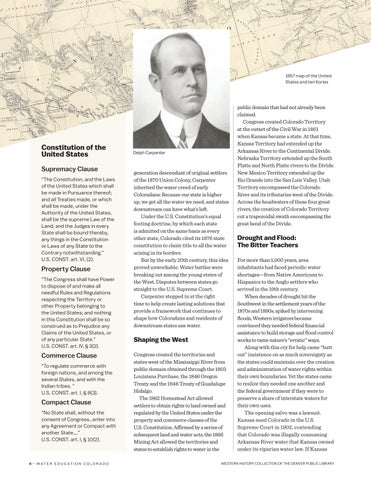
1857 map of the United States and territories
Constitution of the United States Supremacy Clause “The Constitution, and the Laws of the United States which shall be made in Pursuance thereof; and all Treaties made, or which shall be made, under the Authority of the United States, shall be the supreme Law of the Land; and the Judges in every State shall be bound thereby, any things in the Constitution or Laws of any State to the Contrary notwithstanding.” U.S. CONST. art. VI, (2).
Property Clause “The Congress shall have Power to dispose of and make all needful Rules and Regulations respecting the Territory or other Property belonging to the United States; and nothing in this Constitution shall be so construed as to Prejudice any Claims of the United States, or of any particular State.” U.S. CONST. art. IV, § 3(2).
Commerce Clause “To regulate commerce with foreign nations, and among the several States, and with the Indian tribes. ” U.S. CONST. art. I, § 8(3).
Compact Clause “No State shall, without the consent of Congress…enter into any Agreement or Compact with another State….” U.S. CONST. art. I, § 10(2).
6 • WAT E R E D U C AT I O N C O L O R A D O
Delph Carpenter
generation descendant of original settlers of the 1870 Union Colony, Carpenter inherited the water creed of early Coloradans: Because our state is higher up, we get all the water we need, and states downstream can have what’s left. Under the U.S. Constitution’s equal footing doctrine, by which each state is admitted on the same basis as every other state, Colorado cited its 1876 state constitution to claim title to all the water arising in its borders. But by the early 20th century, this idea proved unworkable. Water battles were breaking out among the young states of the West. Disputes between states go straight to the U.S. Supreme Court. Carpenter stepped in at the right time to help create lasting solutions that provide a framework that continues to shape how Coloradans and residents of downstream states use water.
Shaping the West Congress created the territories and states west of the Mississippi River from public domain obtained through the 1803 Louisiana Purchase, the 1846 Oregon Treaty and the 1848 Treaty of Guadalupe Hidalgo. The 1862 Homestead Act allowed settlers to obtain rights to land owned and regulated by the United States under the property and commerce clauses of the U.S. Constitution. Affirmed by a series of subsequent land and water acts, the 1866 Mining Act allowed the territories and states to establish rights to water in the
public domain that had not already been claimed. Congress created Colorado Territory at the outset of the Civil War in 1861 when Kansas became a state. At that time, Kansas Territory had extended up the Arkansas River to the Continental Divide. Nebraska Territory extended up the South Platte and North Platte rivers to the Divide. New Mexico Territory extended up the Rio Grande into the San Luis Valley. Utah Territory encompassed the Colorado River and its tributaries west of the Divide. Across the headwaters of these four great rivers, the creation of Colorado Territory cut a trapezoidal swath encompassing the great bend of the Divide.
Drought and Flood: The Bitter Teachers For more than 1,000 years, area inhabitants had faced periodic water shortages—from Native Americans to Hispanics to the Anglo settlers who arrived in the 19th century. When decades of drought hit the Southwest in the settlement years of the 1870s and 1890s, spiked by intervening floods, Western irrigators became convinced they needed federal financial assistance to build storage and flood control works to tame nature’s “erratic” ways. Along with this cry for help came “butt out” insistence on as much sovereignty as the states could maintain over the creation and administration of water rights within their own boundaries. Yet the states came to realize they needed one another and the federal government if they were to preserve a share of interstate waters for their own uses. The opening salvo was a lawsuit. Kansas sued Colorado in the U.S. Supreme Court in 1902, contending that Colorado was illegally consuming Arkansas River water that Kansas owned under its riparian water law. If Kansas
WESTERN HISTORY COLLECTION OF THE DENVER PUBLIC LIBRARY