From headwaters to plains, Coloradans are working to keep rivers — and fish — thriving.
The Fish Issue
A joy for sport anglers, a boon for local economies, and a necessity for rivers, lakes and entire ecosystems, Colorado’s fish are appreciated by many and critical for all who value Colorado’s waterways. Explore how Coloradans are working to support and restore native fish populations and looking to recreation as a way to foster a love for fish, conservation and water.
Casting Toward Stewardship
Hooking kids on the fun of fishing is just the start — educational initiatives are reeling in new lifelong conservationists who care about fish and the ecosystems that make angling possible.
BY EMILY PAYNE
Native Waters
Colorado’s native fish evolved to match the state’s diverse landscapes and waterways. In the face of plummeting populations, Coloradans target restoration efforts to help these fish endure.
BY ELISABETH KWAK-HEFFERAN
Fish on the Move
Fish need freedom to move, but barriers — from dams to dry riverbeds — can limit their range. Now, collaboration is reopening those pathways and keeping rivers and fish alive.
BY ELIZABETH MILLER
Water news from across Colorado: Dry Times in the Basin Farmers and ranchers across four states are cutting back as the Colorado River system runs low.
The State Reporting from Colorado's major watersheds.
MEMBER'S CORNER Celebrate the impact of WEco’s members.
INTRODUCTION
A Note From The Director
Stewardship in Action
Water Education Colorado is so pleased to share our Fall issue of Headwaters magazine centered on Colorado’s fish, the ecosystems that sustain them, and the people and programs that ensure their future. Across its three major articles, the magazine explores how recreation, restoration, and reconnection intersect to support both aquatic biodiversity and human stewardship.
1. Recreational fishing to encourage stewardship and stimulate the economy: Recreational fishing emerges as both a cultural touchstone and an economic powerhouse. Colorado Parks and Wildlife (CPW) stocks 90 million fish annually, generating more than $1.4 billion in GDP and directly funding 70% of wildlife management through license sales. Beyond economics, fishing clinics and classroom programs like Trout in the Classroom engage youth and families in hands-on conservation, teaching stewardship through experience. The article emphasizes how the next generation of anglers and water stewards is directly linked to local economies.
2. Native fish and restoration: We take an in-depth look at Colorado’s remarkable diversity of native fish. We also navigate some of the challenges they face due to pollution, non-native species, and climate change. Through detailed case studies, like the rediscovery and reintroduction of the greenback cutthroat trout and recovery of desert river species such as the razorback sucker, the story reveals how scientific partnerships and genetic research are reshaping conservation. The message: Native fish represent the resilience of Colorado’s waters, and their survival depends on continued habitat restoration and adaptive management.
3. Reconnecting Waterways and Species: The final feature traces the movement of fish across rivers and time. By showing how new infrastructure, partnerships, and flow management reconnect fragmented waterways, this piece underscores collaboration as Colorado’s greatest conservation tool, where scientists, water managers, and communities co-design the future of healthy, connected rivers.
I hope this edition of the magazine informs our readers while continuing to elevate the work that water stewards across Colorado continue to do to learn about the link of fish ecology and Colorado waterways. I also would like to thank all of those who supported our work to make this possible.
In other important news, WEco has concluded our 2025 in-person programs, I would be remiss not to share our gratitude for everyone who made our 2025 programs a complete success. From our Social Water Series events, the 2025 Water Leaders and Water Fluency programs, the Sustaining Colorado Watershed Conference, webinars, the updated Community Guide to Colorado Water Conservation and Efficiency, and our weekly Freshwater news, we are successful because of support and collaboration from the wider water community.
Thank you, and I hope you enjoy this new issue of Headwaters magazine.
Onwards,
Executive Director
STAFF
Juan Pérez Sáez Executive Director
Sabrina Scherma
Programs Director
Saeda Aljazara Administrative and Operations Coordinator
David Grimsland
Membership and Development Manager
Paulina Gutierrez Program and Outreach Coordinator
Tess Koskovich
Marketing, Communications and Outreach Manager
Jerd Smith
Fresh Water News Editor
Caitlin Coleman
Publications and Digital Resources Managing Editor
CREATIVE
Dana Smith
Headwaters Art Director
BOARD OF TRUSTEES
Lisa Darling President
Dulcinea Hanuschak
Vice President
Brian Werner
Secretary
Alan Matlosz
Treasurer
Cary Baird
Perry Cabot
Nick Colglazier
Nathan Fey
David Graf
Eric Hecox
Matt Heimerich
Julie Kallenberger
David LaFrance
Dan Luecke
Karen McCormick
Leann Noga
Peter Ortego
Nate Pearson
Dylan Roberts
Monika Rock
Ana Ruiz
Elizabeth Schoder
Don Shawcroft
Chris Treese
Katie Weeman
THE MISSION of Water Education Colorado is to ensure Coloradans are informed on water issues and equipped to make decisions that guide our state to a sustainable water future. WEco is a non-advocacy organization committed to providing educational opportunities that consider diverse perspectives and facilitate dialogue in order to advance the conversation about water.
HEADWATERS magazine is published three times each year by Water Education Colorado. Its goals are to raise awareness of current water issues, and to provide opportunities for engagement and further learning.
THANK YOU to all who assisted in the development of this issue. Headwaters’ reputation for balance and accuracy in reporting is achieved through rigorous consultation with experts and an extensive peer review process, helping to make it Colorado’s leading publication on water.
CSU Spur, Hydro/The Shop, 4777 National Western Drive, Denver, CO 80216 (303) 377-4433
WHAT WE'RE DOING
Meet the 2025 Water Leaders Program Graduates
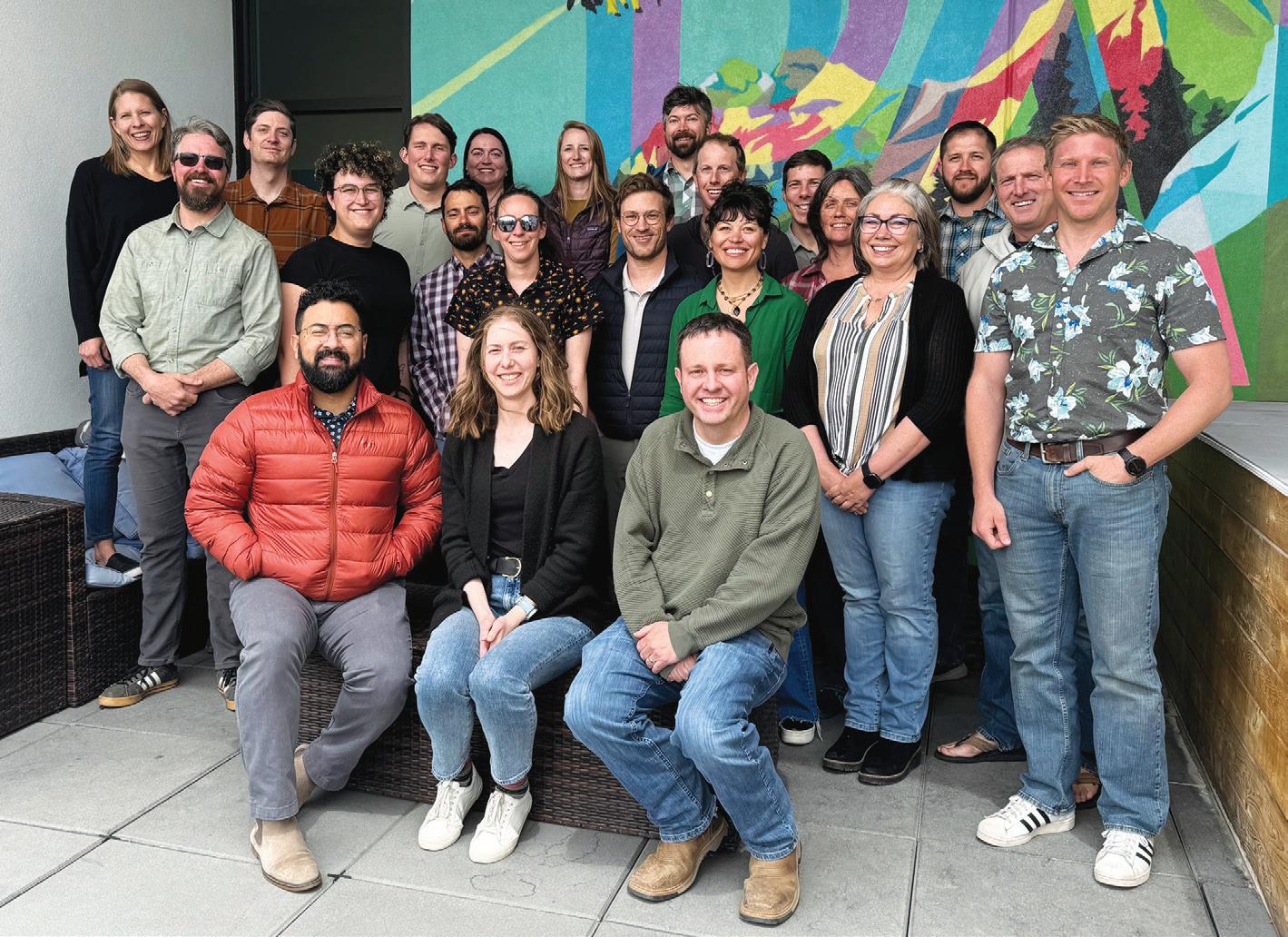
With another Water Leaders Program successfully wrapped up, we’re proud to celebrate the 2025 graduates! Over the past eight months, they’ve dedicated countless hours to virtual and in-person training, while learning from coaches, mentors and one another. They leave the program with new tools, sharpened skills, and the confidence to make a lasting impact on their organizations, the Colorado water sector, and our state as a whole. Please join us in congratulating this year’s outstanding class! With gratitude and recognition to our title sponsors at the Colorado Water Conservation Board and Molson Coors.
Adam Prior
City of Greeley
Amanda Hill
Gates Family Foundation
Annie Berlemann
Colorado Springs Utilities
Dan Graeve
Legislative Council Staff/
Greg Hobbs Memorial Scholarship Recipient
David Schiowitz
SGM
Diane Roher
Hazen and Sawyer
Fern Beetle-Moorcroft
HRS Water Consultants
Jared Heath
City of Fort Collins Utilities
Jen Stephenson
Northern Water
Kayla Ranney
HDR
Lindsay DeFrates
Colorado River District
Matt Stockton
City of Thornton
Mickey O’Hara
The Nature Conservancy
Michael Lawlor
City of Boulder
Nathan Phelps
Schnabel Engineering
Nate Pearson
Colorado Department of Natural Resources
Ryan Dalton
Pueblo Water
Taylor Winchell
Denver Water
Tracy Emmanuel
Otak
Tyler Gilman
Mount Werner Water & Sanitation District
Applications for the 2026 program will open in the new year. Want to be sure not to miss the announcement? Add your name to a notification list at wateredco.org/water-leaders.
Water Fluency
The Water Fluency Program is wrapping up its 11th year! This year’s program focused on the Yampa/ White/Green river basins, highlighting innovative water practices and management. Over the course of five days, our class of 36 participants engaged in lectures, field visits, and discussions to deepen their understanding of Colorado water.
A special thank you to our 2025 Water Fluency Title Sponsor, the Colorado Water Resources & Power Development Authority, for making this program possible.
A Conversation With ANA RUIZ
Because water is a finite resource that’s fundamental to life, it forces us to collaborate and see things from other people’s perspectives.
We spoke with Water Education Colorado board member and environmental scientist with the Colorado Department of Public Health and Environment, Ana Ruiz. Read the full interview on the blog at watereducationcolorado.org.
BEHIND THE STORIES
From The Editor
Hooked on Fish
There’s something splashy about this issue of Headwaters magazine and our focus on fish. It’s exciting to report on creatures that people connect with and a recreational activity that so many individuals are personally invested in.
In reporting for this issue, I learned that there are many types of fish in Colorado – more than 35 species of catchable sport fish, plus another 20 or so non-game natives. The fish in these two buckets, the sport fish and natives, require vastly different management and spark interest in two seemingly different ways.
“... some of the very same fish species that are bred for sport are among the greatest threats to native fish populations.”
There’s no question that people love fishing, that anglers play an important role in helping manage the state’s fisheries, and that fishing contributes billions to the state economy. Yet some of the very same fish species that are bred for sport are among the greatest threats to native fish populations. The Upper Colorado River Endangered Fish Recovery Program identifies the smallmouth bass, northern pike, and walleye as the biggest obstacles to the recovery of rare native fish. These invasive fish can be predatory, eating natives and competing for habitat and resources.
Yet responsibly stocked fish and native fish aren’t at odds. The endangered fish recovery programs work closely with Colorado Parks and Wildlife — together they share a non-native
fish stocking agreement to determine which non-natives are allowed in the basin. They even take measures to test certain fish, such as walleye, to ensure they are stocking only sterile fish in reservoirs.
While working to contain the non-natives that have been introduced, officials are also eliminating barriers to natives. In “Fish on the Move” (page 24) Elizabeth Miller reports on efforts to connect habitats so that native fish can move up and down rivers. She also covers a project in which a fish screen was installed to keep native fish out of the Grand Valley Water Users Association canal to protect them. In addition to encouraging or limiting movement, wildlife managers are making strides in supporting, breeding, stocking and recovering Colorado’s native fish. Learn about the natives and threats to them, including the non-natives, in Colorado’s different river basins in Elisabeth Kwak-Hefferan’s “Native Waters” (page 16).
It’s easy to care about Colorado’s natives, and to cheer for threatened and endangered fish. It’s also easy to care about fishing and to develop a physical connection with fish and water resources. As Emily Payne writes in “Casting Toward Stewardship” (page 12), “the more anglers get out on the waters, the more they care about the fish and aquatic ecosystems that make the sport possible.”
Here’s to more people caring enough about fish to learn more and take action toward sustainable aquatic ecosystems. May we foster a healthy environment for our native fish to survive, and our anglers to enjoy!
Flowing Forward Together
An evening celebrating the 2025 President’s Reception and Awardees.
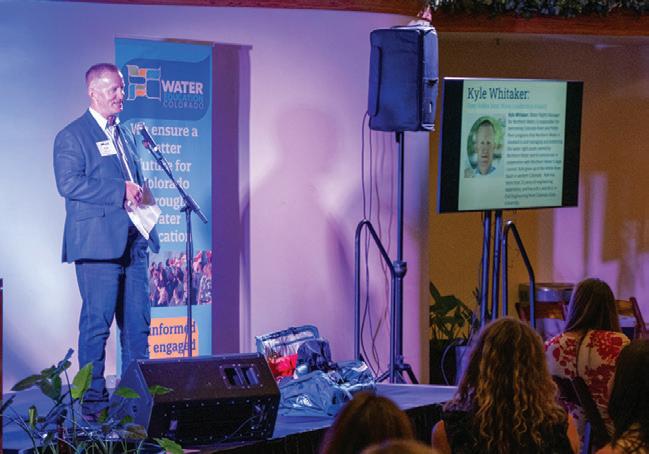
The 19th annual President’s Reception and fundraiser was held on September 10, 2025, celebrating the vital work of water education in Colorado while honoring this year’s outstanding awardees. We are proud to recognize Robert Sakata with the 2025 Diane Hoppe Leadership Award and Kyle Whitaker with the 2025 Greg Hobbs Next Wave Leadership Award. This year’s reception also marked the first
under the leadership of Juan Pérez Sáez as Executive Director.
With immense gratitude, we are pleased to share that sponsorships, ticket sales, auction bids, and donations totaled more than $108,257 — funds that will directly support WEco’s programs, educational materials, and efforts to engage elected officials, water professionals, educators, students, and the broader community.
THANK Y OU TO OUR 2025 PEAK AND TORRENT SPONSORS
Robert T. Sakata
Robert T. Sakata has dedicated his life to agriculture, water stewardship, and public service in Colorado. A lifelong farmer and respected leader in the state’s agricultural and water policy arenas, Sakata began his role in January 2024 as the Colorado Department of Agriculture’s (CDA) first-ever agricultural water policy advisor. This newly created position was designed to provide a stronger voice for Colorado farmers and ranchers on water issues.
Commissioner of Agriculture Kate Greenberg praised Sakata’s appointment, calling him “the right person at the right time.” She said that his lifetime of experience as both a farmer and a water policy leader, coupled with his commitment to Colorado’s agricultural communities, uniquely positions him to represent and support producers.
Sakata is the president of Sakata Farms, Inc., a family-run operation in Brighton, Colorado, founded in 1944 by his late father, Bob Sakata. Today, the farm cares for roughly 2,500 acres of irrigated land stretching across Brighton, Platteville, and Hudson.
From a young age, Sakata's parents instilled in him the value of community service. Following in their footsteps, he became the founding president of the board of directors for the Colorado Fruit & Vegetable Growers Association, which was established to unite produce growers across the state with a shared voice in policy.
In his new role as agricultural water policy advisor, Sakata brings firsthand experience with irrigated agriculture and decades of water leadership.
As CDA Conservation Services director Les Owen observed, “Robert brings experience that can only be gained by making a living in irrigated agriculture to this position. This will make him a tremendous asset to CDA in advocating for the agriculture industry on water issues.”
Sakata’s water leadership is extensive. In 2021, Governor Polis appointed him to the Colorado Water Conservation Board (CWCB) as the South Platte Basin representative. His term concluded in 2024, at which point he transitioned to serving as Commissioner Greenberg’s delegate to the CWCB. He has also been
engaged in local and regional water management, serving on the boards of the Fulton Irrigation Company, the Brighton Ditch Company, and the New Brantner Irrigation Ditch Company.
His service history extends far beyond these roles. Sakata served as a member of the Metro Basin Roundtable, sat on the Colorado Water Congress Board of Directors, and contributed his expertise to the National Onion Association Board of Trustees, the Adams County Farm Bureau Board of Directors, and the Colorado Onion Association Board of Directors.
He also gave 15 years of service on the Colorado Water Quality Control Commission, appointed by three different governors — a testament to the respect and trust he earned across administrations.
In recognition of his leadership, the Colorado Farm Bureau honored Sakata in 2022 with the Outside of Farm Bureau Service to Agriculture Award.
Throughout his career, Sakata has spoken often about the importance of building trust and fostering dialogue around water. “I am honored to
be able to participate in water discussions no matter where, in order to build trust and foster positive relationships that can carry meaningful dialogue forward,” he has said. His approach reflects both his humility and his dedication to ensuring that water policy decisions remain rooted in collaboration, respect, and a shared vision for Colorado’s agricultural future.
Today, as both a farmer and a public servant, Sakata balances the realities of operating a large-scale irrigated farm with the responsibility of shaping statewide agricultural water policy. This unique perspective enables him to bridge the gap between producers on the ground and policymakers at the table. Whether tending to crops, serving on an irrigation board, or advising state leaders, Sakata brings the same commitment: to safeguard Colorado’s agricultural heritage, advocate for the responsible use of water, and support the farmers and ranchers who sustain the state. Robert is a most worthy recipient of WEco's 2025 Diane Hoppe Leadership award.
Robert Sakata (third from right) celebrates at the 2025 President's Reception surrounded by Colorado Department of Agriculture staff.
2025 DIANE HOPPE LEADERSHIP AWARD
Kyle Whitaker
Kyle Whitaker, the water rights manager for Northern Water where he has worked since 2018, is the recipient of the 2025 Greg Hobbs Next Wave Leadership Award. He is respected statewide for his roles with programs on both the South Platte River and Colorado River.
Eric Wilkinson, former general manager of Northern Water, is a huge fan of Kyle’s. “He has practical knowledge and is always looking for solutions. He’s a true leader and puts so much time into his roles.”
Growing up in the White River Basin in western Colorado, attending college in Fort Collins
and then spending 18 years with the Division 5 (Colorado River) engineer’s office has prepared him to advance collaborative solutions to water issues.
Kyle is currently the Colorado Water Users representative to the Platte River Recovery Program’s Governance Committee. Likewise, he is also the co-chair of the Water Users Group for the Upper Colorado River Recovery Program.
Does he enjoy the work? “It’s a real challenge, but I like to think I can help bring people together and look at mutually beneficial outcomes, while protecting the state’s positions.”
And there certainly is plenty of action on both river basin fronts. In the South Platte, there is the State of Nebraska’s pending lawsuit against Colorado. In the Colorado River Basin there is the challenge of the forthcoming new guidelines and operating criteria.
“In any instance Colorado water users will have to adapt. We hope it brings more certainty, but there may be some difficult times ahead.”
Through it all Kyle remains optimistic and emphasizes the need for collaboration.
Wilkinson adds, “Kyle is very subtle in his leadership, not
dominating and he convinces you rather than tells you.”
As water rights manager for Northern Water, Kyle oversees interstate, intrastate, local and stakeholder-led Colorado River and Platte River programs. He also manages and protects Northern Water’s water rights.
He serves as a member of the Upper Colorado Wild and Scenic Stakeholder Group. Kyle is a member of the Water Advisory Committee for the Platte River Recovery Program, in addition to his role on the Governance Committee, and is a member of the Water Acquisition Committee for the Upper Colorado River Endangered Fish Recovery Program.
In case that isn’t enough, Kyla is the water conservancy district appointee to the South Platte Water Resources Advisory Project, or SPWRAP and he served on the Colorado River Drought Task Force in 2023
How does he balance all his committees and programs?
“There is so much to learn from our colleagues in other parts of Colorado and other western states. To be given the opportunity to learn from others' experiences ... is invaluable."
In summing up Kyle’s style, Wilkinson said, “he makes the Eveready Bunny look like a slacker and he never looks tired!”
THANK YOU ALSO TO OUR 2025 PRESIDENT’S RECEPTION CASCADE AND RIPPLE SPONSORS
• CEGR Law
• Colorado Department of Agriculture
• Conscience Bay Research
• HDR
• Northern Water
• Alyson Scott Law
• Central Colorado Water Conservancy District
• Colorado River District
• Colorado Water Resources and Power Development Authority
• Colorado Water Center
• Denver Water
• Foresgren Associates Inc.
• Kogovsek & Associates, Inc.
• LRE Water
• Rio Grande Water Conservation District
• Southeastern Colorado Water Conservancy District
• Southwestern Water Conservation District
• Stifel
• Titos Handmade Vodka
• The Nature Conservancy
• Upper Yampa Water Conservancy District
• Wright Water Engineers, Inc.
• Western Growers
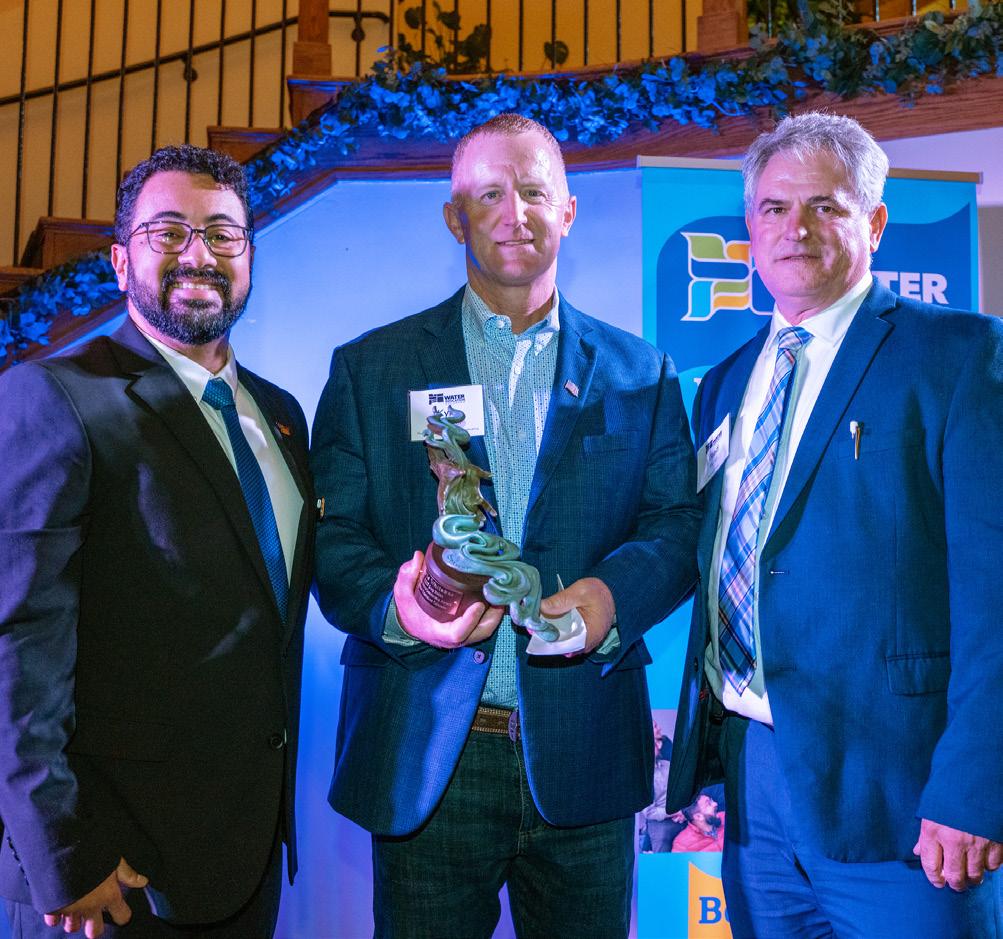
Kyle Whitaker (middle) accepts the Greg Hobbs Next Wave Leadership Award beside WEco's executive director, Juan Pérez Sáez (left) and Northern Water's general manager Brad Wind (right).
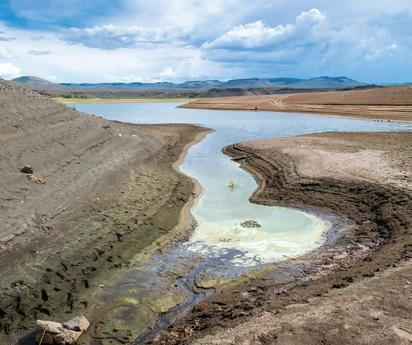
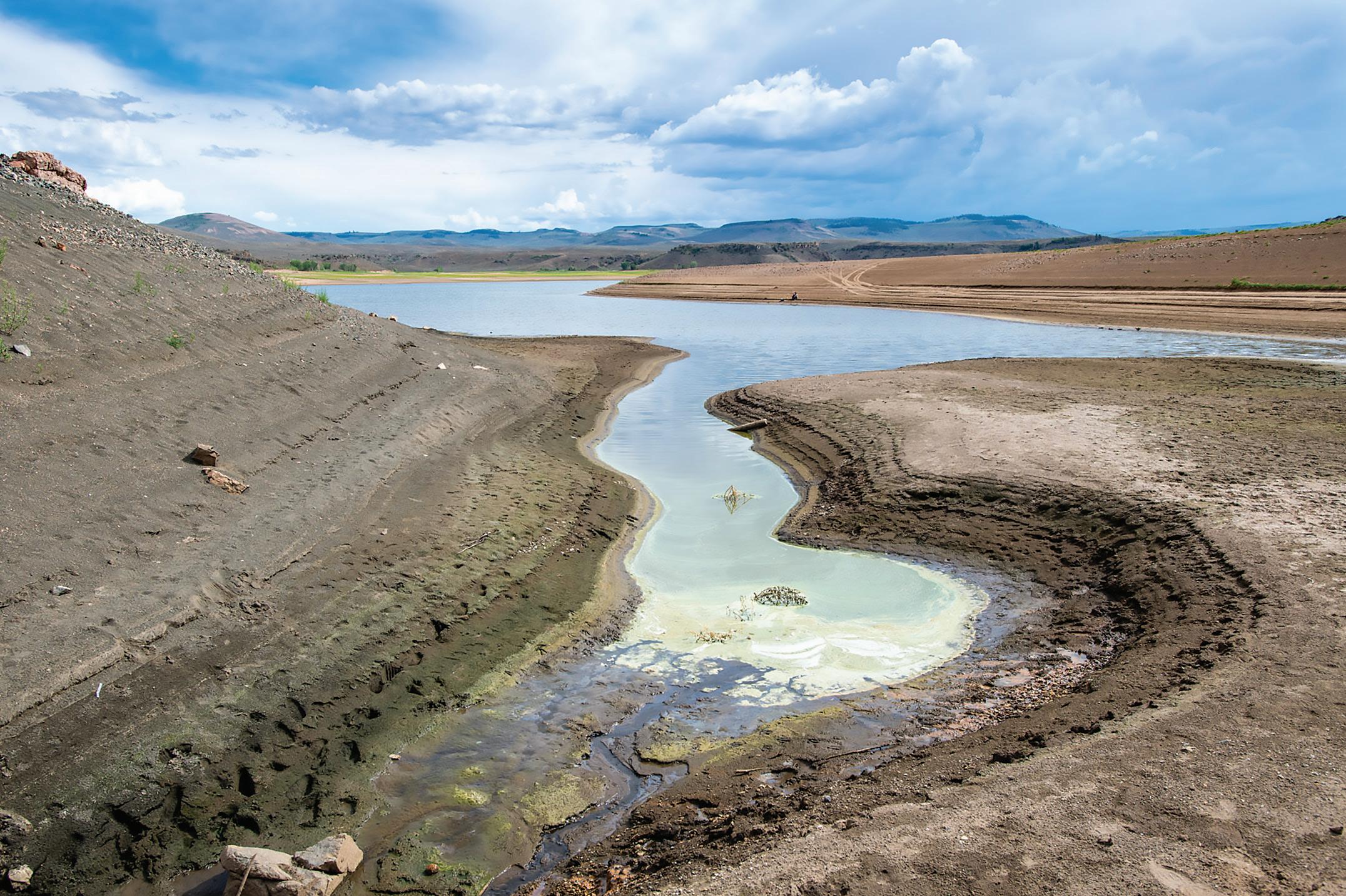
Blue Mesa Reservoir is the largest storage facility in Colorado in the Upper Colorado River system. Prolonged drought and downriver demand is shrinking the reservoir. On this day in July 2021, the water elevation was 7,457 feet. In late October 2025, the water level was barely higher at 7,464 feet — 47.86% below full pool.
Dry Times in the Basin
Farmers and ranchers across four states are cutting back as the Colorado River system runs low.
Water users in four Western states, including Colorado, cut back on water use this summer because of low Colorado River Basin flows.
Less than half the normal amount of water flowed into Lake Powell from the Upper Basin states — Colorado, New Mexico, Utah and Wyoming — this summer. Farmers in the four-state region fallowed fields and changed crop plans to adapt. These dry conditions coincided with high-stakes negotiations over how the water supply for 40 million people will be managed starting in August 2026.
In the Upper Basin, officials are trying to emphasize the shortages that happen each
BY SHANNON MULLANE
year as natural water supplies are strained by a changing climate.
“The Upper Basin’s sacrifices aren’t abstract; they carry real human and economic consequences,” the Upper Colorado River Commission said in a news release in October.
For the entire water year, about 4.69 million acre-feet ran into Lake Powell from the Upper Colorado River Basin. That’s 49% of the 30-year average, according to the Colorado Basin River Forecast Center. It was the seventh driest year since 1963, when the center started making forecasts.
In southwestern Colorado, farmers that use Dolores Water Conservancy District
water have faced shortages in five out of the last eight years. In early June, water users were set to receive 30% of their usual water supply. That increased to 56% because of a decent June runoff, said Ken Curtis, general manager of the Dolores Water Conservancy District.
This story originally appeared in Fresh Water News, a collaboration between the Colorado Sun and Water Education Colorado. Read it online at wateredco.org.
Shannon Mullane writes about the Colorado River Basin and Western water issues for The Colorado Sun.
Water News From Across Colorado
Around The State: Reporting From Colorado's Major Watersheds
ARKANSAS RIVER BASIN
The Colorado Division of Water Resources is working its way through a ponds management program to ensure that Arkansas River Basin water is available to those who own the water rights, reports CPR News. This summer, the agency catalogued all of the ponds in Custer County in order to evaluate whether each pond has appropriate water rights. As of July, more than 400 ponds had no permitting record, but some of those are natural and not considered illegal.
COLORADO RIVER BASIN
Colorado Politics reports that a stretch of the Colorado River from east of Grand Junction to the Utah border is officially infested with zebra mussels, marking the first time that zebra mussels have been found in the Colorado River. Other infested water bodies in Colorado include Highline and Mack Mesa lakes near Fruita, and West and East lakes near Clifton. The infestation on the mainstem of the Colorado River is not being treated because of the risk to native fish populations.
GUNNISON RIVER BASIN
Aspen Journalism reports that some Delta County ranchers are asking Colorado lawmakers to consider a bill that would make it easier for them to get credit for conserving water. These farmers and ranchers are asking for voluntary, compensated water conservation in order to save water on their land and send it downstream to bolster levels in Lake Powell. But first, that saved water needs to be accounted for as it flows through the state. They are asking the General Assembly to pass legislation that would allow the state engineer to shepherd water downstream or require conserved water to bypass other water users’ headgates. However, the shepherding conversation brings up concern about water speculation and interstate water markets. A shepherding law should not be passed without encoding important sideboards and protections into the legislation, says Colorado River District General Manager Andy Mueller.
NORTH PLATTE RIVER BASIN
KUNC reports that forest health work took place this summer as crews felled and hauled lumber to mitigate wildfire risk in the Michigan Ditch watershed. The effort is part of the Michigan Ditch Pre-Fire Mitigation Project, which is organized by a coalition of governments — including the City of Fort Collins, City of Greeley, and the Colorado State Forest Service — who are spending nearly $3 million on work around the Michigan Ditch. The ditch is a transmountain diversion that transports water from the Michigan River in the North Platte Basin to the Poudre River in the South Platte Basin, and provides about 11% of the City of Fort Collins’ raw water supply. The watershed also provides water for the North Platte communities of Walden and Gould.
RIO GRANDE BASIN
A new 15-year lease on 480 acres northwest of Alamosa aims to restore degraded grasslands, improve soil health, and capture carbon, reports the Colorado Springs Gazette. The Colorado State Land Board has authorized a new partnership with Wyoming company, Land and Carbon, Inc. Under the agreement, the land board will receive 10% of revenue from carbon credit sales, and Land and Carbon will fund restoration and monitoring. The company estimates that they will capture 10,000 metric tons of carbon dioxide in the first 15 years. The partnership runs through 2040 and includes a 40-year oversight period to ensure the carbon remains stored.
SAN JUAN/DOLORES RIVER BASIN
The Colorado Sun reports that the San Juan River and other southwestern Colorado streams overflowed in October when two storms in the Pacific, Hurricane Priscilla and Tropical Storm Raymond, released 512% of the normal amount of precipitation for the area. Near Pagosa Springs, San Juan River flows reached the highest level since 1970 — 12.6 feet deep. Homes were evacuated, damaged and lost, and some residents experienced boil-water advisories. Water stored in Vallacito Reservoir, near the town of Bayfield, increased by more than 157% in less than a week. Dam operators describe the water now stored in Vallacito as a “godsend” that will stabilize irrigation supplies next year.
SOUTH PLATTE RIVER BASIN
Fresh Water News reports that Northern Water halted some design and construction contracts for the Northern Integrated Supply Project (NISP) after its biggest customer, the Fort Collins-Loveland Water District said it was considering pulling out of the project. Fort Collins-Loveland was responsible for about 20% of the water supply and construction costs of the project, when it said Aug. 8 that it would no longer participate in the project due to rising costs. As of Oct. 29, the Fort Collins-Loveland district was reexamining their participation level. Construction of Glade Reservoir, part of NISP, is expected to begin in 2027.
YAMPA/WHITE/ GREEN RIVER BASIN
The Steamboat Pilot reports that a new climate monitoring station has been installed in Steamboat Springs above the Colorado Mountain College Campus. The new station is the seventh installation in the Yampa Basin Atmosphere and Soil Moisture Integrated Network (YBASIN). Organizers aim to eventually install 30 stations spanning the entire Yampa River watershed in order to monitor changing conditions in the region — including how dry soils impact runoff — connected to climate change.
Caitlin Coleman
Rio Grande Basin
TOWARD STEWARDSHIP Casting
Recreational fishing is more than a pastime — it’s a hands-on way to teach new generations about aquatic life, sustain rural economies, and protect Colorado’s waters.
BY EMILY PAYNE
—Fisheries biologist Ben Zimmerman
Fourteen children ages
6 to 10 gather at Lake Lehow in Littleton, Colorado, on a bright summer morning. A collection of fishing rods waits in the dirt behind Andre Egli, statewide angler education coordinator at Colorado Parks and Wildlife (CPW), who is showing illustrations of the dozens of fish species that call Colorado home. The children listen with rapt attention, mouths agape. Then come the questions.
“If you catch a fish, can you touch it?” one boy asks. “What’s the biggest fish?” asks another. Others boast knowledge: “Know what? Beavers are bigger than coyotes.”
They race toward the fishing rods to practice casting. “Holy moly, I’m actually doing it!” one girl yells.
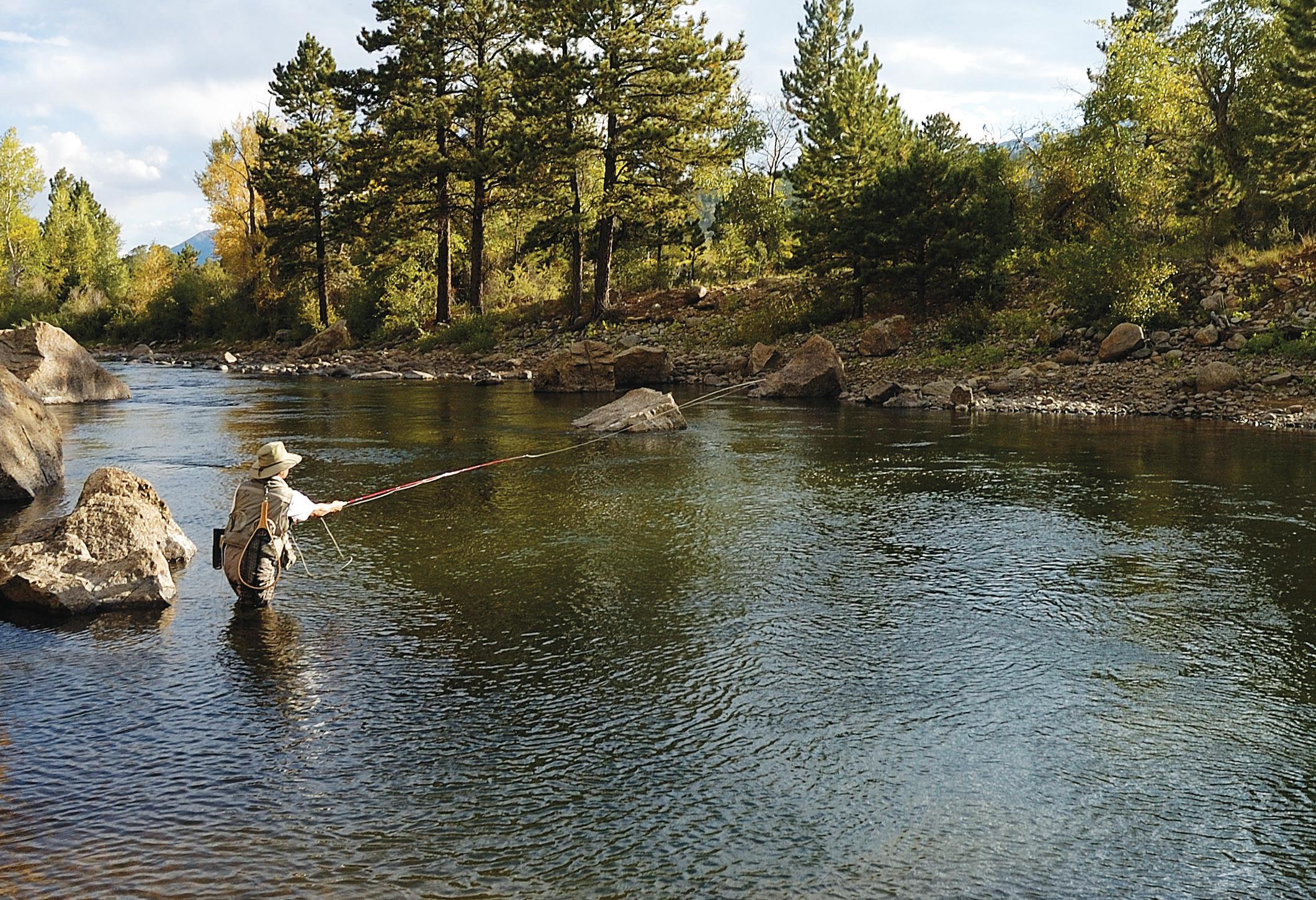
Fishing is anything but boring to these students. They approach the sport with a gleeful curiosity, inquiring about the places fish call home. In this way, fishing is a gateway to aquatic stewardship in Colorado. CPW and others are investing in fishing education, like the Lake Lehow clinic, as a way to protect and even regenerate ecosystems throughout the state.
ROOTED IN RURAL ECONOMIES
Despite an arid climate with desert regions, Colorado has some of the best recreational fishing opportunities in the United States.
Anglers enjoy a variety of landscapes for long fishing days, from high alpine lakes to wide, slow-moving prairie rivers. There are more than 35 species of catchable sport fish — including Colorado’s famed rainbow trout and kokanee salmon — within 6,000 miles of fishable streams and more than 1,300 fishable lakes and reservoirs.
But like skiing, hiking and camping in Colorado, recreational fishing is only possible through a significant investment of state resources.
Many of the fish that anglers pursue in lakes don't naturally reproduce enough to make recreational fishing possible. Instead, fish hatcheries have supported Colorado fish populations since 1881. The majority of fish in many of the state’s waters are stocked by CPW’s 19 hatcheries that breed, hatch and rear more than 90 million fish per year. Additional fish are bred at federal and private hatcheries.
The recreational fishing industry — including hatcheries, private fishing and guiding, tour operators, marinas, gear stores, and more — provides thousands of jobs and injects money directly into local economies. And statewide efforts to protect and manage natural resources also benefit: Revenue generated from hunting and fishing comprises about 70% of CPW’s wildlife management funds, which support habitat restoration, regulation enforcement, research, and public education. This means that every fishing
license sold — some 800,000 annually — directly funds conservation.
“The conservation efforts of CPW and all the fishing clubs, it is a positive effect overall for the whole wildlife system. The fish stocks are regulated very well and controlled very well,” says Martin Harris, Trout in the Classroom coordinator for the nonprofit Trout Unlimited (TU). “From what I’ve seen in my 80 years, I think it’s been very positive.”
But many argue that recreational fishing’s real impact is simply getting people outdoors and into the wild: The more anglers get out on the waters, the more they care about the fish and aquatic ecosystems that make the sport possible.
RAISING NEW GENERATIONS OF ANGLERS
Anglers play an important role in helping to manage the state’s fisheries, says aquatic biologist Jim White. Each year, CPW pays them to catch and remove invasive species. For example, Ouray County’s Ridgway Reservoir Smallmouth Bass Classic, now in its 10th year, is awarding $10,000 to the angler who harvests the most smallmouth bass, an invasive species that was illegally introduced to the area. This helps keep the population under control and minimizes its threat to native species.
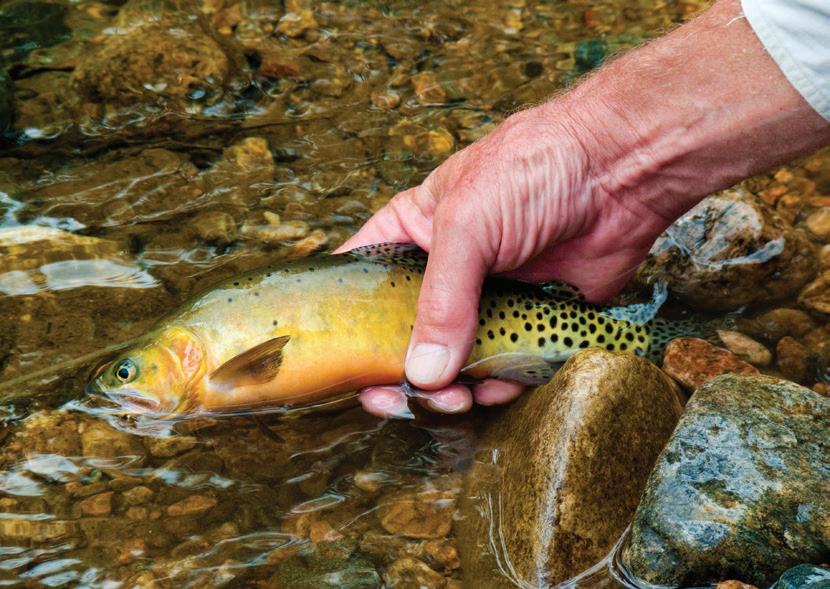
Above: A native greenback cutthroat trout. Anglers need to know which species they have caught so they can decide whether to release or keep the fish.
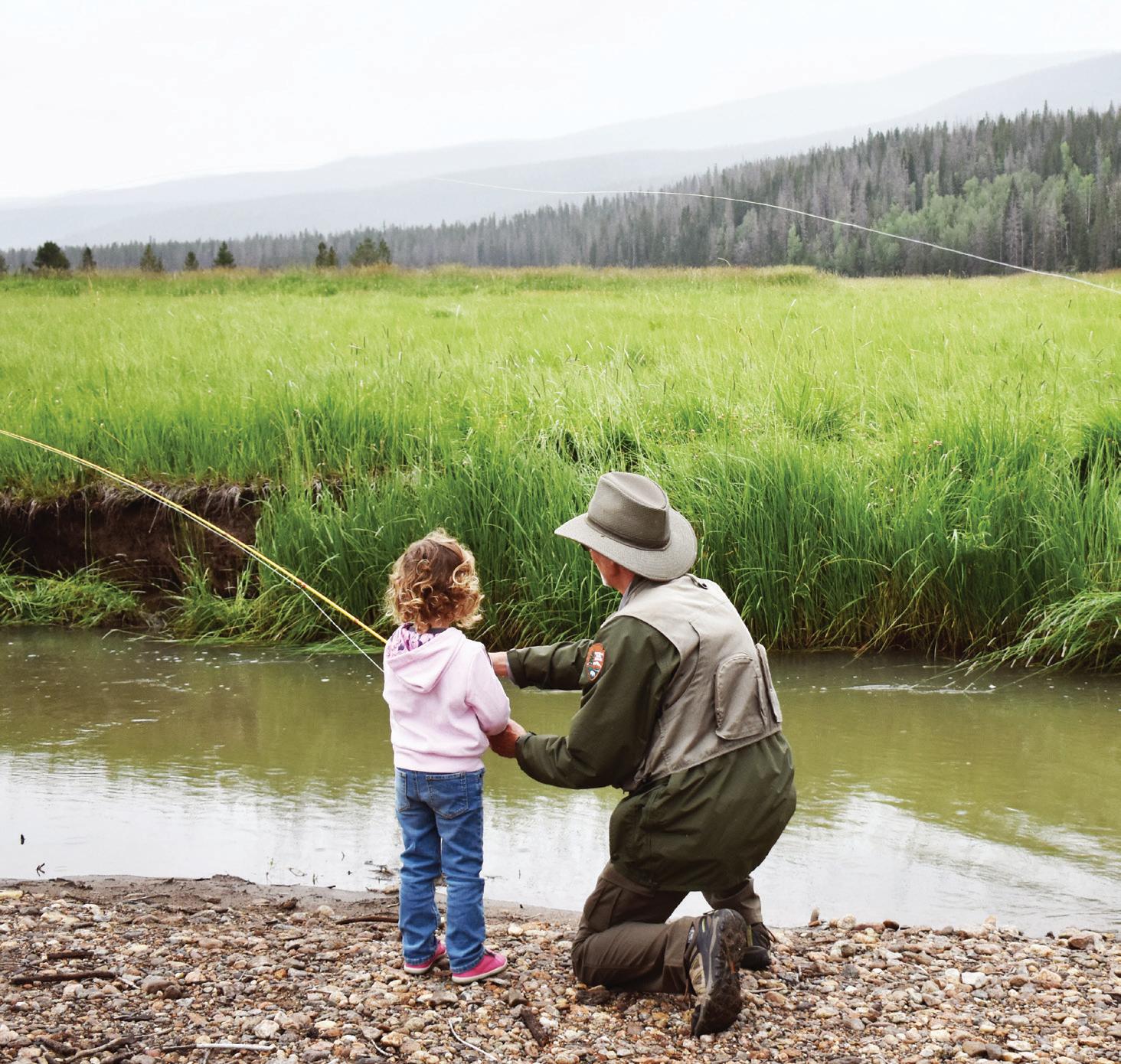
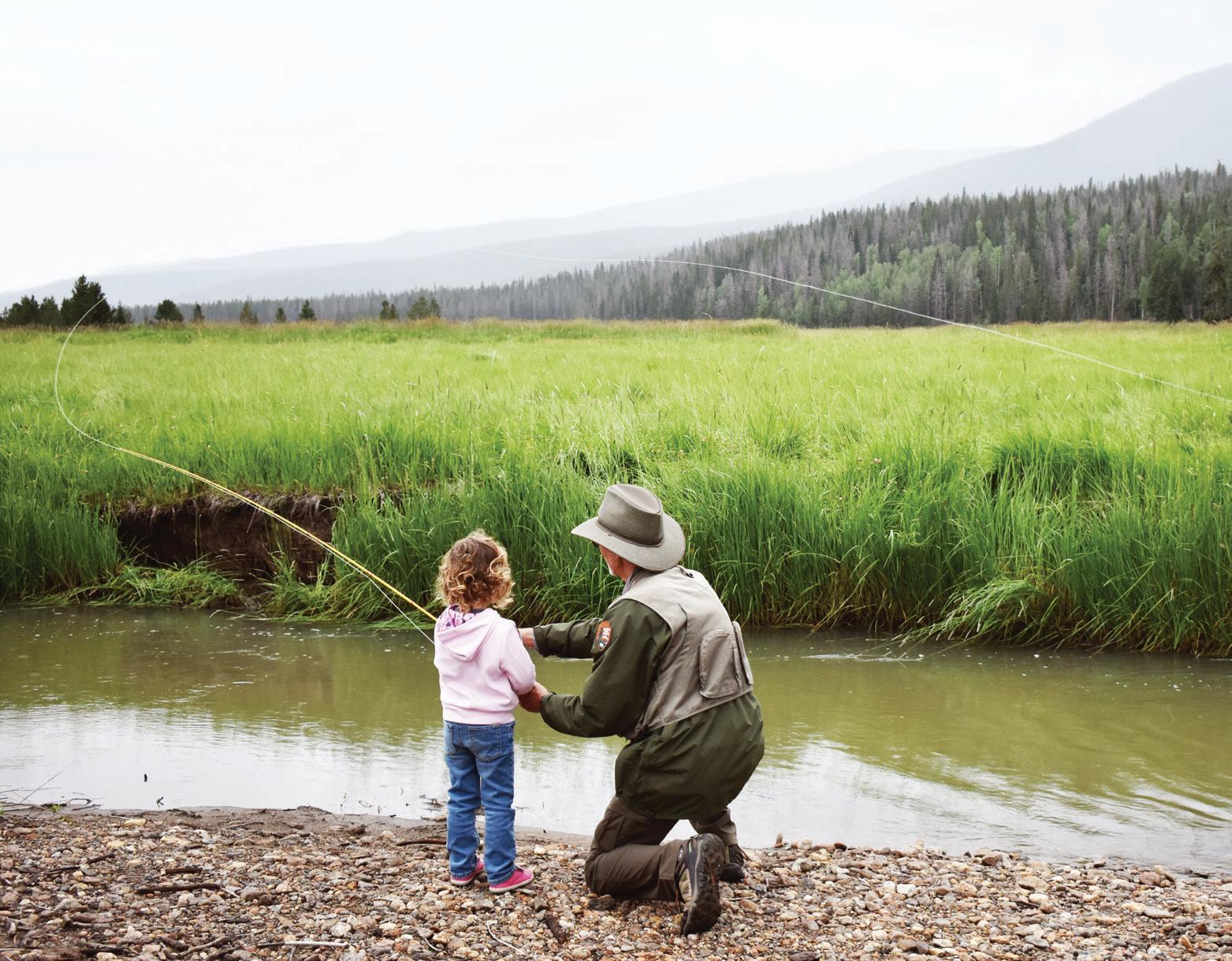
Right: A park ranger at Rocky Mountain National Park teaches a young child to use a fly rod.
"Connecting youth to outdoor activities is critical to their mental development and plants seeds for future conservation of natual resources."
Essentials & Economics of Recreational Fishing
Colorado’s anglers cast a powerful economic line through the state. According to CPW’s latest economic survey, in 2022, fishing contributed more than $1.4 billion to Colorado’s GDP. It generated $2.5 billion in total economic output, funded $214 million in state and local tax revenue, and funded $207 million in federal tax revenue.
The number of licensed residents who fished in 2022 was more than 1.4 times greater than the total population of Boulder County. These anglers participated in 11.1 million days of fishing recreation that year in total. Resident anglers averaged 21 days on the water annually, while nonresidents fished around 7 days and often traveled more than 500 miles one way to reach Colorado’s famed watersheds.
In 2022 alone, Colorado anglers spent $1.6 billion on trip-related items, according to CPW — more than eight times greater than the NHL Colorado Avalanche franchise’s reported revenue. This translates directly into a positive impact for rural communities, particularly as anglers invest travel costs like lodging and food into local economies. On average, resident anglers spent $3,198 annually on fishing and non-residents spent $2,648.
All this spending supported more than 15,000 jobs across Colorado, injecting more than $860 million into the state’s workforce through wages and salaries.
But CPW notes that the full economic importance of recreational fishing in Colorado goes beyond these numbers: “The total value one receives is greater than the amount spent, otherwise the individual would not participate,” the agency writes in its Colorado Sportfishing Economics Fact Sheet.
To keep this economic engine running, CPW invests in programs like the “Fishing is Fun” grant, now in its 36th year. The program provides up to $700,000 annually to local and county governments, park and recreation departments, angling organizations, and water districts to improve angling opportunities in Colorado. The 375 projects funded thus far have focused on making public waterways more welcoming — like trail-building to lakes, securing easements, constructing fishing piers and restrooms, improving parking and signage at streams and lakes, and providing ADA-compliant platforms.
All this licensing, outreach and conservation not only help to protect aquatic habitats but also keep anglers fishing. The stewardship builds satisfaction and drives repeat fishing visits — sustaining the shop visits, tour bookings, lodging stays, and out-of-state travel that are an economic boon for many rural communities.
Anglers need to know which species they have caught, though, so they can decide whether to release or keep the fish. Education is key, and CPW has invested heavily in educating new and seasoned anglers alike.
Egli alone runs about 150 fishing clinics per year, plus there are dozens more organized by regional coordinators. The clinics serve almost everybody, ranging from children to retired veterans. Some classes even teach attendees to fillet and fry their catches. These programs leave a lasting impact on participants, says Egli. One fly fishing clinic participant, who is now semi-retired, volunteers with CPW to help teach new anglers. For Egli, these programs can go a long way in inspiring individuals to take action.
“People go to a zoo and see an animal that lives on the other side of the Earth, but because it looks cool, maybe they want to learn a little more. They might learn that [the animal is] in danger because of palm oil farming, or something like that, and then they stop buying things with palm oil. I think [fishing] can have that same effect,” says Egli.
Whether it’s cleaning up a pond or preventing litter in waterways, “being out there and actually seeing it firsthand, I think can make people take the necessary steps to become active in conservation.”
CPW isn't the only organization connecting fishing education to aquatic stewardship. For example, Harris helps coordinate TU’s Trout in the Classroom program. Each year, students, ages 5 to 18, raise about 200 eggs in 55-gallon tanks in their classrooms, later releasing them into waters across the state. This is TU's most impactful program, Harris says.
“We’re basically creating a mini hatchery,” says Harris. “Raising a generation of people [to be] aware of their local watersheds and how to preserve the ecosystems.”
Trout in the Classroom has been running for about 15 years. Several schools have since expanded the program to include more biological education. The schools collect data from the tanks for a citizen science project, which is now comprised of more than 20,000 data points around how water chemistry changes and impacts fish populations.
Fourth graders in Ignacio are similarly raising roundtail chubs, a rare species of special concern, through the Southern Ute Wildlife Resource Management Division. They learn about healthy water quality, fish behavior, and endangered species conservation while caring for the aquariums.
Fisheries biologist Ben Zimmerman, who helps run the programs, says they integrate conservation in brief but memorable ways throughout the experience, such as encouraging students to count how many different birds they can see and hear while fishing.
“Connecting youth to outdoor activities is critical to their mental development and plants seeds for future conservation of natural resources,” says Zimmerman. “When we host these fishing activities, we have the opportunity to plant some seeds in their minds for conservation.” H
Emily Payne is a writer covering the intersection of food, agriculture, health and climate. She is editor of the global nonprofit Food Tank.
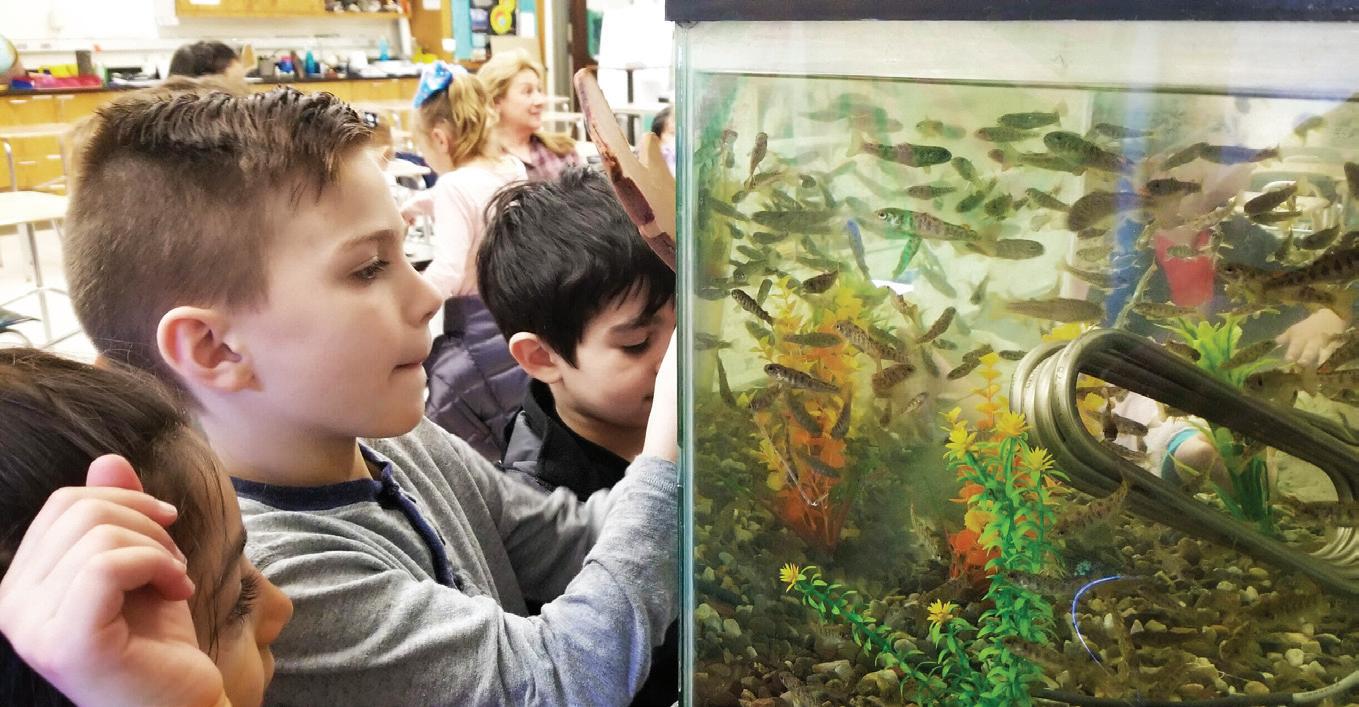
Children check on the juvenile fish they're raising through Trout in the Classroom, a program by Trout Unlimited to connect youth to fishing education.
NATIVE WATERS
From peaks to plains, Colorado’s dizzying variety of native fish are fighting to endure.
BY ELISABETH KWAK-HEFFERAN
PHOTOGRAPH
BY
DAVID HERASIMTSCHUK
AA mayfly-loving trout — speckled, shiny and perfectly hand-sized for that Instagram hero shot. A five-foot-long torpedo of a predator, capable of powering through floodwaters and migrating hundreds of miles. A three-inch minnow, living only a couple of years and content with life in a small pool in an ephemeral creek. Which fish is the true Colorado native?
The answer is all of them. A state with waterways as diverse as Colorado’s has naturally produced a diverse assortment of native fish to match. We have cutthroat trout, lovers of pristine, high-elevation streams on both sides of the Continental Divide. Large, long-lived species like Colorado pikeminnow and humpback chub fight their way through the whitewater of the Western Slope. Tiny brassy minnows and redbelly dace ply the shallow, sandy creeks of the Eastern Plains. Each is adapted to its
own ecological niche, body and behavior tailored to its particular home waters and the other aquatic creatures that evolved alongside it.
Humans have dramatically altered this delicate balance in a very short time span. While some native populations still thrive, many others struggle as their habitats and predators have changed. Starting a couple of hundred years ago, mining pollution, overfishing, and haphazard stocking of non-native fish led some Colorado species to plummet, or even go extinct. Today, native fish still grapple with climate change, dams, water diversions, and competition with invasive species. But humans are also working to turn back the clock and restore these native species. Follow along on this tour of Colorado’s waterways, meeting our home-state fish — and learning what it takes to help them endure.
HEADWATERS
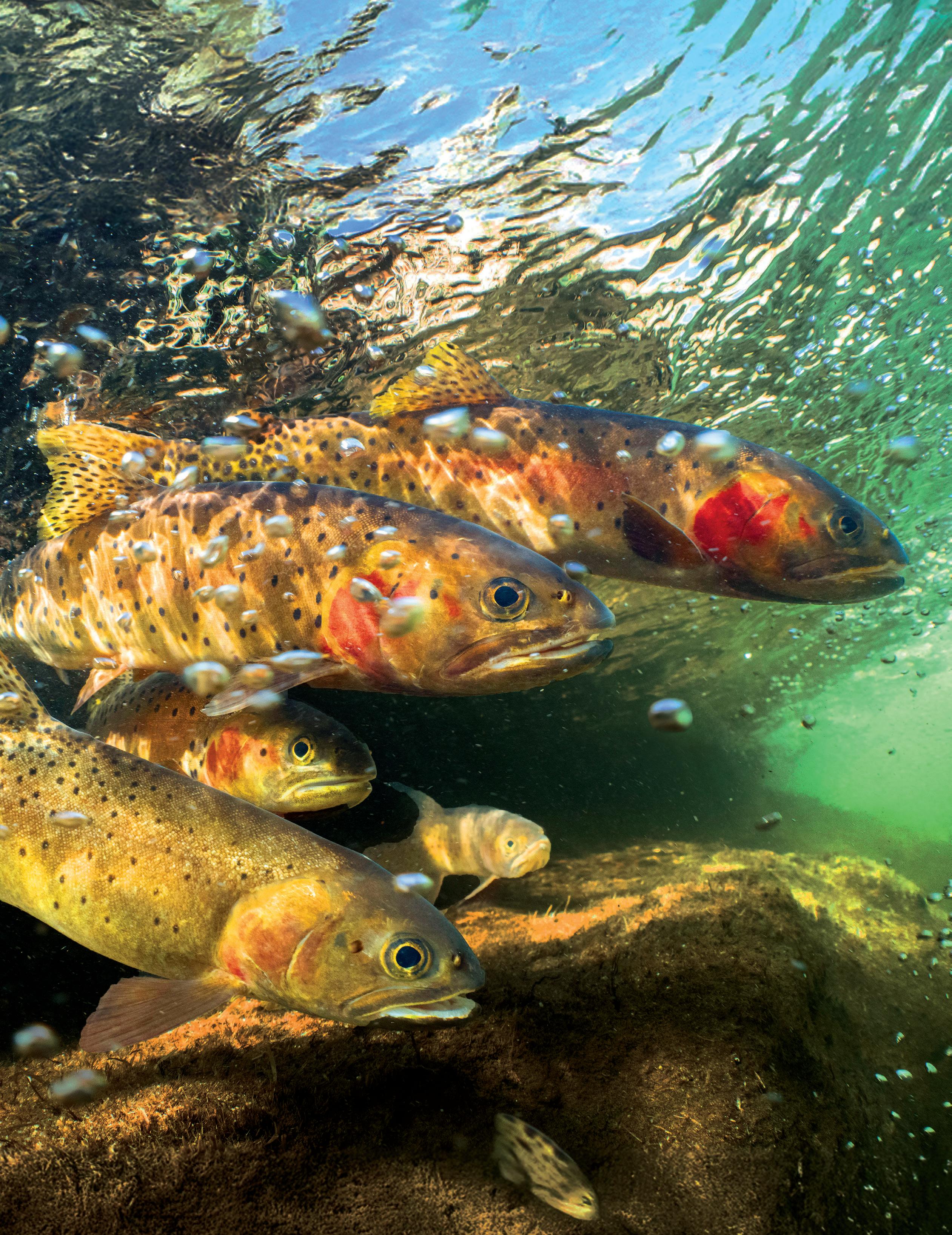
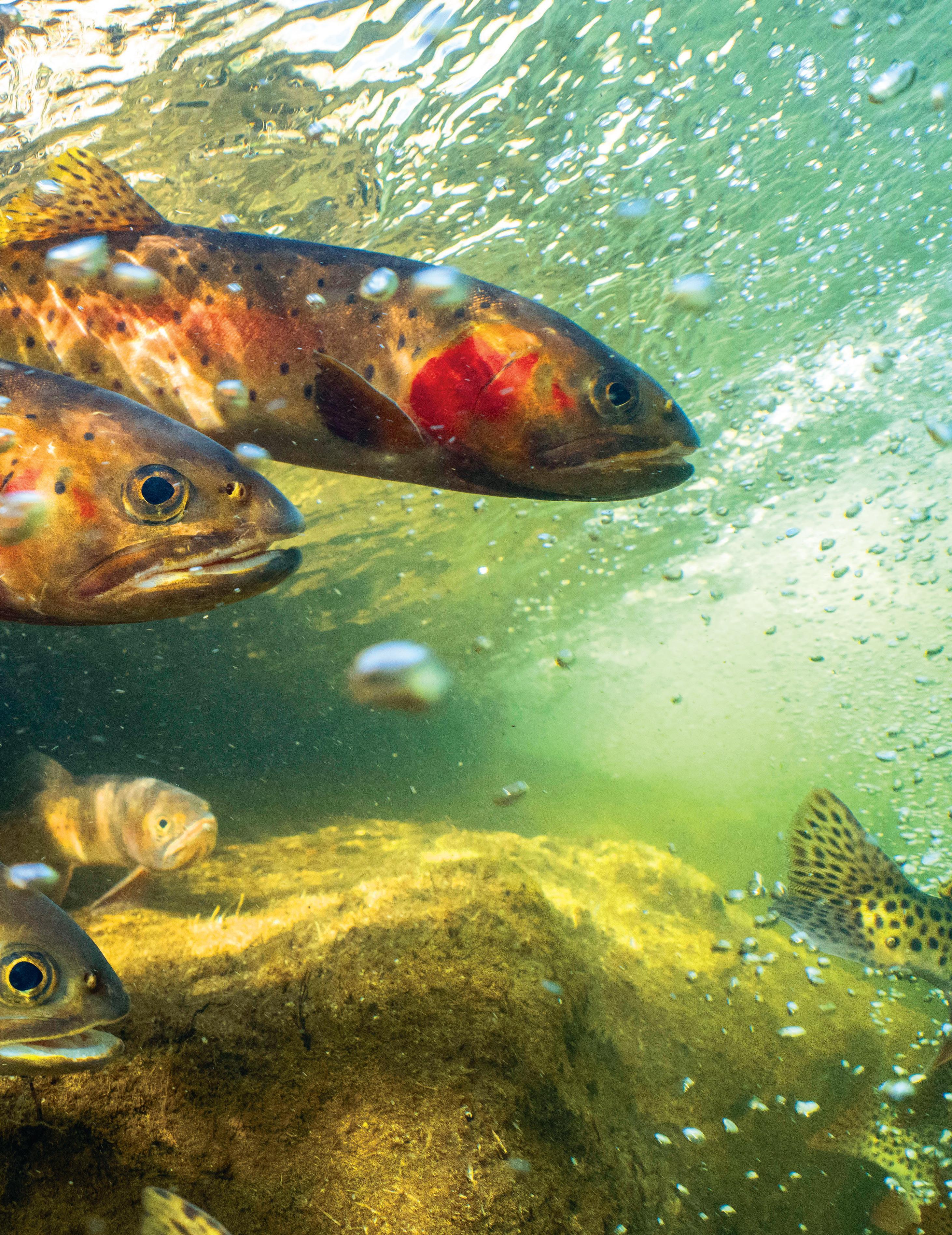
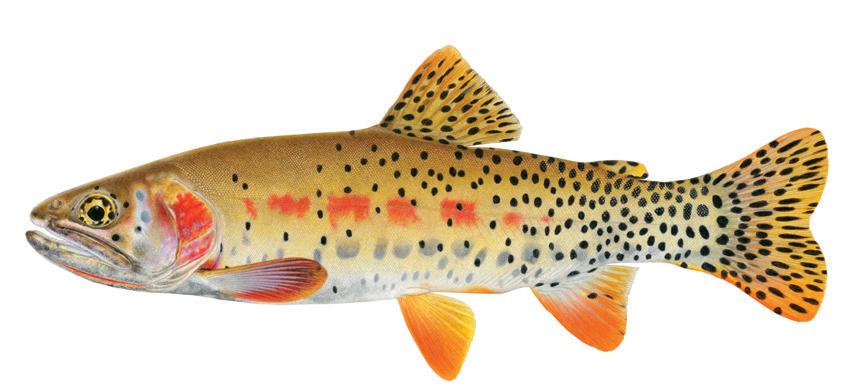
Let’s begin where the rivers do: high in the Rocky Mountains, where clean, cold streams form and flow downhill, eventually feeding the state’s largest rivers. This is the realm of Colorado’s poster fish, the cutthroat trout. Colorful, beautiful and beloved by anglers, cutthroats — recognizable by the iconic red slash markings under the jaw that give the species its name — live in the headwaters of almost every river basin in the state. Cutthroat trout are at home where there’s oxygenated water, gravelly bars for spawning, and good vegetative cover on stream banks.
“Cutthroat trout” isn’t just one type of fish in Colorado, but rather, six. There’s the greenback cutthroat trout, originally from the South Platte River Basin on the east side of the Divide. The yellowfin cutthroat came from the Arkansas River Basin, but is now considered extinct. Moving southwest, the Rio Grande cutthroat rose from the Rio Grande Basin. Then, on the Western Slope, the Colorado River cutthroat is further divided into three lineages: the Green River lineage, found in the Green, White and Yampa rivers; the Uncompahgre lineage, of the Dolores, Gunnison and Upper Colorado rivers; and the San Juan lineage, of the San Juan River Basin.
That’s not to say the average angler — or indeed, the average fish biologist — can tell the cutthroats apart just by looking at them. Nor can they be identified based on where they’re caught these days. Humans, from regular people trying to create new fishing opportunities
to professional fisheries managers, spent much of the last couple of centuries moving cutthroats around the state with little understanding of the differences between subspecies. “It’s really hard to put the genie back in the bottle once that happens,” says Jim White, southwest senior aquatic biologist for Colorado Parks and Wildlife (CPW). “One of the great mysteries in cutthroat trout distributions was, what went where? What did these river basins look like before we started widespread stocking of cutthroats and non-natives?”
Biologists didn’t know the answer until 2012, when a landmark study led by University of Colorado Boulder researchers conducted DNA analysis on museum fish specimens gathered at the beginning of European contact with the West. Those results confirmed the existence of the six genetically distinct types of cutthroat — five previously known to science, and one brand-new one, the San Juan lineage trout. The study speculated that San Juan cutthroats had also gone extinct, but CPW biologists had to be sure. “We beat the bushes, surveyed all the populations, and conducted molecular tests on fin clips from all known cutthroat trout populations in the San Juan Basin,” says Kevin Rogers, CPW aquatic research scientist and co-author on the 2012 genetic study. “Indeed, there were about a half-dozen populations that [matched] the fish that had been collected in the mid- to late 1800s.” (See “Spotlight” for more surprises from the 2012 study.)
One thing all five remaining Colorado cutthroat varieties have in common is a reduction in the amount of habitat they occupy. The state’s cutthroats are now relegated to just 12% of their historical habitat on the high end, down to half a percent on the low end, says
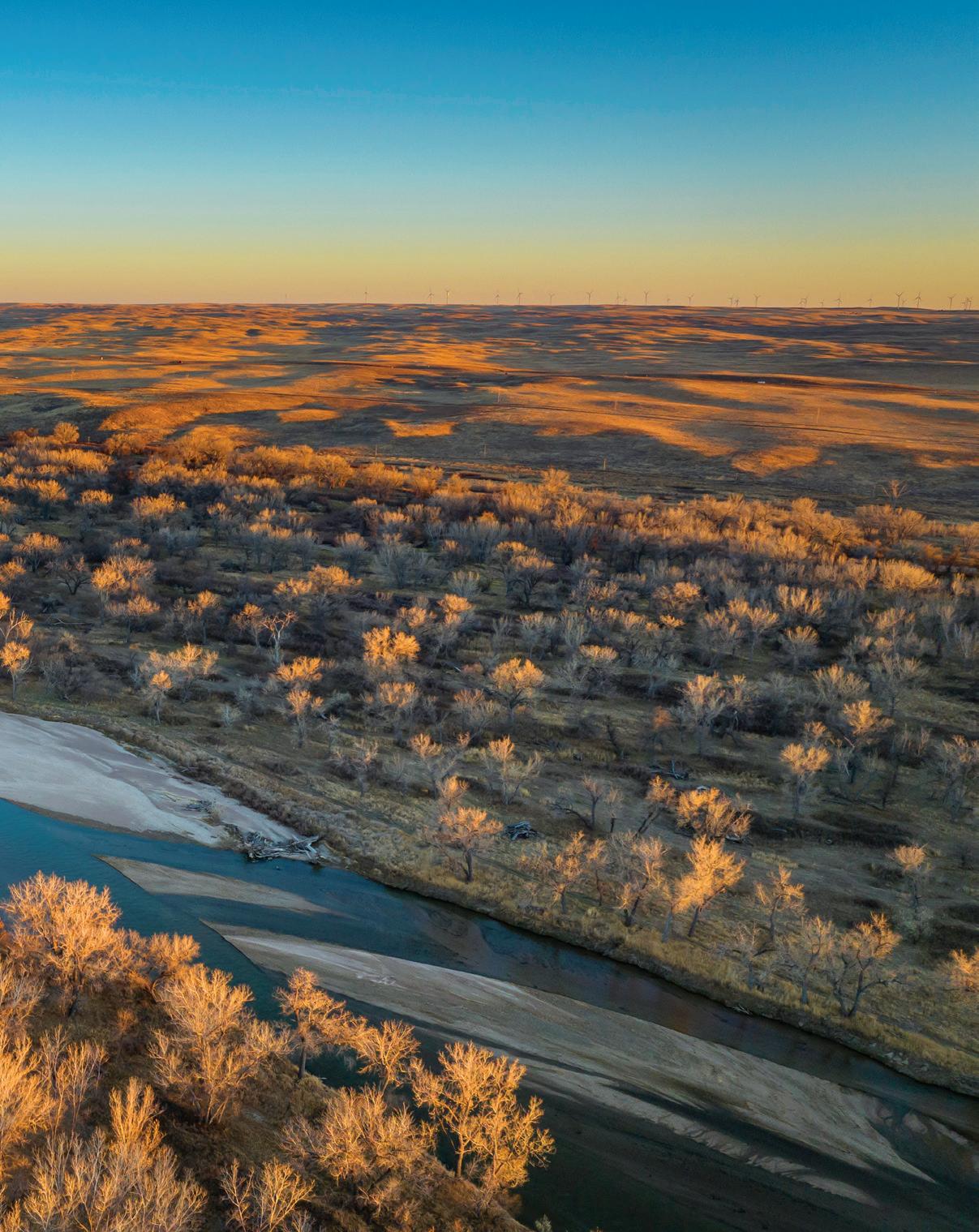
The Yampa River
Boyd Wright, native aquatic species coordinator with CPW. “Most of the lower elevations have been invaded by non-native trout, so cutthroats are persisting only in the headwaters,” Rogers says. Greenback cutthroats are federally listed as threatened, and Rio Grande and Colorado River cutthroats (occupying just 12% and 11% of their historic habitat, respectively) are state species of special concern. The culprits? What began with pollution, overharvesting and the stocking of non-native fish in the era of Western colonization continues today.
Non-native fish pose a major threat to native cutthroats, particularly the brown, brook and rainbow trout that have been stocked statewide and now thrive in Colorado’s waters. “To sum it up, there’s hybridization, there’s predation, and there’s competition,” White says. “All of those three things can interact to disadvantage our native fish populations.” Rainbow and cutthroat trout can breed, resulting in the hybrid cutbow. Non-native trout sometimes even eat the natives. They also compete with cutthroats for food, and often win. Brook and brown trout spawn in the fall and hatch in the spring — so when the cutthroat fry hatch in late summer, their non-native rivals have already had several months to grow bigger.
Climate change isn’t helping. “We have the two ugly stepchildren that come along with a changing climate: drought and wildfire,” Rogers notes. “The toll wildfire can take on cutthroat is substantial. The debris flows that invariably happen afterward can wipe out populations.”
Drought can also lower or dry up streams, further contracting ranges.
But CPW and partner organizations like the U.S. Fish and Wildlife Service are actively working to conserve Colorado’s native cutthroats. Biologists raise the trout in hatcheries for stocking back in their native streams, but there’s a lot more to it than that. First, managers must prep the waterways by removing non-native trout, often by poisoning with natural fish toxicants, a process that can take years. Any present pathogens, like whirling disease, must be eradicated. Managers also have to make sure non-native fish can’t reinvade the stream, usually by building a barrier, like a waterfall. Despite the difficulty and expense, the state is actively working on recovery projects for all five cutthroat varieties. “That’s what we’re about, trying to preserve diversity for future generations to enjoy,” Rogers says.
Greenback Cutthroat Trout
Colorado’s state fish might as well be nicknamed The Comeback Kid. Biologists thought the greenback cutthroat was extinct by 1937 — so imagine their delight upon discovering a remnant population in Rocky Mountain National Park 20 years later. A few more, similar discoveries followed, and managers embarked on an aggressive campaign to restore the fish to its native waters. By the early 2000s, more than 40 greenback populations had been reestablished, a grand success story … until a landmark 2012 genetic analysis study proved that those fish weren’t actually greenbacks after all, but Colorado River cutthroats.
All was not lost. One remnant population of greenbacks had been found in Bear Creek near Colorado Springs, brought there in 1874 by an innkeeper who wanted to provide trout fishing for his guests. Those fish had actually been excluded from Colorado Parks and Wildlife's (CPW) breeding efforts because they looked a little different, with unusual spots on their bellies.
“They called them the weird Bear Creek cutthroats,” Wright says. Genetic testing confirmed that the Bear Creek trout were actually real-deal greenbacks — the only ones left on the planet. CPW managers are again breeding and reintroducing
greenbacks to their native range (the real ones this time). The federally threatened trout now live in eight locations across the Cache la Poudre, Clear Creek, and South Platte watersheds — totaling 18 miles of stream and 30 acres of lake habitat — with two populations naturally reproducing. Land managers have taken pains to protect the critical Bear Creek greenbacks. When they discovered sediment washing into the creek, imperiling water and habitat quality, the City of Colorado Springs hired watershed restoration company Stillwater Sciences and river construction firm FlyWater, inc. to improve habitat and reroute a small section of the creek to reduce sediment inputs. Working with CPW and the U.S. Forest Service, the Stillwater-FlyWater team focused on increasing habitat diversity. They created deeper pools for overwintering habitat and sediment storage and added woody materials to provide cover. CPW plans to reintroduce the greenbacks to even longer, richer stretches of habitat starting next year, which managers hope will more than double the stream miles they occupy. As Rogers says, “It’s kind of a miracle we still have them.”
DESERT RIVERS
As the mountain streams follow gravity into the western lowlands, they flow into larger networks: Rivers like the Yampa, White and Animas feed the desert arteries of the Green and San Juan, and these, together with the Gunnison, Dolores and others join the Colorado. The entire basin touches seven states, from Wyoming and Colorado up north to Arizona and California in the southwest.
The cold swift headwaters give way to rivers that historically swung between huge springtime floods and slow, turbid flatwater. And the trout give way to large, long-lived fish with bodies suited to big water and wild rapids.
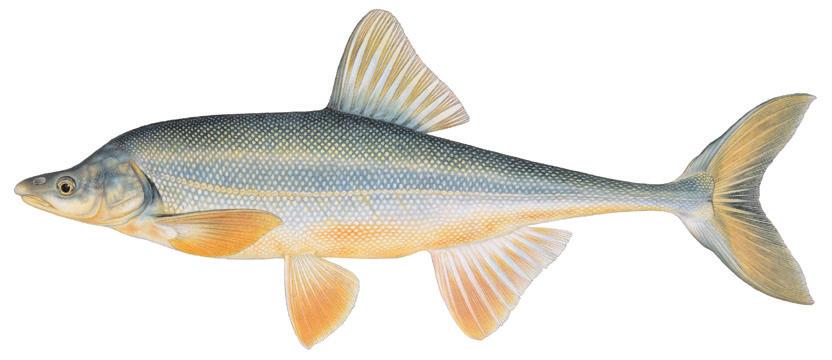
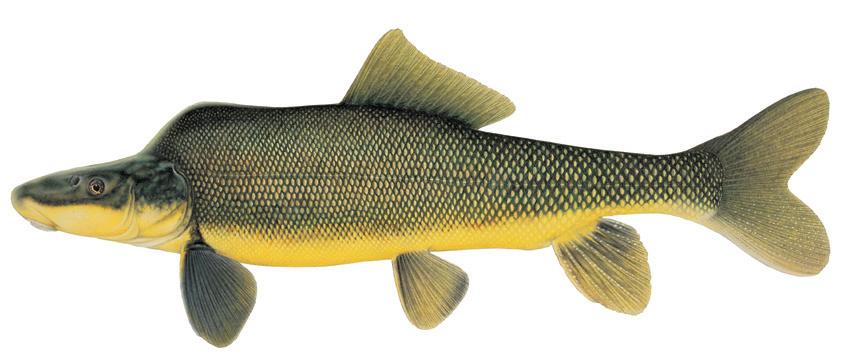
Just over a dozen fish species evolved with the chops to survive in the larger rivers within the Colorado River system. Three of them, called just “the three species” by biologists, are the flannelmouth sucker, bluehead sucker, and roundtail chub. These omnivorous swimmers persist in today’s rivers, though managers keep a close eye on conserving their populations so that they don’t go the way of four other native species. These four — all federally listed as endangered or threatened — have struggled in the face of drastic, human-caused changes to their habitats. The bonytail, a large-finned, skinny-tailed omnivore, is the worst off, with no sustainable wild populations left. Its relative, the humpback chub, sports a pronounced bump behind its head, all the better to stabilize the fish in whitewater. Its populations have stayed stable over the past few years, with most of them found near the
Grand Canyon, and the species was downlisted from endangered to threatened in 2021. The Colorado pikeminnow, a powerful swimmer shaped like a missile, is the largest minnow in North America. It can migrate 200 miles annually and lives 40 years or more. Its numbers are slowly increasing in the Upper Colorado and San Juan subbasins, but are declining in the Green River. And the razorback sucker, a bug- and plankton-eater, features a similar keel behind its head that helps it maneuver through high flows.
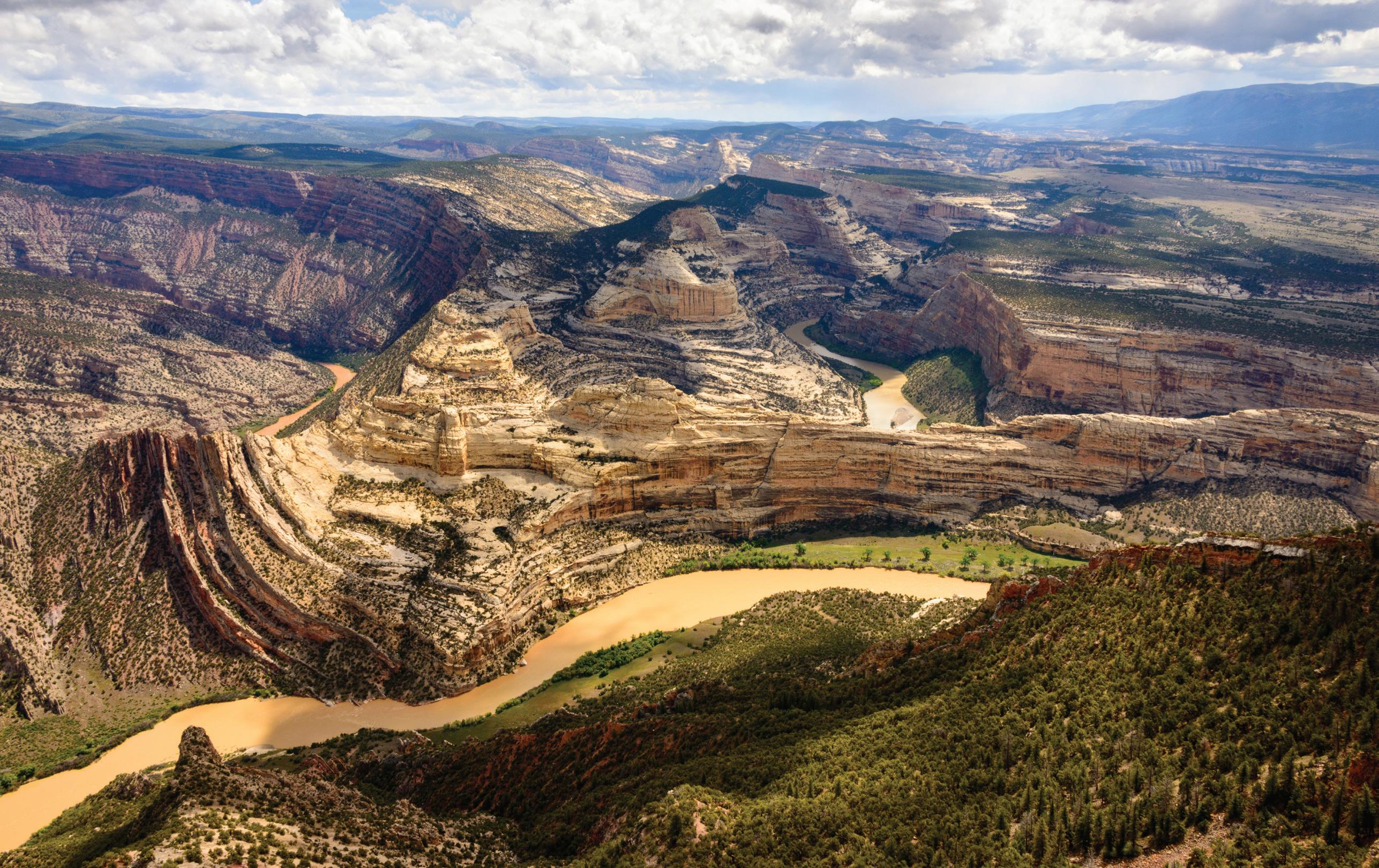
Dinosaur National Monument, where the Green and Yampa rivers meet in Echo Park
All four populations have crashed in response to human water use and reduced water availability resulting from drought and climate change, which has altered the habitats they once inhabited. “We have cross-basin diversions that feed water from the Western Slope over to the Front Range,” says Jenn Logan, native aquatic species manager for CPW. “We don’t have the volume of water that we used to see in the spring. With dams and water going into ditches and filling reservoirs, runoff is nowhere near where it used to be. We don’t have sandbars formed in the way that we used to, and these systems relied on sediment to form complex habitats.” Not only that, but dams change water temperature, with released water alternately cooling or warming the river downstream depending on where in the reservoir it comes from. And of course, they form a physical barrier for fish that evolved migrating through a huge, interconnected river system.
Then there’s the non-native interlopers — primarily smallmouth bass, northern pike, walleye, and green sunfish — all introduced, either purposely or accidentally, by humans looking for expanded angling opportunities. “They’re predatory species — they get in the river and can really compete with and consume the native fish in the Colorado River,” says Josh Nehring, deputy assistant director, aquatic branch, of the CPW fish management team. All have found happy homes in the modern Colorado River Basin with its dams, reservoirs and warmer waters.
But just as in the mountain streams, fisheries managers on the Western Slope are working aggressively to protect the natives. The Upper Colorado River Endangered Fish Recovery Program and the San Juan River Basin Recovery Implementation Program oversee the recovery of the four fish species listed as threatened or endangered. The recovery programs are coalitions of water users, federal, state and tribal agencies, plus nonprofits and energy organizations. They take steps like installing nets at the edge of reservoirs to keep non-natives contained and stocking sterile non-native fish in reservoirs to keep them from establishing a population if they do get out. Other work looks like electrofishing stretches of river — that is, introducing a current that stuns fish in the water — and physically removing the non-natives, leaving the native fish to recover and swim another day; and gillnetting northern pike in their springtime spawning habitats. Water managers go so far as to recontour river channels on the upper Yampa to cut off access to northern pike’s spawning wetlands.
Dam management is another useful tool for both helping native fish and disadvantaging the non-natives. The Upper Colorado River Endangered Fish Recovery Program works with the U.S. Bureau of Reclamation at Utah’s Flaming Gorge Dam on the Green River on timed releases — releasing water when biologists detect the year’s razorback sucker larvae “to attempt to move them down to their wetland habitats,” Logan says. They’ll release water to disrupt smallmouth bass nesting, when possible. And in the Lower Basin downstream of Lake Powell, managers have begun releasing cooler water specifically to make the Colorado River there less hospitable to smallmouth bass. As long-term drought has dropped water levels in Lake Powell, “We’ve been seeing increases in water temperature releases coming through the dam,” says Ryan Mann, aquatic research program manager for the Arizona Game and Fish Department. Some smallmouth bass made their way into the river below the dam in years past, but the water had been cold enough to keep them from reproducing. But in 2022, biologists found baby
Bonytail
By the time biologists noticed the bonytail’s plight, it was almost too late. Once common throughout the Colorado River Basin, bonytail suffered mightily as the river system started changing with the construction of Hoover Dam in the 1930s. The fish vanished from much of its historic range, and by the ‘80s, only a handful of bonytail remained in the wild. Biologists scooped up some of the last ones — just 11 individuals — from Lake Mohave on the Nevada-Arizona border in the ‘70s and ‘80s and brought them into U.S. Fish and Wildlife Service hatcheries for captive breeding. Their numbers have dropped so precipitously, managers are still playing catch-up as they try to recover the species.
“We don’t know a lot about bonytail,” says Jenn Logan with Colorado Parks and Wildlife (CPW). “We don’t know what
environmental conditions are favorable. They were pretty much extirpated before we started to study them.” That’s made species recovery difficult. Despite releasing nearly 600,000 hatchery-raised bonytail into the Upper Colorado River Basin since the early 2000s, no wild populations have made it. Managers detect only 0.01% of the stocked fish after three years in the rivers.
Now, “We’ve taken a step back to think about ways to improve their survival,” Logan says. “Everything from training them to avoid predators to looking at different kinds of releases.” Managers are experimenting with starting bonytail out in river pens, stocking them in tributaries, releasing them at night, and targeting different water temperatures. As Logan puts it, “We’re in the discovery phase.”
By The Numbers
The number of fish species that the Upper Colorado River Endangered Fish Recovery Program works to recover – the Colorado pikeminnow, humpback chub, razorback sucker, and bonytail. The San Juan program aims to recover Colorado pikeminnow and razorback sucker in the San Juan River Basin.
bass. Last summer’s cold-water releases prevented widespread spawning, and managers may continue them into the future. Today’s Colorado River Basin is a radically different place than in centuries past, and, “Unless there’s some amazing technology that comes along to remove all non-native fish or a way to return flows to historic conditions we’re not going to be able to move [major river systems] back to native fish,” Nehring says. But that doesn’t mean those species are doomed. CPW and its partners are actively raising threatened species in hatcheries and reintroducing them to targeted habitats. “We’re really focusing on the tributaries, to keep the natives alive in enough areas where we know they’ll persist,” Nehring says.
Razorback Sucker
The razorback has slowly been recovering its numbers, thanks to non-native fish management and restocking efforts — in fact, it’s proposed for reclassification as federally threatened, a bump up from its current endangered status. Reproducing populations now swim sections of the San Juan, Green, Colorado, White and Yampa rivers, with more than 36,000 estimated individuals in the Green River and about 8,000 in the Upper Colorado, as of 2018 — the most recent data available. One technique that’s been helping juvenile fish make it to adulthood? Creating baby razorback nurseries. Wetlands form a critical piece of razorback sucker habitat. After
spawning and hatching, their fry float downstream to calm flooded wetlands, where the young fish thrive. “They’re really productive, with lots of nutrients — the fish can really grow,” says Jenn Logan with Colorado Parks and Wildlife (CPW). So, without the historical flooding cycle on rivers like the Green and Colorado to reliably create such habitats, managers are stepping in. In five “managed wetlands” in Utah (a sixth is in development near Grand Junction), biologists open gates to welcome larvae and eggs, then close them to shelter the baby razorbacks from non-native predators during this vulnerable life stage.
EASTERN PLAINS
As alpine streams flow east, they meander through Front Range cities, then spread across the arid plains. The water warms, rocky beds grow sandy, and habitats shrink as creeks dry up seasonally. Waters dominated by a single species explode with different fish. “We’ve got this melting pot of biological diversity along the transition zone,” says Wright. “You go from historically a one-species profile in the mountains to more than 28 as you go farther east. These [plains] are very harsh, unpredictable environments.”
The fish that evolved to thrive on the plains, from the region's western edges in Colorado out into Kansas, Oklahoma and Nebraska, are largely the opposite of the big, long-lived species on the Western Slope. They’re a few inches long, live just a couple of years, and reproduce early. These fish are used to biding their time in small pools until rain or spring runoff reconnects the intermittent creeks, finally allowing them a change of scenery.
But the Eastern Plains haven’t escaped the challenges affecting Colorado’s other rivers — its native fish are struggling, too. “Most of our plains fishes are declining or locally extinct because of habitat modification or loss,” says Ashley Ficke, fisheries ecologist with engineering firm GEI Consultants. Humans have diverted water to farms and municipalities, redirected streams into straight channels lacking habitat complexity, and even drained some waters completely. That hits fish like the plains minnow particularly hard, as its semi-buoyant eggs float vast distances between
TOMELLERI; PHOTO: ISTOCK
spawning grounds and ideal nursery habitat. “It needs vast portions of unfragmented stream habitat,” Wright says. “We’ve really lost that in Colorado, and that’s a big reason why they’re very rare.”
As elsewhere in the state, though, fish managers are working to replenish the swimmers of the plains. At a hatchery in Alamosa, CPW breeds 12 rare native fish, half of them eastern species: plains minnow, suckermouth minnow, northern and southern redbelly dace, Arkansas darter, and common shiner. “We’re working with private landowners that have streams or ponds that would be suitable
Spotlight
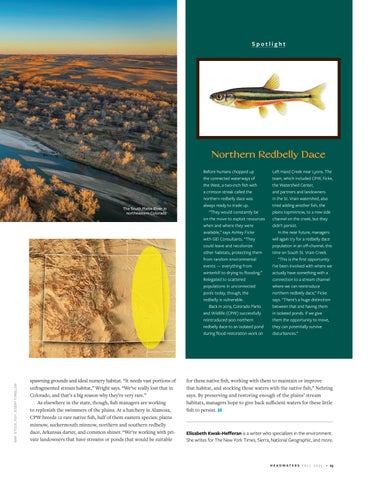
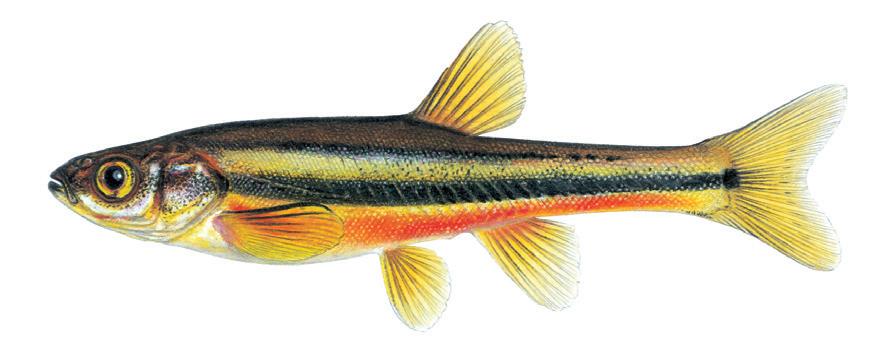
Northern Redbelly Dace
Before humans chopped up the connected waterways of the West, a two-inch fish with a crimson streak called the northern redbelly dace was always ready to trade up.
“They would constantly be on the move to exploit resources when and where they were available,” says Ashley Ficke with GEI Consultants. “They could leave and recolonize other habitats, protecting them from random environmental events — everything from winterkill to drying to flooding.”
Relegated to scattered populations in unconnected pools today, though, the redbelly is vulnerable.
Back in 2019, Colorado Parks and Wildlife (CPW) successfully reintroduced 900 northern redbelly dace to an isolated pond during flood restoration work on
Left Hand Creek near Lyons. The team, which included CPW, Ficke, the Watershed Center, and partners and landowners in the St. Vrain watershed, also tried adding another fish, the plains topminnow, to a new side channel on the creek, but they didn’t persist.
In the near future, managers will again try for a redbelly dace population in an off-channel, this time on South St. Vrain Creek.
“This is the first opportunity I’ve been involved with where we actually have something with a connection to a stream channel where we can reintroduce northern redbelly dace,” Ficke says. “There’s a huge distinction between that and having them in isolated ponds. If we give them the opportunity to move, they can potentially survive disturbances.”
for these native fish, working with them to maintain or improve that habitat, and stocking those waters with the native fish,” Nehring says. By preserving and restoring enough of the plains’ stream habitats, managers hope to give back sufficient waters for these little fish to persist. H
Elisabeth Kwak-Hefferan is a writer who specializes in the environment. She writes for The New York Times, Sierra, National Geographic, and more.
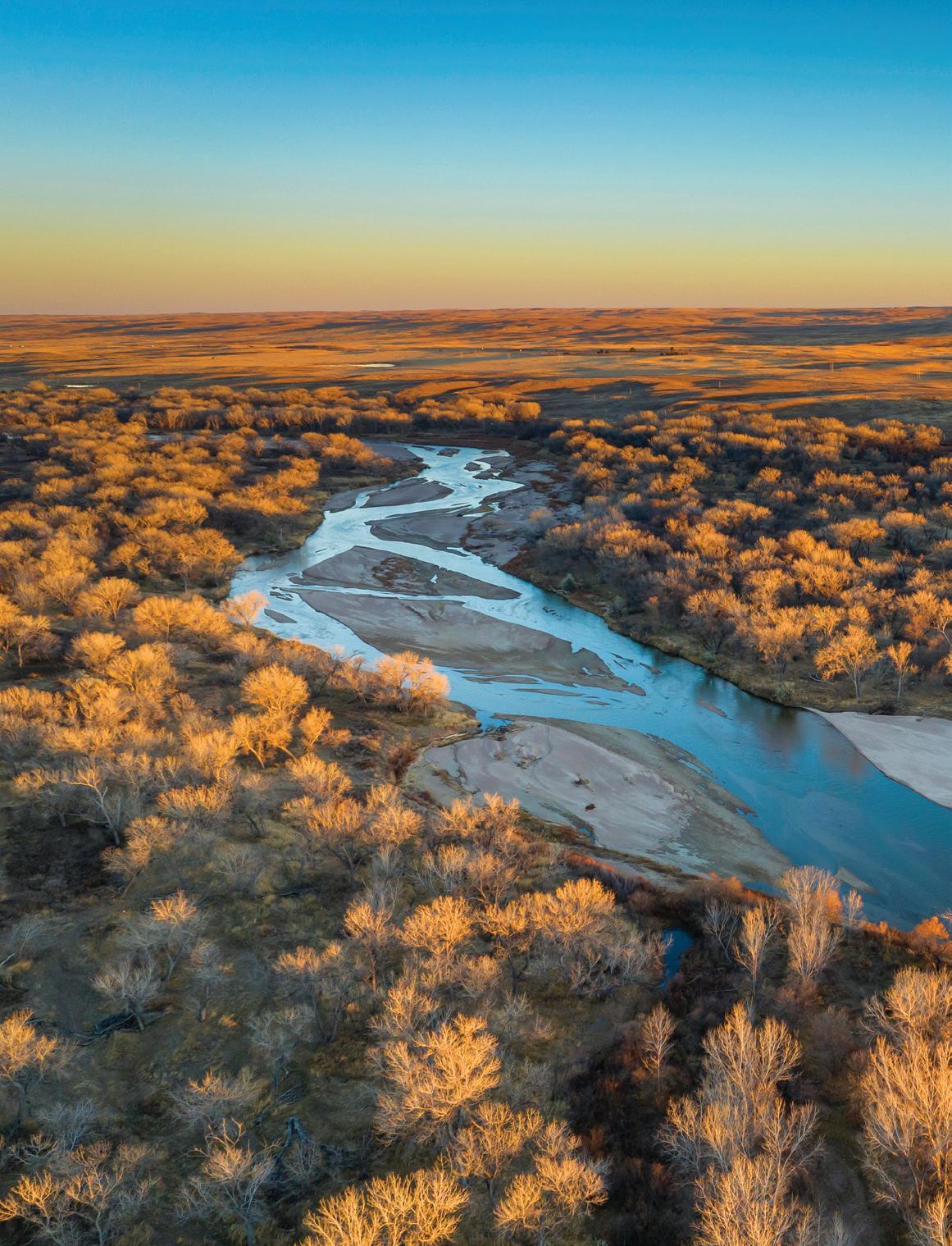
The South Platte River in northeastern Colorado
FISH ON THE
move
Tracking fish across Colorado’s rivers reveals progress — and remaining hurdles — in reopening historical migration routes.
BY ELIZABETH MILLER
In 2011, a razorback sucker, an olive-colored fish with a bony, razor-like keel behind its head that is found only in the Colorado River Basin, started its life in a hatchery. It was released into the wild as part of an effort to support the endangered species’ recovery with a small identification tag implanted under its skin. That tag allowed biologists to check in on this fish through its life, following its journey of nearly 1,000 miles.
Four years after its release near Green River, Utah, biologists caught it 291 river miles away on the Gunnison River in Colorado. The sucker’s identification tag was picked up again in 2017 by a biologist’s antenna in Lake Powell. Then, it swam upstream through Cataract Canyon, braving some of the biggest rapids on the Colorado River in peak runoff. A fish passage around the Tusher Diversion, on the Green River in Utah, allowed it to continue upstream to reach one of the most important spawning areas for razorback suckers, Razorback Bar, where strategically timed dam releases support spawning and newly hatched fish. In total, the Utah Division of Wildlife Resources estimates this razorback sucker traveled at least 942 miles over seven years, moving through several fish passages.
That single sucker’s journey illustrates both how widely fish species may migrate and how human management is enabling that movement. Other native fish in Colorado are also known to travel hundreds of miles, like the Colorado pikeminnow, but fish move on smaller scales, too, to access different habitats and food sources within a single river. Human and environmental stressors can limit that travel, with low streamflows, dams, irrigation diversions, and other infrastructure making it difficult or impossible for fish to move up and down rivers as they did historically. Human effort can also reconnect river miles, with success for fish, and for the ecosystems they rely on, often found through collaborative approaches.
EXPLORING WHERE, WHEN AND WHY
There’s no asking a fish why it migrates, but biologists infer from when and where they’re found what they might have been seeking. Moving can bring access to more or different food sources. It can put a fish in habitat better suited to the season, like finding shady eddies with slightly cooler water in summer, or deep, slow-moving pools for over-wintering. They often move to spawn in specific locations. Slower water can give fish a chance to rest out of strong currents. Shallower pockets can offer small or young fish a place to avoid being eaten by larger species.
“The general population has a pretty good handle on the concept of habitat fragmentation and how detrimental it is for things like deer, elk and antelope. When you chop that [habitat] up into smaller and smaller pieces, you have fewer and fewer animals on the landscape,” says Jon Ewert, aquatic biologist with Colorado Parks and Wildlife (CPW). “Fish are exactly the same way … The more contiguous habitat you have that fish are able to move into and up and down and through, the better off the ecology of the whole system is going to be.”
Tracking fish can help researchers see which strategies to support fish migration are working, where problems are arising, and how populations are recovering.
Razorback sucker
AN EPIC RECONNECTION
Automated antenna systems in waterways detect passive-integrated-transponders, or PIT tags, small enough to surgically embed in fish and follow their movements around a landscape, as was the case with that roaming razorback sucker.
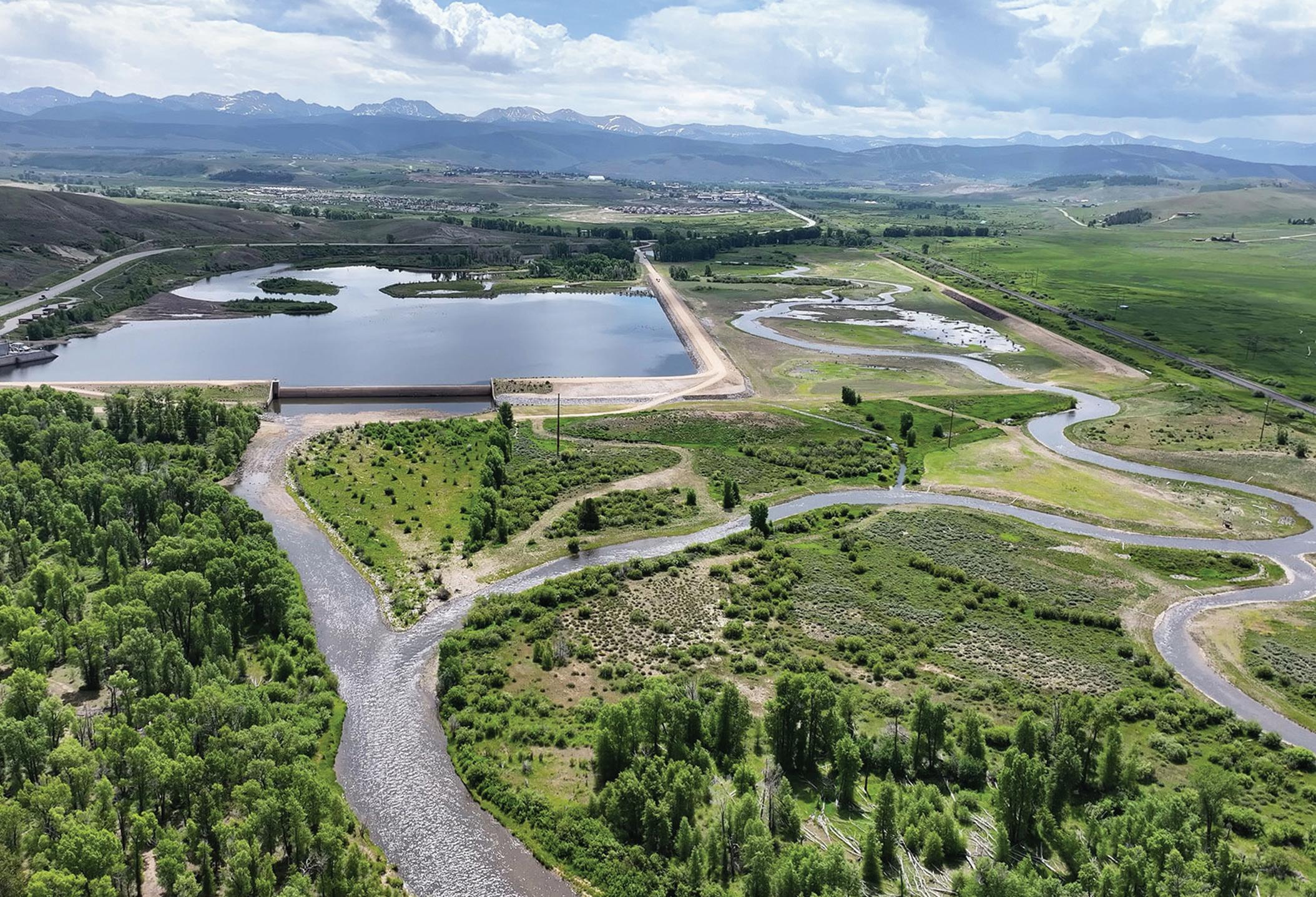
When the first fish found their way into the Colorado River Connectivity Channel in fall 2023, no equipment was required to see them. Within hours of flooding the re-created river channel that reconnected the Colorado River around Windy Gap Reservoir for the first time since 1985, people on the banks could see fish flickering through the water. In May, aquatic biologists estimated 848 brown trout and 221 rainbow trout were living in a one-mile reach of the new channel.
But biologists like Ewert are eying other signals for bigger changes in the river ecology. The connectivity channel reconnected fish habitat, but also restored natural river processes that direct how sediment, cobbles, boulders and logs move downriver. Windy Gap Reservoir’s wide, shallow pan trapped larger material, like cobbles and gravel that can rejuvenate riffles, but let fine sediment through. Downstream, that sediment filled in spaces between riverbed cobbles that were once habitat for macroinvertebrates and native sculpin, a small, stout fish that lives in cold, rock-bottomed tributaries.
“You’re just deleting that habitat from the system,” Ewert says. The species that depend on that habitat, like sculpin and
aquatic insects, started to vanish, too. With them went the river’s food web.
“What we were seeing over the course of decades is less invertebrate production, and therefore less trout production.”
Sculpin were spotted last fall in the Upper Colorado River and the connectivity channel for the first time in several decades. When the connectivity channel reaches its full potential over the coming years, Ewert expects to see two keystone species, native sculpin and the giant stonefly or salmon fly, proliferating in this part of the Colorado River. Northern Water’s Municipal Subdistrict, Trout Unlimited, Natural Resources Conservation Service, Colorado Parks and Wildlife, Colorado Water Conservation Board, Grand
The Colorado River Connectivity Channel flows on the right of the Windy Gap Reservoir. The re-created river channel reconnected the Colorado River in 2023 for the first time since 1985.
County, the Colorado River District, and the Upper Colorado River Alliance partnered to create the project.
At the dedication ceremony in October, Bill Emslie, Northern Water Municipal Subdistrict president, explained that partnerships assembled the funding, design and action to make the channel possible. Local Grand County residents had conceived of the idea in the 1990s, not long after Windy Gap was built. The reservoir’s harm to the river quickly became visible, and locals persisted in gathering the allies and resources necessary for the work. Naturalist and fly fisherman Bud Isaacs is credited with raising the alarm with Trout Unlimited, starting the process of meetings and design work for a solution to the waning trout populations. The channel joined a $90 million package of projects that the municipal subdistrict has underway to both improve stream health, and secure Front Range water supplies, including construction of Chimney Hollow Reservoir near Loveland.
Windy Gap Reservoir also blocked trout from high-quality spawning habitat upstream, where fry hatch, get washed downstream with the first high flows, live out their lives, then work back upstream to spawn near where they hatched. But removing Windy Gap would only have given fish a few miles of river access before they were blocked by another diversion structure. In anticipation of the $33 million connectivity channel, Trout Unlimited, Colorado Parks and Wildlife, and other partners worked with the Town of Granby with funding from the U.S. Fish and Wildlife Service and Colorado Water Conservation Board to add fish and boat passage around a diversion structure for the town’s water supply, extending the river miles that trout and sculpin can access. Similar motives led to remodeling a concrete sill that served as a measurement weir on the Fraser River to a more fish-friendly design.
“Now, in theory, if you’re a rainbow
trout in Dotsero, Colorado, which is many river miles downstream of here, you can start swimming upstream and not encounter any barriers to movement until you get to the Fraser River diversion at Winter Park, which, that’s a lot of river miles,” Ewert says. In total, by CPW calculations, the Colorado River Connectivity Channel opened up about 235 stream miles of contiguous habitat upstream of Windy Gap.
Similar projects are appearing around the state, with the success of one making the case for the next. A fish passage around the Redlands Diversion Dam on the Gunnison River has allowed more than 182,600 native fish access to more of their historic range. In a series of projects beginning in 2015, Trout Unlimited worked on Elk Creek and Canyon Creek, two Colorado River tributaries on the south side of the Flat Tops, to adjust
irrigation diversion structures that had become barriers to spawning grounds. Subsequent efforts have moved upstream in collaboration with the Middle Colorado Watershed Council.
COORDINATING RELEASES
Other projects have focused on carving out some share of water for conservation efforts, including keeping water in rivers to support fish migrations large and small. Since the 1990s, the Upper Arkansas River Voluntary Flow Management Program has tried to release water into the Arkansas River at just the right pace to cover trout spawning beds while not flushing newly hatched fry downriver or diminishing the trout’s ability to search for food,
At Redlands Diversion Dam, a fish passage allows native fish to access more of their range.
Safer Passage
As they’re able to move up and down river channels, fish can run into human-created hazards, like canals flowing with water that, instead of reconnecting downriver, will see fish floundering in fields or trapped in vanishing pools as the canal is dewatered at the end of irrigation season. Some 272,021 native fish were rescued just from the Grand Valley Water Users’ canal in Grand Junction between 2004 and 2023, according to a 2024 report from the Upper Colorado River Endangered FIsh Recovery Program. A screen over the entrance tries to deter fish from entering the canal, but debris can clog that screen, leading
the irrigation company to divert water around it or lift it away. Fish salvage operations rescue hundreds or thousands of stranded native fish each fall.
“It can be really difficult, particularly with really large rivers,” says Cat Adams, who studied fish screens as a research associate with the larval fish laboratory at Colorado State University. Her study looked at the Green River Canal in eastern Utah. The Upper Colorado River Recovery Program counted 700 endangered fish entering that canal on its way to water the town’s melon fields in 2012. In a single day, 301 razorback sucker became entrained. The recovery program
installed a screen over the canal in 2019. Water flows over a fine mesh screen at an angle, redirecting fish and even larvae back into the river, Adams explained. A ditch rider clears the screen of algae, silt and vegetation. In the years since, no fish have been detected below the screen.
“In the areas where there’s four imperiled fishes, three of them currently endangered, in the river basin, stuff like this is particularly important as they face the other myriad issues, like non-native fishes, water modification, habitat loss, on top of being entrained in canals,” Adams says. “So, just another tool in the toolbox.”
which becomes harder in the deeper and faster water ideal for boaters. Brown trout were the focus, but rainbow trout are establishing a fishery there as well.
Five parties joined the effort — the Southeastern Colorado Water Conservancy District, Colorado Parks and Wildlife, Chaffee County, Arkansas River Outfitters Association, and Trout Unlimited — to support spawning trout in the Arkansas River headwaters while still meeting other water users’ needs, including those of boaters in the most commercially rafted section of river in the country.
“People long before my time said, ‘Hey, we should get all these groups talking and see if we could move this water in a way that’s beneficial for all interests,’” says Tom Waters, Arkansas Headwaters Recreation Area park manager. “What’s grown from it is what we have today.”
It’s a voluntary program, and subject to the whims of high run-off years, dry winters, and hot summers without monsoons. A testament to the program’s success comes in the overall increased biomass in the river — the quality and density of fish, says Paul Foutz, senior aquatic biologist with CPW. The Arkansas River headwaters also now counts 102 miles of Gold Medal water, a designation from Colorado Parks and Wildlife that recognizes the highest quality trout fishing streams.
“What was once not a Gold Medal river is now the longest stretch of Gold Medal water in the state,” Waters says, crediting both flow management and mine reclamation near Leadville.
MINIMUM FLOWS
When setting minimum instream flows, the Colorado Water Conservation Board often considers the depth of water a fish needs to swim from pool to pool or riffle to riffle in that waterway, as well as other factors.
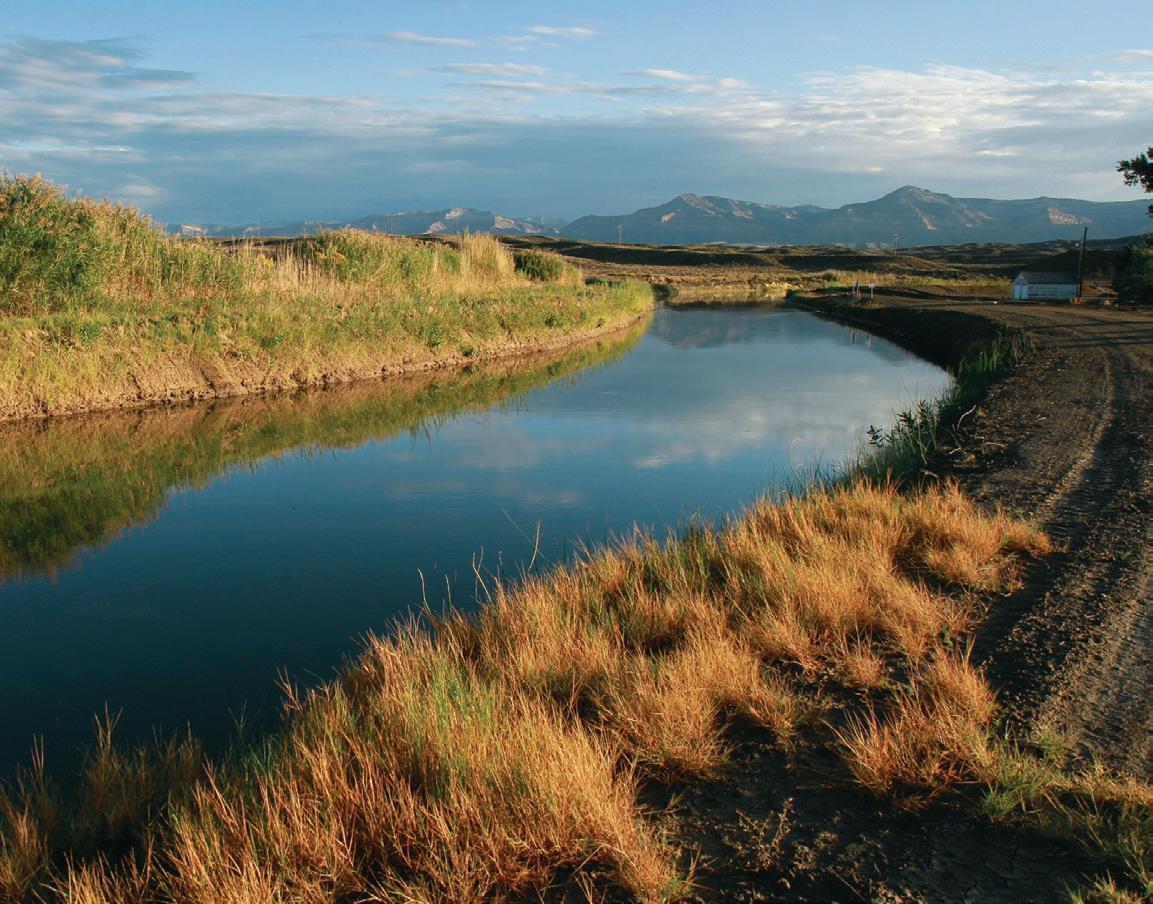
The Grand Valley Water Users Association's Government Highline Canal
“The idea behind every minimum flow is somewhat migrational — is fish passage — inherently,” says Tony LaGreca, stewardship manager with the Colorado Water Trust. The Colorado Water Trust works to secure water for environmental priorities, including fish and their migratory and habitat needs.
Since the 2010s, through the Yampa River Environmental Release Program, the trust has collaborated with the City of Steamboat Springs and the nonprofit Friends of the Yampa to see up to 7,100 acre-feet of water released into the Yampa River from upstream reservoirs to boost the water level during the hottest, driest summer months.
In shallower streams, water temperatures increase to levels that can stress and kill fish. To spare the fish further strain, the river closes for fishing and even wading, LaGreca says, a significant loss to the local outdoor recreation
economy. Adding more water can keep river water temperatures at levels where the fishery remains open for anglers, and the river stays open for tubing, a popular pastime for Steamboat Springs visitors.
Sometimes, efforts to support fish habitat and movement take a creative turn, as with a project that benefits the 15-Mile Reach, a stretch of the Colorado River between Palisade and Grand Junction. This reach is recognized as critical for the recovery of endangered and threatened fish species.
There, the Colorado Water Trust's leased water from the upstream Reudi Reservoir fuels hydropower generation at the Vinelands Power Plant, just above the town of Palisade. The power plant’s tailwater is released to critical habitat for the threatened and endangered fish that live within the 15-Mile Reach or downstream. These flows fill important habitat like backwaters, side channels,
and eddies and pools at the bottom of riffles that might otherwise dry. At times, water from this project has accounted for half of the water in the reach. The excess power generated by the project is sold and accrues profits that will fund future infrastructure upgrades.
“It’s a really great project only because of the collaboration, and because we have so many partners who were willing to work together,” LaGreca says. “We see a lot of folks coming and talking to us because they understand nothing gets done in water without everybody working together, and the environment is part of that.”
Independent journalist Elizabeth Miller writes about environmental issues in the American West for publications including The Washington Post, Scientific American, Outside, Backpacker, and The Drake.
An angler fishes on the Arkansas River, which boasts 102 miles of Gold Medal waters.
MEMBER'S CORNER
A Community Of People Who Care About Water
IN THE SPOTLIGHT: UPPER ARKANSAS WATER CONSERVANCY DISTRICT AND GENERAL MANAGER GREG FELT
Our Members
Connect the Dots Statewide
The Upper Arkansas Water Conservancy District (UAWCD), a proud Water Education Colorado (WEco) member since 2009, works to protect water rights in the Upper Arkansas Basin while seeking opportunities to expand the basin’s water supply. Under the leadership of general manager Greg Felt, UAWCD also fosters cooperation, education and innovation.
Greg's passion for rivers began as a rafting enthusiast. In the 1990s, he cofounded both a rafting company, then ArkAnglers, the largest fly-fishing operation on the Arkansas River. Time on the river sparked his curiosity about water management and spurred his involvement in water policy.
In 2006, Greg applied for a seat on the UAWCD board, beginning 18 years of service. Along the way, he discovered a talent for seeking win-win solutions — an approach that has shaped his career as a county commissioner, member of the Colorado Water Conservation Board, and now general manager of UAWCD.
ENGAGE
Dive into our diverse programming. Find more information on our website. A few ideas to pique your interest: Visit our shop to order a copy of the newly updated Community Guide to Colorado Water Conservation (shop. watereducationcolorado.org).
Coming this fall and winter, look for most of our community guides translated into Spanish.
Make your voice heard! Visit our social media pages or craft a letter to the Fresh Water News editor to share your thoughts, opinions or experiences.
Greg has supported WEco both personally and professionally, with particular interest in county commissioners, who play a critical role in land-use decisions statewide.
Greg was organizing water education sessions at Colorado Counties, Inc. conferences when he saw an opportunity to partner with WEco.
“[CCI] may have been worried about conflict ... but this is about education — it’s what people need to know,” he said. It was a perfect fit for WEco. Through collaborations on WEco’s annual basin tours and CCI events, Greg has helped bring water education to leaders across the state.
Whether guiding a raft down the Arkansas or navigating the intricacies of water policy, he brings the same spirit of connection and problem-solving. WEco is grateful to count UAWCD — and Greg — as long-time collaborators and supporters.
Misson: IMPACT
Water Education Colorado is the leading organization for informing and engaging Coloradans on water. Through leadership training, educational resources, and programming, we are working toward a vibrant, sustainable and water-aware Colorado.
150
The number of participants who have engaged in WEco's Social Water Series since July 2024. These free, educational events bring the community together to explore and learn about the many ways water connects us.
VOLUNTEER
We rely on our volunteers!
Email us at info@wateredco.org to express interest:
Share your expertise and we’ll plug you in — as a blog contributor, a speaker, or a peer reviewer for publications.
Join a contact list to provide local support when we bring one of our programs to your area.
Help us connect with Colorado's Spanish-speaking communities to provide new educational resources and opportunities.
Your gift advances an engaged Colorado, leading to informed decisions and sustainable solutions.
Three ways to give:
Sponsor an upcoming program or event to showcase your organization's support for water education. Visit wateredco.org/ get-involved/sponsorship-opportunities to learn more.
WEco accepts charitable gifts of appreciated stock — you get double the tax benefit! Contact David@wateredco.org.
You can donate year-round to support WEco's ability to provide Fresh Water News reporting and other valuable learning experiences to diverse audiences across the state. Visit wateredco.org/ donate today.
WATE R EDUCATION COLO R ADO .O R G
Publication of Water Education Colorado's Headwaters magazine is made possible by the generous support of sponsors and advertisers. We would like to extend our appreciation and thanks to these sponsors for contributing financially to this issue.