Perspectives The story of Colorado’s transbasin diversions is fraught with discordance. Even as these engineered marvels have enabled growth and opportunity in the regions to which water is added, they’ve also resulted in ecological losses and other challenges in the river basins from which that water is depleted. As Colorado continues to face the great dilemma of meeting future water demands while protecting its treasured environmental and recreational resources, and considers the role transbasin diversions are or are not to play, age-old disagreements borne of legitimate concerns have arisen. We asked three noted authors and historians, each of whom have dug deeply into the history of efforts to secure water supplies in the state, to share their perspectives on lessons learned from the past—lessons that might help today’s water leaders chart a wise course forward.
Does a Zipper Divide or Connect? By Patty Limerick In the Center of the American West’s “Introduction to Western American Studies,” my students and I entered a phase of preoccupation with the meaning of zippers. The most accomplished of all western American historians, Elliott West, got us into this unexpected intellectual pickle. Elliott had been writing about the early 1840s, when the Rio Grande served as the border between the United States and Mexico. The river, he wrote, “did not divide the land and its peoples on either side of it any more than a zipper divides a pair of pants.” In what was not my cleverest pedagogical move, I called this creative analogy to my students’ attention. Several students mobilized to deploy skepticism, declaring that they saw not the slightest resemblance between a zipper and a river designated as a border. In a class writing assignment, one student made a brave effort to understand the comparison: “I think Elliott West meant,” this courageous thinker wrote, “that even if you divide your zipper and your pants fall off, are they not a pair of pants?” A visit to Dictionary.com brought merciful relief. A zipper, it turns out, is “a device consisting of two toothed tracks…each bordering one of two edges to be joined, and a piece that either interlocks or separates them when pulled.” At last, the point: Just like a zipper, a continental divide “either interlocks or separates” the land and the peoples on either side of it. Every transbasin diversion renews and reinvigorates the question: Are the Western Slope and the Front Range of Colorado interlocked or separated? Before I began writing A Ditch in Time, a pleasant state of ignorance would have permitted me to take on this question with ease. The answer was “mostly separated.” I held an ill-informed belief that would have led me quickly to that answer. I thought that the residents of “the basin of origin” of a given river had, simply by their geographical location, some sort of higher claim— moral and cosmic, if not legal—on the river that moved through the terrain of their homes. If the basin of origin deserved intrinsic protection, then the transbasin diversions of water from the Western Slope to the Front Range separated those two locales, just as a person taking a wallet separates herself from the person who was initially in possession of that wallet. But this line of thought, of course, rested on a wrongheaded and inaccurate understanding of how the arrangements for water allocation in Colorado are made. When I recognized that the Colorado Constitution does not offer protection to the basin of origin, I was surprised at my ignorance. I was certainly familiar with the governing idea of prior appropriation, but I hadn’t taken the next step: to realize that the seniority of a water right was not affected in the least by whether or not the claimant’s
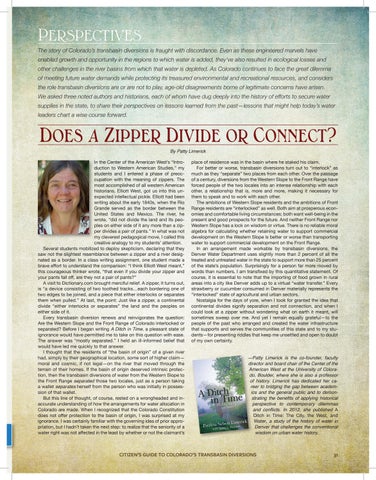
place of residence was in the basin where he staked his claim. For better or worse, transbasin diversions turn out to “interlock” as much as they “separate” two places from each other. Over the passage of a century, diversions from the Western Slope to the Front Range have forced people of the two locales into an intense relationship with each other, a relationship that is, more and more, making it necessary for them to speak and to work with each other. The ambitions of Western Slope residents and the ambitions of Front Range residents are “interlocked” as well. Both aim at prosperous economies and comfortable living circumstances; both want well-being in the present and good prospects for the future. And neither Front Range nor Western Slope has a lock on wisdom or virtue. There is no reliable moral algebra for calculating whether retaining water to support commercial development on the Western Slope is better or worse than transporting water to support commercial development on the Front Range. In an arrangement made workable by transbasin diversions, the Denver Water Department uses slightly more than 2 percent of all the treated and untreated water in the state to support more than 25 percent of the state’s population. Surprisingly for a person far more moved by words than numbers, I am transfixed by this quantitative statement. Of course, it is essential to note that the importing of food grown in rural areas into a city like Denver adds up to a virtual “water transfer.” Every strawberry or cucumber consumed in Denver materially represents the “interlocked” state of agricultural and urban sectors. Nostalgia for the days of yore, when I took for granted the idea that continental divides signify separation and not connection, and when I could look at a zipper without wondering what on earth it meant, will sometimes sweep over me. And yet I remain equally grateful—to the people of the past who arranged and created the water infrastructure that supports and serves the communities of this state and to my students—for presenting riddles that keep me unsettled and open to doubt of my own certainty. Patty Limerick is the co-founder, faculty — director and board chair of the Center of the American West at the University of Colorado, Boulder, where she is also a professor of history. Limerick has dedicated her career to bridging the gap between academics and the general public and to demonstrating the benefits of applying historical perspective to contemporary dilemmas and conflicts. In 2012, she published A Ditch in Time: The City, the West, and Water, a study of the history of water in Denver that challenges the conventional wisdom on urban water history.
CITIZEN’S GUIDE TO COLORADO’S TRANSBASIN DIVERSIONS
31