the compacts. Only water rights pre-dating the compact would be immune from curtailment, and none of the state’s major transbasin diversion projects hold rights from that far back. Because these Colorado Basin shortages could be so severe, all Colorado River water users must sort out the questions posed by the possibility of lower flows. Role of Transbasin Diversions in Future Supply Stakeholders and water planners are working together to prepare and plan for this uncertain and stressed water future. Water planners regularly converse across the Continental Divide to reach mutually beneficial agreements. Coloradans have been learning that the state has only one water future. Dialogue and cooperation through the river basin roundtables and Interbasin Compact Committee are leading to a state water plan outlining a unified vision for meeting water needs across Colorado. But today’s water planners rely less on the possibility of new transbasin diversions than they did in the last century, and instead work with an array of tools to try to address Colorado’s future water supply challenges. The Interbasin Compact Committee uses the metaphor of a four-legged stool to describe available water supply options. Those four legs include limited transfers of water from agricultural to municipal use; conservation and reuse; completion of identified projects and processes; and development of new supplies from the Colorado River. On the long list of identified projects and processes across the state are enlargements or completion of several transbasin diversion projects that the South Platte, Arkansas and Metro basin roundtables on the East Slope are pursuing to fill the looming gap between their projected needs and available water supplies. These include the Moffat Firming Project, the Windy Gap Firming Project, and an unspecified cooperative transbasin diversion project identified in the 1998 Eagle River Memorandum of Understanding. Together, those three agreed-upon but not-yet-permitted or developed projects would divert an additional 68,000 acre-feet of Colorado River Basin water to the East Slope on average each year. Other possible larger transbasin diversion projects, referred to as “new supply,” would bring water from West Slope rivers in the Colorado River Basin to the East Slope from as far downstream as Utah. In a 2000 Colorado Supreme Court case, the court added a comment in their ruling, examining the availability of water stored in reservoirs built for the 1965 Colorado River Storage Project Act. The court said that within the Aspinall Unit, which includes Blue Mesa Reservoir, Morrow Point Reservoir and Crystal Reservoir, “the 240,000 acre-foot marketable pool is available for use in-basin or transbasin, but only by contract with BUREC [the U.S. Bureau of Reclamation].” That’s 240,000 acre-feet of water that the Colorado Supreme Court said the United States could make available for future use. However, available water in Aspinall was not the issue in the case before the court—and Aspinall’s first priority, as part of the Colorado River Storage Project, is helping ensure
year limit on the amount of water Aurora can move from the Arkansas Basin. Cooperative agreements and state planning discussions have led water leaders to expose their priorities and biases but also to understand and embrace different perspectives. Still, many continue to note Colorado’s Great Divide and the need to respect interests on both sides.
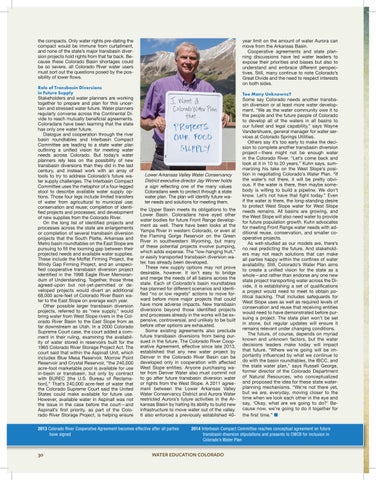
Lower Arkansas Valley Water Conservancy District executive director Jay Winner holds a sign reflecting one of the many values Coloradans seek to protect through a state water plan. The plan will identify future water needs and solutions for meeting them. the Upper Basin meets its obligations to the Lower Basin. Coloradans have eyed other water bodies for future Front Range development as well. There have been looks at the Yampa River in western Colorado, or even at the Flaming Gorge Reservoir on the Green River in southwestern Wyoming, but many of these potential projects involve pumping, which adds expense. The “low-hanging fruit,” or easily transported transbasin diversion water, has already been developed. These new supply options may not prove desirable, however. It isn’t easy to bridge and merge the needs of all basins across the state. Each of Colorado’s basin roundtables has planned for different scenarios and identified “no or low regrets” actions to move forward before more major projects that could have more adverse impacts. New transbasin diversions beyond those identified projects and processes already in the works will be expensive, controversial, and unlikely to be built before other options are exhausted. Some existing agreements also preclude future transbasin diversions from being pursued in the future. The Colorado River Cooperative Agreement, effective since late 2013, established that any new water project by Denver in the Colorado River Basin can be developed only in cooperation with affected West Slope entities. Anyone purchasing water from Denver Water also must commit not to go after future transbasin diversion water or rights from the West Slope. A 2011 agreement between the Lower Arkansas Valley Water Conservancy District and Aurora Water restricted Aurora’s future activities in the Arkansas Basin by halting its ability to build new infrastructure to move water out of the valley. It also enforced a previously established 40-
2013 Colorado River Cooperative Agreement becomes effective after all parties have signed
30
Too Many Unknowns? Some say Colorado needs another transbasin diversion or at least more water development. “We as the water community owe it to the people and the future people of Colorado to develop all of the waters in all basins to our fullest and legal capability,” says Wayne Vandershuere, general manager for water services at Colorado Springs Utilities. Others say it’s too early to make the decision to complete another transbasin diversion project—there might not be enough water in the Colorado River. “Let’s come back and look at it in 10 to 20 years,” Kuhn says, summarizing his take on the West Slope’s position in negotiating Colorado’s Water Plan. “If the water’s not there, it will be pretty obvious. If the water is there, then maybe somebody is willing to build a pipeline. We don’t know. Let’s not have that fight today.” Even if the water is there, the long-standing desire to protect West Slope water for West Slope needs remains. All basins are growing, and the West Slope will also need water to provide for future population growth. Kuhn advocates for meeting Front Range water needs with additional reuse, conservation, and smaller cooperative projects. As well-studied as our models are, there’s no real predicting the future. And stakeholders may not reach solutions that can make all parties happy within the confines of water availability. Still, Colorado’s Water Plan aims to create a unified vision for the state as a whole—and rather than endorse any one new state project transporting water across the Divide, it is establishing a set of qualifications a project would need to meet to obtain political backing. That includes safeguards for West Slope uses as well as required levels of conservation and reuse that receiving entities would need to have demonstrated before pursuing a project. The state plan won’t be set in stone, but regular updates will ensure it remains relevant under changing conditions. The future, of course, depends on myriad known and unknown factors, but the water decisions leaders make today will impact that future. “Where we’re going will be importantly influenced by what we continue to do with the basin roundtables, the IBCC, and the state water plan,” says Russell George, former director of the Colorado Department of Natural Resources, who conceptualized and proposed the idea for these state waterplanning mechanisms. “We’re not there yet, but we are, everyday, moving closer to the time when we look each other in the eye and say, ‘Okay, what are we going to do?’ Because now, we’re going to do it together for the first time.” n
2014 Interbasin Compact Committee reaches conceptual agreement on future transbasin diversion stipulations and presents to CWCB for inclusion in Colorado’s Water Plan
WATER EDUCATION COLORADO