This leads the story of transbasin diversions nearly to the present. Times, attitudes and values have changed. Most water agencies are better neighbors and environmental stewards, and the negotiations and cooperative agreements that began in the 1970s have grown into a way of life for water providers. Although some of these changes are attributable to culture and law, a large part of the cooperation the Colorado water community has undertaken more recently is borne of necessity. Now, population growth and climate are variables that all water suppliers must consider, and with more competition for water, using existing transbasin water supplies to extinction is not only an accepted option, but a necessary one. Colorado’s population reached 5 million in 2008. New water is no longer easy to develop and appropriate, and hasn’t been for a long time. At the same time, researchers have made the public aware of climate change, which threatens to bring further unpredictability to Colorado. The CWCB warns that Colorado has warmed by 2.5 degrees Fahrenheit in the past 50 years and another 2.5 to 5.5 degrees of warming is predicted by 2050, with fluctuating drought and flood events, leaving water managers unsure of what to expect. New transbasin diversions are few in this new era, but water providers have been looking to agricultural water, cooperative exchanges, conservation, recycling and other more creative tools to maximize water and enhance existing supply. The 2002 to 2003 severe drought stressed existing supplies, and it moved Northern Water’s Municipal Subdistrict and Denver to work on expansion or “firming” projects. Without these expansions, both entities draw less than the permissible amount from their transbasin diversions due to limited storage on the Front Range. Windy Gap Firming and Environmental Mitigation Northern Water’s Municipal Subdistrict, which now serves 15 entities, has no storage reservoir on the East Slope, and because the Subdistrict’s water rights are junior to most other upper Colorado River decrees, it can only divert water during above-average water years. To make the most of its transbasin diversion and water rights, the Subdistrict plans to construct the 90,000 acre-foot Chimney Hollow Reservoir adjacent to the Colorado-Big Thompson’s Carter Lake just west of Berthoud. In 2012, the Subdistrict
Trevor Brown Jr.
The Era of Climate Change, Scarcity and Cooperation
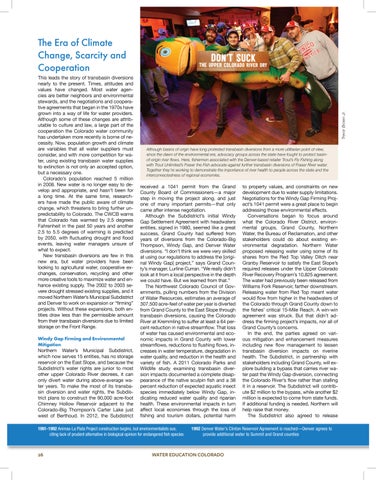
Although basins of origin have long protested transbasin diversions from a more utilitarian point of view, since the dawn of the environmental era, advocacy groups across the state have fought to protect basinof-origin river flows. Here, fishermen associated with the Denver-based retailer Trout’s Fly Fishing along with Trout Unlimited’s Fraser the Fish advocate against further transbasin diversions of Fraser River water. Together they’re working to demonstrate the importance of river health to people across the state and the interconnectedness of regional economies.
received a 1041 permit from the Grand County Board of Commissioners—a major step in moving the project along, and just one of many important permits—that only came after intense negotiation. Although the Subdistrict’s initial Windy Gap Settlement Agreement with headwaters entities, signed in 1980, seemed like a great success, Grand County had suffered from years of diversions from the Colorado-Big Thompson, Windy Gap, and Denver Water diversions. “I don’t think we were very skilled at using our regulations to address the [original Windy Gap] project,” says Grand County’s manager, Lurline Curran. “We really didn’t look at it from a local perspective in the depth we could have. But we learned from that.” The Northwest Colorado Council of Governments, pulling numbers from the Division of Water Resources, estimates an average of 307,500 acre-feet of water per year is diverted from Grand County to the East Slope through transbasin diversions, causing the Colorado River at Kremmling to suffer at least a 64 percent reduction in native streamflow. That loss of water has caused environmental and economic impacts in Grand County with lower streamflows, reductions to flushing flows, increases in water temperature, degradation in water quality, and reduction in the health and variety of fish. A 2011 Colorado Parks and Wildlife study examining transbasin diversion impacts documented a complete disappearance of the native sculpin fish and a 38 percent reduction of expected aquatic insect species immediately below Windy Gap, indicating reduced water quality and riparian health. These environmental impacts in turn affect local economies through the loss of fishing and tourism dollars, potential harm
1991-1992 Animas-La Plata Project construction begins, but environmentalists sue, citing lack of prudent alternative in biological opinion for endangered fish species
26
to property values, and constraints on new development due to water supply limitations. Negotiations for the Windy Gap Firming Project’s 1041 permit were a great place to begin addressing those environmental effects. Conversations began to focus around what the Colorado River District, environmental groups, Grand County, Northern Water, the Bureau of Reclamation, and other stakeholders could do about existing environmental degradation. Northern Water proposed releasing water using some of its shares from the Red Top Valley Ditch near Granby Reservoir to satisfy the East Slope’s required releases under the Upper Colorado River Recovery Program’s 10,825 agreement. The water had previously been released from Williams Fork Reservoir, farther downstream. Releasing water from Red Top meant water would flow from higher in the headwaters of the Colorado through Grand County down to the fishes’ critical 15-Mile Reach. A win-win agreement was struck. But that didn’t address the firming project’s impacts, nor all of Grand County’s concerns. In the end, the parties agreed on various mitigation and enhancement measures including new flow management to lessen transbasin diversion impacts on riverine health. The Subdistrict, in partnership with stakeholders including Grand County, will explore building a bypass that carries river water past the Windy Gap diversion, connecting the Colorado River’s flow rather than stalling it in a reservoir. The Subdistrict will contribute $2 million to the bypass, while another $2 million is expected to come from state funds. If additional funding is needed, Northern will help raise that money. The Subdistrict also agreed to release
1992 Denver Water’s Clinton Reservoir Agreement is reached—Denver agrees to provide additional water to Summit and Grand counties
WATER EDUCATION COLORADO