FRYINGPAN–ARKANSAS Ruedi Reservoir Fry
in gp a n
Hunter
Hunter Tunnel Creek ASPEN
Ro
a
rin
gF
o rk River
SUMMIT COUNTY SECURITY
FOUNTAIN
Cunningham Turquoise Tunnel Reservoir
iv er
R
PITKIN COUNTY
EAGLE COUNTY Homestake Reservoir
Carter Tunnel
Boustead Tunnel Mount Elbert Conduit
Chapman, Nast And Southfork Tunnels
ALMA
EL PASO COUNTY
LEADVILLE
San Isabel National Forest
Twin Lakes Reservoir Creek
CHAFFEE COUNTY
Taylor Park Resevoir
PARK COUNTY PUEBLO COUNTY
Clear Creek Reservoir Antero Reservoir
r ive as R ans Ark
Clear
Fountain Valley Conduit
FAIRPLAY
LAKE COUNTY
Mount Elbert Forebay L a ke Cre e k
COLORADO SPRINGS
CONTINENTAL DIVIDE
BUENA VISTA
LEGEND Tunnel Pipeline Canal Pumpstation Powerplant
Ar ka nsa sR ive r
PUEBLO
Pueblo Reservoir
To Pueblo
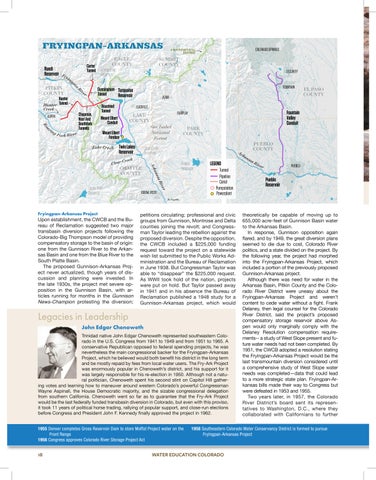
Fryingpan-Arkansas Project
Upon establishment, the CWCB and the Bureau of Reclamation suggested two major transbasin diversion projects following the Colorado-Big Thompson model of providing compensatory storage to the basin of origin: one from the Gunnison River to the Arkansas Basin and one from the Blue River to the South Platte Basin. The proposed Gunnison-Arkansas Project never actualized, though years of discussion and planning were invested. In the late 1930s, the project met severe opposition in the Gunnison Basin, with articles running for months in the Gunnison News-Champion protesting the diversion;
petitions circulating; professional and civic groups from Gunnison, Montrose and Delta counties joining the revolt; and Congressman Taylor leading the rebellion against the proposed diversion. Despite the opposition, the CWCB included a $225,000 funding request toward the project on a statewide wish list submitted to the Public Works Administration and the Bureau of Reclamation in June 1938. But Congressman Taylor was able to “disappear” the $225,000 request. As WWII took hold of the nation, projects were put on hold. But Taylor passed away in 1941 and in his absence the Bureau of Reclamation published a 1948 study for a Gunnison-Arkansas project, which would
Legacies in Leadership John Edgar Chenoweth Trinidad native John Edgar Chenoweth represented southeastern Colorado in the U.S. Congress from 1941 to 1949 and from 1951 to 1965. A conservative Republican opposed to federal spending projects, he was nevertheless the main congressional backer for the Fryingpan-Arkansas Project, which he believed would both benefit his district in the long term and be mostly repaid by fees from local water users. The Fry-Ark Project was enormously popular in Chenoweth’s district, and his support for it was largely responsible for his re-election in 1950. Although not a natural politician, Chenoweth spent his second stint on Capitol Hill gathering votes and learning how to maneuver around western Colorado’s powerful Congressman Wayne Aspinall, the House Democratic majority, and the sizable congressional delegation from southern California. Chenoweth went so far as to guarantee that the Fry-Ark Project would be the last federally funded transbasin diversion in Colorado, but even with this proviso, it took 11 years of political horse trading, rallying of popular support, and close-run elections before Congress and President John F. Kennedy finally approved the project in 1962. 1955 Denver completes Gross Reservoir Dam to store Moffat Project water on the Front Range 1956 Congress approves Colorado River Storage Project Act
18
theoretically be capable of moving up to 655,000 acre-feet of Gunnison Basin water to the Arkansas Basin. In response, Gunnison opposition again flared, and by 1949, the great diversion plans seemed to die due to cost, Colorado River politics, and a state divided on the project. By the following year, the project had morphed into the Fryingpan-Arkansas Project, which included a portion of the previously proposed Gunnison-Arkansas project. Although there was need for water in the Arkansas Basin, Pitkin County and the Colorado River District were uneasy about the Fryingpan-Arkansas Project and weren’t content to cede water without a fight. Frank Delaney, then legal counsel for the Colorado River District, said the project’s proposed compensatory storage reservoir above Aspen would only marginally comply with the Delaney Resolution compensation requirements-- a study of West Slope present and future water needs had not been completed. By 1951, the CWCB adopted a resolution stating the Fryingpan-Arkansas Project would be the last transmountain diversion considered until a comprehensive study of West Slope water needs was completed—data that could lead to a more strategic state plan. Fryingpan-Arkansas bills made their way to Congress but were defeated in 1953 and 1955. Two years later, in 1957, the Colorado River District’s board sent its representatives to Washington, D.C., where they collaborated with Californians to further
1958 Southeastern Colorado Water Conservancy District is formed to pursue Fryingpan-Arkansas Project
WATER EDUCATION COLORADO