Spring 2017 Issue
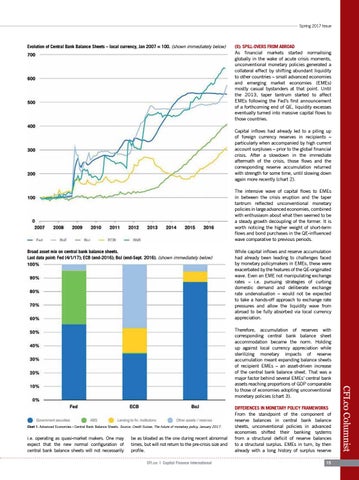
Evolution of Central Bank Balance Sheets – local currency, Jan 2007 = 100. (shown immediately below)
(II): SPILL-OVERS FROM ABROAD As financial markets started normalising globally in the wake of acute crisis moments, unconventional monetary policies generated a collateral effect by shifting abundant liquidity to other countries – small advanced economies and emerging market economies (EMEs) mostly casual bystanders at that point. Until the 2013, taper tantrum started to affect EMEs following the Fed’s first announcement of a forthcoming end of QE, liquidity excesses eventually turned into massive capital flows to those countries. Capital inflows had already led to a piling up of foreign currency reserves in recipients – particularly when accompanied by high current account surpluses – prior to the global financial crisis. After a slowdown in the immediate aftermath of the crisis, those flows and the corresponding reserve accumulation returned with strength for some time, until slowing down again more recently (chart 2). The intensive wave of capital flows to EMEs in between the crisis eruption and the taper tantrum reflected unconventional monetary policies in large advanced economies, combined with enthusiasm about what then seemed to be a steady growth decoupling of the former. It is worth noticing the higher weight of short-term flows and bond purchases in the QE-influenced wave comparative to previous periods.
Broad asset mix on central bank balance sheets. Last data point: Fed (4/1/17); ECB (end-2016); BoJ (end-Sept. 2016). (shown immediately below)
While capital inflows and reserve accumulation had already been leading to challenges faced by monetary policymakers in EMEs, these were exacerbated by the features of the QE-originated wave. Even an EME not manipulating exchange rates – i.e. pursuing strategies of curbing domestic demand and deliberate exchange rate undervaluation – would not be expected to take a hands-off approach to exchange rate pressures and allow the liquidity wave from abroad to be fully absorbed via local currency appreciation.
Chart 1: Advanced Economies - Central Bank Balance Sheets. Source: Credit Suisse, The future of monetary policy, January 2017.
i.e. operating as quasi-market makers. One may expect that the new normal configuration of central bank balance sheets will not necessarily
be as bloated as the one during recent abnormal times, but will not return to the pre-crisis size and profile. CFI.co | Capital Finance International
DIFFERENCES IN MONETARY POLICY FRAMEWORKS From the standpoint of the component of reserve balances in central bank balance sheets, unconventional policies in advanced economies shifted their banking systems from a structural deficit of reserve balances to a structural surplus. EMEs in turn, by then already with a long history of surplus reserve 15
CFI.co Columnist
Therefore, accumulation of reserves with corresponding central bank balance sheet accommodation became the norm. Holding up against local currency appreciation while sterilizing monetary impacts of reserve accumulation meant expanding balance sheets of recipient EMEs – an asset-driven increase of the central bank balance sheet. That was a major factor behind several EMEs’ central bank assets reaching proportions of GDP comparable to those of economies adopting unconventional monetary policies (chart 3).