The success of the BRICS (though not in all cases) in promoting inclusive growth, employment and structural transformation to reduce poverty and inequality provide some valuable lessons for African countries. Overall, the critical building blocks that defined success were building human capital and improving access to assets; investing in infrastructure with structural transformation and jobs in mind; using well-designed social transfer programmes to address poverty and inequality and prioritizing inclusion. IMPLICATIONS FOR BRICS The growth slowdown in emerging economies, including the BRICS, raises some implications. The BRICS need to see cooperation with Africa as an important tool in their quest to resume being an engine of global economic growth. There is a growing consensus that Africa is on the verge of an economic take-off and could become a new pole of global growth. This includes Africa’s untapped natural resource endowment, which provides significant investment potential; the continent’s steady population growth, which, if properly managed, could yield positive returns as well as increasing urbanization, the rise of the middle class and the untapped regional market. Since 2003, many African countries have attained high economic growth rates, and in some cases, managed to sustain relative high rates throughout the global economic and financial and Eurozone crises. African countries have also witnessed notable improvements in the general macroeconomic environment, thanks to an increase in strategic and timely institutional reforms, as well as improved governance in many countries. Business environment is improving in many countries and as a result of improved macroeconomic conditions, Africa has successfully attracted increased FDI in recent years.
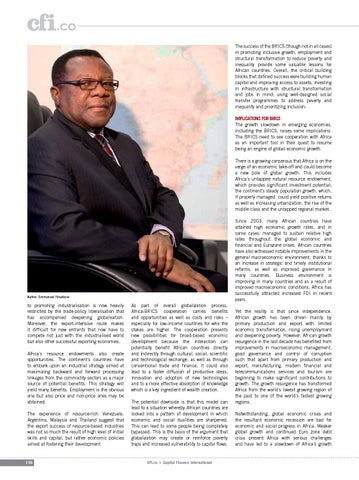
Author: Emmanuel Nnadozie
to promoting industrialisation is now heavily restricted by the trade-policy liberalisation that has accompanied deepening globalisation. Moreover, the export-intensive route makes it difficult for new entrants that now have to compete not just with the industrialised world but also other successful exporting economies. Africa’s resource endowments also create opportunities. The continent’s countries have to embark upon an industrial strategy aimed at maximizing backward and forward processing linkages from the commodity sectors as a major source of potential benefits. This strategy will yield many benefits. Employment is the obvious one but also price and non-price ones may be obtained. The experience of resource-rich Venezuela, Argentina, Malaysia and Thailand suggest that the export success of resource-based industries was not so much the result of high level of initial skills and capital, but rather economic policies aimed at fostering their development
116
As part of overall globalization process, Africa-BRICS cooperation carries benefits and opportunities as well as costs and risks – especially for low-income countries for who the stakes are higher. The cooperation presents new possibilities for broad-based economic development because the interaction can potentially benefit African countries directly and indirectly through cultural, social, scientific and technological exchange, as well as through conventional trade and finance. It could also lead to a faster diffusion of productive ideas, innovation and adoption of new technologies and to a more effective absorption of knowledge which is a key ingredient of wealth creation. The potential downside is that this model can lead to a situation whereby African countries are locked into a pattern of development in which economic and social dualities are sharpened. This can lead to some people being completely bypassed. This is the basis of the argument that globalization may create or reinforce poverty traps and increased vulnerability to capital flows.
CFI.co | Capital Finance International
Yet the reality is that since independence, African growth has been driven mainly by primary production and export with limited economic transformation, rising unemployment and deepening poverty. However, African growth resurgence in the last decade has benefited from improvements in macroeconomic management, good governance and control of corruption such that apart from primary production and export, manufacturing, modern financial and telecommunications services and tourism are beginning to make significant contributions to growth. The growth resurgence has transformed Africa from the world’s lowest growing region of the past to one of the world’s fastest growing regions. Notwithstanding, global economic crises and the resultant economic recession are bad for economic and social progress in Africa. Weaker global growth and continued Euro zone debt crisis present Africa with serious challenges and have led to a slowdown of Africa’s growth