> IFC:
Key Reforms Can Boost Ukraine’s Economy — and it’s Time to Act NB! This article was prepared before the COVID-19 pandemic.
By Jason Pellmar, IFC regional manager for Ukraine, Belarus, and Moldova
Ukraine’s location, workforce and fertile land can help it move up the global value chain.
A
s the second-largest country in Europe, with the largest area of arable land — twice that of France, and thrice that of Germany — Ukraine is an agricultural powerhouse.
With 41.5m usable hectares, covering 70 percent of the country, agriculture is the largest export industry. In 2018, the sector (including the processing industry) generated about 17 percent of GDP. At the same time, Ukraine’s agricultural worker productivity level is among the lowest in Europe. A moratorium on the sale of agricultural land has further discouraged investment. NB: This ended, however, on March 30, 2020, when the Ukrainian parliament adopted the legislation that enables Ukrainian individuals to acquire up to 100 hectares as of July 1, 2021, and for Ukrainian legal entities to acquire up to 10,000 hectares beginning in 2024. FDI inflows remain among the lowest in emerging Europe, and yet there is substantial demand for improved infrastructure: ports, rail, and roads. Ukraine needs significant financing to repay public debt (nearly $11bn per annum, 201921). This makes mobilising international financing to complete the country’s development agenda even more imperative. The financial sector faces challenges too. The state dominates, with more than 50 percent ownership of the banking sector. The high rate of non-performing loans (NPLs) remains a major concern for the stability of the Ukrainian banking sector. According to the National Bank of Ukraine, the ratio of non-performing loans to total gross loans stood at around 48 percent in December last year. Conditions are now ripe for positive change. Ukraine has achieved macro-economic stabilisation and, with a newly formed government in place, the political landscape is conducive to reform. Tackling Ukraine’s multiple bottlenecks requires complex solutions and swift implementation. The way forward lies in structural reforms to 84
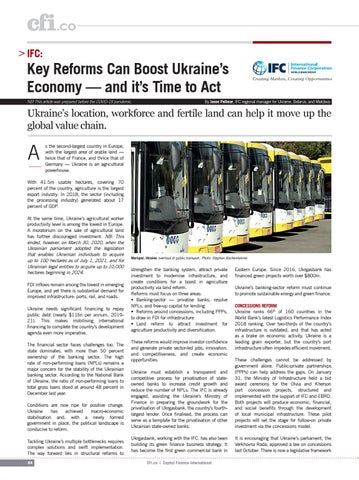
Mariupol, Ukraine: overhaul of public transport. Photo: Stephan Bachenheimer
strengthen the banking system, attract private investment to modernise infrastructure, and create conditions for a boost in agriculture productivity via land reform. Reforms must focus on three areas: • Banking-sector — privatise banks, resolve NPLs, and free-up capital for lending • Reforms around concessions, including PPPs, to draw in FDI for infrastructure • Land reform to attract investment for agriculture productivity and diversification. These reforms would improve investor confidence and generate private sector-led jobs, innovation, and competitiveness, and create economic opportunities.
Eastern Europe. Since 2016, Ukrgasbank has financed green projects worth over $800m. Ukraine’s banking-sector reform must continue to promote sustainable energy and green finance. CONCESSIONS REFORM Ukraine ranks 66th of 160 countries in the World Bank’s latest Logistics Performance Index 2018 ranking. Over two-thirds of the country’s infrastructure is outdated, and that has acted as a brake on economic activity. Ukraine is a leading grain exporter, but the country’s port infrastructure often impedes efficient movement.
Ukraine must establish a transparent and competitive process for privatisation of stateowned banks to increase credit growth and reduce the number of NPLs. The IFC is already engaged, assisting the Ukraine’s Ministry of Finance in preparing the groundwork for the privatisation of Ukrgasbank, the country’s fourthlargest lender. Once finalised, the process can serve as a template for the privatisation of other Ukrainian state-owned banks.
These challenges cannot be addressed by government alone. Public-private partnerships (PPPs) can help address the gaps. On January 31, the Ministry of Infrastructure held a bid award ceremony for the Olvia and Kherson port concession projects, structured and implemented with the support of IFC and EBRD. Both projects will produce economic, financial, and social benefits through the development of local municipal infrastructure. These pilot projects will set the stage for follow-on private investment via the concessions model.
Ukrgasbank, working with the IFC, has also been building its green finance business strategy. It has become the first green commercial bank in
It is encouraging that Ukraine’s parliament, the Verkhovna Rada, approved a law on concessions last October. There is now a legislative framework
CFI.co | Capital Finance International