Capital Finance International
Spring 2020
£9.95 // €14.95 // $15.95
AS WORLD ECONOMIES CONVERGE
Sheikh Hamdan bin Mohammed bin Rashid Al Maktoum, Crown Prince of Dubai:
SMART CITY PRINCE
ALSO IN THIS ISSUE // NASDAQ: ESG DELIVERY AND MARKET DISTRUST // UNCDF: GAME-CHANGING FINANCE OECD: PRIVATE FINANCE TO REALISE SDGs // ROCHE: FINANCING HEALTH SYSTEMS IFC: UKRAINE’S ECONOMY // HARVARD BUSINESS SCHOOL: IMPACT-WEIGHTED ACCOUNTS
Enjoy electric. The new EQC. Join us in the fully electric era. With the first member of the Mercedes-Benz EQ family. www.mercedes-benz.ch/EQC
A B C D E F G
A
EQC, 408 HP (300 kW), 26,3 kWh/100 km (fuel equivalent: 2,4 l/100 km), 0 g CO2/km (average of all new models sold: 174 g CO2/km), CO2 emissions fro
om fuel and/or electricity consumption: 34 g/km, energy efficiency category: A.
AVENGER
The Aviation Pioneers Squad Scott Kelly Rocio Gonzalez Torres Luke Bannister
SUPER AVENGER NIGHT MISSION
Be the Storm
V8 Levante Trofeo with 580 HP. The most powerful Maserati
Levante Trofeo: Engine: V8 90° 3.799 cm 3 - max power: 580 HP at 6750 rpm - max torque: 730 Nm at 2500-5000 rpm - max speed: 300 km/h - 0 to 100 km/h acceleration: 4.1 secs. fuel consumption (combined cycle): 13,3 – 13,2 l/100 km * - CO 2 emissions (combined cycle): 302 – 299 g/km. - Efficiency class: G. * The Greenhouse gas CO 2 is main responsible for the global warming; the average CO 2 emission of all offered vehicles in Switzerland is of 137 g/km.
First Thoughts A recent Accenture survey discovered that 60 percent of the 30,000 consumers canvassed worldwide expect companies to take a positive stand on issues such as sustainability, transparency and fair employment practices. There will be no hiding place behind the traditional bottom line. Businesses must now report on “triple bottom-line” criteria — which measure integrity and sensitivity as well as financial performance. Research tells us that 90 percent of millennials feel so strongly that companies should “do the right thing” that they would switch brands to support a worthwhile cause. They shun firms that fail to live up to responsible ethical standards. But — should you suspect that respondents would be unlikely to say otherwise — be aware that in this case, the figures don’t lie. Unilever CEO Alan Jape has pointed out that, in 2018, the company’s sustainable living brands grew 69 percent faster than the rest of the business. (That compares with 46 percent in the year before.)
& Jerry’s campaigns for social justice and climate change action are well known. These are just two of Unilever’s 28 sustainable living brands, and this category accounts for seven of its top 10 best-sellers. The writing is on the wall for companies not prepared to heed consumers. Accenture tells us that brands are now community property. Shareholders have a stake — but so do employees, who bring the brand to life, and customers, who sustain it with loyalty and drive it forward with meaningful demands. “In an era of radical visibility,” the consultancy points out, “technology and media have given individuals the power to stand up for their opinions and beliefs on a grand scale. This power, reflected in everything from the #MeToo movement to the growing intolerance for fake news, is infiltrating every aspect of people’s lives, including their purchasing decisions.”
Almost three-quarters of Unilever’s growth is coming from purpose-led brands. Dove has helped and encouraged 35 million youngsters to tackle low self-esteem over the past 15 years, and Ben
Brands are increasingly reliant on reputation and responsiveness for their existence. The demand for ethically produced, sustainable products and services can only rise.
First Thoughts
Unilever’s sustainable brands are defined as those that communicate concerns for the planet or social purpose, help to reduce the company’s environmental footprint, and enhance the social impact of the business.
Larry Fink, chairman and CEO of BlackRock Inc, makes the point well: “The public expectations of your company have never been greater… Every company must not only deliver financial performance, but also show how it makes a positive contribution to society. Without a sense of purpose, no company, public or private, can achieve its full potential.”
8
First Thoughts
9
> Correspondence
“ “ “
Despite being unable to arrange chimes of Big Ben to welcome Brexit, the enterprising Conservative party managed to pull something else out of the spangly bag: a made-in-Britain tea towel picturing a triumphant Boris Johnson. This may give a hint of textile production (cottage industry) opportunities for the Britons who, never, never, never will be slaves. To save space the legend emblazoned around the prime-ministerial girth was, “Got Brexit Done” rather than the more accurate: “Awaiting the Results of Tricky Bargaining That Could Take Quite A While.” Aesthetes may prefer to consider the party’s Brexit key fob, fridge magnet or mug. Let’s hope we are not the mugs. GORDON HURD (Chalfont St Giles, UK)
I have never been comfortable with single-use plastic cutlery and not only because of a preference for silver service. As your avocado-centric article (CFI.co Winter) points out, these little bits of plastic cannot be properly recycled and cause unacceptable pollution. It is comforting to know that the avocado pip resembles latex and, with a little help, can be transformed into knives, forks and spoons. At first, I thought the berry was going to be magicked into the countercutlery movement but see now that that is a whole lot of guacamole. Chapeau to Scott Mangula in Mexico for this fascinating tableware development. SUZANNE FAVRE (Geneva, Switzerland)
Ian Fletcher’s piece in your Winter issue, focusing on the monetisation (and potential weaponization) of data, was an interesting and timely read. The most worrying facet of this emerging trend to put a price on our thoughts, preferences and tendencies is that the information becomes available to the highest bidder. That bidder could be (and often is) someone in a position of power; Donald Trump’s administration, for example. Democracy is already a poor, tattered thing that’s been tormented into a caricature of its ideal self. With social media, fake news and the dreaded data added into the mix, get ready to kiss goodbye to any semblance of it. TARIQ HIJAZ (Beirut, Lebanon)
10
Spring 2020 Issue
“ “
I read with great interest your article about AMC Natural Drinks and its success story. As a Spanish citizen, resident in the countryside, it is encouraging to see a “good news” story at a time when we hear that rural areas are emptying, and farmers are protesting as the supermarkets force them to sell their produce at unsustainable margins. In Spain, we are blessed with a wonderful climate and fertile soil; it makes me proud that a company here in the south is producing quality products in such an innovative and sustainable way. JESÚS CASTRO BAEZA (Linares, Spain)
While I understand Ursula von der Leyen’s need to put her best-foot forward for a stronger Europe, I wonder how she envisages advances when the EU is about to lose a €9bn contribution from the UK. The Eurozone is forecast to grow by a meagre 1.2 percent — before factoring-in the effects of coronavirus. I have always been a cautious supporter of the European project and believe that it has brought many benefits. However, is it not fair that we should expect a modicum of realpolitik from Frau President? AMANDEEP SANDHU (Birmingham, UK)
11
> Editorial Team
Sarah Worthington George Kingsley Jackie Chapman Tony Lennox Kate Stanton Brendan Filipovski John Marinus Ellen Langford Helen Lynn Stone Dane Cobain
COVER STORIES Evan Harvey, Nasdaq: ESG Delivery and Market Distrust (22 – 23)
UNCDF
Columnists
Getting the Right Blend in Game-Changing Finance
Otaviano Canuto Evan Harvey Tor Svensson Lord Waverley Ian Fletcher
(24 – 26)
OECD
DISCUSSION PAPER Private Finance to Realise the SDGs
Distribution Manager William Adam
(28 – 29)
Subscriptions Maggie Arts
Cover Story A Prince with a Mission
Commercial Director John Mann
(34 – 39)
Director, Operations Marten Mark
Roche Financing Health Systems Against NCDs
Publisher Anthony Michael
Capital Finance International Meridien House 69 - 71 Clarendon Road Watford WD17 1DS United Kingdom
T: +44 203 137 3679 F: +44 203 137 5872 E: info@cfi.co W: www.cfi.co Editorial on p16-21, 190 © Project Syndicate 2020
Printed in the UK by The Magazine Printing Company using only paper from FSC/PEFC suppliers www.magprint.co.uk
12
(53)
INSTITUTIONAL INVESTING FOR THE SDGS IFC
Key Reforms Can Boost Ukraine’s Economy (84 – 85)
Harvard Business School Impact-Weighted Accounts (158 – 159)
A Joint Discussion Paper from MSCI and the OECD Meggin Thwing Eastman, Paul Horrocks, Tansher Singh, Neeraj Kumar CFI.co | Capital Finance International
December 2018
Spring 2020 Issue
FULL CONTENTS 14 – 41
As World Economies Converge
Otaviano Canuto Nouriel Roubini Joseph Stiglitz Evan Harvey UNCDF OECD Tor Svensson Tony Lennox James Zhan 42 – 49 Spring 2020 Special: Narrowing Gender
50 – 85
Europe
Brendan Filipovski Heidelberg University Matthew Eyton-Jones Elekta Kathrein Privatbank CBRE Welltec
86 – 103
CFI.co Awards
Rewarding Global Excellence
104 – 123
Africa
PwC Nigeria Abdoulaye Kouafilann Sory Simba Group Sonnie Ayere
124 – 143
Middle East
Mohamed A El-Erian Nasdaq Lord Waverley UNCTAD
Gap
Roche Gorgi Krlev Spain NAB Richard Hausmann Grupo T-Solar IFC Tobias Prestel
Pablo Morales CERN Pension Fund The Access Bank UK Limited AIB Tirelli & Partners SegurCaixa Adeslas Katja Muelheim
Folajimi Akinla Arnaud Floris PwC South Africa DLM Capital Group
Fidelis Finance African Development Bank Group (AfDB) Shirley Machaba
KIB Linklease QNB ALAHLI Mohamed El Dib Book Review Exim Credit Joseph R Waryoba KelloggInsight Ryan Merheby First Qatar Applied Science Private University (ASPU) 144 – 153 Latin America Fiduciaria Central Oscar de Jesús Marín CMI EY Sergio Caveggia Jimena Garcia AFP Confía
154 – 163
North America
Hal Williams Harvard Business School Toronto Finance International ISID 164 – 189 Asia Pacific KC Li SBM Group Sherzod Khodjhaev GAMOW RavenPack FBS Max Myanmar 190 Final Thought
CFI.co | Capital Finance International
Robert Zochowski McGill University
ICBC SDG Lab at UN Geneva Zaw Zaw
13
> Otaviano Canuto on Central Banks and Climate Change:
Turning Black Swans Into Green
There are three possible motivations for the engagement by central banks with climate change: financial risks, macro-economic impacts, and mitigation/adaptation policies.
R
egardless of the extent to which individual central banks incorporate the three prongs of motivations, they can no longer ignore the issue.
Last month, a Bank for International Settlements (BIS) book referred to a “green swan” as an adaptation of the concept of a “black swan” used in finance. Extreme weather events — floods, violent storms, droughts and forest fires — occurred on all inhabited continents last year. At least seven of them resulted in damage of more than $10 billion, according to a report by Christian Aid. Regardless of scepticism in some quarters, and the varying opinions about the role of human action, the fact is that the average global temperature at sea and on land has been rising since the 1970s, and shows a greater range of variations and extremes (Chart 1).
Chart 1: Change in global average temperature relative to 1880–1900.
Source: Rudebusch, G.D. Climate Change and the Federal Reserve, FRBSF Economic Letter 2019-09, March 25, 2019. Note: Global average surface temperature based on land and ocean data from the National Aeronautics and Space Administration (NASA)
CFI.co Columnist
As a result of this rise in temperatures, there is a higher frequency of extreme weather events. A recently published study by Vinod Thomas and Ramón Lopez estimates that high-intensity storms and floods could double over the next 13 years. Chart 2 depicts the worldwide increase in natural catastrophes, and proportions of insured losses, in recent decades. With different degrees of urgency and coverage, central banks are now considering climate change issues as relevant to their functions. Without the participation of the US Federal Reserve, 50 central banks created the Network of Central Banks and Supervisors for Greening the Financial System (NGFS) in December 2017. This is a network for mutual consultation on environmental risk-management practices, and those associated with climate change. Christine Lagarde, president of the European Central Bank (ECB), has stated that climate change policies will be crucial to her mandate. There are three possible motivations for the engagement by central banks. The first is the set of risks to financial stability potentially brought about by natural disasters. This is particularly the case for financial sectors such as banks and insurance companies. 14
(left - number of relevant natural loss events | right - overall and insured losses) Chart 2: Increase in the number of extreme weather events and their insurance (1980-2018).
Source: Bolton et al, The green swan - central banking and financial stability in the age of climate change, BIS, Jan. 2020 (data from MunichRe, The Natural Disasters of 2018 in Figures)
According to the Institute of International Finance (IIF) report Sustainable Finance in Focus, Climate change: a Core Financial Stability Risk (June 6, 2019) more than $2.5tn of global financial assets in 2016 were subject to some kind of risk as a result of climate change. As the first NGFS report noted: “Climate-related risks… fall squarely within the mandates of central banks and supervisors to ensure the financial system is resilient.” CFI.co | Capital Finance International
There are two types of financial risk in this context: physical threats to the value of assets resulting from climate shocks, and trends such as rising sea levels, rising temperatures, and melting polar ice caps. Such physical risks include potential direct losses, and indirect impact on global value chains and repair costs. There are also financial risks arising from climate change mitigation strategies that may
Spring 2020 Issue
Chart 3: Channels and spillovers for materialisation of physical and transition. Source: Source: Bolton et al, The green swan - central banking and financial stability in the age of climate change, BIS, Jan. 2020
"There are two types of financial risk in this context: physical threats to the value of assets resulting from climate shocks, and trends such as rising sea levels, rising temperatures, and melting polar ice caps." be implemented, called “transition risks”. The move to a low-carbon economy will change the allocation of resources, technologies in use, and the construction of infrastructure. The strategies adopted will have consequences on the value of company assets, from carbon taxes to options to accelerate the transition to renewable energy. Chart 3 provides a snapshot of associated financial risks. It is worth noting that risks associated with climate change also bring opportunities. According to estimates of growth models indicated by the IIF, a transition to a low-carbon economy could eliminate climate damage equivalent to nearly two percent of the GDP of G20 countries by 2050.
In addition to financial risks and stability, another concern is impact on economic growth, inflation and on monetary policy decisions. ECB president Christine Lagarde evaluates climate change impacts on the eurozone economy in the institution's models and assessments. The Federal Reserve officially considers climate change to be a “negligible macro-economic
The Green Swan: “The growing realisation that climate change is a source of financial (and price) instability: it is likely to generate physical risks related to climate damages, and transition risks related to potentially disordered mitigation strategies. Climate change therefore falls under the remit of central banks, regulators and supervisors who are responsible for monitoring and maintaining financial stability.”
Lael Brainard, a member of the board of governors of the Federal Reserve System, added: “Climate risks are projected to have profound effects on the US economy and financial system. To fulfil our core responsibilities, it will be important for the Federal Reserve to study the implications of climate change … and to adapt our work accordingly.”
The book refers to a "green swan" as an adaptation of the concept of "black swan", popularised in finance after Nassim Taleb’s 2007 book. Black swans refer to unexpected events, with low probability but heavy impact, only after they happen. By their nature, they do not fit the analysis of normal and known conditions. "Climate change can lead to 'green swan' events and be the cause of the next systemic financial crisis", note the authors of the book. i
The third area of potential central bank engagement with the issue of climate change is less consensual. It is about using their balance sheets to favour its mitigation, giving special treatment to green bonds in its asset acquisition programmes. Despite opposition from members of the ECB — such as the president of the Bundesbank, the German central bank — Christine Lagarde has referred to a role of the ECB in supporting the EU’s economic strategy. Regardless of the extent to which individual central banks incorporate the three prongs of motivation, they can no longer ignore the issue of climate change. As noted in the book CFI.co | Capital Finance International
ABOUT THE AUTHOR Otaviano Canuto is principal at the Center for Macroeconomics and Development, a senior fellow at the Policy Centre for the New South and a non-resident senior fellow at Brookings Institution. He is a former vice-president and a former executive director at the World Bank, a former executive director at the International Monetary Fund, and a former vice-president at the Inter-American Development Bank. Otaviano has been a regular columnist for CFI.co for the past seven years. Follow him on Twitter: @ocanuto 15
CFI.co Columnist
The Organisation for Economic Co-operation and Development (OECD) suggests that what it calls a “decisive transition” could raise GDP, in the long run, by up to 2.8 percent in the G20 countries.
risk” in the medium term. Nonetheless, as acknowledged by Glenn D Rudebusch, from the Federal Reserve Bank of San Francisco: “In coming decades, climate change — and efforts to limit that change and adapt to it — will have increasingly important effects on the US economy.” Relevant considerations for the Federal Reserve in fulfilling its mandate for macroeconomic and financial stability, he says.
> Nouriel Roubini:
The White Swans of 2020
I
n my 2010 book, Crisis Economics, I defined financial crises not as the “black swan” events that Nassim Nicholas Taleb described in his eponymous bestseller, but as “white swans.” According to Taleb, black swans are events that emerge unpredictably, like a tornado, from a fat-tailed statistical distribution. But I argued that financial crises, at least, are more like hurricanes: they are the predictable result of built-up economic and financial vulnerabilities and policy mistakes. There are times when we should expect the system to reach a tipping point – the “Minsky Moment” – when a boom and a bubble turn into a crash and a bust. Such events are not about the “unknown unknowns,” but rather the “known unknowns.” Beyond the usual economic and policy risks that most financial analysts worry about, a number of potentially seismic white swans are visible on the horizon this year. Any of them could trigger severe economic, financial, political, and geopolitical disturbances unlike anything since the 2008 crisis. For starters, the United States is locked in an escalating strategic rivalry with at least four implicitly aligned revisionist powers: China, Russia, Iran, and North Korea. These countries all have an interest in challenging the US-led global order, and 2020 could be a critical year for them, owing to the US presidential election and the potential change in US global policies that could follow. Under President Donald Trump, the US is trying to contain or even trigger regime change in these four countries through economic sanctions and other means. Similarly, the four revisionists want to undercut American hard and soft power abroad by destabilising the US from within through asymmetric warfare. If the US election descends into partisan rancor, chaos, disputed vote tallies, and accusations of “rigged” elections, so much the better for America’s rivals. A breakdown of the US political system would weaken American power abroad. Moreover, some countries have a particular interest in removing Trump. The acute threat that he poses to the Iranian regime gives it every reason to escalate the conflict with the US in the coming months – even if it means risking a full-scale war – on the chance that the ensuing spike in oil prices would crash the US stock market, trigger a recession, and sink Trump’s re-election prospects. Yes, the consensus view is that the targeted killing of Qassem Suleimani has 16
"Although the SinoAmerican cold war is by definition a low-intensity conflict, a sharp escalation is likely this year." deterred Iran, but that argument misunderstands the regime’s perverse incentives. War between US and Iran is likely this year; the current calm is the one before the proverbial storm. As for US-China relations, the recent “phase one” deal is a temporary Band-Aid. The bilateral cold war over technology, data, investment, currency, and finance is already escalating sharply. The COVID-19 outbreak has reinforced the position of those in the US arguing for containment, and lent further momentum to the broader trend of Sino-American “decoupling.” More immediately, the epidemic is likely to be more severe than currently expected, and the disruption to the Chinese economy will have spillover effects on global supply chains – including pharma inputs, of which China is a critical supplier – and business confidence, all of which will likely be more severe than financial markets’ current complacency suggests. Although the Sino-American cold war is by definition a low-intensity conflict, a sharp escalation is likely this year. To some Chinese leaders, it cannot be a coincidence that their country is simultaneously experiencing a massive swine flu outbreak, a severe bird flu, a coronavirus epidemic, political unrest in Hong Kong, the reelection of Taiwan’s pro-independence president, and stepped-up US naval operations in the East and South China Seas. Regardless of whether China has only itself to blame for some of these crises, the view in Beijing is veering toward the conspiratorial. But open aggression is not really an option at this point, given the asymmetry of conventional power. China’s immediate response to US containment efforts will likely take the form of cyberwarfare. There are several obvious targets. Chinese hackers (and their Russian, North Korean, and Iranian counterparts) could interfere in the US election by flooding Americans with misinformation and deep fakes. With the US electorate already so polarised, it is not difficult to imagine armed partisans taking to the streets to challenge the results, leading to serious violence and chaos. CFI.co | Capital Finance International
Spring 2020 Issue
Revisionist powers could also attack the US and Western financial systems – including the Society for Worldwide Interbank Financial Telecommunication (SWIFT) platform. Already, European Central Bank President Christine Lagarde has warned that a cyberattack on European financial markets could cost $645 billion. And security officials have expressed similar concerns about the US, where an even wider range of telecommunication infrastructure is potentially vulnerable. By next year, the US-China conflict could have escalated from a cold war to a nearhot one. A Chinese regime and economy severely damaged by the COVID-19 crisis and facing restless masses will need an external scapegoat, and will likely set its sights on Taiwan, Hong Kong, Vietnam, and US naval positions in the East and South China Seas; confrontation could creep into escalating military accidents. It could also pursue the financial “nuclear option” of dumping its holdings of US Treasury bonds if escalation does take place. Because US assets comprise such a large share of China’s (and, to a lesser extent, Russia’s) foreign reserves, the Chinese are increasingly worried that such assets could be frozen through US sanctions (like those already used against Iran and North Korea). Of course, dumping US Treasuries would impede China’s economic growth if dollar assets were sold and converted back into renminbi (which would appreciate). But China could diversify its reserves by converting them into another liquid asset that is less vulnerable to US primary or secondary sanctions, namely gold. Indeed, both China and Russia have been stockpiling gold reserves (overtly and covertly), which explains the 30% spike in gold prices since early 2019. In a sell-off scenario, the capital gains on gold would compensate for any loss incurred from dumping US Treasuries, whose yields would spike as their market price and value fell. So far, China and Russia’s shift into gold has occurred slowly, leaving Treasury yields unaffected. But if this diversification strategy accelerates, as is likely, it could trigger a shock in the US Treasuries market, possibly leading to a sharp economic slowdown in the US. The US, of course, will not sit idly by while coming under asymmetric attack. It has already been increasing the pressure on these countries with sanctions and other forms of trade and financial warfare, not to mention its own worldbeating cyberwarfare capabilities. US cyberattacks against the four rivals will
continue to intensify this year, raising the risk of the first-ever cyber world war and massive economic, financial, and political disorder. Looking beyond the risk of severe geopolitical escalations in 2020, there are additional medium-term risks associated with climate change, which could trigger costly environmental disasters. Climate change is not just a lumbering giant that will cause economic and financial havoc decades from now. It is a threat in the here and now, as demonstrated by the growing frequency and severity of extreme weather events. In addition to climate change, there is evidence that separate, deeper seismic events are underway, leading to rapid global movements in magnetic polarity and accelerating ocean currents.. Any one of these developments could augur an environmental white swan event, as could climatic “tipping points” such as the collapse of major ice sheets in Antarctica or Greenland in the next few years. We already know that underwater volcanic activity is increasing; what if that trend translates into rapid marine acidification and the depletion of global fish stocks upon which billions of people rely? As of early 2020, this is where we stand: the US and Iran have already had a military confrontation that will likely soon escalate; China is in the grip of a viral outbreak that could become a global pandemic; cyberwarfare is ongoing; major holders of US Treasuries are pursuing diversification strategies; the Democratic presidential primary is exposing rifts in the opposition to Trump and already casting doubt on vote-counting processes; rivalries between the US and four revisionist powers are escalating; and the real-world costs of climate change and other environmental trends are mounting. This list is hardly exhaustive, but it points to what one can reasonably expect for 2020. Financial markets, meanwhile, remain blissfully in denial of the risks, convinced that a calm if not happy year awaits major economies and global markets. i ABOUT THE AUTHOR Nouriel Roubini, Professor of Economics at New York University's Stern School of Business and Chairman of Roubini Macro Associates, was Senior Economist for International Affairs in the White House’s Council of Economic Advisers during the Clinton Administration. He has worked for the International Monetary Fund, the US Federal Reserve, and the World Bank. His website is NourielRoubini.com. 17
> Mohamed A El-Erian:
Adapting to a Fast-Forward World
F
irms and governments must increasingly internalise the possibility – indeed, I would argue, the overwhelming probability – of an acceleration of four secular developments that influence what business and political leaders do and how they do it. Decision-makers should think of these trends as waves, which, especially if they occur simultaneously, could feel like a tsunami for those who fail to adapt their thinking and practices in a timely manner. 18
The first and most important trend is climate change, which has evolved from a relatively distant concern, on which there is ample time to take remedial action, to an imminent and increasingly urgent threat. The mobilisation of various concerned segments of society, owing partly to unusual climatic disruptions in recent years, has greatly increased the pressure on companies to act now. BP’s recent announcement that it intends to achieve “net-zero” carbon emissions by 2050 – a notable CFI.co | Capital Finance International
promise by an energy company that operates in several highly challenging settings – is the latest example of business responding to such calls. It is only a matter of time until this pressure also prompts governments to take further steps, not only to encourage green activities, but also to tax and regulate those that cause pollution. Second, privacy concerns have grown alongside technical innovations involving artificial intelligence and big data.
Spring 2020 Issue
The third secular force involves disruptions to the multi-decade process of economic and financial globalisation. The initial trigger for this was the tradepolicy pivot by US President Donald Trump’s administration – from cooperative conflict resolution to explicit confrontation, from multilateralism to bilateralism (or even unilateralism), and from rule-based to more ad hoc arrangements – aimed at creating a still-free but fairer trading system. But deglobalisation has been turbocharged by the outbreak of the deadly COVID-19 virus, which has disrupted the flow of goods and services in China and beyond. These challenges to globalisation have opened the door for governments to weaponise economic tools to meet objectives that transcend economics, such as national security. This, in turn, is calling into question conventional wisdom about crossborder supply chains, just-in-time inventory management, and reliance on external demand to boost domestic growth. The final trend is demographic and concerns more than the aging of societies in Europe and Asia and this trend’s economic and political implications. It also goes beyond the growing realisation that millennials’ starkly different expectations – regarding professional careers, personal engagement, political action, and the delivery of goods and services – will persist and deepen. For starters, businesses need to be smarter about “anywhere, any place, any time” delivery. Furthermore, job loyalty and tenure are decreasing, while expectations of comprehensive job fulfillment and engagement are rising. Self-mobilisation for political and other causes, often with no visible leadership structure, has become a lot easier, yet often is less durable and raises tricky questions about what comes afterward. And all of this is taking place amid the continued migration of an ever-expanding range of interactions from physical to virtual spaces.
Society is increasingly recognising that recent technological advances allow not only for more efficient compilation of huge amounts of personal data, but also for using this information to monitor and alter behaviors. Broadly speaking, data are controlled and exploited either by governments (particularly in China), Big Tech companies (as in the United States), or more by users (as in Europe). But none of these three general operating paradigms seems to provide sufficient comfort and assurance to most people.
Each of these secular forces will have an important impact on the effectiveness and success of companies and governments alike. And while being challenging overall, the four trends involve a diverse and geographically dispersed set of winners and losers. Executives and policymakers therefore must make timely revisions (including pre-emptive changes) not only to their business models and operational approaches, but also to both their tactical and strategic mindsets. Getting this right will require cognitive diversity, openness to constructive criticism, repeated scenario analyses, and multidisciplinary approaches. Moreover, because CFI.co | Capital Finance International
each of the secular forces involves a considerable degree of uncertainty (with lots of known unknowns, and probably more than a few unknown unknowns behind them), a combination of resilience, optionality, and agility also is important. And this is even before one considers unanticipated periodic shocks such as the COVID-19 outbreak. The challenges to sound decision-making and leadership in both business and government are not limited to mapping each of the four secular forces and the required adaptation. Decision-makers also must consider correlations and causalities between these trends that can make their total impact multiplicative rather than merely additive. As a quick illustration, consider another aspect of demographic change: migration and the humanitarian challenges that often come with it. Climate change confronts countries with the possibility of waves of migratory human flows that they will find hard to accept and inhumane to refuse. The combination of de-globalisation and the misuse of AI and big data to infringe individual privacy is similarly troubling. This could lead to questionable behavior by some governments and encourage malicious non-state actors to disrupt societies and economies. The world is in a period of accelerating change, the leading edge of which is the ever-growing list of developments that have gone from impossible to inevitable. Many (though by no means all) of the challenges facing business and political leaders may be broken down into four secular changes that can help anchor the timely formulation of required responses at the local, national, regional, and global levels. The faster that companies and governments recognise this, the likelier they will be to alter the balance of benefits, costs, and risks in their favor. i ABOUT THE AUTHOR Mohamed A El-Erian, Chief Economic Adviser at Allianz, the corporate parent of PIMCO where he served as CEO and coChief Investment Officer, was Chairman of US President Barack Obama’s Global Development Council. He is President Elect of Queens’ College (Cambridge University), senior adviser at Gramercy, and Part-time Practice Professor at the Wharton School at the University of Pennsylvania. He previously served as CEO of the Harvard Management Company and Deputy Director at the International Monetary Fund. He was named one of Foreign Policy’s Top 100 Global Thinkers four years running. He is the author, most recently, of The Only Game in Town: Central Banks, Instability, and Avoiding the Next Collapse. 19
> Joseph Stiglitz:
Plagued by Trumpism
A
s an educator, I’m always looking for “teachable moments” – current events that illustrate and reinforce the principles on which I’ve been lecturing. And there is nothing like a pandemic to focus attention on what really matters. The COVID-19 crisis is rich in lessons, especially for the United States. One takeaway is that viruses do not carry passports; in fact, they don’t observe 20
national borders – or nationalist rhetoric – at all. In our closely integrated world, a contagious disease originating in one country can and will go global.
around the world through the damage caused by global warming and the associated extreme weather events.
The spread of diseases is one negative side effect of globalisation. Whenever such cross-border crises emerge, they demand a global, cooperative response, as in the case of climate change. Like viruses, greenhouse-gas emissions are wreaking havoc and imposing massive costs on countries
No US presidential administration has done more to undermine global cooperation and the role of government than that of Donald Trump. And yet, when we face a crisis like an epidemic or a hurricane, we turn to government, because we know that such events demand collective action.
CFI.co | Capital Finance International
Spring 2020 Issue
We cannot go it alone, nor can we rely on the private sector. All too often, profit-maximising firms will see crises as opportunities for price gouging, as is already evident in the rising prices of face masks. Unfortunately, since US President Ronald Reagan’s administration, the mantra in the US has been that “government is not the solution to our problem, government is the problem.” Taking that nostrum seriously is a dead-end road, but Trump has traveled further down it than any other US political leader in memory. At the center of the US response to the COVID-19 crisis is one of the country’s most venerable scientific institutions, the Centers for Disease Control and Prevention, which has traditionally been staffed with committed, knowledgeable, highly trained professionals. To Trump, the ultimate know-nothing politician, such experts pose a serious problem, because they will contradict him whenever he tries to make up facts to serve his own interests. Faith may help us cope with the deaths caused by an epidemic, but it is no substitute for medical and scientific knowledge. Willpower and prayers were useless in containing the Black Death in the Middle Ages. Fortunately, humanity has made remarkable scientific advances since then. When the COVID-19 strain appeared, scientists were quickly able to analyse it, test for it, trace its mutations, and begin work on a vaccine. While there is still much more to learn about the new coronavirus and its effects on humans, without science, we would be completely at its mercy, and panic would have already ensued. Scientific research requires resources. But most of the biggest scientific advances in recent years have cost peanuts compared to the largesse bestowed on our richest corporations by Trump and congressional Republicans’ 2017 tax cuts. Indeed, our investments in science also pale in comparison to the latest epidemic’s likely costs to the economy, not to mention lost stock-market value.
"Trump and the Republican Party have been sowing distrust toward government, science, and the media for years."
Nonetheless, as Linda Bilmes of the Harvard Kennedy School points out, the Trump administration has proposed cuts to the CDC’s funding year after year (10% in 2018, 19% in 2019). At the start of this year, Trump, demonstrating the worst timing imaginable, called for a 20% cut in spending on programs to fight emerging infectious and zoonotic diseases (that is, pathogens like coronaviruses, which originate in animals and jump to humans). And in 2018, he eliminated the National Security Council’s global health security and biodefense directorate. Not surprisingly, the administration has proved ill-equipped to deal with the outbreak. Though COVID-19 reached epidemic proportions weeks ago, the US has suffered from insufficient CFI.co | Capital Finance International
testing capacity (even compared to a much poorer country like South Korea) and inadequate procedures and protocols for handling potentially exposed travelers returning from abroad. This subpar response should serve as yet another reminder that an ounce of prevention is worth a pound of cure. But Trump’s all-purpose panacea for any economic threat is simply to demand more monetary-policy easing and tax cuts (typically for the rich), as if cutting interest rates is all that is needed to generate another stock-market boom. This quack treatment is even less likely to work now than it did in 2017, when the tax cuts created a short-term economic sugar high that had already faded as we entered 2020. With many US firms facing supply-chain disruptions, it is hard to imagine that they would suddenly decide to undertake major investments just because interest rates were cut by 50 basis points (assuming commercial banks even pass on the cuts in the first place). Worse, the epidemic’s full costs to the US may be yet to come, particularly if the virus isn’t contained. In the absence of paid sick leave, many infected workers already struggling to make ends meet will show up to work anyway. And in the absence of adequate health insurance, they will be reluctant to seek tests and treatment, lest they be hit with massive medical bills. The number of vulnerable Americans should not be underestimated. Under Trump, morbidity and mortality rates are rising, and some 37 million people regularly confront hunger. All these risks will grow if panic ensues. Preventing that requires trust, particularly in those tasked with informing the public and responding to the crisis. But Trump and the Republican Party have been sowing distrust toward government, science, and the media for years, while giving free rein to profit-hungry social-media giants like Facebook, which knowingly allows its platform to be used to spread disinformation. The perverse irony is that the Trump administration’s ham-handed response will undermine trust in government even further. The US should have started preparing for the risks of pandemics and climate change years ago. Only governance based on sound science can protect us from such crises. Now that both threats are bearing down on us, one hopes that there are still enough dedicated bureaucrats and scientists left in the government to protect us from Trump and his incompetent cronies. i ABOUT THE AUTHOR Joseph E Stiglitz, University Professor at Columbia University, is the co-winner of the 2001 Nobel Memorial Prize, former chairman of the President’s Council of Economic Advisers, and former Chief Economist of the World Bank. His most recent book is People, Power, and Profits: Progressive Capitalism for an Age of Discontent. 21
> Evan Harvey, Nasdaq:
Medium Is the Message ESG Delivery and Market Distrust
Despite cultural assumptions surrounding content and interpretation, we tend to believe that the way we communicate is meaningful.
“I
n operational and practical fact, the medium is the message” — this sturdy pronouncement from Canadian philosopher and social theorist Marshall McLuhan appears in the first line of his 1964 book Understanding Media: The Extensions of Man — and tends to be the only thing that people remember about his work. Which is unfortunate, because that phrase sits atop a deep and disturbing critique of machine culture worth revisiting in an age of automation and trust in artifice. But if we focus on the medium of sustainability disclosure, the various channels through which companies champion their environmental, social, and governance bona fides, the underlying spirit of McLuhan’s catchphrase lives on. Stakeholders tend to measure disclosures in a few ways. Some may attend to the rigour, transparency, and frequency of performance data. Others may pore over lengthy narratives, searching for alignment on keywords or common ambitions.
CFI.co Columnist
There is another, more prevalent way to rank and rate the value of a particular ESG disclosure, and it has everything to do with the medium. Where are companies disclosing this information? Is it a mandated practice, in a mandated form, or is it voluntary and freeform? Are there real consequences (legal, financial, reputational) for inaccurate or misleading disclosures? The answers to these questions tend to influence transactional decisions and macroeconomic trends. CHANGING CHANNELS Most companies around the world disclose ESG data in sustainability reports. These reports are haphazardly published, varied in content and length, self-edited and self-audited, and more often organised around a company’s
"If measurable performance alone could drive trust in an idea, ESG would only have fervent supporters." key messaging points rather than established disclosure protocols. Given that characterisation, one can see how the medium may be undermining the message. How are investors and others to properly evaluate the responsibility (and sustainability) of a company if that is the predominant delivery channel for performance data? Most experts recognise the problem. “The potential for losses from inaccurate or fraudulent ESG disclosures will rise,” says Leonard Wang (ESG Disclosures—Prospects for the Future, Bloomberg Tax, August 2019). “Fraud and deception gravitate toward unguarded venues. Investor losses from ESG disclosure failures could increase pressure for broad mandatory disclosure requirements. Companies should anticipate a high probability for eventual broad ESG disclosure rules”. Sustainability reporting in Europe has undergone a transformation in trust and acceptance because regulators stepped in. The Paris Climate Agreement (COP 21), EU Sustainable Finance Action Plan, Non-financial Reporting Directive, Taxonomy Regulation, and various individual country Governance Codes have all driven ESG reporting to maturity. Mandates to green government insurers and pension funds have increased investment; ESG-minded asset managers are offered more business than they can handle (The Remarkable Rise of ESG, Forbes, 2018).
US adoption rates have lagged. According to an RBC Global Asset Management survey, European investors are still ahead of their US counterparts. While 97 percent of UK investors said they use ESG principles, only 65 percent of Americans do the same (Responsible Investing Survey, RBC GAM, 2019). Interestingly, there was no change in US investor attitudes on this topic between 2018 and 2019 — a which saw tremendous upticks in ESG investment, particularly open-end and exchanged-traded fund flows. TRUST IS A FRAGILE COMMODITY If measurable performance alone could drive trust in an idea, ESG would only have fervent supporters. A 2015 study in the Journal of Sustainable Finance & Investment, which itself aggregated data from 2,200 other studies, found not only a non-negative correlation between ESG performance and corporate financial performance, but also a positive relationship in a large majority. Another large study found that stock price performance is positively correlated with good sustainability practices in 80 percent of companies (The Comprehensive Business Case for Sustainability, Harvard Business Review, 2016). A report by investment bank Nordea concluded that “the relative [return price] performance between the top and the bottom ESG-rated companies differed by as much as 40 percent” (Cracking the Code, 2017). This doesn’t even cover compelling ESG connections to product innovation, riskresilience, resource-cost modelling, stakeholder engagement, or even an evolving understanding of fiduciary duty. Yet market acceptance of ESG as a legitimate force still seems to hang in the balance. This may sound strange to readers in countries or economies where certain issues (climate change, gender equality) are simply native to the social scene and business culture. But a fair amount of evidence suggests that the attitudes of a few key constituencies are still
"How are investors and others to properly evaluate the responsibility (and sustainability) of a company if that is the predominant delivery channel for performance data?" 22
CFI.co | Capital Finance International
Spring 2020 Issue
unformed, and that has much to do with the format of ESG data. “The biggest obstacle to investment,” said Robert Eccles and Svetlana Klimenko in a recent HBR article, “is that most sustainability reporting by companies is aimed not at investors but at other stakeholders, such as NGOs, and is thus of little use to investors.” (The Investor Revolution, Harvard Business Review, 2019). They also point out that regulators rarely stipulate standards of disclosure and most companies avoid the scrutiny of third-party data auditing or assurance. Most investors say that ESG performance increases their trust in a company (2019 Edelman Trust Barometer Special Report: Institutional Investors), even if they may harbour doubts about ESG as an enduring market trend. Progressive firm Generation Investment Management said in a white paper last year that current ESG metrics are “imperfect proxies” and in dire need of third-party verification. ESG could tip over into common practice — standards will emerge, stakeholders will engage, and meaningful capital will flow — or it could become contaminated with misinformation, misuse, and mistrust. Given the crises we face, it isn’t certain that we have the time to correct this scenario. “No society has ever known enough about its actions to have developed immunity to its new extensions or technologies,” wrote McLuhan in the same book. Do we now know enough to create a cure…? i
ABOUT THE AUTHOR Evan Harvey is the Director of Corporate Responsibility for Nasdaq. He also serves on the Board of Directors for the UNGC US Network and chairs the Sustainability Working Group at the World Federation of Exchanges.
Author: Evan Harvey
23
> UNCDF:
Getting the Right Blend in Game-Changing Finance By Joan Larrea and Laura Sennett
I
n December of 2015, the global news website, Quartz, published a piece entitled “Both Venture Capitalists and Banks are Betting on Blockchain.”
In the five or so years since this piece was posted, the debate over blockchain persists — whether it is hope or hype, future or fraud, promising and scalable or inefficient and forgettable. What has driven this intense debate is the contention that blockchain is more than merely an innovative technology — that it represents a game-changer in how we transfer data, conduct transactions or share information. Perhaps the closest analogy in the development finance space involves blended finance, which Convergence defines as “the use of catalytic capital from public or philanthropic sources to increase private sector investment in sustainable development”. While the discussion surrounding blended finance is not as heated as the debate over blockchain, the subject has similarly taken over much of the conversation space in the area of development finance. And like blockchain, what drives the blended finance conversation is the contention that it represents a game-changer. In this case, a game changer in its potential to catalyse private capital towards investments that would otherwise be overlooked — namely investments in developing countries generally and least developed countries (LDCs) in particular — delivering on return-on-investment and the development impact that defines the Sustainable Development Goals (SDGs) agenda. On the basis of existing results, however, the sceptics of blended finance have more to hang their hat on than the believers when looking at its ability to drive finance to the places hardest to reach. UNCDF and Convergence collaborated on a report in 2019, Blended Finance in the Least Developed Countries 2019, which detailed the state of blended finance in the context of LDC transactions. Just six percent of the total private capital mobilised globally by official development finance over the 2012-2017 period benefited LDCs, according to OECD data. (This is not necessarily “underweighting” relative to the size of their economies, though it is small relative to the amount of official development assistance, or ODA, received by LDCs.) In the report The State of Blended Finance 2019, published by Convergence, the percentage of transactions in low-income countries that were blended finance in nature fell significantly; from 24
"Donors need to accept that blended finance is not always going to be the best solution to finance a given transaction in these geographies." 43 percent for the 2010-2012 period to 26 percent for the 2016-2018 period. This reality exists within a context where ODA is at best stagnant, and at worst avoiding the areas where it is most needed. The OECD reported last year that ODA dropped by almost three percent in 2018, with a declining share going to the neediest countries. Overall, the investment needs for LDCs to achieve the SDGs is three times the existing level of total capital investment into LDCs, according to the UN Conference on Trade and Development (UNCTAD). But none of this means that it is time to place blended finance in the category of “hype” and look for other solutions. One of the most important things to remember is that blended finance, particularly in the development context, is still in its early days. Until the Addis Ababa Action Agenda — the international conference held in 2015 that laid out the foundation for SDG financing — there were practically no communities of practice or profound contemplation on the subject of blended finance and sustainable development. Now that we have had five years to consider blended finance’s role in sustainable development, there are a few new strategies that both donors and investors can consider when pursuing blended finance solutions to deliver sustainable development to the areas that need it most. TAKING A PORTFOLIO APPROACH Theoretically, blended finance is an attractive proposition. Concessional capital from a government or philanthropic organisation can absorb the early losses tied to risky investments. This makes the risk-adjusted return on the riskier investments more palatable to investors with large amounts of capital — including institutional investors and pension funds. And while these sources of capital investment should be targeted for development-oriented investments, it does not mean that blended finance is always the best solution. One reason is the size of the transactions in developing countries and LDCs. In many instances, it is simply not big enough for traditional investors, meaning that executing an investment would simply not make business sense relative to the costs. Separately, these groups of CFI.co | Capital Finance International
investors often lack the boots on the ground in, or deep knowledge of, developing and LDC markets. So even if the cost of the transactions were not prohibitive, the perceived risk of the investment — just as often as the actual risk — can still prevent the unlocking of commercial capital. This does not mean that blended finance can never be used for investments in developing and least developed countries; and of course, we should do all we can to help investors separate the perceived risks of investing in these markets from actual risk. There is also scope for financial engineering to deliver scale and reduced risk, for example by blending within large investment funds whose money goes down either directly into small transactions or into smaller, lower cost, and more nimble local funds. But donors need to accept that blended finance is not always going to be the best solution to finance a given transaction in these geographies. And in a context where ODA is an ever finite, if not shrinking, resource, donors would be better served if they adopted a portfolio approach towards blended finance transactions. Such an approach calls on donors to assess their development projects in the context of the portfolio as a whole, not as a set of disconnected, individual investments. More to the point, it means lining up projects and strategically deploying ODA in a holistic fashion. A portfolio approach involves concentrating your ODA on the riskiest investments and preserving your blended finance deals for those projects that are a bit more palatable. Despite the downward trend of ODA, the fact that it can be deployed as purely concessional capital gives it an essential and irreplaceable purpose. Deploying more ODA towards a very risky investment, versus less ODA in the hope of unlocking private capital, can be the best way to use those precious funds. In essence, this is a Ricardian argument on comparative advantage. When parties trade in goods or services on the basis of what each party is able to produce most effectively, the resulting efficiency produces an all-in economic gain. Donors should probably not be trying to induce private sector investment in the most extreme of situations where they, and only they, have the type of capital that can enter these situations. COMMUNITIES OF PRACTICE The concept of blended finance is not new. Investment transactions of this nature have been around for at least 50 years, even if we did not call it blended finance. But today, while it is
Spring 2020 Issue
CFI.co | Capital Finance International
25
increasingly becoming a tool of development finance, communities of practice only recently emerged surrounding it. The easiest proof is the fact that there are still varying definitions of what blended finance is. At a practical level, this means that the field has not yet truly leveraged those actors with specific capabilities in blended finance to ensure that they apply their skills and capital in a tailored, impactful way. Fortunately, more and more official donors are looking to blended finance to drive impact. As sub-sets of donors emerge with specific interests within blended finance, they need to be able to easily identify blended finance structures and transactions that fit with their specific comparative advantages — whether on the basis of instrument used; geographic area or region; an investment sector, or a development theme, such as scale, LDCs, or gender. Institutions such as the Swedish International Development Co-operation Agency, Sida, have an edge in the issuance of guarantees in complex, structured transactions such as the IFC Managed Co-Lending Portfolio Programme. Others have strong institutional connections to the host governments where they work. The Millennium Challenge Corporation, for instance, operates through compacts with host governments that allow it to push for investment environment changes that facilitate the major infrastructure projects it supports. Leveraging comparative advantage in this space will go a long way towards ensuring that the right blended finance transactions are being executed, in the right places, in the right ways. DO NOT OVERLOOK LOCAL CAPITAL International capital markets would seem to offer some solutions for those in the development finance space seeking to mobilize additional money into the SDGs. The trillions it would take to close the annual SDG financing gap for developing countries is still a fraction of the global financial assets that are traded daily. But this capital is also very difficult to access for riskier investments in developing countries and LDCs. Institutional capital of this nature is looking for scale, predictable returns, replicable vehicles, and oft-invested markets. This does not mean ignoring such markets, but it does mean not overlooking local capital markets. Many developing countries and LDCs simply do not have developed local capital markets. But where there are local capital actors, they may very well represent the appropriate sources of capital for a blended finance transaction. These sources of capital are often investing in safer bets, notably government bonds. So, a blended finance transaction with its first-loss cushion involving a local project can be quite suitable for a local bank to invest in. In addition, local capital can be deployed without incurring any foreign exchange risk. 26
One particular kind of investment where this can be impactful involves SMEs, specifically in LDCs. For SMEs in these markets to scale, their capital needs are typically between $50,000 and $1m. Of course, it doesn’t make sense to blend $50,000 at a time, which is why many blended finance structures designed to invest in SMEs typically blend different forms of capital in an intermediate vessel first (a financing facility or fund), which then makes smaller investments into SMEs. A good example is Aceli Africa, a financing facility designed to improve local lending to agricultural SMEs in Africa. Once operational, it intends to do this by offering financial institutions cash incentive payments to defray the high operating costs, and a risk-sharing mechanism to reduce lenders’ exposure. REVERSE ENGINEER Between the SDGs becoming mainstream and the increasing awareness of the impact investment market — the Global Impact Investors Network estimates the size of the market at just over $500bn — the desire for investment tools and products that provide return on investment and SDG impact is growing. But to better entice the private sector, it’s critical for donors who are engaged in blended finance to adapt their products to the needs of the private sector. They need to look first at the type of investor they need to energise, understand the constraints on that investor type, and then mould, or reverse engineer, their own offering to those commercial requirements. Donors mostly have a fixed set of products and it falls to the private sector investor to figure out how and whether to use them. UNCDF has been involved in two blended finance vehicles designed to invest in SDG-oriented projects in developing and least developed countries. One vehicle — the BUILD Fund — focuses on capitalising early stage companies and SMEs in LDCs. A separate vehicle — the International Municipal Investment Fund (IMIF), managed by the infrastructure investment and global asset manager, Meridiam; and created by UNCDF, United Cities and Local Governments and the Global Fund for Cities Development — is a bespoke fund. It is designed to focus exclusively on supporting cities and local governments; notably municipalities in developing countries, including the least-developed countries. Both funds rely on first loss tranches to catalyse commercial capital into the mezzanine and senior tranches, which will be protected from early losses. Blended finance is, by no means, a panacea to achieve the SDGs. But there is no path to sustainable development reaching the places with the greatest development needs without private capital, which will not be accessible unless an array of game changing tools is deployed. CFI.co | Capital Finance International
Blended finance can be one of those gamechanging tools, but only if it is utilised in a gamechanging fashion. With 10 years to go until the 2030 deadline of the SDGs, there is little time to waste. ABOUT THE AUTHORS Joan Larrea is CEO of Convergence Blended Finance, the global network for blended finance. It generates blended finance data, intelligence, and deal flow to increase private sector investment in developing countries. Laura Sennett is policy specialist with the United Nations Capital Development Fund, which makes public and private finance work for the poor in the 47 least developed countries. ABOUT UNCDF UNCDF offers “last mile” finance models that unlock public and private resources, especially at the domestic level, to reduce poverty and support local economic development. UNCDF pursues innovative financing solutions through: (1) financial inclusion, which expands the opportunities for individuals, households, and small and medium-sized enterprises to participate in the local economy, while also providing differentiated products for women and men so they can climb out of poverty and manage their financial lives; (2) local development finance, which shows how fiscal decentralization, innovative municipal finance, and structured project finance can drive public and private funding that underpins local economic expansion, women’s economic empowerment, climate adaptation, and sustainable development; and (3) a least developed countries investment platform that deploys a tailored set of financial instruments to a growing pipeline of impactful projects in the “missing middle.’’
Author: Joan Larrea
Author: Laura Sennett
2020
BEST MUTUAL INSURER
WINNER UK
Best Mutual Insurer - UK 2020 Scottish Friendly are proud to have won the CFI.co award for Best Mutual Insurer - UK for the second year running.
www.scottishfriendly.co.uk www.twitter.com/Scotfriendly
www.facebook.com/ScottishFriendly
www.instagram.com/Scotfriendly
www.linkedin.com/company/Scottish-Friendly
Scottish Friendly Assurance Society Limited. Scottish Friendly House, 16 Blythswood Square, Glasgow G2 4HJ.Life, Savings and Investments. Authorised by the Prudential Regulation Authority and regulated by the Financial Conduct Authority and the Prudential Regulation Authority. Details can be found on the Financial Services Register - Registration No. 110002. Member of ABI and AFM.
> OECD:
Key Takeaways From the Third OECD Conference on Private Finance to Realise the SDGs By Moreira da Silva
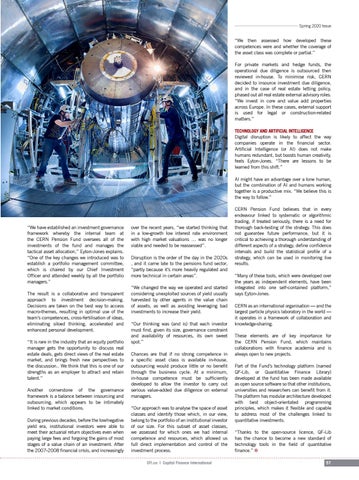
The third annual OECD conference on private finance for sustainable development brought together more than 600 public and private actors to determine the steps ahead.
T
here is an urgency for the private sector to shift more resources to sustainable development. At the 2020 OECD Private Finance for Sustainable Development (PF4SD) Conference, there was urgency to find ways to get ahead of global trends using global finance in smarter ways. The world is 10 years away from delivering on the SDGs, including the goal of eradicating extreme poverty. This means lifting just under 10 percent of the world’s population — around 700 million women and men — from poverty over the next decade. In the meantime, the climate crisis is threatening to overshadow all development challenges and to overturn hard-won gains. According to the World Bank, the worsening impacts of climate change could force over 140m people to leave their homes by 2050. Furthermore, the planet’s main life support system — the ocean — is under unprecedented pressure. There are direct implications for 40 percent of the world’s population: those living within 100km of the coast. It is no longer enough to react to crises as they arise. Strategic investments in sustainable development is needed, and this means thinking outside the box. This means shifting the culture of profitmaking; giving returns on investment a new meaning, and creating incentives to match. It means understanding and shaping how the next generation is defining the value of people and planet. Private finance to sustainable development is increasing, but gaps remain. Shifting just one percent of total global financial assets — estimated at $382tn — could bridge the existing $2.5tn annual investment gap for delivering the goals. The good news is that shareholders are gradually moving from simple profit-making to both profit and purpose. They are reorienting management towards more sustainable business practices to address ESG issues. The sector has grown in recent years, rising to nearly $18tn in assets, with additional $6tn in sustainable investing to capture some 28
Director of the Development Co-operation Directorate (DCD) at OECD: Jorge Moreira da Silva
component of ESG. This is a sizeable amount of the $30tn “sustainable investment universe”, suggesting that ESG is more than a fad. Impact investing is also capturing the growing attention of mainstream investors, whose market size is estimated at more than $500bn and growing. For many impact investors, the SDGs have become a guideline for key performance indicators. At the conference, Travis Spence, MD of JP Morgan Asset Management, highlighted a change in the dialogue around ESG from a “nice to have” to a “must have”. In investment portfolios, ESG criteria are material factors and the main drivers shaping portfolios. LONG WAY TO GO International capital markets have never seen as much investment as we see today. Yet, too few of these flows are serving the wellbeing of people and planet. Newly released data on blended finance show that private finance, mobilised by development finance, reached $205bn between 2012 and 2018. But less than six percent went to least developed countries, and less than six percent to social services such as education and health. The majority went to economic infrastructure. This is CFI.co | Capital Finance International
misaligned with the objective of leaving no one behind. The PF4SD Conference also dived into alignment of private finance with specific SDGs. GENDER EQUALITY – SDG 5 Gender equality is a prerequisite for sustainable development, and interest in gender-investing is increasing. Finance institutions have accepted the “2X Challenge: Financing for Women” and mobilised $2.5m of the $3bn goal. India has launched the world’s first domestically funded SDG bond to help tribal women become selfreliant. As a minimum requirement and a first step, investors need to ensure that their activities do not undermine women’s empowerment. CLIMATE ACTION – SDG 13 The majority of private finance mobilised for development continues to be channelled into economic infrastructure. Sustainable infrastructure will be the foundation to realise the transformation to low emissions and climate resilient development pathways. There are improved estimates for the additional benefits of climate action, such as reduced pollution and improved land use. With low global interest rates and the window closing on the opportunity to limit temperature rise to below 1.5°C, the time
Spring 2020 Issue
with the support of the G7, the G20, the UN and the OECD. Scaling-up private finance for sustainable development requires data to bridge understanding, measurement and disclosure of risks. The OECD is working to promote a more consistent, standardised measurement of all types of flows for SDG financing, monitoring and reporting as well as that of all finance through the new Total Official Support for Sustainable Development (TOSSD). Financial institutions, public and private, need to rethink their models and incentives, and partner better to take on the risks of investments in difficult contexts — and there are many. Looking at megatrends, these risks can’t be ignored. We need to invest in stability. With 85 percent of the poorest people living in the top 20 climate-affected countries, these countries’ economic and environmental instability can’t be subsidised with non-renewable activity. Finance must be aligned with sustainable development in the toughest contexts. The cost to global economic, environmental and social stability is too high, and the returns are too great. The Private Finance for Sustainable Development (PF4SD) conference is an annual OECD event that provides a forum for sharing successes in altering incentives, targeting investment better and improving operations for sustainable development.
Jorge Moreira da Silva, left with OECD Secretary-General Angel Gurría, center
to close the investment gap is now. Technology is on our side, but all pools of finance, and all actors, need to work together. This starts with governments. LIFE BELOW WATER – SDG 14 The “ocean economy” is expected to grow rapidly until 2030 (OECD, 2016[2]) and as more capital enters ocean-based industries, it is critical that investments are geared toward improved sustainability. But the majority of investors are not aware of their investments’ impact on the marine environment, and how a degrading ocean may subsequently affect their portfolios’ performance and value. DECENT WORK AND ECONOMIC GROWTH – SDG 8 With 30 million young African people expected to enter the labour market every year to 2030 makes SDG 8 one of the most pressing challenges. SDG 8 calls for reducing informal employment, narrowing the gender pay gap and improving working conditions. ILO’s Decent Work Agenda highlights the importance of promoting sustainable enterprises for innovation and growth. High-impact investments create quality jobs. Enhancing social dialogue is a key lever to achieve this agenda, and governments should invest in institutions underpinning multistakeholder engagement and social dialogue.
Aligning private finance with the SDGs requires an open dialogue and trust-building between public and private actors. The Kampala Principles on Effective Private Sector Engagement in Development Co-operation aim specifically to guide collective work on making private sector partnerships more effective while ensuring inclusivity at country level. THE ROAD AHEAD After five years of slow progress towards financing the SDGs, there is a clear need for more resolute action. Governments hold primary responsibility. Public policy and regulation must foster public and private investments truly aligned with the SDGs. Capital allocation towards sustainable development means incentivising long-term green investments, and channelling existing finance.
The inaugural PF4SD Conference in 2018 explored new ways of mobilising more and better finance. The 2019 edition stressed the need for universal measures of the social and environmental impacts of development finance. In 2020, the theme was aligning finance with the SDGs, convening public and private actors committed to working together to promote a better alignment of global financial flows with the 2030 Agenda in developing countries, including development finance, private investment flows and business activities. i ABOUT THE AUTHOR Since November 2016, Moreira da Silva has been the director of the Development Cooperation Directorate (DCD) at OECD. From 2013 to 2015, he was Portugal’s Minister of Environment, Energy and Spatial Planning. ABOUT THE OECD The OECD Development Co-operation Directorate promotes co-ordinated, innovative international action to accelerate progress towards the UN’s Sustainable Development Goals (SDGs).
The G7 Ministers of Development have called for a SDG-compatible finance framework to make private investment and savings work better for the goals. At the PF4SD Conference, Cyrille Pierre, deputy director for global affairs, culture, education and international development at the Ministry for Europe and Foreign Affairs of France expressed readiness to take leadership here, CFI.co | Capital Finance International
29
> Lord Waverley on Development Banks
By Name and By Nature: A Boon in Troubled Times Development Finance Institutions (DFI), Development Finance Companies (DFC) or Development Banks (DB) are institutions that provide finance for development projects predominantly in weaker or developing economies.
D
evelopment banks provide mediumto long-term risk capital and technical assistance to developing economies where it cannot be found from the private sector. They are usually owned by several shareholders, often countries or governments. The two main types of development bank are Multilateral Development Banks (MDB) and National Development Banks (NDB). MDBs have shareholders from several countries and finance development projects in several countries and regions, such as the Asian Infrastructure Investment Bank (AIIB) or the World Bank. NDBs such as the Agricultural Development Bank of China or the Development Bank of Kenya are set up by governments to finance and support domestic development projects. MDBs and NDBs fund private and public projects that provide and support global public goods.
CFI.co Columnist
Depending on their purpose and designated region, the banks have different mandates and remits. The AIIB, for example, focuses finance on Asia to create wealth and improve infrastructure connectivity. The African Development Bank (AfDB) is geared towards sustainable economic development and social progress on that continent. The Agricultural Development Bank of China focuses its attention, unsurprisngly, on agricultural development in China. There are, however, common strains between them. What further sets development banks apart from commercial lenders is the inclusion of wider factors in their decision-making, such as climate change, sustainability, social impact, economic infrastructure and equality. With this diverse mandate, development banks are increasingly expected to provide solutions to global problems. But where did development banks come from, and where are they going? The first came in 1944, with the establishment of the World 30
Bank. The International Bank for Reconstruction and Development (IBRD), its lending arm, was designed to finance the reconstruction of Europe after World War II. During the late 1950s and 1960s, several multilateral development banks were established. Throughout the ‘60s and ‘70s, sub-regional development banks were established, mostly in Latin America and Africa. There was also a rise in the number of Arab banks, reflecting the growing importance of oil-producing nations in the Middle East. The 1990s saw the collapse of the Soviet Union and subsequent introduction of the European Bank for Reconstruction and Development (EBRD). More recently, Asia has seen a resurgence of development banks, primarily in China with the AIIB and the NBD (also known as the BRICS bank). The 2008 financial crash saw a global increase in lending from development banks as private finance fell. Total capital loaned between 2007 and 2009 increased by 36 percent, from $1.16tn to $1.58tn, with total assets of development banks in 2008 totalling $5tn. This is the core strength and purpose of development banks: alleviating the cyclical boom-and-bust nature of private finance. Due in part to their strengths as international institutions that cover large regions and invest in diverse projects, support for development banks has grown. Their traditional mandate has expanded to address global issues. The decision-making process and subsequent implementation take into account factors such as economic and environmental sustainability, impact on gender equality and poverty. Development banks, especially multilateral development banks, make for effective stakeholder management, where all shareholders are satisfied and the outcomes or policy-decisions are effective and positive, rather than a mismanaged amalgamation of competing and irrelevant objectives. CFI.co | Capital Finance International
Spring 2020 Issue
Due to their expansive remit, development banks fund projects ranging from renewable energy to telecommunications and transport infrastructure. They provide finance and engage with untested sectors that private lenders tend to avoid. The National Bank for Economic and Social Development (BDNES) in Brazil and the KfW in Germany fund new technology that has supported technological innovation, while the CORFO in Chile is designed to support entrepreneurship. In 2015, the UN launched its 2030 Agenda, with 17 Sustainable Development Goals (SDGs) and 169 specific social, economic and environmental goals. MDBs in particular are crucial to supporting these goals. While development banks have remained receptive to change and have largely risen to the challenges, they have detractors. Critics argue that they focus on simply financing projects, rather than ensuring their successful implementation. Banks, they argue, might be less opaque in their decision-making processes. That said, they predominantly follow World Bank procurement guidelines covering experience, financials and partnership content. The Overseas Development Institute (ODI) in 2018 offered six recommendations. Chief among them was to boost the provision of global public goods through the enhancement of state and non-state incentives, and better coordination between multi-lateral development banks to produce more coherent and effective global policy. Development banks have done a great deal of good. They have a unique and competitive edge, and should be encouraged to become more receptive and accept greater responsibility. Many want them to use their experience of diverse and complex projects, and their ability to facilitate multiple national interests, to develop effective responses to the world’s greatest challenges. The question is not so much their ability or credentials, but whether they will be allowed to take on a new, larger and more complex mandate: one that supersedes national or regional borders. i
CFI.co Columnist
ABOUT THE AUTHOR Lord (JD) Waverley Member House of Lords, London
Founder SupplyFinder.com Strategic Advisor SmarterContracts.co.uk jd@lordwaverley.com 31
> Tor Svensson, Chairman CFI.co
Vibrant Manchester Outshining London as the Best Business City Manchester’s ability to adapt and reinvent itself has replaced an industrial past with digital, creative and service industries. Now, regeneration and redevelopment have brought new vibrancy.
D
uring the Industrial Revolution, Manchester became the first industrialised city in the world. After the Second World War, fortunes changed. Between 1961 and 1983, Manchester lost 150,000 jobs in manufacturing. The spark has returned to the city centre which has been the subject of massive investment. Industry and trade are still front-runners, but “softer”, knowledge-based sectors also thrive: fintech, media, retail and wholesale, life sciences, leisure, education, and health. MANCHESTER EDGES-OUT LONDON AS THE BEST BUSINESS CITY IN EUROPE Manchester has seen the lion’s share of foreign and domestic investment, and research shows that it outshines London as the best European city to invest in for innovation-centred growth businesses (see Table 1). Manchester has been dubbed “The Second City of the UK”, with a metropolitan area population of 3.3 million (versus London’s commuter belt inhabitants approaching 15 million).
CFI.co Columnist
The relative value of smart human capital and cost of living are important factors in Manchester’s favour, along with health, safety and quality of life. Also beneficial are the city’s impressive transport systems, infrastructure and connectivity, within the region and internationally. Manchester’s growing tourism industry attracts more international and business visitors than all English cities other than London. Major companies and corporations have made a home there, including Google, the BBC, The Co-op, and Kellogg's. Amazon is planning to expand its staffing to 6,000 in the northwest. Doug Gurr, Amazon's UK country manager, says Manchester offers “an incredible talent pool, a thriving hub of fast-growing UK tech startups and is a centre of academic and intellectual excellence”. The city is also an education hotspot, home to the University of Manchester, internationally 32
Manchester: Media City UK
BEST INVESTMENT CITY FOR
BEST INVESTMENT CITY FOR
INNOVATION-CENTRED
INNOVATION-CENTRED
GROWTH BUSINESSES IN EUROPE
GROWTH BUSINESSES (GLOBAL)
1. Manchester (97)
1. New York (100)
2. London (96)
2. Dubai (99)
3. Amsterdam (93)
3. Singapore (98)
4. Dublin (92)
4. Manchester (97)
5. Copenhagen (90)
5. London (96)
6. Dusseldorf (88)
6. Amsterdam (93)
7. Barcelona (86)
7. Dublin (92)
8. Zurich (83)
8. San Francisco (91)
9. Paris (80)
9. Copenhagen (90)
10. Brussels (79)
10. Mexico City (89)
Table 1. Source: CFI.co
Table 2. Source: CFI.co
Research Methodology The study was conducted in March 2020 during the Coronavirus outbreak, which significantly affected the results.
The perspective is that of innovation-centred MSMEs across industry sectors, comprising start-ups, relocation and business expansion for domestic and foreign investors as well as joint ventures. The results are influenced by early development stage AI-powered proprietary algorithms to handle the volume of data from publicly available information, statistics, surveys and research.
The city score is based on parameters from lagging indicators and forward-looking factors and forecasts – which can be speculative and uncertain – relating to aspects including business climate, FDI friendliness, tax environment, connectivity, infrastructure, innovation ecosystems, reputation, job creation, human capital, lifestyle quality, safety, and healthcare systems.
CFI.co | Capital Finance International
The results were partly established on discretionary scoring. The top-scoring city is set on par, and those following were standardised on a relative basis. Further background information on the tallying and ranking methodology is available from CFI.co upon request.
Spring 2020 Issue
renowned for its innovative courses and the UK's largest one-campus university. Tim Newns, the executive of MIDAS, the city’s inwards investment promotor, said its growing status as the UK’s hotbed of innovation has seen it become a destination of choice for life sciences, digital development, financial services, manufacturing and education. “Innovation is crucial in establishing regional, national and international relationships,” he said, “and with the momentum that’s currently building, Greater Manchester – indeed the wider north-west – has all the tools in place to fuel further growth and cement our position as a world-leading destination for business.” The city enjoyed a 36 percent rise in SMEs from 20102018, which fuelled employment and steady economic growth. The fore-cast population increase from 20162036 is 15.1 percent. The job market is booming, and job openings are likely to outstrip those of major centres such as Berlin and Paris. The UK government supports innovation in the region with initiatives such as the Northern Powerhouse, an economic devel-opment plan to swing the balance of investment. The scheme facilitates improvements in transport and infrastructure, as well as investment in science and technology. It also promotes the devolution of the economic powers through “City Deals”. Boris Johnson’s government is keen to continue this surge in public and private investment. The Brexit “closure” is also ex-pected to have an “opening” impact. MANCHESTER RANKS #4 INTERNATIONALLY AS INNOVATION GROWTH HUB New York, Dubai and Singapore maintain their top three positions as the best international cities for business innovation value creation (See table 2). With coronavirus, trade wars and other uncertainties, Manchester has bumped several Chinese and SouthEast Asian centres to jump to the fourth spot globally. In a world under stress, Manchester’s domestic economic system – based on liberal capitalism, personal freedom, democracy and the rule of law – creates back-up for the city’s expertise in innovation and profit creation. REINVENTING INDUSTRIAL PAST Manchester is chock-full of ambitious and innovative professionals in engineering, sciences, arts and industries. Talent-hungry companies would do well to pursue their investment in the city. i
33
CFI.co Columnist
Manchester: City Centre
ABOUT THE AUTHOR Tor Svensson has visited Manchester many times over the past 40 years and is always amazed by the city’s vibrancy. Svensson is chairman of CFI.co, and an economist, lecturer, businessman and researcher.
A PRINCE WITH A MISSION, A VISION (AND A PLAN FOR A COLONY ON MARS) By Tony Lennox
For anyone familiar with the dashing Crown Prince of Dubai, it would have come as no surprise to find him on stage, in front of an international audience, delivering his vision of the future… as a hologram.
L
ike an Arabic Captain Kirk, Sheikh Hamdan bin Mohammed bin Rashid Al Maktoum “beamed down” to dispense a space-age visualisation of technological endeavour and opportunity.
Cover Story
The VR presentation at the Seventh Annual World Government Summit in 2019 demonstrated just how far Dubai has come in half a century. The Crown Prince, like his father and grandfather before him, is aware that Dubai’s future will depend on throwing off the national dependence on oil.
Dubai, the prince said, was a place of limitless inspiration and inventiveness. Every effort was being made to ensure that the city was at the cutting-edge of technical modernism, and determined to stay 10 years ahead of the global competition. Outlining his hi-tech topic, Seven Shifts Shaping Future Cities, he said: “We need to harness the power of innovation and creativity to set standards for smart cities.”
At 37, he is not only the heir to the rulership of Dubai, he is the embodiment of the city’s ambition, and the man trusted to take his people into the future.
Sheikh Hamdan bin Mohammed bin Rashid Al Maktoum is the appointed heir of his father, the 70-year-old Sheikh Mohammed bin Rashid Al Maktoum, vice-president of the United Arab Emirates and ruler of Dubai. He is also a role model for a generation of young Emiratis.
Politicians and business leaders in Dubai for the summit were left in no doubt as to the city’s aspirations.
He is trying to position his city in the vanguard of the fourth industrial revolution – a future of artificial intelligence and the Internet of Things
34
(IoT), which promises to change the way the world works. Hamdan is the second son of Sheikh Mohammed and Sheikha Hind bint Maktoum bin Juma Al Maktoum. Their eldest son, Rashid, died of a heart attack at the age of 33. It was Hamdan, Sandhurst graduate and all-action man, who was officially named Crown Prince in 2008. He also attended the London School of Economics, and says his time at Sandhurst taught him “the importance of self-discipline, commitment, virtue, responsibility, endurance, understanding, teamwork, friendship and the benefits of hard work”. He was appointed to the chairmanship of the Dubai Executive Council (DEC) at 24, having demonstrated a thorough understanding of his father’s vision for Dubai – that the key to its prosperity lay in economic and social variety.
CFI.co | Capital Finance International
Spring 2020 Issue
Sheikh Hamdan is taking that vision and giving it a 21st-Century twist. At the recent launch of one of his initiatives to promote entrepreneurship, he said that his father had told him from an early age that ambition was everything, and that “second place was the first place of losers”. He is known to the people of the UAE simply as “Fazza”, the Arabic word for victory. His drive to ensure that Dubai maintains its status as a futuristic, global city is supported by major government involvement in the creation of an appropriate environment for business. Government cash — plenty of it — is directed to ensure that the seeds of invention and creativity are successfully sown and nurtured. In his role of chairman of the DEC, Sheikh Hamdan supervises public expenditure and development strategies. He also has oversight of all Dubai’s government entities. In 2015, the Dubai Strategic Plan was launched, with Sheikh Hamdan’s insistence on the idea of a “barrierfree society” written into its fabric. His energy and range show throughout Emirati society. Noting that Dubai’s highway network was often populated by some of the world’s worst drivers, he personally forced through a pointsbased traffic-control system, penalising errant motorists by confiscating their licences and their (frequently very expensive) cars. His adventurous personality provides plenty of photo opportunities for the country’s media. In 2013, after leading a delegation to win the bid for the 2020 World Expo, he was pictured waving the UAE flag from the top of the world’s tallest building, the Burj Khalifa, during the national celebrations that followed. Speaking at a government conference in 2019, Sheikh Hamdan gave an upbeat report on Dubai’s progress towards a diverse economy. He insisted that a policy of openness, together with government initiatives supporting entrepreneurship, was making Dubai an “ideal investment destination”. He added that Expo 2020, taking place in Dubai in October, would promote growth and support greater productivity and investor confidence in the economy. These are not just words. At the same conference, the director general of Dubai’s Department for Economic Development, Sami Al Qamzi, praised the Crown Prince’s vision, reporting that “decisive government action” had accelerated the rate of economic growth, and that GDP had increased, in 2018, by 1.9 percent.
35
Cover Story
Maintaining a healthy link with the rest of the Islamic world is another of Sheikh Hamdan’s key aspirations. The wider Islamic economy is responsible for as much as 10 percent of Dubai’s GDP. The Crown Prince has made a point of publicly praising Saudi Arabia, saying that Saudis and Emiratis were “the same people”.
Sheikh Hamdan’s role as a driving force in Dubai has been recognised on the international stage. In 2017, LinkedIn named him an influencer, joining a select club of 500 of the world’s foremost thinkers, leaders and innovators. The citation included references to Sheikh Hamdan’s belief that the development of young people in Dubai was an essential focus, and not just for the economy. He is aware economic goals should not outweigh environmental concerns. He recently led a volunteer force of young Emiratis in a marine environment clean-up along Dubai’s coast. Thousands responded to his social media appeal for help. He said of the event’s attendance: “This is a testament to our children's awareness of the importance of preserving the environment. Our city is our home. We are all responsible for its cleanliness and for sustaining its resources.” This focus on young people is powering Sheikh Hamdan’s vision of the future. One of his first acts as Crown Prince was to found the Hamdan Bin Mohammed e-university in Dubai. He believes that only by improving educational standards and opportunities can the country benefit from what he calls “the index of human capital”. He created a Centre for Giftedness and Creativity, whose aims include identifying young and talented students, coupled with the provision of quality learning environments. The project is designed to develop leadership skills and encourage young people to disseminate new thinking into the wider society.
Cover Story
In line with global thinking on the fourth industrial revolution, the focus is on a search for talent in the fields of science, maths, technology, languages and leadership. The studying is relentless, with “hot house” programmes for students outside of regular term times. Another Sheikh Hamdan initiative is the Innovation Incubator; a business development tool which aims to identify and support emerging entrepreneurs. Most tend to be aged 30 and above, he observed; he wants to change that statistic to foster younger achievers.
and supporting creative minds in developing solutions.” The event, the equivalent of a hi-tech Olympics, focused on robotics and AI. It attracted competitors from throughout the world to Dubai last October to form the nucleus of the scientific community of the future. Sheikh Hamdan saw the event in terms of Dubai’s ambition to become one of the world’s leading cities in shaping the future and developing innovation in key sectors.
Dubai has witnessed a rapid growth in start-ups and SME development in the past 10 years. The Innovation Incubator aims to further that, concentrating on services, IT, health, media and design sectors.
He is eager to establish an environment where entrepreneurs are given financial support and business advice, mentoring, and a solid network of care. Government cash is available to ensure start-ups are given adequate opportunity to thrive. The Government Procurement Programme (GPP) puts an emphasis on supporting SMEs.
It helps that the energetic and adventurous Sheikh Hamdan is seen as a role model among Dubai’s younger generation. Every year he presents prestigious awards to Dubai’s young businesspeople, and wants every tool to be made available to this youthful powerhouse.
In 2018, the value of government contracts to Emirati businesses topped AED (Arab Emirate Dirham) 1 billion ($272m) for the first time. While most of these funds go to construction and engineering businesses, some is earmarked for less conventional projects.
At the launch of a major technology competition, the First Global Challenge, held in Dubai in 2019, he said: “We are steadfast in our journey of equipping talent with vital skills and tools
Sheikh Hamdan is keen to promote green initiatives. As patron of the Dubai Electricity and Water Authority, he is a major supporter of alternative energy sources.
36
He has been instrumental in encouraging Dubai homeowners to install solar panels on their properties, and he is involved in a push to provide charging stations for electric vehicles. The city’s target is to produce 75 percent of its energy from clean sources by 2050. As if to illustrate the extent of his space-age ambition, in January 2020, Sheikh Hamdan signed off on the final piece of the UAE’s plans to launch a probe to the planet Mars this year. The Hope Probe mission is the start of a dream by the UAE, which has already invested $5.4bn in space technology to establish a colony on Mars early in the 22nd Century. The spacecraft will collect scientific data on the planet’s upper and lower atmospheres. The Crown Prince is the chairman of the Mohammed bin Rashid Space Centre, on the eastern outskirts of Dubai. He has been working tirelessly to ensure that the UAE will become the first Islamic country to launch a space probe. The eventual aim is to establish a space city of 600,000 people on the Red Planet. The Crown Prince may not be on board when the envisaged manned mission blasts off, but his epitaph may be that he prepared the way for his people “to boldly go where no man has gone before”. i
CFI.co | Capital Finance International
Spring 2020 Issue
>
Heartthrob, Action Man, Photographer, Royal… But Plain ‘Fazza’ to His People By Tony Lennox
Dubai’s Crown Prince Hamdan bin Mohammed bin Rashid Al Maktoum has it all: good looks, a personal fortune of some $5bn, an all-action lifestyle, and millions of adoring followers.
S
ome guys, as Robert Palmer once sang, have all the luck. When the 37-yearold royal married in 2019 he doubtless broke a few hearts. He had been one of the world’s most eligible bachelors, a man could have stepped from the pages of a febrile Jilly Cooper novel. “Fazza” — as he is known to Dubai citizens and his global Instagram following — is heir to the throne of one of the richest states on earth. He travels the globe, hobnobbing with the world’s most interesting people; he rides horses (and camels), skydives, scuba-dives, and plays polo and tennis. He fits all this activity into a hectic schedule — which includes directing the affairs of state — and sails his own superyacht, writes poetry… and rescues injured animals. The keen amateur photographer rescued an Arabian oryx, which had become trapped in plastic netting, in 2018. He posted video footage of the rescue on his Instagram account. He did the same when he saved a stranded turtle, pushing it seaward with one hand while filming with the other. All this has made the dashing sheikh a particular favourite of Emirates Woman, a glossy fashion and lifestyle magazine which tracks his every move, writing about his exploits — whether rubbing shoulders with Prince Charles at Royal Ascot or nuzzling gazelle.
Paradoxically — for a young man passionate about all things modern, from robots to rockets to space travel — Sheikh Hamdan is committed to preserving Emirati heritage, whether it’s poetry, his love of camel racing or falconry.
Falconry was once the sport of Arab royalty, though in recent years its popularity has waned. Hamdan would like to see the sport restored to its former glory. He owns many birds of prey and is frequently pictured with his favourites. His fascination for the history of his people led him to establish the Hamdan Bin Mohammed Heritage Centre in Dubai, which promotes and fosters Emirati culture. In a country with an obsession for all things modern, Sheikh Hamdan is eager to remind Dubai of its Bedouin past. He holds an annual camel trek into the desert, but his greatest passion is equestrianism. “I love horses,” he says, “they are my life. When I ride my cars I feel bored. With horses it’s different. I love to be with them.” Sheikh Hamdan could be seen taking part in (and winning) a 120km endurance horse race in neighbouring Saudi Arabia in February this year. He won individual gold at the 2014 World Equestrian Games, held in Normandy, and led the UAE team to gold in 2012. His passion for horses means he’s a frequent visitor to his father’s Godolphin stables in Newmarket. The prince’s love of horses stems directly from his 70-year-old father, Sheikh Mohammed bin Rashid Al Maktoum, UAE vicepresident and ruler of Dubai, also a talented rider in his day. Sheikh Mohammed is a giant of the horseracing world, having invested many millions in Godophin, which operates state-of-the-art stables in England, Australia, Ireland, Japan and the US as well as Dubai. Sheikh Mohammed’s influence on the sport has been transformative. Launching Godophin in the early 1990s, he injected cash and modern CFI.co | Capital Finance International
training techniques into a flagging sport. Sheikh Hamdan is actively continuing his father’s legacy. The Crown Prince, who regularly attends elite racing events across the globe, is heavily involved in the care and development of Godophin’s horses. The animals are not so much trained as royally pampered. Englishman Charlie Appleby, who has worked for Godolphin as a trainer since 2013, recently joked: “The horses want for nothing. If I was ever to come back as an animal, I’ll be a Godophin racehorse, please.” Sheikh Hamdan’s enthusiasm for photography is clear from his Instagram account, which has 9.4m followers. He takes pictures of almost everything he does, and everywhere he goes. A recent photograph of the Burj Khalifa, the world’s tallest building, with its topmost spire spearing the clouds, went viral. Many of his photographs and videos are taken as he plunges through the skies over Dubai in another of his roles — that of semi-professional skydiver. And when a new and dizzyingly high zip wire was installed in Dubai’s forest of skyscrapers, the prince was one of the first to try it out… filming his breath-taking descent as he went. Sheikh Hamdan founded the Hamdan International Photography Awards in 2012. The awards, which offer prize money of $400,000 — the world’s largest photography prize — attract entrants from around the world. He follows dozens of other photographers on Instagram, but he also tracks innovators such as Tesla founder Elon Musk. Tesla is currently involved in converting Dubai’s taxi fleet to all-electric vehicles. The Sheikh is known to keep an eye on Los Angeles-based Zach King, a YouTuber famous for his “magic vines” — video clips digitally edited to give the impression of magical tricks. Arabian folk tales are filled with references to enchantment, and perhaps the Crown Prince’s interest in conjuring is yet another allusion to his country’s antiquity. Or perhaps, together with all his other passions, he just enjoys a joke. i 37
Cover Story
The publication is particularly fond of Sheikh Hamdan’s poetry, written in the Nabati style, an ancient form unique to the Arabian peninsula and used by Bedouin tribes. The verses are passed orally from generation to generation. Nabati went out of fashion as oil brought prosperity and literacy to the region, but Sheikh Hamdan is keen to preserve it for future generations. He publishes his poems (in Arabic) on his Instagram account, covering themes including chivalry, wisdom, patriotism and love.
"Sheikh Mohammed is a giant of the horseracing world, having invested many millions in Godolphin, which operates stateof-the-art stables in England, Australia, Ireland, Japan and the US as well as Dubai."
Dubai has Tall Buildings, Stratospheric Ambition and a Grasp of Future Success By Tony Lennox
"My grandfather rode a camel, my father rode a camel, I drive a Mercedes, my son drives a Land Rover, his son will drive a Land Rover, but his son will ride a camel." These were the prophetic words of Rashid bin Saeed Al Maktoum, the ruler of a tiny Gulf sheikhdom in the early 1960s.
I
t was his way of warning that the oil which was making his community rich did not guarantee a prosperous future. He was astute enough to realise that the destiny of Dubai — then a dusty backwater on the shores of the Persian Gulf — would depend on one thing: diversification. Sheikh Rashid remembered a time when pearldiving drove Dubai’s tiny economy – an industry which collapsed when Japan began flooding the global market with cultured pearls in the 1920s.
Cover Story
Rashid established his vision for Dubai just as British Prime Minister Harold Wilson was making the end-of-empire decision to pull military forces from East of Suez in 1971. Cash-strapped Britain could no longer afford to defend the seven emirates, clumped together in the southeastern corner of the Arabian Peninsula. The emirates, known then as the Trucial States, had been a British Protectorate since the early 1800s. Now they were on their own. The Saudis and the Iranians helped themselves to outlying bits of the emirates before the UAE formally came into being in 1971. In 2021, the UAE celebrates its golden jubilee, and the world, in the intervening 50 years, has been witness to its extraordinary transformation. Dubai, the largest city in the emirates, is today a dazzling metropolis — a magnet for investors, a major trading hub linking east and west, and a playground for wealthy sun-seekers. Only a generation ago, there was nothing here but shifting desert sands; now six-lane highways wind through a forest of glittering skyscrapers. Even the police drive Lamborghinis, Ferraris, Bugattis and Bentleys. Along Dubai’s shoreline, millions of tons of sand and rock have been dredged from the Persian Gulf to create artificial land extensions and archipelagos, some of which are visible from space. These reclaimed lands are crammed with 38
high-class shopping malls, water parks, marinas and mansions. Rashid’s son, and prime minister of the UAE and ruler of Dubai, is Mohammed bin Rashid Al Maktoum. He is keenly involved in horse racing, and is one of the UK’s biggest personal landowners. Now 70 years old, the Sandhursteducated ruler has built on his father’s legacy and vision, turning Dubai into a city for the 21st Century. The financial crisis of 2008 briefly stalled the progress of what had become the world’s fastestgrowing economy. At the time, dredgers were constructing the World Islands archipelago just offshore. All work ground to a halt and the ruling family dipped into its own fortune to breathe new life into the project. The drive for diversity includes a recent decision to liberalise the UAE investment market. A new law has opened the door to 100 percent foreign ownership in specific sectors, giving the UAE an advantage over countries where the requirement for a local investor is still the norm. It is one of a raft of reforms designed to lessen the country’s dependence on oil. These reforms, the government believes, will contribute to the continued rise of the financial services sector, leading to investment in the automotive, property, energy and chemicals sectors. A free and open environment for business is making Dubai — and the wider UAE — increasingly popular as an investment destination. The UAE’s population has grown from around 300,000 in 1971 to 9.8m today. Only 1.4m are Emirati citizens; the bulk of the population is comprised of immigrants. Many are from the Indian sub-continent, and form the backbone of the workforce in construction and the service industry.
Dubai
Spring 2020 Issue
Dubai is set to host Expo 2020 in October – the biggest World Expo ever staged. It will have three main themes: Opportunity, Mobility and Sustainability. British involvement in the event is significant. Architect Norman Foster has been enlisted to create the Mobility pavilion, while London-based Grimshaw Architects is responsible for designing the Sustainability pavilion. Dubai’s hotels are almost fully-booked from October 2020 to January 2021. The UAE hopes to showcase its alternative energy advances by unveiling the world’s largest solar power project, which is expected to generate 1,000 megawatts of energy. Some 192 nations are due to take part in Expo 2020. Among the exhibits on display will be a “future of flight” installation – an interactive experience involving the fuselage of a faster, lighter aircraft without windows, with noisecancelling sound shrouds, the brainchild of the Dubai government-owned airline, Emirates. The IMF expects Expo 2020 to have a positive effect on the UAE economy, helping it overcome concerns about volatile oil revenues. The UAE is the only country to have a Ministry of Happiness. Dubai’s ruler, Sheikh Mohammed, has pledged to make the UAE “among the best (countries) in the world” by 2021. He recently said: “I want Dubai to be a place where everybody from all over the world meets each other, to just love it.” He initiated the UAE Vision 2021 a decade ago, explaining at the time: “Today our economy consists of a non-oil GDP of 70 percent. We will build an economy that is independent of oil and market fluctuations alike.” The project calls for a shift to a diversified and knowledge-based economy. Mohammed wants to focus on health, economy, security, housing and education, “a fundamental element for the development of a nation, and the best investment in its youth”.
The rulers of the UAE know that the secret of success is to never rest upon one’s laurels. The Sheikh is clearly determined to make sure that his grandson will never have to exchange his Bentley for a camel. i 39
Cover Story
At 2,720ft (830m), Dubai’s Burj Khalifa tower is the highest building in the world, a gleaming, space-age spike of glass, steel and concrete which dominates the “City of Gold”. It is an emblem of the UAE’s stratospheric expansion over the past half-century. Completed in 1311 AD, England’s Lincoln Cathedral was (for more than 200 years) the world’s tallest man-made structure at 525 ft (83m). For King Edward II, it was an edifice dedicated to the glory of God, and a symbol of his growing power and confidence. Three years later, near a village called Bannockburn, rebellious Scots delivered a painful reminder to the king that power and ambition involved more than the ability to erect a tall building.
> 2020 UNCTAD World Investment Forum:
More Important Than Ever in an Age of Worrying Trends By Dr James Zhan
In December this year, Abu Dhabi will welcome government leaders, CEOs and investment stakeholders for the seventh biennial UNCTAD World Investment Forum (WIF).
T
he forum’s mission is to promote investment for sustainable development. And there are worrying trends, as well as signs of hope.
UNCTAD’s latest assessment is that global FDI remained flat in 2019, at $1.39tn, a one percent decline from 2018. But FDI was up in Latin America and the Caribbean, as well as in Africa. As director of UNCTAD’s Investment and Enterprise Division, and organiser of the forum, I am concerned that global FDI is stagnating. But I see that investors, firms and governments are putting sustainability at the core of their activities. This makes me optimistic that — through initiatives like the World Investment Forum — we can change investor ehaviour and leverage investment for sustainable development. Private sector innovation and investment can accelerate the world’s shift to a sustainable growth track. Governments need to realign the regulatory and policy environment to increase the share of invested capital driven by sustainability. This requires dialogue between all stakeholders, the sharing of best practices, and the agreement of investment and financing solutions. Since 2008, the World Investment Forum has been the UN’s leading multi-stakeholder platform to drive investment for sustainable development. It offers participants the opportunity to influence investment policymaking, shape the global investment environment, and network with global leaders in business and politics. It has helped
"The WIF will continue its mission to provide a universal and inclusive platform for investment stakeholders to address emerging investment issues, to support international investment, and to maximise the contribution of investment to sustainable development." translate initiatives, such as the Sustainable Development Goals (SDGs) and the Paris Climate Change Agreement, into immediate action. It has shaped policies that better address sustainability challenges and promoted the mobilisation of capital for sustainable investment, especially in the developing world. The WIF was established to fill the need for an international forum on investment policy. The idea was to supersede intergovernmental negotiations by providing a platform for inclusive dialogue for the entire community of investmentdevelopment stakeholders. The process led to consensus on policies and norms, a “soft” approach to global investment policymaking. In its objectives, timing and approach, the establishment of the WIF has proved prescient. The past decade has been one of huge shifts. Digitalisation and automation were barely on the radar at the start of the decade but are now on all policy agendas. These developments have forced a rethink of capitalism itself, underscoring
the need for inclusive, action-orientated dialogue between key stakeholders across sectors, civil society, academia and international organisations. Looking ahead to this years’ WIF in Abu Dhabi, there are three key questions for the global investment-development community: 1. How can investment stakeholders rapidly integrate sustainability criteria into investment decisions and business operations and create long-term value and sustainable development impact? 2. How can governments and businesses respond to the consequences of technological change for development, harness its potential, and mitigate the risks of premature de-industrialisation and social change? 3. What are the implications of increasing fragmentation in international economic policymaking that has led to a rise in protectionism and competition, as well as an emphasis on regionalism and a move away from liberalisation to intervention? Together, these subjects will have profound consequences for the new era of globalisation and structural transformation, posing challenges and opportunities. The WIF will continue its mission to provide a universal and inclusive platform for investment stakeholders to address emerging investment issues, to support international investment, and to maximise the contribution of investment to sustainable development. With the stakes ever higher, and with UNCTAD’s latest forecast for FDI this year looking weak, the World Investment Forum is needed more than ever. i ABOUT THE AUTHOR Dr James Zhan is senior director of investment and enterprise at the United Nations Conference on Trade and Development and lead editor of the World Investment Report.
40
CFI.co | Capital Finance International
Spring 2020 Issue
WORLD INVESTMENT FORUM 2020 INVESTING
IN
SUSTAINABLE
DEVELOPMENT
6–10 December Abu Dhabi, United Arab Emirates
A global summit to chart the course for the post-crisis era Follow
worldinvestmentforum.unctad.org for event updates
For further information, contact wif@unctad.org CFI.co | Capital Finance International
41
> Spring 2020 Special
The US, Land of the Free, Set to Become ‘Land of the She’ as Gender Gap Slowly Narrows
T
he United States has long been touted as the land of opportunity, and for some women in tech that dream is becoming reality.
These small victories are the result of concerted efforts at every level, internal corporate acceleration programmes and mentorship and networking support.
According to the National Centre for Women in IT, female-led tech companies have been found to deliver a 34 percent higher return on investment. The growing library of data-backed research and a shift in public opinion are forcing venture capitalists and HR managers to rethink old patterns. Although more women than ever are launching or leading tech companies, they still only account for 11 percent of the Fortune 500 tech executives.
Non-profits have sprung up to encourage girls into pursuing studies in the fields of science, technology, engineering, and mathematics (STEM). One such is Code.org, a non-profit advancing the US computer science curriculum in all 50 states. More than a million US teachers incorporate Code. org courses into their lesson plans, and nearly a million students worldwide have competed in its annual Hour of Code hackathon.
The tech world has benefitted from women’s contributions, but it still struggles with diversity and gender pay equality. Women comprise just 26 percent of the US tech workforce — which totals some four million professionals — and earn a median annual salary $24,000 shy of the male average. They also attract less VC funding than men. In 2019, companies with all-female founding teams secured less than three percent of invested capital across the entire US start-up ecosystem. Although dismal, these figures represent an improvement over previous years, and progress is being steadily pushed forward by empowered entrepreneurs and inspired investors. Companies with one or more female founders raised over $18bn in 2019, and a record number of them made it to unicorn status ($1bn valuation or higher). Crunchbase reports a five-fold increase since 2013 in the number of unicorn companies boasting at least one female founder — from just four to 21.
42
Code.org students are 45 percent female, 50 percent underrepresented minority, and 45 percent from high-needs schools. Research from McKinsey and Company found that women of colour were under-represented at every level in the workplace, particularly at the senior leadership stage. While women now account for about one in five C-suite executives, only one in 25 is a woman of colour. Black Girls Code (BGC) is a non-profit that hopes to change those statistics, and has been training girls in STEM subjects for over a decade. McKinsey estimates an additional $12tn in GDP could be unlocked by narrowing the gender gap over next five years. That sum should be motivation enough, but it’s the challenges that female founders are successfully tackling that have convinced consumers and investors. From biotech engineers pushing the boundaries of healthcare to eco-warriors fighting against climate change, female founders are harnessing the power of technology and science – for the collective good. i
CFI.co | Capital Finance International
Spring 2020 Issue
CFI.co | Capital Finance International
43
> AYAH BDEIR littleBits FOUNDER AND FORMER CEO Innovation, Invention from Mouths and Hands of Babes Get them while they’re young and make it fun, says littleBits founder Ayah Bdeir, and we can ignite a child’s innate curiosity for STEM subjects. Innovators of science, technology, engineering and mathematics (STEM) are researching and collaborating to deliver solutions for niche problems as well as global challenges. But the progress is hindered, according to Bdeir, by a dearth of women in the industry. Efforts to address the problem at university and professional levels have fallen short. To get more women into tech careers, we must first “break the cycle,” says Bdeir. “If we want more girls in the boardroom, we have to start in the playroom.” Bdeir started tinkering as an engineer at an early age. Fascinated by how all the bits fitted together, she deconstructed household electronics to study and reassemble them again. She was born in Canada to Syrian immigrant parents from Lebanon, where the family later returned to raise the children. Her parents encouraged Ayah and her two sisters to pursue their passions and to ignore any genderbased stereotypes. Her father fuelled her interest in electronics and programming with electricity and chemistry kits. She saw her mother as a role model, a university-educated woman with a fulfilling career. After graduating from the American University of Beirut with an engineering degree, Bdeir was accepted into the MIT Media Lab graduate programme and moved to the US. It was a pivotal moment for Bdeir, who had experienced such joy as a young engineer-in-the-making, but found her undergrad engineering courses “dry and boring”. At MIT, she was encouraged to combine her creativity and tech skills to develop solutions and inventions. It was there that she first saw “how you could combine amazing advances in engineering with great ideas of design and social change”. “I felt like all students should have this experience,” she said. Bdeir founded littleBits in 2011, beating a rush of STEM-crazed toymakers to market. But the hardware-happy, tech-education company had been brewing as a side project for years. It was never intended to be a product, but an “experiment to make engineering and inventing more fun, more playful and more inviting to people who are not engineers”. She took the prototypes — magnetically linking electronic building blocks — to a few tech shows, 44
and the response from the younger audience members led to Bdeir’s eureka moment. “Lines and lines of kids started forming at the booth,” she recalls. “They would build something and ask, ‘Is this how my nightlight works?’ or ‘Is that why the elevator doors always open?’” She immediately saw the potential for a tech product that engages children and makes them want to learn — and was sure others would too. She found it relatively easy to raise start-up money, securing $850,000 in the initial funding round. Since its launch, littleBits has raised $62.3m. “The vision was always the same: inspiring people to be creative with electronics. Investors were as enamoured as I was with littleBits’ potential.” Bdeir was determined to create a gender-neutral product, in part due to her “secret mission” of getting more girls into STEM. She set out to democratise electronic engineering, elevating it from the domain of elite experts. She created a system of colour-coded electronic building blocks with intuitive design and universal appeal. Bdeir issues an open invitation to transform from passive tech consumers into creative problemsolvers. The first edition Bits are “snuggled in between a Picasso and the Post-it” in the permanent collection of the New York MoMA, where littleBits kits can also be found in the CFI.co | Capital Finance International
giftshop. Parents can encourage kids to unleash their creativity at home with starter kits (about $100), while school systems and corporate enterprises can schedule onsite professional development sessions (about $3,000). The littleBits line-up features around 10 kits and more than 70 interoperable “bits”. “We’ve sold millions of products to inventors in more than 150 countries,” she said. “We have more than 300 littleBits Inventor Clubs from Sao Paulo to San Francisco to Bangkok.” Bdeir is proud to highlight littleBits’ consistent userbase ratio of 35 to 40 percent female — four times the industry average. But she’s determined to do more. In 2019, she joined Disney’s Snap The Gap project, a $4m initiative that provides 10-year-old girls in California with littleBits kits as well as support material and mentorship to stimulate and nurture interest in STEM fields. After nearly a decade at the helm, Bdeir has stepped down as littleBits CEO, following the company’s acquisition by Sphero, a tech company that has embraced the concept of educational play. “I am inspired by empowering people to invent,” she said. “I want the next generation of inventors to be equipped with the technology literacy, critical thinking skills and the creative confidence to develop solutions for 21st-century problems. Based on the inventions I’ve seen, we’re well on our way.”
Spring 2020 Issue
> LISA DYSON KIVERDI CO-FOUNDER AND CEO Edible Protein from Thin Air: Dyson Knows a Bargain When She Sees One Lisa Dyson looked to nature for inspiration on how to combat climate change; now she runs a biotech company that spins edible protein from the air that we breathe. Say the word “carbon” and most people’s minds turn to the negative — pollution and greenhouse gases. But Dyson, CEO and co-founder of San Francisco-based Kiverdi, reminds us that we are all carbon-based life forms. Carbon is emitted and captured as part of the Earth’s natural cycle, but centuries of unchecked human activity have disrupted a delicate balance. “Our system is out-of-whack,” Dyson said at the 2019 VERGE Carbon Conference. “We’re removing natural carbon sinks. The Amazon is on fire. We are destroying our soil, which is also a carbon sink, and we’re pumping carbon into the atmosphere at a rate that is faster that our natural ecosystems can handle or recycle.” Dyson and fellow MIT alum John Reed cofounded Kiverdi by piggybacking on 1960s NASA research that targeted supercharged carbon recyclers to sustain deep space travel. The study focused on microbes called hydrogenotrophs, which have the power to transform hydrogen into energy — including food — through carbondioxide reduction. NASA wanted to create a closed-loop system, using the microbes to convert the exhaled breath of astronauts into a sustainable food source. The plan was eventually shelved, but when Dyson unearthed the study, she realised she had the key to a puzzle. Many medicines are microbial biproducts. Kiverdi has pushed the science further to replicate the natural chemical refineries that are fuelled by single-celled organisms such as yeast, algae and bacteria to create matter from carbondioxide. Kiverdi uses a bioreactor to process different microbe and input combinations and create a variety of fine-tuned solutions. “We’ve created a bunch of closed loops that we’re working to commercialise,” Dyson reports; about 50 patents for carbon transformation technology have been granted, or are pending. The Kiverdi business model promotes environmental and economic sustainability — by converting low-cost carbon waste into high-value products. Kiverdi has proven the profitability of carbon recycling and won over investors and partners in the process. The company has secured multiple rounds of non-dilutive grants and early capital funding. Kiverdi’s list of eco-friendly breakthroughs started with a microbe-based alternative to palm oil, a key driver of global deforestation.
The company also recently made headlines by introducing the world’s first air-based protein, presenting a timely step forward in the fight against world hunger. The Global Carbon Project reported a modest 1.3 percent increase in 2019 emissions; bad news when that represents an annual record of more than 43 billion tons. Land-use emissions were singled out as prime culprits, with deforestation at a five-year high. Land use in 2019 contributed to 14 percent of total global emissions — and more than half of the annual increase in carbon emissions. Grabs for the world’s arable land — in a bid to provide for the 820 million people suffering from hunger — have been haunted by outdated production methods and short-term wins at the expense of long-term benefits. “The fact that our modern agricultural system produces more greenhouse gases than our planes, trains, trucks and cars combined means that we have to think about how we eat,” Dyson points out. CFI.co | Capital Finance International
She believes that it’s time to switch to a futuristic, hyper-efficient version of agriculture. Traditional farming relies on horizontally scaled, land-based, weather-dependent operations. Kiverdi’s high-tech system is vertically scaled — and requires 10,000 times less surface area and 2,000 times less water. The world population is expected to reach 10 billion by 2050, but Kiverdi hopes to bring in sustainable, mass-market protein alternatives before then. Kiverdi has launched a spin-off company, Air Protein, to produce and market its protein powder. The flour boasts a strong nutritional make-up: 80 percent protein, a full set of essential amino acids, and plenty of vitamins and minerals — including the B12 component that vegan diets lack. “One-in-three Americans considers themselves a ‘flexitarian’,” Dyson said in an interview with Medium. “Air Protein will enable consumers to make the choices they are increasingly interested in making: eating delicious, healthy foods without the footprint.” 45
> JUDY FAULKNER CEO AND FOUNDER OF EPIC SYSTEMS From Basement Beginnings… to a Self-made Billionaire Judy Faulkner is the hands-on programmer who pioneered the concept of patient-centric digital medical records in the US. Faulkner taught herself the basics of coding in just one week during her undergraduate years — and went on to become a computer science professor. It was during that time, in the mid1970s, that she had the stroke of inspiration that would lead to the founding of Epic Systems. Distracted and daydreaming, she was suddenly hit by an idea. “I remember running into the kitchen, grabbing a pad of paper and just writing code, code, code, code,” she said in a New York Times interview. In a Wisconsin basement in 1979, Faulkner launched Epic Systems with “one-and-a-half employees”. Today, the company resides on a 1,100-acre countryside campus and employs nearly 10,000 people. Epic reported revenues of $2.7bn in 2018, and Forbes estimates Faulkner’s personal wealth to be nearly double that. Faulkner is a skilled mathematician and an astute entrepreneur. In the ‘70s, healthcare providers were using specialised programmes to track patients’ electronic health records (EHRs). But the systems were hospital- or practicespecific, and vital information was often lost over the course of treatment. Epic Systems, originally called Human Services Computing, was created as an ecosystem of health data that orbits the patient over a lifespan. The company develops software solutions for hospitals, clinics and speciality practices. Its software suite can help speed-up revenue cycles, with streamlined paperless payment systems and insurance management. With Epic solutions, doctors can use AI-backed insights that enhance decision-making or introduce telehealth advancements for patient care. The patient is at the heart of everything Epic does, and Faulkner ensures that the engineers grasp the seriousness — and responsibility — of that charge. She dispatches her team on immersion trips to operating rooms (ORs) across the US, where they witness the real-life application and impact of their developments. “You might faint,” she said (it has happened), “but you watch the OR to see how our can software do better. How do we make it better? How do we get feedback?” Engineers in this high-stakes field commit to gruelling schedules to ensure every line of code is correct. Epic’s sprawling campus was designed 46
to promote productivity and creativity. Workers have offices conducive to uninterrupted focus, and windows fill the buildings with natural light. The workplace is full of whimsical features, such as an illuminated “intergalactic hallway”, an Indiana Jones-style tunnel, a treehouse with a swing bridge and a Star Wars-themed conference room. Workers can expect an additional perk after five years of service: a one-month sabbatical, with round-trip airfares for two to a destination of their choice, plus per diems for food and accommodation. The offer is extended again after each five-year block of service. Epic is employee-owned and developer-led. Since its start over 40 years ago, the company has grown without the benefit — or burden — of venture capital or private equity. Faulkner has insisted on developing all Epic software inhouse. “If you are publicly traded, then your legal fiduciary duty is to increase shareholder value,” Faulkner told Healthcare Transformation. “We think our duty is to keep patients healthy, keep healthcare organisations strong, and keep clinicians happy.” CFI.co | Capital Finance International
The Epic platform currently holds the EHRs of more than 250m patients. Faulkner is excited about what that huge data repository could mean for the future of evidence-based medicine: “We’re going to be able to make much more informed decisions and have much more insight into the long-term effects of what we do.” But the company and its CEO have taken flak for the stance taken against recent US legislation aimed at implementing interoperability standards. Critics accuse Faulkner of attacking the federal rule to maintain a monopolistic hold on US healthcare data. She says her motivation is more altruistic. “Studies have shown that most of the mobile health apps resell or share the data with others, and that’s dangerous,” she warns. “When patient data goes to an app from a health system, family members’ data will go over too. There is no way to get that out.” Faulkner acknowledges that the legislation contains good elements, but insists that some things — such as the removal of IP protection for screens and algorithms — should be fixed before it is enacted.
Spring 2020 Issue
> KATHY HANNUN PRESIDENT AND CO-FOUNDER OF DANDELION ENERGY Taking Underground Approach to Carbon Neutral Heating for Homes systems, requires little maintenance, and makes little noise. The technology for geothermal energy has been around for decades, but installation costs and complexity have made it a luxury product for a niche market. Before Dandelion, residential geothermal systems would cost about $50,000 — and those who could were happy to pay it. Hannun, a civil engineering and computer science graduate, was determined to bring geothermal to the masses, and she has done just that. Dandelion has revolutionised the market with a geothermal installation offer for around $20,000. To put that price in perspective, a central air conditioner and gas furnace with all the ductwork costs anywhere from $6,500 to $12,500. The Dandelion system can be purchased with cash or via financing. Hannun credits the solar industry for paving the way. “Because of solar, we have consumer loan products that allow you to finance products for your home over 20 years with zero money down,” she says. “So, for homeowners who choose to purchase geothermal with a loan, they come out cash-flow positive. That sort of loan product didn’t exist before solar, so we couldn’t have offered it and overcome that cost barrier for consumers.”
Limitless carbon-neutral energy is right under our feet, says Kathy Hannun, the co-founder and president of geothermal giant Dandelion Energy. While geothermal usually means magma-driven energy projects, Dandelion focuses on the Earth-powered heating and cooling of homes. Dandelion residential geothermal systems allow heat exchange by circulating a water solution through a closed-loop deep underground, where the temperature remains a steady 13 degrees Celsius. A fan system enables homeowners to regulate the temperature by pushing or pulling that heat. Dandelion has a two-fold mission: to help homeowners slash energy costs, and to reduce carbon emissions. The company chose New York as its base and is eager to aid the state in its climate action commitments. In the north-east of the US, winters can be brutal and natural gas hard to find; burning fuel oil is a necessary evil for many residents. The heating and cooling of homes accounts for 25 percent of New York’s carbon emissions, but Hannun’s solution is
a more cost-effective and carbon-conscious alternative. Hannun was working as a product manager and Rapid Evaluator at Google’s Alphabet’s X lab when she started exploring the technology behind geothermal energy. She developed the idea with a colleague, James Quazi, and the two launched Dandelion as a spinout company in 2017 — Hannun as CEO, and Quazi as CTO. “We saw an opportunity to do something — to innovate in a way that is beneficial for homeowners who are spending a tremendous amount on heating and cooling, as well as for the environment,” Hannun told Fast Company, which named her one of its 100 Most Creative People of 2018. Dandelion’s geothermal systems release a fifth of the carbon emissions produced by fossil fuelbased systems, and can reduce energy bills by 50 percent, a win-win for people and the planet. Geothermal energy is safer than fossil-fuel CFI.co | Capital Finance International
Apart from warming-up investors and moving legislation, the solar industry has attracted — and trained — some top tech talent. Hannun isn’t above poaching a worthy candidate for the team. Dandelion’s head of operations, Danny Rubin, previously managed the workforce, permitting and logistics of solar operations in the north-east. “We’re so lucky that we can just take somebody that grew up with the solar industry and then apply them to this problem,” Hannun said. Hannun counts herself lucky to have found favour with investors as well, and recently announced the close of a Series A-1 funding round that pushed total investments up to $35m. In the press release, she referred to 2019 as a “breakthrough year for Dandelion and residential geothermal”, during which the company tripled its workforce and customer base. “Humankind’s dependence on fossil fuels is leading us in the direction of global instability and environmental ruin,” Hannun told Forbes. “If we can work to make our energy sources clean and renewable, we will be in a much better position to succeed as a species. From my perspective, this is the defining problem of our generation.” 47
> KELLEE JAMES FOUNDER AND CEO OF MERCARIS Hard Row to Hoe, but Pioneering Firm for Organic FinTech Connections is Flourishing
Photo by Todd Rosenberg Photography
Organic agriculture is a win for consumers and the planet, but many dedicated farmers have struggled to reap financial rewards off their efforts. Cue Kellee James, founder and CEO of Mercaris, a company that blurs the lines between agriculture, finance and tech. The company’s aim is to fix the misconnect between consumer demand for organic products and the need for a data-backed marketplace for the supply chain. James launched Mercaris in 2013 with cofounder and CTO Chris Duesing. The company provides a digital trading platform and market data services for certified agricultural commodities. James served as an Obama White House Fellow, advising the US administration on environmental markets. “For 10 years, I've worked at the intersection of environmental performance and markets,” she said in an interview with Comcast, “and so I decided to take on the challenge of getting this information out there.” Mercaris was added to Comcast’s portfolio of minority-led start-ups — the Ventures’ Catalyst Fund — in October 2013. “We make it possible for everyone in the supply chain, from farmers to food manufacturers, to track prices, volumes and other statistics for organic corn, or non-GMO soybeans,” James says. “We also allow buyers and sellers of raw commodities to meet and trade online.” 48
Trading in certified agricultural commodities helps put a price on the benefits of organic practices. US farmers considering going organic must first undergo a three-year transition period — with no application of prohibited substances to the land. Initial certification costs vary depending on the certifying agent and farm location, size, and complexity. The exercise can cost anything from a few hundred dollars to several thousand, and annual recertification is required. Once certified, a farm must adhere to chemical-free, labour-intensive land management. Harvest yields may tend to be smaller when compared to conventional farming methods, but they’re often more profitable. “With the recent challenges in agriculture, people are looking for ways to change or diversify their operations. While many of the benefits of organic farming are known, we need more hard data, particularly on the financial side.” In partnership with the Croatan Institute, Mercaris tracks the value of organic farmland and supports initiatives to revitalise rural areas as an economic development strategy. According to the Organic Trade Association, participating communities have shown an increase in median household income and a 1.35 percent drop in poverty rates. Research supports claims that organic farming can tackle climate change by boosting the carbon sequestration capacity of the soil. CFI.co | Capital Finance International
Mercaris operates on a dual-revenue business model, as a data service and an auction site. Membership on the trading platform is free, but buyers and sellers are charged a small percentage of sales. The company gives its registered farming clients complimentary access to market data to support informed decision-making. “Before Mercaris, there was virtually no way to track granular market data like regional variations in organic grain prices, or forward prices in a way that was rigorous, consistent and available to anyone,” James explained. Within 10 months, Mercaris went from concept to company, and by late 2018, it had attracted $4.9m in venture capital funding. As a femaleand minority-led company, that didn’t come easy. “Some of our male colleagues don’t get asked about revenue — they can be aspirational,” she said. “When we pitch, we have to prove the numbers.” Mercaris was launched with an environmental mission in mind, and James has sought likeminded investors. “Agriculture has a particular vulnerability to climate change. We want investors to be looking at businesses (and) products that are going to amend or mitigate the next crisis.” Mercaris fosters environmental sustainability and market transparency. “Agriculture is changing,” James says. “We are helping people be part of that change.”
Spring 2020 Issue
> NEHA NARKHEDE CONFLUENT CO-FOUNDER AND CTO ‘Resolving the Pain Points’ to Become a Pioneer of Event-Streaming Tech Give a girl a computer at an impressionable age, and she just might grow up to launch a billiondollar tech company. So goes the story with Neha Narkhede, Confluent co-founder and a pioneer of event-streaming technology. Indian-born Narkhede was only eight when her parents bought her her first computer. She took an instant shine to the creative power and problem-solving potential of technology, and so began a passion that continues to this day. Narkhede serves as Confluent’s CTO and is responsible for its technology and product strategy. “For a company like Confluent, where the technology is the product, it made a lot of sense for me to combine the CTO roles with the chief product officer role,” she says, “and that’s the path I’ve taken.” Silicon Valley based Confluent counts a number of big-name companies — with even bigger data flow — as clients: Goldman Sachs, Netflix and Uber. Confluent’s event-streaming platform is powered by the open-source software, Apache Kafka, which Narkhede helped to create during her five-year tenure as an engineer at LinkedIn. Before that, the computer science grad had led development projects as an Oracle engineer. At LinkedIn, Narkhede collaborated with colleagues Jay Kreps and Jun Rao to author the open-source software that would become an industry standard — and unite three colleagues as Confluent co-founders. LinkedIn donated Apache Kafka to the open source community in 2011, and Narkhede, Kreps and Rao launched Confluent three years later. “From ride-sharing applications to instant fraud detection, Kafka has been a foundational technology in enabling real-time products and experiences that weren’t previously possible,” Narkhede told Business Wire. She touted the fully managed Confluent Cloud service, which has enabled IT teams to “leapfrog months of effort”. “By offering an easy and fully automated way to use Kafka, event streaming is now an option regardless of a team’s size, expertise or budget,” she said. Confluent builds real-time data systems with far-reaching scalability. It is an advocate for, and contributor to, the open-source community. “Open source is less a business model and more a go-to-market strategy — a distribution channel,” Narkhede told Forbes, which placed her on its 2019 America’s Self-Made Women list, with a net worth at $360m.
The company has achieved rapid growth, including a six-fold increase in cloud customers. In January 2019, it announced the completion of a $125m Series D funding round, led by Sequoia and backed by other major investors such as Index Ventures and Benchmark. This latest round of funding puts the company value at $2.5bn. Confluent also rakes in the accolades, and was named in 2019 as Google’s Technology Partner of the Year for Data and Analytics, and as one of the top 10 in Forbes Cloud 100. In an interview with IDG Connect, Narkhede shared some advice for other tech entrepreneurs eyeballing the C-suite. First, she counselled, search for problems to solve, not projects that impassion. “Specifically, in your first six months in a new role or job, focus on resolving a series of pain points without worrying about how interesting the project at hand is. This builds trust and opens up many doors for one to grow in their role.” CFI.co | Capital Finance International
Next, she urged people to cultivate not only exceptional tech skills, but also personal conviction and authenticity. Like many modern professionals — and most minorities — Narkhede has been in situations where she felt discounted or marginalised, but that has only fuelled her fire to prove the haters and doubters wrong. The best way to do that is “to be amazing at your job”, she says. Narkhede hopes that 2019 will prove to have been a tipping point of lasting change; there were 21 female-founded or -co-founded “unicorn” companies. In 2013, just four billion-dollar companies with at least one female co-founder were registered. More women are making it to the executive suite – and data shows that diverse leadership fosters profitable returns. “I am creating and leading a company every day, despite the odds of working in a completely maledominated field, as an immigrant,” Narkhede said. “I'll always have ambitions beyond my dayto-day, but I'm incredibly lucky to have found a job that I love, and that I'm good at.” 49
> Europe
Germany Fending-off a Recession By Brendan Filipovski
Germany narrowly avoided recession last year — but is unlikely to be so lucky in 2020. Several indicators and events point to tough times, and lower long-term growth. Is it “the next Japan”? The German IFO (Institute for Economic Research) index for industrial production forecasts suggest that the decrease in industrial production will continue for the first three months of this year. For the mechanical engineering, metal manufacturing and processing, electrical equipment, and automotive industries, the decrease is expected to be steeper. Their IFO index values decreased in December by -56.8 percent, -31.7 percent, -26.5 percent, and -20 percent respectively. German industrial production is reliant on exports. The rise of US protectionism has hurt key export sectors. In 2018, the US placed tariffs on European steel and aluminium. The US has also threatened tariffs on European cars of up to 25 percent. This has German industry worried. In 2019, some major German car makers met with President Donald Trump (the US was Germany’s largest export market for cars in 2018). German car exports decreased by 13 percent in 2019, contributing to the lowest level of production in 23 years. The US was meant to decide on car tariffs in November, but the decision has been delayed as part of wider trade negotiations with the EU. If the threats are realised, then some German car and car parts manufacturing may relocate from Germany to the US. 1.4 1.2 1 0.8 0.6
0.4 0.2 0 -0.2 -0.4 %
2017 Q1
2017 Q2
2017 Q3
2017 Q4
2018 Q1
2018 Q2
2018 Q3
2018 Q4
2019 Q1
2019 Q2
2019 Q3
Chart 1: Real GDP Growth - Change from Previous Quarter. Source: Eurostat
1.5 1 0.5 0 -0.5 -1 -1.5 -2 -2.5 -3 %
Jan
Feb
Mar
Apr
May
Chart 2: Industrial Production (excld. constructuon) - Change from previous month, 2019. Source: Eurostat
50
CFI.co | Capital Finance International
Jun
Jul
Aug
Sep
Spring 2020 Issue
CFI.co | Capital Finance International
51
G
erman car exports were also likely to be affected by the uncertainty of Brexit. Britain was Germany’s second-largest export market for cars in 2018. The value of exports in 2018 was 19.3 percent lower than in 2015. There have also been declining total car sales in China, where monthly car sales have fallen for 18 consecutive months, with an 8.1 percent overall decrease over 2019. China is Germany’s third-largest export market for cars. Volkswagen is the market leader, with a share of 18.5 percent in 2018. Any economic effect from the coronavirus is likely to depress car sales still further. Several German car makers have factories in China, so the slowdown hurts German auto manufacturers on two fronts. The economic impact of the transition to electric cars cannot be underestimated. Volkswagen’s 2015 Dieselgate scandal has forced a faster transition than planned. Policymakers have put targets in place, and car makers are scrambling to keep pace. In the longer term, moves away from global free trade will hurt Germany’s key industries. It will decrease exports and force changes in the country’s global supply chains. Germany is more vulnerable than its peers to a rise in global protection. In 2017, trade was 86.5 percent of German GDP. For the UK it was 61.4 percent, China 38.2 percent, Japan 34.6 percent, and the US 27.1 percent. Germany will face increasing competition from China across a range of exports. China’s R&D spending is pushing it into advanced manufacturing segments where it competes with Germany and other leading manufacturers. Chinese product quality is improving, while Germany’s spark has waned. A recent study by the Bertelsmann Stiftung institute found that only one in four German firms is innovative enough to be internationally competitive. Firms often lack the size to compete with Chinese counterparts. China is improving access to export markets and cheaper inputs through its Belt and Road initiative. This is increasing competition for German products and inputs in many Asian markets. Germany’s energy policy will also weigh against growth in the longer term. After the Fukushima nuclear disaster in 2011, Germany shut down seven of its plants and plans to close its last in 2022. It is also phasing-out coal-fired plants to reduce greenhouse gas emissions. The last coalfired plant will be closed in 2034. In January, the government announced a €44.5bn compensation package for the coal and coal-power industry. Renewable generation (now at around 40 percent of total supply) is better for the environment, but 52
"Germany’s demographic decline is the largest concern for the long term." comes with reduced economic growth, at least in the short- to medium term. Higher electricity prices mean less money spent on other goods and services. In 2019, Germany had the highest household electricity prices in the EU (for a medium household). Prices have increased by 30 percent from 2010 levels. Some experts predict that prices will increase by another 20 percent with the phase-out of coal. Low productivity is a longer-term growth concern. The increase in employment following the Schroeder labour market reforms led to a decrease in average labour productivity per worker. This reflected the lower productivity of new workers and their concentration in the service industry, which has a lower level of productivity than manufacturing. Since the 2000s, labour productivity has not recovered, despite increased investment in ICT. Germany’s demographic decline is the largest concern for the long term. According to the UN’s 2019 population estimates, the population is expected to decline and age over the next 80 years. The total dependency ratio (the percentage of the population supported by the working-age population) has been growing from a post WW2 low of 45 percent in the mid-1980s, and is expected to reach over 80 percent by 2055. The working age population peaked in the mid-1990s at 55m. It is expected to decrease after 2020 as Baby Boomers retire; by 2035, it is predicted to be around 47m. By 2100, it will be just above 40m. Immigration places Germany in a much better situation than many other European nations. Despite this, the future remains stark. In Japan, the demographic decline is more advanced and pronounced. In the 27 years since the collapse of its asset bubble in its 1992, and the steady fall of its working age population from 1995, Japan’s annual real GDP growth has exceeded two percent only five times — and has averaged just 0.91 percent. For 2020 to 2025, the IMF estimates annual growth of 0.5 percent. Japan has responded with three main policies. The central bank cut interest rates, reaching zero by the start of the 2000s. It then pioneered quantitative easing. It was not enough to kickstart strong growth. The government also began to spend on infrastructure. The results have been mixed, CFI.co | Capital Finance International
but one thing is clear: Japan has little monetary or fiscal room for further stimulus. Its public debt rose from 64.3 percent in 1990 to 237.7 percent in 2019. Japan has also invested heavily in robotics and automated production. The goal is to increase labour productivity as the number of workers declines. Japan remains in the top four countries for the number of robots per industrial and manufacturing worker (3.03 in 2017). This has resulted in increased productivity in manufacturing. In contrast, the service sector has remained flat. Automation and AI are starting to make inroads and promise to unlock productivity gains. Of these policies, spending on infrastructure and increased automation holds the most promise for Germany. The Euro area has had a zero-interest rate since June 2014, and quantitative easing was restarted in September 2019. In terms of fiscal stimulus, Germany has the means, but does it have the will? Since 2012, Germany’s overall fiscal balance has been in surplus. As a result, pubic debt has decreased from 81.05 percent of GDP in 2012 to 58.6 percent of GDP in 2019. It is expected to reach 50 percent by 2023. The average for advanced economies in 2019 was 104 percent. Germany could use its fiscal capacity for stimulus on infrastructure. According to the European commission, Germany has underspent on infrastructure since the early 2000s. Such spending would provide a longer-term growth dividend beyond its initial stimulatory impact. The Germans are proud of their fiscal conservatism; Japanese levels of public debt are unfathomable to them. In 2009, Germany enshrined stricter fiscal rules into the constitution. Federal government deficits must be no more than 0.35 percent of GDP, and state governments must run balanced budgets from 2020. Germany introduced the limits to prevent future increases in public debt, such as the increase after the global financial crisis. German manufacturing has a high level of robot density, ranking third in the world; one spot ahead of Japan but lagging Singapore (4.38), and South Korea (6.31). Like Japan, Germany has yet to see strong productivity growth in the service sector. But new breakthroughs in AI have the potential to increase productivity in services. There are more mundane gains to be had, according to the OECD. Staff and management can be better trained to take advantage of ICT. Whatever happens this year, German growth is facing strong headwinds over the longer term. Japan provides lessons — and a cautionary tale. i
Spring 2020 Issue
> Innovate to Overcome:
Financing Health Systems Against NCDs By Pablo Morales
Non-communicable diseases (NCDs) account for a growing global health burden — and 41 million mortalities each year.
L
ow- to middle-income countries (LMICs) are disproportionately affected by NCDs. An estimated 97m people (or 1.4 percent of the world’s population) fell below the poverty line because of out-of-pocket healthcare spending in 2010. A lack of investment in NCDs will contribute towards an estimated global financial loss of $47tn in GDP from 2011 to 2025. The costs of NCDs to health systems, businesses and individuals are significant. Within the next 10 years, cancer treatment costs are expected to rise by one-third , creating pressure in public and private sectors. There are two key examples global movements taking action to prevent or treat NCDs. The Sustainable Development Goals 3.4 (to reduce one-third of premature mortality from NCDs by 2030), and the increase in countries moving towards Universal Health Coverage (UHC). Despite these advances, around 100m people are still pushed into extreme poverty by the financial burden of healthcare. Management of long-term, chronic NCDs is resource intensive, and the risk of catastrophic healthcare expenditure increases in LMICs. Insufficient public coverage and reimbursement for innovative therapies — coupled with the disease burden — exposes patients to treatment costs. Those unable to afford care have no choice but to go without. Disease funding and optimal cancer-treatment outcomes are linked, and there is a need for innovative models to address the funding gaps. The global landscape study, Innovative Funding Models For Treatment Of Cancer And Other High-Cost Chronic Noncommunicable Diseases, discovered a range of exciting funding models. While complementing traditional funding, these can have a major impact on those who suffer because of poverty. The challenge for stakeholders is to identify the models most appropriate for their health system, the needs of the population — and to take action. An effective NCD response requires strengthening the functions of a health system: providing health care, resource generation, financing, and
stewardship. Lack of adequate management for any of these components could devalue efforts. That would result in wasted public resources, unnecessary pain and premature deaths. The funding challenges are universal and unavoidable, with an increasing financial impact for patients, health systems and economies. Responses vary from region to region, country to country. But there are also commonalities of collaboration that can create win-win partnerships. Creating opportunities and sharing knowledge ensure that funding innovations are sustainable and scalable in other markets and regions. Successful efforts are often driven by collaborations between funding partners with a shared interest in improving patient care and minimising financial hardship. These collaborations are increasingly driven by the private sector (healthcare industries, private insurers and financers) seeking partnerships with traditional funders.
private stakeholders to support the development of innovative and sustainable models to finance access to healthcare. He is currently exploring the potential of financial technology to strengthen health system funding in low and middleincome countries. His educational background is in Industrial Engineering and holds a Masters in Health Economics from the University of Queensland, Australia. Before joining Roche, he built a career as a Strategic Management consultant working for top consulting firms as E&Y and PwC. Additionally, as a consultant for the Inter-American Development Bank he led the design of national health policy changes in Costa Rica. Pablo Morales is currently a full-time resident in Basel, Switzerland.
The NCD funding gap is significant and — without action — it will grow. Innovative health financing can address this challenge, and ensure that patients benefit from the latest scientific and technological advances. Effective control of cancer and other NCDs is possible, and all stakeholders — communities, governments, non-profit organisations, the private sector — have roles to *Details and footnotes for this article are available upon request. play. i ABOUT THE AUTHOR Pablo Ignacio Morales is a Health Systems Strategy Leader at Roche’s Global Access organization. In his role, Pablo collaborates with public and CFI.co | Capital Finance International
Author: Pablo Morales
53
> Financial Innovation:
Unleashing Full Potential of
Impact Investing
By Gorgi Krlev
Many relevant fields and geographic areas are blank spots on the impact investing landscape, because they appear too risky or offer too low returns. If impact investing is to contribute to the SDGs, this needs to change. Financial innovation could be a way to work towards this goal. What we need are financial instruments that give social ventures more time than commercial ventures to mature, keep them on track and enable a longterm perspective through private and public interaction. We also need to find ways of combining investments to level out risk or return across fields or geographic regions.
I
mpact investing is meant to address the world’s most pressing problems.
In theory, this can work, when financial investors put social impact first and are willing to compromise on market returns. In line with this, there has been a gradual increase in the discourse that investments should be made for impact, and not only with impact. The European Venture Philanthropy Association (EVPA) is spearheading this philosophy, but reality shows it is easier said than done. Recent research has shown that impact investments for sustainable development are least placed in areas where they are most needed. A study of the Overseas Development Institute (ODI) shows that blended finance is least active in countries with low (or no) credit ratings. An investigation by the OECD has shown that the amount of private finance tends to be lower in regions marked by social fragility and security issues. But if such countries and regions remain blank spots on the impact investing landscape, the market’s transformative potential in view of the Sustainable Development Goals (SDGs) is seriously hampered. Similar, if less dramatic, observations can be made of social investments in industrialised countries. Social impact bonds — whose “bond” designation has been criticised, since they are actually private-public funding and service partnerships — often focus on areas where potential state savings are biggest, or where outcome achievement is easily monitored. This is the case for work-integration enterprises or resocialisation programmes for prisoners. The Peterborough Prison social impact bond in the UK, for example, has become known as a world first. Areas with lower (indirect) financial 54
"An investigation by the OECD has shown that the amount of private finance tends to be lower in regions marked by social fragility and security issues." returns and higher risk, such as interventions on homelessness or drug addiction, appear less attractive. Equity investments, in a less-than-transparent market, often focus on social tech ventures, such as digital health platforms, or sustainable consumer goods, such as edible straws. These may become financially self-sufficient efficient in a reasonable timeframe. Ventures that will take a long time to succeed on the market — or will always be based on a hybrid income model consisting of earned income, subsidies and donations — are often ignored. These could be innovative neighbourhoodsupport or shared economy models, or interventions that prop-up cultural exchange and address extremism. Given the challenges of individual isolation and newly resurgent cultural conflicts, most would agree that effective action in these areas is needed. Both observations taken together show that there is a de facto exclusion of a large range of fields and geographical areas for impact investing. If we care about making impact investing a tool for moving towards the SDGs, this should concern us. The question is, how can impact investing unleash its full potential? One answer is: by promoting financial innovation. We need structured, mezzanine finance CFI.co | Capital Finance International
products, which enable the involvement of private and public investors, introduce a longterm perspective, and contribute to risk-sharing. At the level of individual deals, if investors want to give investments a chance that are high-risk, low-return, but of high societal importance, two options in particular should be considered. The first is to employ mezzanine instruments that combine a loan, equity and/or bond logic. Ventures would initially receive a loan at a below market return of x percent. Only after break-even would this be topped-up by an equity component for the investor, or by a fixed-income component of y percent to be delivered by the investee. The achievement of predefined social impact key performance indicators (KPIs) by the venture would be rewarded by no additional financial return expectations. Missing them, for example due to “mission-drift, would be “punished” by an additional return expectation of z percent. Such an instrument protects the start-up phase of a venture and keeps it on track for its social mission, while satisfying social and financial return expectations. The Financing Agency for Social Entrepreneurship (FASE) reports that their use is becoming more common. Secondly, investors could seek strategic partnerships with foundations or governments. Foundations, based on their prosocial mission and high endowment, might be willing to offer first-loss guarantees, giving the ventures more time to sustain themselves and buffer investor risks. Governments might, in the medium- to longterm, enable financial sufficiency for a nonmarket venture through introducing a service into public contracting on regulated quasi-markets for social services.
Spring 2020 Issue
Heidelberg University, Germany: Facade of the main building
For specific fields, industries, or geographic areas, structured financial products could help achieve viable risk-return profiles. Investments could be combined across regions, where more stable ones provide a counterbalance to those that are less stable, levelling out the overall risk. They could also be placed within a region but across fields, so that for example market rate return investments in booming areas, such as green tech, would help fund empowerment. The structured investments mentioned here could be designed like Asset Backed Securities (ABS), which got notoriously prominent because of their role in the past financial crisis. However, instead of being driven by high-return expectations — via the restructuring of low-risk products into highrisk derivatives — they level-out risk (or return) to a moderate degree. A positive side-effect could be the potential aggregation of many smaller scale investments to make them attractive for institutional investors, such as Germany’s Ananda Ventures, which typically aims for deals above €500k. These are only a few options, but I believe they could be crucial for getting impact investing into areas where it is most needed. Investors, market-
shapers and intermediaries should consider them, and if they already employ them, share their experiences. Next to the structural barriers discussed here, our lack of knowledge about players and deals in impact investing is the second-biggest challenge in the path towards the SDGs. i ABOUT THE AUTHOR Gorgi Krlev holds a PhD from Oxford University (Kellogg College). He is a postdoctoral researcher at the Centre for Social Investment (CSI) at the University of Heidelberg. His research focuses on social finance, impact, entrepreneurship and innovation. The book, Social Innovation — Comparative Perspectives, won the Best Book 2019 Award of the Public and Non-profit Division of the Academy of Management (AOM). He can be found on Twitter @gorgikrlev. ABOUT CSI The Centre for Social Investment is a research centre at the Max-Weber-Institute for Sociology in the Faculty of Economics and Social Sciences of Heidelberg University. It is an interdisciplinary centre for research, education and training. CFI.co | Capital Finance International
Author: Gorgi Krlev
55
> CERN Pension Fund:
As Groundbreaking as its Research You’ve no doubt heard about CERN, based in Geneva: the Large Hadron Collider, the search for the elusive Higgs Boson, dark matter and antiproton decelerators...?
A
nd that’s where most people’s knowledge of the epicentre of scientific advancement starts and stops. CERN’s experiments and findings are above the heads of most of us, only make understandable by dumbed-down precis and easily digested headlines. But, in the same way that movie stars and royalty must brush their teeth and visit supermarkets, CERN has a “real life” as well. Not everything going on in the organisation is molecular and miraculous. Founded in 1954, the European Organization for Nuclear Research (Conseil Européen pour la Recherche Nucléaire, to give it its full title and explain the acronym) was one of Europe's first inter-governmental bodies. It works with 23 member states and eight associate-member states, not all of them European. There are some 3,500 CERN employees in 2020 — and not all of them are scientists. Workers in any capacity, regardless of glamour, must consider things such as retirement. And in the same way that CERN leads scientific exploration to give insights into such as subjects as antimatter and the early universe, its efforts in the humble, lesser-known space of pension funds are equally noteworthy. The fund provides benefits to the staff and fellows of CERN. It operates as a capitalised, defined-benefits scheme with some CHF4.4bn (£3.8m) in assets under management, and provides pensions and social security benefits (including death and disability benefits) to some 7,500 members and beneficiaries in 48 countries. The challenging risk/return objectives of the fund, coupled with challenging market conditions called, over the years, for an in-depth rethinking of its operating models. This meant questioning even established and well accepted practices. Pension fund CEO Matthew Eyton-Jones says the one thing which sets CERN apart from the rest in this area is tackling everything possible in-house, rather than outsourcing — as many funds do. 56
CEO: Matthew Eyton-Jones
“CERN is a little bit unusual, because it’s an intergovernmental organisation outside of the Swiss national system of pensions and social security. (The same is true for organisations such as the United Nations.) It has to create its own social security system inside the organisation.” There have been several transformations over the years because of changing demographics: more people retiring, and less younger workers coming through. Longer lifespans are changing the equation. “Pension funds are all underfunded to a degree, so we have the challenge of altering ours to reach full funding,” says Eyton-Jones. Major changes came in 2010 when the benefit structure was made less generous. “That’s in-line with what’s happened elsewhere. There was a fundamental change in our investment strategy in about 2012, and we moved away from a traditional investment model CFI.co | Capital Finance International
of equities and bonds to alternative assets: private equity, hedge funds, real estate, and we have continued with that theme. “We spend a lot more effort on risk-management, as well. That, traditionally, wasn’t the case. Investment performance has been very good: positive performance every year since at least the beginning of 2012. “The staff are happy with the way the fund is going, it’s targeted to be fully funded in the future.” Not all changes were well received by the workforce at the time, but that, as EytonJones points out, was the case worldwide. The fund is well maintained, with a governing board and sub-committees (which include external experts) meeting regularly to ensure a solid base for the CERN nest egg. A 30-strong team work for the Pension Fund , and it’s a “stimulating work environment”, the CEO says. Investment Governance Framework
Spring 2020 Issue
“We then assessed how developed these competences were and whether the coverage of the asset class was complete or partial.” For private markets and hedge funds, the operational due diligence is outsourced then reviewed in-house. To minimise risk, CERN decided to insource investment due diligence, and in the case of real estate letting policy, phased out all real estate external advisory roles. “We invest in core and value add properties across Europe. In these cases, external support is used for legal or construction-related matters.” TECHNOLOGY AND ARTIFICIAL INTELLIGENCE Digital disruption is likely to affect the way companies operate in the financial sector. Artificial Intelligence (or AI) does not make humans redundant, but boosts human creativity, feels Eyton-Jones. “There are lessons to be learned from this shift.” AI might have an advantage over a lone human, but the combination of AI and humans working together is a productive mix. “We believe this is the way to follow.”
“We have established an investment governance framework whereby the internal team at the CERN Pension Fund oversees all of the investments of the fund and manages the tactical asset allocation,” Eyton-Jones explains. “One of the key changes we introduced was to establish a portfolio management committee, which is chaired by our Chief Investment Officer and attended weekly by all the portfolio managers.” The result is a collaborative and transparent approach to investment decision-making. Decisions are taken on the best way to access macro-themes, resulting in optimal use of the team’s competences, cross-fertilisation of ideas, eliminating siloed thinking, accelerated and enhanced personal development. “It is rare in the industry that an equity portfolio manager gets the opportunity to discuss real estate deals, gets direct views of the real estate market, and brings fresh new perspectives to the discussion.. We think that this is one of our strengths as an employer to attract and retain talent.” Another cornerstone of the governance framework is a balance between insourcing and outsourcing, which appears to be intimately linked to market conditions. During previous decades, before the low/negative yield era, institutional investors were able to meet their actuarial return objectives even when paying large fees and forgoing the gains of most stages of a value chain of an investment. After the 2007-2008 financial crisis, and increasingly
over the recent years, “we started thinking that in a low-growth low interest rate environment with high market valuations … was no longer viable and needed to be reassessed”. Disruption is the order of the day in the 2020s , and it came late to the pensions fund sector, “partly because it’s more heavily regulated and more technical in certain areas”. “We changed the way we operated and started considering unexploited sources of yield usually harvested by other agents in the value chain of assets, as well as avoiding leveraging bad investments to increase their yield. “Our thinking was (and is) that each investor must find, given its size, governance constraint and availability of resources, its own sweet spot.” Chances are that if no strong competence in a specific asset class is available in-house, outsourcing would produce little or no benefit through the business cycle. At a minimum, in-house competence must be sufficiently developed to allow the investor to carry out serious value-added due diligence on external managers. “Our approach was to analyse the space of asset classes and identify those which, in our view, belong to the portfolio of an institutional investor of our size. For this subset of asset classes, we assessed for which ones we had internal competence and resources, which allowed us full direct implementation and control of the investment process. CFI.co | Capital Finance International
CERN Pension Fund believes that in every endeavour linked to systematic or algorithmic trading, if treated seriously, there is a need for thorough back-testing of the strategy. This does not guarantee future performance, but it is critical to achieving a thorough understanding of different aspects of a strategy, define confidence intervals and build the statistical profile of a strategy, which can be used in monitoring live results. “Many of these tools, which were developed over the years as independent elements, have been integrated into one self-contained platform,” says Eyton-Jones. CERN as an international organisation — and the largest particle physics laboratory in the world — it operates in a framework of collaboration and knowledge-sharing. These elements are of key importance for the CERN Pension Fund, which maintains collaborations with finance academia and is always open to new projects. Part of the Fund’s technology platform (named QF-Lib, or Quantitative Finance Library) developed at the fund has been made available as open source software so that other institutions, universities and researchers can benefit from it. The platform has modular architecture developed with best object-orientated programming principles, which makes it flexible and capable to address most of the challenges linked to quantitative investments. “Thanks to the open-source licence, QF-Lib has the chance to become a new standard of technology tools in the field of quantitative finance.” i 57
> Welltec:
Building on a Heritage of Innovation to Drive Efficiency and Sustainability Since Welltec was formed 25 years ago, its mission has been to increase operational efficiency and quality, and to improve safety and sustainability in the oil and gas sector.
T
hose early sentiments and that commitment to innovative thinking – which did not typify the industry standard of the time – remain embedded in the Welltec company culture. Continual improvement is still the game plan. The company grew from the vision of founder Jørgen Hallundbæk and his ideas first outlined in his thesis for the Technical University of Denmark back in 1987. He focused on oil and gas well interventions, and from his dedication and study emerged the Well Tractor, an innovation that has transformed the industry. When it was first introduced to the market, the tractor enabled interventions that had never been possible before. Its importance to the industry hinged on its ability to use remedial tools in horizontal and highly deviated wells without the use of heavy equipment.
Founder and CEO: Jørgen Hallundbæk
The Well Tractor differed from previous intervention technologies in that it is run on electric line – but could be configured to be as short as three metres, or 10 feet. This meant that the device could be transported by helicopter for rapid mobilisation, significantly reducing the personnel-and-equipment footprint that was often required for clumsier intervention methods. The innovation allowed oil companies to change their strategies based on a new paradigm, resulting in substantial cost savings as well as increased recovery from their wells. In a continued spirit of innovation, Welltec recently launched a series of well-completion products to complement its range of intervention services – which have also been engineered to reduce the environmental footprint. Several operators have witnessed substantial reductions in CO2 and methane emissions within a short period of time. The oil and gas sector is traditionally riskaverse, and it has long sought an alternative 58
CFI.co | Capital Finance International
Spring 2020 Issue
for completion and construction methods that minimise risk and save operational expenses. Welltec's AWA system (Advanced Well Architecture) has proven itself as a solution. The system allows for the deployment of multi-zone intelligent completions in a stable environment, with the multi-zone reservoir fully isolated from the wellbore during the deployment of the upper completion – and any subsequent workovers that may be required. “Cementless” has long been an industry aim, and the recent deployment of Welltec’s Annular Isolation (WAI) metal expandable packers on the completion of Total’s Moho North field in Congo was one of the world’s first to meet the goal. The operation saved 10 days of operating time on one well and, perhaps more importantly, reduced CO2 emissions by around 400 tonnes by cutting offshore rig fuel consumption. In addition, the operation eliminated the use of cement pumps for cement placement and clean-up by an estimated 12-48 hours per well, resulting in additional CO2 emissions savings of around 10 tonnes. Other applications of the Welltec Annular Barrier (WAB) technology, from which the WAI is derived, is to manage Sustained Annular Pressure (SAP) issues. SAP is vital in preventing the harmful migration of gas to the surface. Drill sites not using this technology are allowing methane emissions into the atmosphere. The use of WAB technology can continue to cut methane emissions – which account for six to eight percent of all oilfield-related greenhouse gas. Although the WAB and WAI are recent developments, thousands of Welltec’s E-linebased interventions have replaced coiled tubing operations over the years. That means significant savings from reduced logistics and personnel at the wellsite, reduced operational time, and reduced CO2 emissions. It is hoped that E-line interventions can cut CO2 emissions almost entirely. GEOTHERMAL ENERGY Welltec has also focussed on improving efficiency and sustainability in sectors other than oil and gas. The company can help with the energy transition via geothermal energy, which has been attracting a lot of attention as an essential tool in any renewable energy options portfolio. In 2016, geothermal energy contributed to about three percent of total primary production of renewable energy in the EU, which has the fourth-largest geothermal power capacity in the world. It offers the highest-capacity factor in the renewable market, and this energy source requires a consistently high temperature fluid flow to ensure a reliable output. Here, again, Welltec’s expertise in well integrity is crucial. During the construction process of these wells, there is a requirement for high-temperature 59
packer solutions to enhance construction and protect the lifespan of these wellbores. Like oil and gas wells, zonal isolation for stimulation is important along with the ability to repair any wellbores that are shut-in due to casing collapse, a common issue in this sector. ENABLING THROUGH TECHNOLOGY In one example, a 23MW geothermal well had to be shut-in, due to significant failures within the casing. The solution was a Welltec Annular 60
Barrier that allowed for a pressure-tight base and hydrostatic support to the column of cement slurry placed above it. This removed any contamination during the curing process, resulting in a good cement operation and offering mechanical support to the casing string in the event of thermal contraction or expansion during production or shut-down operations. This was the first time a WAB had been used to revive a geothermal well. The job also marked the CFI.co | Capital Finance International
first time Welltec worked in a geothermal well, in the Philippines. It deployed the WAB with secondstage cementing equipment to save the well and ensure savings for the client. To have drilled a new well would have cost the between $9m and $12m. Developing new solutions to meet specific challenges that the energy industry is facing has become a hallmark and signature of Welltec. The commitments made at the company’s foundation 25 years ago remain steadfast. i
Spring 2020 Issue
> Tobias Prestel and Katja Muelheim:
Bringing Together Family Offices to Make the World a Better Place Family Business owners and Family Offices have significant wealth. How can this be used to make our world a better place? CFI.co meets the two founding partners of Prestel who, over the past ten years, have brought together thousands of Family Offices and UHNWI at their events. WHAT ROLE DOES THE FAMILY OFFICE PLAY IN THE WORLD'S ECONOMY? Katja Muelheim: Private wealth globally is expected to top US$100 trillion this year. Family Offices typically start out with at least US$ 120 million and on average manage US$ 500 million. According to Forbes, there are 2,000+ billionaires today. This number captures individuals but does not include all the Family Offices that manage massive amounts of family wealth. In total there are some 10,000 Family Offices worldwide, depending on definition. Add to this all the family-owned businesses (the American Walton family, owners of Walmart, being worth US$ 190 billion, and in Europe the family that owns BMW are but two examples). And as you see, private wealth runs the world – not just in terms of financial volumes, but also through the owners various activities. With great wealth comes great responsibility! WHAT INTERESTS AND TOPICS DO THESE FAMILY OFFICES HAVE IN COMMON? Tobias Prestel: Family wealth is usually based on expertise and more importantly, values. Not just shooting for quarterly dividends, because focus means taking the long-term view. This is where private wealth outshines decision making based purely on speedily achieved shareholder value. And what most family wealth and Family Offices look for these days is to make money while doing good. Yes, you do want a good return. Yes, you are extraordinarily professional when it comes to investments, but there is real joy when you make a positive impact. For example, making business sustainable and aligned to the UN's SDGs. WHAT ROLE DO YOU PLAY IN THIS? Katja Muelheim: For the past ten years, we have been bringing together these people at our Family Office Forum events. They are held in key world economy locations: London, Zurich, Singapore, Dubai, New York City, and Wiesbaden (near Frankfurt). Each event attracts more than 100 genuine Family Offices and investors. I love to connect people so they can build together and come up with great ideas. When you meet your peers, ideas spring up. And if you share an idea, it grows. Miracles happen when you bring
Founding Partner: Tobias Prestel
Founding Partner: Katja Muelheim
special people together. At our events I see how people click. To enable this and to create positive energy is our passion, and so Tobias and I are actively involved in ensuring the right mix of wealth owners, Family Offices and solution providers.
Tobias Prestel: They come to our events because it's a safe place full of knowledge, not a product sales show. We assure them of full privacy, and do not use them as bait and sell them to sponsors as happens so often elsewhere. Yes, of course CIOs seek out investments and dealflow, but most come to meet their peers, exchange views, and discuss their experiences in Governance and Investment Best Practise. They want to learn new things and gain true inspiration, rather than be pitched products.
Tobias Prestel: Genuine Family Office means, to my mind, those that are private, not commercial; those whose key activity is to manage and invest. Beware, there is a growing number of commercial Family Offices that do have wealth but their key activity is to operate as a solution provider: serving clients, looking for business, approaching you like a vendor – not as a buyer. Katja Muelheim: Yes, the value you get when you come to our events is in meeting many more wealth owners looking to invest money and solve family issues than providers trying to sell you something. This is a promise we have been delivering on for the past ten years. We are proud to have created a safe networking environment which connects wealth owners and Family Offices.
Katja Muelheim: The dynamics at our events are incredible, with all these wealth owners and their Family Offices engaging with one another. For example, over 50 billionaires in the same room at our event in Dubai. All our events, including in London, Zurich, Singapore, New York City and Wiesbaden, are made special because of the guests: super-wealthy people and their Family Office managers who normally are very much under the radar. When they recognise that they are in a room with the majority there being their peers – and only a few selected solution providers adding knowledge – the true magic happens.
WHY DO THESE SPECIAL FAMILY OFFICES, WEALTH OWNERS AND FAMILY MEMBERS COME TO YOUR EVENTS WHEN NORMALLY, THEY WOULD NOT GO THAT ROUTE. WHAT DO THEY DO AT YOUR EVENTS?
Tobias Prestel: The magic is helping to make the world a better place for us and the generations to come – by making money while doing good. i To learn more, visit prestelandpartner.com
CFI.co | Capital Finance International
61
> SegurCaixa Adeslas:
Staying One Step Ahead in World of Health Insurance
S
egurCaixa Adeslas is Spain’s leading health insurance company with a 30.1% market share (29.6% in 2018) and a premium income of €2,688 million in 2019.
transformation and operational model, aimed at delivering best-in-class customer experience and trust.
The company’s leadership is based on the range and quality of its services. Policyholders have access to 1,240 of proprietory and chartered medical centres – as well as 216 private hospitals and a network of 194 company owned dental clinics.
Innovation is at the heart of the process: seeking and providing services that are agile and in accordance with market and customer needs. The company explores the potential of new technologies for customising services and creating value. Process digitalisation shortens management times and rationalises the use of resources.
Its list of medical professionals is the longest in Spain – more than 43,000 specialists. These partnerships improve healthcare results, enhance the link between doctors and patients, and build on client relationships.
One of the main initiatives is Adeslas Salud y Bienestar, the health and wellbeing platform. This customer partnering system brings together in a single tool a series of digital services for proactive collaboration with policyholders.
SegurCaixa Adeslas has a premium income of €3,863 million and is part of the Mutua Madrileña Group, with CaixaBank as one of its shareholders. In addition to its leadership in health, it is also ranked #1 for accident insurance. It ranks #2 for property insurance and it was the fastest-riser of the 10 main companies last year for motor insurance, with 9.8% growth. It is also a major player in the death and liability insurance fields.
The innovation commitment also applies to catchment and loyalty strategies in the branch network of CaixaBank’s bancassurance network, as well as traditional insurance channels. For example, last year SegurCaixa Adeslas launched a new range of products, called MyBox, which maintains the premium for 3 years and is based on a unique value offer in the market.
SegurCaixa Adeslas has improved its market share in recent years as it is geared to profitable growth with a policyholder-centred approach. Key to this strategy are the company’s technology
Services are constantly reviewed to ensure they keep pace with customers’ needs – and are even one step ahead – in an evolving market. The company prioritises the alignment of its insurance solutions and processes with proactive and well-informed consumers. i
"Innovation is at the heart of the process: seeking and providing services that are agile and in accordance withabove market and customer needs." The company grows consistently the market
Distribution of premium income (2019) In millions of €
3,863
2,688
Premium income evolution in the last 3 years Source: ICEA (Spain)
Health 69.5%
+7,8% +3,9%
+4,1% +4,6%
+3,4%
+4,1% Non-Life market
2017
2018
1,175
2019
The company grows consistently above the market. In 2019 SegurCaixa Adeslas beats the Non-Life market (+0,7p.p.) and already reaches 10.5% market share.
• 62In 2019 SegurCaixa Adeslas beats the Non-Life market (+0,7p.p.) already reaches 10.5% market share CFI.coand | Capital Finance International
Other 30.5%
Spring 2020 Issue
brilliant s
lutions
i n t e r n a t i o n a l
b a n k i n g
16, Sir William Newton Street, Port Louis, Mauritius T: +230 202 9200 | E: SalesteamIBD@bankone.mu bankone.mu/international CFI.co | Capital Finance International
63
> Spain NAB:
Setting Agenda for Spanish Impact Investment Market By Laura Blanco Director of Knowledge and Outreach & José Luis Ruiz de Munain CEO
At an estimated €90m1, Spanish impact investment is considered an incipient market by European standards2, well behind Germany, France, Italy and even Portugal.
T
his market counts 14 impact funds3, and has been developing slowly over the past 10 years out of individual private initiatives from different sectors interested in supporting and financing social enterprise. This has taken place through projects linked to incubators and accelerators, and funds with belowmarket profitability expectations. Microfinance and ethical banking have been leading the charge, and are well-established actors of the ecosystem. The most recent figures from the OECD4 rank BBVA Microfinance Foundation as world leader in impact investing in developing countries, with some $ 1.2bn of philanthropic5 debt instruments disbursed in the 2017-2018 period, followed by the Grameen CA Foundation with $37m. Caixa Microbank granted €773m in microloans to families, small companies and entrepreneurs in 2018, growing its loan portfolio to a total of €1.5bn. In ethical banking, the total loan portfolio in Spain amounted to €1.5bn in 20186. These actors — led by three pioneers: Eurocapital EAF, Open Value Foundation, and UnLtd Spain — got together in 2018 to create a National Advisory Board for Impact Investment, called Spain NAB, to join the GSG (Global Steering Group for Impact Investment) by June 2019. Working with more than 70 organisations from the Spanish impact investment sector to identify the main roadblocks for supply, demand and intermediation, and to build a consensus on the measures required to grow the market, Spain NAB has created a cohesive community with a clear agenda. This consists of five recommendations prioritised from the more than 100 produced. Spain NAB has ambitions to grow the market four times by June 2021, to a figure of some €360m. The recommendations: 1. Strengthen social enterprises incubators and accelerators 64
through
"The supply of capital for impact investment in Spain is limited. The investment culture is dominated by a dichotomy between philanthropy and traditional investment." Supporting social enterprises in the initial stages of their development is a good strategy to generate positive impact on society in the medium and long term. Some companies have difficulty accessing financing due to their hybrid nature. Spanish incubators and accelerators play a key role in strengthening and training social enterprises from the social economy, as well as those set under common corporate law. Supporting the work of these entities, and their capacity to offer technical assistance and financing, is vital to developing the full potential of social entrepreneurship and the impact investment market. 1.1 Creation of an alliance of social incubators and accelerators to share best practices, standardize processes and cover the different needs of social enterprises. 1.2 Creation of a support programme through subsidies (or adaptation of existing ones), with public and / or private capital, to cover the costs borne by social incubators and accelerators to support and offer technical assistance to entrepreneurs. 1.3 Creation of a financing vehicle, with public and / or private capital with no expectations of financial return, for social enterprises in their initial phases (idea / pilot). 1.4 Creation of a financing vehicle, with public and / or private capital, for social enterprises in seed and start-up phase. 1.5 Creation of a financing vehicle, with public and / or private capital, for innovation and transformation projects at consolidated social enterprises. CFI.co | Capital Finance International
2. Attract public and private funds to catalyse impact investing The supply of capital for impact investment in Spain is limited. The investment culture is dominated by a dichotomy between philanthropy and traditional investment. As a result, the financing needs of social enterprises are often left unfulfilled. Since the initial rounds of financing are usually too small and risky for most investors, it is essential to create hybrid instruments catering to the needs of social enterprise. This catalytic capital should lower risk of projects with belowmarket returns but high potential. 2.1 Use of domestic and supranational public resources to catalyse new impact funds and reinforce existing ones 2.2 Capture Structural Funds from the European Union (2021-2027) 2.3 Create a specific vehicle to invest in different risk-return-impact strategies such as technical assistance, and blending 2.4 Create and distribute dedicated impact funds by private capital asset managers and financial institutions 2.5 Incorporate social and environmental impact variables in the financing offered by financial entities and fund managers 2.6 Participate in the drafting of the Sustainable Finance Plan of the European Union to reinforce the importance of impact investing to institutional investors 2.7 Promote an EU harmonised legal framework (regulatory and fiscal) for venture capital entities qualifying as EuSEF and improve the tax treatment of financing instruments under EuSEFs 2.8 Promote public and private investment instruments that foster innovative structures to enhance social impact.
Spring 2020 Issue
3. Relying on the capital and knowledge of foundations to boost impact investing Foundations provide capital and technical assistance to organisations and social enterprises. In many GSG member countries, key initiatives in market development were funded by private foundations. A key element is the alignment of the missions of foundations with their fiduciary responsibility through impact investing. This has been possible because domestic regulatory bodies have eliminated legal barriers that were preventing foundations from investing according to beyondprofit-maximisation criteria. Another way to contribute to the growth of the sector is through hybrid instruments in which impact investing is supported by venture philanthropy. 3.1 Clarify the regulatory framework (state and regional) to allow foundations to make mission-related investments, both through their endowment and reserves and their annual budget, based on revenues and income 3.2 Raise awareness and train foundations on the possibilities to use impact investing for mission fulfilment 3.3 Create a joint pilot financial vehicle between several foundations to allocate part of their endowment to impact investments 3.4 Use endowments and reserves of foundations to create new vehicles of patient and hybrid capital that invest through a combination of equity, debt and non-refundable contributions 3.5 Promote venture philanthropy from foundations to support social organizations towards internal transformation processes and financial sustainability 3.6 Promote venture philanthropy from foundations to support social enterprises in their initial stages of development 3.7 Use the budget of foundations to build part of the infrastructure required for the development of the impact investment market (studies, databases, spreading of initiatives). 4. Promote outcomes-based contracts to foster social innovation Payment-by-results contracts (PbRs) or Social Outcomes Contracts (SOCs) represent an innovation in public procurement and in the provision of social services in Spain. SOCs represent an obligation for the contracted party to deliver certain impact results instead of specific benefits or services in order to get paid. In these contracts, payments are subject to achieving pre-agreed social impact objectives 65
and require impact measurement. SOCs such as the Social Impact Bond (SIB) have received attention. Here, a public administration commits to pay some investors their initial capital — plus a return based on the results/outcomes delivered by a social provider versus some pre-agreed goals. SIBs are a tool to align the interests of public administrations, service providers and investors towards preventive and innovative solutions for the “wicked” problems. SIBs can also help to achieve measurable social impact. There are currently several initiatives regarding implementation of SIBs in Spain, with the Barcelona council and the government of Catalunya, the Madrid council, the government of the Basque country, and the government of Navarre. 4.1 Give greater visibility to PbRs that are being implemented in Spain and abroad to raise awareness, and train relevant actors 4.2 Train public administrations opportunities offered by PbRs
on
the
4.3 Experiment with public policies that promote payment-by-results contracts and evidence-based policies, in order to introduce these mechanisms in the new Public Procurement Law 4.4 Establish a line of financing from the central administration, along with philanthropic resources, which could be blended in to pay for feasibility studies and PbRs design 4.5 Promote the creation of outcomes funds from public administrations to co-finance and expedite implementation of PbRs for innovative projects addressing problems 4.6 Create a pilot for a PbR scheme in which an alliance of foundations acts as the “outcomes payer” 4.7 Establish PbR-dedicated impact investment funds. 5. Create knowledge and market infrastructure to build an impact economy Market infrastructure is pivotal for the development of new markets. Other countries’ experience demonstrates the importance of having solid and diverse financial and nonfinancial intermediaries, as well as raising awareness, and training different groups.
financing needs of social enterprises at each stage of development, or to collect both the social and financial track record of Spanish social enterprises 5.2 Emphasise communication regarding impact investing to increase visibility of domestic and international success stories 5.3 Training on the potential of impact investing for relevant actors in the social, public and private sectors 5.4 Promote the measurement and management of social impact through commonly accepted methodologies and tools 5.5 Create an evidence-based interventions database, including information on PbRs, to share knowledge among public administrations at all levels 5.6 Create a unit costs database to allow measuring and comparing of impact from specific social interventions 5.7 Training and awareness-raising for the new generations to increase perception and understanding of companies as key actors in solving social and environmental challenges. Spain NAB’s agenda aims at advancing the 2030 Agenda in Spain, leveraging on international experiences and best-practice to mobilise public and private capital to solve the most urgent challenges facing us. Spain NAB will be working on several projects. The main one is the taskforce on SOCs and Outcomes Funds launched in alliance with Fundación COTEC on an event organised by the Madrid council and Open Value Foundation on January 14. Through September 2020, the taskforce will work with commissioners, social purpose organisations and intermediaries to explore international and domestic initiatives and experiences, and identify barriers and best practices, including the creation of an outcomes funds. Through this taskforce, Spain NAB will produce a toolkit for main users of SOCs (commissioners and social purpose organisations). The taskforce will work on the existing legal and regulatory barriers, which will result in a proposal for a regulatory sandbox, which could allow interested parties to experience with SOCs in a safe and friendly environment. i
ABOUT THE AUTHORS Laura Blanco is director of knowledge and outreach for Spain NAB, the Spanish National Advisory Board for Impact Investment. Since 2017, she has been studying strategies and instruments for sustainable investments, with a focus on impact measurement methodologies while working as head of research for Nakatomi Capital’s private equity group. Prior to that, Blanco was an investment manager at Baring Asset Management. She started her career in New York as an equity analyst working for UBS and Credit Suisse, earning a spot in both Institutional Investor and Latin Finance Research Olympics. In 2006, she moved to Hong Kong as a principal of fintech start-up Lusight Research to open the Asian market. She holds an MBA from NYU Stern School of Business. José Luis Ruiz de Munain is the CEO of Spain NAB and founder of its Secretariat, Foro Impacto, which successfully led the process of Spain's entry to the GSG in June 2019. He is a founding trustee of UnLtd Spain, a social entrepreneurship accelerator, and Senior Advisor of the International Venture Philanthropy Center (IVPC), a center of international excellence aiming at creating a Latin American Network of Venture Philanthropy. He has been a consultant for public, private and third sector entities, such as the IDB Lab, PwC, CECA or BBVA, and professor and lecturer in several business schools and universities. He holds a bachelor in Economics and an MBA from IE Business School.
Author: Laura Blanco
Footnotes Despite a growing interest in impact investing, Spanish actors from the public, social and financial sectors highlight lack of knowledge on the subject as a big challenge. Dedicating resources to research and training is key to providing the knowledge and tools required. Promoting a culture of impact measurement and management is imperative.
1ESADE and Foro Impacto, 2019, p 26. Hacia una Economía de Impacto: Recomendaciones para Impulsar la Inversión de Impacto en España. www. foroimpacto.es 2Maduro, Pasi, Misuraca, 2018, pp 41-45. Social Impact Investment in the EU 3ESADE and Foro Impacto, 2019, Anexo 2, p 65. La inversión de impacto en España: Intermediación de Capital. www.foroimpacto.es 4OECD DAC statistics, January 2020. Private Philanthropy for the SDGs. 5Include foundations’ PRIs and MRIs, impact investments and other non-grant activities with the main goal of promoting economic development and welfare of
5.1 Conduct studies to better understand the characteristics of the sector, for example on the 66
developing countries. 6Barómetro de las Finanzas Éticas y Solidarias, 2018.
CFI.co | Capital Finance International
Author: José Luis Ruiz de Munain
Spring 2020 Issue
> The Access Bank UK Limited:
It’s All About Service for Nigerian Bank Making Impact on the World Fundamental to the growth of the The Access Bank UK is an operational culture built on strong customer relationships and the delivery of quality services.
T
he Access Bank UK Ltd is a wholly owned subsidiary of Access Bank Plc, a Nigerian Stock Exchange-listed company.
companies wishing to invest and trade in SubSaharan Africa, MENA and Asian markets, and refuses to chase unsustainable yields as a route to growth.
It provides trade finance, commercial and private banking, and asset management products and services for customers in their dealings with Organisation for Economic Co-operation and Development (OECD) markets. It supports
The bank is authorised by the Prudential Regulation Authority (PRA) and regulated by the Financial Conduct Authority (FCA) and the PRA. The Access Bank UK Ltd Dubai Branch, situated in the iconic Gate Building of Dubai International
Financial Centre (DIFC) is regulated by the Dubai Financial Services Authority (DFSA). The Access Bank UK is committed to developing an environmentally sustainable business model. This is reflected in its moderate appetite for risk, its passion for customer service, and its commitment to build long-term relationships. It plays a key role in the group’s vision to be the world’s most-respected African bank.
The Access Bank UK DIFC Branch: situated in the iconic Gate Building of Dubai International Financial Centre
CFI.co | Capital Finance International
67
MD and CEO: Jamie Simmonds
“The Access Bank UK was founded to establish a credible, sustainable OECD hub for the Access Bank Group,” says Wigwe. “This was achieved with commendable efficiency, while also becoming a successful and profitable business on its own right.” Many high-net-worth customers who use the bank for trade finance and commercial banking also use its asset management and private banking for their UK personal financial interests. In 2018, the bank became a direct member of three key UK payment clearing systems: Bacs (Bankers’ Automated Clearing Services), C&CCC (Cheque and Credit Clearing Company’s Image Clearing System) and Faster Payments. The Access Bank UK managing director and CEO, Jamie Simmonds, said it was a landmark for the bank. “It enabled us to build a sustainable platform with direct entry into the UK payment clearing system,” he said. “We have a clear commitment to strong customer service and joining the UK payment clearing system is an example of our drive to meet the needs of our customers.” The Access Bank UK provides a number of services to support business activities around the world. It was awarded Confirming Bank status by the International Finance Corporation as part of the Global Trade Finance Programme, further strengthening its trade finance capabilities. The bank was the first Nigerian bank in the UK to be appointed as correspondent bank to the Central Bank of Nigeria, undertaking infrastructure work on behalf of the Nigerian government. It also issues Letters of Credit on behalf of the Nigerian government and Nigerian National Petroleum Corporation (NNPC). The commercial banking team offers relationshipbased service at competitive rates, and marketleading systems and service. “Our global private bank has been built around our passion for delivering excellent service,” 68
says Simmonds. “We take a proactive approach to product and service delivery.” The Access Bank UK’s Dubai branch offers products and services to the MENA region. The DIFC branch is committed to building on the approach that has proven so effective for The Access Bank UK. The bank provides support and development opportunities for its employees. It is led by a team of professionals determined to deliver superior financial solutions. “Our staff are CFI.co | Capital Finance International
highly experienced and many have spent time working in the Sub-Saharan, West African, and international marketplaces,” says Simmonds. “We are firmly committed to the diversity of our workforce. We encourage a sense of individual ownership while also fostering team spirit. “Our people are fundamental to our bank’s continued development.” The Access Bank UK was the first Nigerian bank to achieve Investors in People accreditation, and has advanced its status to Gold. “Consistently low
Spring 2020 Issue
The Access Bank UK: offices in the heart of the City of London
staff turnover rate reflects in part the advances we have made in training and development.” The bank is currently working in partnership with the Chartered Institute of Personnel & Development (CIPD) programmes. The bank has demonstrated significant allround growth in 2018, achieving and exceeding targets for all the main objectives. Operating income was up 47 percent year-on-year to £53m, with all four strategic business units performing well. Pre-tax profits overall grew
significantly by 50 percent to £33m and the pre-tax return on equity rose to 18.3 percent, up from 16.6 percent in 2017. Income from the bank’s Trade Finance operation grew by 20 percent year-on-year to £23.7m, of which £9.3m was correspondent banking, representing annual growth of 45 percent. Commercial banking had another exceptional year, with income growing by 90 percent to £21.9m, while asset management income rose by 13 percent to £1.7m. CFI.co | Capital Finance International
The bank completed the return of the initial investment to establish the operation in Dubai a year earlier than anticipated. Income of £2.1m represents year-on-year growth of 213 percent in its second full year of operation. Herbert Wigwe said: “The completion of the first decade of trading was one of the year’s major milestones. The bank has earned a reputation for innovation and flexibility, outperformed its targets and, thanks to the enduring strength of its customer relationships, has built the foundations for its continued progress.” i 69
>
Real Cutting Edge in Cancer Care is Centred on Radiation Therapy
S
wedish company Elekta brings together science, technology and clinical intelligence to revolutionise cancer care.
For almost five decades, Elekta has been a leader in precision radiation medicine. Radiation therapy is a critical cancer treatment, used on its own or in combination with surgery, 70
chemotherapy and immunotherapy. More than 50 percent of patients are judged suitable to receive radiotherapy. The methods used today are based on decades of global research, development and innovation – largely driven by Elekta. More than 140,000 patients around the world are treated with the company’s solutions CFI.co | Capital Finance International
every day. But 95 percent of all radiotherapy equipment is available to only 20 percent of the world’s population. “We work hard to increase the global access to this critical and lifesaving treatment,” says CEO Richard Hausmann, “by innovating and deploying novel solutions that make precision radiation medicine accessible and sustainable.”
Spring 2020 Issue
Most recently, Elekta announced its support of the International Atomic Energy Agency partnership initiative to increase access to diagnostics and treatment of women’s cancers in low- and middle-income countries. That support will be provided in the form of a brachytherapy training module through Elekta BrachyAcademy, a peer-to-peer educational platform. Elekta remains committed to improving global access to cutting-edge, precision-made radiation solutions. It prides itself in creating and developing new products that are “right sized for developing healthcare economies”. Elekta’s novel radiation delivery technologies and software solutions include: Elekta Unity integrates high-field MR imaging with an advanced linear accelerator. This enables unprecedented precision and accuracy and allows adaptive radiation therapy to be used to treat more patients, and a broader array of cancer indications. For the first time the doctors can see live MR images before, during and after treatment, dramatically improving the precision of the treatment.
its advanced imaging and motion management technologies, the latest generation radiosurgery platform – Leksell Gamma Knife® Icon™ – delivers treatment to healthy tissue at a reduced dose. Each year, more than 80,000 patients with intracranial tumours and brain disorders benefit from Gamma Knife radiosurgery. Elekta’s line of high-definition digital accelerators includes the latest generation Versa HD™ – a system designed to treat a spectrum of tumours throughout the body using conventional and emerging techniques – as well as the clinically-proven Elekta Synergy® and Elekta Infinity™ linacs. MOSAIQ® Plaza is a comprehensive suite of digital tools that works seamlessly with Elekta radiotherapy systems to provide the foundation for intelligence-driven, value-based healthcare. MOSAIQ Plaza’s smart data centre connects healthcare professionals to patients through every step of their journey to ensure efficient, standardised daily practice.
Leksell Gamma Knife® stereotactic radiosurgery system has positioned Elekta at the forefront of precision radiation medicine for the treatment of a wide range of intracranial diseases. With
Elekta Brachytherapy Solutions involve an indispensable and evolving radiation therapy technique that employs sophisticated tools to irradiate tumours. It can be used to treat a range of gynecological, prostate and breast cancers. Elekta brachytherapy solutions include remote afterloaders, applicators, imaging and planning systems. i
Elekta Unity
Elekta's Leksell Gamma Knife® Icon™ radiosurgery system
Elekta CEO, Richard Hausmann (right) tours the manufacturing site in Crawley, UK
Elekta Synergy Launch: Ministry of Health, Rwanda
The University Medical Center (UMC) Utrecht, Netherlands treated the world’s first patient with Elekta Unity MR-Linac.
"Radiation therapy is a critical cancer treatment, used on its own or in combination with surgery, chemotherapy and immunotherapy. More than 50 percent of patients are judged suitable to receive radiotherapy. The methods used today are based on decades of global research, development and innovation – largely driven by Elekta." CFI.co | Capital Finance International
71
>
Breakthrough Cancer Treatment Technology Established on All Continents
CEO: Richard Hausmann
R
ichard Hausmann, PhD, took over as CEO of Elekta in June 2016, and has taken bold steps to introduce paradigm-shifting technologies into radiation oncology.
Dr. Hausmann was instrumental in the final development, launch and commercial success of Elekta Unity, the world’s first high-field magnetic resonance imaging radiation therapy (MRgRT) system. Elekta Unity devices have since been sold and installed in medical centres around the world following its 2018 certification in the US and Europe. “Our ambition is to offer solutions with greater precision to save lives and improve the quality of life of people with cancer. No imaging method is more precise than high field magnetic resonance – that is the basis of our Elekta Unity,” says Hausmann. 72
“By working in close collaboration with our customers we continue to push the boundaries to create a future where all patients, no matter where they live, can benefit from precise and individually tailored radiotherapy treatments.” He continued the development and visionary work of a global research consortium to speed up clinical research and establish guidelines on how to best use this new technology. Under Hausmann’s leadership, Elekta has advanced its position as a leader in the digital health technology that is crucial to improving cancer survival. An example is MOSAIQ Plaza, a patient-centric, integrative ecosystem introduced in 2019. It is designed to manage a connected workflow for every moment of each patient’s journey, enhancing the experience, increasing the effectiveness of care delivery, and reducing CFI.co | Capital Finance International
physician burnout – a significant and growing challenge. Despite the current challenges presented by COVID-19, Dr Hausmann says Elekta is committed to ensuring that business continues so that people can receive the radiation treatment they need, regardless of where in the world they live. “Indeed, our cloud-based and mobile software solutions enable our customers to perform critical tasks even during an essential complete lock down,” he says. Richard Hausmann has a doctorate in theoretical nuclear physics from the University of Regensburg and, with almost three decades of global experience in the industry, has a solid track record of bringing clinical innovations to the market. He is known for his insights into customer and patient needs, creativity and strong implementation management with a focus on outcomes. i
Spring 2020 Issue
> AIB:
A ‘New’ Name on the High Streets of Northern Ireland Following a significant strategic investment, extensive research and an engagement programme, First Trust Bank in Northern Ireland has officially changed its title to AIB.
T
he head of AIB in Northern Ireland, Adrian Moynihan, spoke to CFI.co about the bank’s rationale for, and approach to, the rebranding.
Reflecting the name of the parent company, the AIB Group, the programme marks “a continuation of the bank’s strategy of closer integration across its three main markets” — Northern Ireland, the Republic of Ireland, and Great Britain. It ensures all geographies operate under a single identity which delivers a consistent message, Moynihan says. “During 2017 and 2018, we invested around £10m in improving our customer offering across all channels — to the point where the business was fundamentally strong.
Angela McGowan, director of the CBI Northern Ireland, and Adrian Moynihan, head of AIB NI, at the first in a series of special customer events to celebrate AIB’s recent rebrand from First Trust Bank.
“The re-brand to AIB was the next logical step for us. It builds on those strong fundamentals and gives us a stronger platform.” While the change of name was officially announced last year via the bank’s online channels, ATMs and marketing collateral, 2020 sees the AIB branch network unveiling fresh signage and livery. To mark the occasion, every branch in AIB’s Northern Ireland network will be hosting a celebratory event for its customers and the local community. Guests can enjoy entertainment and giveaways — and meet their local AIB team. “We have started the new year and a new decade with a new name, new branding, but the same great team,” said Moynihan. “The rebrand strengthens our commitment to the broader Northern Ireland economy, and ensures we can continue to improve our offering and services for our customers.” One of the most important elements was “that our customers don't need to take any action, other than to note the name”, he said. 214
Pictured at AIB Meadowbank’s rebrand celebration is Chloe Higgins and Noah with Siobhan McElhinney, AIB Meadowbank Branch Manager.
“They won't see any effect on the bank — other than benefit from the new products and improved service. We will be tapping into the AIB Group’s wider expertise and specialisations.” Outside the banking marketplace, the transition to the AIB brand means that the region stands to gain from the larger parent bank's high level of CFI.co | Capital Finance International
community sponsorship, including sporting and music events. Moynihan praised the “preparation, dedication and enthusiasm” displayed by the Northern Ireland team. “Our staff have fully embraced the evolution, ensuring a seamless transition,” he said. i 73
> Kathrein Privatbank:
A Past Rich in Tradition. A Future Filled with Promise. Kathrein Privatbank AG, with its headquarters in Vienna's first district, was founded by Carl Kathrein in 1924 and is one of the leading private banks in the German-speaking region. Its core competence is the management of personal, corporate and institutional assets as well as private foundation assets.
K
athrein’s history spans more than 95 years, and during this time it changed its corporate form more than once. It all began when the private bank was founded by Carl Kathrein on February 5, 1924 under the name "Bankkommanditgesellschaft Kathrein & Co”. Less than a year later, in January 1925, Kathrein & Co was "among the persons authorised to deal in foreign exchange". On May 17, 1926, founder Carl Kathrein was granted a "small bank license" and the company's name changed to "Kathrein & Co. Bank- und Kommissionsgeschäft". After World War II, in 1951, the bank came into the possession of the Wolzt and Schaefer families who managed the bank as "Kathrein & Co Bankkommanditgesellschaft" until 1974. In 1997, the company split off from the commercial business and in the following year 1998, the company name was changed to "Kathrein & Co Aktiengesellschaft". In 2011, the bank took its current name "Kathrein Privatbank Aktiengesellschaft". Throughout this time, Kathrein Privatbank AG has kept its headquarters at Wipplingerstraße 25, making it one of the oldest and most renowned private banks in Austria. In May 2019, experienced Raiffeisen bank manager Wilhelm Celeda became CEO of Kathrein. Celeda worked at Raiffeisen Centrobank for 25 years and also headed the bank as CEO from 2015 to 2019. His responsibilities include Business Development, Foundation Office and Trading & Treasury. Stefan Neubauer, who most recently worked in the management at Raiffeisen Centrobank, is a member of the board and responsible for domestic and international private banking and marketing at Kathrein. "After more than a year as a member of the board, I can say with confidence that my move to Kathrein was definitely the right decision. My team and I strive daily to optimie our product and service offer and thus position Kathrein even stronger in the market”, said Neubauer. The board is completed by Harald P. Holzer, who is also Chief Investment Officer and has been with Kathrein for more than 20 years. 74
CFI.co | Capital Finance International
Spring 2020 Issue
"After more than a year as a member of the board, I can say with confidence that my move to Kathrein was definitely the right decision. My team and I strive daily to optimise processes and thus position Kathrein even better.” The private bank's areas of expertise range from Wealth Management, Fund Management and Financing to Business & Family Office. For decades, Kathrein has been one of the first points of contact for foundations and matters of company succession. In fund management, the asset-managing Kathrein Mandatum Fund celebrated its 20th anniversary in the summer of 2019. The fact that Kathrein Privatbank's proprietary funds, some of which have been in existence for 20 years, are not only consistent, but also very successful, was demonstrated by the recognition they received at the Dachfonds Awards 2019. The private bank received the award for a fourth consecutive year and won first place for three
products. Harald P Holzer, member of the board and Chief Investment Officer of Kathrein Privatbank, is proud: "I have been part of Kathrein management since 1999, and during my tenure I have played a significant role in enhancing our portfolio management function. I am particularly pleased that the years of work of the entire portfolio management team are paying off". What is also remarkable is the first-place award for the recent fixed-income fund of funds within the Kathrein Mandatum series, which only launched about a year ago,” said Holzer. After the recent recognition at the Dachfonds Awards Austria, Kathrein also received an excellent mark by the Fuchs | Richter Prüfinstanz. The private bank was able to shine CFI.co | Capital Finance International
in the category “portfolio quality”, where it ranks first. In the overall ranking of the best private banks in Austria, Germany, Switzerland, and Liechtenstein, Kathrein Privatbank takes 5th place. CEO Wilhelm Celeda commented as follows on the recent CFI.co Award and the distinction as Best Private Banking Solutions Austria 2019: "After the awards at the end of 2019, another award is now following. The award for Best Private Banking Solutions not only stands for a successful start to the year, but once again underlines the quality of our work at Kathrein and confirms that we are pursuing the right strategy. This makes me proud in my role as CEO and motivates the entire institution". i 75
> Grupo T-Solar - The Generation Game:
In 2020, That Means CSR, Environment, Efficiency and Opportunities for All Employees Grupo T-Solar – a leading independent renewable power producer and asset manager – generated more than 595 gigawatt-hours (GWh) of clean electricity in 2019.
T
he company has an enviable record in the development and operation of renewable power plants – 53 of them – with almost 400 megawatts (MW) of installed capacity in Spain, Italy, Peru, Japan, USA and India. Grupo T-Solar focuses on the European market, with 92 percent of its assets in Spain and Italy. Including recent divestments in Japan and US, the company manages more than €1.9bn in renewable assets. T-Solar is a vertically integrated platform with extensive, long-standing, in-house expertise across the value chain: development, financing, construction management, project management, and operations of solar (PV and CSP) powerplants. An experienced and well-qualified management team controls the development, financing, management and operation of energy assets. A cohesive 35-strong T-Solar team – engineers, business administrators, lawyers and financial experts – has been working together for 13 years to achieve these results. Grupo T-Solar has broad experience in setting-up new business and developing new markets and
Archidona PV plant
projects, with recognised achievements in all the key areas of renewable business. It has a strong international profile with experience in markets including Spain, Italy, the US, India, Japan, Peru, Puerto Rico and South Africa. Deep technical knowledge of renewables
Itay: Constantino Paradiso PV plant
76
CFI.co | Capital Finance International
– in particular solar technology – has focused on project development and the optimisation of operational and financing structures. GRUPO T-SOLAR ASSET PORTFOLIO Since 2008, Grupo T-Solar has positioned itself as an independent renewable energy leader with
Spring 2020 Issue
Spain: Arnedo PV Power Plant
a develop-to-own strategy. The objective is to maximise value from its existing portfolio and develop a pipeline of utility-scale projects – while retaining operational and financial discipline. “We want to consolidate and strengthen our presence in the renewable energy markets through the investment in high-quality projects increasing our current installed capacity,” says CEO Marta Martínez. GROUP WITH A MISSION Grupo T-Solar concentrates its efforts and business activity on solar energy, one of the most important, affordable and clean energy sources on the planet. It achieves this through continuous investment effort and collaboration with reliable partners. It remains committed to the development of a sustainable business in accordance with the highest ethical, moral and legal standards. The vertically integrated platform offers extensive in-house expertise across the value chain. A disciplined approach to the acquisition of portfolios under operation, and the development of new projects, has led to attractive returns. “We focus on optimising operational and financing structures that deliver consistent dividend,” says Martínez. “To achieve those objectives, we leverage our relationship with Tier 1 suppliers and financing institutions.”
ENERGY MANAGEMENT CENTRE Grupo T-Solar has developed an energy management centre (EMC) to conduct remote monitoring and operation of its power plants. The EMC is the core technical asset of the organisation, providing real- time 24/7 monitoring and remote control of powerplants worldwide from a centralised location. It is equipped with the latest computing technology and a reliable telecommunications infrastructure to keep track of each plant’s performance. Additionally, the EMC is accredited by the grid operator in Spain (Red Eléctrica de España) to provide control-centre services The continuous follow-up and improvement of the powerplants’ performance keeps energy production at the optimal level and, at the same time, guarantees the return of the investment in the long term. The improvement of plant availability through the early detection of failures assures the highest energy production levels. Analysis of historical data optimises current performance and influences the design of new projects. There is also real-time, around-theclock security surveillance through cameras and intrusion-detection mechanisms. Grupo T-Solar’s CSR efforts are concentrated in a fight against climate change, and form a CFI.co | Capital Finance International
core part of the group’s corporate strategy. It has implemented an audited Environmental Management System and has programmes focused on reforestation, biodiversity and habitat protection. Energy efficiency, sustainable resource planning and material optimisation initiatives are standard features of the organisation. Grupo T-Solar is committed to local communities, and has implemented social initiatives and annual activities. The Social Support Fund in Peru, created in 2011, improves education in the area of the direct influence of the Majes and Repartición solar plants. Grupo T-Solar also supports initiatives to provide access to drinking water, business training projects for young students, and academic research and training projects. It sponsors events to promote human rights with various NGOs, awareness of climate change, and – in 2020 – works with PICE Network for Energy Consumers to avoid energy poverty in Spain. COMMITTED TO EMPLOYEES Grupo T-Solar promotes personal development plans, gender equality, and social volunteering action among its employees. The main initiatives for employees are the equality 77
and conciliation initiative (efr), the talent development programme, coaching and teambuilding activities, and the group’s Health & Wellbeing programme. UNITED NATIONS GLOBAL COMPACT INITIATIVE The company is a signatory to the UN Global Compact Initiative, committed to promoting and implementing universally accepted principles in the areas of human rights, labour, environment and anti-corruption. It publishes and presents a Sustainability Report containing the progress of the implemented programmes and measures. MEET THE T-SOLAR TEAM Marta Martínez is the CEO of T-Solar. She is an entrepreneur: co-founder of the telecommunications company Comunitel in 1998 (currently part of Vodafone) and of T-Solar in 2007. She started her career at PwC and held various management positions in the financial area of the automotive group Peugeot-Citroën. Martínez specialises in developing and financing projects, and in M&A transactions. She became T-Solar’s chief executive in 2011 and was responsible for the firm’s internalisation process, currently present in six countries. Marta Martínez is certified by the Spanish Board Directors Association (IC-A) in Good Corporate Governance. “As an experienced manager and entrepreneur,” she says, “my goal is to detect business opportunities, create optimal conditions for their development, mitigating the risks and leading the teams to engage and deliver. “To achieve the best results, we need the full involvement of the team. Creating an inspiring environment is the mission of every manager. This participative leadership is my contribution to the project, and it’s aligned with my way of being and thinking.” Martínez is skilled in financing, M&A, processes definition and implementation, strategy, leadership and corporate governance. “I consider myself a lifelong learner, constantly embracing changes,” she says.
CFO: Manuel Fernández
78
Enrique Barbudo is the M&A and business development director of Grupo T-Solar Global. He started his career in the telecommunication division of Siemens in Germany, and during his 15-year tenure he held technical, sales and business development positions. He also worked for Cisco Systems. Barbudo was a cofounder of T-Solar in 2007, responsible for business strategy implementation and the company’s international expansion leading project development until commercial operation date. Jose Benito García is the O&M director at T-Solar. He started his career at Union Fenosa group in the field of the operation and management of powerplants. He later joined GdF Suez group (now Engie), responsible for co-generation plants. He joined T-Solar in 2008 and created the O&M department. He manages the operation of PV and CSP plants in Spain, Italy, Peru, the US, India and Japan. He has participated in the development and construction of renewable energy projects. He has in-depth knowledge of the legislative, technical, financial, contractual and administrative requirements and experience in the negotiation of large EPC and O&M contracts, as well as PPA agreements. Manuel Fernández has been CFO of Grupo T-Solar since August 2017, in charge of the group’s overall financial management, embracing market related functions (trading, investments, structured finance and investor relations) as well as administration and control (accounting, planning and reporting, controlling, tax, and risk management). Fernández has a diverse 25-year professional background in capitalintensive sectors: chemicals (Dow Chemical Company), renewable energy (Torresol Energy and Sunedison), Infrastructures (Red Eléctrica). He has worked in Western Europe, the US, Latin America and the Middle East. Fernández is at ease in corporations from multinationals to start-ups. He is an expert in negotiation and execution of complex financial operations, a a member of the group’s Management Committee and a director in multiple affiliated companies. His role frequently exposes him to the highest level of decision-making bodies in the T-Solar
O&M Director: Jose Benito García
CEO: Marta Martínez
Group of Companies (board of directors, general shareholders’ meetings, and audit and investment committees. Elena Herrero-Visairas is the legal director of T-Solar. She is responsible for corporate management, legal and compliance advice and is the group secretary. She has more than 20 years’ experience in domestic and international law. Before joining T-Solar in 2007, she worked for international law firms, starting her career at MFB in London, then moving to Stephenson Harwood and DLA Piper in Madrid, where she worked in the transport and energy sectors. Elena Herrero-Visairas set up the T-Solar legal department in 2007, providing legal support for the business development strategy. She has expertise in corporate management, financing and M&A of energy projects. She designed and implemented the company’s compliance programme. i
Legal Director: Elena Herrero-Visairas
CFI.co | Capital Finance International
M&A & Business Development Director: Enrique Barbudo
ICONIC TIMEPIECES With classic Scandinavian timepieces and timeless men’s accessories, Georg Jensen prides itself on having designs that every gentleman will truly appreciate.
W W W.G E O R GJ E N S E N .CO M
80
CFI.co | Capital Finance International
Spring 2020 Issue
> Tirelli & Partners:
‘Being Happy is a Priority, and Ethics Can’t Be Limited to a Code of Practice’
Italian real estate firm challenges traditional profit generation — and stands up for wellbeing.
T
irelli & Partners is a top luxury real estate firm — and a cutting-edge real estate consultant.
It was established in 1987 as a boutique agency to provide personalised service to sellers, buyers, owners and tenants of luxury properties both in Italy and abroad. The idea was to provide the sector with the same level of expertise and professionalism that clients receive in other spheres of business. The company is now a leading brand and stands out for the quality and dedication it brings to its services — residential or commercial. While still highly active in the luxury residential property market — which includes publishing Italy´s only in-depth analytical report of the sector every six months since 2003 — Tirelli has expanded its operations to include the following services — office, retail, hospitality and logistics: • Transactional consultancy (purchasing, sales, lease-back and rental) • Real estate consultancy (investment analysis, Highest and Best use assessments, feasibility studies) • Technical consultancy (due diligence, project
management, contract and closing assistance) • Evaluations and surveys (any asset class, real estate portfolios and real estate credits) • Information and research The company serves high-net-worth individuals in their investments and divestments, as well as leading national and foreign investors in their decision-making processes. “We are convinced that the ethics of each professional activity cannot be limited to the code of practice,” says principal Marco E Tirelli, “but must include the professional rapport with the client and the civil society.” “In each profession, an interpersonal dimension is implied that goes beyond the code of practice. This is what Tirelli strives to achieve through projects that view business in a broader perspective.” In November 2019, the company converted into a benefit corporation. A month later, Tirelli & Partners became the first real estate company in Italy to obtain the B Corp® certification. (B Corp is a global movement counting more than 3,200 businesses in over 150 industries and 70 countries.) CFI.co | Capital Finance International
Instead of solely distributing dividends to shareholders, benefit corporations use their business as a positive force for change in society. These companies look beyond mere profit and redefine their business priorities, choosing to focus on individual social cohesion and the regeneration of natural environments. “For us, being happy is a priority,” says Tirelli. “The first line of the charter states it clearly: ‘Our ultimate aim is the pursuit of wellbeing and happiness of all the people who make up Tirelli & Partners, thereby creating a shared economic prosperity’.” The articles of association include a rule that limits the wage gap between the highest and lowest employees in the company to seven times. “If we want the world to remain a welcoming place for all, we must ensure that businesses become a positive source of change, redefining the priorities that guide our actions.” “At first sight, we just look like real estate experts. Actually, our job is to preserve and grow personal relationships. We look beyond profit to have a positive impact on people’s lives.” i 81
> CBRE:
Approaching Shadows of Data Opacity and Risk From Flexible Office Market By David Casas Alarcón CBRE Property Management Accounting Lead
We live in a world that offers and value tailored convenience. We are accustomed to the smartphone, the internet, transit options and retail offerings delivering more flexibility than ever before.
N
ew business models cater for people’s preferences, disrupting retail and hospitality sectors. Office space has its own catalyst for change — one that addresses companies’ desire for more flexibility while putting the focus on the human experience of the workplace. Flexible space solutions mean lease agreements that can be procured quickly, with variable terms, and little capital improvement required. This brings profound implications for occupiers and investors, challenging many aspects of the established office leasing model. SUB-LEASING OFFICE SPACE Co-working is the category that has shown the biggest growth over the past four years. Operators lease office space to the landlord, and sub-lease it to individuals, providing shared areas with the equipment and services of a state-of-the-art corporate workplace.
Figure 1: Investors risk appetite compared with 2019. Source: CBRE Research, Global Investor Intentions Survey, 2014 to 2019.
Co-working brands were pioneered by a wave of entrepreneurs seeking a fresh workplace approach and came to the fore after the 2008 global financial crisis. This was driven by shifts in lifestyle, along with the spread of cloud computing, VPNs, fast wifi and 4G (soon 5G) connectivity. It was a dramatic expansion in the range of spaces where office work is conducted. ABOUT CO-WORKING… Many co-working companies have adapted their space and services for a corporate audience, with a hybrid of private offices and co-working spaces. This model has driven unprecedented growth, with more than 900,000 square metres of space added in European markets in 2019, representing 56 percent of the new “flex space”. HIGH DEPENDENCY AND INVESTORS The CBRE 2019 Global Investor Intentions Survey revealed that investors are intrigued by flexible-workspace opportunities — but are still assessing potential risks. 82
Figure 2: Purchase level expectation compared with the previous year. Source: (see figure 1 above)
Most investors indicated that the higher the proportion of co-working space in a building, the worse it was for long-term capital values. LEASE TERMS The rise of flex space will probably mean a drop in average lease lengths. Flex space operators don’t demand traditional commitments and CFI.co | Capital Finance International
restrictions from their users to provide income security. It is not yet known how this variable income stream will function during economic downturns. Flex tenants rarely have strong covenants, so buildings with high flex concentrations are susceptible to more risk than those where flex
Spring 2020 Issue
"Many co-working companies have adapted their space and services for a corporate audience, with a hybrid of private offices and co-working spaces. This model has driven unprecedented growth, with more than 900,000 square metres of space added in European markets in 2019, representing 56 percent of the new “flex space”." space is just a small proportion of the total rent roll. IMPACT ON YIELDS Limited exposure to flexible space has not had a noticeable impact on yields. Developers and investors may benefit from diversification and the operator’s ability to use communal spaces. Lack of tenant track record and underlying tenancy risk typically increases an asset’s risk profile. Buildings where flexible space represents greater than 50 percent of Rentable Building Area (RBA) have so far traded at a discount. Recent deals on the Continent have shown a decreasing yield differential, although the current cycle and the absence of quality investment product will have to be taken into account. OPAQUE MARKET DATA As the flexible segment grows, it becomes harder to have a clear view on real occupancy and rent cost levels. Space which is listed as let could still be on the market. Some larger corporate deals will be well documented, but the majority of short-term deals are almost impossible to track. This means that real vacancy rates and supply levels become more opaque, and calculation methods prone to distortion. The rents paid by final users are also obscured, making it harder to agree development or investment decisions based on current forecast pricing and supply levels.
a decade of experience in the real estate and finance industries. In 2012, he took over the role of Outsourcing Analyst for Capgemini Consulting, where he advised the company’s real estate clients on the most efficient solutions for financial process externalisation. Since 2016, Alarcón has been part of the CBRE Corporate Outsourcing Hub in Warsaw, which drives the finance process transformation for property management and other CBRE business lines across Europe, Middle East and Africa (EMEA), delivering efficiencies and compliance. ABOUT CBRE CBRE Group, Inc is a commercial real estate services and investment firm. It is the largest company of its kind in the world. It is based in Los Angeles, California and operates more than 450 offices worldwide and serves clients in more than 100 countries. CBRE offers a broad range of integrated services, including facilities, transaction and project management; property management; investment management; appraisal and valuation; property leasing; strategic consulting; property sales; mortgage services and development services. The CBRE Global Investors subsidiary sponsors real estate investments via investment funds and direct investments that it manages.
The incorporation of flexible space to the investment portfolio has the potential to increase and diversify a building’s income stream. Tenants command higher rental rates and improve effective occupancy relative to a traditional office lease. But this can be difficult to achieve, and there is little transparency about rental revenue and effective occupancy for the major flex operators — predominantly private companies. Landlords often do not negotiate a profit-sharing agreement, or share any potential increase in revenue to cover the risk. The relationship remains a traditional one, which introduces additional risk because of the creditworthiness, lease longevity and variable business models of flex space operators. i ABOUT THE AUTHOR David Casas Alarcón is an economist from the university of Malaga, Spain, with more than CFI.co | Capital Finance International
Author: David Casas Alarcón
83
> IFC:
Key Reforms Can Boost Ukraine’s Economy — and it’s Time to Act NB! This article was prepared before the COVID-19 pandemic.
By Jason Pellmar, IFC regional manager for Ukraine, Belarus, and Moldova
Ukraine’s location, workforce and fertile land can help it move up the global value chain.
A
s the second-largest country in Europe, with the largest area of arable land — twice that of France, and thrice that of Germany — Ukraine is an agricultural powerhouse.
With 41.5m usable hectares, covering 70 percent of the country, agriculture is the largest export industry. In 2018, the sector (including the processing industry) generated about 17 percent of GDP. At the same time, Ukraine’s agricultural worker productivity level is among the lowest in Europe. A moratorium on the sale of agricultural land has further discouraged investment. NB: This ended, however, on March 30, 2020, when the Ukrainian parliament adopted the legislation that enables Ukrainian individuals to acquire up to 100 hectares as of July 1, 2021, and for Ukrainian legal entities to acquire up to 10,000 hectares beginning in 2024. FDI inflows remain among the lowest in emerging Europe, and yet there is substantial demand for improved infrastructure: ports, rail, and roads. Ukraine needs significant financing to repay public debt (nearly $11bn per annum, 201921). This makes mobilising international financing to complete the country’s development agenda even more imperative. The financial sector faces challenges too. The state dominates, with more than 50 percent ownership of the banking sector. The high rate of non-performing loans (NPLs) remains a major concern for the stability of the Ukrainian banking sector. According to the National Bank of Ukraine, the ratio of non-performing loans to total gross loans stood at around 48 percent in December last year. Conditions are now ripe for positive change. Ukraine has achieved macro-economic stabilisation and, with a newly formed government in place, the political landscape is conducive to reform. Tackling Ukraine’s multiple bottlenecks requires complex solutions and swift implementation. The way forward lies in structural reforms to 84
Mariupol, Ukraine: overhaul of public transport. Photo: Stephan Bachenheimer
strengthen the banking system, attract private investment to modernise infrastructure, and create conditions for a boost in agriculture productivity via land reform. Reforms must focus on three areas: • Banking-sector — privatise banks, resolve NPLs, and free-up capital for lending • Reforms around concessions, including PPPs, to draw in FDI for infrastructure • Land reform to attract investment for agriculture productivity and diversification. These reforms would improve investor confidence and generate private sector-led jobs, innovation, and competitiveness, and create economic opportunities.
Eastern Europe. Since 2016, Ukrgasbank has financed green projects worth over $800m. Ukraine’s banking-sector reform must continue to promote sustainable energy and green finance. CONCESSIONS REFORM Ukraine ranks 66th of 160 countries in the World Bank’s latest Logistics Performance Index 2018 ranking. Over two-thirds of the country’s infrastructure is outdated, and that has acted as a brake on economic activity. Ukraine is a leading grain exporter, but the country’s port infrastructure often impedes efficient movement.
Ukraine must establish a transparent and competitive process for privatisation of stateowned banks to increase credit growth and reduce the number of NPLs. The IFC is already engaged, assisting the Ukraine’s Ministry of Finance in preparing the groundwork for the privatisation of Ukrgasbank, the country’s fourthlargest lender. Once finalised, the process can serve as a template for the privatisation of other Ukrainian state-owned banks.
These challenges cannot be addressed by government alone. Public-private partnerships (PPPs) can help address the gaps. On January 31, the Ministry of Infrastructure held a bid award ceremony for the Olvia and Kherson port concession projects, structured and implemented with the support of IFC and EBRD. Both projects will produce economic, financial, and social benefits through the development of local municipal infrastructure. These pilot projects will set the stage for follow-on private investment via the concessions model.
Ukrgasbank, working with the IFC, has also been building its green finance business strategy. It has become the first green commercial bank in
It is encouraging that Ukraine’s parliament, the Verkhovna Rada, approved a law on concessions last October. There is now a legislative framework
CFI.co | Capital Finance International
Spring 2020 Issue
World Bank’s latest Logistics Performance Index 2018. Note: The countries are color-coded based on their performance on the LPI index. Source: WB Data. Map by bluetundra. Links available online at CFI.co
in place to create a pipeline of concession projects to support foreign currency inflows and reduce logistics costs. The government is launching an ambitious PPP programme. The initiative, supported by the IFC, will allow the government to partner with private companies to deliver major infrastructure projects in five key sectors: airports, rail, roads, energy, and healthcare. Around 70 percent of Ukraine’s population lives in cities that grapple with deteriorating public transportation, utilities, and roads. Fiscal constraints have left urban infrastructure in disrepair; 40 percent of water and wastewater treatment equipment needs to be replaced.
March 30, 2020, when the Ukrainian parliament adopted the legislation that enables Ukrainian individuals to acquire up to 100 hectares as of July 1, 2021, and for Ukrainian legal entities to acquire up to 10,000 hectares beginning in 2024. The moratorium severely hurt farmers ability to use their land effectively and inhibits access to finance. Furthermore, agricultural land in state and communal ownership is poorly managed, generating fiscal losses. Lifting of the moratorium on agricultural land sales will introduce an open land market that can attract investment to
Ukraine’s agricultural sector, especially in areas like irrigation and higher value-added agriculture. According to World Bank estimates, land reform alone could boost Ukraine’s GDP growth by as much as 1.5 percent over the next five years. Land reform will allow the introduction of new financial instruments, such as partial credit-risk guarantees and risk-sharing facilities. Ukraine has made recent progress in the business environment. It should be able to push forward to become a prosperous country with the implementation of structural reforms. i
In Ukraine, the potential for climate-smart investment in urban infrastructure — green buildings and transport — amounts to $13bn. The city of Mariupol, in the country’s south-east, has been overhauling its public transport system with environmentally-friendly and affordable bus services. The IFC provided both financing and advisory support. The city of Zaporizhzhia is also working with the IFC to develop a Smart City programme. The project aims to ease congestion, increase safety, and promote efficient energy use. Another important focus is land reform, which can boost agriculture and agribusiness and address the low agri-worker productivity. A ban on the sale of farmland was introduced in 2001 as a temporary measure but has continually been prolonged. NB: This ended, however, on
Author: Jason Pellmar
CFI.co | Capital Finance International
85
ANNOUNCING
AWARDS 2020 SPRING HIGHLIGHTS Once again CFI.co brings you reports of individuals and organisations that our readers and the judging panel consider worthy of special recognition. We hope you find our short profiles interesting and informative. All the winners announced below were nominated by CFI.co audiences and
86
then shortlisted for further consideration by the panel. Our research team gathered additional information to help reach a final decision. In many cases, senior members of nominee management teams provided the judges with a personal view of what sets their companies and institutions apart from the competition.
CFI.co | Capital Finance International
As world economies converge we are coming across many inspirational individuals and organisations from developing as well as developed markets - and everyone can learn something from them. If you have been particularly impressed by an individual or organisation’s performance please visit our award pages at www.cfi.co and nominate.
Spring 2020 Issue
> BNP PARIBAS: MOST ESG RESPONSIBLE INTERNATIONAL BANK GLOBAL 2019
This leading European bank with an international presence in 72 countries, is well positioned to move the needle on the global energy transition. In response to the climate emergency, BNP Paribas in 2015 realigned its financing and investment criteria to support the objectives outlined by the Paris Agreement and the UN Sustainable Development Goals (SDGs). It began by cutting funding for new coal facilities and doubling financing for players in climate change transition and renewable energies. The bank pledged to
increase financing to €15 bn ($16.8 bn) by 2020. When it exceeded its target a full year early, it set a revised target of €18 bn ($20.2 bn) by 2021. Committed to accelerating the global energy transition, BNP Paribas is restructuring its portfolio to eliminate exposure to thermal coal in the European Union within the next decade and world-wide by 2040. The bank tracks its progress — and wins points for transparency — by publishing annual reports that breakdown financing activity by energy source and power
generation. In 2019, BNP Paribas was the leading financer of renewable energy projects in Europe, the Middle East, and Africa, while ranking third in Asia and in the world overall, contributing nearly $3 bn in new project financing. BNP Paribas has a decades-long history of supporting energy producers, and the climate change strategy it has implemented will spur the industry’s sustainable transformation. The CFI.co judging panel presents BNP Paribas with the 2019 award for Most ESG Responsible International Bank (Global).
> CREDIT SUISSE: BEST WEALTH MANAGEMENT SERVICES EUROPE 2020
Credit Suisse, founded in 1856, has earned a reputation as a reliable financial partner. The Swiss multinational has a global presence, with branches in major financial hubs. Clients appreciate Credit Suisse’s strict bank-client confidentiality policy and superior wealth management services. The bank begins every client relationship with a Q&A session to understand the long-term investment goals. It then assigns each client a dedicated personal advisor and invites them to plan for a financially
secure future with one of three investment accounts. Credit Suisse offers a full-service solution — the Compact Invest Mandate — that requires minimal input from clients. The clients define the investment strategy — and the Credit Suisse team executes it. Seasoned investors may opt for the more flexible Expert MyChoice Mandate and take charge of their own wealth management. This high-touch service is supported by a personal manager and an investment consultant, who co-ordinate
with the client — daily, if need be — to identify opportunities and hedge against risks. Credit Suisse also provides professional wealth management in a tried-and-true fund format. The bank employs more than 45,000 professionals, including some 3,500 dedicated relationship managers who monitor client portfolios and analyse global trends. The CFI.co judging panel commends the bank’s customer-centric approach and presents Credit Suisse with the 2020 award for Best Wealth Management Services (Europe).
> QNB ALAHLI: BEST SME BANK EGYPT 2020 AND BEST RETAIL BANK EGYPT 2020
QNB Alahli has won the trust of the Egyptian people — and a leading share of the country’s financial market. The QNB Group subsidiary follows a robust commercial strategy that has solidified its position as a market leader, delivering one of the lowest non-performing loans, and one of the highest loans-to-deposits ratios, in the sector. QNB Alahli offers financial products and services tailored to the needs of retail customers, corporate clients and MSMEs (micro, small, and medium-sized enterprises). It practises continuous innovation to update products and launch new services in
anticipation of market trends and client demands. For retail clients, QNB Alahli offers current and savings accounts, certificates of deposit and term-specific time deposits, as well as a full line of credit facilities and digital services. It invites high-net-worth individuals to explore its premium banking services, with preferential rates and exclusive benefits. QNB Alahli rolls out the red carpet for business clients through specialised programmes dedicated to services, consulting, and financing. It hit the government target of a 20 percent SME portfolio a full year CFI.co | Capital Finance International
ahead of schedule. It has established long-term relationships with entrepreneurs and helped companies grow and flourish. In co-operation with the European Bank for Reconstruction and Development, QNB Alahli supports the Women in Business programme, which provides training resources, networking events and advisory services for female-led projects and SMEs. QNB Alahli has consistently fared well in previous CFI.co awards programmes, and this year the judges present it with dual awards for 2020: Best SME Bank and Best Retail Bank (Egypt). 87
> UNIVERSITY OF ANTWERP: MOST INNOVATIVE RESEARCH INSTITUTION EUROPE 2019
The University of Antwerp fuels cutting-edge research with innovative educational offerings and collaborative partnerships. Over 20,000 students contribute to scientific research through its 17 Research and Innovation Centres. Research domains range from socioeconomic policy and globalisation to genomics, infectious diseases, and sustainable development. The university disseminates 3,650 scientific publications per year to highlight researchers’ work and promote the free exchange of knowledge. It casts a wide net for corporate and academic partners to
create an ecosystem of collaborative research opportunities that extends well beyond Flemish borders. In one flagship project, the university unites students with a network of hospitals to study tropical diseases — starting with a strong focus on microbiology — and bring vaccinations quicker to market. In December, it launched a joint project to establish the Antwerp Biobank, a facility which processes and stores human bodily samples for scientific research. It anticipates cutting the ribbon this spring on the innovation hub, Blue App, which aims to scale
the university’s research projects in sustainable chemistry. The university inspires young people to focus on passion projects with the power to positively impact quality of life. In September, three of the university’s research students were awarded prestigious starting grants from the European Research Council — a testament to the high calibre of scientific research for which the university is known. For these reasons and more, the CFI.co judging panel presents the University of Antwerp with the 2019 award for Most Innovative Research Institution (Europe).
> ICBC DUBAI (DIFC) BRANCH: MOST INNOVATIVE INTERNATIONAL BANK EMEA 2019
For over a decade, the Industrial and Commercial Bank of China (ICBC) has been contributing to the development of the Middle East from its branch in the Dubai International Financial Centre (DIFC). As a part of the ICBC family, the Dubai (DIFC) Branch benefits from a network covering 48 countries and a customer base including 7 million global corporates and 600 million individual clients. ICBC Dubai (DIFC) Branch has made headway on the “Belt and Road Initiative” by fortifying trade exchanges between China and the Middle East. The bank
has funded flagship projects, like the world’s largest solar thermal power plant and the first Middle Eastern clean-coal power plant. It mobilises resources and coordinates between project investors and operators in the search for innovative financing solutions. The bank has customised products to meet the targeted financing needs for big-name clients, like the Emirates National Oil Company. ICBC Dubai (DIFC) Branch investigates — and invests in — fintech advances for the most efficient future. Its inhouse platform manages global
financial market operations according to a parametric, modular configuration that enables direct connectivity between middle and backoffice applications. Innovation is at the heart of ICBC Dubai (DIFC) Branch, and employees are encouraged to stoke their imagination — and fuel the future development of the institution — in annual branch-wide innovation contests. The CFI.co judging panel has recognised the bank in previous programmes and is pleased to present ICBC Dubai (DIFC) Branch with the 2019 award for Most Innovative International Bank (EMEA).
> THE WALT DISNEY COMPANY: BEST CORPORATE TREASURY MANAGEMENT TEAM UNITED STATES 2019
One of the world’s most beloved entertainment brands, the Walt Disney Company has a storied past nearly a century long. What began as a family-owned cartoon studio has grown into a multinational publicly-traded company spanning four segments: Media Networks; Parks, Experiences and Products; Studio Entertainment; and Direct-to-Consumer and International. The company is home to creative spirits and tech superstars who bring storytelling to life — and financial experts who are next-level mages in matters of money. Disney’s Corporate Treasury Department is responsible 88
for billions in working capital, financing, foreign currency exposure, and retirement assets. A team of experienced financing, financial risk, and investment managers strives to keep the company on a sound fiscal footing. The department experiences low turnover and high engagement, with regular opportunities for employees to cross train and sharpen skills. The enduring stability of the team encourages long-term relationships with rating agencies based on honesty and integrity. The Walt Disney Company can chalk up 2019 as a milestone year of transformation, and the CFI.co | Capital Finance International
treasury team was instrumental. The Company strengthened its offerings with the acquisition of 21st Century Fox, which follows on Disney’s prior acquisitions of Pixar (2006), Marvel (2009), and Lucasfilm (2012). This top-tier selection of exclusive content bodes well for the company’s recently launched streaming service, Disney+. The CFI.co judging panel notes that business is booming across the brand — leading the judges to present The Walt Disney Company with the 2019 award for Best Corporate Treasury Management Team (United States).
Spring 2020 Issue
> MITSUBISHI UFJ FINANCIAL GROUP: BEST INVESTMENT BANKING SERVICES JAPAN 2020 Tokyo-based Mitsubishi UFJ Financial Group (MUFG) is one of the world’s largest bank holding and financial services companies. The group stands tall, with a 360-year history of financial expertise. In 2018, it embarked upon a structural reform process under the Re-Imagining Strategy to increase its market adaptability and promote sustainable growth. MUFG has detailed how it intends to hone its competitive edge with 11 transformational initiatives; there is an overarching focus on beefing-up digital technologies. The group shows strong corporate citizenship, and is committed to customer service and societal needs. Over the past three years, it has issued green and social bonds worth $2.7bn. Proceeds from its seven green bonds
support environmental projects in fields such as renewables and energy efficiency. Its social bond proceeds allow progress in affordable housing, health and education. MUFG has taken an integrated, group-based approach to deliver a range of investment, assetmanagement, and inheritance services via a network that covers 50 countries. The group has about $2.8tn in assets under management, and implements tight capital control and effective risk governance across its network of commercial, trust and investment banking subsidiaries. The CFI.co judges were unanimous in declaring Mitsubishi UFJ Financial Group as winner of the 2020 award for Best Investment Banking Services (Japan).
> AIB IN NORTHERN IRELAND (FORMER FIRST TRUST BANK): BEST BANK REBRAND EUROPE 2019 Formerly trading under the name First Trust Bank, the institution has entered the final stage of rebranding and officially adopted its new moniker. First Trust Bank was created in 1992, providing a wide range of financial products and services to help customers achieve their dreams and ambitions. The bank covers the Northern Ireland market for its parent company, Allied Irish Banks (AIB), one of the top four Irish banks, with headquarters in the Republic and a strong presence in Great Britain. Over the past several years, AIB Group has invested £10m in transforming AIB in Northern Ireland, enhancing its products, services and digital capability and thereby improving the customer experience. The AIB team in Northern Ireland has responded with energy and enthusiasm to the synergies brought about by the rebrand, as well as a
commitment to compliance and customer care. Team members participate in regular strategic sessions to discuss both the direction of the company and its driving motivations. Customer-centricity is paramount and every aspect of the rebrand has been considered from the client perspective to create the smoothest transition possible. Along with the name change and some aesthetic updates to the bank’s digital banking platforms, clients can expect uninterrupted service. As AIB Group unites its three main markets under a single, revitalised brand identity, AIB (NI) harnesses the power of the group to better serve its customers. The CFI.co judging panel applauds the bank’s customer-focused consistency and declares AIB in Northern Ireland (formerly First Trust Bank) as the winner of the 2019 Best Bank Rebrand (Europe) award.
> MCKESSON: BEST PHARMACEUTICALS DISTRIBUTOR NORTH AMERICA 2020 The McKesson story began over 180 years ago when it became one of the first importers and distributors of wholesale drugs and chemicals in North America. The company has a long-standing tradition of customer-centricity, first peddling therapeutic tinctures and tablets from covered wagons across the US in the 1800s and eventually building a pharmaceutical distribution network that covers the nation. Around a third of America’s medication passes through McKesson’s network each day, contributing to the $208bn in revenue reported for the 2018 fiscal year. The company’s core business focuses on healthcare distribution and technology solutions. McKesson maintains 27 pharmaceutical distribution centres strategically located across the US to ensure seamless delivery of life-saving drugs, surgical and medical supplies and solutions for specialised practices. The company has
developed strong relationships with suppliers and is a trusted partner of hospitals, clinics, and pharmacies at every level, from national retail chains to independent community dispensaries. McKesson boasts a heritage of pioneering healthcare influence, helping to shape the direction of the industry and set standards for the supply chain. Its facilities are equipped with advanced technology to unlock efficiency and increase automation, but the company pledges to never sacrifice the human element in favour of high-tech automation. As the link between drug manufacturers and pharmacies, McKesson moves not only product but also knowledge, helping pharmacists to provide the best patient care possible. The CFI.co judging panel declares McKesson as the 2020 winner of the Best Pharmaceuticals Distributor (North America) award. CFI.co | Capital Finance International
89
> TIRELLI & PARTNERS: BEST EXCLUSIVE RESIDENTIAL PROPERTY CONSULTANCY ITALY 2020
Tirelli & Partners’ property book reads like the setlist of modern fairy tales: a Roman penthouse with a two-tiered terrace, a Tuscan villa complete with vineyard and winery, a Sardinian resort with stables, paddocks and riding school… Tirelli & Partners provides high-quality, high-touch care and customised consultancy and intermediary services for exclusive residential and commercial properties. Clients have praised Tirelli for its professionalism, assistance and advice, from conception and product-planning to marketing and commercial initiatives. As a globally
certified B Corporation and an Italian Benefit Company, Tirelli & Partners aspires to more than profit margins. The B-Corp designation refers to 3,200 companies — in over 150 sectors and 70 countries — that have pledged to follow a “non-extractive” business model that safeguards the environment and provides shared benefits for all. Italy became the first European country (and the second country worldwide) to legally define the objectives of a Benefit Company, insisting that positive social and environmental impacts be integrated into
business models. After a year-long certification process, Tirelli & Partners underscores its commitment to positive change, and hopes to inspire imitation. In 2019, it established the non-profit Cambia Mente (Changing Mindsets) Association to pursue, promote and propagate the benefits of responsible capitalism. The CFI. co judging panel believes in this new reality of shared prosperity and progress, and declares Tirelli & Partners as the 2020 winner of the Best Exclusive Residential Property Consultancy (Italy) award.
> PANTHERA SOLUTIONS: MOST INNOVATIVE BOUTIQUE ASSET ALLOCATION CONSULTANCY EUROPE 2019
Panthera Solutions is a Monaco-based enterprise advancing the global field of Applied Behavioural Finance. It operates as a think-tank, laboratory and solutions provider to optimise the investment-decision architecture. Through the Panthera Academy, the company offers a suite of training, coaching and consulting services to enhance investment skills through a four-step process. Intervention and application frameworks are diagnosed, adapted, implemented and practised. Panthera calls the trademarked process Intuitive Behavioural Design, and it customises interventions to the specific needs of individual clients. The company has released a cloud-based behaviour-tech SaaS (software as
a service) solution called Panthera Tree. This is designed to maximise investors’ adaptive and technical skills and minimise any reliance on luck. Despite the proliferation of buzzwords such as “agile leadership” and AI, many asset managers fail to apply modern, evidence-based learning to their operations. Panthera Solutions is an innovator which brings knowledge-based solutions to the table. Panthera dissects the investment process and, supported by detailed preliminary research and investigation, consistently achieves its overarching objective of helping finance professionals to make better decisions. Panthera unites a small but seasoned team of senior consultants, business
developers and academic advisors to elevate professional investment management to the level of artform. The CFI.co judging panel felt that Panthera Solutions has met the challenge of translating applied behavioural finance into a user-friendly programme. The company initiatives improve evidencebased investment decisions and promote transparency and good governance. Many clients have reached the same conclusion, with more than €100bn in assets under Panthera’s consultancy. The CFI.co judges are pleased to present the firm with the 2019 award for Most Innovative Boutique Asset Allocation Consultancy (Europe).
> PRIMEXIS: BEST BUSINESS ACCOUNTING & CONSULTING SERVICES FRANCE 2020
France is an attractive investment destination for multinationals looking to expand operations, and Paris-based Primexis is the firm trusted to ensure that the books are balanced and business runs smoothly. Over the past four decades, the operational consultancy and specialised accounting firm has won the confidence of clients from a cross-sector selection including industry, service, banking, insurance and real estate. The firm deploys a workforce of 300 motivated professionals to look after the needs of some the world’s biggest multinationals, including Aberdeen Standard Investments, Sony, 90
BNP Paribas, IBM, General Electric and Marriott International. The team recently settled into new digs in the freshly renovated Pacific Tower of the Parisian business district, La Défense. The 2,600 square metre office space features 185 individual and 100 collaborative workstations. The move has enhanced operational performance and employee wellbeing while underscoring Primexis’ ambitious growth. The firm builds high-quality relationships with employees and clients to support performance improvement over the long term. Primexis works with key decisionmakers from finance, accounting Information CFI.co | Capital Finance International
System and HR departments at French groups, French subsidiaries of foreign groups and midsized companies. It offers project management assistance, integration of information systems, and outsourcing services for administrative functions. Primexis has also developed sectorspecific services for real estate and banking insurance consulting. The CFI.co judging panel applauds the firm’s intent to future-proof the business by investing in human capital and tech infrastructure. The judges present Primexis with the 2020 award for Best Business Accounting & Consulting Services (France).
Spring 2020 Issue
> ROYAL BANK OF CANADA: BEST PRIVATE BANKING SERVICES CANADA 2020 As one of the world’s largest financial institutions, the Royal Bank of Canada (RBC) deploys a purpose-driven, principles-led approach to help clients and communities prosper. The bank is a one-stop destination for business and institutional clients, and private clients benefit from a wealth of products and services to support every stage of their personal and professional journeys. RBC affords clients “anytime, anywhere” access with more than 1,200 branches, 4,200 ATMs and a robust digital platform. It attracts new clients with competitive products and ensures loyalty with outstanding service and rewards. RBC has specialised chequing and savings accounts for students, new residents and holders of US-dollar accounts, and offers a selection of 20 credit cards. The bank
is a trusted ally in the housing market, providing mortgage services, educational resources, planning tools and special partner offers. RBC credit lines and loans come with competitive rates and advice to assist with cash flow and debt reduction. It encourages its clients to plan for the future by opening investment accounts, and covers the full range, including several tax-smart investment plans, mutual funds, stocks and bonds, guaranteed investment certificates, savings deposits and exchange-traded funds. RBC has launched a series of Beyond Banking Ventures to solve realworld problems and generally improve quality of life. The CFI.co judging panel is pleased to present the Royal Bank of Canada with the 2020 award for Best Private Banking Services (Canada).
> GRUPO T-SOLAR: BEST GREEN ENERGY BOND ISSUER EUROPE 2020 The sun bathes the planet with an abundance of affordable energy — and Grupo T-Solar harnesses that power at every step of the renewable energy value chain. The group was established in Spain over a decade ago and has developed a repertoire of skills that spans the spectrum of renewables expertise. Grupo T-Solar influences the renewables market as a power producer, and as an asset manager. In addition to the development, management and operation of energy projects, Grupo T-Solar is leading the charge for green financing. The group started 2020 by announcing the completion of one of the market’s larger financings: €34m and €234.1m in senior secured class A1 and A2 bonds, respectively, plus a 10-year loan of €299.7m. The transaction refinances 23 solar projects across Spain, totalling 127
megawatts (MW) of power potential. It also earned top marks — a resounding E1/80 — in Standard and Poor’s Green Evaluation, which analyses transparency, governance and mitigation of environmental impacts. Grupo T-Solar issued its first bond in 2017, totalling €118.3m, and refinancing 11 solar powerplants with a combined capacity of 34.2MW. The group operates more than 50 plants in Spain, Italy, Peru and India — and those operations stopped the emission of 216,000 tons of CO2 last year. The CFI.co judging panel notes that Grupo T-Solar has set its sights on the long term to create a sustainable business plan that enables investors to cut their carbon footprint — and reap healthy returns. The judges declare Grupo T-Solar as the winner of the 2020 award for Best Green Energy Bond Issuer (Europe).
> SRI LANKA BANKS' ASSOCIATION: BEST SUSTAINABLE BANKING LEADERSHIP SOUTH ASIA 2019 The Sri Lankan Banks' Association (SLBA) fills a critical role in national development by balancing business decisions against the possible impact on the country’s human, social, and environmental capital. The association launched the Sustainable Banking Initiative (SLBA-SBI) in 2015 to unite the financial sector on a platform that provides industry workers with educational opportunities and actively promotes responsible banking practices. Banks use the platform to come to a consensus on sustainable standards, define responsibilities, and coordinate efforts to implement best practices. A committee of participating SLBA banks authored a set of 11 Sustainable Banking Principles that have been adopted by 18 signatory banks. The principles promote green economies, collaborative partnerships, financial inclusion, and environmental and social governance, to highlight just a few. In
2017, SLBA added a knowledge-sharing element to the platform, including SBI guidelines, an implementation toolkit, case studies, and courses. It developed a six-module e-learning course that helps bank employees throughout the network deepen their understanding of sustainable banking principles — and then transform that knowledge into action. The Central Bank of Sri Lanka has published a sustainability roadmap that illustrates some of the tools available when developing a sustainable finance framework, but participation is voluntary rather than regulatory at present. SLBA hopes to influence public finance policy and inspire industry participation to achieve sustainable economic growth for a greener and more inclusive future. The CFI.co judging panel presents the Sri Lanka Banks' Association with the 2019 Best Sustainable Banking Leadership (South Asia) award. CFI.co | Capital Finance International
91
> SCOTTISH FRIENDLY: BEST MUTUAL INSURER UK 2020
Glasgow-based mutual Scottish Friendly has a 150year legacy of helping families hedge against the unexpected and invest for a financially secure future. The firm offers financial products including life insurance, bonds and investment or Junior ISAs (individual savings accounts). Scottish Friendly has grown into one of the UK’s largest mutuals, with a recent landmark acquisition that doubled its assets under management — now at over £5bn — and pushed membership to some 700,000 policyholders. The deal, which was two years in the making, supports the firm’s three-
pronged strategy of organic growth, outsourcing partnerships, and consolidation. As a mutual, Scottish Friendly is beholden not to shareholders but to its policyholders, and company profits are reinvested for members’ benefit. The firm advocates for financial inclusivity and offers to help clients “navigate the monetary maze” of saving and investing. It conducts focus groups and applies feedback to align products and services to customer demand. Scottish Friendly has incorporated client suggestions and rolled out a new app with improved functionality,
flexibility and speed. The firm’s continuous improvement has garnered a fresh following of younger, more tech-savvy membership — as well as recognition. In 2019, the small firm was named Best Mutual Insurer and Best UK Junior ISA Provider in the CFI.co and Investment Life and Pensions Moneyfacts awards programmes. Despite a risk-averse environment, Scottish Friendly anticipates profits and growth in line with previous years. The CFI.co judges declare Scottish Friendly the repeat winner of the Best Mutual Insurer UK award — this time for 2020.
The Access Bank UK has a strategic network -with headquarters in London and offices in the financial districts of Dubai and Lagos -to facilitate international trade and alleviate risk for import and export clients. Trade is the Access Bank UK's key revenue engine, and it continues to fuel the growth of the subsidiary and its parent, the Nigerian Access Bank Group. Trade revenue grew confidently due in part to expansion and increased activity in Ghana, Kenya, Tanzania, Angola, the Middle East and Asia. The bank has captured a sizable
share of the market through its Dubai branch, with a notable revenue increase. The bank has achieved this by following a moderate-risk strategy while earmarking profits to spur continuous improvement. Investment and infrastructure costs rose , including a faster payments system through an innovative fintech partnership. The bank further strengthens its appeal with outstanding customer service. It attracts the highest calibre of professionals by recognising and rewarding talent. Its low turnover allows managers to build lasting
relationships with clients, and support their trade interests across multiple jurisdictions. Due to the bank's extensive reach and reputation, it has been chosen as a trusted partner of the Organisation for Economic Co-operation and Development and the International Finance Corporation. It is also a repeat winner in the CFl.co awards programme. For its steady management and robust credit profile, the judges present The Access Bank UK with the 2020 award for Best Africa Trade Finance Bank.
> THE ACCESS BANK UK LTD: BEST AFRICA TRADE FINANCE BANK 2020
> FIDUCIARIA CENTRAL: BEST REGIONAL SOCIO-ECONOMIC IMPACT FINANCE LATIN AMERICA 2019
MR OSCAR MARÍN: OUTSTANDING CONTRIBUTION TO SOCIO-ECONOMIC DEVELOPMENT COLOMBIA 2019
From its headquarters in Bogota and Medellin, partners with national clients and international investors to spur the socio-economic development of Colombia. As a subsidiary of IDEA (Institute for the Development of Antioquia), Fiduciaria Central is a crucial partner for projects spanning the sectorstrata of hotel tourism, real estate, and various commercial enterprises. Since its inception in 1992, Fiduciaria Central has established a positive and prevalent presence in Colombia, covering departments and municipalities unlike any other company. The fiduciary’s versatile lineup of products and services includes investment fund management, representation of bondholders and administration of pension liabilities, amongst others, but its overarching goal is to serve as 92
a financial facilitator between businesses by “untying knots in the economic process”. Oscar Marín, Fiduciaria Central President since 2016, spearheaded the bank’s acquisition in his former capacity as IDEA Management during the early 2000s. Marín’s political career experiences before joining the fiduciary gave him an understanding of service leadership that now permeates the corporate culture. Fiduciaria Central’s highimpact projects have boosted economic growth and strengthened national infrastructure. Marín levers the fiduciary’s widespread presence to apply financial inclusion strategies that help lower-income families become homeowners and generate jobs for indigenous communities. Care is a recurring theme throughout the CFI.co | Capital Finance International
fiduciary’s playbook, whether it’s looking after the wellbeing of employees and their families or collaborating with regional authorities to create support systems for the local population. Good corporate governance is a constant, and Fiduciaria Central manages to balance the need for corporate transparency with respect for client and staff confidentiality. Marín and his team were rewarded for their efficient portfolio management with an upgraded rating of AAA in 2019. The CFI. co judging panel recognises Fiduciaria Central’s sterling performance with the 2019 award for Best Regional Socio-Economic Impact Finance (Latin America) and Mr Oscar Marín with the 2019 award for Outstanding Contribution to Socio-Economic Development (Colombia).
Spring 2020 Issue
> TORONTO FINANCE INTERNATIONAL: BEST FINANCIAL SERVICES HUB INVESTMENT PROMOTION PPP GLOBAL 2020 Toronto Finance International (TFI) serves as a connector and coordinator, linking cross-levels of industry, academia and government to grow and promote the city’s financial services sector. As a public-private partnership (PPP), TFI takes a constructive, collaborative approach to business, working with domestic and international partners to bring key stakeholders together to achieve successful outcomes. TFI was founded in 2001 to boost Toronto’s competitiveness as a leading global financial services hub. Toronto represents the second-largest financial centre and third-largest tech cluster in North America, making the city an ideal breeding ground for FinTech innovation. In 2019, TFI released a report showing that FinTech investment in the region had grown by 10 times over five years, to the tune of $221m over 25 deals.
The Toronto region boasts one of the highest global FinTech investment growth rates, with a compound annual rate of 118 percent since 2010. TFI connects business leaders, academics and government officials to throw the weight of the collective consensus behind initiatives that target areas including talent acquisition and sustainable finance. It mobilises members and encourages stakeholders to work collectively to drive the growth and competitiveness of the industry. TFI lends its voice to global discussions and drives debate on the world stage — always with an eye to fostering industry innovation and positioning Toronto as a leading global financial centre. The CFI.co judging panel declares Toronto Finance International as the 2020 winner of the Best Financial Services Hub Investment Promotion PPP (Global) award.
> QIAGEN: BEST LIFE SCIENCES CORPORATE GOVERNANCE GERMANY 2020 Scientists, doctors, lab directors and other life-science professionals – including several Nobel Prize winners – form the QIAGEN client list. The company advances scientific knowledge by providing the tools to study and analyse the building blocks of life — DNA, RNA and proteins. QIAGEN is also using laboratory developed tests to aid healthcare workers in the coronavirus outbreak. The company emerged as an entrepreneurial offshoot of university research conducted nearly 40 years ago, and in the ensuing four decades has evolved into an enterprise employing 4,700 people across 25 countries. QIAGEN is a leader in the areas of molecular diagnostics. Its differentiated Sample To Insight solutions provide laboratories with specialised products, applications and insights into genetic diseases and cancer treatments such as immunotherapy. QIAGEN
views business as a vehicle that can improve quality of life as well as generate profits. As a good corporate citizen, the company has gone beyond compliance to become a trendsetter of sustainable business development. It runs operations in an energy efficient and eco-conscious manner, nurtures a highperformance and healthy work culture, and forges partnerships to spur social and scientific progress. The QIAGEN team feels a strong sense of public duty and goes the extra mile to deliver on its promise to improve lives. The latest innovation is a screening initiative to test for latent tuberculosis – a disease which the World Health Organisation estimates affects one in four people worldwide. The CFI.co judging panel recognises these efforts as a force for positive change, and confers on QIAGEN the 2020 award for Best Life Sciences Corporate Governance (Germany).
> ICBC DUBAI (DIFC) BRANCH: BEST INTERNATIONAL BANK BOND ISSUER EMEA 2019 The Industrial and Commercial Bank of China (ICBC) has been laying the groundwork for stronger international trade relations since long before the launch of the government’s “Belt and Road Initiative”. ICBC has maintained a proactive presence over the past 10 years from its branch in the Dubai International Financial Centre (DIFC). ICBC Dubai (DIFC) Branch represents a vital part of a network serving 7 million corporate and 600 million individual clients in 48 countries. As a fully licensed financial institution, ICBC Dubai (DIFC) Branch has helped regional and Chinese institutions raise funds through numerous successful bond issuances and has been a consistent issuer of EMTNs (euro medium-term notes). In October 2019, ICBC Dubai (DIFC) Branch issued a $1bn medium-term note, with a three-year $500m tranche and a five-year
$500m tranche. It jointly underwrote and bookran the first sovereign panda bond and the first federal bond. In November 2019, ICBC Dubai (DIFC) Branch was mandated as the Joint Global Coordinator for China Development Bank to issue its first sustainable green bond. Proceeds from the bond fund projects involving clean energy, circular economies, and responsible resource use. It also supports solutions to curb pollution, protect the environment, and adapt to climate change. The bank’s steadfast performance has resulted in repeat wins in the CFI.co awards programme, and as the achievements continue to compound, the judges are delighted to announce another notch in its victory belt. The judges declare ICBC Dubai (DIFC) Branch as the 2019 winner of the Best International Bank Bond Issuer (EMEA) award. CFI.co | Capital Finance International
93
> AÉROPORT DAKAR BLAISE DIAGNE: BEST REGIONAL AVIATION HUB WEST AFRICA 2019
Aéroport Dakar Blaise Diagne opened in December 2017, with the hope of becoming the principal air hub in West Africa. Five times larger than its predecessor, it has a capacity to handle three million passengers and the ambition to build two more terminals and another runway – to increase the capacity to five million travellers per annum by 2022 and ten million by 2035. Such was the success of its first year of operations, it exceeded projections twofold to attain a growth rate of 8.5 percent. This means that the debt
incurred by the Government to finance this colossal infrastructure undertaking will have been repaid in its entirety before its maturity – which is impressive by any standards. The major part of this success story is attributable to the airport´s ability to attract airlines, from major international players such as Air France, Delta, and Iberia to new carriers from neighbouring countries, such as RwandAir, Camair-Co and Air Peace. The airport boasts many innovations and has grand aspirations for the future: it
plans to construct a sustainable Aero City with a solar centre powering all on-site installations. It envisages becoming a green lung offsetting its carbon footprint. Above all, the company aims to make the passenger experience a pleasant one, where the time spent at the airport is enjoyable and not stressful. Given all these factors, the CFI.co judging panel has no hesitation in naming Aéroport Dakar Blaise Diagne as the Best Regional Aviation Hub in West Africa 2019.
> AFP CONFIA: BEST PENSION GOVERNANCE EL SALVADOR 2020
Since its launch in 1988, AFP Confia has been instrumental in shaping El Salvador’s pension fund system, which constitutes 44 percent of the country’s GDP. AFP Confia claims a majority share of the national market, with more than 1.5m pensions and $6bn in assets-undermanagement. This makes it the largest pension fund in Central America and the Caribbean. The company demonstrates strong corporate governance and an ethical code of
integrity, commitment and excellence. AFP Confia acts with honesty and transparency, respects eco-efficiency standards, and protects client confidentiality. Board committees monitor operations to mitigate risk and combat corruption. AFP Confia has invested time and resources to better serve clients while supporting sustainable growth and development. The company responded swiftly to new legislation that opened its portfolio to
international diversification, and unlocked fresh digital efficiencies. It has embarked on a complete digitalisation strategy using data analytics, biometric tech and artificial intelligence. AFP Confia, a subsidiary of the Atlantida Financial Group, has a Fitch AA credit rating. The CFI.co judging panel applauds the company’s steadfast service, and presents AFP Confia with the 2020 award for Best Pension Governance (El Salvador).
> DLM CAPITAL GROUP: BEST STRUCTURED FINANCE & SECURITISATION TEAM WEST AFRICA 2020
Dunn Loren Merrifield Capital Group is a Nigeriabased developmental bank which operates as a full-service investment house — a crucial link between sovereign bodies, regional industries and international money markets. DLM benefits from the leadership of a dedicated professional team. Under the guidance of founder and CEO Sonnie Ayere, the group has pioneered structured finance and securitisation in West African capital markets. DLM Capital Group has acted as the sole arranger to more than 80 percent of the structured finance — and all of the securitisation transactions — in the Nigerian market. It delivers 94
bespoke solutions that support high-impact economic and infrastructure projects. Housing, micro-finance and SMEs have been a prime focus, with an innovative medium-term note mortgage refinancing programme and a Bus Rapid Transit (BRT) securitisation scheme. The BRT transaction resulted in 10 percent savings for the transit company — and increased public transport for citizens. In addition to debt and equity capitalraising, DLM offers financial advisory services, including mergers and acquisitions and company set-up. The group deploys teams of talented individuals across specialised departments CFI.co | Capital Finance International
— investment research, risk management, finance advisory, sales, technology and legal — all united behind a corporate culture that prioritises customer service and encourages professional growth for employees. Expansion into the agriculture, education, and healthcare sectors is planned via new proprietary funding conduits. The CFI.co judging panel deems DLM Capital Group — a repeat winner in the awards programme — to be a developmental partner of positive impact. The judges present DLM with the 2020 award for Best Structured Finance & Securitisation Team (West Africa).
Spring 2020 Issue
> EFG ASSET MANAGEMENT: BEST FIXED INCOME FUND MANAGER UNITED KINGDOM 2019 If the adage is true — that knowledge is power, and time is money — then an adept asset manager is the not-so-secret weapon of savvy investors. The EFG Asset Management research team monitors major and emerging markets to publish independent, data-backed reports, including a yearly outlook and quarterly investment insights in nine languages. These insights give EFG asset managers and EFG clients, which include professional advisers and institutional investors from around the world, a competitive edge when charting investment strategies. EFG launched the Future Leaders Panel in 2018 to task industry and academic experts with drafting a proprietary framework to identify visionary corporate leadership. The organisation deploys a team of 150 professionals from its London headquarters and offices in Switzerland, China, Singapore and the USA, resulting in a truly
global perspective and presence. EFG counts its people as its best asset, and the openarchitecture investment approach encourages them to exercise autonomy tempered with discipline. EFG Asset Management serves as the investment arm of parent company EFG International, a global private banking group. The firm offers a comprehensive suite of customised wealth management solutions, including fixed income portfolios, traditional equity and multi-asset strategies. Around 80 EFG investment experts are currently managing more than $20b worth of assets, but the firm aims to double those numbers over the next five years. In recognition of the firm’s achievements and vision, the CFI.co judging panel presents EFG Asset Management, a repeat winner in the awards programme, with the 2019 Best Fixed Income Fund Manager (United Kingdom) award.
> SWAN: BEST INSURANCE & SAVINGS PLANS MAURITIUS 2020 SWAN, Mauritius’ leading full-service financial solutions provider, puts people at the centre of business. SWAN delivers the complete package of non-banking financial solutions to protect clients and their possessions, provide for their future and make progress towards a plan for prosperity. The group caters to individual and business needs with a fourpillar focus of protect, provide, progress and prosper. Individual SWAN protection plans cover life, health, home, transport and travel, while the business plans include liability and keyman insurance plans, amongst others. SWAN encourages clients to actualise their dreams by setting up savings provisions today to secure tomorrow’s education and retirement goals. The group aims to accompany clients throughout life’s important milestones. SWAN individual and business
loans have helped clients achieve personal ambitions, like buying a home or car, as well as professional ones, like launching a startup or taking the company to the next level. SWAN guides clients towards peace of mind and prosperity with a broad range of wealth management services. The group arms its workforce with extensive onboarding training and continuous professional development to increase engagement and competence, and the team puts in the legwork to stay abreast of market trends and client expectations. Founded in 1855, the group underwent a rebrand in 2015 and now operates via its listed companies, Swan General Ltd and Swan Life Ltd. The CFI.co judging panel is pleased to present SWAN with the 2020 award for Best Insurance & Savings Plans (Mauritius).
> THE INTERNATIONAL BUTLER ACADEMY: BEST PRIVATE BUTLER TRAINING GLOBAL 2020 The butler embodies the highest standards of service excellence: trustworthy and loyal, discreet and competent. Wealthy households and great estates worldwide seek professionally trained butlers — but good help can be hard to find in a market where demand has outstripped supply. The International Butler Academy (TIBA) was founded two decades ago by industry veteran Robert Wennekes to train new recruits in this fascinating and compelling profession. Wennekes continues to serve as a TIBA faculty and board member, and as chairman of the Butler Guild Association, but the academy is now under ambitious new leadership, with Gordon Munro as CEO. TIBA students spend two months in the residential training programme at the palatial Huize Damiaan in the Netherlands, founded as a
monastery in 1892 and renovated in 2014 as the country’s largest private mansion. The luxurious setting gives students a glimpse of what their future could hold and provides an opportunity to put abstract instruction into practice. TIBA has begun an expansion plan that will allow guests to book a “Royal Experience” in one of three exclusive suites, each featuring round-the-clock service by a dedicated four-student team. TIBA hopes to unite academy alumni and industry professionals in the Butler Guild’s online community, which serves as a font of information and bastion of solidarity. The CFI.co judging panel is pleased to see the academy expand on a legacy of exceptional service, and declares TIBA the repeat winner of the global award for Best Private Butler Training — this time for 2020. CFI.co | Capital Finance International
95
> FIRST QATAR REAL ESTATE DEVELOPMENT COMPANY: MOST INNOVATIVE REAL ESTATE DEVELOPMENT TEAM MIDDLE EAST 2020
FIRST QATAR REAL ESTATE DEVELOPMENT CO.
As its name implies, the Pearl-Qatar is a rare jewel. The sculpted island, nestling off the coast of Doha, is a feat of modern ingenuity and engineering. The project has added four square km of reclaimed land and 32 kilometres of new coastline to Doha. First Qatar Real Estate Development Company and Hilton are rolling out the red carpet for guests at a luxury hotel and residential complex at Pearl-Qatar: Hilton Doha The Pearl. First Qatar broke ground on the ambitious project six years ago and celebrated its inauguration this December . Hilton Doha
The Pearl offers the epitome of luxury living, a destination crafted to the highest standards. The world-class property enjoys a prime location at the gateway to the island, and the 38-storey tower provides spectacular views of surrounding beaches. There are 414 accommodation choices and a selection of exclusive services available to guests, whether for a prolonged stay or a transient stop. The project’s realisation marks a watershed moment for First Qatar as it ventures into hospitality development. Founded in 2005, First Qatar has achieved a level of interdisciplinary
and cross-sectoral expertise beyond its years. The company credits its success to the dedication and vision of its team, which continuously seeks exciting development opportunities. First Qatar supports ongoing employee education and encourages its staff to pursue their professional passions. High employee engagement and low turnover indicate a win-win strategy. The CFI. co judging panel is happy to present First Qatar Real Estate Development Company with the 2020 award for Most Innovative Real Estate Development Team (Middle East).
> APPLIED SCIENCE PRIVATE UNIVERSITY: MOST INNOVATIVE COMMUNITY IMPACT RESEARCH UNIVERSITY MIDDLE EAST 2020
Applied Science Private University (ASU) is a Jordanian institution with international flair and standards. It was founded in 1989 to provide students with an exceptional alternative to expensive foreign programmes. It has become one of the most highly ranked universities in the region, a bastion of academic excellence and cultural heritage. The university annually attracts around 6,000 students from 53 Arab and other worldwide countries. It supports students’ professional and personal development with an academic curriculum of real-world impact and application. ASU leads in the fields of science, research and community service, offering 31 Bachelor and
seven Master degree programmes across nine faculties. ASU provides yearly a high number of full and partial scholarships for innovative students. The Quacquarelli Symonds World University Rankings has recognised ASU as one of the top 100 universities in the Arab world, with demonstrated excellence in teaching, employment, internationalisation, facilities and inclusiveness. The faculties at ASU has granted extraordinary results in their national accreditation, in addition to attaining prestigious international accreditations such as the ACPE for Pharmacy and ABET for Engineering and Computer Science. More than 80% of ASU professors hold PhD
degrees from highly esteemed universities from all over the world, and the university encourages students to achieve the same distinction. Recently, ASU has granted scholarships to over 140 PhD candidates, to study at one of the top ranked 500 universities in its worldwide partner network. ASU is a founding member of the MIT-led Make Impact Consortium, underscoring its commitment to innovation for the global good. The CFI.co judging panel is pleased to recognise a repeat winner, Applied Science Private University, presenting it with the 2020 award for Most Innovative Community Impact Research University (Middle East).
> INVESTBULGARIA AGENCY: BEST INVESTMENT PROMOTION TEAM CEE 2019 Bulgaria boasts a rapidly growing economy with a favourable corporate tax climate and a skilled, IT-literate workforce. Government institution InvestBulgaria Agency is rolling out the red carpet to attract foreign direct investment (FDI), with Bulgarian Prime Minister Boyko Borissov and Mr. Emil Karanikolov - Minister of Economy as proactive participants. InvestBulgaria Agency promotes the country as a bridge between Asia, the Middle East and Europe, and offers cost-free assistance to investors in “class-A” project developments. The agency provides potential investors with a network of contacts and a repository of information. It also offers project management support at the pre-investment stage, providing 96
information on FDI incentives and EU funds, site and facility locations, industrial and free zones. Investors also benefit from legal advice, macro-economic data, and company and industry profiles. InvestBulgaria Agency support continues throughout the life of an investment. It assists investors with visa and incentive applications, connects them with key business partners and organises site visits. Its website features a catalogue of development projects; in focus are tourism, urban planning, production, real estate, commerce and innovation. The CFI.co judging panel is impressed, and presents InvestBulgaria Agency with the 2019 award for the Best Investment Promotion Team (Central and Eastern Europe). CFI.co | Capital Finance International
Spring 2020 Issue
> BANQUE DE TUNISIE: BEST UNIVERSAL BANK TUNISIA 2020 Founded in 1884, Banque de Tunisie (BT) is one of the oldest financial institutions in the country. Over the years, the bank has grown into a full-service financial institution, serving the needs of individuals, entrepreneurs, and corporate clients. BT customers can seek assistance or access accounts via a network of 126 branches and 200 ATMs across Tunisia, or through a multi-access platform for mobile, web and SMS. Banque de Tunisie has developed a dizzying array of financial products and services, including current and savings accounts, mixed mutual funds, credit cards, loans, and insurance solutions. The bank offers a range of packages for individual clients that bundle products to maximise value creation and savings. It provides business clients with a suite of services designed for ease and efficiency, with payroll management, bill collection,
credit lines, e-commerce support and more. And for those Tunisians living abroad, the bank has created a special package including fee-free foreign and inter-account transfers and secure account access via the digital BTNET platform. BTNET serves as an online gateway to the stock market, enabling clients to manage securities portfolios or engage in trading through a securely protected and convenient connection. The mid-sized bank has claimed more than a six percent share of the Tunisian market, and BT credits its success to a customer-centric focus and an on-point workforce. Over half of BT staff hold university degrees, and all undergo a yearlong internal training programme to ensure the seamless adoption of company objectives. The CFI.co judging panel unanimously selects Banque de Tunisie as the 2020 winner of the Best Universal Bank (Tunisia) award.
> HOTFOREX: BEST CLIENT SERVICES GLOBAL 2020 HotForex is a unified brand name of the HF Markets Group and understands that business success comes from superior customer service and stellar teamwork. Over the past decade, HotForex has embodied the mandate spelled out in its moniker — HOT stands for honesty, openness and transparency. HF Markets Group employs more than 200 people globally, including a 45-strong in-house programming team dedicated to developing proprietary trading technology. The firm has been recognised with numerous industry awards, but it’s customer praise that delivers the most satisfaction and pride. Some two million live accounts have been opened by retail and institutional clients from 180 countries on the HotForex’s desktop, mobile and web trading platforms. The broker puts clients at
the centre of operations and offers hightouch customer service, including phone and live chat support in 27 languages. Clients benefit from educational resources to sharpen their trading skills with an online programme covering the basics, an e-course in strategy, and free weekly webinars led by seasoned market analysts. HotForex provides smart tools and secure measures to empower clients and protect their funds. The HF Markets Group has made headway on a five-year expansion plan with recent authorisations from the UK FCA and Dubai DFSA, rounding-out its market penetration, which includes licences from the regulatory authorities of Cyprus, Mauritius, Seychelles and South Africa. The CFI.co judging panel presents HotForex with the 2020 award for Best Client Services (Global).
> ROXGOLD INC.: BEST MINING CSR STRATEGY WEST AFRICA 2020 Since its inception in 2011, Roxgold has run operations with the awareness that corporate social responsibility is linked to business success. The Canadian gold mining company owns and operates assets in West Africa, including the Yaramoko Gold Mine in Burkina Faso and the Séguéla Gold Project under development in Côte d’Ivoire. Roxgold has exceeded production forecasts in recent years, and that boom in business has its roots in a sure-fire CSR strategy. Roxgold understands that the only way to deliver sustainable returns to shareholders is by supporting social development, offsetting ecological impacts and prioritising safety. Over the past three years, the company has completed nearly 140 community projects: it builds
schools and libraries, and sponsors an occupational training centre to provide technical skills development for regional youth. Since 2014, Roxgold’s reforestation campaign has mobilised employees and community stakeholders to plant more than 100,000 trees, and its mine sites are benefitting from increased biodiversity. The company achieved another year of exemplary safety performance in 2019: more than 2.5 million work hours logged and zero lost-time injuries. Since starting production three years ago, Roxgold spent some $3m investing in infrastructure and community projects. The CFI.co judging panel is pleased to present Roxgold with the 2020 award for Best Mining CSR Strategy West Africa 2020. CFI.co | Capital Finance International
97
> SEGURCAIXA ADESLAS: BEST INSURANCE SPAIN 2020
SegurCaixa Adeslas is the non-life insurance company with the best track record in Spain in recent years, thanks to a strategy focused on profitable growth. It is the country’s leading Health insurance company, forming part of the Mutua Madrileña Group, and CaixaBank is one of its shareholders. It also ranks #1 for Accident insurance and #2 for Household insurance. Motor, Death and Liability insurance are also among its main lines of business. The company’s greatest strength is its sales network, backed by both CaixaBank’s banking channel and the traditional insurance channels. SegurCaixa Adeslas is the company preferred by businesses for their employees’
healthcare. Its market share in this segment is 42.8%, confirming Health insurance as the most highly valued company benefit by the workers and one of the best means of achieving customer loyalty. More than 60% of the companies in the Ibex 35, Spain’s benchmark stock market reference index, have an employee Health insurance policy with SegurCaixa Adeslas. Committed to providing a high-value personalised service for policyholders, the company is developing an ambitious technology transformation plan to offer increasingly agile, accessible services. One of its most prominent initiatives is Adeslas Health and Wellbeing, a
digital platform that helps its customers look after their health and increases their involvement in prevention and improving their quality of life. With over 5.6 million health and dental policyholders, it has 1,240 of its own and chartered medical centres and contracts with 216 private hospitals. Adeslas’ list of medical professionals is the longest in Spain, with more than 43,000. It also ranks very highly (with over 50% of the market share) for dental care, for which it also has a network of 194 of its own clinics. The CFI.co judging panel declares SegurCaixa Adeslas as winner of the 2020 award for Best Insurer (Spain).
Welltec was founded in 1994, but the idea behind the robotic well solutions business had been percolating for much longer. As part of a university thesis project, founder and CEO Jørgen Hallundbæk pioneered the technology that would transform the oil and gas industry — and form the basis of a multinational business with a workforce of nearly 1,000 professionals in 50 countries. Welltec operates with an entrepreneurial can-do mindset, constantly assessing situations and trends. Sustainability is a core component of its corporate strategy and the company has been engaged in the fight against climate change for the past
25 years. Safety and environmental protection are paramount at Welltec, with an advanced IT infrastructure and continuous training central to this focus. The company partners with clients to provide intervention and completion solutions supporting the well construction and production phases for oil and gas operators, while reducing carbon footprints. More recently, the company has looked to renewables and has adapted its technology to support Geothermal operators too. Welltec attracts top talent to take innovation from crude concepts to market breakthroughs in record time, and its
achievements are deployed by a truly international operations organization across the world. The Welltec team develops and manufactures everything in-house — from equipment to spare parts — so clients can be assured of Welltec’s exacting standards of quality and safety. This leader in the energy industry anticipates the global market to yield significant growth over the coming year. For its role in climate change transitions for the energy industry, the CFI.co judging panel presents Welltec with the 2020 award for Most Innovative Technology Solutions (Europe).
> WELLTEC: MOST INNOVATIVE TECHNOLOGY SOLUTIONS EUROPE 2020
>
BP PLC: BEST ESG OIL & GAS OPERATOR GLOBAL 2020
Global oil and gas giant BP is embracing the opportunity to restructure its business model. It has pledged to “reimagine energy” on a quest to reach net-zero emissions by 2050. The company is being reinvented, with fresh leadership and a four-core focus: production and operations, customers and products, gas and low-carbon energy, and innovation and engineering. Each group collaborates with three integration teams to realise the environmental goals. The new management structure eschews 98
top-down leadership in favour of round-table collaboration. Integration teams specialise in strategy and sustainability, trading and shipping, regions, cities and solutions. BP enablers provide expertise in finance, legal affairs, communication and advocacy, culture and people. CEO Bernard Looney has set the controls for a net-zero future, and pledged to keep BP “performing while transforming”. BP aims for methane measurement at all their major oil and gas processing sites by 2023, CFI.co | Capital Finance International
transparent reporting and 50% reduction in their operated methane intensity. The company will also reframe relationships with trade associations, and incentivise employees to deliver on their aims and advocate for net zero. BP plans to increase its proportion of investment into non-oil and gas. The CFI. co judging panel approves of the company’s reinvention, and presents BP plc with the 2020 award for Best ESG Oil & Gas Operator (Global).
Spring 2020 Issue
> MAX MYANMAR GROUP: BEST SUSTAINABILITY STRATEGY MYANMAR 2020 Max Myanmar Group has adopted a sustainability plan that promises benefits for all. Max Myanmar emerged on the transport scene nearly 30 years ago, importing buses to Myanmar from Japan. It has grown into a conglomerate of synergetic business units covering transport, trading, hotels, energy, agriculture, manufacturing and logistics. The group is a proud signatory of the UN Global Compact and a champion of the UN Sustainable Development Goals (SDGs). The group views the SDGs as an action plan for value creation at every level — business, community, country and planet. Max Myanmar Group has reached the mid-term review point in its 10-year sustainability plan, which set ambitious benchmarks for community engagement, environmental efficiency,
economic development and employee wellbeing. Energy efficiency measures have been implemented across Max Myanmar operations, and the transition to fully renewable energy sources is under way. As the group expands, it upgrades infrastructure for maximum productivity and minimal waste. Max Myanmar Group is one of the country’s leading employers, with a workforce of more than 4,500 people. It supports their professional development with ongoing training and educational programmes. The Max Myanmar team takes corporate culture to heart, and sustainability initiatives are pursued with vigour by all, from executives to assistants. The CFI.co judging panel declares Max Myanmar Group winner of the 2020 award for Best Sustainability Strategy (Myanmar).
> FBS: BEST COPY TRADING APPLICATION GLOBAL 2020 AND BEST FOREX BROKER ASIA 2020 FBS is a global broker renowned for its reliability, robust trading features and rapid execution of deals. Over the past decade, it has earned the trust of more than 15 million clients worldwide and established a userbase in 190 countries. FBS provides a trading toolkit designed to create a community based on collaboration. It fosters upskilling and unlocks new revenue streams. The company offers two demo accounts for investors to test strategies in a safe environment, and two trading accounts to help amateurs – and experts – to up their Forex game. The FBS helpdesk is manned around-the-clock by customer support agents – collectively fluent in 20 languages – who start each day by scouring market and business news to be properly informed when speaking to
clients. FBS invests in people and hires candidates with agility, attentiveness, empathy and business acumen. It also invests to ensure its tech offerings meet client needs, with a multi-access platform and the Copy Trading app. Copy Trading allows less experienced investors to duplicate tried-andtrue strategies pioneered by master traders. The app connects clients with mentors who are compensated for their collaboration. FBS has been a contender in previous CFI.co awards programmes, and the judges note the broker’s enduring commitment to compliance and customer care. They congratulate FBS, the 2020 winner of dual awards for Best Copy Trading Application (Global) and Best Forex Broker (Asia).
> AQUIS EXCHANGE: BEST SECURITIES TRADING PLATFORM EUROPE 2020 Aquis Exchange is disrupting the trading world with a subscriptions pricing model that is bringing massive savings to the industry. Aquis has developed a pan-European alternative to traditional trading venues, one characterised by deep liquidity, high-value pricing plans and management of regulatory risks. Price points at Aquis are fair and transparent, with a subscription model based on members’ message count rather than commission charged on trade values. Smaller firms often opt for the low-use subscription plan, while members with high traffic tend to prefer a structure that allows for unlimited trading. The exchange’s high-performance matching engine boasts ultra-low latency,
with a processing rate averaging 100,000 messages per second. Following a successful IPO launch in June 2018, the firm has more than doubled its share of the European market, making it the seventh-largest exchange. The steady onboarding of clients points to future growth The UK-based exchange recently opened new offices in Paris to cement their presence in Europe, post-Brexit. Aquis has been given the green light by the UK Financial Conduct Authority to proceed with the planned acquisition of NEX Exchange, expanding its reach to include primary, as well as secondary, markets. The CFI.co judging panel presents Aquis Exchange with the 2020 award for Best Securities Trading Platform (Europe). CFI.co | Capital Finance International
EXCHANGE PLC
99
> ABU DHABI SECURITIES EXCHANGE (ADX): BEST TRADING INNOVATION EXCELLENCE GCC 2020
Digital transformation should be treated as an ongoing journey rather than a concrete destination. While there are many claims of farreaching tech capacity, the current global crisis has separated the wheat from the chaff in terms of business adaptability and technical prowess. Abu Dhabi Securities Exchange (ADX) shines on both fronts, particularly because of the rapid and responsible measures it has taken to ensure business continuity during the Covid-19 pandemic. ADX shuttered its trading halls in mid-March as a pre-emptive step to protect public health, but its hi-tech communication infrastructure has allowed for a seamless transition to remote working. Securities trading continues to flow freely thanks to the bourse’s well-established and highly integrated digital platform, SAHMI. The platform, integrated with the UAE’s government services, provides an array of unified services for investors such as issuing investor numbers, updating investors’
information, enabling investors to inquire about profits or any information related to initial public offerings, transfer of securities, issuing reports related to investors’ portfolios, and deposited shares among other things. The platform also carries information and report on the 69 companies listed on the Exchange. Investors will find a mix of trading securities on ADX, including, government or corporate-issued debt instruments, shares issued by public joint stock companies as well as shares issued by private stock companies listed on ADX’s Second Market. ADX prepares comprehensive and timely reports to help investors monitor and manage their portfolios. It has introduced an electronic voting service through SAHMI digital platform enabling investors to vote remotely on the general assembly of companies in which they own shares. The e-voting system will contribute to increasing the rate of effective corporate
management participation and positively raise performance levels. Thus providing a crucial solution that promotes participation and efficiency in corporate management and reducing operational costs that can stem from the postponement of meetings when the quorum of participants is not complete. ADX also has a mobile-based digital wallet that enables the sending and receiving of digital funds with ease, through a linking of ADX issued investor number. This digital wallet empowers users to manage their stock exchange requirements through a real-time digital payout model, where investors receive their cash dividends instantly within their wallet as soon as it is distributed. Noting the navigation of a turbulent market with a steady hand and quick wit, the CFI.co judging panel declares Abu Dhabi Securities Exchange as winner of the 2020 Best Trading Innovation Excellence (GCC) award.
> GEMFIELDS GROUP LTD: MOST RESPONSIBLE NATURAL RESOURCES LEADERSHIP GLOBAL 2019 The Gemfields Group disparages the exploitative track record of traditional mining companies, avowing that its primary objective is to positively impact communities while supporting African resource nationalism. The group recognises that today’s consumers are more informed and concerned about sustainable business practices and has taken steps to pre-emptively address sector-specific challenges. Gemfields is a pioneer of transparency and a proud corporate citizen who contributes significant revenue to local tax coffers. The group approaches mining operations from the perspective that the
resources of the land belong to the indigenous people. As a custodian of precious African resources — rubies and emeralds — the group diligently fulfils its fiduciary duty to citizens with clear accounting of revenue streams. It challenges the mining industry to go beyond compliance by setting new benchmarks for sustainable business practices. It uses the UN Sustainable Development Goals as a framework to guide operations and aims to give back — to the communities and the environment — as much as it has taken. Before the start of any operation, Gemfields conducts comprehensive
environmental impact assessments and builds a seed bank of indigenous biospecimens to contribute to the rehabilitation of mining lands. It provides seed funding for entrepreneurs, builds schools and health clinics, and improves utilities and transport infrastructure. It helped establish farming associations in Zambia and Mozambique that provide local communities with long-term livelihood projects. The CFI.co judging panel recognises the role the Gemfields Group plays in national economies and local communities with the 2019 Most Responsible Natural Resources Leadership (Global) award.
> 24STORAGE AB: MOST PROMISING VALUE CREATION IPO NORDICS 2020
With the growth of global populations and urban clusters, storage space has become a dwindling resource. Swedish company 24Storage hopes to solve that challenge by digitalising the sector in the country. 24Storage was founded in 2015 and went from inception to IPO in under four years. The company was listed on the Nasdaq First North Growth Market at the end of 2019, with ABG Sundal Collier ASA acting as liquidity guarantor and Arctic Securities as the sole global coordinator and bookrunner. It attracted such 100
interest from institutional investors that there was heavy oversubscription. The investment community seeks opportunities with high-growth potential, and 24Storage has demonstrated an aptitude for value creation and expansion. The company is responsible for more than 53,000 square meters of rentable real estate – and more than 6,000 customers have signed-up for its automated solutions. As the name implies, 24Storage offers a convenient, around-the-clock solution for individual and business clients. The CFI.co | Capital Finance International
10,000 climate-controlled facilities are spread across 23 centres, and can be accessed, by key, at clients’ convenience. The CFI.co judging panel believes in 24Storage’s promising business model and applauds a growth strategy with longterm vision. Early indications — an increase of up to 25 percent in net sales and gross profit margins — show this faith is not misplaced. The judges recognise a rising industry leader, and present 24Storage with the 2020 award for Most Promising Value Creation IPO (Nordics).
Spring 2020 Issue
> ACADIAN ASSET MANAGEMENT: MOST INNOVATIVE INVESTMENT SOLUTIONS NORTH AMERICA 2020 Acadian Asset Management has a global presence, with headquarters in Boston and wholly owned affiliates in Britain, Singapore, Japan, and Australia. As one of the first quantitative equity managers on the scene, Acadian Asset Management has worked steadily to remove all behavioural biases from the investment decision-making process. The company makes informed investment decisions backed by solid tech. Three times daily, it feeds 200m data points from a network of 70-plus data vendors into a quantitative analytical model to determine which asset classes to buy, and which to avoid. Acadian was an early signatory of the UN Principles for Responsible Investment, and it takes that commitment to heart. It incorporates ESG considerations into the business model by tracking
companies’ carbon footprint — and penalising shoddy progress with lower rankings in the model. ESG quantitative analysts manage diversified portfolios of 400 to 600 names, making direct engagement a challenge. Despite this, the team achieved direct ESG engagement with 300 companies last year, and its strong relationship with data vendors has put pressure on companies to be transparent in providing carbon disclosures. Acadian collaborates with the PRI, a founding member of the United Nations Sustainable Stock Exchanges (SSE) initiative, and the Church of England to combine bulk assets. The CFI.co judging panel announces Acadian Asset Management as winner of the 2020 award for Most Innovative Investment Solutions (North America).
Capital Finance International award selection criteria: Each year, CFI.co
The judging panel reviewed three companies for the selection of the
seeks out individuals and organisations that contribute significantly to
award. CFI.co (Capital Finance International), is a print journal and
the convergence of economies and truly add value for all stakeholders.
online resource reporting on business, economics and finance.
> ARCA FONDI SGR: BEST PENSION FUND SCHEME ITALY 2020 Italian fund manager Arca Fondi SGR was one of the first in the country to offer open pension funds. With diversification and digitalisation strategies to protect clients’ assets from market volatility, it aims to deliver on their long-term objectives. Arca Fondi SGR registered a strong financial performance in 2019, and timely tech and communication investments have enabled it to weather the current crisis as well. Arca has prudently diversified across a spectrum of funds, including equity, balanced multi-asset, bond, retirement and sustainability. It added to a long list of firsts this April with the launch of the Arca Multi Strategy Prudente fund, which offers new clients a “welcome bonus” equal to 1.5 percent of the subscription amount. The minimum buy-in is €10,000, and
the subscription period expires at the end of June. The flexible fund features a five-year investment horizon across a mix of government and corporate bonds, with an equity exposure potential up to half the asset ratio. The CFI.co judging panel has tracked Arca’s progress over the years and feels that while financial performance is crucial, Arca goes one step further by fully leveraging its experience with both corporates and individual clients to ensure an unbeatable level of services and deep understanding of the needs of the Italian investment community. In recognition of Arca Previdenza, the largest open-ended Italian pension fund, the judges are delighted to present Arca Fondi SGR with the 2020 award for Best Pension Fund Scheme (Italy).
> GUINNESS NIGERIA PLC: BEST CONSUMER GOODS CORPORATE CITIZEN AFRICA 2020 Guinness Nigeria became the iconic drinks brand’s first overseas operation 70 years ago. Nigeria now reigns as the world's second-largest market for Guinness (after the UK; Ireland comes in third). The first dark stout was brewed just three years after Nigeria gained its independence. The company aims to elevate the national business standard through exemplary corporate citizenship. It has a record of transparency, accountability, and community engagement, employing 1,000 full-time employees and 3,000 contract workers. The country advances in tandem with the company, and about 30,000 local farmers are part of the supply chain. Guinness Nigeria holds its partners to exacting standards, helping to raise the production sector’s
international reputation. It has 68,000 shareholders and aligns business with three SDG pillars: positive change, thriving communities, and the reduction of environmental impacts. It has improved local water access, healthcare and sanitation systems, and funds university scholarships. Its environmental standards focus on “reduce, re-use, recover and recycle” and water use is carefully monitored. Responsible alcohol consumption is encouraged via anti-drinkdrive campaigns and the donation of breathalyser kits to law enforcement. The CFI.co judging panel raises a glass to the company’s community contributions and declares Guinness Nigeria PLC the 2020 winner of the award for Best Consumer Goods Corporate Citizen (Africa). CFI.co | Capital Finance International
101
> ELEKTA: MOST INNOVATIVE LIFE SCIENCES LEADERSHIP EUROPE 2019
Swedish company Elekta has pioneered the field of precision radiation medicine — and pledges to be around until cancer isn’t. The company was founded nearly five decades ago, and the research that led to its launch had been brewing since the 1940s. Elekta’s legacy stems from its founder, Lars Leksell, the professor who invented the Leksell Gamma Knife® radiosurgery system — but the company’s history is just part of the picture. Elekta thrives with a tradition of customer-focused, patient-orientated innovation, providing specialised and non-
invasive solutions for treating cancer care and brain disorders. Instead of blasting a tumour and surrounding tissue, Elekta gives clinicians the ability to target just the tumour with precision-guided beams from a radiation therapy device. Artificial Intelligence plays a crucial role in making this possible. Elekta develops technology that can learn and adapt through experience, as doctors do. The company also offers software systems for clinics that boost cost-efficiency and enhance the quality of care. Thanks to strategic acquisitions and a leading portfolio of innovative solutions,
Elekta’s market share continues to increase. The company is headquartered in Sweden, operates 40 facilities around the world, and has a presence in 120 countries. It employs nearly 4,000 people, united in the ambition to provide patients with the most effective personalised treatment available. The CFI.co judging panel commends the company’s tireless pursuit of its mission — to improve, prolong, and save the lives of patients — and declares Elekta the winner of the 2019 award for Most Innovative Life Sciences Leadership (Europe).
> EXIM CREDIT: MOST INNOVATIVE TRADE FINANCE GCC 2020
EXIM CREDIT
C
Leading Trade Finance Import & Export
Operating a business on a global scale often requires trade financing to facilitate the free flow of goods, services, and payments. Exim Credit is a private, Dubai-based investment institution with decades of experience in international trade. It tailors robust risk solutions to enhance the import and export activity of SMEs throughout the Gulf Cooperation Council (GCC) region. Exim Credit conducts comprehensive risk assessments for importers and exporters to ascertain the financial health of each corporate applicant. It does the legwork, comparing
charges and monitoring cash-flow management, to ensure due diligence and fiscally responsible lending. Exim Credit provides approved clients with the trade finance documents needed to drive their business. It offers bank guarantees, letters of credit, tender board guarantees, bank comfort letters, and standby letters of credit. It boasts a strong finance team that procures commodities for clients and negotiates in advance to mitigate challenges with lenders. Exim Credit rolls with the region’s development changes and maintains full
compliance across varying and evolving regulatory landscapes. Trade finance is the company’s bread and butter, but it also offers asset-backed capital raising as well as insurance services. Exim Credit facilitated commodity transactions worth more than $35bn through financial partners in 2019 and is working to obtain a proprietary banking licence to directly serve importers and exporters. The CFI.co judging panel announces Exim Credit as winner of the 2020 award for Most Innovative Trade Finance (GCC).
Over the past four decades, Produbanco has been accompanying its customers through life, from momentous milestones to everyday errands. Produbanco is a member of the Promerica Financial Corporation and has a presence in nine Latin American countries. Its home base is Ecuador, where it boasts a network of around 500 service points and 4,000 agents. The bank helps Ecuadorian citizens and companies by developing empowering financial products and providing a governance structure that adheres to the highest ethical standards. Produbanco is a responsible corporate leader and proactively pursues the UN Global Compact Principles and
Sustainable Development Goals agendas. The bank has introduced green savings accounts and credit lines which allow customers to seek credit for eco-friendly initiatives or channel their savings to support projects with real environmental impact. Since 2016, Produbanco has disbursed $181.2m worth of credit to projects that target sustainable productivity, particularly in the agriculture, livestock, forestry and manufacturing sectors. In 2019, Produbanco increased the number of green loans on book by over half, benefitting 245 sustainability projects. The success was fuelled in part by the popularity of those green savings
accounts, which have attracted around $3.2m in capital since their launch and contributed more than two percent of Produbanco’s total financing for environmentally friendly projects. For the fourth consecutive year, Produbanco has achieved carbon-neutral certification by implementing energy efficiency protocols across its operations and offsetting emissions through environmental sponsorships. Produbanco first registered on the CFI.co judging panel’s radar in 2017, and it has claimed bragging rights in the awards programme ever since. The judges congratulate Produbanco, the 2020 winner of the Best Bank Governance (Ecuador) award.
> PRODUBANCO (BANCO DE LA PRODUCCION SA): BEST BANK GOVERNANCE ECUADOR 2020
102
CFI.co | Capital Finance International
> Africa
African Continental Free Trade Area: Symptom of Potential Being Realised By Lord Waverley
The potential benefits of an African Free Trade Area (FTA) are undeniable, with the continent’s population due to reach 2.5 billion by 2050 — a figure that will account for more than a quarter of the world’s workingage people. At present, intra-African trade accounts for only 15 percent of Africa’s total trade — compared to Asia’s 58 percent. The FTA provides member countries with a huge local export market, often along neighbouring borders – but this has been hampered by import tariffs.
104
CFI.co | Capital Finance International
I
t is often cheaper to export outside Africa than within it, with tariffs averaging 6.1 percent. The UN Economic Council on Africa (UNECA) estimates that an FTA could increase intra-African trade by 52.3 percent through the elimination of those tariffs — and by 106.4 percent if it could manage to eliminate all (non-tariff) barriers. The FTA came into force in May last year and forms the largest trade agreement since the establishment of the World Trade Organisation (WTO) in 1995. Initially created by 54 of the 55 African Union nations — Eritrea being the exception — it came into force after 22 countries deposited their instruments of ratification. Today, 28 countries from Egypt to South Africa participate in the FTA. Five core aims will drive the initiative: 1. Deepen economic integration, liberalise tariffs and remove non-tariff barriers to trade 2. Facilitate free movement of people and capital, developing a basis for an African customs union 3. Create socially and economically sustainable development 4. Enhance the global competitiveness of member country economies 5. Encourage development and diversification of regional economies The FTA’s collective economy is forecast to grow at twice the rate of the developed world’s, but in relative terms it is still in its infancy. It has grand ambitions and the means to reach them — but those means are yet to be fully demonstrated. Liberalising tariffs form the core basis of the FTA’s aims and from this it is envisaged that diversification of Africa’s export industries and the widening of the employment market are priorities. More than 75 percent of Africa’s international exports between 2012 and 2014 were extractive commodities (oil and minerals) and comprised 34 percent of internal exports during the same period. Diversification and greater access to domestic markets would help member countries to reduce their reliance on that sector. Extractive commodities industries are generally not labour-intensive, so diversification will help member countries to reduce their reliance. Promoting manufacturing and agricultural industries — labour-intensive sectors — with a broad diversification agenda would create more jobs and better access to domestic markets. SMEs particularly stand to benefit. They account for roughly 80 percent of the continent’s businesses, but struggle to penetrate international markets. Visionaries hope that
"The FTA’s collective economy is forecast to grow at twice the rate of the developed world’s, but in relative terms it is still in its infancy." easing of intra-African business will act as a springboard into overseas and international markets — SMEs generally operate through larger regional companies. This supports the FTA’s macro-aim of producing sustainable development, increases market stability, investor confidence and interest. On a micro level, it has improved the experience of informal cross-border traders, an estimated 70 percent of whom are women. While core aims lie in liberalising goods, tariffs have been a historic and key source of revenue for many member countries. Protecting the value of domestic goods is especially the case for the continent’s less-developed economies. Countries will need to adjust their tariffs to meet FTA requirements, and this will take time. Participating countries must liberalise 90 percent of goods within five years for industrialised economies, such as South Africa and Kenya, and 10 years for less developed economies. Non-trade barriers will take longer to remove. The so-called G6 countries of Ethiopia, Madagascar, Malawi, Sudan, Zambia, Zimbabwe have been granted 15 years to liberalise tariffs because of the particular challenges related to other barriers — rail and road networks and other infrastructure. So those states with more industrialised economies and good infrastructure (Kenya and South Africa again) will benefit. Countries whose main barriers are non-tariff will see limited benefits until they establish road and rail networks. Evidence suggests that Africa is not immune to global trends of nationalism and protectionism. Anti-immigration sentiment in South Africa, trade restrictions in East Africa, and border closures in Nigeria are all serious threats to FTA aims. Success will require significant concessions from participating countries. Security also poses a hurdle for countries that use border closures to protect goods and reduce smuggling.
Some nations fail to ensure stable government and consistent political governance. This further hinders members’ ability to negotiate, implement and maintain rules and agreements. Flagging governments could have an adverse knock-on effect in achieving a more integrated economic region. There is also little evidence that investors are paying attention to the FTA. Multinationals and foreign investors are not reacting to changes proposed by the FTA, and have not produced evidence of their investment plans or projections. What we are as yet to see is how the FTA will reconcile trends of nationalism and protectionism — threats to the aims of free movement and tariff liberalisation. Nigeria has pulled out of negotiations, fearing that the FTA will harm domestic manufacturers. The FTA has been active for less than a year, and is still in its infancy. There is still a great deal to discuss, negotiate and decide: rules of origin of goods, cross-border payments, competitions policy, intellectual property rights, transport infrastructure and domestic regulations, for starters. But the FTA is symptomatic of a continent rightly moving on from colonial association, exemplified by over-reliance on north/south airlinks. It is realising its potential. Challenges remain, but a continent-wide FTA is an initiative to be encouraged and supported. Support could come in multiple ways. Africa’s challenge of feeding a growing population, providing a livelihood for farmers, and protecting the environment are some of the greatest challenges facing the world today. Uncompetitive, poor productivity, limited access to finance, vulnerabilities of KYC (know your customer) or intermediaries and the question of delayed payments apply throughout all manufacturing industries. These issues must be tackled together to make sustainable progress. Partnership through innovation is desirable, with blockchain as an example. The next generation of software architecture is cropping up in provenance and payment systems to address farmers’ banking needs, to create transparency, and to reduce operational costs. Blockchain technology provides a solution here. Those with the technical expertise should assist where they can with this improvement of informational transparency and accuracy. The UK is well placed in this regard. i
"Evidence suggests that Africa is not immune to global trends of nationalism and protectionism. Anti-immigration sentiment in South Africa, trade restrictions in East Africa, and border closures in Nigeria are all serious threats to FTA aims." 106
CFI.co | Capital Finance International
Spring 2020 Issue
CFI.co | Capital Finance International
107
> PwC Nigeria:
Nigeria’s Finance Act Gets a Facelift to Attract Business and Investment By Folajimi Akinla
Earlier this year, Nigerian president Muhammadu Buhari signed the Finance Bill 2019 into law as the Finance Act of 2019 — the first amendment to the country’s tax laws since 1999.
T
he Act, which comprises 57 sections, seeks to amend seven major federal tax laws: the Companies Income Tax Act (CITA), Petroleum Profits Tax Act (PPTA), Personal Income Tax Act (PITA), Capital Gains Tax Act (CGTA), Value Added Tax Act (VATA), Customs and Excise Tariff (Consolidation) Act (CETA) and Stamp Duties Act (SDA).
The Act brings substantial changes to the tax landscape in Nigeria. Among other things, it seeks to protect the most vulnerable sectors of society, create favourable tax regimes for SMEs, and make Nigeria a more attractive business destination. One of the core objectives of the Act is to bring the laws into line with the federal government’s policies and to generate short-term revenue to fund the 2020 Budget. It is expected that, as pre-1999, a finance bill will be passed annually. FAVOURABLE TAX REGIME FOR SMEs The Act gives SMEs more favourable tax regimes. Under the old law all companies were subject to income tax at a single rate of 30 percent. The Act creates exemptions for SMEs with a gross turnover is less than NGN25m (£52,000), even though they are expected to file annual returns. A medium-sized company is defined as one whose gross turnover exceeds NGN25m but is less than NGN100m (£210,000). Such companies are subject to income tax at the rate of 20 percent. The Act also introduces special regimes under the Value Added Tax (VAT) Act. Companies with a turnover of less than NGN25m do not have to register or charge VAT on their supplies. However, they are expected to pay VAT on their purchases. HOLDING-COMPANY JURISDICTION Prior to the Act, there was a provision — section 19 — in the Companies Income Tax Act (CITA) that, in effect, penalised groups with Nigerian holding companies by subjecting them, in certain circumstances, to tax at the rate of at least 62 percent, instead of the standard rate of 30 percent. 108
"Among other things, it seeks to protect the most vulnerable sectors of society, create favourable tax regimes for SMEs, and make Nigeria a more attractive business destination." Section 19 deems as profit any dividends paid by holding companies in excess of their total profits. The law then imposes an additional tax of 30 percent on such excess dividends as though they were profits. The provision is informally referred to as Excess Dividend Tax. Given the nature of holding companies — which ordinarily do not carry out any business activities and by extension do not have taxable profits — such companies are often susceptible to the Excess Dividend Tax. Besides holding companies, section 19 also had an adverse effect on companies which earned exempt income, and therefore had no taxable profits or taxable profits that were lower than the dividends they paid. It also affected companies that paid dividends from retained earnings where such dividends exceeded the companies’ taxable profits in the year the dividends were paid. Such companies were, in addition to income tax of 30 percent, also subject to Excess Dividend Tax at 30 percent on the excess of dividends over their taxable profits — even though the retained earnings from which the dividends were paid had been subject to tax in previous years. Section 19 was seen as a disincentive to many multinationals considering holding companies in Nigeria. The loss of foreign investment caused by section 19 cannot be quantified. The section also prevented Nigerian companies from investing in their own country. The effect of Section 19 becomes even more onerous when one considers that dividends paid by multinationals and Nigerian companies were also subject to a withholding tax (WHT) of 10 percent CFI.co | Capital Finance International
or 7.5 percent (where the recipient is resident in a country that has a Double Tax Agreement with Nigeria) in the hands of the shareholders / investors. The Act now provides that no additional tax is imposed on dividends that exceed total profits in any of these circumstances. That is, companies distributing excess dividends from retained earnings which had been taxed in prior years, exempt income and franked investment income would no longer suffer Excess Dividend Tax. The result of the amendment is that, from a tax perspective, Nigeria becomes a more attractive destination for holding company structures. INCENTIVES FOR THE REAL ESTATE SECTOR Nigeria has a relatively youthful population of about 200 million people — and a housing deficit estimated at 20 million units. Only 100,000 housing units are developed each year. The major challenges to the real estate sector are difficulties in registering properties and obtaining construction permits, which in turn create obstacles to securitisation of property. It also increased the cost of investing in the sector. These challenges are responsible for the significant amount of “dead” capital in the sector which — estimated to be in the region of $900bn. The luxury real estate market is estimated to hold between $230bn to $750bn in value, while the middle market carries between $60bn and $170bn in value. Real estate investment companies (REICs), are arguably liable to corporate income tax at 30 percent of their profits and a further two percent Tertiary Education Tax (TET). In addition, distributions to shareholders could be liable to WHT at 10 percent. This is a deviation from the treatment of real estate investment trusts (REITs) globally as tax-neutral vehicles. The reason for the difference in practice is lack of specific provisions in the current tax laws. Under the old law, the tax treatment of an REIC made it unattractive to investors (although in practice, the FIRS sometimes did not strictly apply the law).
Spring 2020 Issue
The difference in law, and in practise, creates inequity in the taxation of different REICs and uncertainty around using such a vehicle to attract investments in the real estate sector. The proposed changes to the taxation of REICs seek to align the tax treatments with global best practices. DEFINITION OF AN REIC The Act defines an REIC as a company approved by the SEC to operate as a Real Estate Investment Scheme in Nigeria. The SEC rules have a clear definition of the scope and regulatory requirements for an REIC. DIVIDENDS AND INCOME NOW EXEMPT The Act exempts dividend and rental income received by REICs on behalf of unit-holders from income tax, provided that a minimum of 75 percent of the dividend or rent earned is distributed within 12 months of the end of the financial year in which the income was earned. Should the REIC fail to distribute the dividend or rental income within the stipulated 12-month period, the income would be subject to income tax and TET. However, the Act does not exempt the income (such management fees, profits or any other income) of the REIC from income tax and TET. As an additional safeguard, the Act treats dividends and mandatory distributions by REICs as tax-deductible expenses. This would not create a double dip since the Act also has a general rule that expenses would be tax deductible only to the extent that they relate to the production of taxable profit. Also, as mentioned earlier, dividends paid by REICs are excluded from the ambit of Excess Dividend tax. DISTRIBUTIONS TO REICS TO BE EXEMPT Under the Act, dividends or distributions to a REIC would not be subject to WHT. Therefore, where a REIC is a shareholder in a company, the company must pay gross dividends to the REIC without deducting WHT. However, the Act assumes that the REIC would then be responsible for deducting WHT when distributions are made to its unit-holders. This ensures that there is only one layer of WHT on investments made through REICs and such taxes are remitted to the appropriate authorities especially for individual unitholders liable to State’s Internal Revenue Services. The proposed tax changes are geared towards making REICs tax-transparent investment vehicles in respect of dividends and rental income, placing the obligation for tax on the respective shareholders subject to meeting the minimum distribution threshold and timing. This would make REICs even more attractive than REITs. TAXATION OF PROFITS Before now, Nigerian tax laws did not recognise or impose any tax on income earned from regulated securities lending transactions, even though the 109
Nigerian Stock Exchange (NSE) and Securities and Exchange Commission (SEC) recognise and regulate transactions involving securities lending. Typically, in a securities lending transaction, one party (“lender”), in exchange for collateral (cash or other security) transfers securities (stocks, shares) to another (“borrower”) through an agent (“lending agent”). It is expected that Lender and Borrower earn income (“compensating payments”) on the collateral and securities transferred. The Act now expands the definition of “interests” and “dividends” to include compensating payments made by a lender to a borrower, and by a borrower to a lender, respectively. Prior to the amendment, there was little or no clarity on the taxation of such income. Now, profits arising from such transactions, other than the compensating payments, are now subject to tax. CHANGES IN VAT REGIME One of the biggest and most discussed changes by the Act is the increase of the VAT rate from five percent to 7.5 percent. Since the introduction of VAT in Nigeria in 1993, the rate had remained at five percent until the recent amendment, making Nigeria one of the countries with the lowest VAT rates in the world. In Africa, the average rate ranges between 15 percent and 17.5 percent. While there is some concern that the increase in the rate will result in a corresponding increase in the cost of living, the rate remains one of the lowest globally. On the flip side, it is expected that states’ income would increase given that they get the bulk of VAT revenue under a revenue-sharing formula. One of the arguments for an increase in VAT was to enable states meet their obligations under the recent increase in the national minimum wage. The Act provides clarity to ambiguous provisions in the VAT Act, which now allow FIRS impose VAT on supply by non-residents of goods and services to Nigerian consumers even when the non-residents do not include VAT on their invoices. This procedure is usually referred to, in international VAT context, as reverse-charge mechanism. Other amendments include introducing a list of basic food items which are VAT-exempt. To alleviate the increase in the VAT rate, a list of basic food items comprising 16 categories of over 150 basic food items was introduced. Under the old VAT Act, “basic food item” was not defined. DIVIDENDS FROM PETROLEUM TAX PROFITS Before the advent of the Act, dividends arising from petroleum profits were exempt from any further tax, including withholding tax. The intention was to grant investors in the petroleum companies palliatives given the high tax rates (85 percent for Joint Venture arrangements, 110
Author: Folajimi Akinla
reduced to 65.75 percent for companies in their first five years of production, and 50 percent for Production Sharing Contract arrangements) under the Petroleum Profits Tax regime.
from advertising, marketing and social media platforms would be subject to tax on profits derived from such activities provided they have significant presence in Nigeria.
This exemption has now been deleted, with the effect that all dividends arising from petroleum profits would now be subject to WHT at the applicable rate: 10 percent or 7.5 percent if the recipient of dividend is resident in a country which has a Double Tax Agreement with Nigeria.
REMOTE PROVISION OF SERVICES A non-resident company would be deemed to be taxable in Nigeria where it provides technical, management, consultancy or professional services to persons resident in Nigeria, provided it has a significant economic presence in the country and profits can be attributed to such activities. The amendment seeks to expand the tax base to capture activities where non-resident companies provide services to persons in Nigeria without being physically present in Nigeria.
Digital economy significant economic presence Generally, a non-resident company is only subject to tax in Nigeria if it has a fixed base (FB) in Nigeria and only the profits attributable to the fixed base would be taxable in Nigeria. Prior to the Act, a non-resident company would create a FB in Nigeria if it had a physical presence in Nigeria. Non-resident companies providing services remotely to Nigerian consumers were not subject to Nigerian tax. However, they were subject to WHT of 10 percent or 7.5 percent (where the non-resident is resident of a country that has a Double Tax Agreement with Nigeria) on passive income (dividends, interest, rents and royalties) earned from Nigeria. To address modern business realities, the Act proposes certain amendments. TAXATION OF E-COMMERCE ACTIVITIES Under the Act, a non-resident company would be deemed to be taxable in Nigeria where it transmits, emits signals, sounds, or images by electronic or wireless means in respect of any e-commerce activity, provided it has a significant economic presence in Nigeria and profits are attributable to such activities. The intention is to broaden the tax base by capturing profits arising from e-commerce that have previously escaped tax. It is expected that all non-resident companies earning income CFI.co | Capital Finance International
NEW MINISTERIAL POWERS The Act now gives the Finance Minister new powers to determine, by order, what constitutes “significant economic presence” in Nigeria for the purpose of subjecting non-residents to tax. This gives the minister the discretion and flexibility to define (and redefine) the term to reflect changing business and economic circumstances. CONCLUSION The Act is a step in the right direction. It is expected that there will be annual Finance Acts to address outdated provisions and create revenue streams to implement annual budgets. To achieve the ultimate ends — making Nigeria a more attractive place for business and investment — the Act must be complemented by other actions. Citizens demand more accountability and transparency from public officers on how the Budget is implemented, and how tax revenue and resources are allocated. Government officials must earn the people’s trust as stewards of Nigeria’s resources. There is also room for improvement in areas of tax administration, the judicial system, security, respect for freedom of expression, and other fundamental rights. i
atlasmarazambia.com
Spring 2020 Issue
Business support across Africa. That’s success. In today’s competitive world you need a banking partner that understands you and your business. A partner that brings you world class solutions that will drive your success. Whatever your business we offer solutions to fit your needs exactly - seamless internet banking… and your very own personal banker. Always on-banking with 24/7 internet access Invest for long or short-term financing of future projects for your business Investment plans at competitive interest rates 55 locations in Zambia Great forex deals
ATMA/5223/A4
• • • • •
Corporate Investment Banking For more information visit us at Atlas Mara Zambia, your nearest Atlas Mara branch, call 202 toll-free (Airtel/MTN) and 0211 224459/0211 237022 or go to www.atlasmarazambia.com
Reshaping African Banking Registered Commercial Bank
CFI.co | Capital Finance International
111
> African Finance Evolution:
It May Not Be Televised Yet, but the World Is Certainly Taking Note Burkina Faso-based Fidelis Finance specialises in meeting leasing, credit, factoring, surety and payment guarantee needs — especially those of West African SMEs.
T
he company’s knowhow has earned it national and international recognition, raised living standards and created jobs in the five African countries in which it has operations: Burkina Faso, Ivory coast, Mali, Benin and Togo. The Fidelis business model has become the object of study for finance professionals and university researchers — including behavioural finance scholars at Britain’s renowned Oxford University. All this culminates in an exciting and rapidly evolving sector, says CEO Abdoulaye Kouafilann Sory. “Working as a banker has demands and challenges, but it is an exhilarating mission. It offers you the opportunity to play an important role in the lives of many companies and customers. “I have been in this dynamic area for 25 years. At the beginning, we were driven by a desire to meet challenges and achieve performance objectives, in terms of activity and profitability. “At the same time, we were ensuring compliance with organisational and regulatory requirements through our trained and motivated team.” With thanks to the organic growth of the company and the development of its activities, the odd contradiction has arisen from relationships and initiatives created by Fidelis. That factor is welcomed and tackled head-on. “The sense of corporate social responsibility is growing,” says Kouafilann Sory. “This is the motivation that makes us excited to get up each day to take up new challenges on a firm footing.”
CEO - Fidelis Finance Group: Abdoulaye Kouafilann Sory
The specifics of Fidelis Finance lie in its cultural foundations. The team receives training on cultural values, professional conduct and ethics. Also in the company DNA are co-operative, flexible and agile structuring processes — valuable advances for the company as a whole, reflected in the talents of the staff. “Our focus on SMEs has led to the implementation of a skills-development policy 112
Funding of ambulances with the Ministry of Health of Burkina Faso
CFI.co | Capital Finance International
ECOTI SA: Financing of waste collection equipment in Abidjan
Spring 2020 Issue
Fidelis team: the winner of CFI.co award of the Best Economic, Environmental and Social Impact SME Finance - West Africa 2019
undermined by the modern theory of finance, or behavioural finance. This introduced the importance of cognitive and psychological biases associated with decision-making and investments. The challenge is to provide customised financial services to our clients. And for the future? “One of our short-term goals is to strengthen our policy of widening the circle of our partners to conquer new market segments,” the CEO says. “We hope for a continuous improvement of the business environment in our operations countries, one which facilitates private entrepreneurship. Donation, incubators at the pediatric hospital of Ouagadougou; shaking hands with Professor Diarra Yé Ouattara, Head of Pediatrics under the satisfactory gaze of Mr Brahim Anane, Chairman of Fidelis Finance Group.
capable of handling any circumstance,” he says. “Our teams acquire emotional competences — self- and social awareness and social-relationship management — to better manage relationships with our customers.” The information asymmetry which characterises the SME-bank relationship makes the Emotional Quotient, or EQ, of its teams relevant. “It allows us to create and maintain relationships of trust and enables the sharing of information — other than through financial statements, which contain limited information.” The intensification of competition has led to an expansion of services with shorter deadlines. “The development of fintech, in the medium or long term, are now at the heart of our priorities,” says Kouafilann Sory. “There is an automation of processes, online accessibility of products and services, and a digital marketing strategy in alignment with the development of social networks activities to undertake.” What qualities does the CEO identify in successful corporate leaders? “Our leadership style draws its strength from the famous triptych,” is the response, “the head (intelligence), the heart (ability to manage emotions) and courage (strength of character).”
Fidelis operates in a challenging sector where leaders can make the difference in the field thanks to personality, mentality, actions and attitudes, he says. “We are working to develop ‘action intelligence’ and a talent for anticipation of solutions to tomorrow’s problems. We motivate our teams by creating enthusiasm around the core values — vision, mission and objectives — to make our projects attractive and engaging.” Other character traits that characterise Fidelis? “Courage and resilience. At certain times in the history of our society, we have been forced, without questioning our convictions or our values, to leave our comfort zones to question the status quo, to take difficult decisions and act to adjust. “This has always allowed us to make a difference.” In banking industry, the trick is to set standards high — and meet them. Those standards “are the cornerstone of the company”, says Kouafilann Sory. “Bank leaders need to serve as role models. They must be regarded as trustworthy, courageous, authentic, honest and reliable.” Over the past 30 years in investment industry, the “efficient market hypothesis” has been CFI.co | Capital Finance International
“The major changes brought about by the creation of ZLECA (the African continental free trade area) and of the new monetary zone, Eco will induce more openness. Fidelis Finance is preparing to face these challenges using its established processes, and the combined experience of its committed teams.” With cumulative invested funds of more than €202m for the private sector — 75 percent of which goes to SMEs in the form of medium- and long-term loans — this institution remains a benchmark for financing small firms. Fidelis Finance’s CSR approach, adopted in 2013, is divided into five axes: 1. Finance economic and social growth 2. Preserve the environment and protect the rights of minors 3. Improve the access rate of SMEs to bank financing 4. Promote wellbeing by engaging with communities, 5. Develop skills and promote professional ethical values. This is an institution which is distinguished by its ongoing commitment to economic growth. Its repeated success in the CFI.co awards process — it has been recognised in 2017, 2018 and now in 2019 — is a fitting reward for its years of commitment to value-creation, and its fine CSR record. i 113
> Institutional Investors & Infrastructure Financing in Africa:
The Case for Caisses de Dépots By Arnaud Floris
Africa’s annual infrastructure financing need is estimated at $130$170 bn with a deficit of $52-$92bn, according to the Infrastructure Consortium for Africa (ICA) 2018 annual report.
O
verall commitments for infrastructure development in Africa, however, are on the rise, from $66.9bn in 2016 to $100.8bn in 2018. Government investments rose by 22 percent over the same period — significant, compared with historical trends. But the shortfall is considerable, and a growing number of countries are focusing on mobilising domestic resources.
"To what extent can these investors contribute to bridging the infrastructure financing gap?"
With approximately $634bn of assets under management (AuM) in 2017, African institutional investors — pension funds, insurance companies, Sovereign Wealth Funds (SWFs) and Caisses de Dépôts — stand as an important potential source of funding for infrastructure financing.
Given the nature of their liabilities, comprising inter-generational contractual commitments (pension funds, and insurance companies), public funds (SWFs) and mixed capital (Caisses des Dépôts), these institutions theoretically depend little on short-term refinancing capabilities and have considerable long-term resources at their disposal.
According to the African Development Bank1, these AuM should double this year, reaching $1.8tn. Two questions arise: (i) to what extent can these investors contribute to bridging the infrastructure financing gap? and (ii) is a particular type of investor better adapted to such long-term financing?
In practice, though, each of these actors faces specific challenges depending on its raison d’être and the environment in which it operates. Investment capabilities and strategies are dependent on the nature of the resources collected, the mechanisms used to mobilise them and the regulatory framework. Some investors,
Figure 1: Balance sheets of African Caisses de Dépôts (in € billion). Source: Making Finance Work for Africa Blog
114
CFI.co | Capital Finance International
pension funds for example, are under investment regulations that are often more stringent than those applicable to a SWF or a Caisse de Dépôts. There are functioning disparities within the same category of investors depending on the country of domicile. A pension fund in Kenya does not operate in the same way as a pension fund in Côte d’Ivoire. Consequently, the levels of AuM and the investing capacity of each actor vary greatly from country to country. It is worth examining the variety of models, depending on the type of operators and the country. In North, West and Central Africa, Caisses de Dépôts are gaining traction. A Caisses de Dépôts is a public financial institution whose mission is to receive, preserve and manage private resources — and transform them to finance public-interest priorities. The model, whose expansion is relatively recent, originated in France in the early 19th century. With €420bn on its 2018 consolidated
Spring 2020 Issue
balance sheet, the French Caisse de Dépôts et Consignations (CDC) is one of France’s largest institutional investor. Sister institutions also exist in Italy, Brazil, Portugal, Belgium and Quebec. In Africa, eight caisses are operating: Caisse de Dépôt et de Gestion of Morocco (1959), Caisse de Dépôts et de Consignations of Senegal (2006), Caisse des Dépôts et de Consignations of Gabon (2010), Caisse des Dépôts et de Développement of Mauritania (2010), Caisse des Dépôts et de Consignations of Tunisia (2011), Caisse des Dépôts et Consignations of Niger (2017), Caisse des Dépôts et Consignations of Burkina-Faso (2018), and Caisse des Dépôts et Consignations of Côte d'Ivoire (2019). Cameroon, Chad, Togo, Benin, Congo and Equatorial Guinea have plans to create similar institutions. Within the WAEMU region, it is expected that six out of the eight countries will have a Caisse de Dépôts by 2020. Depending on the country and capacity, resources come from regulated savings funds, guarantees and other deposits, as well as from pension and/or notarial funds and public reserves. The institution acts as both a sovereign fund and a development bank, and even as a commercial bank to finance certain projects. The fundamental characteristic that distinguishes a Caisse de Dépôts from another public or private financial institution is that it collects and manages regulated financial resources, whether mandatory or voluntary. A caisse then allocates these resources to sectors that are poorly served
by the market, or to national public-interest projects, sectors where private actors lack the capacity or mandate to invest. Like pension funds, insurance companies and SWFs, caisses are vectors for allocating savings to growth-bearing projects. It should be noted that a caisse holds a different approach as it primarily aims to support the economic and social development of its country of origin. The institution’s economic model serves a dual purpose: as a guarantor of the savings it is responsible for, and as a long-term investor to bolster a country’s economic and social development. The operating model of a Caisse des Dépôts allows for a different strategy from most market players. The common denominator of these institutions is their high level of equity capital and a low proportion of liabilities due in the shortterm, which allows them to partially overcome the constraints related to short-term asset price volatility and to develop a long-term investment strategy. They are able to invest more in illiquid assets, in areas suffering from financing shortfalls such as infrastructure, housing, SME development, or renewable energy and to focus on public-interest projects. By the same token, some have developed additional specialties such as tourism, territorial engineering or digital technology. The public and independent nature of a caisse allows it to complement other actors in the CFI.co | Capital Finance International
financial system. These institutions generally have equity capital well above average, from earnings accumulated over the years. They are subject to strict management standards, which allows them easy access to financial markets. For a country, the operating model of a Caisse de Dépôts offers advantages for industrial and social development. In Morocco and Tunisia, with consolidated balance sheets of €22.9bn and €2.2bn respectively in 2018, caisses de dépôts play an important role in national priorities. In sub-Saharan African countries, balance sheet sizes vary depending on the seniority of each caisse and the strength of each country’s economy. The model’s development is more recent in this region, and thus the financial capacity of caisses is more limited than in North Africa. A Caisse de Dépôts pools funds from various sources for investment purposes only. The establishment and sustainability of the domestic resource collection mechanism is a long and complex process that requires federating the synergies of targeted actors (banks, pension funds, public institutions). The volume of funds raised depends on the operational capacity of these actors and the vitality of the environment in which they operate. As these are public and private operators, the challenges are numerous and the processes, lengthy. In Morocco, a significant share of resources comes from the management of 115
pension fund reserves. In Tunisia, most of the resources come from the savings deposits of the Caisse d'Épargne Nationale Tunisienne (CENT). In Gabon, Mauritania and Senegal, resources come primarily from consignments and deposits collected. Figure 1 shows the changes in the balance sheets from 2015 to 2018 (in billion euros). In Morocco and Tunisia, AuM are on the rise. The decline observed in 2017 in Tunisia is linked to the fluctuation of the TND/EUR exchange rate, but Tunisia’s CDC AuM in local currency has risen steadily over the period. In Gabon, despite a decline in 2016 due to the country's political/ economic climate, the CDC’s resources have grown from year-to-year. The 2018 results show an increase of 47 percent over 2017. In Mauritania, the resources of the Caisse des Dépôts et Développement have decreased since 2015, mainly due to the decline in deposits and interbank transactions. In Senegal, the resources of the Caisse de Dépôts et de Consignations rose by 20,63 percent from 2015 to 2018, despite a very slight contraction from 2016 to 2017 due to a decrease in deposits and consignments. All of the caisses illustrated show positive net results. Overall, resources are mainly used for enterprise financing and construction projects determined by the government. The financing of infrastructure projects holds an increasingly important part of investment strategies. In Tunisia, the CDC is establishing new infrastructure funds (AIIF, Hanon and Arkam). In Morocco, since 2002, CDG has relied on its infrastructure-focused subsidiary (MEDZ). The Mauritanian caisse is financing a project to build several hundred social housing units in Zouerate and Nouadhibou. The Gabonese CDC devotes 40 percent of its resources to financing the transport, social housing and energy sectors. Although financial capacities are, at this stage, not well adapted to finance large-scale infrastructure projects, African caisses have the potential to play, within defined risk limits, a pioneering and priming role. To do this, a caisse can invest through a dedicated vehicle or by becoming a long-term lender to the public administration. By capitalising on their public nature, Caisse de Dépôts can potentially assist government and local authorities in the design, implementation and management of projects, particularly in segments that are less attractive to private investment such as social infrastructure.
Author: Arnaud Floris
Dépôts have a long and rich experience on which sub-Saharan caisses can capitalise, in terms of management and of resource mobilisation and investment strategies. There is also a need to foster synergies with other types of institutional investors, as well as with regulatory authorities and development financial institutions. Potential supporting solutions include initiatives to help create special vehicles dedicated to infrastructure financing, establishing risksharing mechanisms, facilitating dialogue with regulatory authorities, establishing capacity building programmes for human resources, together with more traditional co-investment initiatives (investments in funds of funds, or specialised funds). In Africa, strengthening long-term investment in economic and social infrastructure is essential to ensure sustainable and inclusive growth. This can only be achieved through a significant growth in public and private investment. With a sound, prudent and long-term management strategy, combined with adequate support, African Caisse de Dépôts can play a key role in the process. i
Globally, promoting the sharing of knowledge and experience is crucial. Mediterranean Caisse de 116
ABOUT THE AfDB The African Development Bank Group (AfDB), or Banque Africaine de Développement (BAD), is headquartered in Abidjan, Côte d’Ivoire. It is a multilateral development finance institution that was founded in 1964 and comprises three entities: The African Development Bank, the African Development Fund and the Nigeria Trust Fund. The AfDB's mission is to fight poverty and improve living conditions on the continent through investment of public and private capital in projects and programmes that contribute to the economic and social development of the region. The AfDB is a financial provider to African governments and private companies investing in the regional member countries (RMC).
Source: Africa Development Bank Group, African Economic Outlook, 2018, page 104
1
Beyond their characteristics as long-term investors, these public institutions can have a leveraging effect on private capital. In Europe, depending on the financial arrangements and the risks they bear, caisses can generally mobilise between five and 15 times the private investment for every euro committed.
ABOUT THE AUTHOR Arnaud Floris is a financial sector development advisor with the Making Finance Work for Africa (MFW4A) Partnership of the African Development Bank. He has a wide range of working experiences in strategic development, project management and resource mobilisation roles within development finance and private sector organisations across Europe and Africa.
CFI.co | Capital Finance International
Spring 2020 Issue
CFI.co | Capital Finance International
117
> Affordable Housing, Entrepreneurship, Nigerian Economy as Targets:
Sonnie Ayere Has the Experience to Make It Happen Founding chairman and group MD of investment firm DLM Capital Group, Sonnie Ayere, has a passion for empowering young Nigerian entrepreneurs – and the goal of boosting the country’s economy.
H
e has the right sort of experience in corporate and structured finance, corporate banking and asset management. Mr Ayere has worked at the International Finance Corporation, a World Bank subsidiary, on the development of the Nigerian bond market – a market that is now worth over NGN N6.5tn ($41.7bn). He launched and directed the investment banking arm of UBA Group as managing director and CEO of UBA Global Markets before establishing his own full service financial investment house, Dunn Loren Merrifield, in 2009. He has also worked with HSBC Bank, NatWest, The Sumitomo Mitsui Bank, Bank of Montreal (BMO) – Nesbitt Burns (the investment banking arm of the Bank of Montreal) where he was part of the senior team responsible for setting up a $20bn Fixed Income Structured Investment Vehicle (SIV). Fascinated by the alchemy of securitisation, Sonnie Ayere developed a keen interest in developing ways of financing large corporate projects, private companies and government institutions. He says he feels “instantly at ease devising innovative models of structured finance”. At the IFC, Mr Ayere held the role of structured finance business specialist for sub-Saharan Africa. He developed finance and securitisation transactions and created instruments that support value in debt-capital markets. Mr Ayere was task manager for the setting up of the Nigeria Mortgage Refinance Company (NMRC) as a private firm charged with the public purpose of developing the primary and secondary domestic mortgage markets. The NMRC raises long-term funds at home and abroad, and encourages the development of affordable housing in a country of 170 million people. The initiative was championed by senior Nigerian government figures, the Federal Ministry of Finance and the Central Bank of Nigeria. It won support from the World Bank, the IFC, the UK’s Department for International Development 118
Founding Chairman and Group MD: Sonnie Ayere
and private sector partners, commercial and mortgage banks.
was the inaugural CEO of the Nigeria Mortgage Refinance Company.
Sonnie Ayere is registered with the UK Financial Services Authority (FSA). He is a Fellow of the Institute of Credit Administration in Nigeria, and the Association of Investment Advisors & Portfolio Managers. He is a technical committee member for the Central Bank of Nigeria’s Vision 2020, a member of the Presidential Committee on Foreclosure and Securitisation Law for Nigeria, and a member of the SEC Committee on Market Practice and Reform.
Sonnie Ayere has advanced mentoring programmes facilitated by the Mara Mentor Scheme and Dunn Loren Merrifield Foundation.
Mr Ayere is also a member of the Bond Steering Committee of Nigeria and the Technical SubCommittee on Aviation Financing for Nigeria. He
He also holds an Honorary Doctorate Degree conferred on him by the European American University in 2009. i
CFI.co | Capital Finance International
Sonnie Ayere holds an MA (Hons.) in financial economics from the University of Dundee, Scotland. He has an MBA from the Cass Business School, London, he concluded the Executive Corporate Finance Programme at the London Business School.
Spring 2020 Issue
CFI.co | Capital Finance International
119
> Simba Group:
Simba’s Roar is Heard Across Nigeria, in a Variety of Sectors and Industries
T
he Simba Group, founded in Nigeria in 1988, is a conglomerate with operations spanning Nigeria’s most dynamic economic sectors: agriculture, power, ICT, and transport.
Simba, in partnership with world-class organizations, has leadership positions across all five of its companies. Those companies share a common vision: to enrich Nigerian lives with innovative products and solutions. The group relies on a “partner-centric” approach. Founder Vinay Grover recently described this 120
process of selection and nurturing as the core of the organisation’s success over the past three decades. Its largest partner is the TVS Motor Company, part of the $8bn TVS Group, for whom Simba handles importation, local assembly, marketing, distribution and after sales service in Nigeria. The company’s TVS King motorised tricycle is the clear market leader in Nigeria, with a commanding market share. TVS’ three-wheeler vehicle, a relatively new entrant in a category which has long provided vital last-mile travel solutions to people across the world, has enjoyed tremendous success CFI.co | Capital Finance International
in Nigeria. As a product, it has several advantages over the established traditional players. But what has propelled it to the leadership position is Simba and TVS’s emphasis on training across the ecosystem, and the presence of a spares and service infrastructure in every corner of the country. The company attributes its success to the investments it has made in the long-term sustainability of the industry, by deploying hundreds of such spares and service centres — some owned by the company, and others via their distribution network — and the continued investment in infrastructure.
Luminous Inverters: Powering small businesses
established itself as a household name in the country, providing power back-up to thousands of homes and offices. It redeploys energy stored in batteries during power cuts, which are a frequent occurrence in many parts of the country. Again, Simba attributes its success in the sector to its quality products, backed by reliable and accessible after-sales service. The Simba Service offering provides customers with 24-hour customer response via a dedicated online portal and call centre, across their distribution network. Also supported by Simba Service is another power back-up portfolio featuring inverter brand, Genus, and Kstar, a global Top 10 company manufacturing UPS systems. These specialised energy solutions have an automatic changeover feature which allows individual customers and critical power load functions, such as in hospitals, a seamless transition from one power source to another. Also in the power portfolio is Sollatek, the country’s leading power protection device provider. Sollatek products ensure that electronic goods such as televisions, air conditioners and refrigerators are protected from poor power conditions. The devices ensure there is no damage to appliances, and no fire risk, due to electrical fluctuations.
TVS King in Nigeria
Simba also represents TVS for the sale of its motorcycles in Nigeria, which includes the TVS HLX – developed exclusively for the African continent, with modifications for each market. TVS Motor Company has sold one million TVS HLX motorbikes in Africa, and the vehicle was even featured on Amazon’s Grand Tour programme presented by Jeremy Clarkson and Richard Hammond. Simba also partners with Luminous Power Technologies, part of the $25bn Schneider Electric group, for the sale of inverter solutions in Nigeria. The market-leading brand has
Simba partners with Mahindra EPS, part of the $20bn Mahindra Group, for agricultural equipment and mechanisation. Mahindra Irrigation solutions deploy water to farmland through a scientifically designed network of pipes and emitters. These solutions are complemented by the application of water-soluble fertilizers through systems known as “drip fertigation”. The company offers a full range of irrigation solutions, including drip irrigation, pressurised systems, and gravity-based systems, customised as per field requirements. Simba is also a leading provider of B2B communication infrastructure in partnership with Avaya, the $3bn American multinational technology company. It focuses on unified CFI.co | Capital Finance International
communications, contact centres, and services. Simba is the only partner of Avaya with fully accredited engineers for APDS (Avaya Professional Design Specialist), ACSS (Avaya Certified Support Specialist) and ACIS (Avaya Certified Implementation Specialist) in West Africa. Simba holds a leading presence in each of the industries in which it participates, and the group places an emphasis on the shared values of subsidiary companies and partners. Head of strategy Kunal Grover recently noted how this forms the most fundamental part of the group’s partner-selection process. He credited the shared values system as a key competitive advantage, and attributed the group’s recent CFI. co award for Socio-Economic Value Creation in Nigeria to this. Of particular note is Simba’s commitment to CSR. This was demonstrated during the recent floods in Kano State in Nigeria when the company distributed hundreds of rice bags to the victims of the calamity. The effort was commended by the Kano State Emergency Management Agency (SEMA). A key ongoing initiative is a commitment to women’s empowerment. Simba runs what it calls the Queen Riders programme, which trains women from under-represented backgrounds and gives them opportunities across the transport industry. The Simba Training School, which conducts advanced mechanic courses, has provided training to women riders, mechanics and vehicleowners, free of charge. It follows participation of the group in the recent conference at the National Centre for Women Development in Abuja, in which they distributed free bicycles to girl students. As an organisation committed to sustainable development in Nigeria, Simba continues to invest in ecosystems within the various industries in which it participates. From training to knowledge transfer, the emphasis and investment on human capital development will, the company believes, continue to propel it further. i 121
> PwC South Africa:
Optimism of South African CEOs is on the Wane Amid Economic Uncertainty By Shirley Machaba CEO for PwC Southern Africa
As we enter a new decade, CEOs are showing record levels of pessimism in the global economy, with 53 percent predicting a decline in the rate of economic growth in 2020.
T
his is up from 29 percent in 2019, and just five percent in 2018. These are some of the key findings of PwC’s 23rd annual survey of almost 1,600 CEOs from 83 countries, launched at the World Economic Forum Meeting in Davos. No matter the vantage point, the path ahead is filled with uncertainty. Since 2012, when CEOs were first canvassed about the prospects for growth in the coming year, the share of CEOs predicting a decline has never reached 50 percent. The number of CEOs who believe global economic growth will improve in 2020 dropped by a record share from 42 percent to 22 percent. CEOs in South Africa are also pessimistic about the rate of global economic growth, with 44 percent (compared to 35 percent in 2019) believing that it will decline over the next 12 months. This survey focuses on CEO insights in growth, technology, regulation and climate change. CEOs’ CONFIDENCE DECLINES Globally, CEOs are less positive about their own companies’ growth prospects, with only 27 percent saying they are “very confident” — the lowest level since 2009, and down from 35 percent last year. CEOs in South Africa are more pessimistic than their global counterparts. Only 14 percent are “very confident”, compared to 18 percent in 2019 – 13 points below the global average (27 percent). Despite a decline in optimism, South African CEOs – 78 percent compared to 56 percent globally – are more confident about their own company’s prospects for revenue growth over the next three years. While confidence levels are generally down across the world, there is a wide variation from country to country, with India and China showing the highest levels of confidence among major economies at 45 percent and 40 percent respectively. The US sits at 36 percent, Canada at 27 percent, the
122
"CEOs in South Africa are also pessimistic about the rate of global economic growth, with 44 percent believing that it will decline over the next 12 months." UK 26 percent, Germany 20 percent, France 18 percent. Japan has the least optimistic CEOs with just 11 percent “very confident” of growth. CONSTRAINTS TO GROWTH The overall uncertainty has moved to the fore in the survey’s ranking of threats to growth prospects. Although over-regulation remained the top perceived threat, CEO concerns over uncertain economic growth rose from number 12 on the list of fears to number three — just behind trade conflicts. In 2019, uncertain economic growth didn’t even make the top 10 list of threats in North America, western Europe and CEE; it barely registered at number 10 in Asia-Pacific. In South Africa, CEOs’ concerns around a broad range of business, societal and economic threats have risen. Chief among them: uncertain economic growth (South Africa: 75 percent; global: 33 percent); policy uncertainty (South Africa: 67 percent; global: 33 percent); social instability (South Africa: 67 percent; global: 18 percent); over-regulation (South Africa: 53 percent; global: 36 percent) and populism (South Africa:44 percent; global: 27 percent). Of business threats, 42 percent of South African CEOs (compared to 32 percent globally) said they were “extremely concerned” about the availability of key skills, unemployment (South Africa: 50 percent; global: 28 percent); 22 percent (compared to 56 percent globally) cited cyberthreats, and 36 percent (15 percent globally) identified volatile energy costs as top concerns. Due to ongoing trade conflicts, China has shifted its growth strategy to alternative territories. Forty-five percent of China CEOs now looking to Australia as a top-three key growth market (nine percent two years ago). CFI.co | Capital Finance International
The top three countries that South African CEOs consider most important for growth are Namibia (19 percent), Australia, Botswana, and the UK (14 percent); and Kenya (11 percent). POLICING CYBERSPACE Technologies that leverage big data, such as AI, robotics, and the Internet of Things (IoT), are driving the Fourth Industrial Revolution. Globally and nationally, regulators and policymakers are contemplating legislation around social media and data privacy. The spotlight has been placed on data privacy — largely driven by the EU’s General Data Protection Regulation (GDPR). This year CEOs were asked to think about the future — 2022 and beyond — and whether they thought governments would intervene in regulating the technology sector. Globally, 78 percent of CEOs (71 percent in South Africa) believe that governments will regulate content on internet and social media to break up dominant tech companies. And 51 percent of global CEOs (South Africa: 50 percent) predict that governments will compel the private sector to financially compensate individuals for personal data. Most CEOs (global: 83 percent; South Africa: 75 percent) stated that the increasing complexity of cyberthreats is shaping their businesses, followed by growing public concern over data privacy (global: 61 percent; South Africa: 48 percent), and vulnerabilities in supply chains and business partners (global: 61 percent; South Africa: 48 percent). Many countries will no longer tolerate selfregulation. CEOs will need to collaborate with governments to shape appropriate solutions that deploy technology and safely leverage data. THE UPSKILLING CHALLENGE The Fourth Industrial Revolution has seen the formation of new business models and new ways of working that require critical technical, digital and soft skills. All over the world these skills are short in supply.
Question Do you believe global economic growth will improve, stay the same or decline over the Spring 2020 Issue next 12 months?
South African CEOs have shifted from record optimism in 2017 to record pessimism in 2020
Improve
Stay the same
Decline 67%
57%
53%
57%
56% 49%
47%
44%
44%
35% 38%
29% 33%
20%
16%
2012
2013
17%
14% 7%
5%
3%
30%
19%
27% 22%
39%
37%
2014
2015
2016
2017
2018
2019
2020
South African CEOs have shifted from record optimism in 2017 to record pessimism in 2020 Question: Do you believe global economic growth will improve, stay the same or decline over the next 12 months? Source: PwC's 23rd Annual Global CEO Survey PwC
3
23rd Annual Global CEO Survey
There are four key forces that are driving the upskilling initiative: 1. Increasing job automation; 2. Decreasing availability of talent; 3. Decreasing mobility of skilled labour; and 4. Aging talent. In 2019, most CEOs agreed that significant retraining and/or upskilling was the most important way to close a potential skills gap. This year, CEOs reported that they are not making much headway in tackling the problem, with just 18 percent of CEOs globally (six percent in South Africa) saying they have made “significant progress” in upskilling. This sentiment is echoed by workers. CEOs in regions with more mature talent pools reported less progress. The study also looked at the key challenges for upskilling. The three biggest for South African CEOs was retention of upskilled employees (19 percent); the effectiveness of organisations’ learning and development functions (17 percent); and a lack of resources to conduct the requisite programmes (14 percent). In a separate survey conducted by PwC, 77 percent of 22,000 workers around the world said that they would like to learn new skills or retrain — but only 33 percent felt they had been given the opportunity to do so outside their normal duties. CLIMATE CHANGE Although climate change doesn’t appear in the top 10 perceived threats to global growth prospects, the survey shows that CEOs express a growing appreciation of the upside of reducing their carbon footprint. CEOs are twice as likely to “strongly agree” that investing in climate change initiatives will boost reputational advantage (30 percent) in 2020 compared with 16 percent in 2010), and 25 percent of CEOs see climate change initiatives leading to new product and service opportunities. In South Africa, 19 percent of CEOs “strongly agree” (against 10 percent in 2010) that climate
change initiatives will lead to new product and service opportunities. While views of climate change-driven product and service opportunities have remained stable in the US and the UK, there has been a dramatic shift in views in China over the past 10 years. China is the largest market for green products and the most polluting country from a carbon perspective. In 2010, only two percent of China CEOs saw climate change leading to opportunities; in 2020 this has risen to 47 percent. This is the largest increase of CEOs in any country. But for these opportunities to turn into long-term success stories, the principles of climate change need to be embedded across businesses’ supply chains. It is imperative for CEOs to develop and integrate a detailed sustainability vision into their long-term strategic plan. Despite current market uncertainty, there are opportunities for South African CEOs to pursue. They should broaden their vision to create a range of opportunities, including upskilling and personnel development.
Internal Auditors in recognition of her excellent achievement in the development and growth of internal auditing in the Public Sector. In 2003, she was named Internal Auditor of the Year by the IIA SA. She was also honoured with the outstanding contribution award by IPFA in 2004. She was a finalist of the “Africa’s Most Influential Woman in Business and in Government” during 2013. She was nominated finalist of the “Top Black Female Leader of The Year” by Top Media Communications during 2014. She was honoured by African Woman Chartered Accountants as “Audit Partner of the year” in 2016. She was also honoured by Black Management forum as “manager of the year” again in 2016. She was honoured by South African Professional Services Awards with the “Big 4 Professional of the Year” as well as being named the overall “Woman Professional of the Year” in February 2018.
When it comes to the most pressing issues and challenges facing CEOs, collaboration between organisations, individuals and governments can enhance individual prospects and the prosperity and vitality of society as whole. i ABOUT THE AUTHOR Shirley Machaba has been the CEO for PwC, South Africa from 1 July 2019. She has been a Partner in PwC Assurance Services practice for 15 years. She is a Chartered Accountant and qualified Chartered Director Southern Africa (CD (SA)), and has over 26 years internal, external audit, risk management, compliance and governance experience within private and public sector across all industries. She has been proactively involved in the internal audit profession at local, regional and global levels. She has received several accolades as follows: In 2002 she was honoured by the Institute of CFI.co | Capital Finance International
Author: Shirley Machaba
123
Middle East
Financial Wisdom of Five Pillars Shared via Dubai’s AIM Summit By John Foot
Annual Investment Meeting Dubai | 2020
The Annual Investment Meeting (AIM) at the Dubai World Trade Centre in March is the largest such platform on the planet. The international event has done much over the years to benefit emerging economies, and for 2020 celebrates the 10th annual gathering under the banner Investing for The Future: Shaping Global Investment Strategies. CFI.co — a media partner to AIM since 2014 — has provided speakers each year, including a Foreign Direct Investment (FDI) expert, an awards judging panel member, a moderator and a panellist. The CFI.co team will be present again this special year. The gathering was initially scheduled for late March but has been postponed because of the coronavirus crisis.
124
Summer 2019 Issue
Annual Investment Meeting | Dubai | 2020
CFI.co | Capital Finance International
125
T
wenty thousand participants from more than 140 countries will be discussing investment trends and considering the future of sustainable investment under AIM’s Five Pillars: FDI, Start-ups, SMEs, Foreign Portfolio Investment (FPI), Future Cities. A special event in focus this year is the One Belt One Road initiative. While certain economies have suffered from recent FDI declines, AIM believes these sources of investment can provide a cushioning effect. AIM, a UAE Ministry of Economy initiative, takes place under the patronage of Sheikh Mohammed bin Rashid Al Maktoum, Prime Minister and ruler of Dubai, and UAE vice-president. Sheikh Mohammed is keen to share the nation’s experience with other countries and encourage economic development.
Annual Investment Meeting Dubai | 2020
AIM has consistently attracted the participation and support of governments and ministries worldwide, as well as infrastructure and project authorities, global investors, financial institutions, sovereign wealth funds, venture capitalists, site selectors, economic experts, investment professionals, international organisations and private corporations from all corners. Economy Minister Sultan bin Saeed Al Mansouri points out that, with the appropriate tools and economic structures, global FDI flows can be improved and investors lured away from protectionist policies. The World Investment Report, released by the United Nations Conference on Trade and Development (UNCTAD), confirms strong investor confidence in the UAE. The country has maintained its lead as the top FDI recipient in the Arab world and ranks second in West Asia. FDI inflows reached $10.39bn in 2018 ($10.35bn in 2017); outflows increased from $14.06bn in 2017 to $15.08bn in 2018. The 2020 AIM gathering identifies promising industry verticals and sets out to: • Help countries set up viable FDI investment opportunities • Show SMEs how best to present business value and competitiveness to investors • Advise countries how to improve their capital account position and link their local businesses with investors • Provide entrepreneurs the help they need to raise venture capital and seed funding, or scale their operations • Outline funding advice for the commercialisation of future cities • Help unlock the investment opportunities of One Belt One Road The conference provides an outstanding platform for smart thinking, where investors can consider the salient points of the five pillars. Participant experiences are enriched via a series of interactive workshops. There are regional opportunity and focus sessions, and suitable projects for the Belt and Road initiative will be presented 126
"The conference provides an outstanding platform for smart thinking, where investors can consider the salient points of the five pillars. Participant experiences are enriched via a series of interactive workshops." and assessed. Belt and Road will involve 65 countries, 4.4 billion people — and some 40 percent of global GDP. An AIM investment report on the subject will be produced. The AIM 2020 exhibition features countries, smart city solutions, and start-ups — all with international aspirations. At least 16 country presentations will promote investment opportunities, each reflecting the five pillars. Eligible start-ups will pitch to a judging panel that will decide on cash prizes and the provision of mentoring and funding possibilities. A roadshow initiative to seek out promising start-ups is also planned. There will be conglomerate investment presentations with the accent on sustainable investments. AIM 2020 will involve high-level meetings between government and the private sector, with a getting-acquainted lunch as a primer. Other networking opportunities include the AIM Gala Dinner and other sponsored meals. An investors’ hub interacts with government officials in a more formal and secured setting. AIM awards will recognise outstanding investment promotion agencies, start-ups, investors, future cities and SMEs. The nine-person Global Leaders Debate at AIM will include Mukhisa Kityi, secretary general of UNCTAD, Rustam Minnikhanov, president of Tartarstan, and Tarek Amer, governor of the Central Bank of Egypt. Strategic Holding develops and manages a portfolio of conferences and exhibitions, including AIM. Other Strategic events include the World Tolerance Summit, the Global Investment in Aviation Summit, the International Property Show, Dubai Investment Week, Dubai WoodShow, and Cairo WoodShow. The president of the UAE, Sheikh Khalifa bin Zayed Al Nahyan, declared 2019 as Year of Tolerance in tribute to founding father, the Late HH Sheikh Zayed bin Sultan Al Nahyan, who said: "To treat every person, no matter what his creed or race, as a special soul, is a mark of Islam." i CFI.co | Capital Finance International
Spring 2020 Issue
> KIB - More than a Bank:
A Partner for Life with Customer Interests at its Heart
C
hange is necessary to ensure growth, development and sustainability — in individuals and organisations.
For KIB, life has always been a journey of continuous evolution, and for more than 40 years the bank has maintained a dynamic and forward-looking approach with a premier market segment of Boursa Kuwait. The KIB journey began as a niche bank catering to Kuwait’s emerging real estate sector. It has undergone many strategic evolutions and transformations to stay ahead of the curve and remains a key player in the banking industry. In 2019, KIB issued a $300m AT1 perpetual Sukuk to support its local expansion plans and enhance its capital base, which was oversubscribed 15 times. KIB is proud to be the “bank for life” for its customers — retail and corporate, young and old, families and small businesses. Through a network of branches spread across Kuwait, with state-of-art alternative channels, KIB offers a full suite of Islamic banking services and solutions, as well as innovative technological solutions. Established in May 1973, KIB set out to meet growing demand for a financial institution specialising in the real estate sector. Known originally as Kuwait Real Estate Bank, KIB swiftly established itself as one of the pillars of Kuwait’s banking industry. By helping to finance one of the most important sectors in Kuwait, the bank contributed to the development of the country’s economic and architectural landscapes. The major turning point came in July 2007, when the bank spearheaded the first transformation of its kind in the Middle East. To address the changing economic climate and the evolving state of the industry in the region, KIB embarked on a strategic transformation from conventional real estate bank to a fullservice bank operating in accordance with the principles of Islamic Shari’ah. In 2018, KIB began a long-term programme to change the way it engaged with customers across every touch point and communication channel. This focused on offering a “next-level” customer experience to deliver more than just banking, in the traditional sense: to become a true “Bank for Life”.
Vice Chairman and Chief Executive Officer: Raed Jawad Bukhamseen
Customer expectations, technological capabilities, and compliance requirements are continuously reshaping the landscape. Staying ahead of the curve but remaining committed its customer-centric focus, KIB exceeded expectations. The bank’s retail offerings focus on innovative and flexible solutions tailored to customer needs. This includes credit card services, account packages, financing solutions, investment tools, and e-banking services. It also provides business and corporate banking products, including project and company financing, treasury services, and real estate banking operations. In 2020, KIB is rolling out fresh digital banking solutions to revolutionise customer experience by integrating omni-channel services. These enable access to accounts and perform banking transactions through interactive digital interfaces. The bank’s updated website offers customers an easier way to manage banking activities. KIB has always participated in the economic development of Kuwait, first by catering to the needs of the real estate sector and then by serving the needs of the Islamic community. It has been involved in financing private sector and national development projects. KIB has consistently assisted SMEs. It has also been committed to investing in the local labour CFI.co | Capital Finance International
market, nurturing, training and employing local talent. Over the past years, it has gone from strength-to-strength, delivering profitability due to its strategy entering the advanced implementation phase. Its growing finance portfolio and improved cross-sell capabilities, as well as its experienced senior management team, has a strong track record for delivering results. A ROBUST FINANCING PORTFOLIO Historically, KIB has maintained a stable depositor base and proven to be resilient throughout the years. KIB has a solid credit rating. During the annual credit review in 2019 carried out by Fitch Ratings, KIB’s Long-Term Issuer Default Rating (LT-IDR) was affirmed at A+ with a Stable Outlook. i 127
> Equipment Leasing in the UAE:
What Do a Bio-diesel Refinery, a Fork Lift Truck and a Laser Hair Removal Device Have In Common? Leasing originated in the Middle East in 2000 BC, when Mesopotamian landowners hired-out farming equipment — with an option for workers to buy the equipment over time.
I
n the modern GCC, leasing is still in its infancy — despite the practice’s regional roots. Just three percent of GCC equipment transactions are leases — mainly aircraft and shipping for major carriers. Linklease pioneers the “true” leasing concept in the UAE and differs from companies or banks which provide a loan over a shorter period, using the equipment as collateral. It focuses on operating leases, where businesses can access large, expensive or multiple pieces of equipment over a period linked to the useful life of the equipment. This means a lower monthly cash outflow with the option to buy, hand-back or re-lease at the end of the period. The Equipment Capital gap in the Middle East is estimated to be worth $40bn. Companies need manufacturing plants, logistical vehicles and other equipment to cope with a rapidly expanding market place. GCC-based Linklease has expanded into Saudi Arabia working with companies distributing equipment in the kingdom. It is also advancing into parts of Africa, where infrastructure growth requires significant capital. Manufacturers and distributors of equipment are also seeking solutions for clients with low capital budgets who can afford monthly repayments. Sectors such as solar power and clean energy generation, healthcare, transport and education are high priority in the UAE. Linklease solutions allow businesses to access equipment that had been unaffordable, or absorbed cash that was needed for day-to-day running of the business. The UAE has helped by focusing attention on laws supporting leasing, including the moveable asset registry. The registry helps to prove who owns the equipment, a major component of a sophisticated leasing environment. Linklease has listings on several market exchanges, attracting global investors who recognise the regional potential of equipment 128
Figure 1: Linklease competitive position
leasing. Leasing is entering a growth period — and Linklease is perfectly placed to play its part.
liquidity in the years leading into the late-2000s encouraged this.
Linklease comprises a small group of banking professionals with specialised knowledge of equipment, drawn from Gulf Finance Corporation, Lloyds Bank, Barclays Bank, GE, HSBC and other top finance institutions.
Linklease has positioned itself by being able to understand the lessee (the client) and the asset (the equipment). It has a depth of experience in the market, including legal, structural and recovery procedures.
The company was founded in 2015 and is led by Steve Thomas-Williams. It has worked with Oracle, BLME, Aston Martin and Zoomlion to lease equipment to end users in the Middle East.
New entrants will usually have strong equipment and client experience, while banks offer a loan with the equipment as security or pledged. This means that they understand their client and the market, but (rightly) wouldn’t want to take a longer-term residual value position on the equipment. Distributors understand the
The predominant tendency in the GCC had been to own equipment — and the abundance of CFI.co | Capital Finance International
Spring 2020 Issue
"Linklease stays close to the customer during the lease period… and even closer to the equipment. Every item is RFIDtagged, and movable equipment is GPStracked, often with immobilisers or systems that require codes in order to function." Bespoke
Deep asset due diligence required including useful life and global resale markets
Avoid: usually unsuitable for leasing due to concentration and exposure
Generic
Suitable for leasing, due diligence is around resaleability and client cashflow value
Deep client due diligence to understand sensitivity analysis
Low Value
High Value
Table 1: Commodity scale
equipment they sell, and the market — but are less keen to provide longer credit terms to clients. Linklease neatly pulls these strands together, creating a unique market position. The “secret sauce” of leasing in the UAE is not difficult to work out, but in practice it can be tricky. DUE DILIGENCE It is crucial to have a blend of client due diligence approaches and an in-depth knowledge of equipment and its resale value, where in the world it can be resold, and its depreciation profile. Assets fit onto a sliding commodity scale, at one end very generic (forklift truck, office laser printer) where value and useful life are established. At the other end, the equipment is either bespoke or custom, and resale is uncertain. Leasing prefers more generic equipment for this reason. Asset value, blended with its commodity nature, gives an indication of what due diligence is needed. Generic low-value equipment requires a lighter due diligence in order to turn an equipment sale around. Some basic criteria can be pre-agreed and offered through distributors. This is an attractive option for leasing companies. Generic high-value equipment requires a greater depth of client due diligence to ensure capability to service the instalments. It is also attractive to leasing companies Bespoke low-value equipment is less attractive and requires deep asset due diligence to CFI.co | Capital Finance International
understand its resale value. If it is too specialised or limited, it isn’t a natural fit for leasing. Bespoke high-value, or custom-built equipment, has limited or no resale value. This is an “avoid” area for leasing. MANAGING THE PORTFOLIO Linklease stays close to the customer during the lease period… and even closer to the equipment. Every item is RFID-tagged, and movable equipment is GPS-tracked, often with immobilisers or systems that require codes in order to function. Every quarter, a company asset manager visits clients to check equipment is being correctly operated and that the lease is running smoothly. RECOVERING THE ASSET The most important job in leasing is to recover the monthly instalments and settle the amount outstanding at the conclusion of the lease. Specialist knowledge and skill-sets are needed in the area of recovery and disposal. The best price for resale may be in another market, and global knowledge of traders, buyers and fair market value of the equipment are essential. Linklease has learned the necessary skills to operated in the MENA region, and is providing access to equipment for many sectors. Aristotle said in that “wealth is in use, not ownership”, and Linklease has taken a leaf out of King Hammurabi’s book. The ruler of Babylon in 1750BC, who codified leasing as a concept. It was an obvious way to help small businesses and the Middle East market. It still is. Back then, leasing contracts were written on clay tablets; today the tablets are electronic. Some things never change. i 129
> QNB ALAHLI:
Thinking Laterally and Literally About Egypt’s Financial Future
Chairman & Managing Director: Mohamed El Dib
Q
NB ALAHLI is one of Egypt’s leading financial institutions, established in 1978 and ranked in 2020 as the country’s second-largest private bank.
The full-service organisation operates around diversified business lines serving corporate clients, SMEs, individuals, professionals and financial institutions through a range of products. Over the years, the bank has also established subsidiaries in specialised fields — leasing, life insurance and factoring. QNB ALAHLI provides services for more than a million clients, served by 6,700 dynamic teams, and supported by a multinational platform and 227 branches across all Egyptian governorates. An expansive network of 487 ATMs and 24,000 pointof-sale machines serves clients around the nation. A customer call centre operates around-theclock, seven days a week. This focus on corporate 130
social responsibility — and the bank’s awareness of the link between social development and organisational success — has driven QNB ALAHLI to participate in charity projects allied with its group values, goals and principles. QNB ALAHLI has maintained its status as a major player in the Egyptian market and has been consistently able to demonstrate growth in loan/ deposit portfolios, market share and returns. All the while, it has maintained sound asset-quality and cost ratios. QNB ALAHLI provides dedicated products for corporate banking, financial advisory, project financing, structured financing, trade financing, cash management, and foreign exchange. With competitive offerings, QNB ALAHLI has established enduring bonds with corporate customers — whether large domestic organisations, subsidiaries of multinational companies, midcaps, or SMEs. CFI.co | Capital Finance International
In the SME sector, QNB ALAHLI applies a business model supported by dedicated business lines offering specialised programmes: consulting, financing, and services. It was the first large bank to achieve its Central Bank of Egypt (CBE) target a year ahead of target. The SME loans portfolio is 23 percent of total (exceeding the CBE status requirement of 20 percent). In the retail space, QNB ALAHLI has managed to capitalise on the bank’s position as a pioneer. It adapted its market segmentation approach to structure products and solutions for individual requirements, with a personalised response and a variety of payment solutions. QNB ALAHLI employs its resources to support and develop the Egyptian economy by expanding its services coverage and promoting financial inclusion. i
> Book Review: The Ride of a Lifetime by Robert Iger
Iger’s Wild Ride to the Top of ‘the Happiest Place on Earth’ Published by Random House. Reviewed by Brendan Filipovski
B
ack in 2005, Robert Iger’s 31-year journey at Disney and ABC looked like it could come to an end.
Iger also talks about the responsibility of keeping the company true to its values of creativity and decency. Disney almost bought Twitter, but decided against it. He could see the marketing potential of the social media site but was wary of the vitriol spewing from some users. “I felt they would be corrosive to the Disney brand,” he notes. It did not mesh with Disney’s motto of being “the happiest place on earth”.
Pulitzer prize-winner James B Stewart had released his book DisneyWar, an exposé on Michael Eisner’s 20-year reign as CEO of the multimedia giant. Iger was Eisner’s secondin-command at the time. He was portrayed as a man under siege, battling for respect while continually being undermined by Eisner. “I’m invisible,” he admitted. “No one takes me seriously”. The timing of Stewart’s book was bad. Iger was the sole internal candidate suitable to replace Eisner as CEO. He had seen-off a serious rival in Michael Ovitz, but now had to wrestle with his own demons — and the now-coloured perceptions of the Disney Board. Fast-forward 14 years, and the release of Iger’s own book shows him as a man at the summit. He stands tall, having presided over megadeals that have made Disney master of the media universe. He has also emerged as an example of valuesbased leadership, a decent man in a sometimesnasty industry. Fittingly titled the The Ride of a Lifetime, the book follows Iger’s journey from small-town Long Island to the high life of Los Angeles. He describes scraping gum from under desks while working his summers as a school janitor, aged 15, his stint as a weatherman after college, buying Listerine for Frank Sinatra as a studio errand boy, listening to David Lynch pitch Twin Peaks at a restaurant, discovering the Jamaican bobsled team at the Calgary Olympics, meeting three presidents of China, haggling with George Lucas for Lucasfilm, and sending Obama an advance copy of Black Panther. He wrote the book thinking that its publishing would coincide with his retirement — something now delayed by the 21st Century Fox deal. The book is thus partly a memoir, as one of the world’s most powerful CEOs looks back over his career. But Iger has also written it as a business book. Through his retelling of his life and career, he shares lessons learned and personal and work philosophies. Iger has said that young people often ask him for advice on careers and startups. This book is a distillation of that advice. Accordingly, The Ride… is divided into two main sections: “Learning” and “Leading”. Some memoirs are presented as the rise of a superhero or a genius. Iger’s memoir is not one of those. He admits to the part luck has played, such as when he was appointed senior vice132
president for ABC programming at the moment he was about to quit. He is also honest about his failures. He admits his mistake in pushing David Lynch to reveal who killed Laura Palmer in Twin Peaks when he was head of ABC Entertainment. He also describes his insecurity with Eisner, and an angry outburst at the Disney Board when he was interviewed for the CEO’s role. His vulnerable side emerges with details of his personal life, including his father’s manic depression. He reveals his ability to interpret his dad’s mood by subtle signs, such as how his footfalls sounded on the front steps. Iger also highlights the importance of humility and respect. “Don’t let your ego get in the way of making the best possible decision,” he advises. He tells the story of how he reconciled with Roy Disney after the “civil war” of the Eisner years. “There was nothing to be gained by making him feel smaller or insulted. He was just someone looking for respect.” Iger’s difficult ascension to Disney CEO played a key part in the development of his humility, and he covers it in detail. “You can’t let ambition get too far ahead of opportunity.” His pride in Disney is allowed to shine through. When he first became CEO, he saw a company that needed to believe in itself again. Buying Pixar was a key first step. “As animation goes, so goes the company.” At that time, the animation department was the main engine of the business, but it had struggled over the previous decade. Its releases had underwhelmed critics and performed miserably at the box office. In a parade at the opening of Disneyland Hong Kong, Iger saw no characters from the previous 10 years of animated Disney movies. Buying Pixar reinvigorated the company’s soul, and gave it back its swagger. Iger had the audacity to conceive of the idea, and the mettle to convince the board that he was right. CFI.co | Capital Finance International
The book also works as a primer on the recent changes in the US media industry. It has chapters on the Disney-ABC merger (Iger had started with ABC), the acquisitions of Pixar, Marvel Studios, Lucasfilm (at a lower price than Pixar), and 21st Century Fox (minus Fox Broadcasting, Fox News, and other Fox TV assets). It closes with the development and launch of ESPN+ and Disney+. Iger describes standing in front of a whiteboard with Steve Jobs as the Apple founder scribbled down the pros and cons of selling Pixar to Disney. He also recalls how Jobs told him that his cancer had retuned — just hours before the deal with Pixar was to be closed. Rupert Murdoch told Iger, over a glass of wine, that he was willing to sell 21st Century Fox because he could see that technological disruption was rapidly changing things. He believed that Fox no longer had the scale to compete: “The only company that has scale is (Disney).” Iger also details the move to streaming services. He describes an epiphany that came after writing a list all of Disney’s business units, including those acquired from Fox. His list allowed him to see the relationship between content creation and technology, and focused his mind on the needs of the streaming space. He still has the whiteboard he scrawled on to achieve the breakthrough. Iger became convinced that Disney needed to get into streaming, even though it required heavy expenditure and the loss of licensing revenue. Courage was needed to see out short-term loss for long-term survival. Iger saw the “innovator’s dilemma” in streaming. He describes how Disney+ and ESPN+ had their origins in Major League Baseball (MLB). In 2017, Disney took full control of BAMTech. It was a service developed by MLB for streaming baseball games on demand, and provided the base technology for Disney+ and ESPN+. Disney needed only to create user interfaces and add the content. Iger plans to retire as CEO of Disney in December 2021. i
Spring 2020 Issue
Simplicity, Professionalism and Passion Make a Trinity for Trust — and Trade
J
oseph R Waryoba, CEO of Exim Credit United Arab Emirates, has an abiding professional philosophy: keep it simple.
“Life is too short for unnecessary complications,” he says. The 36-yearold Tanzanian national has been forging ahead with the KIS (keep it simple) mantra. Waryoba’s career began with some hefty qualifications: a degree in Tourism Management, certificates in software development and flight dispatch, and advanced certificates in project management and Certified Trade Finance (CTFP, International Chamber of Commerce). With that solid knowledge base, he set about acquiring professional experience, first as a tour manager of Tanzania’s Lake Manse Camp. It was then onward and (literally) upward with a position as assistant flight dispatch officer for Coastal Aviation Tanzania. Flight dispatch continued to be his focus in ensuing years, moving on to a position as flight dispatch officer for EgyptAir on the Cairo-Tanzania route.
those guarantees to enable commodity traders to procure their goods — and to make deals successful. “It is my hope that Exim Credit will be able to team-up with some major financial institutions to bring fresh solutions into global trade finance.” Exim Credit is a private investment institution that provides lines of credit to companies, investors, and lenders interested in doing business around the world. With roots in the UAE, the organisation is well positioned to understand and assess the risks in the sector — and to help mitigate them. “We offer robust risk solutions to our clients,” Waryoba says. “Our financial partners have come to rely on our assessments because of our credibility, financial strength, and underwriting capacity. “We are the one of the leading importers and exporters in general merchandise, with decades of experience in international trade. We are now providing trade finance facilities from top Asian banks on behalf of importers, exporters and manufactures to conclude their trade deals.”
Then it was time to branch out on his own. Waryoba was the CEO and founder of Jossimo Safaris Company & Tours in Tanzania, and performed the same roles for Globalwise Softnet Tanzania, Inter Bank Trading Africa (Tanzania), IFC Finance Ltd (Zambia) and (bringing us up to the present) Exim Credit UAE. Not only is Waryoba well qualified on paper and dynamic in action, he is passionate about his professional role. His goal? “To be the best trade finance provider in terms of supporting SME, import and export — globally.” One challenge is to overcome the trade finance gap, he says. “More support is needed to create a bridge for export and importation,” says Waryoba. “With my knowledge of trade finance, based on issuances of trade guarantees, I believe that I will be able to help more people and bring the solution they seek into commodity transactions.” It has been a challenge to support SMEs, he says, due to a lack of cash flow, and compliance and security issues. Another problem: Waryoba’s old enemy, complexity. “Complications mean many SME customers fail to get the service they need,” he says. “With my knowledge and understanding of how trade guarantees work, I’m able to bring solutions through Exim Credit, to support and enhance the facilitation of CFI.co | Capital Finance International
YEARS OF EXPERIENCE Since its inception, Exim Credit has been a leader in general merchandise import and export. “We have over 10 years of experience in international trade. With the support of our global network of suppliers and buyers, we connect genuine importers to exporters, and vice-versa. “This means the efficient conclusion of transactions. We provide trade finance facilities to ensure the conclusion of trade deals.” The company provides trade finance facilities from top European banks — Letters of Credit (LC), Standby Letter of Credit (SBLC), Bank Guarantee (BG), Performance Guarantee/Bond (PG/PB), Advance Payment Guarantee (APG) & Bank Comfort Letter (BCL). It provides those services for customers who lack access to bank facilities, allowing them to complete their trade transactions. Exim Credit’s professionalism and honesty have earned it trust on a world scale. Its client base extends to the US, UK, Tanzania, West and East Africa, the Kingdom of Saudi Arabia, Spain, Egypt, Pakistan, India, Sri Lanka, China, Malaysia, Singapore, Hong Kong, Thailand, Indonesia, Maldives, Mauritius, Philippines, South Korea, Australia, South Africa, Italy, Turkey, Switzerland, the Netherlands, Poland, Canada and Eastern Europe. i 133
> Talk to the Machine:
The Rise of Conversational AI By Ryan Merheby
The contact centre industry is facing one of the largest transformations any job market has seen.
A
I is providing business opportunities to some and threatening the prosperity of others. As the lines between human and AI begin to blur, so do the lines between their respective value in contact centres.
The industry has faced many transformations since its conception in the 1970s. In the early 2010s, there were almost a million people working at contact centres in the UK alone. America and Europe had the largest market shares in the industry, but soon corporations saw more value in “offshoring” such jobs to India and Philippines, abandoning their operations and employees in the west to cut costs of labour. This shift in the market has led to Philippines having the largest global contact centre market share at 26 percent (in 2014) boosting their economy. Since then, many contact centres have migrated to east Asia. While globalisation has reshaped the industry, conversational AI appears to be en route to completely change the dynamics of the workplace at an unprecedented level. As labour costs rise in the Philippines and India, firms will look at the choice of automation over humans. AI has the potential to reshape entire industries, providing increased efficiency while creating and obsoleting jobs along the way. WHAT IS CONVERSATIONAL AI? Conversational AI incorporates natural language and speech processing to interpret the intent, context, and meaning of what a user is saying, while forming a relevant response to the user through text or simulated speech. It can assist a customer as effectively as a human agent. HOW DOES CONVERSATIONAL AI WORK? When a user on a platform sends a message or says a sentence, the user input is sent from the application layer (the interface and databases of the platform). The input reaches the back-end of the platform, the back-end sends the input — along with the context — to the AI layer. This layer consists of NLP (Natural Language Processing) algorithms that take in the user input and context, which is then used to interpret the meaning of the user’s input into machine code. The interpretation is then sent to the Natural 134
"AI has the potential to reshape entire industries, providing increased efficiency while creating and obsoleting jobs along the way." Language Generating algorithm, which pulls relevant data from the source’s database and uses that data to formulate a response that meets the user’s needs. The sentences are put together using sentence-forming algorithms, and sent to the user. A REPLACEMENT OF HUMAN LABOUR? The mass application of conversational AI is not an adoption that is decades into the future, conversational AI is already widespread. Microsoft, Amazon and Google have all recently released pre-trained conversational AI models designed for contact centre work. Conversational AI has also become more accessible and cheaper, as many open-source libraries, pretrained models, and datasets for NLP have been released in recent years, such as: SQuAD (Stanford Question Answering Dataset), spaCy, and DeepPavlov. Modern models have advantages over human agents: • Conversational AI can provide services to customers 24/7, all year • It is more capable of multitasking and could operate more calls than an agent • It is more effective at processing and analysing data than humans • It can use previously learned data, stored in a database, to personalise the experience • Conversational AI allows users to serve themselves • It can recall and provide more relevant information There are also limitations: • Conversational AI is not always familiar with social queues or dialect • It may be too slow to ensure an immersive and dynamic conversation, and unable to keep up human speech rates CFI.co | Capital Finance International
Engineers have begun to implement conversational analysis that effectively interprets intent, social queues, and most words in a variety of languages. They use datasets that contain a knowledge tree of all the words, meanings, and connections. Over the past decade AI has become more efficient and easier to train, as computing power and the number of available tools increases. Nvidia, a GPU manufacturer, recently trained the BERT Large Accurate Language model in under an hour. It was faster at interpreting language than the average human. Nvidia did use over a thousand graphics cards to achieve this, but it marks a massive advancement. IMPACT OF CONVERSATIONAL AI The advancement of conversational AI will make people’s lives more convenient, allowing quick and effective support. However, with every disruption comes externalities. Eight percent of the Philippines’ GDP is produced by contact centres. The industry has been said to have raised living standards, and conversational AI threatens that progress. The technology is mainly used to automate repetitive tasks, but it is beginning to surpass human capability, as well as reducing costs. In 2015, Blue Prism, a company that offers automated solutions, reported saving an average of 30 percent of all costs thanks to conversational AI. Juniper research predicts that there will be eight billion voice assistants by 2023 and that voice commerce will expand to $80bn per year. In the future, the main role of humans may be to decipher the speech of the occasional customer that AI can’t understand. But inevitably, millions of workers globally will be laid-off. In fact, it is already happening. Up to 25 percent of contact centre operations will have been produced by AI this year. On the other hand, as the conversational AI market grows, there will be a larger demand for software and machine learning engineers in the US and Europe, thus creating jobs. But the jobs created may not be in equilibrium with the number of jobs obsoleted. As with most developments of automation, corporations require less and less labour over time. The voice commerce industry is projected to flourish in the coming years and businesses that
Spring 2020 Issue
Architecture Diagram for Chatbots. Source: verloop / chatbotslife.com
implement the technology will generally see a rise in productivity. But what will happen to the millions of contact centre agents whose jobs may be obsoleted is unknown — and attempts to aid workers whose jobs will be lost are few and far in between.
Joe Rogan’s voice at an uncomfortably accurate level.
APPLICATIONS Conversational AI has a wide array of applications other than in contact centres that optimise many sectors of the economy.
Google Duplex is a conversational AI project that can place calls and book appointments. It was showcased in 2018, where it placed a call to a hair salon, and the person receiving the call clearly was not aware that they were talking to a bot. Duplex AI passed the Turing test.
• Transport: Scheduling flights and bus tickets, and potential AI travel agents such as Rasa • Healthcare: Scheduling doctor’s appointments, receiving calls from emergency patients, organising them based on urgency. An example is Microsoft’s Health Bot • Banking: Accounts and customer service at banks can be automated
These deep fakes could impersonate CEOs, political and religious figures, celebrities, and individuals.
Arab Emirates. He is the Co-Founder of Dhonor Healthtech (dhonor.org) - an organ donation management solution that uses AI to match organ donors and recipients efficiently - where he led the development of many AI modules and contracted projects. Dhonor Healthtech also developed Hayat - the national smart organ donor registry in the UAE. Dhonor has been showcased in Forbes and in a World Economic Forum white paper.
The tools exist to impersonate a voice and engage a responsive and realistic dialogue. Scammers will use these tools for financial gain, making them a real threat in the near future. As the technology becomes more accessible to the public, scam calls will be more difficult to identify.
While conversational AI will make life more convenient and productive, the technology can also be used to sabotage and scam individuals and businesses. If a conversational AI passes the Turing test — a measure of whether a human can tell if they are communicating with a human or machine — then they can be utilised to trick people into divulging sensitive information or giving away money.
What happens when we can no longer distinguish between human and AI? How can we ever be sure of who is on the line? Preventative legislation specific to deep fakes are yet to be adopted globally, which leads us to the question: Will governments be able to prevent the risks of malicious conversational AI before they wreak havoc on society? i
Realistic “voices” can be created and used to impersonate people on the phone. A group of machine learning engineers at Dessa recreated
ABOUT THE AUTHOR Ryan Merheby is a 16-year-old high school student and aspiring software/AI engineer in the United CFI.co | Capital Finance International
Author: Ryan Merheby
135
> First Qatar:
A Development Company Casting Pearls on Doha’s Golden Beaches First Qatar was founded in 2005 and has steadily expanded to become an international leader in the investment, development and real estate sectors.
T
he company is part of a corporate group with expertise and knowledge in various industries. Its philosophy is interdisciplinary and its focus crosssectoral. “This means that we benefit from excellent governmental and industrial networks,” says real estate development vicepresident Michael El-Jarouch. “We combine regional culture with international experience. Our partners and clients value this mix, which very few players can offer.” First Qatar has its headquarters in Kuwait and offices in Qatar and Oman. “We are active in the emerging markets and are helping to pave the way in many sub-markets and segments,” says El-Jarouch. HILTON DOHA THE PEARL This architectural gem boasts an unparalleled location at the gateway of the Pearl Island. Designed by some of the world’s top architects, Hilton Doha The Pearl is one of the tallest buildings in Phase 3 of the island. The aim throughout construction has been to create the highest quality and employ the most technologically advanced systems, components, and materials. The visibility, location and dramatic styling of the tower establish, and embellish, the project’s identity. The unique shape, facets and profiles of the tower combine to dominate the skyline and achieve instant landmark status. Tenants will enjoy impressive views, surrounded on two fronts by golden beaches. Hilton Doha The Pearl offers world class accommodation with luxury interiors. It offers ideal long- and short-term stays for businesspeople, families and couples. THE TOWNHOUSES THE PEARL QATAR Gracing the most sought-after location in Qatar and surrounded by water, The Townhouses The Pearl Qatar is a freehold development. Buyers can invest in exclusive townhouses enhanced by a private beach, stunning views and personalised service from Hilton Doha The Pearl. 136
Hilton Doha The Pearl (pictured, and next page)
CFI.co | Capital Finance International
Spring 2020 Issue
"The visibility, location and dramatic styling of the tower establish, and embellish, the project’s identity." CFI.co | Capital Finance International
137
The Townhouses The Pearl
"First Qatar's expertise is continuously enhanced through ongoing staff training, and a combination of experience, vision and drive has pushed the development of the company as a whole." “It was designed to harmonise with the timeless environment of the surrounding sea,” says El-Jarouch. Every element of The Townhouses has been curated to highlight the beach, the views and the five-star luxury lifestyle. The Townhouses are located on the same plot as Hilton Doha The Pearl, divided into two buildings of 51 units. Fully furnished one-, twoand three-bedroom duplexes and penthouses offer impeccable turn-key accessibility – with the benefits of living adjacent to a five-star hotel, sandwiched between the canal and the private beach. 138
Décor features natural materials such as wood and leather, combined with metalic minimalist lines. Townhouses showcase craftsmanship with Italian marble, artistic mosaic walls and fixtures, and luxury bathrooms. Kitchens are fully appointed with dishware and appliances to address any, and every, need and convenience. The Townhouses concierge can arrange for pantry stocking or in-residence dining, and the adjacent Hilton can provide housekeeping, laundry, drycleaning and turndown services. A host of private-resident services and amenities cater to The Townhouses lifestyle. Whether conducting business, keeping up with a fitness CFI.co | Capital Finance International
regime or looking to spend quality time with family, residents at The Townhouses The Pearl Qatar can rest assured of the services and amenities they expect – “and the extras you deserve,” adds El-Jarouch. First Qatar's expertise is continuously enhanced through ongoing staff training, and a combination of experience, vision and drive has pushed the development of the company as a whole. The rewards are impressive annual growth and a healthy return on investment. First Qatar stands by its motto: “We minimise your risks and maximise your benefits.” i
Spring 2020 Issue
Your Market of Choice to the UAE Capital Markets
ADX is more than just an Exchange STRONG, VIBRANT, SUSTAINABLE & DIVERSIFIED ECONOMY
CFI.co | Capital Finance International
139
> Applied Science Private University (ASPU):
Bringing Tomorrow’s Tech Specialists to the World’s Attention
A
pplied Science Private University (ASPU) was established in 1989 to prepare students from Jordan and abroad to become specialists in technological fields. It is the first Jordanian university to achieve a gold level quality assurance certificate from the Accreditation and Quality Assurance Commission for Higher Education Institutions. ASPU was one of the first private universities to be licensed by Jordan’s Ministry of Higher Education, and the first Arab university to receive the ISO 9001 certificate for quality assurance. Over the years, it has become one of the strongest private universities in the Middle East. Its aim for excellence in the fields of science, research and community service has benefitted the kingdom – and its neighbours. There are nine faculties: Arts and Sciences, Engineering and Technology, Pharmacy, Business, Information Technology, Law, Art and Design, Nursing, and Shariah and Islamic Studies. ASPU offers 31 Bachelor and seven Masters programmes, and some 6,000 students from 53 countries are enrolled.
The number of faculty members stands at 240, with more than 200 holding a PhD. The university offers annual scholarships – 140 this year – to students wanting to complete PhD studies at some of the world’s top 500 universities. Recent achievements include a four-star QS rating of the top 100 universities in the Arab world, the first private university in the Middle East and Jordan to do so. It achieved five-star status for Teaching, Employability, Internationalisation, Facilities, and Inclusiveness. ASPU is a founding member of the Make Impact Consortium Alliance led by the MIT, and its Faculty of Pharmacy is the first in the Middle East to obtain ACPE accreditation. It is the first Jordanian private university certified by the international American Accreditation Board for Engineering and Technology (ABET) for all of its
"Over the years, it has become one of the strongest private universities in the Middle East." engineering programs, and the computer science programme also achieved ABET certification. ASPU is the only university in Jordan that has obtained the National Accreditation for seven of it's nine faculties, with the Faculty of Pharmacy the only one in Jordan to obtain gold certification. Faculties of Information Technology, Engineering and technology, Arts and Design, Faculty of Business and Nursing obtained silver status. ASPU is the only private university in Jordan linked to an educational hospital, the private Ibn AlHaytham. The ASPU has partnered with a company which specialises in the treatment of brain tumours using a technique pioneered at Ibn Al-Haytham. The Faculty of Business has been granted Eligibility Approval by the Association to Advance Collegiate Schools of Business (AACSB), and the Faculty of Law has obtained the accreditation from Hcéres (High Council for Evaluation of Research and Higher Education). ASPU publishes The Jordan Journal of Applied Science, which publishes the Natural Science and Humanities series. It has the highest number of publications on the Scopus database –more than 1000 papers. ASPU has several MOUs and agreements with establishments including the University of Sydney and UCL. There is an active student and academics exchange with Turkey, the UK and Cyprus, and ASPU students have distinguished themselves in international competition. The university is rightly proud of its state-of-theart teaching and research-based laboratories, virtual pharmacy, renewable energy centre, Arts and Design Exhibition Centre, Student Activity Centre, conference hall, Olympic stadium and mosque. i
"Recent achievements include a four-star QS rating of the top 100 universities in the Arab world, the first private university in the Middle East and Jordan to do so." 140
CFI.co | Capital Finance International
Spring 2020 Issue
CFI.co | Capital Finance International
141
> Can
Going Big on Eco-friendly Practices Really Pay Off? By Theo Anderson Based on the research of Sunil Chopra & Pei-Ju Wu
The case for doing even more than swapping out lightbulbs.
E
fforts to make companies more environmentally friendly have never been more popular.
The number of LEED-certified commercial and institutional buildings—designed to use less water and energy than typical structures—for instance, has increased from fewer than 50 in 2000 to more than 21,000 in 2014. And the share of companies included in the S&P 500 Index that issued “corporate sustainability reports” jumped from just 20 percent in 2011 to 75 percent in 2014. Such initiatives may be good for the environment, but what effect do they have on the companies that pursue them? Most research has analysed the impact of these “eco-activities” on share prices, and the results have been mixed. Some studies show that eco-friendly practices have a negative effect on a company’s stock price; others show a positive effect. In either case, the impact registers almost immediately after a company announces the activity. Sunil Chopra, a professor of operations management at the Kellogg School, approached the question from a different perspective. Rather than focusing on stock prices, he analysed companies’ operating performance—a range of measures that include costs, revenues, margins, and profits. This method yields a more robust and longer-term picture of the impact of eco-activities. Chopra found that going green is like many investments: the more resources you put in up front, the greater the potential payoff. But to realise the rewards, “you have to show sustained commitment,” Chopra says. “You can’t give up too soon.” THE ECONOMICS OF ECO-ACTIVITIES Chopra and his coauthor, Pei-Ju Wu of Feng Chia University in Taiwan, used a database of press releases to identify companies in the computer and electronics industry that announced an eco-activity between 2000 and 2011, and that had publically available financial data. “Collaborations often involve other parts of the supply chain. They’re more complex, and they require an initial investment. But they do seem to pay off.” 142
They paired each company with a control firm that did not initiate eco-friendly practices but was similar across a variety of factors, including its geographical location, size, sales, and assets. “Our goal was to find the linkage between ecoactivities and changes in operating performance,” Chopra says. “So we tried to find firms that were very similar to those that engaged in environmental actions—except that they didn’t.” This rigorous filtering process left the authors with 71 pairs of companies to analyse. When the researchers analysed the operating performance of companies for two years prior to the announcement and two years following it, they found that overall eco-activities paid off: companies that pursued them performed better than those that did not, and the difference was especially striking in the second year following the announcement. TORTOISE VS. HARE Researchers also found that the approach to sustainability that each company took had a sizeable impact on the timing and size of the economic benefits they experienced. Companies that engaged in eco-activities generally fell into one of two buckets: those that engaged in activities that could be performed independently and those that engaged in activities that required collaboration with other companies. The first bucket includes activities like increasing the fraction of packaging material recycled, while the second bucket includes examples like Hewlett-Packard’s 2007 adoption of a new technology created by Citrix Systems, designed to lower the consumption of power and cooling resources in computer servers. Among companies that engaged in eco-activities, a subset also followed the directives of, and received certification from, a standard-setting organisation like the U.S. Green Building Council, which offers the popular LEED certification. The companies that acted independently reaped immediate benefits. They outperformed those that did not pursue environmental initiatives, as well as those that pursued them in collaboration with other companies, in the year before they announced an eco-activity. (Since a press release sometimes follows the initiation of eco-activities, the activities can begin to impact a company’s operating performance before they are actually announced.) CFI.co | Capital Finance International
Spring 2020 Issue
By the second year after the announcement, though, their operating performance was about the same as that of the control companies. By contrast, companies that collaborated on ecoactivities underperformed both the control group and the independent actors in the year before the announcement. In the two years following it, though, their performance improved substantially, surpassing both the control group and the companies that pursued eco-activities independently. Chopra notes that collaborative efforts are often more costly to set up than activities that can be pursued independently. “If you’re just doing something like changing the light bulbs, that’s simple and has an immediate benefit,” he says. “But collaborations often involve other parts of the supply chain. They’re more complex, and they require an initial investment. But they do seem to pay off.” And certified eco-activities had an even more powerful impact on operating performance. Companies that obtained a certification had substantially better operating income, gross profit, and revenue than the control companies they were compared against—more than compensating for the higher costs they faced. Overall, these companies fared best of all relative to their controls who undertook no environmental initiatives. THE GREEN ADVANTAGE Eco-friendly practices are often framed as money-saving measures: consider the way energy efficient light bulbs are marketed, with the “annual cost savings” printed right on the packaging. But Chopra found that operating performance improved even though companies realised few, if any, cost savings from their eco-activities. So where did the benefit come from then? One theory is that complex eco-activities—the kind that involve collaboration and certification—often impose steep up-front costs, but over the long run can become a competitive advantage and generate more business. “Certification sets you apart,” says Chopra. “This can go down to the consumer level. If I’m going to buy coffee, I might buy coffee that’s certified by a certain alliance. But certainly, at the business-to-business level, certifications help in that regard. If not, everybody is able to get certified, you become part of the subset of suppliers or manufacturers that are certified. So you’re likely to be able to grow your market and grow your revenues.” That reality underscores the truth that eco-friendly practices should be approached as a long-term investment. They’re good for the environment, and the evidence suggests that they’re good for the bottom line— but perhaps not right away. Patience is required. “You might not see the benefits for a while,” Chopra says, “so it’s important for top management to have a strong commitment to them.” i
143
> Latin America
The Pacific Alliance is Going Great Guns, but can it Maintain the Pace? By Lord Waverley
The Pacific Alliance trading bloc, which provides investment and a springboard into the rest of Latin America, accounts for 50 percent of the region’s trade. It looks set to rival the achievements and figures of the EU and East Asia, and has three main objectives: • To create an area of integration that moves progressively towards the free movement of goods, services, capital and people. It is not a customs union. Each country retains its own policy and views, but there is a clear convergence of these policies. • To promote greater growth, development and competitiveness among the alliance’s economies to achieve greater personal wellbeing, overcome socioeconomic inequality, and work towards social inclusion. • To become a platform for political articulation and economic and commercial integration, with an emphasis on the Asia-Pacific region.
145
F
irst proposed by former Peruvian president Alan Garcia, and established in 2011 to include Mexico and the “Andean Three” — Colombia, Peru and Chile — the Pacific Alliance had seemed unlikely to gather traction. With a commitment to free trade at its core, the alliance aimed to be an “effective co-operation space that promotes innovative initiatives” on the competitiveness of regional SMEs, integration of securities markets, tourism, cultural promotion, and the environment. Many onlookers were sceptical as Latin America had experienced several failed custom unions and trade alliances. The sceptics have turned out, thus far, to be wrong. Accounting for a combined population of 225 million and a collective economy that is the eighth largest in the world, the alliance has shown consistent progress. Alliance members combined attracted 38 percent of the region’s direct foreign investment (DFI) in 2018 — which has since risen to 45 percent. Since its establishment, it has seen the development of the Latin American Integrated Market — a common platform for stock exchange markets that allows for the trade of equities and titles from any four stock exchanges in each member country, using local currency. Work is also under way to improve trade facilitation, patent simplification, e-commerce and digitalisation. Business visas are no longer required by membercountry citizens. Its individual economies blend well together, combining the Andean Three commodity dependency with Mexico’s huge manufacturing base. With core industries of mining, agriculture, manufacturing, and tourism, combined with emerging industries such as financial services, the region also provides diverse local demand and commercial opportunity. This facilitates supply and demand within its own frontiers, supports the region’s strengths, and nurtures new businesses. The Pacific Alliance has largely avoided the intraorganisational political issues that have hindered trade agreements such as Mercosur (the trade bloc consisting of Brazil, Argentina, Paraguay and Uruguay). Will it be possible to sustain this success in coming years? Evidence suggests it will. Member states are projecting rises in GDP, but challenges remain. Protests in Chile and Colombia, successive corruption allegations against Peruvian presidents and influential Mexican narco-cartels have not yet caused significant damage to investor confidence, but may yet do so. Chile is gradually replacing fossil fuels with solar energy, while Peru is investing in pipelines to pump water into its coastal desert regions, transforming arid land into fertile agricultural areas. These efforts will be accompanied by ambitious energy projects, major road networks, and railway infrastructure. The alliance has taken full advantage of global trends, not least a boom in alternative export crops.
146
The Pacific Alliance has stated in its 2030 Vision the aim of increasing relations with its 59 observer states. It held a round of technical groups in June 2019 in Santiago, Chile. Australia is expressing interest in joining the alliance, and Canada, Costa Rica, New Zealand, Paraguay and Honduras are also keen. The alliance has also deepened its partnership with the EU through a joint declaration signed in New York. Greater global expansion is made easier and more likely by the Pacific Alliance’s adoption of a more regulatory structure, allowing for easier navigation by foreign investors. It also seems to be receptive to growing trends — they have given much attention to the Asia-Pacific region, with a primary focus on China’s continued rise. Paired with member countries’ prime real estate position along the Pacific rim, facing out to East Asia, the alliance looks primed to capitalise on Asian markets. Successes to date can be summarised as having put member countries in the top 60 countries for ease of doing business. There has been increased trade with other countries, including effective regional integration in Latin America, and a response to diversification. Its weaknesses can be seen in non-uniform improvement and progress in member countries. Further to this, Pacific Alliance member countries are not matching the faster growing GDPs in the region such as Panama and Dominican Republic. Potential future successes (and failures) could come from closer ties with Mercosur, a convergence in regional policy aims and integration. The two blocs could account for 81 percent of Latin America’s GDP, and more than 90 percent of FDI. This would increase intraregional exports, which in 2018 accounted for just 20 percent of total exports. In comparison, the figures for the EU and East Asia are 60 and 50 percent respectively. The two blocs, however, have differing core structures which may prove difficult to reconcile into a successful trade partnership. Much of the Pacific Alliance’s successes stem from its compatibility. A Pacific Alliance-Mercosur link would allow for greater access to Mexico’s corn and car production sectors — an attractive proposition for car markets in Brazil and Argentina. Mexico would also be the prime beneficiary of further regional integration as local companies would become more competitive in global markets. This, in turn, would further synchronise standards across Latin America’s largest economies, bringing stronger supply- and value-chains. The future for the Pacific Alliance is bright — especially if it maintains its commitment to free trade and regional integration. Investors have recognised the reasonable projections of growth for trade, investment, and GDP, as well as the clear plans for stronger international relations and objectives in its 2030 Vision. i CFI.co | Capital Finance International
Spring 2020 Issue
>
A Question of Balance Finds Fine Solution with Fiduciaria Central
President: Oscar de Jesús Marín
F
rom its headquarters in Bogota and Medellin, Fiduciaria Central works to build trust and reach the goals of its clients — Colombian nationals and foreign investors — always with the intent to stimulate the socio-economic development of Colombia. Fiduciaria Central is a subsidiary of IDEA (Institute for the Development of Antioquia) and was founded in 1992; its corporate purpose is the celebration and execution of contracts and operations of the fiduciary activity, subject to the restricted requirements and limitations imposed by the Colombian laws, all of those contained in the Organic Statute of the Financial System, the Colombian Commercial Code and the External Circulars issued by the Financial Superintendence of Colombia. Its position in the sector makes it a crucial partner for projects that cover a range of sectors. Starting with hotel tourism and real estate of all types, including VIS, VIP, VIPA, from strata 3 to 6 throughout the national territory; as well as some commercial enterprises and reaches departments and municipalities that no other company does, helping them to unite each other behind the cause of corporate social responsibility.
Fiduciaria has developed a portfolio of products and services that covers management of investment funds, business administration and payments, legal representation of bondholders and administration of pension liabilities. The main objective of Fiduciaria Central is to serve as a financial facilitator between companies and businesses, helping to "untie knots in the economic process", fact that helped the fiduciary to consolidate as a financially stable entity and allows it to project itself in the future as the fiduciary with the greater participation in regional and national development. The company was acquired at the beginning of the 21st Century by the IDEA, led by the current Fiduciaria Central president, Oscar de Jesús Marín, who was then serving as IDEA manager at the time and returned to the fiduciary in 2016, seeking to promote the consolidation of the company, its positioning in the market and its participation and performance at national level. Marín had accumulated extensive experience in his political career prior to his Fiduciaria appointment, which has allowed him to understand the importance of service and leadership. Those values continue to permeate the corporate culture of the fiduciary, inspiring team members to strive for shared business objectives. CFI.co | Capital Finance International
Fiduciaria Central has developed several high impact projects that have boosted national economic growth and strengthened national infrastructure. Marín has demonstrated exemplary leadership as a president, taking on the task of applying financial inclusion strategies that have helped lower-income families become homeowners, and have generated jobs for indigenous communities. The residents of remote areas of Colombia are both the native labour force and the beneficiaries of the fiduciary’s business developments. It works both ways, meaning that Fiduciaria Central recognises the company would not exist without the goodwill of the people. It cares about the welfare of employees and their families and accepts responsibility for all regulatory compliance with government authorities. With these pillars, it builds support systems for local communities. Good corporate governance is evident in all Fiduciaria Central’s operations, balancing the need for corporate transparency and respect for customers with the confidentiality of their information. Under Marín’s leadership, Fiduciaria Central has reached one of the most important accomplishments for finantial entities, garnering an AAA credit rating for the efficient management of its portfolio in the 2019 term. i 147
> CMI:
One Century Promoting Progress & Development in Latin America For a company about to celebrate its 100th anniversary, one can assume that many things have changed and evolved.
S
o it is for Corporación Multi-Inversiones (CMI) as it approaches its first century in business, but one thing has not changed: the core of it all. CMI’s notion of a legacy and an ethos worthy of pursuit began with its founder, Juan Bautista Gutierrez. It all started in 1920 with a small shop in Guatemala, and the company has expanded its presence and business for three generations to become one of the largest conglomerates in Latin America. This legacy, handed down through generations, is neatly summarised by the acronym “REIR” (which coincidentally means “laughing” in Spanish): Responsibility, Excellence, Integrity and Respect. REIR is a fundamental pillar of the business, under a CSR philosophy that creates real impact in the communities where CMI operates. Companies will struggle to be successful in precarious environments and communities. CMI
has always known this, and carries out business with a philosophy of social responsibility that benefits communities by improving their conditions and ensuring the proper functioning of various operations.
Campero work team (Central America Restaurants). Credits: CMI
As a “multilatina” family corporation present in more than 15 countries, shareholders have a firm grasp of the legacy they are leaving for future generations. This is represented by two large business groups, with deep business purposes that go beyond profitability to the creation of shared value. CMI Foods has a corporate purpose: "Feed your world to fill it with wellbeing." CMI Capital has set as its own, parallel goal of “generating impact investments that drive sustainable development”. In both cases, the customer and the community are the main focus. CMI Foods develops food and nutrition products for Latin American families. It is one of the largest and most important groups in the sector, and the region. Over the years, the company
Cerro de Hula Eolic Energy Project, 126MW, Honduras. Credits: CMI
Juan Luis Bosch Chairman & President Capital and Juan José Gutiérrez Chairman & President Foods. Credits: CMI
148
CFI.co | Capital Finance International House of Pollo Rey, social development program, CMI Foods, Guatemala. Credits: CMI
Spring 2020 Issue
has expanded its business portfolio of products. Operations include wheat and cornflour mills, pasta and biscuits, poultry and pork, processed meats and sausage manufacturing. It also creates balanced meals for domestic animals and pets, and operates restaurants with its brands Pollo Campero and Pollo Granjero. Pollo Campero (Central America Restaurants). Credits: CMI
CMI Capital’s business portfolio consists of real estate, finance and generation of renewable energy — hydro, wind and solar power — and contributes to major sustainability goals such as mitigating climate change and creating opportunities for progress and wellbeing. This is a new stage in the company’s evolution, a phase that builds on past achievements. Since its inception, the company has achieved economic and financial goals, as well as operational and social actions. Pradera Vistares Mall, Guatemala. Credits: CMI
The Juan Bautista Gutierrez Foundation is responsible for these efforts. The foundation has been the social arm of the corporation since 1986, homing in on two major pillars: health and education. Education is driven through a college scholarship programme which has benefited 241 young people to date. It also advocates for the prevention of unwanted pregnancies in adolescents through the “My Health, My Responsibility” model. With the community nutrition and entrepreneurship programme, it battles malnutrition, a major issue in Guatemala. Another important project CMI is driving forward is the House of Pollo Rey. This business model takes products to customers in Guatemala, and allows entrepreneurs to be partners by exclusively selling Pollo Rey and Toledo products. This drives job creation of jobs, especially for women.
San Isidro 2021 apartment complex, Guatemala. Credits: CMI
Tree forest nursery program, Renace Hydroelectric, Guatemala. C: CMI
With its hydroelectric project, RENACE, CMI is working in a sustainable and socially responsible manner guiding its relations with society and community. The corporation is aware of community needs and works for a sustainable model focusing on three axes: corporate values, community relations and sustainable development.
Renace Hydroelectric Project, 301MW, Guatemala. Credits: CMI
This programme, gauged by the Social Progress Index Tool, has achieved measurable impacts including the reduction of malnutrition and the improvement of education. CMI is picking innovation as the driving force to differentiate its products and services, always targeting community wellbeing as an extension of corporate wellbeing. It has focused on developing products suited to customer needs, delivered with respect for the environment and the community.
House of Pollo Rey, social development program, CMI Foods, Guatemala. Credits: CMI
Choluteca Solar Plant Project, 50MW, Honduras. Credits: CMI
CFI.co | Capital Finance International
The corporation sees the path ahead as one of sustainability, with aggressive goals, and commitments that can be measured to meet the UN’s Sustainable Development Goals. i 149
>
Communication and Transparency Vital in Drive to meet Clients’ Pension Needs
C
M
Y
CM
Standing left to right Rafael Alejandro Núñez AFP Confía Board Member Enrique Garcia Dubón AFP Confía Board Member Arturo Herman Medrano Inversiones Financieras Atlántida José Walter Bodden AFP Confía Board Member Seated Maria de Lourdes Arévalo President AFP Confía Guillermo Bueso Anduray Inversiones Financieras Atlántida
A
CY
FP Confía, a subsidiary of Atlántida Financial Group, manages the largest private pension funds in Central America and the Caribbean.
The El Salvador-based pension fund administrator began its operations in 1998. AFP Confia has been instrumental in shaping El Salvador's pensions system, which constitutes 44 percent of the country's GDP. It manages pension savings and retirement benefits for more than 1.5m employees, retirees, and their families.
The company maintains its lead in the pension fund field by working on the key business indicators, strengthening and incorporating better procedures in every management and risk control area, improving efficiency and implementing initiatives that attract new clients and retain existing ones. These key activities generate economic value for shareholders, and are aligned to the company’s four-pillar strategy: Clients, Leadership, Profitability and Innovation.
These pillars have allowed the AFP Confia team to achieve continuous innovation. The team is also implementing new communication channels via AI and other cutting-edge technologies to get closer to clients, and remotely resolve their problems. AFP Confia’s plan for the future is to continue adapting to market changes, with support from the board, shareholders and key partners. As always, it will be led by its duty to meet clients’ needs and expectations. i
Its commitment to complying with highest standards of corporate governance has been internationally recognised, which translates into more transparency and accountability to shareholders, regulators and – most importantly – clients. Clear, complete and promptly communicated information is essential to adhere to international governance best practices and local regulations. AFP Confia has invested time and resources to better serve clients while supporting sustainable growth and development. It responded swiftly to new legislation that opened its portfolio to international diversification, and unlocked fresh digital efficiencies. AFP Confia has embarked on a complete digitalisation strategy using data analytics, biometric tech and artificial intelligence. 150
MY
Standing left to right René Hernández Communications and Marketing Director Kelvin Mejía Risk Director Luis Diego Varaona Operations and Technology Director Patricia de Campos Auditor Rafael Castellanos Investment Director Jorge Mejía Commercial Director Ricardo Pineda Financial Director Seated left to right Alicia de Moreira Legal Director Flor Alvarado Business Inteligence Manager Alba de Ibáñez Human Resources Director Lourdes Arévalo President Lilian de Alegría Compliance Officer
CFI.co | Capital Finance International
CMY
K
BANCO ECONร MICO
YOUR INVESTMENT IS OUR PRIORITY
A le adi ng ba nk in An go la, B an co Econรณ m ico is the first choice of individuals and companies that focus on innovation, accuracy and transparency. Represented throughout the territory, we serve all sectors of the economy, supporting growth and projects. Our dedicated teams are recognized for their expertise and offer customers, service and knowledge, through modern banking and
EconomicoDirecto [+244] 222 693 610 / [+244] 923 166 266 www.bancoeconomico.ao
Spring 2020 Issue
c u s t o m i z e d corporate financial solutions. Banco Econรณmico is a constantly evolving bank that responds with professionalism supporting your business and needs in Angola as a priority from Imports to Exports, with various financial products and services being available. We aim to set a mark of Angola to the World. Talk to us to have more information on how to grow with us.
CFI.co | Capital Finance International
151
> EY:
Argentina Raises Taxes to Cope With Fiscal Deficit By Sergio Caveggia and Jimena Garcia
The Social Solidarity and Productive Reactivation Law No. 27,541 was published in the Official Gazette on December 23, 2019.
T
he law declared a public emergency in economic, financial, fiscal, administrative, pension, tariff, energy, health and social matters. It amends the income tax, personal assets tax, excise tax on certain goods, tax on debits and credits in local bank accounts, and social security rules. It also establishes a new tax on certain purchases of foreign currency, a new tax amnesty programme for certain taxpayers, and new rates on exports of goods and services and the “statistical fee”. Following the law’s enactment, the Executive Branch published Decree No. 99/2019 in the Official Gazette, which contains final regulations implementing the tax reform enacted through the law. These are the main changes introduced by the law and the decree. Corporate income withholding tax:
tax
rate
and
dividend
• The law suspends the application of 25 percent income tax rate for companies and 13 percent withholding tax on payment of dividends and profit distributions until fiscal years starting from January 1, 2021. When the reduced rates will apply (2021 or 2022) is unclear due to confusing text in the law, but that is expected to be clarified soon. • Inflation adjustment for income tax purposes: The application of the inflation adjustment for income tax purposes is maintained. Previously, the negative or positive inflation adjustments applicable to Argentine entities (for years 2018, 2019 and 2020) were allocated equally over three years. For tax years 2019 and 2020, the law requires the inflation adjustment factor to be allocated equally over six years. For tax years beginning on or after 1 January 2021, taxpayers may deduct 100 percent of the negative or positive inflation adjustment in the year in which the adjustment is calculated. • Taxation on interest and capital gains from certain Argentine investments: The income tax exemption that citizens may claim for interest 152
"The new measures are necessary to reduce fiscal deficit and to cope with a heavy sovereignty debt situation." arising from term deposits in local currency in Argentine banks, investments in negotiable obligations, certain common investments funds, debt titles of financial trusts and similar contracts, bonds, and certain other investments is restored. This provision applies to tax year 2019 and onwards. For capital gains arising from the sale of negotiable obligations, certain common investment funds, debt titles of financial trusts and similar contracts, bonds, and certain other investments, the law restores the income tax exemption for Argentine individuals for tax year 2020 and onwards, to the extent those investments are publicly traded on stock exchanges under the supervision of the Argentine Securities and Exchange Commission (CNV); thus, capital gains from the sale of these items will remain subject to tax for tax year 2019. • Personal assets tax: The law introduced important amendments to Personal Assets Tax (Law No. 23.966) which will have an impact in the current 2019 tax period. For Argentine individuals, assets with a value of ARS2m ($1,800) or less remain exempt from tax. For assets above that threshold, a progressive tax rate until 1.25 percent was established. For assets held outside Argentina by Argentine individuals, the Decree establishes differential tax rates which range from 0.7 percent to 2.25 percent, depending on the amount of the assets. The law also replaces “domicile” criteria by “residence” criteria, which is used to determine if an individual will be subject to personal assets tax on the assets held in and outside Argentina (Argentine residents) or only on the assets held in Argentina (non-residents). For foreign individuals (non-residents) with assets in Argentina, the Law increases the tax rate from 0.25 percent to 0.5 percent for the assets held in Argentina. Those CFI.co | Capital Finance International
individuals must designate a local substitute taxpayer to pay the tax. • Tax on debits and credits in local bank accounts for cash withdrawals: The law subjects cash withdrawals from local bank accounts performed since December 24, 2019, to a tax of 1.2 percent (instead of the 0.6 percent regular rate) for Argentine entities not considered as micro and small enterprises. • Federal excise taxes on vehicles for terrestrial transport, motorcycles, vessels and aircrafts: The law modifies the tax rate from a flat 20 percent rate to a progressive rate in accordance with the type of good involved and modifies the exempted threshold. The law does not exempt an amount from the excise tax for sales of aircraft. • “Statistical fee” on import of goods: The statistical fee rate increases from 2.5 percent to 3 percent for imports of goods from January 1, 2020, to December 31, 2020. The decree establishes progressive maximum limits of statistical fee, depending on the amount of the import (up to a maximum fee of $150,000 for imports whose value exceeds $1 million). For imports of certain capital assets and temporary imports, the decree extends the zero percent rate until December 31, 2020. • New tax for and Inclusive and Solidarity Argentina – Purchase of foreign currency: The “PAIS” tax is applicable on FX transactions, purchases of goods and services in foreign currency and international passenger transport and applies for five years for both Argentine individuals and entities. The tax rate is 30 percent and applies to taxable purchases, except for the purchase of digital services, which will be subject to an eight percent rate. Argentine financial institutions, credit card issuers, travel agencies and transport companies will act as collection agents of the tax, which will be withheld at the time of payment for the purchases. • Reform to Social Security System: The law establishes a 20.4 percent social security rate to be paid by private sector employers when their main activities are “commerce” or “services” and their total revenues exceed the threshold established by the Entrepreneur and Small- and Medium-Enterprises Secretary. Other private
Spring 2020 Issue
sector employers will pay an 18 percent rate. The law also establishes a non-taxable base of ARS7,004 ($112), which will be subtracted monthly from each employee’s tax base used for calculating employer contributions. In addition, employers with a payroll of up to 25 employees will benefit from an additional non-taxable base for social security taxes of ARS 10,000 ($159) on the salaries paid. • New tax amnesty programme plan for micro, small and medium enterprises: The law establishes a new regime for settling outstanding tax debts as of November 30, 2019, for micro, small and medium enterprises, including federal taxes, social security taxes (certain exceptions apply) and import and export duties. The law also allows tax liabilities subject to administrative or judicial claims to benefit from this regime and also releases fines and criminal penalties for the regularised infringements. Some sectors have argued the amnesty programme is a good measure to alleviate the economic crisis in which SMEs have been immersed in the last years. However, it would seem to be a paradox that the law which established a remission of penalties for those who have not fulfilled their obligations has also raised and created new taxes. This situation has generated debate on the social cost that the government is willing to take to improve its tax collection.
Author: Sergio Caveggia
In any event, the new measures are necessary to reduce fiscal deficit and to cope with a heavy sovereignty debt situation. The other side of the coin is the impact that the raise of taxes may generate to the overall economy. i ABOUT THE AUTHORS Sergio Caveggia is a tax partner currently in charge of Transaction Tax area in Argentina. He joined EY Argentina in 1994 and has developed expertise over 24 years in international taxation and merger and acquisition matters. He is highly experienced in inbound and outbound investments, buy side, sell side and restructuring services within the International Tax and Transaction area. Caveggia has served in a variety of industries and has also been involved in many due diligence procedures performed in the past 20 years. He has given lectures in national universities and is a frequent speaker in tax seminars. He has also written several articles dealing with Argentina tax issues. He is a Certified Public Accountant who graduated from University of Belgrano in Argentina. He obtained his Tax Specialist’s Degree at the University of Belgrano and has a postgraduate certificate in Business and Management from Universidad Catolica Argentina (UCA). He is also member of the Professional Council of Economic Sciences of Buenos Aires and the Argentina Fiscal Association. CFI.co | Capital Finance International
Author: Jimena Garcia
Jimena Garcia is a Manager currently working in the International Tax and Transaction area in Argentina. She joined EY Argentina in 2014. She has extensive experience in social security & labor law buy-side and sell-side due diligence and has served in numerous companies in different industries. She also participated in the coordination of many cross-border engagements, dealing with foreign labor and social security legislation matters on each transaction. Jimena participates in numerous seminars and trainings related to payroll taxes and labor law matters. Jimena is a Lawyer graduated in 2010 from UNLAM (Universidad de La Matanza). She is enrolled in the Bar Association of the City of Buenos Aires (CPACF). 153
> North America
US Media Consolidation By Brendan Filipovski
The 1996 Telecommunications Act brought a wave of mergers and acquisition in the US TV and telecommunications industry as companies jostled for the future. The future came, it was Netflix, and now TV and telco companies are scrambling to stay relevant. They are also watching over their shoulder as Amazon, Google, and Apple move into the industry. In the last two years, there has been unprecedented consolidation in the US TV and tel-co industry. CBS remerged with Viacom in December 2019 in an all-stock deal worth around $30bn. Disney acquired 21st Century Fox in March 2019 $71.3bn. This included 20th Century Fox film studio but did not include Fox News and several other Fox TV assets which were spun off into Fox Corporation. AT&T acquired Time Warner in June 2018 for $85bn. Comcast bought European pay TV giant Sky in 2018 for $38.8bn. Many of these M&As were also contested pushing up the value of the deals. For example, Comcast also tried to buy 21st Century Fox forcing Disney to up its bid. This consolidation has largely been driven by the rise of Netflix. Netflix started as a DVD mail-rental service in 1997 but is now a media behemoth with a capitalisation of $151bn. In 2002, it began its streaming service. In 2013 it aired origi-nal content for the first time. It now has over 60m subscribers in the US and was 19.1 percent of all US internet traffic in 2018. Netflix has hurt traditional TV companies because its growth in subscribers has eaten into their ratings and the subscriber numbers for cable TV. From 2014 to 2018-9, Niel-sen found that the average prime-time ratings for broadcast TV fell by 20 percent, and 35 percent for the 18 to 35 demographic. In 2012, Netflix had 23.4m US subscribers and the cable TV companies had 52.6m. In 2017, Netflix had 50.8m and cable TV 48.6m. This has led to less advertising revenue for traditional media and less subscription rev-enue for cable TV. Some cable companies have worked out a deal with Netflix to bundle it with its other services but the growing spectre of subscribers “cutting the cord� and moving from pay TV to broadband-only and streaming services like Netflix remain. Netflix has grown because its streaming service offers several functional advantages over traditional linear TV. Netflix allows viewers to watch their favourite TV show or movie whenever they want. Netflix also makes all episodes available at once. On average Netflix users watch two episodes in a sitting and watch a whole series within five days.
154
CFI.co | Capital Finance International
Spring 2020 Issue
CFI.co | Capital Finance International
155
N
etflix’s recommendation algorithm is also helping it to gain subscribers and to keep them watching. In 2016, 80 percent of views on Netflix were driven by its recommendation algorithm. Netflix believes that the algorithm adds value by helping viewers choose what to watch rather than leaving them paralysed with choice. Netflix has also grown because of its strategy to increase original content. In 2016, 58 percent of users said they watched Netflix because of its original content. In 2019, Netflix released 371 original TV shows or movies. This is almost a third of all original content released by the entire US TV industry in 2019. The content is also good. As of 2019, Netflix has won 94 Emmys (Prime-Time and Daytime) and 6 Academy Awards. In addition to its impact on ratings and subscribers, Netflix’s increase in original content also hurts traditional TV because it decreases the licensing revenue they used to enjoy from Netflix. Of the $12bn that Netflix spent on content in 2018, only 15 percent was spent on external content. Besides increased spending power, Netflix has been able to increase content because of the advantages of streaming over linear TV for the TV company. Netflix is not restricted to showing only one show in primetime. Instead, Netflix subscribers can all watch their favourite show in primetime (or at their optimal time). This maximises the viewers for each show, which enables Netflix to produce more shows. Netflix’s AI algorithms also allows it to better predict what shows subscribers want in the future. This also increases the potential viewers for each show. This has allowed Netflix to dispense with costly pilots to test audiences. Instead, Netflix commissions whole projects from the start. This also helps draw creative talent away from traditional TV. The main weakness of Netflix compared to traditional TV and telcos is that Netflix has no physical infrastructure for delivering its content to subscribers. Netflix sees this as a strength. As its CEO, Reed Hastings puts it, Netflix is “… just focused on streaming and customer pleasure”. However, it does leave Netflix vulnerable to cutthroat actions from Internet Service Providers. In 2017, the Federal Communications Commission repealed regulations from the Obama administration that prevented ISPs from blocking or slowing the speeds of any given website or web service. This is known as “net neutrality” or “common carriage”. In 2014, Netflix was forced to pay Comcast and Verizon for access and full speed. Netflix could find itself in similar situations going forward. To overcome this weakness, Netflix has struck deals with cable TV operators like Comcast and AT&T to include Netflix as part of its service bundles.
156
"Google has also moved into the broadband space, building fibre optic networks in 16 major US cities, although they have not expanded to any new cities since 2016." Netflix is banking on its size. With its large number of subscribers, it is betting that cable and broadband operators cannot afford to block it or slow down its download speed for users. Who wants to be the provider who does not allow their customers to use Netflix? Many financial commentators argue that the Netflix’s business model is unsustainable. Netflix is spending billions on content generation but has yet to turn a positive cashflow. Netflix has been betting on subscriber growth, and the future returns and savings from generating its own content. Netflix has been funding this strategy through debt. It has close to $15bn in long term bonds. So far investors remain optimistic despite the debt. Netflix has a PE ratio of over 80. AT&T currently has a PE ratio around 16, Comcast: 17, Disney: 13, and ViacomCBS: 5. Some analysts predict that Netflix will have positive cashflow within five years, mostly led by growth in international subscribers. Amazon, Google (YouTube), Apple and Facebook also pose a similar future threat for traditional TV media. They all provide streaming services: Amazon Prime Video, YouTube Premium, Apple TV+, and Facebook Watch. Facebook, Google, and YouTube already enjoy significant advertising revenue. All four companies also produce original content. Google has also moved into the broadband space, building fibre optic networks in 16 major US cities, although they have not expanded to any new cities since 2016. Another interesting new entrant is Tubi. Launched in 2014, it is a free streaming service that makes its money through advertising. Advertisers bid for commercial breaks in real-time. Its content deals include NBC, Paramount, and MGM. Investors include former vice chairman of Lionsgate, Mark Amin. Some traditional TV companies have also moved into streaming i.e. Disney+, Hulu (Disney and Comcast), HBO Now (AT&T), and CBS All Access. Despite increasing competition in streaming, Netflix enjoys first-mover advantage and has the largest numbers of subscribers and viewers in the US. This advantage is likely to erode over time and will be particularly tested by the recent entry of Disney+. Netflix’s also enjoys an advantage internationally. It launched to over 190 countries in 2016 and CFI.co | Capital Finance International
now has over 90 million subscribers outside the US. It is also producing original content in many of those countries. Access to international growth will provide it with extra revenue as competition in the US intensifies. AT&T was a leading cable and broadband provider before the acquisition of Time Warner, and this has increased with the acquisition of Charter Communications from Time Warner. More importantly, AT&T now has gained lots of new content including: Warner Bros., HBO, CNN, the Cartoon Network, and Turner Sports. CBS’s merger with Viacom increases the new company’s overall size but it also helps it to compete with Netflix and the new players in terms of content. Viacom owns Paramount Pictures, Comedy Central, MTV, BET networks, and Nickelodeon. CBS owns CBS and Showtime. The merger is actually a re-merger with the companies splitting in 2006 after Viacom had bought CBS in 1999. Viacom started as a syndication division of CBS Network in 1952. Comcast is already one of the leading vertically integrated TV companies int he US. It is one of the top cable and broadband providers in the US and owns content from NBC and Universal Pictures. Its acquisition of Sky provides it with an avenue of overseas growth, taking some pressure off its US business. Disney’s acquisition of 21st Century Fox increased its content. Like Netflix, it is in the content game not the infrastructure game. Disney gained 20th Century Fox Studio’s giant back catalogue but also the movie rights to several Marvel characters not currently owned by Marvel Studios (acquired by Disney in 2009) e.g. the X-Men and Fantastic Four. Disney launched its own streaming service in November 2019, Disney+. Its acquisition of 21st Century Fox also increased its stake in the Hulu streaming service from 30 percent to a controlling share of 60 percent. Of the remaining traditional US TV companies many now look like future acquisition targets, particularly because of their content. This includes AMC, Discovery and Starz (owned by Lionsgate). So far Netflix itself has stayed out of the M&A space. It remains focused on generating its own original content. Given its capitalisation, Netflix is more likely to be an acquirer rather than a target going forward. The first wave of consolidation that occurred after the 1996 Telecommunications Act was driven by the removal of the cross-media barriers between telecommunication companies and media companies. With the growth of the internet, many companies were also looking to the future. Some of the bigger examples include the merger of Time Warner Cable and Turner (1996), the Viacom purchase of CBS (1999), and Time Warner merger with AOL (2000). i
Spring 2020 Issue
Misdeeds and Meltdowns ‘Preserved in Aspic’ by Online Streaming Services By Hal Williams
E
vents and actions have defined and defiled our apparently enduring financial landscape. Some of those events and actions were legal; some were illegal, others questionable, unbelievable, incomprehensible, or unconscionable.
Some were all six, but mostly they were inscrutable – to people like me, anyway. While the main players were liningup ducks, trashing competitors’ careers, issuing sell notes and shorting sure-things to make cunning billions, we – I’ll take the liberty of dragging you into my zone of ignorance – bumbled about in our daily lives. What we knew about breaking news in the financial sector came in the form of soundbites, headlines and those screen-crawlers across the bottom of the TV while something unrelated, like a drugs bust or a penalty shootout, is going on above. A lot of it we barely noticed, some we noticed but didn’t understand, and when we did understand we failed to gauge its import. As with so much in life, it all just happened around us. Mainstream content aside, online film-streaming sites have become troves – permanent records, almost – of businessthemed documentaries and feature films, laptop-friendly clearing houses for all the teasers, thrillers and exposés that slipped under our radar (or went over our heads) the first time around. For entertainment value alone we are spoiled with modern classics such as The Wolf of Wall Street. Aside from the grimly fascinating spectacle of Jordan Belfort’s excess and errant genius – so well portrayed by Leonardo DiCaprio – the film offers humour, eye candy and some brilliant cameos. Director Martin Scorsese has the ability to allow an ordinary head a two-hour peek through artistic eyes. This is a story of glam, of greed… and a glimpse of a teetering house of cards blown down and rebuilt so often, and with such verve, nerve and speed, that it manages to retain an illusion of brownstone solidity. We gloss over the harsh lessons learned from the Wolf’s rapacious behaviour and celebrate instead his charisma, tracking his paw-pads to the lair of success. A shame about all the people who got burned along the way, but hey… Many cinematic recreations and reveals punch harder, to the point of grabbing viewers by the scruff. The titles in this genre tend to take the definite article – The Big Short, The Great Hack – and for good reason. These are defining moments in the haunted and horrifying financial and political systems we have created, and the psyches we have developed to help us cope with their effects. And, it must be said, it all makes for cracking viewing. While The Great Hack is noteworthy more for its exposé of the gathering, hoarding, peddling and misuse of Big Data – democracy is as doomed as ever, thanks to those flaming algorithms – The Big Short is a timely analysis of just what happened during the Global Financial Crisis of 2008. As markets worldwide teeter in 2020, here’s some 20/20 in terms of over-the-shoulder clarity, an immersive retrospective of the slow-then-swift collapse of a system CFI.co | Capital Finance International
based on trust but designed to be exploited. The Big Short should be compulsory viewing for every business-school student, and seems genuinely geared as much to educate as to entertain. The tale is told from several perspectives, with Hollywood stars appearing in fourth-wall-breaking cameos to explain crucial terminology – I’ll allow you to step out of my zone of ignorance for a moment – to people like me. Margot Robbie (as herself) in a bubble bath, defining sub-prime mortgages, is an example, and one that sticks in my mind better than the definition. Arcane terminology is frequently used by sly traders to ensure that I/we remain embarrassed by ignorance and grateful that someone – anyone – is onhand to deal with all this. That’s how Wall Street likes it. Even for those without a firm grasp of the finer points of the financial lexicon, The Big Short is a gripping study of the players, victims and facts in (or near) the spotlight of the American-dream buster. It’s brilliantly acted and cast, and even, as I said, explained within the script. Somehow, even with to-camera explanations in a 2015 film, years after the events in question, I still failed to grasp the finer points of the financial skulduggery. But I enjoyed the film. And I guess that means the mortgage market’s still open, folks. No less creativity has gone into some of the documentaries lining the virtual shelves of your streaming library. Some are so hard-hitting and damning that you wonder, as a viewer, why anyone would agree to take part: few participants come out looking good. Credit to the pushy documentary makers for not taking “He’s in a meeting” for an answer. Take a look at Dirty Money, which flips the corporate world (well, Volkswagen, if we’re being precise) on its back and eviscerates it as it lies there helpless, ugly and squirming. There are biopics too, to expose and celebrate the big guns, from (the eponymous) Steve Jobs and Bill Gates (Inside Bill’s Brain) all the way down to, er, Donald Trump. I didn’t watch that one. These visual biographies can be every bit as exciting as your generic boobs-booms-bangsbad guys blockbuster… and sometimes even bloodier. Schadenfreude – let’s face it – plays a part in our willingness to delve into this sector of the cinematic catalogue. We watch with quiet awe the gathering of someone’s success wave, waiting all the while for the equal, opposite and wicked joy of seeing it all come crashing down. (Oh, sorry, you want out from my zone again…?) In those terms, anyway, and as a cautionary tale if you are in the promotions / event-organising world, the documentary Fyre (The Greatest Party That Never Happened) comes highly recommended. Here’s hubris on a stick with payback as a side-dish, served lightly chilled in the comfort of your living room while some poor rich bastards scramble and bawl and brawl in a mire of mismanagement, greed and fraud. This is a feast that can be enjoyed by anyone who has ever been ripped-off – and that’s most of us – because in this one (spoiler alert), the biters get bit. But, as so often, so does everyone else. i 157
> Harvard Business School
Impact-Weighted Accounts: the Missing Piece in Economy Puzzle By Robert Zochowski
Capitalism is in need of a renaissance. Despite headlines of strong global economic growth, there are signs that all is not well.
E
nvironmental advocates have been leading calls for change before the climate crisis produces irreversible changes to our world. Now, investors, politicians and business leaders are heeding that call, as evidenced by the recent declarations by the World Economic Forum and the Business Roundtable. At Harvard Business School, impact-weighted accounts are seen as the missing piece needed to catalyse change. Across the world, particularly in capitalist economies, the vast majority of businesses seek continual growth. Most businesses in a competitive market are not considered viable without long-term growth in revenues and/or profits (commonly referred to as performance). Huge consultancies have emerged to help companies optimise operations, customersegmentation, and churn-reduction to support revenue and growth. Business schools have designed curricula to provide students with the requisite skills. In the current accounting-reporting frameworks, and much of corporate law, there are two groups of stakeholders whose rights are held above all others: equity and debt owners. In the course of normal business, debt holders are expected to be paid the contractually defined interest and principle amounts, otherwise they can bankrupt the company, and equity owners are entitled to any profits after earnings. The maximisation of performance, beyond the amount needed to pay debt service, is for the benefit of equity owners. Employees, societies, and the environment have largely been considered to be the means to generate the payments to the primary stakeholders, rather than stakeholders in their own right. Laws protecting employees, such as the Employee Retirement Income Security Act (ERISA) in the US, protect against the potential effects of an unbounded performance-focused system — which prioritises corporate owners. Capitalism and globalisation have, by many measures, been successful. Substantial progress has been made in almost every measure of 158
human wellbeing. But these gains are not without challenges, and the scale of those challenges is becoming unmanageable. The systems which brought growth are also the cause of negative environmental, employment and product impacts. The planet and its climate are at a tipping point. Employment trends are creating welfare dispersions. Even in the wealthier, developed economies, there are massive disparities that have consequences for health, happiness, and security. The legitimacy of business, and the promise of capitalism, are increasingly called into question. The legitimacy of a business depends on its ability to create value for society. Companies that create value for investors, workers, customers, suppliers and the larger ecosystem are evidence of businesses’ power to increase wellbeing. Directors and executives who manage companies aim to combine resources (raw materials and labour) in strategic ways that create more value than they consume, represented by quadrants I and II. CFI.co | Capital Finance International
Once they have developed a business model that creates significant value, a company’s managers decide how to allocate this among stakeholders. In capital markets, businesses deemed successful by owner-centric measures may destroy value for other stakeholders, represented by quadrant II. Traditional accounting methods that use a single metric to measure firms ignore this. Businesses seeking to maintain a licence to operate may protect against this non-financial stakeholder value-destruction by measuring the total value delivered. In the same way that accounting standards define which financial transactions to capture, and how to account for them within financial statements, we require a methodology that reveals a firm’s overall value to society. Without such a transformation in business accounting, strategic analysis will continue to ignore negative and positive impacts on non-financial stakeholders. Impact-weighted accounts are monetary line items on a financial statement — income statement or a balance sheet — to supplement the financial health statement. The aspiration
Spring 2020 Issue
in the United States and the International Accounting Standards Board (IASB), impactweighted accounts will be adopted by the market through the use of parallel accounting statements. Work with the accounting and audit community to build rigor around the process of gathering data and reporting on and eventual monetisation of impact will be critical to achieving an audit standard for these parallel accounting statements. Work with the accounting and auditing communities to build rigor around the process of gathering data and reporting on and eventual impact monetisation will be critical to achieving an audit standard for these parallel statements. i
Harvard Business School: the north facade of the Baker Library
is an integrated view of performance which allows investors and managers to make informed decisions based on private gains and losses, as well as the impact a company has on society and the environment. Impact-weighted accounts change our intuition. To build an impact economy, all participants must understand that actions have consequences. In the absence of such accounts, we are creating the illusion that most commercial activities have no impact. Investors incorporate existing ESG metrics into their investment decisions today, investing based on inputs or outputs, not impact. This forces the assumption that similar inputs produce equal impacts across funds. Impact-weighted accounts would allow for a better understanding of the societal and environmental effects of ESG investing. They would provide a scalable, replicable means to compare ESG Funds, reducing diligence and search costs. Allowing informed decisions gives corporate managers new information about costs and benefits. Currently, impact information is conveyed in the language of the respective disciplines, such as GHGs and Quality Adjusted Life Years. This is challenging for managers unfamiliar with these terms to evaluate the economic benefits of their choices. By converting impact into monetary terms, the full scope of value creation or destruction becomes apparent. STRENGTHENING INCENTIVES With impact-weighted accounts, data can be used to create incentives toward the SDGs. It is appropriate to draw a parallel with the development of modern financial infrastructure.
Asset and portfolio risk measurement and quantification, which revolutionised asset allocation and portfolio management, are built on the uniform financial disclosures frameworks. Monetisation of social and environmental impacts represents the next step in portfolio theory, and will permit the development of effective risk-return-impact optimisation tools and the identification of a new efficient investment frontier. The potential to systematically model and optimise impact by in similar metrics to those used for risk and returns, versus current market practice of disregarding impact completely or by conducting separate overlay qualitative and quantitative assessments, has the potential to dramatically change capital flows throughout our system. To catalyse the uptake of impact-weighted accounts, numerous efforts are underway in addition to our research efforts at Harvard Business School. The OECD, SASB and Social Value International are jointly leading a working group to explore how current standards form a larger system for impact measurement and management, the working group for this effort – convened by the IMP - includes, but is not limited to, many members of the auditing and accounting firms. The Value Balancing Alliance, True Price, The Impact Institute, the Capitals Coalition, & ISO, among others, are also working toward building stakeholder support, conducting research, and piloting projects with companies to build the ecosystem around greater impact reporting and monetisation. We believe that even without near-term uptake of impact-weighted accounts by the Financial Accounting Standards Board (FASB) CFI.co | Capital Finance International
ABOUT THE AUTHOR Robert Zochowski is the Director and Senior Researcher for The Impact-Weighted Accounts Project and the Social Impact Collaboratory at Harvard Business School. Previously, Rob was a Vice President at Goldman Sachs where he had roles in Investment Product Innovation, Strategy & Development, Alternative Investment Strategies, and Private Wealth Management. Rob has consulted with the National MS Society and the World Wildlife Fund and was a 2019 Three Cairns Climate Fellow focused on mitigating the environmental effects of charcoal use in Mozambique. Rob received his MBA from Columbia Business School in the Executive Program where he concentrated on Social Enterprise and Impact Investing, graduating Deans Honors with Distinction (top 10%). He was featured in Poets and Quants annual 100 Best & Brightest Executive MBAs list. Rob is the 2019 recipient of the Carson Family Changemaker Award which recognizes commitment to the field of social enterprise. Rob earned his Bachelor’s Degree in Economics from Georgetown University where he graduated Magna Cum Laude.
Author: Robert Zochowski
159
> Toronto Finance International:
Toronto Takes Its Place at the Head Table of North American Finance Toronto is North America’s second-largest financial centre, and is fast becoming a destination of choice for companies looking to establish a presence in North America.
T
he city is well positioned to capitalise on its world-class talent in financial services and technology, as it is situated in the continent’s third-ranked tech cluster.
Toronto Finance International (TFI) is a public-private partnership between Canada’s largest financial services institutions and the government. It champions the city, the country, and the possibilities both offer. “Our mission is to drive the growth and competitiveness of the Canadian financial sector and establish Toronto’s prominence as a leading international financial centre,” says Jennifer Reynolds, President and CEO of TFI. “Half of Canada’s outward foreign direct investment is from the financial services sector, and it boasts the second-fastest growing source of services exports. The sector is an increasingly important part of Canada’s global economic footprint.” Over the past 10 years, Toronto has shown the fastest growth rate for employment in the North American financial services industry. In 2018, the city ranked third globally for the proportion of employment within the financial services sector.
Financial District: Toronto City Skyline
century. We hope to continue this momentum of attracting top talent to Toronto.”
This growth has been complemented by the development of the region’s innovation ecosystem. From 2010 to 2018, Toronto had the world’s highest growth rate for FinTech investment. Financial services is the largest contributor to Toronto’s GDP, and a key pillar to the Canadian economy.
The Toronto native graduated with a Bachelor of Arts with a double major in Economics and Political Science from McGill University, from where she also received her MBA. She is also a graduate of the Harvard Business School Women's Leadership programme.
Canada’s three largest life and health insurers rank among the world’s top 15, and the country’s pension funds are ranked third globally by assets. The Canadian pension funds are well known and highly regarded by international investors. “We have a welcoming culture that attracts talent from across the globe and our economy thrives on our diversity of talent and people from a wide variety of backgrounds,” says Reynolds. “In 2019, we welcomed over 340,000 immigrants to Canada, the highest number in more than a 160
Reynolds joined TFI in 2017 and her 20-year career in the financial services industry has included senior roles in investment banking, venture capital, and global risk management. Prior to joining TFI, she was the President and CEO of Women in Capital Markets (WCM), Canada’s largest industry association and advocacy group for women in the financial sector.
President and CEO: Jennifer Reynolds
CFI.co | Capital Finance International
In addition to her role leading TFI, Reynolds is a director on the boards of Citibank Canada, the Canada Development Investment Corporation (CDEV), and the Women’s College Hospital Foundation. In 2015 and 2017, she was named a Women's Executive Network (WXN) Canada's Most Powerful Women: Top 100 Award Winner. i
www.cmi.co
100 years fostering
development in Latin America Through our Foods and Capital Business Groups, we are committed to the progress, well-being and sustainable development of the countries in which we operate.
8 Business Units CMI FOODS
Mills and flours
Food Livestock production & industry consumption
CMI CAPITAL
Restaurants Central America
15 countries 3 continents
Campero USA (restaurants USA)
Renewable energy
Real estate
Finance
+ 40,000 employees
> ISID, McGill University:
Updating the DFIs’ Operating Models to Achieve the UN 2030 SDG Agenda By Franque Grimard and Christian Novak Institute for the Study of International Development (ISID), McGill University
The UN General Assembly set the Sustainable Development Goals (SDGs) five years ago. The estimated annual amount of investment needed to achieve them is short — by $2.5tn to $3tn.
T
he stakeholders that play a key role in directing and mobilising capital to finance the goals have not done enough.
In relation to actions taken by countries towards domestic resource mobilisation for addressing the SDGs, 79 of the 107 national development plans analysed by the UN lack an investment strategy. Countries need to create development plans that are prioritised in their budgets, and that are solidly integrated in their national financing frameworks. This is also necessary to attract capital. Since total flows of net Official Development Assistance (ODA) in 2018 amounted to “just” $150bn, there are hopes that international financial institutions as well as private capital markets will be mobilised to help address the financial shortfall. However, the international financial system has not taken enough action. Despite some welcome initiatives, the financial markets continue to operate mostly under shortterm commercial goals, taking a conservative approach towards investing in developing countries. Prudential reg ulations imposed on commercial banks following the 2008 financial crisis made lending to developmental areas like SMEs and infrastructure more stringent. Development finance institutions (DFIs) have a crucial role to play here. DFIs currently still mobilise low volumes of private capital, especially their “private-sector windows” (PSWs). The provision of guarantees remains low, and the use of financial instruments and structures that have the capacity to result in high financial additionality is minimum. The DFIs’ PSWs investments in the more challenging countries, sectors and segments of the population are disproportionately low. Their investment capacities are overall not maximised as a result of prudent use of capital, limited use of the wide range of financial products that exist in the mainstream financial market, and operating inefficiencies. DFIs, especially their PSWs, are vital stakeholders in directing and mobilising capital to achieve 162
Montreal, Canada: the downtown Montreal campus of McGill University
the 2030 Agenda. Below we expand on these matters and present our recommendations in the following three areas: 1. Mobilisation of private capital 2. Offering of financial products and structures with high financial additionality 3. Maximisation of investment potential MOBILISATION OF PRIVATE CAPITAL Based on an analysis of the eight largest MDBs’ PSWs, their direct and indirect mobilisation in 2016 represented $1.5 of private capital for every $1 invested from their own accounts. Direct mobilisation represented $0.40 of private capital for every $1 invested from their own accounts. While these ratios apparently increased in recent years, they remain very low, and must grow by to help address the financing shortfall. Mobilisation ratios can increase as a result of adapted efforts from dedicated teams, and by using an increased number of mobilisation structures. It is necessary that projects have market terms (including regarding financial CFI.co | Capital Finance International
returns and tenor), and that they are structured according to market best-practice, or the possible mobilisation volumes are limited and distort the markets We recommend that the DFIs’ PSWs make use of the broader mobilisation structures that exist in the market. The mainstream financial sector has been using securitisations, credit-linkednotes (CLNs), collateral loan obligations (CLOs), tailor-structured funds and many by-products of these, which may also be used by DFIs for mobilisation purposes. We also recommend that the DFIs’ PSWs increase their interactions with private capital sources by sharing their investment knowledge and by proposing structures that address their interests and risk tolerance levels. OFFERING OF FINANCIAL PRODUCTS AND STRUCTURES WITH HIGH FINANCIAL ADDITIONALITY The DFIs’ PSWs have mostly used loans as their primary financial product, and have dedicated limited structuring efforts towards maximising
Spring 2020 Issue
potential. Variable payment obligations and tailored subordinated loans — loan products with high financial additionality — are almost non-existent in DFIs’ portfolios. Guarantees represent a very small portion of the DFIs’ portfolios, with most being low-risk, short-term, and related to trade financing. Guarantees represent a mainstream financial product that possesses a relevant capacity to unlock markets. We recommend that the DFIs’ PSWs provide a wider variety of financial products, structured for the specific cases when so may result in higher financial additionality. MAXIMISATION OF INVESTMENT POTENTIAL DFIs have disproportionately invested in upper- and lower-middle-income countries as compared to low-income countries. Most DFIs present portfolio concentration on a few countries, including high-income ones. In the SDG priority sectors of education, health and energy, DFIs are underserving large segments of the poorest populations. Direct investments in SMEs and infrastructure, which are areas that are fundamental for economic development in developing countries, have also been relatively low. We believe that the largest limitations to the DFIs’ investment potential result from their current operating models. In this regard, we recommend making use of the wider range of financial products that exist in the mainstream financial market (and applying dedicated structuring) to finance projects in countries and/or sectors and segments where the risk level is deemed higher. Internal inefficiencies, namely by: increasing delegation to management while strengthening board oversight of management functioning and deliverables, must be improved by applying the best-practice in commercial and investment banking, diminishing any focus on delivering volumes, incorporating additional specialised personnel from the mainstream financial sector, and adjusting management decision-making process and institutional culture. We also believe that there is room to increase the utilisation of DFIs’ capital by maximising their balance sheets with tools commonly used by commercial banks, such as securitisations, insurances, and creation of separate investment funds. Risk-diversification must also be increased. TOWARDS THE 2030 AGENDA Collaboration between DFIs and private investors, as well as among DFIs, must improve significantly. In this regard, we suggest maximising the use of DFIs' donor-funded innovation windows and concessional funding windows that focus on least-developed countries and/or underserved sectors and segments of the
population. Testing investments can pave the way for private capital. Such windows house professionals with track records in leading innovation in development financing. DFIs’ actions should be harmonised to avoid duplication. This would involve minimising duplicated due-diligence efforts, as well as business origination and investment structuring. DFIs-private capital funds should be launched, along with public-private development finance institutions. DFIs must share their own investment financial capacities, including capital. We believe that the implementation of these points would contribute to achieving the 2030 Agenda. Accomplishing the SDGs is not only dependent on the adaptation of DFIs, but also on complementary effective actions from countries, the international financial system and the private sector, in addition to collaboration among all stakeholders. i ABOUT THE AUTHORS Franque Grimard is an Associate Professor of the Department of Economics at McGill University. His research specialties are Development and Health Economics, where he is interested in the application of statistical analysis and data collection to applied policy issues such as poverty and social protection, health, gender empowerment, public finance management, corporate social responsibility and extractive industries, and sustainable development. His work on economic development has been published in the Journal of Development Economics, World Development, Economic Development and Cultural Change, the Review of Development Economics and Ecological Economics. Professor Grimard is also the president of the Canadian Development Economics Study Group (CDESG). Operating with an IDRC grant, CDESG is the main research group on development economics in Canada organizing policy panels in the area of development economics, sponsoring developing country scholars to come to CDESG conferences to present their work, building a community of researchers in Canada and abroad to produce research and applied policy in development economics for policy makers in Canada and in developing countries. Christian Novak is a Professor of Practice at McGill University - Institute for the Study of International Development (ISID), where his works focus on development financing. Christian is also Managing Partner of FMA - Frontier Markets Advisors, a Canadian firm that provides advisory services to organizations involved in development financing and impact investing. His previous experience includes senior emerging markets and global responsibilities in investment banks and in a leading regional development financial institution, in the areas of risk management and debt capital markets. CFI.co | Capital Finance International
ABOUT ABOUT MCGILL UNIVERSITY'S INSTITUTE FOR THE STUDY OF INTERNATIONAL DEVELOPMENT (ISID) ISID's mission is to advance knowledge of the social, political, economic and environmental processes and conditions that enable people and societies to develop their full potential, living long, healthy, meaningful, and productive lives in community with others. The Institute supports critical cutting-edge research through fostering the engagement and collaboration of a multidisciplinary team of faculty, practitioners, and students. ISID’s academic programs aim to train a new generation of passionate and innovative future leaders in the skills they need to conduct rigorous, normative and evidencebased analysis of the concepts, policies, and practices of international development. Through extensive outreach programs that aim to build bridges between academic researchers, international development policymakers and practitioners, and affected communities, ISID strives to create and communicate knowledge that contributes to understanding and solving real world development challenges. Website: mcgill.ca/isid
Author: Franque Grimard
Author: Christian Novak
163
> Asia Pacific
ASEAN: Recognising a Regional Power and Building on Success By Lord Waverley
The Association of South East Asian Nations (ASEAN) consists of 10 countries: Thailand, Indonesia, Malaysia, Philippines, Singapore, Brunei, Laos, Vietnam, Myanmar and Cambodia. Founded in 1967, the intergovernmental organisation was created to promote economic growth and regional stability among its member countries, based on values of shared prosperity and economic co-operation.
164
CFI.co | Capital Finance International
Spring 2020 Issue
CFI.co | Capital Finance International
165
I
n 2007, the ASEAN Charter was drawn up, enshrining into law its institutional framework — primarily underlined by consultation and consensus of all member countries. The charter also solidified three basic pillars for ASEAN to function as “a community of opportunities”: • Political-security community • Economic community • Socio-cultural community The association has developed a common market between its members for free movement of goods, capital, services and people across South East Asia. Its collective GDP exceeds $2.8tn, the sixthhighest figure in the world. The region accounts for a population of over 622 million — more than the population of the EU and US. It also accounts for the world’s third-largest labour force, behind China and India. It is projected to be the world’s fourth-largest economy by 2050. Beyond this, it ranks as the fourth-largest exporting region (behind North America, China and the EU) and accounts for roughly seven percent of global exports. ASEAN is currently China’s third-largest trading partner — $444.4 billion annually — with EU trade placed at some $260bn. It has developed free trade agreements with China, South Korea, Japan, and India, Australia and New Zealand, developing ‘plus-three’ and ‘plus-six’ groups, (fifth after India’s withdrawal from negotiations in 2019) respectively. Economic statistics suggest that the region is operating at near optimum capacity. ASEAN is one of the fastest-growing economies, and has massive potential for sustained growth. It has had a great many successes and is poised to go further. Economic co-operation has seen intra-ASEAN trade increase year-on-year (four percent from 1993 to 2017), spurred on by free movement of goods and services, and increased economic integration. Pushing for further integration and developing effective initiatives such as the Chiang Mai Initiative — a currency swap arrangement between South East and East Asian countries that helped to stabilise domestic currencies amid heavy market speculation — ASEAN proved itself to be an effective economic organisation. Of the top 10 Most Inclusive Emerging and Developing Asian Economies, ASEAN member countries make up half, with Thailand at number one. Promoting and maintaining peace and stability throughout the region has been a focus. Examples of efforts to stabilise and ensure peace can be seen with the Nuclear Treaty, with members banned from owning or testing nuclear weapons and counter-terror pacts, intelligence-sharing networks and extradition processes in place. ASEAN also oversaw the introduction of Myanmar to the bloc and has been instrumental in engaging that country in economic initiatives to forge new diplomatic relations.
166
Much of ASEAN’s relative internal peace stems from its policy-making processes, based on consensus and consultation. This approach to decision-making allows member countries to avoid confrontation; members are able to act independently with differing objectives under a collective association or regional economic co-operation. A consensual approach is vital in reconciling and facilitating significant diversity in demographic, religious, ethnic and economic developments, as well as geographical and governance issues. It is this diversity, however, that has seen ASEAN struggle to overcome certain hurdles. Member countries often have competing objectives and alliances, and fail to form effective action as a result. The dispute over territory in the South China Sea is an example of this. ASEAN is failing to find consensus on an approach to China and the dispute as countries such as Cambodia maintain close ties to China. These also present security risks with terrorist insurgencies, the Rohingya crisis, and ongoing narcotics and human trafficking recurring problems. Disparity in economic development also produces its own difficulties with growth, with increased GDP per capita not uniform. In Singapore, average GDP per capita is roughly $65,000; in Indonesia it is $10,000, and in Myanmar less still at $1,400. Economic growth is not only uneven between countries, but within with middle classes benefitting from economic growth and integration. ASEAN is seeing the rise of a major consumer class within the region. Household purchasing power is improving, fast-becoming one of the world’s major consumer goods markets. Members are estimated to have 125 million households within this consumer class by 2025. While initiatives are spread across three core pillars, they are set to focus on economic endeavours. The region is projected to see major growth in terms of population and economy, from 142 cities with more than 200,000 residents. But the future is not clear. There must be large investment in relevant infrastructure. Comprehensive transport networks are planned in Thailand and Philippines, but other members are trailing. Education is a vital factor. If universal, or at least wide-spread, education systems are not developed, ASEAN nations will struggle to capitalise on projected population growth and urbanisation. Myanmar and Indonesia are projected to have major skills shortages by 2030. While ASEAN’s strength lies predominantly in its size, the region looks set to become a powerhouse and an effective global economic force. This is not without its challenges. ASEAN must adapt, build, and facilitate this growth with transport, education, economic integration, trade regulation and financial services as essential components. Human rights abuses must be addressed, too, in order to ensure a region at peace with itself. i CFI.co | Capital Finance International
Spring 2020 Issue
>
KC Li’s Career Started High… And Then It Took Off Big Time
K
C Li, economist and chairman of SBM, wears many hats.
He has an enviable career history. After attaining a BSc (Econ) from the LSE and an LLM in international tax law, he started his career as a lecturer in public finance at the University of Mauritius. He has held prominent positions in the public sector, including advisor to the Minister of Finance and chairman of the Stock Exchange Commission. In 1989, he launched the first unit trust and property fund in Mauritius. LI was board member of the State Trading Corporation, the National Remuneration Board, and the National Economic and Social Council. He also sat on the councils of the Financial Services Consultative and the University of Mauritius. LI was an external lecturer for the University of Surrey School of Management (UK) and has published reports and articles on co-operative banking, project management, development finance, structural adjustment and fiscal planning issues. In 1992, Li started his own private consulting firm and served the United Nations Economic Commission for Africa (UNECA) and the UN Industrial Development Organisation (UNIDO). In 1993, he founded the Mauritius International Trust Co. Ltd (MITCO), one of the first firms in the country licensed to provide international tax and investment advisory services.
He was also a Member of the Parliament of Mauritius (2010-2014) and sat on the Public Accounts Committee. In 2015, KC Li was awarded the national honour of Grand Officer of the Star and Key (GOSK) of the Indian Ocean by the Republic of Mauritius for distinguished services in the economic, social and political fields. In May 2018, he was granted the Lifetime Achievement Award by The Banker Africa for his outstanding contribution to the financial sector in the region. He sits on the board of directors of several emerging markets funds and Asia hedge funds, including private equity, infrastructure and real estate funds in Africa and Asia. KC Li is also a board director of the State Insurance Company of Mauritius (SICOM) and Cairo-based Afreximbank, and chairman of SBM
Kee Chong LI KWONG WING, G.O.S.K. (K.C. LI) SBM
Bank (Kenya) Ltd, and Banque SBM Madagascar SA. Li is the independent non-executive chairman of SBM Holdings Ltd (SBM Group). He was awarded the Magnolia Award by the Shanghai Municipal People’s Government in 2014. In September 2018, at the Forum on ChinaAfrica Co-operation (FOCAC) Summit in CFI.co | Capital Finance International
Beijing, the Inter-Bank Association between China and African countries, a consortium of major African banks and China Development Bank, was launched. KC Li is a founder council member. He has been chairman of the UnionPay Africa Regional Council since June 2019, and member of the Kisumu Economic and Social Council in Kenya since January 2020. i 167
>
CSR, Creativity, Continuous Evolution Keep ICBC on the Path to Banking Perfection
I
CBC is one of the leading global banks with more than 400 overseas branches and subsidiaries, and a presence in 48 countries and regions.
ICBC has been integrating the social responsibility into its development strategy, supporting poverty relief, protecting the environment, preserving resources, and working for public welfare.
firms, ICBC established innovation labs and strengthened its “smart bank” focus for operations, IT management, and technology research.
With a diversified business structure, innovation capability and competitive market position, the bank provides a comprehensive range of financial products and services to more than seven million corporate clients — and 600 million individual customers — around the world.
For four consecutive years, ICBC has dominated the Brand Finance Banking 500 rankings since 2017. It fares well in brand strength: one of only three banks to achieve a global AAA+ brand rating in 2019. In response to increased competition from financial technology
To bridge economic activities between China and the Middle East, ICBC began serving the MENA region in 2008. It maintains branches in Dubai, Abu Dhabi, Doha, Kuwait and Riyadh. ICBC offers comprehensive range of services in the Middle East, including transaction services,
168
CFI.co | Capital Finance International
Spring 2020 Issue
"With China’s financial markets opening up, ICBC remains committed to the Belt and Road Initiative and provides a one-stop solution for various investment avenues into China’s bonds, stocks and alternative assets." a strong presence in the Asian markets, it has accompanied key stakeholders in the region to arrange a series of investor roadshows. This helps Asian investors to understand regional dynamics and invest in the region. In 2019, ICBC was the only Chinese bank in the region, acting as a joint-lead manager for several public bond issuances. ICBC assists many local institutions to better understand Chinese financial market opportunities. In 2019, the bank organised a series of forums on China’s capital market opportunities in GCC countries, which attracted representatives of regional sovereign and financial service institutions. Senior ICBC bankers shared their insights on Chinese market development, outlook and regulatory policy. With China’s financial markets opening up, ICBC remains committed to the Belt and Road Initiative and provides a one-stop solution for various investment avenues into China’s bonds, stocks and alternative assets. As a strategic banking partner of the PPP MENA Forum 2019, ICBC continues to be a strong supporter of Public Private Partnership initiatives launched by regional governments. ICBC is one of the leading financial Institutions in fintech development and application. In 2019, the bank established a fintech research institute specialising in new technologies in the financial industry. During 2019, ICBC implemented a new generation of the ECOS intelligent banking information system, which covers entire business product lines through a parametric and modular structure. This creates an integrated management platform and enables a paperless, efficient management process. Through the promotion of IT systems, ICBC is moving towards best-level customer services. funding/financing, Treasury investment banking.
services,
and
With deep strategic friendship based on mutual respect and a desire to work with China and the UAE, ICBC serves as a longterm strategic partner for governments and leading corporations in China and the MENA region. It supports development in key areas such as infrastructure, power, water, oil and gas.
ICBC strives to promote environmental sustainability and green economic development. The bank plays a major role in the UAE’s clean energy strategy by facilitating the world’s largest thermo-solar power plant project, Mohamed bin Rashid Solar Park. This project was recently awarded as the Middle East and Africa Power Deal of the year by Project Finance International (PFI). ICBC takes a deep interest in the development of regional financial and capital markets. With CFI.co | Capital Finance International
ICBC makes a great effort to stimulate creativity with an annual innovation contest. This creates a platform for all — especially the younger generation — to plan and focus on future development. ICBC continues its business development innovation, fintech, and cultural activities as a stepping-stone on the path to better serving its customers, and the society as a whole. i 169
> Change, Change, Change:
With Sustainability at the Very Core, Transformation Poses No Threat Business transformation requires a change-management strategy to align the people, processes, and technology initiatives of a company with its vision.
C
orporate overhauls are ideally undertaken pre-emptively, but in practice it is more commonly a reaction to dynamic and challenging circumstances. With the mission of achieving a tangible improvement in an organisation and its trajectory, transformations are a fundamental and risk-laden “reboot”.
Such transformations should be bold and rapid. During usual business operations, some employees may find the process frustrating. To achieve a rapid result, management must minimise resistance. MYANMAR REFORMS Since the re-opening of the Myanmar economy in 2011, the country has undergone significant economic, legislative and political reforms. It has made great strides in the past seven years and the results are commendable. The government is decidedly pro-business and is open to foreign investment. To maintain momentum and build investor confidence, a clear and stable legal framework is crucial. A robust Companies Law can instill sound corporate practices that safeguard investors, creditors and other stakeholders – for SMES as well as for multilaterals and conglomerates. Key law reforms in Myanmar include that foreign investors will be able to own up to 35% of a local company before it is considered a ‘foreign’ company, giving greater scope for international investors to operate in Myanmar. More flexible capital structures and changes to share capital allow companies to raise or reduce capital, with fewer procedural requirements.
"The group remains committed to the principle of the Universal Declaration of Human Rights and UN’s Global Compact." MAX’S SUSTAINABLE CULTURE Max Myanmar Group, incorporated in 1993, has become a font of growth for people, stakeholders – and the country’s economy. Max Myanmar has made measurable progress and has become truly multi-disciplinary. It has an enviable track record in its various fields of work, and a reputation based on integrity and experience. The group is strengthening itself as well as building a foundation for responsible business practice in Myanmar. Its aspiration to be a leading national institution has paid off, driving growth for stakeholders, and for the country as a whole. Max Myanmar Group has lived up to its potential and demonstrates the importance of acting responsibly. trates the importance of acting responsibly. Successfully set up Strategic Partnership with foreign partners in the area of logistics, manufacturing and insurance shows how the private sector can follow its lead in a way that is consistent with international bestpractice. Max Myanmar is committed to excellence in sustainability and corporate governance across
each of its business segments: transport, trading, hotels, energy, agriculture, manufacturing, and logistics. Its has happily participated across the group in United Nations Global Compact since 2012, and has contributed to UNGC’s Myanmar network. As a national pioneer of corporate sustainability, Max Myanmar proactively conducted an indepth sustainability assessment of its own operations, with input from international experts. It also organised a sustainability seminar with its stakeholders. Max Myanmar’s engagement with corporate responsibility is one of long standing, and the group solidly upholds its reputation. Max Myanmar strives for business success in ways that demonstrate respect and champion ethical values. As a responsible Myanmar organisation, it has always shown compassion and respect for people and planet. Long- and short-term impacts to the environment and community are taken into account in all business decisions. The group remains committed to the principle of the Universal Declaration of Human Rights and UN’s Global Compact, the world’s largest corporate citizenship initiative. Max Myanmar aspires to be the first-choice company for employees and stakeholders, and a benchmark for excellence in corporate identity. INITIATED, INTEGRATED, INNOVATED As part of its 2025 Sustainability Goals, Max Myanmar is focusing on Responsible Production for environmental protection, Innovative Application for lifestyles, and Socio-economic Contribution for society.
"Since the re-opening of the Myanmar economy in 2011, the country has undergone significant economic, legislative and political reforms. It has made great strides in the past seven years and the results are commendable." 170
CFI.co | Capital Finance International
Spring 2020 Issue
To ensure the group-wide spread of this culture, and to communicate the message to subsidiaries, there are three parts of reform process: • Business structure • Finance structure • Corporate foundation These structures align with the group’s mediumto long-term targets and sustainability initiatives. To reform the business structure, Max Myanmar is building trust, worthiness and brand value as a unified group. It aims to raise community awareness and engagement while boosting cost-efficiency through productivity. It encourages confidence in technology through its integrated reporting system, which ensures transparency for shareholders. This is a group that prides itself on delivering innovations and services that advance general wellbeing.
LOOKING FORWARD Max Myanmar’s strategy is to look for better ways of doing business and achieving market leadership. That means meeting – or exceeding – the expectations of employees, customers and communities. From internal business processes to customer service and community relations, the group’s proactive approach is a crucial factor in ensuring growth for all. Developing an effective management framework for sustainable development requires sound decision-making and solid governance.
Max Myanmar recognises that long-term outcomes require the adoption of strategies and activities that meet company and stakeholder needs while protecting and sustaining human and natural resources. Effective production based on sustainable business standards allows the continued improvement of the lives of customers. It also enhances the supply chain’s ability to support sustainability.
The concept of sustainable development must be integrated into business planning and management systems. Governance is increasingly important, and the corporation and
The group strategy is to focus on maximizing sustainable competitiveness in a transparent and responsible manner and to build, promote and maintain the brand image of the group. i
CFI.co | Capital Finance International
its senior management consider themselves accountable for the direction of business development.
171
172
CFI.co | Capital Finance International
Spring 2020 Issue
>
Zaw Zaw Wants Nothing but the Best for Group and Country – Preferably With Some Football
Founder and Executive Chairman: Zaw Zaw
Z
aw Zaw is the founder and executive chairman of the Max Myanmar Group and AYA Financial Groups.
His vision for Max Myanmar Group was simply to create one of the best institutions in the country – with a special focus on transparency and corporate responsibility. Zaw Zaw is a firm believer in giving compassionate aid, and was quick to contribute to those affected by the COVID-19 crisis. Within 1 week of the prevention programs were launched, he contributed MMK 600 million (USD 0.5 million) worth medical aids for Waibagi hospital and Yankin Children’s Hospital and provided facility quarantines as well as funded Health Insurance Benefits for caregivers and has provided accommodation, food and transport for the embattled doctors and nurse of Waibagi Hospital. With additional donation of protective chambers for Covid Testing, he has contributed MMK 1.44
"He has been the chairman of the Myanmar Football Federation since 2005, and
Yangon with a major in mathematics, and worked in Japan before returning to Myanmar in 1995 to establish the Max Myanmar Company (now the Max Myanmar Group).
billion kyats (USD 1 million) to Myanmar’s fight against the Coronavirus outbreak.
Zaw Zaw has been honoured with his country’s State Excellence Award, presented by the president of Myanmar, Win Myint. He has also been recognised for leading the group to support Dream Asia, the AFC’s social responsibility initiative. Dream Asia promotes a culture of giving, and emphasises the potential of football to bring about positive change in Asian societies.
Through the Ayeyarwady Foundation, he has donated more than 80 billion kyats (USD 56 million) to philanthropic causes and corporate social responsibility activities.
Zaw Zaw is passionate about promoting the sport in Myanmar. He has been the chairman of the Myanmar Football Federation since 2005, and is vice-chairman of Asian Football Confederation.
In his business dealings, Zaw Zaw has almost three decades of management experience to draw on. He graduated from the University of
He was recognized as Banker of the Year by The Myanmar Times in 2014 for his leadership performance. i
is vice-chairman of Asian Football Confederation."
CFI.co | Capital Finance International
173
> FBS:
Sharing ‘Inside Line’ and Tech Advances with Clients FBS has been successfully operating in the Forex market since 2009 – and sharing its accumulated expertise with more than 15m traders around the world.
T
he global company was born with the goal of “staying on the clients' side” and building long-term relationships for collaboration and mutual benefit.
Technology is part of its success story. The FBS Copy Trade app connects clients with mentors (who are compensated for their collaboration). The social trading platform allows investors to follow the strategies of selected professionals and emulate their success using the tried-andtrue methods they have pioneered. Another app provided by the company is FBS Trader, an all-in-one platform providing access to the world's most sought-after trading instruments. All the necessary functionality is packed into one powerful application that gives 24/7 access to trades – from any iOS or Android device. FBS platforms boast robust underlying technologies, effective reporting tools, and 174
user-friendly interfaces. FBS offers proven trading technologies which can be shared by individual and institutional traders worldwide. The company’s trading and analysis platforms provide access to all major international exchanges and financial markets. FBS clients can design, test, optimise, monitor and even automate their own equities, options, and trading strategies. Despite the global fall of markets due to the coronavirus pandemic – and the resulting economic stresses – the trading industry continues to steadily evolve. “We face a truly unprecedented situation when nothing is clear,” experienced traders are saying. “Isn't that the best time to become a trader?” FBS continually develops its strategies to set new and ambitious goals. From the comfort of their homes, people can start trading on platforms optimised for versatility and reliability. CFI.co | Capital Finance International
The company provides seamless account management, advanced analytics, fast deposits and withdrawals that enable clients to swiftly respond to market changes. With access to realtime stats, it is possible to track currency rates using price charts. Never missing opportunities is crucial when trading during volatile periods – such as right now. FBS invests in people by hiring agile and highly-skilled professionals. In January, the broker became the Official Trading Partner of FC Barcelona. This partnership will be mutually beneficial while delivering recognition, patronage, awareness and positive points. FBS has won the long-term confidence of its clients, as well as official recognition. The company has netted numerous awards, including coveted recognition at the Forex Broker Awards 2020. It won the top honours for Best Copy Trading Application – Global 2020, and Best Forex Broker – Asia 2020. i
Spring 2020 Issue
CFI.co | Capital Finance International
175
>
Island Nation’s Bank Group Goes From Bit Part to a Starring Role SBM — aka the SBM Group, previously known as the State Bank of Mauritius — is a major player by any name.
T
he publicly listed company, the second-largest bank in Mauritius, has successfully positioned itself on the regional market. Over the past five years, under the watchful eye of group chairman KC Li, SBM is now playing in the top of that league. With a growth strategy based on regionalisation, diversification and digitalisation, SBM’s total assets increased by a 80 percent — $3.35bn in 2014 to $6.04bn as at December 2018. Headquartered in Mauritius, with a strong capital base and liquidity position, SBM Group has responded to the constraints of a small market by focusing on regionalisation.
SBM has gone from a local retail banking services provider to a growing trade and investment facilitator in the Asia-Africa corridor. Over the past three years, SBM Group has established a foothold on mainland Africa by acquiring the Fidelity Commercial Bank and selected assets and liabilities of Chase Bank Limited (in receivership) in Kenya. It is now a strong Top Tier 2 Bank. SBM Kenya is now making a healthy contribution to the financial growth of the group. SBM has complemented its Kenya strategy with the conversion of its Indian branches to a fully-fledged subsidiary with a universal banking licence. With the opening of two more branches in India, SBM paved the way for further growth while diversifying its customer base within target segments of retail and corporate banking. SBM has now set the base for serving the end-to-end financial needs of global players operating along the Asia-Africa corridor — with Mauritius as the anchor point. SBM has increased the number of branches in Madagascar to six and enriched its presence in the Indian Ocean Rim by opening its first corporate office in the Seychelles. To implement its regionalisation strategy, SBM had to reinvent its way of doing business and diversify its range of products and services. With clients looking for more sophisticated financial solutions, and to respond to the demand of the new markets where it operates, SBM introduced 176
"SBM has gone from a local retail banking services provider to a growing trade and investment facilitator in the Asia-Africa corridor." a series of modern banking, financial and nonfinancial solutions. Diversification of its non-banking activities was aimed at meeting clients’ end-to-end financial needs. It also complemented the growth of banking entities across geographies. Under its non-banking cluster, SBM offers insurance policy or investment solutions, asset management and factoring solutions, as well as tailor-made wealth management solutions adapted for highnet-worth clients. SBM also provides advisory services with respect to raising debt and equity capital from investors for corporations, banks and sovereign governments. Through its regionalisation and diversification initiatives, SBM was able to meaningfully participate in the issue and listing of the Afreximbank’s Depository Receipts two years ago. The choice for SBM as a partner was a clear recognition of its track record. SBM Capital Markets, the investment arm of group, has an experienced team of corporate financial professionals with a reputation for smoothly executing complex transactions. The team acted as Lead Arranger for oversubscribed bond issues, including the SBM MUR1.5Bn ($40m) bond, the SBM $65m bond and SIT MUR1.5Bn notes. It was recently appointed as arranger and adviser on the Government Infrastructure Leverage Note, and has provided advisory services on multiple private equity deals. SBM’s diversification strategy has been enhanced through successful partnerships with respected organisations. It was the first financial institution in Mauritius to collaborate with the leader of the digital financial service and lifestyle platform, ALIPAY, which is operated by Ant CFI.co | Capital Finance International
Spring 2020 Issue
Kee Chong LI KWONG WING, G.O.S.K. (K.C. LI) SBM
Financial Services, a sister company of Alibaba Group. The objective was to facilitate payments by merchants and Chinese tourists visiting the island — and to maintain good relationships with Asia. SBM’s strategies have been enhanced by continuous investment in the research and development. SBM is aware that the growth of a business depends on its ability to adapt to new technologies. The world is converging on digitalisation, and people are getting connected at an impressive rate. In line with the technological developments around the world, the government of Mauritius implemented a digital transformation strategy — and so did SBM Group. As a reliable financial services provider, SBM deepens its technological research and investment to find the best talent and to transform its services to digital. Back in 2015, SBM implemented a plan to allow its customers to do their banking online, and at their convenience. There was no longer a need to physically visit a branch. The digitalisation plan began with the deployment of online services via internet banking and mobile apps on customers’ mobile phones and tablets. SBM offers customers easy access to their accounts, and has extended CFI.co | Capital Finance International
this same service to other countries where it operates, including India, Kenya, Madagascar and the Seychelles. SBM’s digitalisation and innovation initiatives also consider the environment. SBM has set up an electronic signature system which allows the digitalisation of documents and forms, reducing paper consumption. By partnering with giants from Silicon Valley — notably Consensys — SBM has been at the forefront in provoking debate on the introduction of blockchain in the banking and administrative systems, mainly as a tool to facilitate the KYC (know your customer). The SBM Academy, launched two years ago, will be used for high-level training — including potential courses on the use of blockchain technology to improve efficiency and service in the financial sector. SBM Group has evolved from being a retail domestic bank in Mauritius — capitalising on its strengths and experience and making use of the advantages that Mauritius offers as a financial hub — to become a financial institution with investment banking capabilities in the Indian Ocean rim. It facilitates trade and investment in the booming Asia-Africa corridor — in the interest and needs of its customers. i 177
> RavenPack:
How News Analytics Has Helped Investors Navigate the Coronavirus Crisis RavenPack’s news sentiment and analytics platform provides financial professionals with insights and actionable statistics derived from the news - how well has it been operating during the coronavirus crisis?
O
ver 2.4 million people globally have contracted the Covid-19 virus to date. Of those 165,000 have died, and 628,000 have recovered. Cases have been recorded in just about every country in the world bar the islands of the Pacific, and a handful of African and Asian states. The whole world is in lockdown, and as a result trade has almost ground to halt. This may lead to one of the deepest recessions in recent history. What can RavenPack news analytics say about the Covid-19 pandemic, and more importantly, how can it help investors navigate the crisis? Our data is mainly used by investors to gain an edge in financial markets. This is achieved by either gaining an information advantage or preempting market moves. In the Covid-19 crisis, the data - which is no respecter of lives - has done its job as well as it has always done. We know this because research shows investment strategies that rely on our data operate just as well during crises as the rest of the time; and also because of our own unique insights and experiences during this crisis in particular. Right at the start, for example, on the last day of 2019, our news analytics registered the first forewarning of the crisis to come, when news sentiment for "pneumonia" fell below a key level it had not breached for over a year. A day later the platform ingested its first piece of news referring to what would become the novel coronavirus, a story about a “SARS-related virus outbreak”, in the Taipei News. During January, the Covid-19 story started to gain traction and the headline count for stories about an “epidemic” rose sharply providing a forewarning of the surge in actual cases to come. From a financial market perspective the data was also effective: although the S&P 500 didn’t really react to the virus until February 21 our data was raising warning flags well before then. 178
CFI.co | Capital Finance International
Spring 2020 Issue
One bad omen was the rise in the volume of comentions of “coronavirus” with “recession” in the same news story; with the first co-mention occurring on January 16. A week later such comentions represented 10% of all recession news. On February 17 the share had gone up to 50%. A few days later the S&P 500 began one of its steepest slides in history. There were other early warning signs too. So called insiders, or high level company execs, began dumping shares in the companies they worked for in the days prior to the market crash. It was a sign they knew things were going to get rocky. Whilst insider data is available for free from the SEC, accessing and analysing it would be a timeconsuming endeavour, yet in the blink of an eye our platform can aggregate all the different stories reporting on insiders selling and spit out a timeseries showing whether they are on the rise or not. In this case it could have provided yet another warning sign of the crash to come - as well as an example of how our data can be used by analysts to save time. As we started to develop a set of bespoke tools and indicators specifically tailored towards the crisis, we decided to go one step further and produce a news monitor to provide a means whereby our clients could generate insights about the Covid-19 pandemic themselves using our news analytics. The resulting monitor, a free resource available at coronavirus.ravenpack.com, was put together at breakneck speed thanks to a massive companywide team-effort and its launch met with a resounding success. So far the monitor is nearing 100,000 visits and been referenced in various mainstream news sites. Users can immediately get a general idea of the level of media saturation about the coronavirus via two main indexes - the Media Hype index which measures the number of outlets that are reporting Covid-19 content, and the Media Coverage
CFI.co | Capital Finance International
index which gives a percentage of the total news ingested by our platform which is about the virus. At the time of writing these are showing that 58.85% of sources and 78.2% of the total news is about the virus. There are also other indices which monitor references to ‘hysteria’, ‘panic’ and ‘fake news’ in the media, as well as an index which measures coronavirus media contagion across the more than 370,000 entities tracked by our natural language algorithm. It is possible to drill down by country, industry group and sector, as well by ‘theme’ with stats for news about ‘social distancing’, ‘face masks’ and ‘remote working’, amongst other things. Users of the news monitor have been able to generate a whole host of insights regarding the coronavirus. These include the fact that the level of panic and hysteria in the news appears to have leading properties for an increase in actual new cases - a statistic derived by comparing the Panic Index with the coronavirus case count. The monitor also revealed an interesting relationship between the rise in overall coronavirus coverage and how that prefigured spikes in references to fake news. This was discovered by comparing the Media Hype Index with the Fake News Index. The Covid-19 monitor incorporates something we know from experience, which is that news and real life display reflexivity: the two influence each other in an endless dance. When the news changes it is often a precursor of real world events, and by bringing all our analytics together in a free monitor we have tried to go some way to enabling everybody to share in a valuable font of knowledge. i
If you would like to find out more about RavenPack news analytics or to visit Coronavirus News Monitor then please visit ravenpack.com and follow the prompts.
179
>
The EAEU is an Alternative to the EU — But Will It Last? By Lord Waverley
T
he Eurasian Economic Union (EAEU) spreads across Eastern Europe and Central and Northern Asia, covering some 20 million square kilometres and represent-ing 180 million people.
But with concern about uniting principles — aside from removal of trade barriers — there is little keeping member countries engaged. The project had been mooted since a 1994 speech at Moscow University by Kazakhstan’s Nursultan Nazarbayev. By June of that year, plans had been 180
drawn-up for greater economic co-operation between Eurasian countries. The EAEU came into force in January 2015, and its economies today amount to a combined GDP of $5tn. It developed from the Eurasian Customs Union, founded in 2010 between Russia, Belarus and Kazakhstan. It was further advanced with Armenia and Kyrgyzstan signing treaties in 2014 and joining in January and August 2015, respectively. Designed as an alternative to Western Europe’s EU customs union, the EAEU seeks to unite CFI.co | Capital Finance International
former Soviet states and develop an integrated and cohesive eco-nomic entity. The EAEU aims to develop a comprehensive framework for a common market in three main sectors: energy, industry and agriculture. It seeks to do this through the removal of tariffs and non-tariff barriers, and by implementing greater economic co-operation and harmonisation of domestic policy. The EAEU had early successes. It made a strong start to integration, creating three tiers of supranational institutions:
Spring 2020 Issue
1. Supreme Eurasian Economic Council, comprised of heads of states 2. Eurasian Intergovernmental Council, comprised of heads of government 3. Eurasian Economic Commission, which carries out the day-to-day work of the union. Remove all internal customs borders, thus easing flow of goods, capital, services and labour between member countries has been notable. It has also gone some way in removing non-tariff barriers, which has caused member countries to modernise more swiftly — diversifying economies and developing more com-prehensive infrastructure. It has also allowed for greater engagement by Russia and its neighbouring countries; prior to the EAEU, only five percent of Russian trade was with EAEU members. With the EAEU focusing on economic issues, there is limited scope for political fallout between member states — allowing members to maintain political inde-pendence and divergence, without consequence. There is scope for future successes within the EAEU, especially in its specified sectors of energy, industry and agriculture — particularly if it can effectively co-operate on a macroeconomic scale. The EAEU is not without its challenges. The relative speed at which the EAEU was created was made possible through Russia’s bilateral deals with individual member countries. This avoided complex and time-consuming multicountry negotiations, but the speed has come at a cost. Each country joined tentatively, and for differing reasons. The project was largely instigated by Russia, and member countries’ interest and commitment to the EAEU is waning.
"The EAEU had early successes. It made a strong start to integration, creating three tiers of supranational institutions."
Belarus has a strong reliance on Russian energy imports — in particular, oil and gas. It joined the union to strengthen ties to Russia and shore up energy sup-plies. Armenia had strong interests in the union’s security and economic benefits. Armenia had been nearing the conclusion of long negotiations with the EU when it decided to join the EAEU, drawnin by reduced energy prices and security benefits in light of long-standing conflict with Azerbaijan. Kyrgyzstan relies on significant migrant labour remittances from Russia, and was interested in joining the union to expand access to the Russian labour market, and resultant financial assistance. Kazakhstan, the second-largest economy in the union, had different reasons for joining. It desired greater free trade within the region to aid its developing economy, but was also interested in containing Russia via a regulatory agreement and framework. This is evident as Kazakhstan has made significant efforts to limit the EAEU to the economic sphere. CFI.co | Capital Finance International
With terms on energy and trade loosely agreed at the EAEU’s conception, it is difficult for a comprehensive regulatory framework to be developed. The EAEU inter-governmental and supranational institutions are lacking in authority. Member countries are seemingly unwilling to cede any power or sovereignty to EAEU institutions, and are equally unwilling to abide by any new rulings. With little-developed institutions, there is a great deal for member countries to agree on. This is hampered by competing objectives. Symptomatic of waning EAEU interest and commitment, some initial integration developments are beginning to unravel. The region is waiting to see if Uzbekistan — the most populous state in the region — will join. Uzbekistan is increasingly seen as a rising star of emerging and frontier markets, a view validated by The Economist, which ranked it as the “most improved na-tion” in 2019. It has come a long way in liberalising economic and monetary policies and opening up to foreign and domestic investment over the past three years. Membership would strengthen the association. A lack of strong governing institutions hampers long-term aims, however. Economic integration on the scale desired by the EAEU is unlikely between countries that lack common objectives. The lose agreements that facilitated the divergence and independence that drew member countries together, are the same mechanisms that are seeing the EAEU challenged. It should be remembered that the journey, in the short 25 years since statehood was thrust upon members, could well see EAEU fulfilling potential to become a strong and inclusive economic union in a competitive common market. Iran and Mongolia have expressed an interest to join, which would expand the union’s landmass, population and collective GDP. There is talk of a single currency, too, but this long-term aim is not high on the priority list. What it signals is a view to develop the EAEU along the lines of the European Union. Currently the EAEU faces two major issues. It lacks a comprehensive regulatory framework supported by common institutions and supranational governance. This hampers developments in policy, economic cooperation and growth. Secondly, member countries’ commitment is on the wane. Uzbekistan joining would be a shot in the arm. Russia is struggling economically under Western sanctions. But the EAEU’s core function – to offer an alternative to the EU – remains clear and unwavering. i 181
> Sherzod Khodjhaev, Deputy Minister for Energy, Republic of Uzbekistan:
Uzbekistan Gets to Grips with Challenges of Responsible Electric Power Generation There is something magical about electricity: it has always been present, but its power was only harnessed at the end of the 19th Century.
I
n that relatively short time, it has become almost as necessary as oxygen to billions of people: we only truly notice electricity it when the supply is cut. When outages occur, cities — and even countries — become virtually paralysed. But 940m people, 13 percent of the world’s population, still don’t have access to electricity, or to the progress and prosperity it brings. An outage in the UK last summer left almost a million people without an electricity supply — and they literally did not know what to do. From lighting to heating, internet to home entertainment systems, all appliances were becalmed. In the UK such outages are rare; in Uzbekistan, where a 100 percent electrification rate was achieved a few years ago, this is a more frequent occurrence. It is estimated that in the 10 years facing us, world energy consumption will increase more than 55 percent. The more technologically advanced societies become, the more electricity is required. By 2030, electricity consumption in Uzbekistan is set to double. The Ministry of Energy was instructed to come up with a comprehensive plan to meet that demand. The solution includes building a nuclear power station, commissioning new thermal power plants with an aggregate capacity of almost 8,000 megawatts over the next decade, and developing renewable sources of energy such as solar power and wind. Power consumption in Uzbekistan for 2020 will be about 73bn kilowatt hours, which is nine percent more than the previous year. The demand from manufacturing industries is anticipated to grow by 10 percent, and domestic use will increase by 8.5 percent. The numbers reflect the growth of the Uzbek economy, improvements to the lives of its people, and the positive changes taking place in Uzbekistan. The reform programme initiated by President Shavkat Mirziyoyev aims to meet these increasing demands of a growing population and a diversifying economy. There is an urgent need to ensure an ample, uninterrupted supply.
182
CFI.co | Capital Finance International
Spring 2020 Issue
to the International Energy Agency, in 2017 there were still 600 million people with no electricity. The major task is not only connection to the grid, but a search for a sustainable addition of reliable power generation. Reforms will only succeed with changes in attitude to efficiency, and increased understanding of strengths and weaknesses. The focus must be on minimising wastage and losses due to inefficiency, underinvestment and lack of accountability. Huge strides have been made in recent years, but there is a long road ahead.
The country’s power supply system stretches around 255,000km, more than six times the length of the equator. Included are 9,700km of 220-500kV main overhead power transmission lines delivering electricity to some 33m people as well as industrial facilities. Such a network requires constant updating and repair, modernisation and the introduction of innovative technologies. Unfortunately, nearly 62 percent of the electricity network is more than 30 years old. Distribution networks are worn, which leads to a large loss of electricity — more than 13 percent of the total supplied by thermal power plants. Uzbekistan is striving to become energy sufficient, as well as efficient. A lot of its gas is being used for power generation, something which can be avoided. Gas is a valuable and finite commodity that could be more carefully utilised for better returns. The solution is to diversify energy sources and direct efforts towards renewable sources, as well as more traditional generation methods. Projects have been identified for the construction of solar and wind powerplants with a total capacity of 8,000 megawatts, with the engagement of foreign and domestic investors. Other projects anticipate hydroelectric capacity rising, with plans for the construction of small hydropower stations in the private sector. Uzbekistan is grateful for the support it receives from institutions including the World Bank, the European Bank for Reconstruction and Development (EBRD), and Asian Development Bank (ADB). They provide financial support and access to an international pool of expertise. Any organisation or company is only as good as the people working for it. The country has a highly educated population, but there is always a need for further learning and empowerment in the field of IT. A knowledge-sharing exercise is under way. International co-operation efforts include the creation of a joint venture with Assystem, a
French project management and engineering company, an agreement to undertake transmission and distribution projects within and without Uzbekistan, infrastructure activities, and a bid to update the national electrical grid. A presidential decree was signed on November 23, 2016, for further modernisation and updating of low-voltage (0.4-6-10 kV) networks for 20172021. In 2020, 67.9bn kWh of electricity will be produced, including 61.4bn kWh at thermal plants and 6.5bn kWh at hydropower plants. Total exports will amount to $128.8m (with $23.9m in the first quarter). In 2020, 2.15bn kWh of electricity will be exported to Afghanistan. At present, Uzbekistan has a total installed capacity of 15GW (gigawatts). Policymakers are aiming to double that by 2030, with nearly half of new capacity coming from renewable sources.
Electricity has historically been a great enabler for economic development, social welfare and healthcare, and its role is increasing. Electrification of transport and heating defines the cornerstone of global energy supply. Contributing to the momentum is the promise of a cleaner supply, which will benefit the environment. Hopefully, these positive changes will bring an improved quality of life to many countries. In 2020, three projects (totalling $978.4m) will be completed, including the construction of a first and second combined cycle gas turbine unit with an individual capacity of 280MW at the Takhiatash Thermal Power Plant. Also under construction is a second combined cycle gas turbine unit with a capacity of 450MW at the Turakhurgan Thermal Power Plant. A 17MW co-generation gas turbine unit at the Ferghana Thermal Power Centre and six power units (with a capacity of 150MW) will be upgraded and commissioned at the Syrdarya Thermal Power Plant. Within the framework of state programmes, 2,718km of power transmission networks and 905 transformer points will be installed and reviewed, and 3,053km of transmission networks and 1,839 transformer points overhauled. i
Consumption in the modern world comes with responsibility. Uzbekistan is working to implement modern management principles, corporate governance, and transparency in all entities. The country is aware of the high international standards of efficiency and monitoring of environmental impact. Globally, the number of people without access to electricity fell to below one billion in 2017. This is great news — and not just for those gaining better opportunities. It’s also good news for the global economy. For the world’s remaining underdeveloped regions to participate in the global marketplace, universal access to modern forms of energy is essential. The big question is how these regions will develop capacity. In the increasingly globalised energy value-chain, they may play a vital role. Recent progress in improving access to electricity has been concentrated in Asia. India has made significant advances. The biggest challenge remains in sub-Saharan Africa, where, according CFI.co | Capital Finance International
Deputy Minister for Energy: Sherzod Khodjhaev
183
> GAMOW:
Game Theory, Green Cred and the Challenge of Financing the Future By Floriane Maman, Ian R Cherradi and Claudia Hitaj
A green transition of finance to support the UN’s Sustainable Development Goals (SDGs) in emerging economies.
H
umankind faces a historical challenge in climate change: the way we have done business for the past decades hinders our efforts to reduce carbon emissions and preserve ecosystems.
There is a disconnect between economy, finance and environment: traditional practices and behaviours in all sectors do not permit the swift, collective action needed. Carbon-neutral, and even carbon-negative, projects are one solution — but their financing faces two challenges: designing and developing them at a reasonable cost, and avoiding the pitfall of “greenwashing”, when the green characteristic of a project is lip-service. And these challenges are even greater in emerging economies due to local conditions, the lack of transparent data, and the capacity gap.
Figure 1: Reductions in environmental impacts per 1 million EUR achieved by different renewable energy technologies, on average across a selection of green bonds. Note: NMVOC – non-methane volatile organic compound, Fe-eq – iron equivalent, CHP – combined heat and power (only biomass-fueled CHP plants were considered). Average environmental impact, measured in positive contributions to the reduction of the relevant metrics
Where there is political will and a strategic interest from stakeholders, improvements in environmental performance can be achieved without additional cost. Thanks to a collaboration between architects, engineers, financial and public stakeholders, the construction of the Siemens Middle East headquarters in Masdar, Abu Dhabi, avoided over 90 percent of carbon emissions for the same cost per square metre as a typical UAE HQ. The advent of green finance can be likened to the adoption of a new set of rules to include environmental, social, and governance aspects in financial decisions. Success requires the cooperation of different players. Game theory can shed light on some of these behavioural relationships. GAMOW outlines (in Figure 2) some possible rules, finding inspiration in a traditional Indian game called Pachisi. For green finance to play a successful role, a legal and practical framework must be established. It should offer preferential rates of return and other rewards to those genuinely heading towards zerocarbon emission projects. With that framework defined, the judiciary could allow class actions against greenwashing. 184
per 1 million EUR, for 61 renewable energy projects in 29 countries over the 2015-18 period. Source: LIST
The most telling legal example to date is that of climate activists who had occupied Credit Suisse premises and were escaped penalty because of their motivation. Structural issues need to be addressed to support the growth of green bonds in emerging economies, which have reached $500bn. Issued mainly in Europe, led by the Luxemburg stock exchange, along with Paris, London and Frankfurt, the potential size of the market is estimated at $100tn. This momentum is maintained by increasing demand from institutional investors and pension funds eager to add a climate purpose to their portfolio. Some issues remain. Climate solutions can carry technical risks for investors, since they can take the form of disruptive innovation, or require scaling-up in the case of locally sourced solutions. Counterparty risk, legal risk and credit rating come into play in emerging economies. Green bonds are well suited for long-term, risk-averse institutional investors. However, these investors face fiduciary constraints that allow them to CFI.co | Capital Finance International
choose only investment-grade bonds that are rated equal to, or better than, BBB- in Standard & Poor’s scale and Baa3 in Moody’s. Green bonds are financially similar to conventional bonds. They are priced according to the issuer’s yield curve. (The yield of a green bond for a certain maturity will be the same as the yield of other bonds issued by the same entity for this specific maturity.) In addition, the green bond’s likelihood of credit default is assessed as the risk of default of the issuer, with the bondholder getting access to the balance sheet of the issuer in case of default. The credit rating of the green bond is close to that of the issuer. In emerging economies, sovereign bonds are usually rated below investment grade, which excludes them from the green bonds’ issuer group. Several ways exist for bonds financing projects in emerging markets, such as those in Sub-Saharan Africa, to meet the requirements of institutional investors for investment-grade credit profiles. Project credit features could be (temporarily) enhanced by risk-mitigating instruments,
Spring 2020 Issue
including credit insurance, local currency guarantee or loss absorption. Anchor equity investment or project preparation grants financed by development stakeholders would ease the overall financial structuring. The listing of securities on local and international stock exchanges would help to reduce the currency and liquidity risks. A new class of green bonds, blended finance instruments, can be differentiated from ordinary bonds. The rewards and requirements for this new class of bonds can be standardised to achieve scale and systematic uptake by investors. Such a development should be complemented with a workflow of project preparation and due diligence practice on the environmental, social, financial and legal aspects. Quarterly standardised financial and impact reporting (either SASB or GRI) and the use of scientific metrics are equally important for investors to clarify their contribution to climate mitigation. SCIENTIFIC METRICS Currently, no mandatory standard exists for issuers of green bonds. Ideally, issuers provide information on the project selection process used to screen eligible projects (1), the use of proceeds (2), and the environmental benefit of the project by reporting qualitative or quantitative indicators, referred to as impact reporting (3). Almost all green bond issuers provide some data to back their claims of environmental benefit, but there is no consensus on what qualifies as good impact reporting. In its 2019 report on post-issuance reporting in the green bond market, the Climate Bonds Initiative found that the 1,517 bonds with impact reporting used more than 200 metrics to quantify their projects. The most common is greenhouse gas (GHG) emissions, but within the category emissions can be reported in different units or in percentage terms. Other common metrics include energy saved, generated or stored, air or water pollutants avoided or reduced, water saved, material recycled or waste avoided. Lifecycle based environmental metrics introduce an integrated framework that ensures that the impacts of a project are captured from resource extraction and construction phases, through use to end-of-life, deconstruction and disposal. The Luxembourg Institute of Science and Technology has calculated the lifecycle based environmental impacts of 61 renewable energy projects in 29 countries (financed through green bonds issued by the European Investment Bank over the 2015-18 period). Hydropower outperformed wind power for GHG emissions, while the biomass CHP power projects slightly increased GHG emissions over 185
Figure 2: A green transition of finance - the Pachisi investment game. Source: GAMOW
their life cycle (Figure 1). Biomass CHP power projects performed better in avoiding the use of metal. The “green” label for bonds could expand to report different levels of environmental performance (shades of green). Issuers could also attach several labels to bonds to appeal to investors interested in different environmental or social impacts, from reducing GHG emissions or reducing water use to increasing access to education or health care. i BOUT THE AUTHORS Floriane Maman is a co-founder and Managing Director of GAMOW. She has 15 years of experience in the private and the public sector in finance, strategy, partnerships, general management and development finance. She is a co-author of the 2018 OECD publication “Making Blended Finance work for the Sustainable Development Goals” and “Social Impact Investment 2019: the impact imperative”. She holds a BA in Corporate Law from PanthéonSorbonne, a MSc. in Management from ESCP Europe and she is a Certified Public Accountant in France, England and Wales. Ian R Cherradi is the Chief Strategy Officer of GAMOW. He is an entrepreneur, with 20 years of experience in sustainable architecture design, urban infrastructure systems, strategic thinking, 186
macroeconomics, anti-corruption (with positive results) and advocacy. He made recommendation for the Millennium Development Goals in Africa. He holds a M. Arch from Université Libre de Bruxelles with a specialty in Landscape and Urban Planning from IUAV in Venice. He led the research project “The Gate” on climate change and transition. Claudia Hitaj is a Research & Technology Associate at the Luxembourg Institute of Science & Technology. She is an economist in the LifeCycle Sustainability Assessment group, focusing on green finance and energy and agricultural economics. Claudia holds a BA in Economics and Mathematics from Yale, a MPhil in Environmental Policy from the University of Cambridge, and a PhD in Agricultural and Resource Economics from the University of Maryland. ABOUT GAMOW GAMOW, a Swiss-based entity, advises public, private and civil society decisionmakers in the implementation of the UN’s Sustainable Development Goals (SDGs). The company’s services span strategic, financial and operational advisory as well as research activities in sustainable finance. The team has a specific expertise in risk management, change management, energy, infrastructure, urban planning and agriculture. Email contact@gamow.org CFI.co | Capital Finance International
Author: Floriane Maman
Author: Ian Cherradi
Author: Claudia Hitaj
Discover the world of STOXX
Innovation meets transparency in indices As a global index provider, STOXX makes investment strategies accessible using fully rules-based and transparent solutions. Our trusted offering of more than 10,000 indices covers the entire investment spectrum from traditional blue-chip benchmarks to smart beta to cutting-edge thematics. In a data-driven world, STOXX harnesses the power of new technologies to unlock long-term, structural investment opportunities. Choose STOXX to access the ideas that are shaping the world of tomorrow. Find out more on stoxx.com and contact us: Zug: +41 43 430 7160 New York: +1 646 876 2030
London: +44 207 862 7680 Tokyo: +81 3 4578 6688
Frankfurt: +49 69 211 0 Hong Kong: +852 2530 7862
INNOVATIVE. GLOBAL. INDICES. STOXX is part of Deutsche Börse Group STOXX® indices are protected through intellectual property rights. STOXX Ltd. does not endorse, issue, market or promote financial products based on STOXX® indices and has no liability with respect to such financial products.
Power to distribute, excellence to execute. LBBW is Germany’s leading Landesbank for customer-oriented capital markets business. On the back of a strong origination, trading and distribution platform LBBW is bringing together issuers with well-known top tier investors, medium-sized institutional accounts and its captive savings banks network. Capital market solutions
Excellence in Distribution 2018
Breaking new ground
for banks, corporates, savings banks and institutional investors are LBBW’s core strengths – this way helping clients to achieve their financial targets. Its track record as bookrunner in the EUR SSA, FIG and corporate market gives evidence of how leading issuers and newcomers trust LBBW’s quality advice. www.LBBW.de
ESG Banking Team Germany 2018
Green Bond Issuer Team Germany 2018
Spring 2020 Issue
> SDG Lab at UN Geneva:
Delivering the 2030 Agenda in Decade of Action Will Call for Co-operation and Courage In 2020, to mark its 75th anniversary, the United Nations have initiated UN75, the largest and most inclusive global conversation on how to build a better future.
T
he initiative intends to map out what works and what doesn’t within the framework of the 2030 Agenda for Sustainable Development. When calling for global participation in the conversation, UN Secretary-General António Guterres remarked that no country can solve the complex global challenges on its own. Participation is pivotal to shaping the future we want.
And 2020 will be a year of great importance: there are just 10 years left to achieve the 17 Sustainable Development Goals (SDGs) of the 2030 Agenda. The goals, adopted by all countries in 2015, constitute a universal roadmap for the world and represent a shared commitment for people, planet and prosperity. Among its key aims, the 2030 Agenda includes bringing to life a lowcarbon, climate-smart economy, ending extreme poverty and hunger, and promoting peace, just societies and gender equality. All of which must be accomplished within the next decade. Doing so necessitates concrete action to be taken now to safeguard the progress made over the past five years. To deliver on the 2030 Agenda, stakeholders, stretching across sectors, societies and countries, require greater mobilisation — a point made by UN Deputy Secretary-General, Amina J Mohammed, when briefing Member States on the Decade of Action in late 2019. She acknowledged that “game-changing transformation” has yet to occur. Gender inequality, the climate crisis, poverty and hunger, corruption and numerous other obstacles still haunt and hinder us. UNPACKING THE DECADE OF ACTION Under the umbrella of the Decade of Action, the UN has identified three action points: mobilisation, ambition and concrete solutions. Governments and other actors need to showcase good practices and address their failures.
UN SDG Lab: Building Bridges
These three action points resonate with the SDG Lab at UN Geneva, and strike at the chord of the Lab’s DNA. As a relative newcomer in the sustainable development space, the Lab acts by serving as a connector, an amplifier, a questionasker and an innovator. THE SDG LAB’S ROLE The SDG Lab leverages the convening power of the UN. It brings together governments, actors from the UN system, civil society, academia and the private sector, and offers a neutral space to advance the SDGs. The role of the Lab is increasingly relevant in disseminating SDG solutions. Among the key initiatives that the Lab has spearheaded is its work in connecting the expertise and resources of the finance and development communities. Development finance is taking a new turn. More investors are looking to drive capital for impact, and to integrate social and environmental aspects into their investment processes. Both communities acknowledge that much more can be achieved together than separately.
and philanthropic capital to incentivise the mobilisation of additional private finance. BRIDGES FOR SUSTAINABLE FINANCE In 2019, the SDG Lab, together with 50 partners, held Switzerland’s first-ever Building Bridges Week (buildingbridgesweek.ch). The event’s ambition was to help influential financial players gain exposure to sustainable development and insight into impactful investments. The Week also tapped into the growing fatigue with the “business as usual” attitude. Many citizens have pressing demands for new investment models aligned with the 2030 Agenda. They want to see their money make a difference, as well as financial returns. In the spirit of the Decade of Action, initiatives such as these help to mobilise the SDG actors of international Geneva and beyond, boost ambitions and provide SDG solutions. In line with the momentum of UN75, the SDG Lab will continue to do its part to accelerate implementation of the goals. i
New sustainable finance projects have been developed in the Geneva ecosystem. One such project is the “Pipeline Builder” that aims to bridge the need for investment at country level with actors who want to drive more capital for greater impact. Another concept that is being explored is an initiative that would facilitate SDG financing by strategically utilising public CFI.co | Capital Finance International
189
> Jim O’Neill:
All Eyes on South Korea
South Korea is all the rage these days. Earlier this month, Parasite, from the South Korean filmmaker Bong Joon-ho, won Best Picture at the Academy Awards. Having read the reviews and seen the film a few days earlier, I was not surprised. Still, for the uninitiated, it is worth noting that this was the first time that a foreign-language film took home the top Oscar. Now, many around the world are eagerly searching for more examples of South Korean coolness – from K-pop to cutting-edge fashion designers.
O
ne usually doesn’t associate economics with coolness. Nonetheless, I have long pointed to South Korea as one of the most interesting economic case studies to appear in my professional lifetime. No other so-called “emerging economy” has matched its success over the past 40 years. Home to 50 million people, South Korea has experienced faster income growth than any other similar-sized country. In terms of per capita GDP, South Korea has gone from being close to most Sub-Saharan African countries to enjoying a standard of living similar to that of Spain.
Final Thought
To be sure, Parasite tells a story of Seoul’s haves and have-nots, and offers a scathing critique of inequality in contemporary South Korea. And yet, one of the notable components of South Korea’s success is the relatively low variability in its income growth compared to many other countries that have reached high-income status. Its Gini coefficient (a standard measure of inequality) indicates a more egalitarian income distribution than that of the United States and many European countries. What lessons does South Korea hold for the rest of the world? Let’s start with low- and lowermiddle-income countries. As I have pointed out many times, long-term economic growth essentially comes down to two things. The first is the size and growth of a country’s labor force. It is much easier to achieve stronger growth in an economy that has a large number of prime-age people working – plain and simple. This factor lies at the heart of China and India’s growth stories over the past few decades. But a vibrant, growing workforce is not enough. Many Sub-Saharan African countries, Pakistan, and even India (on occasion) have failed to reap the potential benefits of their large, 190
"At least in terms of access and adoption to 5G and the latest wave of information and communication technologies, South Korea already seems to be ahead of the US." young populations. Indeed, governments in these countries often regard the size of their population as a burden, because they have failed to achieve the second factor of growth: sustained productivity gains. This point goes to the heart of what makes South Korea unique. For whatever reason, most of the countries that have enjoyed strong productivity growth over the past 40 years have been those with smaller populations. Aside from South Korea, the only other big exception is the US, which has a population well over 300 million and until recently enjoyed robust productivity growth. During my time at Goldman Sachs in the 1990s and early 2000s, I presided over the creation of an index to monitor sustainable growth trends. It consisted of many variables that seemed to be important for productivity: the strength of governance and institutions, investments in education, openness to trade and investment, the adoption and penetration of technology, and so on. In studying these trends, what I found most interesting was not just the annual top-level results, but also the strong correlation between specific variables and average incomes. Not only did South Korea often rank in the top 20 overall, but it also came in first on key indices such as the use of technology. The country got in early on the computer age, and it paid off. CFI.co | Capital Finance International
Given their low positions on the index at the time, I often advised policymakers in Sub-Saharan African countries to study South Korea and try to mimic its model. I cannot resist suggesting this again, particularly in the case of Africa’s most populous country, Nigeria, which also happens to be a notable source of global culture, particularly in music and film. Moreover, there is reason to think that South Korea might eventually outperform many other rich countries, too. After all, its response to ongoing global challenges seems to have been more effective than that of Germany, which until recently was regarded as a lasting economic success story. This is not to suggest that South Koreans are living carefree. The country must contend with several major challenges, not least the slowdown in China and climate change, which calls for the development and deployment of cleaner forms of energy and transportation. But almost no country will be spared the effects of these forces, so the real question is who is most likely to adapt best. Similarly, countries at all levels of development are grappling with the effects of new technologies. But, at least in terms of access and adoption to 5G and the latest wave of information and communication technologies, South Korea already seems to be ahead of the US. I don’t know which countries will fare best in the coming decades. But I suspect that we will be thinking more about South Korea, with or without the Oscars. i ABOUT THE AUTHOR Jim O’Neill, a former chairman of Goldman Sachs Asset Management and a former UK Treasury Minister, is Chair of Chatham House.
BROADSWORD