> Europe
Germany Fending-off a Recession By Brendan Filipovski
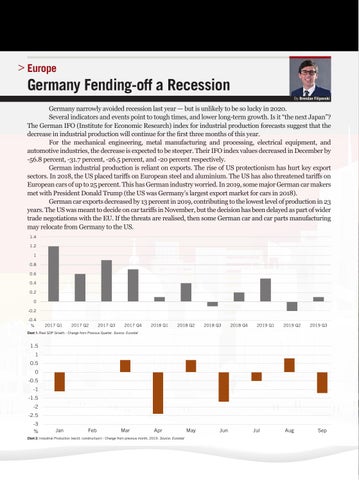
Germany narrowly avoided recession last year — but is unlikely to be so lucky in 2020. Several indicators and events point to tough times, and lower long-term growth. Is it “the next Japan”? The German IFO (Institute for Economic Research) index for industrial production forecasts suggest that the decrease in industrial production will continue for the first three months of this year. For the mechanical engineering, metal manufacturing and processing, electrical equipment, and automotive industries, the decrease is expected to be steeper. Their IFO index values decreased in December by -56.8 percent, -31.7 percent, -26.5 percent, and -20 percent respectively. German industrial production is reliant on exports. The rise of US protectionism has hurt key export sectors. In 2018, the US placed tariffs on European steel and aluminium. The US has also threatened tariffs on European cars of up to 25 percent. This has German industry worried. In 2019, some major German car makers met with President Donald Trump (the US was Germany’s largest export market for cars in 2018). German car exports decreased by 13 percent in 2019, contributing to the lowest level of production in 23 years. The US was meant to decide on car tariffs in November, but the decision has been delayed as part of wider trade negotiations with the EU. If the threats are realised, then some German car and car parts manufacturing may relocate from Germany to the US. 1.4 1.2 1 0.8 0.6
0.4 0.2 0 -0.2 -0.4 %
2017 Q1
2017 Q2
2017 Q3
2017 Q4
2018 Q1
2018 Q2
2018 Q3
2018 Q4
2019 Q1
2019 Q2
2019 Q3
Chart 1: Real GDP Growth - Change from Previous Quarter. Source: Eurostat
1.5 1 0.5 0 -0.5 -1 -1.5 -2 -2.5 -3 %
Jan
Feb
Mar
Apr
May
Chart 2: Industrial Production (excld. constructuon) - Change from previous month, 2019. Source: Eurostat
50
CFI.co | Capital Finance International
Jun
Jul
Aug
Sep