Spring 2020 Issue
with the support of the G7, the G20, the UN and the OECD. Scaling-up private finance for sustainable development requires data to bridge understanding, measurement and disclosure of risks. The OECD is working to promote a more consistent, standardised measurement of all types of flows for SDG financing, monitoring and reporting as well as that of all finance through the new Total Official Support for Sustainable Development (TOSSD). Financial institutions, public and private, need to rethink their models and incentives, and partner better to take on the risks of investments in difficult contexts — and there are many. Looking at megatrends, these risks can’t be ignored. We need to invest in stability. With 85 percent of the poorest people living in the top 20 climate-affected countries, these countries’ economic and environmental instability can’t be subsidised with non-renewable activity. Finance must be aligned with sustainable development in the toughest contexts. The cost to global economic, environmental and social stability is too high, and the returns are too great. The Private Finance for Sustainable Development (PF4SD) conference is an annual OECD event that provides a forum for sharing successes in altering incentives, targeting investment better and improving operations for sustainable development.
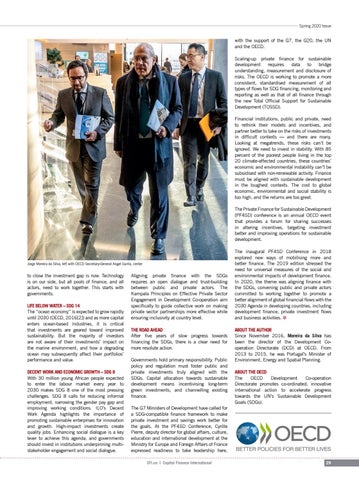
Jorge Moreira da Silva, left with OECD Secretary-General Angel Gurría, center
to close the investment gap is now. Technology is on our side, but all pools of finance, and all actors, need to work together. This starts with governments. LIFE BELOW WATER – SDG 14 The “ocean economy” is expected to grow rapidly until 2030 (OECD, 2016[2]) and as more capital enters ocean-based industries, it is critical that investments are geared toward improved sustainability. But the majority of investors are not aware of their investments’ impact on the marine environment, and how a degrading ocean may subsequently affect their portfolios’ performance and value. DECENT WORK AND ECONOMIC GROWTH – SDG 8 With 30 million young African people expected to enter the labour market every year to 2030 makes SDG 8 one of the most pressing challenges. SDG 8 calls for reducing informal employment, narrowing the gender pay gap and improving working conditions. ILO’s Decent Work Agenda highlights the importance of promoting sustainable enterprises for innovation and growth. High-impact investments create quality jobs. Enhancing social dialogue is a key lever to achieve this agenda, and governments should invest in institutions underpinning multistakeholder engagement and social dialogue.
Aligning private finance with the SDGs requires an open dialogue and trust-building between public and private actors. The Kampala Principles on Effective Private Sector Engagement in Development Co-operation aim specifically to guide collective work on making private sector partnerships more effective while ensuring inclusivity at country level. THE ROAD AHEAD After five years of slow progress towards financing the SDGs, there is a clear need for more resolute action. Governments hold primary responsibility. Public policy and regulation must foster public and private investments truly aligned with the SDGs. Capital allocation towards sustainable development means incentivising long-term green investments, and channelling existing finance.
The inaugural PF4SD Conference in 2018 explored new ways of mobilising more and better finance. The 2019 edition stressed the need for universal measures of the social and environmental impacts of development finance. In 2020, the theme was aligning finance with the SDGs, convening public and private actors committed to working together to promote a better alignment of global financial flows with the 2030 Agenda in developing countries, including development finance, private investment flows and business activities. i ABOUT THE AUTHOR Since November 2016, Moreira da Silva has been the director of the Development Cooperation Directorate (DCD) at OECD. From 2013 to 2015, he was Portugal’s Minister of Environment, Energy and Spatial Planning. ABOUT THE OECD The OECD Development Co-operation Directorate promotes co-ordinated, innovative international action to accelerate progress towards the UN’s Sustainable Development Goals (SDGs).
The G7 Ministers of Development have called for a SDG-compatible finance framework to make private investment and savings work better for the goals. At the PF4SD Conference, Cyrille Pierre, deputy director for global affairs, culture, education and international development at the Ministry for Europe and Foreign Affairs of France expressed readiness to take leadership here, CFI.co | Capital Finance International
29