> OECD:
Key Takeaways From the Third OECD Conference on Private Finance to Realise the SDGs By Moreira da Silva
The third annual OECD conference on private finance for sustainable development brought together more than 600 public and private actors to determine the steps ahead.
T
here is an urgency for the private sector to shift more resources to sustainable development. At the 2020 OECD Private Finance for Sustainable Development (PF4SD) Conference, there was urgency to find ways to get ahead of global trends using global finance in smarter ways. The world is 10 years away from delivering on the SDGs, including the goal of eradicating extreme poverty. This means lifting just under 10 percent of the world’s population — around 700 million women and men — from poverty over the next decade. In the meantime, the climate crisis is threatening to overshadow all development challenges and to overturn hard-won gains. According to the World Bank, the worsening impacts of climate change could force over 140m people to leave their homes by 2050. Furthermore, the planet’s main life support system — the ocean — is under unprecedented pressure. There are direct implications for 40 percent of the world’s population: those living within 100km of the coast. It is no longer enough to react to crises as they arise. Strategic investments in sustainable development is needed, and this means thinking outside the box. This means shifting the culture of profitmaking; giving returns on investment a new meaning, and creating incentives to match. It means understanding and shaping how the next generation is defining the value of people and planet. Private finance to sustainable development is increasing, but gaps remain. Shifting just one percent of total global financial assets — estimated at $382tn — could bridge the existing $2.5tn annual investment gap for delivering the goals. The good news is that shareholders are gradually moving from simple profit-making to both profit and purpose. They are reorienting management towards more sustainable business practices to address ESG issues. The sector has grown in recent years, rising to nearly $18tn in assets, with additional $6tn in sustainable investing to capture some 28
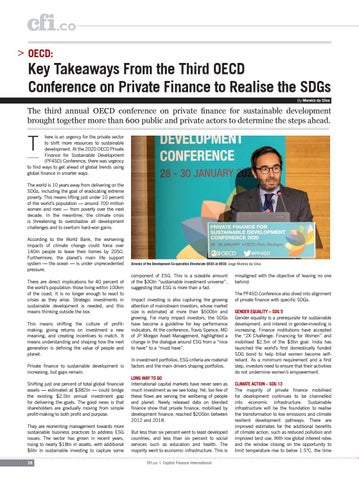
Director of the Development Co-operation Directorate (DCD) at OECD: Jorge Moreira da Silva
component of ESG. This is a sizeable amount of the $30tn “sustainable investment universe”, suggesting that ESG is more than a fad. Impact investing is also capturing the growing attention of mainstream investors, whose market size is estimated at more than $500bn and growing. For many impact investors, the SDGs have become a guideline for key performance indicators. At the conference, Travis Spence, MD of JP Morgan Asset Management, highlighted a change in the dialogue around ESG from a “nice to have” to a “must have”. In investment portfolios, ESG criteria are material factors and the main drivers shaping portfolios. LONG WAY TO GO International capital markets have never seen as much investment as we see today. Yet, too few of these flows are serving the wellbeing of people and planet. Newly released data on blended finance show that private finance, mobilised by development finance, reached $205bn between 2012 and 2018. But less than six percent went to least developed countries, and less than six percent to social services such as education and health. The majority went to economic infrastructure. This is CFI.co | Capital Finance International
misaligned with the objective of leaving no one behind. The PF4SD Conference also dived into alignment of private finance with specific SDGs. GENDER EQUALITY – SDG 5 Gender equality is a prerequisite for sustainable development, and interest in gender-investing is increasing. Finance institutions have accepted the “2X Challenge: Financing for Women” and mobilised $2.5m of the $3bn goal. India has launched the world’s first domestically funded SDG bond to help tribal women become selfreliant. As a minimum requirement and a first step, investors need to ensure that their activities do not undermine women’s empowerment. CLIMATE ACTION – SDG 13 The majority of private finance mobilised for development continues to be channelled into economic infrastructure. Sustainable infrastructure will be the foundation to realise the transformation to low emissions and climate resilient development pathways. There are improved estimates for the additional benefits of climate action, such as reduced pollution and improved land use. With low global interest rates and the window closing on the opportunity to limit temperature rise to below 1.5°C, the time