>
The EAEU is an Alternative to the EU — But Will It Last? By Lord Waverley
T
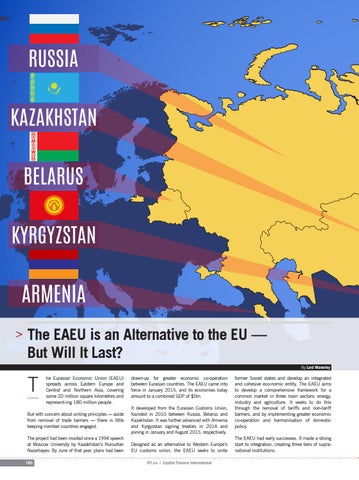
he Eurasian Economic Union (EAEU) spreads across Eastern Europe and Central and Northern Asia, covering some 20 million square kilometres and represent-ing 180 million people.
But with concern about uniting principles — aside from removal of trade barriers — there is little keeping member countries engaged. The project had been mooted since a 1994 speech at Moscow University by Kazakhstan’s Nursultan Nazarbayev. By June of that year, plans had been 180
drawn-up for greater economic co-operation between Eurasian countries. The EAEU came into force in January 2015, and its economies today amount to a combined GDP of $5tn. It developed from the Eurasian Customs Union, founded in 2010 between Russia, Belarus and Kazakhstan. It was further advanced with Armenia and Kyrgyzstan signing treaties in 2014 and joining in January and August 2015, respectively. Designed as an alternative to Western Europe’s EU customs union, the EAEU seeks to unite CFI.co | Capital Finance International
former Soviet states and develop an integrated and cohesive eco-nomic entity. The EAEU aims to develop a comprehensive framework for a common market in three main sectors: energy, industry and agriculture. It seeks to do this through the removal of tariffs and non-tariff barriers, and by implementing greater economic co-operation and harmonisation of domestic policy. The EAEU had early successes. It made a strong start to integration, creating three tiers of supranational institutions: