> ISID, McGill University:
Updating the DFIs’ Operating Models to Achieve the UN 2030 SDG Agenda By Franque Grimard and Christian Novak Institute for the Study of International Development (ISID), McGill University
The UN General Assembly set the Sustainable Development Goals (SDGs) five years ago. The estimated annual amount of investment needed to achieve them is short — by $2.5tn to $3tn.
T
he stakeholders that play a key role in directing and mobilising capital to finance the goals have not done enough.
In relation to actions taken by countries towards domestic resource mobilisation for addressing the SDGs, 79 of the 107 national development plans analysed by the UN lack an investment strategy. Countries need to create development plans that are prioritised in their budgets, and that are solidly integrated in their national financing frameworks. This is also necessary to attract capital. Since total flows of net Official Development Assistance (ODA) in 2018 amounted to “just” $150bn, there are hopes that international financial institutions as well as private capital markets will be mobilised to help address the financial shortfall. However, the international financial system has not taken enough action. Despite some welcome initiatives, the financial markets continue to operate mostly under shortterm commercial goals, taking a conservative approach towards investing in developing countries. Prudential reg ulations imposed on commercial banks following the 2008 financial crisis made lending to developmental areas like SMEs and infrastructure more stringent. Development finance institutions (DFIs) have a crucial role to play here. DFIs currently still mobilise low volumes of private capital, especially their “private-sector windows” (PSWs). The provision of guarantees remains low, and the use of financial instruments and structures that have the capacity to result in high financial additionality is minimum. The DFIs’ PSWs investments in the more challenging countries, sectors and segments of the population are disproportionately low. Their investment capacities are overall not maximised as a result of prudent use of capital, limited use of the wide range of financial products that exist in the mainstream financial market, and operating inefficiencies. DFIs, especially their PSWs, are vital stakeholders in directing and mobilising capital to achieve 162
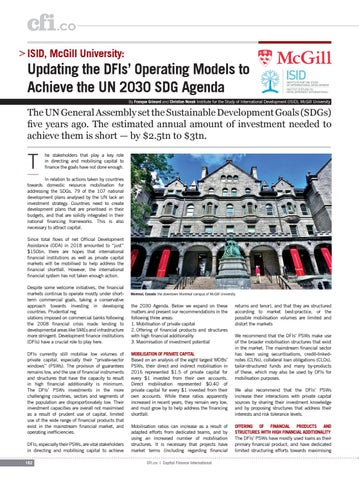
Montreal, Canada: the downtown Montreal campus of McGill University
the 2030 Agenda. Below we expand on these matters and present our recommendations in the following three areas: 1. Mobilisation of private capital 2. Offering of financial products and structures with high financial additionality 3. Maximisation of investment potential MOBILISATION OF PRIVATE CAPITAL Based on an analysis of the eight largest MDBs’ PSWs, their direct and indirect mobilisation in 2016 represented $1.5 of private capital for every $1 invested from their own accounts. Direct mobilisation represented $0.40 of private capital for every $1 invested from their own accounts. While these ratios apparently increased in recent years, they remain very low, and must grow by to help address the financing shortfall. Mobilisation ratios can increase as a result of adapted efforts from dedicated teams, and by using an increased number of mobilisation structures. It is necessary that projects have market terms (including regarding financial CFI.co | Capital Finance International
returns and tenor), and that they are structured according to market best-practice, or the possible mobilisation volumes are limited and distort the markets We recommend that the DFIs’ PSWs make use of the broader mobilisation structures that exist in the market. The mainstream financial sector has been using securitisations, credit-linkednotes (CLNs), collateral loan obligations (CLOs), tailor-structured funds and many by-products of these, which may also be used by DFIs for mobilisation purposes. We also recommend that the DFIs’ PSWs increase their interactions with private capital sources by sharing their investment knowledge and by proposing structures that address their interests and risk tolerance levels. OFFERING OF FINANCIAL PRODUCTS AND STRUCTURES WITH HIGH FINANCIAL ADDITIONALITY The DFIs’ PSWs have mostly used loans as their primary financial product, and have dedicated limited structuring efforts towards maximising