> Harvard Business School
Impact-Weighted Accounts: the Missing Piece in Economy Puzzle By Robert Zochowski
Capitalism is in need of a renaissance. Despite headlines of strong global economic growth, there are signs that all is not well.
E
nvironmental advocates have been leading calls for change before the climate crisis produces irreversible changes to our world. Now, investors, politicians and business leaders are heeding that call, as evidenced by the recent declarations by the World Economic Forum and the Business Roundtable. At Harvard Business School, impact-weighted accounts are seen as the missing piece needed to catalyse change. Across the world, particularly in capitalist economies, the vast majority of businesses seek continual growth. Most businesses in a competitive market are not considered viable without long-term growth in revenues and/or profits (commonly referred to as performance). Huge consultancies have emerged to help companies optimise operations, customersegmentation, and churn-reduction to support revenue and growth. Business schools have designed curricula to provide students with the requisite skills. In the current accounting-reporting frameworks, and much of corporate law, there are two groups of stakeholders whose rights are held above all others: equity and debt owners. In the course of normal business, debt holders are expected to be paid the contractually defined interest and principle amounts, otherwise they can bankrupt the company, and equity owners are entitled to any profits after earnings. The maximisation of performance, beyond the amount needed to pay debt service, is for the benefit of equity owners. Employees, societies, and the environment have largely been considered to be the means to generate the payments to the primary stakeholders, rather than stakeholders in their own right. Laws protecting employees, such as the Employee Retirement Income Security Act (ERISA) in the US, protect against the potential effects of an unbounded performance-focused system — which prioritises corporate owners. Capitalism and globalisation have, by many measures, been successful. Substantial progress has been made in almost every measure of 158
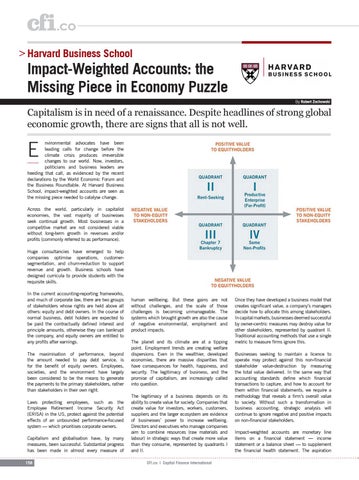
human wellbeing. But these gains are not without challenges, and the scale of those challenges is becoming unmanageable. The systems which brought growth are also the cause of negative environmental, employment and product impacts. The planet and its climate are at a tipping point. Employment trends are creating welfare dispersions. Even in the wealthier, developed economies, there are massive disparities that have consequences for health, happiness, and security. The legitimacy of business, and the promise of capitalism, are increasingly called into question. The legitimacy of a business depends on its ability to create value for society. Companies that create value for investors, workers, customers, suppliers and the larger ecosystem are evidence of businesses’ power to increase wellbeing. Directors and executives who manage companies aim to combine resources (raw materials and labour) in strategic ways that create more value than they consume, represented by quadrants I and II. CFI.co | Capital Finance International
Once they have developed a business model that creates significant value, a company’s managers decide how to allocate this among stakeholders. In capital markets, businesses deemed successful by owner-centric measures may destroy value for other stakeholders, represented by quadrant II. Traditional accounting methods that use a single metric to measure firms ignore this. Businesses seeking to maintain a licence to operate may protect against this non-financial stakeholder value-destruction by measuring the total value delivered. In the same way that accounting standards define which financial transactions to capture, and how to account for them within financial statements, we require a methodology that reveals a firm’s overall value to society. Without such a transformation in business accounting, strategic analysis will continue to ignore negative and positive impacts on non-financial stakeholders. Impact-weighted accounts are monetary line items on a financial statement — income statement or a balance sheet — to supplement the financial health statement. The aspiration