Spring 2020 Issue
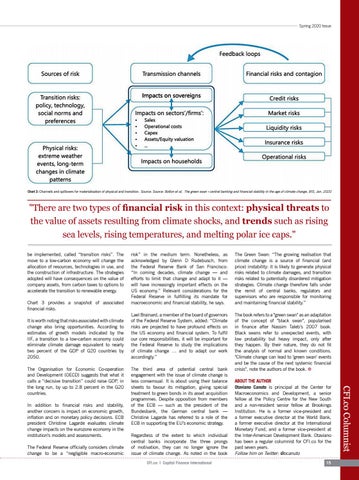
Chart 3: Channels and spillovers for materialisation of physical and transition. Source: Source: Bolton et al, The green swan - central banking and financial stability in the age of climate change, BIS, Jan. 2020
"There are two types of financial risk in this context: physical threats to the value of assets resulting from climate shocks, and trends such as rising sea levels, rising temperatures, and melting polar ice caps." be implemented, called “transition risks”. The move to a low-carbon economy will change the allocation of resources, technologies in use, and the construction of infrastructure. The strategies adopted will have consequences on the value of company assets, from carbon taxes to options to accelerate the transition to renewable energy. Chart 3 provides a snapshot of associated financial risks. It is worth noting that risks associated with climate change also bring opportunities. According to estimates of growth models indicated by the IIF, a transition to a low-carbon economy could eliminate climate damage equivalent to nearly two percent of the GDP of G20 countries by 2050.
In addition to financial risks and stability, another concern is impact on economic growth, inflation and on monetary policy decisions. ECB president Christine Lagarde evaluates climate change impacts on the eurozone economy in the institution's models and assessments. The Federal Reserve officially considers climate change to be a “negligible macro-economic
The Green Swan: “The growing realisation that climate change is a source of financial (and price) instability: it is likely to generate physical risks related to climate damages, and transition risks related to potentially disordered mitigation strategies. Climate change therefore falls under the remit of central banks, regulators and supervisors who are responsible for monitoring and maintaining financial stability.”
Lael Brainard, a member of the board of governors of the Federal Reserve System, added: “Climate risks are projected to have profound effects on the US economy and financial system. To fulfil our core responsibilities, it will be important for the Federal Reserve to study the implications of climate change … and to adapt our work accordingly.”
The book refers to a "green swan" as an adaptation of the concept of "black swan", popularised in finance after Nassim Taleb’s 2007 book. Black swans refer to unexpected events, with low probability but heavy impact, only after they happen. By their nature, they do not fit the analysis of normal and known conditions. "Climate change can lead to 'green swan' events and be the cause of the next systemic financial crisis", note the authors of the book. i
The third area of potential central bank engagement with the issue of climate change is less consensual. It is about using their balance sheets to favour its mitigation, giving special treatment to green bonds in its asset acquisition programmes. Despite opposition from members of the ECB — such as the president of the Bundesbank, the German central bank — Christine Lagarde has referred to a role of the ECB in supporting the EU’s economic strategy. Regardless of the extent to which individual central banks incorporate the three prongs of motivation, they can no longer ignore the issue of climate change. As noted in the book CFI.co | Capital Finance International
ABOUT THE AUTHOR Otaviano Canuto is principal at the Center for Macroeconomics and Development, a senior fellow at the Policy Centre for the New South and a non-resident senior fellow at Brookings Institution. He is a former vice-president and a former executive director at the World Bank, a former executive director at the International Monetary Fund, and a former vice-president at the Inter-American Development Bank. Otaviano has been a regular columnist for CFI.co for the past seven years. Follow him on Twitter: @ocanuto 15
CFI.co Columnist
The Organisation for Economic Co-operation and Development (OECD) suggests that what it calls a “decisive transition” could raise GDP, in the long run, by up to 2.8 percent in the G20 countries.
risk” in the medium term. Nonetheless, as acknowledged by Glenn D Rudebusch, from the Federal Reserve Bank of San Francisco: “In coming decades, climate change — and efforts to limit that change and adapt to it — will have increasingly important effects on the US economy.” Relevant considerations for the Federal Reserve in fulfilling its mandate for macroeconomic and financial stability, he says.