Question Do you believe global economic growth will improve, stay the same or decline over the Spring 2020 Issue next 12 months?
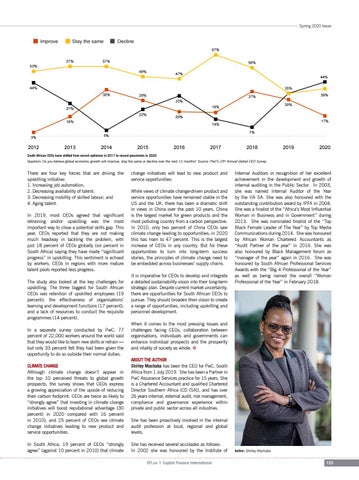
South African CEOs have shifted from record optimism in 2017 to record pessimism in 2020
Improve
Stay the same
Decline 67%
57%
53%
57%
56% 49%
47%
44%
44%
35% 38%
29% 33%
20%
16%
2012
2013
17%
14% 7%
5%
3%
30%
19%
27% 22%
39%
37%
2014
2015
2016
2017
2018
2019
2020
South African CEOs have shifted from record optimism in 2017 to record pessimism in 2020 Question: Do you believe global economic growth will improve, stay the same or decline over the next 12 months? Source: PwC's 23rd Annual Global CEO Survey PwC
3
23rd Annual Global CEO Survey
There are four key forces that are driving the upskilling initiative: 1. Increasing job automation; 2. Decreasing availability of talent; 3. Decreasing mobility of skilled labour; and 4. Aging talent. In 2019, most CEOs agreed that significant retraining and/or upskilling was the most important way to close a potential skills gap. This year, CEOs reported that they are not making much headway in tackling the problem, with just 18 percent of CEOs globally (six percent in South Africa) saying they have made “significant progress” in upskilling. This sentiment is echoed by workers. CEOs in regions with more mature talent pools reported less progress. The study also looked at the key challenges for upskilling. The three biggest for South African CEOs was retention of upskilled employees (19 percent); the effectiveness of organisations’ learning and development functions (17 percent); and a lack of resources to conduct the requisite programmes (14 percent). In a separate survey conducted by PwC, 77 percent of 22,000 workers around the world said that they would like to learn new skills or retrain — but only 33 percent felt they had been given the opportunity to do so outside their normal duties. CLIMATE CHANGE Although climate change doesn’t appear in the top 10 perceived threats to global growth prospects, the survey shows that CEOs express a growing appreciation of the upside of reducing their carbon footprint. CEOs are twice as likely to “strongly agree” that investing in climate change initiatives will boost reputational advantage (30 percent) in 2020 compared with 16 percent in 2010), and 25 percent of CEOs see climate change initiatives leading to new product and service opportunities. In South Africa, 19 percent of CEOs “strongly agree” (against 10 percent in 2010) that climate
change initiatives will lead to new product and service opportunities. While views of climate change-driven product and service opportunities have remained stable in the US and the UK, there has been a dramatic shift in views in China over the past 10 years. China is the largest market for green products and the most polluting country from a carbon perspective. In 2010, only two percent of China CEOs saw climate change leading to opportunities; in 2020 this has risen to 47 percent. This is the largest increase of CEOs in any country. But for these opportunities to turn into long-term success stories, the principles of climate change need to be embedded across businesses’ supply chains. It is imperative for CEOs to develop and integrate a detailed sustainability vision into their long-term strategic plan. Despite current market uncertainty, there are opportunities for South African CEOs to pursue. They should broaden their vision to create a range of opportunities, including upskilling and personnel development.
Internal Auditors in recognition of her excellent achievement in the development and growth of internal auditing in the Public Sector. In 2003, she was named Internal Auditor of the Year by the IIA SA. She was also honoured with the outstanding contribution award by IPFA in 2004. She was a finalist of the “Africa’s Most Influential Woman in Business and in Government” during 2013. She was nominated finalist of the “Top Black Female Leader of The Year” by Top Media Communications during 2014. She was honoured by African Woman Chartered Accountants as “Audit Partner of the year” in 2016. She was also honoured by Black Management forum as “manager of the year” again in 2016. She was honoured by South African Professional Services Awards with the “Big 4 Professional of the Year” as well as being named the overall “Woman Professional of the Year” in February 2018.
When it comes to the most pressing issues and challenges facing CEOs, collaboration between organisations, individuals and governments can enhance individual prospects and the prosperity and vitality of society as whole. i ABOUT THE AUTHOR Shirley Machaba has been the CEO for PwC, South Africa from 1 July 2019. She has been a Partner in PwC Assurance Services practice for 15 years. She is a Chartered Accountant and qualified Chartered Director Southern Africa (CD (SA)), and has over 26 years internal, external audit, risk management, compliance and governance experience within private and public sector across all industries. She has been proactively involved in the internal audit profession at local, regional and global levels. She has received several accolades as follows: In 2002 she was honoured by the Institute of CFI.co | Capital Finance International
Author: Shirley Machaba
123